Introduction
CNC milling is one of the most important machining processes which is widely used to shape and produce the complex machine parts. The performances of the CNC milling are significantly worsened by the external factors such as the tool wear, cutting temperature, cutting tool chatter, and tool breakage. However, the tool wear plays a critical role in dictating the dimensional accuracy of workpiece (Yao et al., Reference Yao, Li and Yuan1999) and has a high challenge to predict tool life in milling process (Alauddin et al., Reference Alauddin, Baradie and Hashmi1997). So far, there are many empirical and mechanistic models for predicting tool wear proposed fundamentally based on the Taylor's tool life equation (Wong et al., Reference Wong, Kim and Kwon2004; Daniel et al., Reference Daniel, Soren, Volodymyr and Jan-Eric2017; Grzesik, Reference Grzesik and Grzesik2017). The tool wear predictions of the relative study are usually based on different algorithm predictors, different source data, and different sensing devices for remaining useful life (RUL), as shown in Table 1.
Tool wear predictions based on different algorithm predictors, data sources, and sensing devices for RUL

The predictors of the tool wear mainly include the theoretically mechanistic models (Ren et al., Reference Ren, Baron, Balazinski, Botez and Bigras2015; Zhu and Zhang, Reference Zhu and Zhang2019; Goodall et al., Reference Goodall, Pantazis and West2020), the neural network of machine learning (Salgado and Alonso, Reference Salgado and Alonso2007; Drouillet et al., Reference Drouillet, Karandikar, Nath, Hourneaux, Mansori and Kurfess2016; Marani et al., Reference Marani, Zeinali, Songmene and Mechefske2021), and the vision-based monitoring (Dutta et al., Reference Dutta, Pal and Sen2016; You et al., Reference You, Gao, Guo, Liu and Li2020), etc. The predictive source data of the tool wears for different RUL predictors are normally from the 3-phase AC power (Salgado and Alonso, Reference Salgado and Alonso2007; Li et al., Reference Li, Ouyang and Liang2008; Drouillet et al., Reference Drouillet, Karandikar, Nath, Hourneaux, Mansori and Kurfess2016; Marani et al., Reference Marani, Zeinali, Songmene and Mechefske2021), the tool cutting sounds (Salgado and Alonso, Reference Salgado and Alonso2007; Yen et al., Reference Yen, Lu and Chen2013; Ren et al., Reference Ren, Baron, Balazinski, Botez and Bigras2015; Ubhanyaratne et al., Reference Ubhanyaratne, Pereira, Xiang and Rolfe2017; Gomes et al., Reference Gomes, Brtio, Bacci da Silva and Viana Durate2021; Marani et al., Reference Marani, Zeinali, Songmene and Mechefske2021), the workpiece vibrations (Gomes et al., Reference Gomes, Brtio, Bacci da Silva and Viana Durate2021), the tool cutting forces (Yang et al., Reference Yang, Guo, Haung, Chen, Li, Jiang and He2019; Zhu and Zhang, Reference Zhu and Zhang2019; Gao et al., Reference Gao, Xia, Su, Xiang and Zhao2021), and the images of tool edges and workpieces (Castejon et al., Reference Castejon, Alegre, Barreiro and Hernandez2007; Dutta et al., Reference Dutta, Pal and Sen2016; You et al., Reference You, Gao, Guo, Liu and Li2020). The predictive sensing devices of the tool wears are generally used the power cells (Salgado and Alonso, Reference Salgado and Alonso2007; Drouillet et al., Reference Drouillet, Karandikar, Nath, Hourneaux, Mansori and Kurfess2016; Goodall et al., Reference Goodall, Pantazis and West2020; Marani et al., Reference Marani, Zeinali, Songmene and Mechefske2021), the microphones (Salgado and Alonso, Reference Salgado and Alonso2007; Gomes et al., Reference Gomes, Brtio, Bacci da Silva and Viana Durate2021), the accelerometers (Gomes et al., Reference Gomes, Brtio, Bacci da Silva and Viana Durate2021), the dynamometers (Yang et al., Reference Yang, Guo, Haung, Chen, Li, Jiang and He2019; Zhu and Zhang, Reference Zhu and Zhang2019), the acoustic emissions (Yen et al., Reference Yen, Lu and Chen2013; Ren et al., Reference Ren, Baron, Balazinski, Botez and Bigras2015), and the camera sensors (Dutta et al., Reference Dutta, Pal and Sen2016; You et al., Reference You, Gao, Guo, Liu and Li2020).
For tool wear predictors, Goodall et al. (Reference Goodall, Pantazis and West2020) investigated a mechanistic model with cyber-physical system to predict the tool wear from 3-phase power of CNC system that showed the prediction accuracy of R 2 was 0.801 and the 3-phase power consumptions of CNC system obviously increased 13–18% with increasing tool wear. A generic wear model with adjustable coefficients was presented by Zhu and Zhang (Reference Zhu and Zhang2019) and the predictive accuracy of tool life was about 98.5%. Generally, the theoretical model for tool wear can be adapted to predict the actual processing changes in real-time. However, it is difficult to model and ensure all of the cutting conditions that are suitable in the actual cutting process. In spite of Zhu and Zhang (Reference Zhu and Zhang2019) proposed a generic algorithm model with adjustable coefficients to predict the tool wear which used cutting forces from the dynamometer to estimate the RUL model of a cutting tool. However, it is well-known that mechanistic models are a little difficult to be modeled and ensured for all of tool cutting conditions, even for same cutting tools with identical specifications during the actual cutting process on-line.
Hence, the neural networks of the machine learning are proposed consecutively in the recent year to predict the tool RUL from the past behavior data of cutting tool and are provided the effective predictive maintenance strategies. For example, Drouillet et al. (Reference Drouillet, Karandikar, Nath, Hourneaux, Mansori and Kurfess2016) implemented the back-propagation neural network (BPNN) with different training functions for predicting the tool flank wear which detected the 3-phase power of the spindle from the power cell. Results showed that error of the prediction time for tool life is within 1 min. In addition, there were many similarly neural networks applied in determining and predicting the tool wear such as long short-term memory (LSTM), last squares version of support vector machines (LS-SVM) (Salgado and Alonso, Reference Salgado and Alonso2007; Zhou et al., Reference Zhou, Zhao and Gao2019; An et al., Reference An, Tao, Xu, Mansori and Chen2020; Li et al., Reference Li, Wang, Li, Dong and Li2020; Marani et al., Reference Marani, Zeinali, Songmene and Mechefske2021), fuzzy-logic (Yao et al., Reference Yao, Li and Yuan1999; Ren et al., Reference Ren, Baron, Balazinski, Botez and Bigras2015), Bayesian networks (Karandikar et al., Reference Karandikar, Schmitz and Abbas2012; Karandikar et al., Reference Karandikar, Abbas and Schmitz2014), trajectory similarity-based prediction (TSPB), differential evolution SVR (DE-SVR) (Yang et al., Reference Yang, Guo, Haung, Chen, Li, Jiang and He2019), and self-organization feature map (SOM) (Yen et al., Reference Yen, Lu and Chen2013). It is worth mentioning that the reports of LSTM (Marani et al., Reference Marani, Zeinali, Songmene and Mechefske2021) and LS-SVM (Salgado and Alonso, Reference Salgado and Alonso2007) are based on the loading current of the feed motor and the tool cutting sound using a power cell and a microphone, respectively. The predicting accuracy of the LSTM training regression was 0.99593 for monitoring online with a clamp current meter. The average computing time of the LS-SVM was less than 0.93 s.
Remarkably, the machine learning methods have excellent prediction for the tool wear based on a large amount of data, historical failure, and truncation data, which were needed to be experimented preliminarily at different cutting conditions, at different workpiece materials, and at different machines. However, for new types of cutting tools or when the similar tools have just launched, such historical failures and truncation data are usually limited or even unavailable. In order to overcome the large amount of experimental data, the vision-based systems (Dutta et al., Reference Dutta, Pal and Sen2016; You et al., Reference You, Gao, Guo, Liu and Li2020) were used to inspect the workpiece surface texture and the tool edge wear for determining whether the RUL of the cutting tool was ended on-line. In general, the vision-based systems were often combined with machine learning to predict the tool wear. But the vision-based system also faces the challenges of the cutting coolant fluid, the cutting chip, the sticky crumbs, and the oil-fog dust during the image processing. In addition, the resolution of the vision-based system plays a critical role in dictating the dimensional accuracy, needing about under several micrometer levels.
For source data and sensing device of the tool wear (Chang and Wu, Reference Chang and Wu2016; Chang et al., Reference Chang, Chen and Wu2019), the signal of the cutting forces estimated from dynamometer and the signal of the cutting sounds estimated from microphone or acoustic emission have a great cost to engage in machine for a long term and on-line monitoring. Nowadays, a built-in power meter measured the current of spindle motor is widely integrated into CNC controller to estimate the loading current, the cutting force, and the machining torque for real-time digital manufacturing (Li et al., Reference Li, Venuvinod and Chen2000). According to experiment testing, the cutting force estimated from the loading current of the built-in power meter has a big challenge for identifying tool tiny wear due to the resolution of a built-in power meter. In order to overcome the doing large amount of experimental data and the predicting different tool RULs, this study combines theoretical force modeling, machine learning, and the contactless AC-current sensor which all are embedded in smart machine box (SMB) to realize the practical RUL prediction for on-line and real-time applications. The theoretical force modeling and the BNN of machine learning are only based on the initial loading current of the new cutting tool.
Background
Tool wear experiment
The changed rates of the tool wear usually have three stages during processing: initial, steady, and the sharp stages. The initial stage is the wear-in period which the surface contact area between the tool and the workpiece is small and the sharp of cutting edge is easily broken quickly due to the heavy wear effect, and thus, a limited height of wear band is engender. The steady stage has a uniform wear that linearly increases with increasing cutting distance and has a larger contact area between the tool and the workpiece. The sharp stage is a rapid wear period that the wear rapidly increases with increasing cutting force which means that the cutting flank has a high failure risk due to the reducing cutting ability. For the practical changed rates of the tool life during the processing of three stages, the tool life correlation T l between the cutting speed V c, the feed speed fz, and the cutting depth b was formulated using modified Taylor's equation (Taylor, Reference Taylor1907; Dos Santos et al., Reference Dos Santos, Duarte, Abrao and Machado1999; Hosseinkhani and Ng, Reference Hosseinkhani and Ng2020), as follows:
 $$\matrix{ {T_l = \displaystyle{{C_n} \over {V_c^i \times f_z^j \times b^k}}} \cr }, $$
where C n is a constant coefficient of modified Taylor's equation. The index i, j, and k are the tool life exponents depending upon the tool-workpiece materials and the cutting environment. In this study, the cutting speed, feed-rate, and axial depth of cutter are selected for predicting tool life at different cutting parameters.
For collecting relevant massive data, the cutting conditions and parameters suggested from a manufacturer of the metal-cutting tools included the feeds per tooth, the axial depths, and the feeds, as shown in Table 2. In general, the end mills are usually performed either slot or side milling with up or down milling during cutting process. The slot milling normally offers a most efficient method for milling massive volumes of the long or deep grooves, particularly, when the vertical milling machines are used. For down milling, the frictions between the cutter and the workpiece are less because the chip thickness varies from a maximum to a minimum during cutting process. The up milling easily results in massive heat generation because the cutter and the workpiece move in the opposite direction. Therefore, the slot milling without water-soluble coolant was selected during cutting processing in this study. The range of the feeds per tooth is 0.1–0.2 mm/tooth with increasing 0.025 mm/tooth each time. The range of the axial depths is set 0.25–2 mm with increasing 0.25 mm each time indicated that the experiment is 8 times in each case. In general, the resultant forces of the cutting tool have tangential, radial, and axial forces acting on any cutting point of an infinitesimal cut area. In order to build the big data analysis of the resultant forces for the cutting coefficients of the tangential, radial, and axial forces, a series of cutting tests was performed at different cutting conditions.
Different cutting parameters of milling tool for acquiring cutting forces and spindle currents

As mentioned above, the milling tool wear usually includes the initial, steady, and sharp stages during cutting process. The flank wear rate of the tool at initial stage is obviously rapid increase due to higher cutting temperature changes. The interval of the initial stage in this study was defined about 100 m of the tool cutting distance before. For predictive tool life, the average current of the spindle loading during the initial stage was calculated as a reference current I r. The percentage current ratio of the tool cutting C r is defined as follows:
 $$\matrix{ {C_{\rm r} = \displaystyle{{I_{\rm p}-I_{\rm r}} \over {I_{\rm r}}}100\% } \cr }, $$
where I p and I r are the present current and the reference current value, respectively.
Analytical model of cutting forces
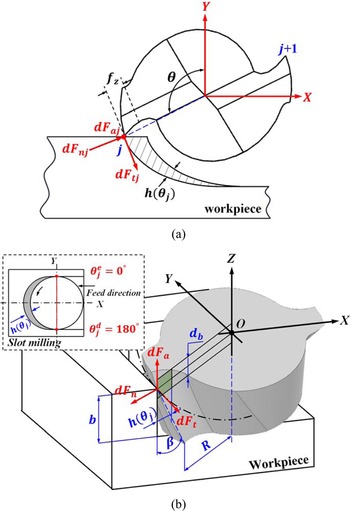
In order to predict the cutting force from the cutting current, the analytical model of the cutting force coefficients with shear and ploughing needs to be established for reducing the experimental numbers and for predicting the different cutting conditions (Bird and Chivers, Reference Bird and Chivers1993; Guo and Chou, Reference Guo and Chou2004). Generally, the cutting forces can be mainly divided into a tangential force (dF t), a normal force (dF n), and an axial force (dF a) during the tool cutting process, as shown in Figure 1. Assume a cutting force cuts a depth d b with an immersion angle θ j acted on the jth tool edge that each cutting force of dF tj, dF nj, and dF aj analytical models given by Altintas (Altintas, Reference Altintas2012) may be estimated from uncut chip thickness h(θ j) and cutting depth d b as follows:
 $$\matrix{ {\left[{\matrix{ {dF_{\rm t}( {\theta_j} ) } \cr {dF_{\rm n}( {\theta_j} ) } \cr {dF_{\rm a}( {\theta_j} ) } \cr } } \right] = h( {\theta_j} ) d_{\rm b}\left[{\matrix{ {K_{{\rm ts}}} \cr {K_{{\rm ns}}} \cr {K_{{\rm as}}} \cr } } \right] + d_{\rm b}\left[{\matrix{ {K_{{\rm tp}}} \cr {K_{{\rm np}}} \cr {K_{{\rm ap}}} \cr } } \right]} \cr }, $$
where K ts, K ns, and K as are the tangential, the normal, and the axial coefficients of shearing forces, respectively. The K tp, K np, and K ap are the tangential, the normal, and the axial coefficients of ploughing forces, respectively. When the h(θ j) is f zsinθ j and the d b is (R/tanβ)dθ j, each cutting force can be incrementally calculated as follows:
 $$\matrix{ {\left[{\matrix{ {dF_{\rm t}( {\theta_j} ) } \cr {dF_{\rm n}( {\theta_j} ) } \cr {dF_{\rm a}( {\theta_j} ) } \cr } } \right] = \left({R \times f_z \times {\cos}\theta_j\left[{\matrix{ {K_{{\rm ts}}} \cr {K_{{\rm ns}}} \cr {K_{{\rm as}}} \cr } } \right] + \displaystyle{R \over {{\tan}\theta_j}}\left[{\matrix{ {K_{{\rm tp}}} \cr {K_{{\rm np}}} \cr {K_{{\rm ap}}} \cr } } \right]} \right)d\theta _j} \cr }, $$
where f z, R, and β are the feed per tooth, the tool radius, and the helix angle of the cutting tools, respectively. Then, each axis cutting force at X, Y, and Z directions from tangential, the normal, and the axial forces are expressed as follows:
 $$\left[{\matrix{ {dF_x( {\theta_j} ) } \cr {dF_y( {\theta_j} ) } \cr {dF_z( {\theta_j} ) } \cr } } \right] = \left[{\matrix{ {-\cos \theta_j} \hfill & {\sin \theta_j} \hfill & 0 \hfill \cr {\sin \theta_j} \hfill & {-\cos \theta _j} \hfill & 0 \hfill \cr 0 \hfill & 0 \hfill & 1 \hfill \cr } } \right]\left[{\matrix{ {dF_{\rm t}( {\theta_j} ) } \cr {dF_{\rm n}( {\theta_j} ) } \cr {dF_{\rm a}( {\theta_j} ) } \cr } } \right].$$
Cutting forces analytical model of the end mill (a) bottom view and (b) isometric view.

The total cutting force of each axis can incrementally be calculated as follows:
 $$\left\{\eqalign{& F_x( {\theta_j} )= \mathop \sum \limits_{\,j = 1}^N \int_{\theta _j^e }^{\theta _j^d } \displaystyle{R \over {{\tan}\beta }} \left\{ -\displaystyle{{\,f_z} \over 2} [ K_{\rm ts}{\sin}2\theta_j + K_{\rm ns}( 1-{\cos}2\theta_j ) ]\right. \cr & \quad\quad\quad\quad - [K_{\rm tp}{\cos}\theta_j + K_{np}{\rm sin}\theta_j ]\} d\theta _j, \cr & \quad F_y( {\theta_j} ) = \mathop \sum \limits_{\,j = 1}^N \int_{\theta _j^e }^{\theta _j^d } \displaystyle{R \over {{\tan}\beta }} \left\{ \displaystyle{{\,f_z} \over 2} [ K_{\rm ts} ( {1-{\cos}2\theta_j} ) - K_{\rm ns}{\sin}2\theta_j]\right. \cr & \quad\quad\quad\quad + [K_{\rm tp} {\sin}\theta_j - K_{\rm np} \cos \theta_j ] \}d\theta_j , \cr & \quad F_z( {\theta_j} ) = \mathop \sum \limits_{\,j = 1}^N \int_{\theta_j^e }^{\theta_j^d } {\displaystyle{R \over {{\tan}\beta }}( {\,f_zK_{\rm as}{\sin}\theta_j + K_{\rm ap}} ) d\theta_j}}\right.$$
where  $\theta _j^d$ means the departure angle d of cutting tool at the jth cutting edge,
 $\theta _j^e$ means the entry angle e of cutting tool at the jth cutting edge, and N is total cutting edges. Finally, the average cutting force of each axis direction that integrated the instantaneous cutting force over one revolution within an immersion zone (
 $\theta _j^e \le \theta \le \theta _j^d$) can be expressed with each cutting force coefficient, as follows (Altintas, Reference Altintas2012):
 $$\matrix{ {\left[{\matrix{ {{\bar{F}}_x} \cr {{\bar{F}}_y} \cr {{\bar{F}}_z} \cr } } \right] = \displaystyle{1 \over {2\pi }}\left[{\matrix{ {\int_{\theta_j^e }^{\theta_j^d } {F_x( {\theta_j} ) d\theta } } \cr {\int_{\theta_j^e }^{\theta_j^d } {F_y( {\theta_j} ) d\theta } } \cr {\int_{\theta_j^e }^{\theta_j^d } {F_z( {\theta_j} ) d\theta } } \cr } } \right] = f_zNb\left[{\matrix{ {\displaystyle{{K_{\rm ns}} \over 4}} \cr {\displaystyle{{K_{\rm ts}} \over 4}} \cr {\displaystyle{{K_{\rm as}} \over \pi }} \cr } } \right] + Nb\left[{\matrix{ {\displaystyle{{K_{\rm np}} \over \pi }} \cr {\displaystyle{{K_{\rm tp}} \over \pi }} \cr {\displaystyle{{K_{\rm ap}} \over 2}} \cr } } \right]} \cr }. $$
Modeling algorithm of prediction and training
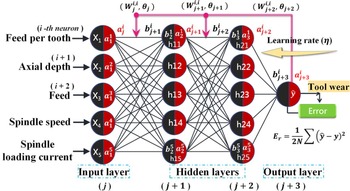
In this study, the BPNN model performed forward and backward propagations was selected to predict and train the tool wear and the remaining tool life via SMB-enabled monitoring for intelligent sustainable manufacturing. The BPNN model designed in this study is a supervised learning algorithm that consists of an input, an output, and two hidden layers, as shown in Figure 2. The input layer named the first j layer has five variable neurons (X 1 to X 5), including the different feeds per tooth, the axial depths, the feeds, a spindle speed, and the loading current of the spindle. The two hidden layers called j + 1 and j + 2 are five neurons each that the five neurons in first and second hidden layers are named h11 to h15 and h21 to h25, respectively. The output layer called j + 3 layer is only a neuron for tool flank wear with loading current. The numbers of the hidden layers and the neurons were usually no standard decision-making process to ensure the best quantity. Therefore, the study is based on trial and error methods to decide the two hidden layers with each five neurons for all weights and biases.
Schematic model of multi-layer BPNN using an input layer with five neurons, two hidden layers with each five neurons, and one output layer with a neuron for prediction remaining tool life at different cutting conditions.

During the BPNN learning algorithm, the predictive tool wears can be divided into four steps: the forward-propagation, the backward-propagation, the weight and biases updating of the activation function, and the propagation error. The forward-propagation implants the input data Xi of the different feeds per tooth, the axial depths, the feeds, a spindle speed, and the loading current of the spindle to further produce a propagated information of the weights and biases to update the activation function of each hidden neuron. Then, the backward-propagation process tries to optimize and modify the weights and the biases for each neuron. The errors about the network's modifiable weights used the gradient descent will send a new random weight or a random disturbance to avoid the local minimum effect.
For the forward-propagation, the post-activation of the neuron outputs and the pre-activation of the neuron inputs are denoted as  $a_j^i$ and as
 $b_j^i$ where i and j are the ith neuron number in the jth layer, as shown in Figure 2. The pre-activations and the post-activations of all neurons in each layer are the hyperbolic activation function that defined as f. The neuron outputs of the post-activation
 $a_j^i$ at first layer of the input data Xi and other layers are described as follows:
 $$\matrix{ {\left[{\matrix{ {a_j^i } \cr {a_j^i } \cr } } \right] = \left[{\matrix{ {{\boldsymbol f}( {X_i} ) } \cr {{\boldsymbol f}( {b_j^i } ) } \cr } } \right], \;\matrix{ {{\rm for}\,{\rm first\;}\,{\rm layer\;}( {\,j = 1\,{\rm and}\,{\rm the}\,{\rm neurons}\;i = 1\;{\rm to}\;5} ), } \hfill \cr {{\rm for}\,{\rm other}\,{\rm layer\;}( {\,j = 2, \;3\,{\rm and}\,{\rm the}\,{\rm neurons}\;i = 1\;{\rm to}\;5} ), } \hfill \cr } } \cr } $$
where  ${\boldsymbol f}( {X_i} ) = ( e^{X_i}-e^{{-}X_i}) /( e^{X_i} + e^{{-}X_i})$ and
 ${\boldsymbol f}( {b_j^i } ) = ( e^{b_j^i }-e^{{-}b_j^i }) /$
 $( e^{b_j^i } + e^{{-}b_j^i }).$
The post-activation  $a_j^i \;$ of all neuron matrix outputs for each layer is denoted as follows:
 $$\matrix{ {a_j^i = \left[{\matrix{ {a_1^1 } & {a_1^2 } & {a_1^3 } & {a_1^4 } & {a_1^5 } \cr {a_2^1 } & {a_2^2 } & {a_2^3 } & {a_2^4 } & {a_2^5 } \cr {a_3^1 } & {a_3^2 } & {a_3^3 } & {a_3^4 } & {a_3^5 } \cr } } \right]} \cr }. $$
For the neuron inputs of the pre-activation  $b_{j + 1}^i$ after second layer are described as follows:
 $$\matrix{ {[ {b_{\,j + 1}^i } ] = [ {a_j^i \times \omega_j^{i, i} + \theta_j} ] } \cr }, $$
where j is 1 to 3 and i is a neuron number. The  $\omega _j^{i, i}$ indicated that the first column i is the neuron node at the jth layer and the second column i is the neuron node at the j + 1 layer. The θ j is a bias value at the jth layer. For example, the pre-activation
 $b_{j + 1}^i$for j = 1 with neuron nodes 1 to 5 is shown as follows:
 $$\left[{\matrix{ {b_2^1 } \cr {b_2^2 } \cr {b_2^3 } \cr {b_2^4 } \cr {b_2^5 } \cr } } \right] = [ \matrix{ {a_1^1 } \hfill & {a_1^2 } \hfill & {\;a_1^3 } \hfill & {\;a_1^4 } \hfill & {\;a_1^5 } \hfill \cr } ] \times \left[{\matrix{ {\omega_1^{1, 1} } & {\omega_1^{1, 2} } & {\omega_1^{1, 3} } & {\omega_1^{1, 4} } & {\omega_1^{1, 5} } \cr {\omega_1^{2, 1} } & {\omega_1^{2, 2} } & {\omega_1^{2, 3} } & {\omega_1^{2, 4} } & {\omega_1^{2, 5} } \cr {\omega_1^{3, 1} } & {\omega_1^{3, 2} } & {\omega_1^{3, 3} } & {\omega_1^{3, 4} } & {\omega_1^{3, 5} } \cr {\omega_1^{4, 1} } & {\omega_1^{4, 2} } & {\omega_1^{4, 3} } & {\omega_1^{4, 4} } & {\omega_1^{4, 5} } \cr {\omega_1^{5, 1} } & {\omega_1^{5, 2} } & {\omega_1^{5, 3} } & {\omega_1^{5, 4} } & {\omega_1^{5, 5} } \cr } } \right] + \left[{\matrix{ {\theta_1} \cr {\theta_1} \cr {\theta_1} \cr {\theta_1} \cr {\theta_1} \cr } } \right].$$
For the output layer of the predictive  $\hat{y}$
 $$\matrix{ {\hat{y} = a_{\,j + 3}^i = f( {b_{\,j + 3}^i } ) } \cr }, $$
 $$\matrix{ {a_{\,j + 3}^i = f( {[ {\,f( {[ {\,f( {[ {\,f( {X_i} ) \times \omega_j^{i, i} + \theta_j} ] } ) \times \omega_{\,j + 1}^{i, i} + \theta_{\,j + 1}} ] } ) \times \omega_{\,j + 2}^{i, i} + \theta_{\,j + 2}} ] } ) } \cr }, $$
 $$\matrix{ {[ {b_{\,j + 3}^i } ] = [ {\,f( {[ {\,f( {[ {a_j^i \times \omega_j^{i, i} + \theta_j} ] } ) \times \omega_{\,j + 1}^{i, i} + \theta_{\,j + 1}} ] } ) \times \omega_{\,j + 2}^{i, i} + \theta_{\,j + 2}} ] } \cr }, $$
where  $a_{j + 2}^i = f( {b_{j + 2}^i } )$. The mean square error Er between the predictive value
 $\hat{y}\;$ and the target value y is defined as follows:
 $$\matrix{ {E_r = \displaystyle{1 \over {2N}}\sum {{( \hat{y}-y) }^2} = \sum\limits_{i, j} {{( {a_{\,j + 3}^i -y} ) }^2} } \cr }, $$
where N is the total number of training Xi data. In general, the deviation of learning maybe has a large error value obtained at the end of each iteration. The derivative error functions with respect to current weight  $\omega _j^{i, i} ( k ) \;$ and current bias θ j(k) are calculated back-propagated using partial derivatives to the layers for new weight
 $\omega _j^{i, i} ( {k + 1} ) \;$ and bias θ j(k + 1) values at each connection of (k + 1)th iteration.
 $$\matrix{ {\omega _j^{i, i} ( {k + 1} ) = \omega _j^{i, i} ( k ) -\eta \displaystyle{{\partial E_r} \over {\partial \omega _j^{i, i} }}} \cr }, $$
 $$\matrix{ {\theta _j( {k + 1} ) = \theta _j( k ) -\;\eta \displaystyle{{\partial E_r} \over {\partial \theta _j}}} \cr } ,$$
where η is the learning rate for training network. The gradient descent of the adaptive moment estimation, Adam, is efficiently a way to minimize a derivative error function (Chang et al., Reference Chang, Wu and Hsu2020). The Adam combines the momentum and adaptive learning rate with weight and bias corrections that estimated first and second moment of the gradients and used them to update the parameters. The first moment and the second moment of the gradients are an exponentially decaying average over the past gradients and over the past square gradients, respectively. Therefore, the Adam gradient descent is used to calculate its gradient and back propagation to the network for weight adjustment and error minimization as follows:
 $$\eqalign{& \matrix{ {\omega _j^{i, i} ( {k + 1} ) = \omega _j^{i, i} ( k ) -\displaystyle{{\eta \times {\bar{m}}_t} \over {N \times \sqrt {{\bar{v}}_t + \epsilon } }}} \cr }, \cr & {\rm where}\,\;{\bar{m}}_t = \displaystyle{{m_t} \over {1-\beta _1}} = \displaystyle{1 \over {1-\beta _1}}\left[{\beta_1m_{t-1} + ( {1-\beta_1} ) \displaystyle{{\partial E_r} \over {\partial \omega_j^{i, i} }}} \right],\cr & {\bar{v}}_t = \displaystyle{{v_t} \over {1-\beta _2}} = \displaystyle{1 \over {1-\beta _2}}\left[{\beta_2v_{t-1} + ( {1-\beta_2} ) {\left({\displaystyle{{\partial E_r} \over {\partial \omega_j^{i, i} }}} \right)}^2} \right],} $$
where m t and v t are the exponentially decaying average over the past gradients and over the past square gradients, respectively.  $\bar{m}_t$ and
 $\bar{v}_t$ are bias corrections of the first and second moment estimations. N and
 $\epsilon$ are the dataset pairs and a smoothing coefficient that avoids division by zero, respectively. The default values of η, β 1, β 2,
 $\epsilon$, m 0 and v 0 are 0.001, 0.9, 0.999, 10−8, 0, and 0, respectively.
Results and discussion
System architectures
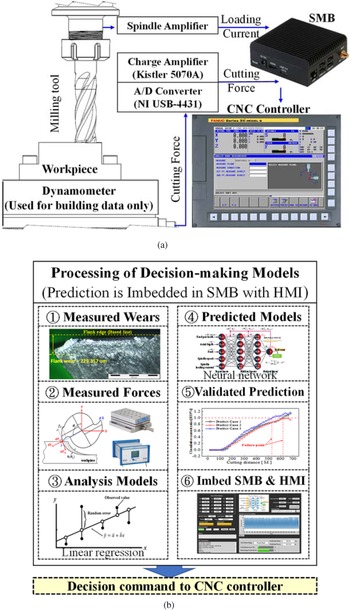
In order to establish the current models of the tool wear, the experimental system includes a 5-axis CNC with a current amplifier of the spindle, a dynamometer with a charge amplifier and an A/D converter, a SMB, and a decision-making model of the predicted wear, as shown in Figure 3. The 5-axis CNC is the vertical machining center (model YCM-FV85A) with a built-in controller of Fanuc 18i-MB5 model. The maximum spindle speed, spindle motor power, rapid speed, and feed speed of the CNC are 12,000 rpm, 7.5 kW, 36 M/min, and 10 M/min, respectively. The modules of the measured cutting forces included a dynamometer of model Kistler 9257B, a charge amplifier of model Kistler 5070A, and an A/D converter of model NI 4431. The measurement ranges of the cutting forces in XY and Z directions are −5~5 kN and −5~10 kN, respectively. The forced sensitivities in X, Y, and Z directions are −7.56, −7.56, and −3.7 pC/N, respectively. The measurement range, measurement error, output voltage, and frequency of the charge amplifier are ±200 ~ 200,000 pC, <±3%, ±10 V, and 0~45 kHz, respectively. The resolution, sample rate, and input voltage range of the A/D converter are 24 bits, 102.4 kS/s, and ±10 V, respectively. The dynamometer is only used for building force data and will not be set on CNC machine for predicting tool life on-line.
Experiment setup of predictive tool life. (a) On-line manufacture of CNC machine with intelligent SMB (b) based on linear regression and neural network of decision-marking model imbedded in SMB.

The specifications of the SMB are the Intel Atom X5-Z8350 Soc, 4 GB DDR3L memory, 32 GB eMMC storage, and Gigabit LAN for windows 10 system. All decision-making models are embedded in SMB system for intelligent manufacturing based on linear regression and BPNN algorithms. The workpiece materials are aluminum (Al7075-T6) with size of 100 × 100 × 100 mm3. The ultimate tensile strength, yield strength, hardness, and elongation at break of the workpiece are 54 kg/mm2, 47 kg/mm2, 80 kg/mm2, and 8%, respectively. The end milling cutters (Nachi LIST 6230) made by HSS-CO and without coating are a two-flute, a diameter of 20 mm, a length of 100 mm, and a helix angle of 30°. All decision-making models of the predicted tool wear are based on the spindle loading current via SMB-enabled monitor using coupling algorithms for sustainable manufacturing. The RUL of the milling tool could be then predicted on-line and real-time and could ability to communicate with CNC controller at the same time.
Experimental tool wear
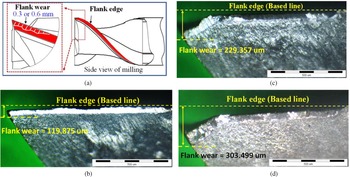
During the tool cutting process, there are many wear forms of the milling tool such as the flank wear, the face wear, the rake wear, and the boundary wear. All wear forms usually depended on the cutting conditions and the material properties of the workpiece and the tool (Stevenson, Reference Stevenson1998; Liu et al., Reference Liu, Ai, Zhang, Wang and Wan2002; Kuljanic and Sortino, Reference Kuljanic and Sortino2005; Zhu and Zhang, Reference Zhu and Zhang2017). In general, the flank wear directly affects the processing accuracy of the workpiece and is easily measured during cutting process as described by Feng et al. (Reference Feng, Hung, Lu, Lin, Hsu, Lin, Lu and Liang2019). Therefore, the flank wear band of the milling tool was measured intermittently during the tests using a tool microscopy and the standardization of the cutting tool life test is estimated using ISO 8688-2:1989 definition. The failure of a milling tool was determined until the average height of a flank wear band reaches 0.3 mm or the maximum height of a flank wear band reaches 0.5 mm, as shown in Figure 4a.
Wear morphologies of milling tool (a) geometric flank definition, (b) flank wear referred to flank edge after cutting distances of 140 M, (c) 340 M, and (d) 680 M.

According to the cutting conditions of Table 2, the flank value of the tool wear was measured after each cutting distance of 20 meter (labeled 20 M) using the optical microscopy (Olympus-STM6) for tool life experiment. Figure 4b–d shows the morphological images of the flank wear referred to a flank edge after different cutting distances of 140, 340, and 680 M with the average heights of the flank wear band of 0.119, 0.229, and 0.303 mm, respectively. The average height of the flank wear at the tip nose in Figure 4d is obviously over 0.3 mm that is defined as the end of the cutting tool life frequently caused by chipping, cracking, and breakage of the flank edge. According to the wear band, the tool flank wear versus total cutting distances, cutting forces, and currents will be estimated subsequently.
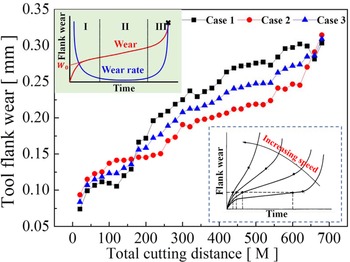
Finally, the tool flank wears after different cutting distances processed at the spindle speed of 1433 rpm, at the feed per tooth of 430 mm/min, and at the axial depth of 1 mm are shown in Figure 5. Results demonstrated that the tool wear curves nearly satisfy the Taylor's tool life characteristics indicated there have usually three stages of the tool wear, including the initial stage I, steady stage II, and sharp stage III, as shown in the inset left top of Figure 5. The total cutting distance and the flank wear of the milling tool at the initial stage are about 0 to 100 M and 0 to 125 μm, respectively. The flank wear rate at the initial stage is obviously a rapid increase due to higher cutting temperature changes. For the steady stage, the total cutting distance and the flank wear of the milling tool are about 100 to 560 M and 125 to 300 μm, respectively. The flank wear rate at steady stage is almost linear and stable increases due to non-sensitive changes of cutting temperature. Finally, the flank wear rate after a cutting distance of about over 560 M rapidly accelerates at the sharp stage due to higher cutting temperature changes and pressure sensitives. Eventually, the end of the remaining tool life is approximately at a cutting distance of 680 M that an average height of flank wear band reaches 0.3 mm.
Tool flank wears versus total cutting distances processed at the spindle speed of 1433 rpm, at the feed per tooth of 430 mm/min, and at the axial depth of 1 mm.

Cutting forces and currents
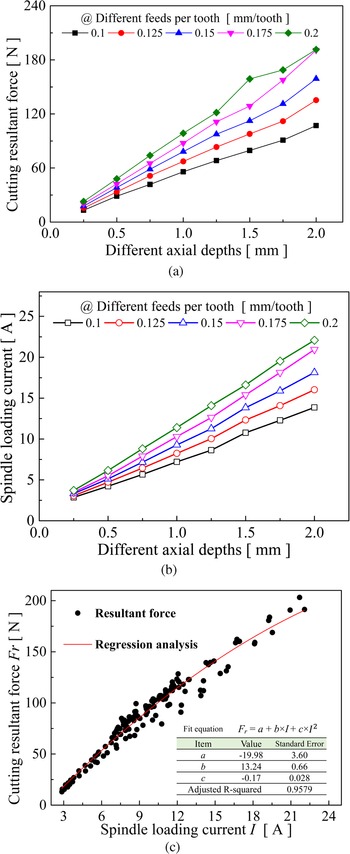
The resultant forces of the cutting tool versus the different axial depths of 0.25–2 mm and the different feeds per tooth of 0.1–0.2 mm/tooth along the cutting direction of the Y-axis are shown in Figure 6a. Experimental results demonstrated that the resultant forces of the cutting tool linearly increased with increasing axial depths and feeds per tooth.
Relationships between spindle loading and cutting tool at different feeds per tooth (a) cutting resultant forces versus different axial depths, (b) spindle loading currents versus different axial depths, and (c) cutting resultant forces versus spindle loading currents.

This is because the flute engagement of the cutting tool with workpiece increased with increasing axial depths. The flute engagement of the cutting tool during milling process is critical and important issues as it directly influences the tangential force. The tangential force is related to a cutting pressure and instantaneous chip load that is usually proportional to radial force (Zheng et al., Reference Zheng, Li and Liang1997; Wang et al., Reference Wang, Xie, Qin, Lin, Yuan and Wang2015). The radial forces at the flank edge of the cutting tool blade during milling process increased with increasing feeds per tooth.
Furthermore, the loading currents of the spindle versus the different axial depths of the cutting tool at different feeds per tooth along the cutting direction of the Y-axis are shown in Figure 6b. The loading currents of the spindle also increased with increasing axial depths and feeds per tooth of the cutting tools. No matter how much axial depths or feeds per tooth, the curve trend of the loading currents and the resultant forces at different axial depths are remarkably almost same positive correlation, as shown in Figure 6c. The correlations are useful for describing simple relationships among data of the loading current and the resultant forces for BPNN prediction on-line. The relationship between the resultant force F r and spindle loading current I is as follows:
 $$F_{\rm r} = {-}19.98 + 13.24 \times I-0.17 \times I^2.$$
In general, the loading current of the cutting tool from a spindle motor is relatively easier acquired than the resultant forces. Thus, the loading currents of the spindle are used to train and predict the cutting forces using the BPNN model during intelligent manufacturing.
Cutting force coefficients
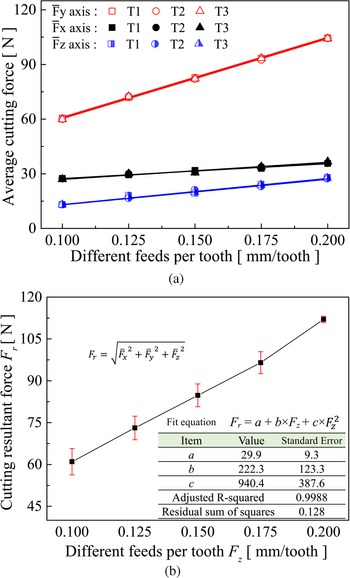
Figure 7a shows the average cutting forces of each axis versus different feeds per tooth for same three tools named T1, T2, and T3 using slot milling processing. The different feeds per tooth are set as 0.1, 0.125, 0.15, and 0.2 mm/tooth. The spindle speed and the axial cutting depth are 1433 rpm and 1 mm, respectively. Results showed that the average cutting forces increasing with increasing feeds per tooth no matter which axis is. The average cutting forces of y direction are obviously larger than other directions due to along Y direction cutting. For getting cutting force coefficients, the regression equations of all average cutting forces in each axis of  $\overline {F_x}$,
 $\overline {F_y}$, and
 $\overline {F_z}$ versus the different feeds per tooth of f z are formulated as mentioned above. All force coefficients, K ts, K ns, K as, K tp, K np, and K ap are shown in Table 3. In order to build the big data analysis of the resultant forces for the cutting coefficients of the tangential, radial, and axial forces, the average resultant forces
 $\bar{F}_{\rm R}$ versus the different feeds per tooth of f z are shown in Figure 7b and are formulated in lower right corners in the inset of Figure 7b. In order to estimate the different cutting forces from loading current at different cutting conditions, this study firstly estimates the cutting force coefficients from average cutting forces of each axis at different feeds per tooth.
Average cutting forces versus different feeds per tooth for same three tools named T1, T2, and T3 using slot milling processing (a) average cutting forces of each axis and (b) average resultant forces of three tools.

Cutting force coefficients of three milling tools from cutting forces

BPNN predictive tool wear
In general, the Adam combines the momentum and the adaptive learning rate with weight correction that estimated first and second moments of the gradients and used them to update the parameters of the back-propagation. Figure 8 shows that the BPNN training errors of the predictive tool wear using Adam algorithm convergence with different learning rates of 0.01, 0.005, 0.001, 0.0005, and 0.0001 for iterative numbers of 320 k. As mentioned above, there are four layers of the BPNN that included one input layer with five neurons, two hidden layers with each five neurons, and one output layer with one neuron node. During BPNN training and prediction, the initial weights and biases are random values at each first training and the activation function for input, output, and hidden units is a hyperbolic tangent which is the optimal condition for faster convergence. The default coefficient values of η, β 1, β 2,  $\epsilon$, m 0, and v 0 are 0.001, 0.9, 0.999, 10−8, 0, and 0, respectively.
BPNN training errors of the predictive tool wear using Adam algorithm convergence with different learning rates of 0.01, 0.005, 0.001, 0.0005, and 0.0001 for iterative numbers of 320 k.

The results showed that gradient convergences of the training error obviously decreased with increasing iterative numbers. However, the convergent error values easily caused the fluctuations of up and down with different learning rates when the iterative numbers are increased, such as the learning rates of 0.01, 0.005, and 0.001. It was concluded that a faster convergence with a hyperbolic tangent can decay the error loss faster but sensitively gets stuck at a worse value of the loss. On the other hand, the increasing of the iterative numbers ultimately complicates the learning convergences to an exact minimum and to causes it highly jumping to new and local minimum values potentially.
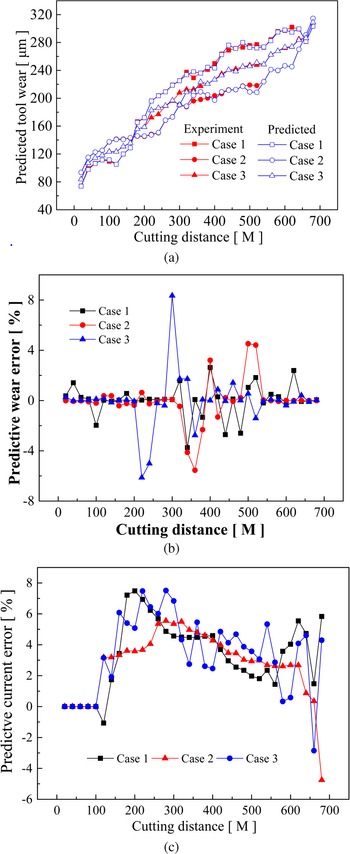
According to the results above, this study used a learning rate of 0.0001 and the iterative numbers of 320 k to predict the tool wears of case 1, case 2, and case 3 at different cutting distances, as shown in Figure 9a. The performances of the predicted tool wear curves are highly close to each case data using BPNN with hyperbolic activation function and Adam convergence. Figure 9b is the predicted wear errors versus different cutting distances for three cases. The average errors of case 1, case 2, and case 3 are 2.7, 4.3, and 2.9%, respectively. Figure 9c is the predicted current errors versus different cutting distances for three cases. The average errors of case 1, case 2, and case 3 are 4.0, 3.3, and 3.9%, respectively. For the first stage of tool wear, the loading current gradually increased with increasing cutting distance due to tool wear. The second stage of the tool wear demonstrated that the milling tool becomes stable cutting and has larger cutting forces. Finally, the loading current gradually decreased after the loading current reaches the maximum value, it can be predicted that the flank of the milling tool has quickly worn out or even cracked due to without cutting force.
Predictive tool wear using BPNN with Adam convergence (a) tool wears versus cutting distances, (b) predictive wear errors, and (c) predictive current errors.

Predictive tool life and HMI
For predicting the tool life time, the study used the cumulative statistical analysis of the current ratio with different cutting distances to represent the RUL. The end of the tool life is defined as when the cumulative current ratio is 100% that is called failure point of the cutting. Figure 10 is the cumulative current ratio of the tool life versus different cutting distances after BPNN prediction. The current ratios are cumulated and summed together with increasing a cutting distance of 20 M each time. Results showed that the ends of the tool life for the case 1, case 2, and case 3 curves are at the cutting distances of 620, 620, and 540 M, respectively. The predictive errors of case 1, case 2, and case 3 are 3.3, 3.3, and 10.0%, respectively. For the experimental validation, the frictions between the cutter and the workpiece during cutting process will affect the loading current of the spindle and cutting forces, even at same cutting conditions.
Cumulative current ratio of the tool life versus different cutting distances after BPNN prediction for case 1, case 2, and case 3.

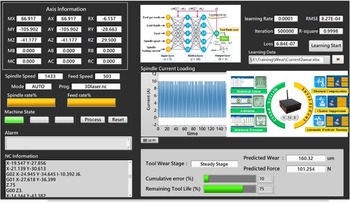
For realized sustainable manufacturing, this study developed an on-line SMB monitoring with HMI (human–machine interface) dashboard based on the BPNN and force modeling to predict the remaining tool life, as shown in Figure 11. SMB is built on gateway system using Visual Studio software at Windows® 10 (Intel® Atom™ x5-Z8350 Processor, CPU 1.44 GHz, model UPC-GWS01). The publish-subscription communication protocols of the SMB is based on message queue telemetry transport (MQTT) facilitate data exchange by enabling data to be transferred to multiple clients. MQTT is a protocol of communication between machine tools and cloud system and is based on M2M communication standard of ISO/IEC 20922:2016. SMB functions include internet of things (IoT) and intelligent manufacturing functions. The IoT for cloud platform of intelligent manufacturing includes historical alarm, activation, and historical processing.
HMI dashboard using on-line SMB monitoring based on the BPNN and force modeling to predict the remaining tool life.

The SMB architecture mainly performed the autonomous actions based on the edge layer, the fog layer, and the cloud layer. The edge layer performed the data acquisition and published with MQTT to a local area network (LAN) message broker from the manufacturing operations of the machine tools. The fog layer executes the local communication, cloud communication, and BPNN stream analysis that communicated the LAN and internet area network (IAN) each other. Finally, the cloud layer accomplishes the communication and data exchange purposes that integrated into the manufacturing plants. Cloud platform is built using MQTT protocol, Postgre SQL, RESTful API, and dashboard (MVC). Cloud databases can storage and analyze big data of activation, historical alarm, and historical processing. Restful API can get the analytical data from cloud databased. HMI dashboard shows the end of tool life, historical processing, axis information, machine states, activation, and historical alarm for analytical data on a visual interface. For CNC machine tool, the SMB is able to connect different CNC controllers, such as Heidenhain, Fanuc, Mitsubishi, and Syntec, via TCP/IP protocol and unified communication library.
Conclusions
The RUL performances of the CNC milling are significantly predicted by the multi-layer BPNN, loading current factors, and SMB. The loading current of spindle with BPNN and coupling theoretical models of tool wear can be adapted to perform the actual processing changes in real-time. For source data and sensing device of the tool wear, the signal of the cutting forces estimated from loading current of spindle has a low cost to engage in machine for a long term and on-line sustainable manufacturing. Remarkably, the BPNN learning method has excellent prediction for the tool wear based on a large amount of data, cumulative current ratio, and historical failure data which were experimented preliminarily at different cutting conditions. The methodology developed facilitates the monitoring of the tool wears, which currently still has several limitations in monitoring spindle current due to its small resolution of data acquisition. Besides, it emphasizes that this methodology can be applied in sustainable manufacturing with other cutter conditions required the BPNN training of the model previously.
Acknowledgments
This work was partially supported by the Ministry of Science and Technology, Taiwan, under Grant No. MOST 108-2221-E-150-034. This work was also partially supported by 109AF0068 and 109AF066.
Wen-Yang Chang received the M.S. and Ph.D. degrees in Department of Mechanical Engineering in 2001, and in Department of Engineering Science in 2008, both from the National Cheng Kung University. He is currently working in National Formosa University. His current research involves development of smart manufacturing, automatic control and integral systems, and mechanics simulation.
Bo-Yao Hsu received the M.S. degree in Department of Mechanical and Computer-Aided Engineering in 2018 and is currently working toward the Ph.D. degree in Department of Power Mechanical Engineering both from National Formosa University. His current research involves development of smart manufacturing, automatic control and integral systems, and mechanics simulation.