


1. INTRODUCTION
Consumers and users vary. To successfully develop a product or product line, designers must determine what user variation will be addressed and how this variation will be handled. The term “user” was selected because this method focuses primarily on individuals who interact with the artifact; other research may refer to these individuals as consumers, customers, and so on. To understand user variation, designers must have a representation of the user; the representation that is appropriate is dependent on the stage of the design process. Designers can evaluate user variation by considering the artifact purpose(s) and desired affordances. Analysis at this level evaluates similarity at the design problem level. In order to have the most flexibility to address user variation, designers must consider the variation as part of the conceptual design process. Prior to concept generation, the design information considered should be solution independent (Ulrich & Eppinger, Reference Ulrich and Eppinger2012). As a result, the available information for designers to consider when addressing user variation is limited to user characteristics and design specifications.
Design specifications consist of a metric and a target. The metrics indicate the quantifiable evaluation criteria, while the targets are the desired values for the criteria. Individual design specifications provide designers with detailed information that will allow them to identify what user variation exists; a method for evaluating user variation is proposed in Cormier (Reference Cormier2014). Addressing user variation then becomes a meta-design problem within conceptual design. The ideal scenario is that for each user, the artifact purpose(s) can be addressed equally well with the same artifact (functions, components, connections, and layout). This situation is not realistic, but it points to the varying levels of artifact commonality that can be achieved (see Fig. 1). Artifact commonality becomes solution dependent at the function level; as a result, user commonality at these levels should not be considered until after concept generation has been completed. Conceptual design is a difficult stage when the user group is largely homogeneous. Concept generation becomes even harder when the group of users and their corresponding needs is significantly heterogeneous.
Levels of artifact commonality.

The term user variation is used to refer to the differences in user characteristics, user needs, and the corresponding design specifications. This variation can be a result of preference, anthropometry, age, user location, and so on. As user needs are mapped to the engineering domain, so too is the variation. However, variation in the user domain does not necessarily require variation in the engineering domain. An affordance-based viewpoint also points out that variation in the engineering domain may not provide any additional benefit unless there is enough variation to alter what affordances exist for a user. Consider the example of a drill. Differing uses for a drill may lead to the same required torque. Further, an increase in the available torque only changes the affordances if it enables the user to produce a different type of hole, drive a new fastener, and so on. The research presented here provides designers a framework for creating individualized design specifications such that user affordances are realized; designers can then look at the variation in design specifications and generate solutions to handle the variation. As such, this work helps clarify the metadesign problem of addressing user variation.
Numerous design methods have been created to address user variation, and these are discussed briefly in Section 2.2. However, there is little work focused on selecting an appropriate method for addressing user variation, resulting in the ad hoc or a priori selection of a design methodology. Further, even with the current research available to assist engineers in creating product variety, few products fully meet user needs (Cowper, Reference Cowper2008). This could be in part because the needs of individuals are commonly grouped (market segmentation), and few methods formally consider the variation within a segment.
The contribution of this work is to present a method that allows designers to evaluate user variation early in a design process. This lays the foundation for more formalized approaches to support design process selection. Further, because the evaluation is done at the individual level, it opens up the possibility to mass customization as a potential solution to addressing user variation. In the following section, a review of previous research is provided focusing on affordance-based design and other early stage design research. Section 3 provides the methodology for analyzing user variation. Section 4 presents a case study looking at child strollers (sometimes called prams or pushchairs). The paper concludes in Section 5 with challenges and areas of future work.
2. PREVIOUS WORK
This research focuses on the initial stages of a design process when the problem is defined and clarified and design specifications are developed to help guide the development of concepts. We review some previous approaches to handling user variation in these stages of a design process, because the design specifications produced should enable design methodologies designed to address user variation.
2.1. Affordance-based design and problem formulation
The use of affordances as a basis for design was identified by Maier and Fadel (Reference Maier and Fadel2001a); research then began to address formal integration within a design process. Representing user needs via affordances was proposed by Maier and Fadel (Reference Maier and Fadel2003), suggesting that user needs be structured as affordances once they are gathered and understood. To facilitate this process, a set of common affordances was identified (Maier & Fadel, Reference Maier and Fadel2003); this research was adapted and formalized to create an affordance basis (Cormier et al., Reference Cormier, Olewnik and Lewis2014). This affordance basis can be leveraged when translating the raw user needs into affordance statements. This set of affordances can then serve as the formalization of the problem (i.e., the designers must design an artifact that realizes the desired affordances).
Maier and Fadel (Reference Maier and Fadel2009) present an affordance-based design process, as well as a technique for designing a particular affordance. The latter is used as a basis for the process used to generate design specifications (discussed further in Section 3). Galvao and Sato (Reference Galvao and Sato2005) introduce a technique that relates tasks, functions, and affordances. This technique could be leveraged after the approach presented in Section 3 to aid in the conceptual design of the artifact. Affordance-based design maintains a relational viewpoint; the benefits provided by an artifact are dependent on the characteristics of the user and the characteristics of the artifact. This relational viewpoint focuses designers on the fact that they must develop an artifact to provide a set of affordances despite user variation. Affordance-based design is a paradigm that can be used in conjunction with existing design methods. This work proposes an affordance-based method to help designers understand variation, which can then be addressed with one or more of the established approaches. Current approaches to address user variation are discussed in the following section.
2.2. Methodologies to address user variation
There has been significant research focused on how to extend product variety and meet different user needs, as well as on general product architecture research. This section discusses previous research that is used for understanding and classifying how user variation is addressed. It should be noted that the review of literature here is intended to highlight that which is relevant to addressing user variation, and by no means is it intended to be representative of the entire field.
2.2.1. Mass customization
Customer variation provided the foundational need for mass customization, which utilizes the idea that providing a product that better satisfies each individual user's needs while maintaining affordable prices is a means for a company to be successful (Pine, Reference Pine1993). Further work identified four corporate approaches to mass customization: collaborative, adaptive, cosmetic, and transparent customization (Gilmore & Pine, Reference Gilmore and Pine1997). Mass customizable products should receive direct input in some form from the user, and because of this, it requires a level of system flexibility. However, mass customization may not always be appropriate or economically feasible. In this case, one solution to address some level of user variation is to use product families.
2.2.2. Product families
A product family is a group of products that satisfies multiple market segments, yet shares a common core of technology (components, assemblies, processes, etc.), referred to as the product platform (Meyer & Lehnerd, Reference Meyer and Lehnerd1997). There has been a significant amount of research focused on how to realize product families. From a corporate standpoint, Maier and Fadel (Reference Maier and Fadel2001b) investigated how to create product families based on a product release schedule. From a system standpoint, there are two general approaches to creating product families, which have been identified as a module-based approach and a scale-based approach (Simpson, Reference Simpson2004). The modular approach uses the addition or subtraction of modules to or from the platform to differentiate family members (Marion et al., Reference Marion, Freyer, Simpson and Wysk2006). In contrast to this, the scale-based approach leverages a design where parameters can be modified to change the functionality of the product (Simpson et al., Reference Simpson, Maier and Mistree2001). The difference in these two approaches may result in one approach being better suited depending upon what type of user variation exists.
To this extent, there has been research that has focused on creating product families to minimize user trade-offs. One method investigated is hierarchical product families, which strive to offer better performance while maintaining market coverage (Hernandez et al., Reference Hernandez, Allen and Mistree2002). To accomplish this, multiple levels of commonality are specified, such that commonality is not increased at the expense of performance. The method was extended in Williams et al. (Reference Williams, Allen, Rosen and Mistree2004) to account for nonuniform demand. An additional way to offer users better performing products is through the use of (re)configurable systems.
2.2.3. (Re)configurable systems
A system that can be altered after it has been fielded is said to be configurable; a configurable system in which these alterations can be performed repeatedly and reversibly is said to be reconfigurable (Ferguson et al., Reference Ferguson, Siddiqi, Lewis and de Weck2007). Thus, reconfigurable systems are a subset of configurable systems; both require a degree of design flexibility (Saleh et al., Reference Saleh, Mark and Jordan2009). Reconfigurability has been identified as a solution to systems requiring multi-ability, evolution, or survivability (Siddiqi et al., Reference Siddiqi, de Weck and Iagnemma2006). Cormier and Lewis (Reference Cormier and Lewis2010) identified (re)configurability as a means to resolve different performance and form requirements between users, as well as to allow for multiple users or occasion-based use.
2.2.4. Robust design
The principles of robust design are to make a design insensitive to variation (or noise; Phadke, Reference Phadke1989). This philosophy can be applied to designing for user variation, where the varying user needs represent the noise, and the system must be designed to satisfy the outlined criteria. The main drawback of robust design is that it could result in a sacrifice of performance for certain users. Similar to robust design, universal design is a concept that started in the field of architecture, and focuses on creating designs that are robust enough to be usable by any individual (Null & Cherry, Reference Null and Cherry1996). Another related approach, design for human variability, looks to improve quality of use for the spectrum of variable users by directly incorporating user information into the design process (Garneau & Parkinson, Reference Garneau and Parkinson2009a).
Design for human variability is a field in which engineering design concepts, such as optimization, robust design, and reconfigurable systems, are used to address user variation related to the user's anthropometry (Garneau & Parkinson, Reference Garneau and Parkinson2009a). This has also been extended to start accounting for preferences as well (Garneau & Parkinson, Reference Garneau and Parkinson2009b). However, much of this work focuses on the physical design of the system, optimizing an already established conceptual design or product architecture.
The decision to use robust design, or any of the other methods discussed, is a meta-level design decision. In order to facilitate the selection of a method to address variation, numerical taxonomic approaches are proposed as a means of understanding the variation that is present in a set of users. When the needs and characteristics of individual users are considered, there is a significant increase in the amount of information that must be considered. The numerical techniques help designers identify the underlying structure of the information.
3. AFFORDANCE-BASED GENERATION OF DESIGN SPECIFICATIONS
The relational nature of affordance-based design highlights the fact that designers must be concerned with both variation of the user and the required variation of the artifact. As such, designers must explicitly evaluate certain user characteristics and the characteristics of the artifact. Because this method is intended to be used in the early stages of a design process, the artifact is represented by a set of design specifications. These design specifications are specific to a single individual within a user role; for an artifact, there may be multiple user roles (e.g., user roles of driver, passenger, etc., exist for passenger vehicles). Further, multiple individuals may serve in any given role. Making design specifications specific to an individual in a specific user role is a derivative of the affordance-based design approach; because the design specification targets are set at the individual level, they inherently maintain the relational nature of affordances (i.e., the design specification is set such that the affordance is realized). The overall process for gathering and transforming this information is outlined in Figure 2. Once the information is available, designers can use this information to understand the user variation as they move into conceptual design.
Overall process model.

3.1. Step 1: Create affordance-based representation of user needs
The starting point for the methodology is an affordance-based representation of the user needs. Cormier et al. (Reference Cormier, Olewnik and Lewis2014) proposed the desired affordance model as a means to organize the information required for an affordance-based representation of a design problem; the desired affordance model, used in conjunction with a user characteristics model, captures all the relevant information required for the method proposed in this work. As such, this model is recommended; however, any affordance-based formulation of the problem is an acceptable starting point provided it captures the following information:
• the affordances that the artifact must strive to realize
• the set of user roles that individuals fulfill throughout the artifact's lifecycle that leads to the desired affordances
These affordances, represented in an n × 1 vector, with elements A x summarize the overall problem. This vector is then used in later steps of the method as a basis to identify design specifications and user characteristics. This ultimately allows designers to link design specifications and user characteristics.
The method later identifies information that captures
• the user characteristics that may impact the realization of an affordance (including information relating to human factors, knowledge, preferences on usage, and constraints)
• the characteristics of a user's artifacts that may impact the realization of an affordance (including available connections, physical characteristics, energy sources, etc.)
Once the set of user roles and their desired affordances have been captured, designers can move on to identifying the list of design specification metrics. These design specification metrics are then mapped to the set of affordances.
3.2. Step 2: Create design specification metrics and map to affordances
Designers need to identify what design specification metrics will allow designers to determine what affordances are present (and ultimately at what level of quality). These design specifications serve as a solution-independent abstraction of the artifact. Ulrich and Eppinger (Reference Ulrich and Eppinger2012) provide a set of guidelines for constructing a list of metrics:
• Metrics should be complete [reflect the entire customer need].
• Metrics should be dependent, not independent, variables [depend on design decisions].
• Metrics should be practical [obtain the required data with reasonable effort].
• Some needs cannot easily be translated into quantifiable metrics, but should still be considered (e.g., instills a sense of pride in the users) [listed as subjective].
• Metrics should include popular criteria used for comparison in the marketplace.
Identification of design specifications should be done on an affordance-by-affordance basis. This follows advice provided by Ulrich and Eppinger (Reference Ulrich and Eppinger2012), who state
A good way to generate the list of metrics is to contemplate each need in turn and to consider what precise, measureable characteristics of the product will reflect the degree to which the product satisfies that need. In the ideal case, there is one and only one metric for each need. In practice, this is frequently not possible.
Further, design specifications have the potential to impact a number of affordances. The artifact being designed is abstractly represented as a 1 × m vector of design specifications, with elements DSy. Equation (1) captures the relationship between affordances and design specifications (i.e., the realization of an affordance is a function of the design specifications). Equation (2) highlights that a single design specification can influence the realization of multiple affordances.
 $$A_x=f\lpar {{\rm DS}_1\comma \; .\; .\; .\; \comma \; {\rm DS}_M } \rpar $$
 $$\hbox{DS}_y \to \lpar {A_1\comma \; .\; .\; .\; \comma \; A_n } \rpar $$
Once all design specifications have been generated, designers should evaluate the mapping between each design specification and the list of affordances identified in Step 1. That is, once all design specifications have been identified, designers should, for each design specification, determine if it influences the presence or quality of each affordance. This will help ensure there is a complete mapping between affordances and design specifications.
The relationship between design specifications and affordances is documented using a matrix (see Fig. 3), which is termed the affordance-to-specification matrix (ASM). This matrix emerged from an effort to relate user characteristics, affordances, and design specifications. Upon examining the ASM in Figure 3, it can be seen that it is closely related to the house of quality (Hauser & Clausing, Reference Hauser and Clausing1988); instead of customer attributes, affordances are used to capture the user side design objectives. This is one case of where affordances and existing design tools are complementary.
Affordance-to-specification matrix.

Once design specification metrics have been identified, initial targets for each metric must be determined; the initial targets are frequently revised later in the design process (Ulrich & Eppinger, Reference Ulrich and Eppinger2012). Traditionally, a single set of design specifications is determined for a given product or segment (Ulrich & Eppinger, Reference Ulrich and Eppinger2012). In the affordance-based approach, design specifications are created for each individual user. Therefore, in order to generate design specifications for each user, user models are required.
3.3. Step 3: Create user models
A user purchases an artifact because of the affordances it provides him. However, the affordances that a specific artifact offers to a specific user at a specific time are dependent on the attributes of the artifact, user, and operating environment. The artifact will be represented (abstractly) by the completed set of design specifications. The design specification metrics were identified in the previous step. However, designers must capture the characteristics of the user in order to establish the appropriate design specification targets. Human factors, knowledge, and preferences all influence the targets; further, each user has a set of associated constraints that must be satisfied.
There is a large amount of data that could be collected for each user, though not all of it will be required to develop the product. Designers need to identify the subset of user characteristics that are required to evaluate if the desired affordances are provided (and at what level of quality). As such, users are represented abstractly as a 1 × p vector of user characteristics, with elements UCz. In doing so, they should address the categories outlined in Figure 4. These user characteristics may need to be refined once concepts are generated.
User characteristics categories.

Equation (3) captures the relationship between affordances and user characteristics (i.e., the realization of an affordance is a function of the user characteristics). Equation (4) highlights that a single user characteristic can influence the realization of multiple affordances.
 $$A_x=f\lpar {{\rm UC}_1\comma \; .{\rm \; }.{\rm \; }.{\rm \; }\comma \; {\rm UC}_p } \rpar $$
 $$\hbox{UC}_z \to \lpar {A_1\comma \; .\; .\; .\,\comma \; A_n } \rpar $$
User characteristics are identified for each affordance, for each user role. For each affordance A x, the designer identifies the user characteristics that influence the presence or quality of that affordance; if one or more characteristics are not contained in the current user characteristic vector, they are added. Thus, the n × 1 vector of affordances drives the identification of the p × 1 vector of user characteristics, leveraging the relationship from Equation (3). The process also serves to map the n × 1 affordance vector to the p × 1 user characteristics vector. The result is an n × p matrix that captures the relationship between affordances and user characteristics; this matrix is termed the affordance-to-characteristic matrix (ACM). An example can be seen in Figure 5. To ensure completeness of this mapping, designers should review the relationships after the user characteristics vector is complete.
Affordance-to-characteristic matrix.

As discussed in Step 1, affordances are identified for one or more user roles. As such, user models are being created for each user role, with users being modeled abstractly as their user characteristics. This serves two purposes: first, it helps keep the size of the user model manageable; second, it allows for the fact that different individuals may be satisfying different user roles. For a given design problem, there may be redundancy of user characteristics across user roles (i.e., the same user characteristics appears in multiple user roles, such as the stature of the user for a given user role). If different individuals fulfill each role, all the information must be gathered; if the same individual fulfills multiple user roles, her information can simply be plugged into each model (with minimal additional effort). In determining how many different individuals will or should be fulfilling the identified user roles, designers should consider the overall goal of the product (typically outlined in the mission statement; Ulrich & Eppinger, Reference Ulrich and Eppinger2012).
A more complete understanding of how users vary (derived from their data) can enable designers to respond strategically and generate innovative solutions for handling user variation. Once user characteristics are identified and the user data has been collected, this information can be used to identify target values for each design specification metric.
3.4. Step 4: Generate target and acceptable values for each design specification metric
In order to complete the creation of the design specifications, designers must leverage the user models to generate target values for the previously identified design specification metrics. In a typical design process, a single value would be set for the target. In the affordance-based approach, numerous user specific design specifications must be generated to be able to leverage the relational benefits. As such, in this step, designers are establishing mapping functions that automatically generate individual targets and acceptable values for each design specification for each individual given a set of user characteristics. This is done by leveraging the given user information. The first step in doing this is to identify if a user characteristic influences a design specification. Once a relationship is identified, a mapping function is developed, such that designers can take the identified subset of user characteristics and generate a target value for the design specification metric. For example, based on the types of materials and the size of holes to be created, a target value for drill torque could be determined.
To identify the relationships between user characteristics and design specifications, a basic procedure has been developed. For each user characteristic, perform the following steps:
a. Using the ACM (see Fig. 5), identify the subset of affordances that is dependent on the user characteristic in question.
b. For each affordance identified in Step a, use the ASM (see Fig. 3) to identify the design specifications that drive each affordance.
c. For each design specification metric identified in Step b, determine if the user characteristic in question influences the target value or acceptable value for it. The mapping between design specifications and user characteristics can then be captured in a specification-to-characteristics matrix (SCM). See Figure 6 for the general form; dashed boxes can be used to indicate when a connection had the potential to exist (but was determined not to).
Specification-to-characteristics matrix.

To illustrate this concept, consider the ACM and ASM from Figure 7 and Figure 8, respectively. These are used to construct the SCM shown in Figure 9 using the following steps.
1. For User Characteristic 1
a. Leveraging the ACM, we can see that UC1 only impacts A1.
b. Leveraging the ASM, A1 is impacted by DS1, DS2, and DS4. Thus, UC1 has the potential to influence these three design specifications (DS1, DS2, and DS4).
c. Considering the relationship between UC1 and the design specifications that influence A1, assume it is determined that UC1 only impacts DS1; thus, this is noted in the first column of the SCM shown in Figure 9. While there was potential for UC1 to impact DS2 and DS4, there was no influence identified (indicated as NI in Fig. 9).
2. For User Characteristic 2
a. Leveraging the ACM, we can see that UC2 only impacts A1.
b. Again, leveraging the ASM, A1 is impacted by DS1, DS2, and DS4.
c. Considering the relationship between UC2 and the design specifications that influence A1, assume it is determined that UC2 impacts DS1, DS2, and DS4. This leads us to complete the second column in the SCM shown in Figure 9.
3. For User Characteristic 3
a. Leveraging the ACM, we can see that UC3 impacts A2 and A3.
b. Leveraging the ASM, A2 is impacted only by DS3, while A3 is impacted by DS3 and DS4.
c. A2 creates a one-to-one mapping between UC3 and DS3; thus, UC3 must influence DS3, resulting in Equation (5). A3 indicates UC3 has the potential to impact DS3 and DS4. In this example, we will assume UC3 impacts both, resulting in Equation (6). This results in the third column of the SCM shown in Figure 9.
(5) $$\hbox{A}_{2} \;\hbox{indicates} \;\hbox{UC}_3 \to \hbox{DS}_3 $$(6)$$\hbox{A}_{3} \;\hbox{indicates} \;\hbox{UC}_3 \to \lpar {\hbox{DS}_3\comma \; \; \hbox{DS}_4 } \rpar $$
4. For User Characteristic 4
a. Leveraging the ACM, we can see that UC4 impacts A3 only.
b. Leveraging the ASM, A3 is impacted by DS3 and DS4.
c. Considering the relationship between UC3 and the design specifications that influence A3, assume it is determined that UC4 does not impact either DS3 or DS4. This results in the fourth column of the SCM shown in Figure 9.
5. For User Characteristic 5
a. Leveraging the ACM, we can see that UC5 impacts A1 and A4.
b. Leveraging the ASM, A1 is impacted by DS1, DS2, and DS4, while A4 is impacted by DS4 only.
c. Considering the relationship between UC5 and the design specifications that influence A1, assume it is determined that UC5 impacts DS1 and DS4 (but not DS2). A4 provides a one-to-one mapping between UC5 and DS4 from A4; thus, UC5 must influence DS4. With all user characteristics considered, we can also complete the “# Involved” column that identifies the number of user characteristics that influence each design specification. This results in the final SCM shown in Figure 9.


Example affordance-to-characteristic matrix (used to create example specification-to-characteristics matrix).

Example affordance-to-specification matrix (used to create example specification-to-characteristics matrix).

Example specification-to-characteristics matrix.

Looking at the SCM, a designer can clearly see what user characteristics drive design specifications. Further, they can also see what affordances and how many influence each design specification. When establishing the connections in the SCM, there is a chance that for a given user characteristic, it will not be tied directly to a design specification (see User Characteristic 4 in Fig. 9). This can occur because user characteristics and design specifications are identified independently. Further, because design specifications are solution independent, it can be hard to map certain user characteristics to a design specification (e.g., mapping a user's fine motor control capability to a design specification). Further, any user characteristics that weakly influence a design specification should be annotated. User characteristics that are weakly mapped or unmapped to design specifications should be carried forward in the design process to prevent a loss of information. With the connections between user characteristics and design specifications known, a set of mapping functions can be developed to help designers generate target values, as well as acceptable values.
When developing these mapping functions, designers must be careful when multiple affordances influence the same design specification for a single user characteristic. Consider DS3 in Figure 9. It can be seen DS3 is a function of UC3, but two affordances (A2 and A3) are influenced by this design specification. This implies that when developing the mapping functions between UC3 and DS3, both affordances must be considered, because they may have different mapping functions. Designers can then incorporate the influences from all affordances into the mapping function (to ensure the most restrictive cases are satisfied). For the design specifications shown in Figure 9, we can determine that for any user i the following is true:
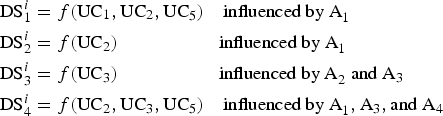 $$\eqalign{& \hbox{DS}_1^i=f\lpar {\hbox{UC}_1, \hbox{UC}_2, \hbox{UC}_5 } \rpar \quad\hbox{influenced by A}_{1} \cr & \hbox{DS}_2^i=f\lpar {\hbox{UC}_2 } \rpar \quad\quad\quad\quad\quad\hskip4pt\hbox{influenced by A}_{1} \cr & \hbox{DS}_3^i=f\lpar {\hbox{UC}_3 } \rpar \quad\quad\quad\quad\quad\hskip4pt\hbox{influenced by A}_{2} \ \hbox{and A}_{3} \cr & \hbox{DS}_4^i=f\lpar {\hbox{UC}_2, \hbox{UC}_3, \hbox{UC}_5 } \rpar \quad\hbox{influenced by A}_{1}, \hbox{A}_{3}, \hbox{and A}_{4}}$$
These mapping functions can take essentially any form, and can be developed in a number of ways. The complexity of the function is largely determined by the complexity of the relationship between the user characteristics and design specification. For example, in Equation 7, the optimal diameter of a tool grip (the design specification) is a simple function of the user characteristics index finger and thumb lengths (Garneau & Parkinson, Reference Garneau and Parkinson2009a).
 $$D_{{\rm Opt}}=\displaystyle{{L_{{\rm index}} } \over 4} - \displaystyle{{L_{{\rm index}}+L_{t{\rm humb}} } \over {2{\rm \pi }}}$$
In an affordance-based design paradigm, designers must be concerned with first providing an affordance. A secondary concern is the quality at which an affordance is provided, acknowledging that one design may perform better than another (Maier & Fadel, Reference Maier and Fadel2001a). When establishing design specifications, it is recommended that designers identify ideal and acceptable target values (Ulrich & Eppinger, Reference Ulrich and Eppinger2012). Ideal target values will likely account for a desired affordance quality. Acceptable target values must at a minimum provide the affordance.
Once the functions are generated, the individualized set of design specifications can be created for an individual user within a user role. Thus for all i users, there is a (potentially) unique value for all m design specifications. Because the design specifications are generated at the individual user level from unique user characteristics, the presence or quality of an affordance can be evaluated from a user's individual design specifications, while maintaining the relational benefit, which is one of the primary benefits of an affordance-based approach. Once design specifications have been generated for each user within each user role, designers can begin to analyze the data for user variation.
4. CASE STUDY OF A CHILD STROLLER
This section demonstrates how the methodology outlined in Section 3 would be applied to the design of a child stroller, sometimes referred to as a pram or pushchair. The user characteristics are simulated with the help of information from the US Census as well as data from the 1988 Army Anthropometric Survey data set (Gordon et al., Reference Gordon, Churchill, Clauser, Bradtmiller, McConville, Tebbetts and Walker1989). The case study was created by simulating the user characteristics for 100 users (l = 100).
4.1. Step 1: Create affordance-based representation of needs for child stroller
For a child stroller, there are a number of affordances that the stroller should provide to the operator. A desired affordance model (Cormier et al., Reference Cormier, Olewnik and Lewis2014) can be seen in Figure 10 for the operator user role. If desired, this affordance model could be expanded to include other roles; the current affordance model is sufficient to demonstrate the methodology. These nine affordances (n = 9) are now used to identify design specification metrics.
Child stroller desired affordance model for operator user role.

4.2. Step 2: Create design specification metrics for stroller and map to affordances
Leveraging the desired affordance model, designers then determine the design specifications that will influence the presence and quality of each affordance. The most important benefit a stroller provides the operator is the ability to transport children. For this affordance, a number of design specification metrics are needed to evaluate how well the affordance is realized if at all. The design specifications needed to evaluate this affordance include the following:
1. the number of children it can transport
2. the total load the stroller can transport
3. the operational length
4. the operational width
5. the turning circle
6. the number of lay down spots
7. the number of sitting spots
8. the number of standing spots
The first two design specifications are directly tied to the number and characteristics of the children being transported by the operator. The operational length, width, and turning circle impact this affordance because the stroller must be able to operate in the desired locations to provide transportation. Further, based on the capabilities of the child, the three different types of transport options (termed spots) will determine if a child can be transported (e.g., infants require a lay down spot, toddlers who can sit upright can use a sitting spot, and older child who can stand and hold on can use a standing spot). For each affordance, designers can identify the design specifications that impact each affordance, remembering that previously identified design specification may impact multiple affordances. This results in a total of 32 design specifications (m = 32). The 9 × 32 ASM seen in Figure 11 shows the final list of design specifications, along with how they map to the different affordances.
Affordance-to-specification matrix for stroller.

Once the design specification metrics have been identified for the stroller, initial targets for each metric must be determined. However, this cannot be done until the user characteristics for the operator are known. These user characteristics are determined in the following step.
4.3. Step 3: Create user models for stroller
With the design specification metrics known, designers must identify the user characteristics required to generate the target values. For each affordance, designers must evaluate what user characteristics will influence the presence and quality of the affordance. For the first affordance, transportation of children, the following user characteristics influence this affordance:
• the number of children to transport
• the capabilities of the children
• the weight of each child
• the usage destinations
The first user characteristic is essentially implied. The capabilities of the children impose constraints on how the child must be transported (a violation of these constraints means the affordance is not realized). The weight of the children must be accommodated, and the usage destinations impose further constraints on the operating dimensions of the stroller. This process is repeated for each affordance. The final list of 19 user characteristics (p = 19) for the operator role can be seen in Figure 12, along with how they map to the different affordances to create the 9 × 19 ACM. The general user characteristics are coded such that they can be processed algorithmically, resulting in 66 variables that encode the 19 user characteristics. Thus, the coded user character data is a 100 × 66 data matrix.
Affordance-to-characteristic matrix for stroller operators.

4.4. Step 4: Generate target and acceptable values for each design specification metric
With the design specification metrics and relevant user characteristics identified, the connections between them are identified. For the identified connections, mapping functions are then developed that capture how the user characteristics influence the design specifications. These mapping functions are created to generate target values for each design specification metric from the identified subset of user characteristics; a similar approach could be used to generate acceptable values (this is omitted for brevity).
The process for connecting design specifications outlined in Step 4 of the methodology (see Section 3) was applied to generate the connections shown in Figure 13, resulting in the 32 × 19 SCM. The dotted boxes shown in Figure 13 show potential connections between the design specifications and user characteristics; connections are indicated with a box. With the connections identified, the mapping functions used to generate design specifications could be developed. For this case study, these functions contain a combination of logic and mathematical models. An example is shown in Figure 14 for the design specifications transportation length, width, and height. These design specifications are a function of the methods used to transport the stroller and the automotive characteristics. In this case, because targets are being identified, the most restrictive case is determined. Once all of the functions are established, the generation of a unique set of design specifications for each individual user can be automated (i.e., each design specification is generated with its respective mapping function).
Specification-to-characteristics matrix for the child stroller.

Mapping function for transportation dimension design specifications.

These design specifications represent the set of information that will move forward into conceptual design. If user characteristics could not be mapped to design specifications, this subset of the user characteristics themselves would be part of the information that moves forward into conceptual design along with the design specifications. For this case study, the influence of all user characteristics was captured by the generated design specifications.
The result of this process is that the 32 design specifications could be generated from the 19 user characteristics. Further, because the generation of individual design specifications is now automated, a large number of users can be considered with only a moderate increase in computational cost. For this case study, the user characteristics were simulated. However, in practice, this information could be mined from a number of sources or gathered through market research. This approach then provides a formal mechanism to transform this data into usable design information.
5. CONCLUSIONS AND FUTURE WORK
This paper presents an affordance-based method to produce relational design specifications in the early stages of a design process. These design specifications are produced for each individual based on the user's unique characteristics (knowledge base, anthropometry, etc.). As such, they provide a formal mechanism to capture the influence of user characteristics on design specifications. Further, the method also identifies user characteristics that cannot be (fully) captured by design specifications, and should be considered later on in the design process. As such, the method transforms user information into technical engineering information when possible, while identifying the subset of user information that should be considered later in a design process. This information then drives conceptual design, providing the required information to explore a variety of design methodologies (robust design, product family design, etc.).
Future work will focus on testing the method on different types of design problems. This will further formalize how the range of different user characteristics can be worked into the mapping functions. In addition, there is potential to identify and create a suite of mapping functions that can be tuned to individual design problems. This will leverage existing work from different engineering domains. For example, a review of the design for human variability models should provide a subset of models for artifact interfaces.
A much broader aspect of future work is formally extending this method to interact with other early design process tools to better understand the design problem. This method produces individual design specifications, but other tools such as discrete choice analysis have the potential to supplement this information by identifying relative importance of these specifications. Further, there is potential to use discrete choice analysis focusing on usage scenarios to better inform the mapping functions when generating acceptable target values. Finally, the proposed methodology generates a large amount of information. Techniques to process this information and help designers understand the user variation prior to entering conceptual design will need to be developed and refined. An initial effort regarding this can be found in Cormier (Reference Cormier2014).
Phillip Cormier is a Teaching Assistant in the Department of Mechanical and Aerospace Engineering at the University at Buffalo. His research interests include using (re)configurable systems, product families, and mass customization to create innovative systems for satisfying consumer variation. He also works with design firms to incorporate advanced design theory and methodology techniques into their current practices.
Kemper Lewis is Professor and Chair of the Department of Mechanical and Aerospace Engineering and Site Director of the National Center for e-Design as part of the National Science Foundation's Industry/University Cooperative Research Center program at the University at Buffalo–SUNY. He previously served as Executive Director of the New York State Center for Engineering Design and Industrial Innovation. His research expertise is in the areas of design theory, complex system trade-offs and optimization, and decision modeling. He is a Fellow of the American Society of Mechanical Engineers and has served on the National Academies Panel on Benchmarking the Research Competitiveness of the United States in Mechanical Engineering.



