

The great majority of black Africans in Renaissance EuropeFootnote 1 were slaves, and the impetus for this essay came from a desire to investigate some who were not. High-ranking and important African ambassadors – and even their lowlier cousins, envoys – were at the other end of the spectrum to slaves, and offer an opportunity to analyse a variety of European representations of Africa and Africans generated by their presence and office.
As introduction, here are two stories concerning embassies from Ethiopia to fifteenth-century ItalyFootnote 2 where the difficulties of ‘representing’Footnote 3 one country to another, and the consequent perplexities of cultural difference, can be seen very clearly. Both have laughter, that most subtly nuanced and complex of cultural responses, at their centre. In the first, an Ethiopian embassy to Venice in 1402 brought as gifts for the doge and signoria ‘4 leopards, spices and various other pleasing items’,Footnote 4 among which were a skin described as that ‘of a wild man’ and the skin of ‘an ass of diverse colours’.Footnote 5 Francesco Novello da Carrara, the lord of Padua, was contacted by the Venetian government for help in transporting two of the leopards to Germany, and in return he asked that the skins be taken to Padua for him to see. His response to them was memorable – he laughed – and he later wrote to the doge, Michele Steno: ‘I saw the skins with hilarity and pleasure.’Footnote 6 The second story comes from a letter written by Candido di Gagliano of the collegiata of S. Maria di Cividale in Friuli to his friend, Corrado Bojani, on 5 August 1404. Candido was in Rome. He described in vivid detail the visit to Rome of three Ethiopian ambassadors sent to obtain indulgences and absolution from sins for fellow countrymen, and to acquire saints’ relics. Candido wrote that their reports of Ethiopia tallied completely with what was written in the ‘Book of the Three Magi’, owned by the law professor Angelo degli Ubaldi,Footnote 7 and that the Ethiopians willingly listened to the contents of this manuscript (some of which was concerned with Ethiopian Christianity), and while the interpreter was explaining it, ‘they moved closer together, laughing and greatly enjoying [hearing] what we knew and appreciated about them, and about the names of their dukes, princes and popes’.Footnote 8
Laughter is a rather complicated cultural signifier and decoding these scenes from Renaissance Italy is not altogether easy, but some of the more pressing contextual references and concerns can at least be mentioned. In the 1402 story, the first skin must have been of an ape,Footnote 9 possibly a gorillaFootnote 10 or a chimpanzee, and the second most probably of a zebra. Renaissance Italians (with their interest in origins of all types) were fascinated by the notion of a wild man, and the ape skin must have fuelled these fantasies. Whether Francesco Novello thought he was seeing the skin of a wild man or of an ape is not recorded, but his hilarity may have signalled surprise or incongruity, occasioned both by the skin of the extraordinary hairy human/ape and by the striped zebra skin, as stripes in themselves could be considered funny. It is possible that Novello had an interest in Africa because at an early date he possessed at least two sub-Saharan African slaves; in October and November 1405, he gave two black female slaves to his doctor as payment for services rendered.Footnote 11
In fifteenth-century Italy, the craze for menageries of wild and exotic non-European animals led initially to a steady stream of big cats, and later to the import of giraffes, elephants and rhinoceroses, all of which were passed around between princes and lords as welcome gifts. In addition to their connection to live, unfamiliar animals, the skins were also funny because as dead, unknown ex-animals they had no place in the European hierarchy of pelts. Animal skins in Europe were employed as status indicators, and were frequently chosen as ambassadorial gifts, but what status was represented (or indeed could be represented) by a zebra or an ape skin? The animal skins presented as gifts by the Ethiopians could have been chosen on account of their known novelty in Italy, for they would probably not have been exceptional or exceptionally costly in Ethiopia (now there are two types of zebra in Ethiopia and no gorillas, but it is difficult to be certain what the situation was in the fifteenth century). But it is also possible that the Ethiopians brought animal skins as gifts because they were the gifts usually given in Africa, and because in Africa as in Europe, animal skins were used as status indicators. According to the chaplain to the Portuguese embassy to Ethiopia in the 1520s, Francisco Álvarez, Ethiopian courtiers wore various animal skins (sheep, lion, tiger, leopard) according to their rank.Footnote 12 Whatever the case, the Ethiopians would have been very surprised that their gifts engendered hilarity. A passage from the humanist Lapo da Castiglionchio the Younger's Dialogue On the Benefits of the Curia, written during the summer of 1438 in response to the start of the Council of Ferrara–Florence (1438–42), backs up the view that things or people perceived as ‘strange’ by Italians (which included nearly all foreigners) produced laughter:
Lapo: Indeed the Byzantine emperor has come . . . followed by priests, high priests, legates and many translators from all the Eastern peoples and nations among whom the name of Christ is worshipped. The variety of their language, their character, their adornment, their dress, their bearing, and finally, their bodies themselves leads not only to delight but also to laughter and wonderment.
Angelo: ‘It is so. I mean, I never look at men of that sort without laughing.’Footnote 13
The second story from 1404 reveals the other side of the coin – Ethiopian ambassadors laughing on account of Italian knowledge of Ethiopia. Why did the Ethiopians react in this way? What did laughter signify in this context? Were they laughing because it was so unusual to encounter accurate information in Italy about Ethiopia and Ethiopian Christianity? Or were they in reality laughing out of a sense of cultural superiority because they were enjoying hearing the errors in what was written about their home country? And what did they feel about the fact that this knowledge was contained in a manuscript about the Three Magi? What was the relationship in their minds between the black Magus and Ethiopia? In Europe, John of Hildesheim's Book of the Three Magi,Footnote 14 finished before 1375, was the primary literary basis for King Caspar as a black Ethiopian, and it also propounded the view that the emperor of Ethiopia was the descendant of and successor to the Three Wise Men who all died without heirs.Footnote 15 And one wonders too whether the names of Ethiopian ‘dukes and princes’ made them laugh because of the foolishness of using these terms in relation to Ethiopian elites (it was a favourite trick of the humanists to feign pretence that all social structures could be rendered in the terminology of ancient Rome) or whether the names and positions had been mangled in translation. Or were they homesick in Rome for Ethiopia and therefore merely reacted happily upon hearing familiar names?
These two fleeting moments of laughter have allowed the introduction of this essay's main themes: European readings of the strangeness of African animals and artefacts, which stood in as representations of Africa; the role of African ambassadors in fleshing out European and African ideas of each other's worlds and connections between them; cultural assumptions and cultural difference in the fifteenth and sixteenth centuries (especially in this transcontinental situation); competing versions of global knowledge and of global Christianity; and the relevance of the prototype of the black Magus for sub-Saharan African ambassadors to Europe. The fifteenth and sixteenth centuries were crucial moments in the history of relations between Africa and Europe, and encompassed not only political and diplomatic encounters, but also the articulation of a whole host of cultural and religious assumptions. Catholicism was a key element in this relationship, and analysing the embassies sent by Christian sub-Saharan African countries to Portugal and Italy in terms of cultural relationships repays investigation. Both sides had their misconceptions of each other, but they managed to interface on ‘middle ground’, and one possibility is that Catholicism provided this ‘middle ground’.
An analysis of the cultural context to these embassies reveals how complicated the task of ‘representing’ Africa could be. The two Christian countries under discussion in this essay are Ethiopia (in East Africa) and the Congo (on the West coast of Africa), with two very different histories of Christianity and two very different histories of contact with Europe. Both countries were primarily interested in links with the pope because of his position as head of the Catholic church. Nearly all papal rituals stressed the majesty of the pope who possessed absolute power and was the Vicar of Christ, and all kings, emperors and their representatives had to kiss his feet in a symbolic gesture of ‘adoration’, similar to the way in which Roman emperors were once adored.Footnote 16 (In Portugal, by contrast, ambassadors were required to kiss the hand of the king.Footnote 17) During the Renaissance magnificence in papal ritual increased, probably to reinforce the pope's power as head of a worldwide church, but it may also have been a response to increased magnificence from secular rulers.Footnote 18 For both reasons, and as European knowledge of the non-European world expanded and the papacy became more concerned to find new populations to Christianise and bring into the ‘fold’, many fifteenth- and sixteenth-century popes welcomed embassies from extra-European countries as a way of raising their profile. The exact reception accorded depended upon the personality and policy of individual popes, and upon precise world circumstances. Both the Congo and Ethiopia were also interested in links with Portugal, Congo because Portugal was the European power with which they had first come into contact and which they knew, and Ethiopia because Portugal was expanding to the East and was fast becoming the most important world power.
Ethiopia had been Christianised in the fourth century, and its church is one of the Oriental Orthodox churches (along with the Syrian, Coptic and Armenian churches), which had in common their rejection of the Council of Chalcedon in 451. Christianity was an essential part of its national and cultural identity, a defining feature that set it apart from all its surrounding Muslim neighbours, and by the sixteenth century renewed Muslim pressure certainly injected a sense of urgency into diplomatic and religious links between Ethiopia and the papacy. Ethiopian Christians were expected to practise circumcision, observe the food prescriptions set out in the Old Testament and honour Saturday as the Sabbath, and thus represented to Renaissance Europeans the ‘strangeness’ of African Christian practices. Leo X wrote to the emperor Dāwit II in May 1515 exhorting him to abandon the rite of circumcision as a precondition to Ethiopia entering the European Christian community. Only when the practice was abandoned could Ethiopia join with Portugal, the papacy and other kings to liberate Jerusalem, and only then would the pope send him a special nuncio bearing both spiritual and temporal gifts.Footnote 19 Needless to say, Ethiopia did not suspend circumcision. As the sixteenth century progressed, more and more emphasis was placed on religious conformity, and popes began to be far more demanding about the standardisation of religious norms. Matthew, the Ethiopian ambassador to Pope Paul III (1534–49), was formally interrogated in Rome about Ethiopian Christianity, and although his answers on most subjects conformed to Catholic precepts, he admitted to the controversial practice of circumcision while denying the often-raised medieval legend about Ethiopians practising baptism by fire.Footnote 20
If one accepts Renaissance Aristotelian notions of civilisation, Renaissance Europe must have perceived a sharp contrast between Ethiopian civilisation, with its written culture and its long and distinguished tradition of chronicle-writing, and Congolese civilisation, with its oral and non-literate culture. The Congo only became Christianised in the fifteenth century, with the arrival of the Portuguese, and an elite of Congolese then became literate, able both to read and to write. Although writing one's name is in itself no proof of further ability to write, it does at least indicate a consciousness of literacy. Signatures survive, for example, of five Congolese envoys and students (and students certainly had to be literate in a meaningful way) in Lisbon in August 1514, four of whom were related to the Manicongo or ‘king’ of the Congo (one of them is D. Henrique, the first sub-Saharan African to be made a bishop, in 1518),Footnote 21 and a further five signatures are extant from September 1514, of Congolese who were returning to the Congo.Footnote 22 Envoys or ambassadors from other parts of Africa who were not able to write (for example, Pero Barroso, an interpreter from Benin who was in Lisbon in 1515) made a cross on the paper instead of signing.Footnote 23 In 1485 Diogo Cão and two of his companions engraved a stone marker at Ielala, about 160 kilometres from the mouth of the Zaire, with the Portuguese royal arms, a cross and an inscription recording the three names.Footnote 24 It is generally agreed that the ruler of Sogno, one of the six provinces of the Congo, was the first to convert to Christianity in 1491,Footnote 25 and later the Manicongo was persuaded to convert,Footnote 26 and some of his family, his elites and his subjects followed suit, taking the Christian names of the Portuguese royal family and Portuguese nobles. Portuguese royal recognition of their African royal and noble kin included the devising of Portuguese coats of arms for their African brother rulers and co-religionists – those for the Manicongo, for example, are preserved in the sixteenth-century Book of Nobility and Perfection of Arms in the Torre do Tombo in Lisbon.Footnote 27
The Portuguese appropriation of the Congo and Portuguese overseeing of the country's religious structure should have ensured that Congolese Catholicism was closely modelled on European Catholicism, but although Portugal and the papacy continued to monitor every aspect, they could only do this from a distance, from Europe. So, for example, in 1595, the Congolese ambassador to Portugal, called António Vieira, who was a relative of King Alvaro II of the Congo, was closely interrogated about the state of religion in the Congo, even being quizzed about such apparently minor matters as the behaviour of the six local lay confraternities in the capital São Salvador.Footnote 28 He passed the exam with flying colours, but other sources indicate that Congolese Catholicism retained many of its pre-Christian aspects, which the Portuguese secretly condoned.
An Ethiopian embassy to the papacy is recorded in 1306,Footnote 29 but in the fifteenth and sixteenth centuries embassies became much more common, even though Muslim Egypt tried to stop or hinder all such traffic. Had they been allowed to reach their destination, embassies from the Congo to the papacy would also have become much more common in the sixteenth century after the Christianisation of the kingdom. A few were given instructions and many set off (for instance, Manuel, the brother-in-law of Nzinga Mvemba, or Afonso I, wrote to King João III of Portugal asking for an armed caravel to take him to Rome to offer obedience to the pope in 1540),Footnote 30 but none made it until the Portuguese Duarte Lopez finally arrived dressed as a hermit in Rome in 1589 after many adventures to find that he had become a subject of, and the country he ‘represented’ had become the possession of, Philip II, the king of Spain,Footnote 31 and that Sixtus V was unwilling to accede to his requests. The problem for Congolese ambassadors was that their route to Rome inexorably passed through Portugal (as they had to take ships to reach Europe and all the ships were Portuguese), but that once in Lisbon, the Portuguese were extremely reluctant to let the Congolese out of their sphere of influence and so kept them in Portugal.Footnote 32 This is what happened to the Congolese ambassador to Portugal, D. Pedro de Sousa, who was held in Lisbon in 1514 and not allowed to go to Rome with the famous Portuguese embassy to Leo X, headed by Tristão da Cunha.Footnote 33 Portugal guarded its power over the Congo jealously, and it is not coincidental that Congolese ambassadors started appearing in Rome only after Portugal's annexation by Spain in 1580.
The second part of this essay will examine more closely the ways in which African ambassadors and embassies could ‘represent’ or be thought to represent Africa. In addition to giving representations of ‘exotic’ Africa as diplomatic gifts, the most obvious way is by representing the interests of their rulers and their countries. An embassyFootnote 34 could be composed of one individual or several, and ambassadors (with official credentials) should be distinguished from members of their trains or suites. In practice, official letters of instruction to ambassadors which were routine across much of Europe are sometimes lacking for ambassadors from sub-Saharan Africa, although significant numbers of official letters between Ethiopian emperors and popes,Footnote 35 between Congolese and Portuguese rulersFootnote 36 and between Congolese kings and popes,Footnote 37 are still extant and provide reasonable amounts of information about ambassadors and their aims. The stated aims of these embassies were often straightforwardly to make contact, or to offer obedience (egged on by European advisers, who were often religious, who said that was how Christian rulers in Europe behaved). Many ambassadors also seem to have been charged with checking aspects of Roman Catholic Christianity (e.g. the exact position of the popeFootnote 38 or how mass was conducted) and with trying to obtain relics and images of saints. Occasional ambassadors arrived in Europe to attend church councils. Ethiopian delegates (who turned out to be unofficial) headed by Pietro the deaconFootnote 39 attended the Council of Florence called by Eugenius IV, as did Andrea the abbot, the head of the Coptic delegation (which signed an agreement of union with the Catholic church). Their visit to Italy was recorded by Antonio Averlino, known as Filarete, in a double panel on the bronze doors of St Peter's, which were completed in 1445.Footnote 40 The first part of the panel records Eugenius IV consigning the decree of union to Abbot Andrea in Florence (Figure 1), and the second records the departure of the delegates (Figure 2) (but the scenes are generic rather than specific in terms of location, with the location being flagged by the word ‘Florentie’ underneath). Although only the Copts were involved in signing the decree of union, some of the same figures reappear in both scenes (including probably Pietro the deacon). Notice the stripes (stripes were the most frequently represented textile pattern in Ethiopian painting)Footnote 41 and the hand cross (a feature of Ethiopian and Coptic Christianity). And in August 1561 Pius IV wrote a letter to the bishop of Hierapolis, asking him to encourage the Ethiopian emperor Mina to sent representatives to the Council of Trent.Footnote 42 But while some embassies had religious aims, other imperatives were more diplomatic and political. Both sides wanted what might have looked like the same thing – support in the fight against Muslim countries – but both wanted the other power to provide it. So all embassies from Ethiopia also had the task of trying to obtain papal and European financial, technological and psychological help against the Muslim threat in their region, just as all papal contacts with Ethiopia had the underlying motive of trying to enlist Ethiopian manpower against the Muslim threat on another flank.
Antonio Averlino (known as Filarete), ‘Pope Eugenius IV Consigning the Decree of Union to Abbot Anthony, the Head of the Coptic Delegation at the Council of Florence’, detail of panel from the central door of St Peter's Basilica, Città del Vaticano, bronze, completed 1445. Photograph: Bibliotheca Hertziana – Max-Planck Institut für Kunstgeschichte, Rome.

Antonio Averlino (known as Filarete), ‘The Departure of the Coptic and Ethiopian Delegates from the Council of Florence’, detail of panel from the central door of St Peter's Basilica, Città del Vaticano, bronze, completed 1445. Photograph: Bibliotheca Hertziana – Max-Planck Institut für Kunstgeschichte, Rome.

The embassies themselves could take many forms – the most notable distinction is between those embassies from sub-Saharan Africa headed by or featuring Europeans (for example, Pietro Rombulo from Messina headed the Ethiopian embassy to Rome in 1450) and those headed by or featuring sub-Saharan Africans (for example, the Ethiopian Saga za Ab, known in Europe as Sagazabo, in 1527–33 or Ne-Vunda from the Congo in 1604–8) – but another important distinction was between ambassadors who were secular and those who held religious positions (for instance, the emperor of Ethiopia's chaplain called Antonio who headed the 1481 embassy to Sixtus IV or the Portuguese chaplain Francisco Álvarez who was Ethiopian ambassador to Clement VII in 1533). It was a delicate matter to decide who to send on these missions. There were obvious advantages to using Europeans rather than Africans as ambassadors to the papacy when the rules governing diplomatic etiquette were as rarified as they were at the papal court in the Renaissance, but the majority of Europeans who travelled to Ethiopia and the Congo (the only pool of potential candidates for appointment) were usually not of very elevated social status (they were often merchants or artisans), which was a considerable disadvantage.
There was also a difference of approach here between Ethiopia and the Congo, probably related to differences in social structure, and the Portuguese control of the Congo, as well as to direct and indirect familiarity with the papal court. Indigenous Ethiopian ambassadors were usually religious officials of high rank or trusted members of the imperial household, perhaps because the Ethiopians thought that European Christian powers could best be approached by men of religion. (This meant that they did not change into European clothes when in Europe but continued to wear their own religious dress). Indigenous Congolese ambassadors, on the other hand, were normally relatives of the king and could be cast in a much more ‘noble’ or princely light. As high-ranking royal relatives and courtiers, they donned expensive European clothes given to them by the Portuguese monarchs or popes on arrival at court. One other outstanding difference is noticeable between ambassadors from these two countries, for some Congolese ambassadors brought their wives, who represented yet another facet of Africa – African womanhood. For example, both Pedro de Manicongo and his unnamed wife were assigned sets of European court clothes in Lisbon by King João II in 1493,Footnote 43 and Damião de Góis commented on the many conversations in the second decade of the sixteenth century between King Manuel I and the Congolese ambassador, and on the way Queen Maria honoured the Congolese ambassador's wife.Footnote 44 It is highly unlikely that an Italian ambassador would have been accompanied on his embassy by his wife in the fifteenth or early sixteenth centuries, and this is a startling example of African women being inserted into a role of political importance in Europe. The most famous fifteenth-century sub-Saharan African royal relative was ‘Prince Bemoim’ (Jelen, the bumi of Jolof), a Wolof from Senegambia and a member of the wider royal family,Footnote 45 who visited João II in Portugal in 1488.Footnote 46 João responded to his royal guests in royal fashion: Bemoim, his relatives and his retinue of forty were issued with European clothing suitable to their rank (to transform them outwardly into Europeans), and were allocated servants (to make their status clear). One chronicler praised Bemoim's impressive appearance and – rather ludicrously, as he had to speak through an interpreter – his oratory (considered one of the most fundamental Renaissance skills). While in Portugal Bemoim converted to Christianity and was baptised at a ceremony in the queen's bedchamber, taking the king's name João as his baptismal name; the king, queen and heir to the throne served as his godparents. A few days later he was dubbed a knight by his suzerain and given his own coat of arms before paying formal homage to the Portuguese king. However, Bemoim's subsequent fate – he was murdered on the return voyage to West Africa by a Portuguese noble Pero Vaz whom the king then declined to prosecute or punish – revealed that in fundamental ways King João II may not have recognised Bemoim's claim to be his Christian brother and kingly vassal.Footnote 47
An interesting indicator of how the Portuguese behaved publicly towards eminent African visitors is provided by the fact that in the sixteenth century envoys and ambassadors from sub-Saharan Africa formed the largest group of Africans who were made knights in two of the very prestigious military Orders in Portugal – the Order of Christ and the Order of Santiago. D. Pedro de Sousa, the ambassador from the Manicongo to Portugal mentioned above, became a knight of the Order of Christ on 12 April 1512 (and one of two sets of clothes made for him in December 1515 included a black cloak or cape, black hose and a black cap,Footnote 48 which could have been his required dress as a knight of this Order). ‘Jacome Abexi’ (Giacomo the Abyssianian), the young nobleman related to the emperor of Ethiopia, sent with Matthew (Mateus) the Armenian to Portugal to learn about diplomatic missions,Footnote 49 also became a knight of the Order of Christ on 2 April 1515.Footnote 50 And two out of three black Africans admitted as knights to the Order of Santiago during the sixteenth century were ambassadors: Luís Peres, fidalgo and lord chamberlain of the Manicongo, in 1550, and D. Pedro da Silva, an ambassador of the king of Angola, in 1579.Footnote 51 In an anonymous genre scene of the Lisbon waterfront dated c. 1560–80, there is a prominent depiction of a black knight of the Order of Santiago,Footnote 52 and the period from 1500 to 1580 when these four Africans were knighted was obviously a moment when African embassies and ambassadors to Portugal were being favourably received.
There were many routes whereby knowledge of or opinions on sub-Saharan Africa could have reached Europe. For instance, the ‘converted’ Muslim, Leo Africanus (Al-Hasan al-Wazzan),Footnote 53 wrote his great work of historical geography on Africa (Della descrittione dell'Africa) while living in Rome in the 1520s, under the patronage of Leo X, so it is reasonable to assume that Leo had access to its contents. This was translated into English by John Pory, and published with significant additions and interventions in 1600, under the title A Geographical Historie of Africa.Footnote 54 In both Italy and Portugal, there was far greater familiarity with Islamic North Africa than with the largely ‘pagan’ sub-Saharan Africa, and such knowledge as there was had sometimes (as in the case of Leo Africanus’) been filtered through a North African lens. Certain Italian cities, such as Venice, had greater knowledge of Africa than others, such as Florence, because of longstanding contacts, and in general merchants were more interested and knowledgeable about the realities of contemporary Africa than kings and popes, whose understanding of African affairs was very likely to have been strongly influenced by classical and biblical sources. A by-product of African diplomatic ‘representation’ in Italy was an increase in the circulation of information about sub-Saharan Africa. One possible example of this can be seen in a map datable to before 1456 of ‘Egyptus Novelo’ included in a copy of a Latin translation of Ptolemy's ‘Geography’, now in the Bibliothèque Nationale in Paris.Footnote 55 The two halves of the map are derived from utterly different sources: the map of Egypt is in some senses a classically inspired Ptolemaic representationFootnote 56 while the map of Ethiopia is not Ptolemaic but derived from contemporary sources (so, for example, the rivers are well drawn and accurate and the mapping of the central region of the country is very detailed).Footnote 57 As the map had been drawn by the Florentine Pietro da Massaio, one hypothesis is that members of the Ethiopian delegation to the Council of Florence (1438–42) had been the source for the depiction of the Ethiopian section of ‘Egyptus Novelo’ in the Ptolemaic manuscript.Footnote 58 An interesting connection here is that this codex, along with a tapestry ‘representing’ Ethiopia (but it is not known in what way), had been sold in 1456 by a Florentine merchant Giovanni Artano to Alfonso d'Aragona of Naples.Footnote 59 Another example of information flow via Ethiopian nationals is the Camaldolese monk Fra Mauro of Venice's worldmap (mappamondo) of 1459 – Fra Mauro was a monk at S. Michele di Murano. His depiction of Ethiopia included parts that had been previously unknown, and he stated in a legend on the map itself that these new areas had been drawn by natives of Ethiopia with their own hands but that he had not been able to include all the new information.Footnote 60
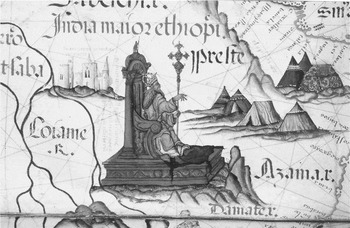
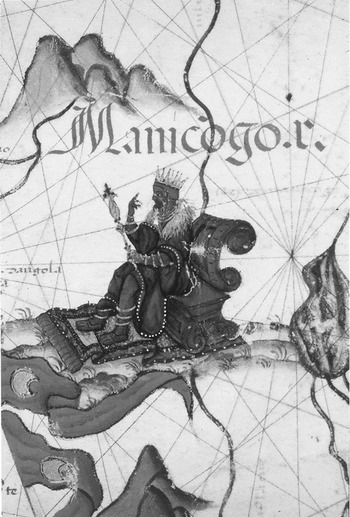
As far as Europe was concerned, the myths that had accrued around the legendary person of Prester John and his kingdom in the Indies impeded the absorption in Europe of ‘correct’ information about Ethiopia, as by the fourteenth century Prester John's kingdom had ‘moved’ from India to China to Ethiopia. Indeed, in many of the maps of Africa from the first half of the fifteenth century onwards, Prester John is represented as the principal ruler in Ethiopia. In the Portuguese cartographer Diogo Homem's Queen Mary Atlas of 1558 now in the British Library,Footnote 61 the ruler of Ethiopia is represented as white, wearing clothes and a crown, and seated on a very elaborate Renaissance throne (Figure 3). The representation of the Manicongo from the same atlas shows him as black, with a crown and headcap, wearing clothes, on a throne, on a carpet (Figure 4). These two African rulers who had contacts with Portugal and Italy are the only two rulers of sub-Saharan Africa represented in this way in this atlas – the two other black African rulers (one of Mali and one of Nubia) are represented semi-naked, either standing or seated on a cushion – and they articulate the link between Christianity and civilisation in visual terms. All four kings wear gold crowns and hold staffs of office, so their power (as opposed to their level of civilisation) is not at issue.
Diogo Homem, detail of Prester John, the ruler of Ethiopia, from the Queen Mary Atlas, 1558, British Library, Cotton MSS Additional MS 5415a, fo. 15v. Photograph: The British Library Board.
Diogo Homem, detail of the Manicongo, the ruler of the Congo, from the Queen Mary Atlas, 1558, British Library, Cotton MSS Additional MS 5415a, fo. 114r. Photograph: The British Library Board.
The myth of Prester John was sustained by a very high level of disinformation which was fed into the European knowledge base – apocryphal letters claiming to have been written by him, and false ambassadors claiming to have been sent by him – as well as by the priorities of humanists who set greater store on texts that contained information about Ethiopia by classical authors such as Ptolemy and Strabo than contemporary, eye-witness reports by merchants or travellers, or flesh and blood Ethiopians. Francesco Sforza, the bibliophile ruler of Milan in the mid-fifteenth century, was taken in by a false ambassador, and in classic Renaissance manuscript-hunting fashion wrote a letter to Prester John in 1459 asking if he had a copy of the text of Solomon's works which he longed to read and own.Footnote 62 The church in Ethiopia claimed a connection with biblical Israel through the queen of Sheba (an Ethiopian), and for a Renaissance Italian the prospect of locating lost manuscripts of Solomon's writings in Ethiopia would have been very beguiling.
The Prester John myth also had important implications for Ethiopian ambassadors in terms of terminology, for they were consistently described in documents and texts as indiani or Indians, even though they were known to come from Ethiopia. Ethiopians in Italy in the fifteenth and sixteenth centuries referred to themselves as Abisssini or Abyssinians and (of course) never as indiani. Perversely, following Greek usage, throughout the Italian peninsula during the Renaissance the Italian and Latin words for Ethiopia and Ethiopian were used as generic terms for sub-Saharan Africa and sub-Saharan African rather than as specific terms (and this Latin usage also occurred on occasion in Portugal, so the Congolese in Lisbon are sometimes described as Ethiopians).Footnote 63 However, this incorrect usage was exactly mirrored in Ethiopian texts by Ethiopians using the generic term ‘Franks’ for Europeans.Footnote 64 This kind of ‘blanket’ naming or labelling based on an adherence to misinformation or tradition survived even when the potential for correcting it was readily available. In Renaissance Rome there was a constant presence of resident Ethiopians supported by the popes, who lived in a hospice near the church of Santo Stefano degli Abissini (or dei Mori), just to the north-west of the basilica of St Peter's in the Vatican,Footnote 65 and provided a base for pilgrims from their homeland to stay while in Rome, and in Ethiopia a small colony of Italians was recorded as having been resident at the emperor's court in Barata for twenty-five years when Giovanni Battista Brocchi from Imola arrived in Ethiopia probably sometime in 1480.Footnote 66 This lazy division by Italians and Ethiopians alike of foreigners into generic Africans or generic Europeans suggests that difference in skin colour overrode any other considerations of difference in language or origins.
In the third part of the essay, four aspects of the ceremonial culture of embassies from sub-Saharan Africa to the papacy will be considered in order to see what kinds of cultural assumptions were made on both sides, and whether the European knowledge base about Africa increased because of their visits. Diplomatic ceremonies at the curia were controlled by the papal masters of ceremonies, one of whom was Paris de Grassis (in post 1504–28), who in addition to keeping a diary also penned a still unpublished treatise on ambassadors to the Roman curia.Footnote 67 Perusal of its folios makes sobering reading. By definition, good papal masters of ceremonies were nit-picking and slightly obsessive individuals with excellent memories for detail, but the irascible Paris de Grassis's expectations with regard to ceremonial rituals placed foreigners – especially non-Europeans – at such a disadvantage that it was miraculous that any of them were ever permitted to enter the presence of the pope. In this treatise Paris de Grassis included a section on ‘the orators sent by Prester John to the pope’, in which he described the 1481 embassy to Sixtus IV, which by chance he had observed while still a youth (much of his information came from Giovanni Battista Brocchi who had acted as interpreter).Footnote 68 The first cluster of ceremonial concerns started with the entrance and reception of ambassadors, and their procession through the streets to their appointed lodgings. Ritual ‘Europeanisation’ was required even before entrance, and cultural assumptions about dress were very rigid. Paris de Grassis attempted to regulate exactly how ambassadors should be dressed as they entered (even specifying the colour of the inner and outer garments, the material and the length); in order for them to be dressed correctly, ambassadors from outside Europe had to be presented with European clothes.Footnote 69 The trajectory of Bemoim's transformation in Lisbon from African prince to European ambassador and Christian knight (via the acquisition of European clothes, European servants, European accoutrements, European skills and outward European religious conformity) was typical. Most ambassadors from sub-Saharan Africa who arrived in Rome were forced through at least some of these apparently civilising hoops; nor should it be forgotten that foreigners who did not ‘Europeanise’ were treated as figures of fun. Even after they had arrived at the Vatican, substantial hurdles could still remain. Ambassadors and embassies were rated according to their country of origin and the title of the ruler who had sent them, so that imperial ambassadors required different treatment to royal ambassadors who in turn required different treatment to ambassadors from a republic. Across the Italian peninsula and in Western Europe the pecking order of rulers was already well established by the Renaissance, but the first, crucial task for an ambassador from a non-European country was to have his ruler's position or title translated into the appropriate Latin term (so, for example, the Ethiopian ambassadors to Sixtus IV in 1481 were awarded imperial status). An early sixteenth-century note in the Vatican archives addresses precisely this issue of whether the black so-called king of the Congo should be titled emperor, king or duke.Footnote 70
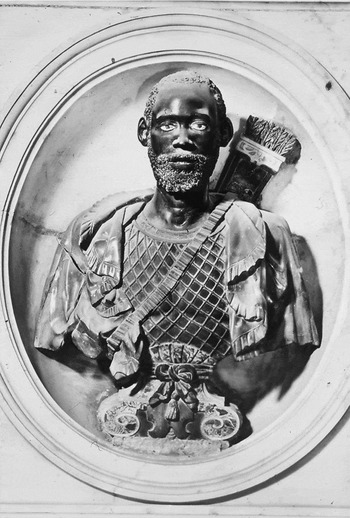
A formal audience with the pope was obviously the most crucial of all components of an embassy to the papacy, and was the moment when the stated aims of the embassy should have been most apparent. One ambassador achieved much closer contact with a pope than just a formal audience. The first indigenous Congolese ambassador ever to reach Rome was Ne-Vunda, called Antonio Emmanuele Funta in Italian sources, a close relative of the Congolese king.Footnote 71 He had set off with a train of twenty-five, including his nephew, in 1604, and arrived in 1608 with only four alive. He was very ill on arrival on 2 January, was visited by Paul V on his sick bed on the evening of 5 January, and he died later that night, on the eve of Epiphany.Footnote 72 The aptness of the date was not lost on the Roman people, who according to Giovanni Paolo Mucanzio, one of the papal masters of ceremonies, saw the parallel between Ne-Vunda's arrival from the extremities of Africa to venerate the pope and offer obedience, and the journey of the Magi.Footnote 73 Paul V deliberately played on these echoes when he ordered that a death mask be taken of Ne-Vunda to provide a basis for a sculpted bust, and that Ne-Vunda's body be buried opposite the manger scene (presepio) in the church of S. M. Maggiore. In fact, representation of one of the Magi as black became common in Europe only from 1450 onwards, and was never much in use in Rome (where the first black Magus only appeared in c. 1519),Footnote 74 but the idea was appealing. Ne-Vunda's bust was sculpted by Francesco Caporale (Figure 5), and is now positioned in the baptistery (the monuments have all moved from their original positions). He is dressed in a Roman toga, but he also carries a quiver of arrows on his back (records reveal that in fact he was dressed in ‘Spanish’ fashion), a strange conjunction of the classical and the primitive. At this moment, Ne-Vunda was being used to project a very particular representation of Africa. Even though he had been seen in Rome, and the sculpture incorporated the features of his death mask, the Africa he ‘represented’ was still an imaginary and incorrect classical and biblical Africa rather than a real and authentic contemporary Africa. Ne-Vunda's visit was also celebrated in a medal of him having an audience with Paul V (Figure 6), an audience that never took place in that form. Renaissance popes from the early fifteenth century onwards had chosen to portray themselves and important events in their reigns in medals, so it is interesting that Ne-Vunda's papal audience had been chosen as significant. Roman news-gatherers on Ne-Vunda's arrival also noted with amusement that he only had ‘seashells for money’Footnote 75 – the general purpose monies in the Congo were indeed certain shellsFootnote 76 – but that the pope would pay for everything he needed.
The third matter of crucial importance for the reception of an embassy was that appropriate gifts were brought, for gifts too signified very clearly a country's position in the diplomatic league table. A rare glimpse of gift exchange from an Ethiopian perspective is afforded by an Ethiopian text originally written in the sixteenth century entitled Homily on the Wood of the True Cross that describes the presents given by Venice to the Ethiopian ambassadors in 1402.Footnote 77 Several of these presents seem to reappear as gifts in other contexts at other times, so it is well worth tracing their story in outline. According to the Ethiopian text, during the reign of the emperor Dāwit I (1382–1413), two European merchants arrived at the Ethiopian court. The emperor asked what had happened to the True Cross found by Helena in the time of Constantine, and was told that ‘the European kings had divided it up amongst themselves in little pieces’; he subsequently sent ambassadors to Europe to acquire a piece of the Cross. When they arrived in Venice, the doge arranged for a piece to be sent via Alexandria to Ethiopia, along with other relics and presents. In 1509 the empress Eleni of Ethiopia sent an Armenian ambassador to the king of Portugal who carried as a gift ‘a cross made from the same wood on which Our Lord was crucified in Jerusalem, and of which a portion was sent to us’. In her accompanying letter she described how the wood had been separated in two pieces, one of which was sent and one of which was kept.Footnote 78 It seems likely that a smaller section of this second piece (in conjunction with a gold cross) was sent by the Ethiopian emperor Dāwit II with his ambassadors Francisco Álvarez and Şaga za Ab who left in 1527 for Rome via Portugal. And in January 1533 in Bologna this gold cross was finally presented by Álvarez to Pope Clement VII in a public consistory, and presumably the piece of the True Cross was with it.Footnote 79 So this relicFootnote 80 would have travelled from Venice to Ethiopia to Portugal and back to Rome in the space of 130 years in a highly ritualised sequence of circular gift-giving. What does this signify? It has been suggested that unwanted diplomatic gifts given to Florence or Venice were sold at auction after the relevant embassy left town, and even that visiting princes or ambassadors sold the gifts they had been given back to the city shortly after the ritual had taken place.Footnote 81 But here the opposite has taken place – a truly revered gift has later been given away in order to claim parity of status through gift-giving.
Francesco Caporale, bust of Ne-Vunda, the Congolese ambassador to the papacy, porphyry, 1629, Santa Maria Maggiore, Rome. Photograph: The University of London.
Medal depicting Ne-Vunda's reception by Paul V, 1608. Photograph: The University of London.

Three other gifts from the 1402 embassy are worthy of mention. The first was liturgical – a silver chalice with effigies of the twelve apostles, inscribed with the words of the mass – which was almost certainly later given to Francisco Álvarez by Dāwit II in November 1520 as a personal present.Footnote 82 The second represented the new technology of Europe – a mechanical clock that struck the hour ‘without benefit of human hand’, described in minute detail in the Ethiopian text;Footnote 83 clocks such as this had been made in Italy since the first half of the fourteenth century. The third is an oddity, for Venice sent to the emperor of Ethiopia, the ruler of a country with diverse climactic and geographical regions, but more noted for its droughts than its summertime tropical monsoons (which are also typical), gifts of clothes to wear ‘when it rained’.Footnote 84
The fourth part of ambassadorial visits to Rome was concerned with formal access to religious sights and artefacts. Veneration of relics was an integral part of a visit to Rome, and ambassadors and envoys from sub-Saharan Africa were given exceptional access, possibly in an attempt to induce awe. In October 1441 Eugenius IV wrote a letter from Florence to the canons and chapter of the basilica of St Peter in Rome, asking them to show the Veronica (the piece of cloth believed to be imprinted with Christ's face) to Andrea the abbot of Eygpt, and Pietro the deacon of Ethiopia, who had attended the Council of Florence. Although he was muddled about their positions (he called them both ambassadors of the emperor Constantine of Ethiopia known as Prester John) and about the aim of their missions (he claimed to think that they had both come to ask for union with the Western church), Eugenius's reasons for wanting them to be given this exceptional access were clear – he wanted them to be ‘edified’, and he wanted by granting this papal sign of great favour to further incline them in the direction of unity.Footnote 85 The Veronica was normally displayed only on certain set occasions such as the Sunday following Epiphany, Easter Sunday and Ascension Day. The 1441 visitors were also shown many other relics, such as the heads of the apostles Peter and Paul, and the head of St John in S. Giovanni in Laterano.Footnote 86 By chance, the Ethiopian ambassadors in Rome in 1450 were not only fortunate enough to visit during a Jubilee year but were treated to the spectacle of the canonisation on 24 May of the great Franciscan preacher, San Bernardino of Siena, by Nicholas V in St Peter's. Their presence was remarked upon by another preacher, Giacomo della Marca, who was sitting near to them.Footnote 87 So it appears that while African knowledge of Europe may have increased as a result of these embassies, European knowledge of Africa remained unsatisfactorily mired in traditional preconceptions and misunderstandings.
The question of who acted as interpreters or translators for these embassies is a crucial one, especially in the context of navigating cultural difference and furthering the circulation of knowledge and understanding of sub-Saharan Africa in Europe. Access to the necessary knowledge (whether of language or etiquette) was essential if everything were not to be ‘garbled’ in translation’. If a European who could translate into Latin or the relevant vernacular were available or indeed were to lead the mission, there was no problem. Occasional glimpses of how translation was managed spatially can occasionally be found. Paris de Grassis records that whenever Sixtus IV was in church during the stay of the Ethiopian ambassadors in 1481, the head of the embassy, Antonio, stood on the pope's right and Giovanni Battista Brocchi stood on the pope's left, translating for him – which means that translation took place across the person of the pope.Footnote 88 The presence in Rome of the small Ethiopian community and Ethiopian hospice at S. Stefano should have ensured availability of interpreters in Rome itself, but the reputation of the community was not always high, so trustworthy Ethiopians who could interpret into Italian and Latin were at a premium. But how did interpreting square with the fact that ‘eloquence . . . was the hallmark of the ambassador’?Footnote 89
European ambassadors may have been preferred on occasion to indigenous ambassadors in Ethiopia and the Congo not only because they could speak the requisite languages, but also because they understood the rules governing the writing of formal letters and knew how to write to popes and kings. Francisco Álvarez in his book on the Portuguese embassy to Ethiopia describes in extraordinary detail the genesis of the two letters sent by Dāwit II to Clement VII which were eventually (after over eight years in transit) read to the pope in a consistory in Bologna in 1533. In 1524 Dāwit said he wished to write to the pope of Rome, and asked for help, and Álvarez agreed. The content of the letter was relayed orally from the emperor to his chief chaplain to ‘the monk who is going to Portugal as ambassador’ (that is, Sagazabo) and finally to Álvarez. Álvarez wrote his letter, and the process was reversed as it was translated into Ge'ez and sent back to Dāwit, who was very pleased ‘and amazed because it had not been taken out of books’. Dāwit ordered his learned priests to study in their books and search for what more could be put into a letter, and a separate one was constructed by them.Footnote 90
Not only did these two letters reach their destination but the process whereby they were then translated back into Portuguese, then Latin and finally Italian is known, and they were preserved by being printed almost immediately – March 1533 – in a small pamphlet by Jacob Keymol from Flanders.Footnote 91 It was at this 1533 reception of the Ethiopian ambassadors from Portugal and Ethiopia by Clement VII that the Italian humanist Paolo GiovioFootnote 92 obtained, in addition to the material for the digression on Ethiopia that he included in his Histories of his Time (other material came from the head of the Ethiopian community of S. Stefano), a copy of a portrait of the Ethiopian emperor Dāwit II,Footnote 93 also known by his baptismal name as Atanadi Dengel,Footnote 94 or Lebna Dengel (‘incense of the Virgin’).Footnote 95 Giovio penned a textual description of the emperor in his work, adverting to the skin colour of his face (‘like that of a quince roasted over ashes’, in a typically Italian reference to food) and to his plainly ‘not curly hair in the manner of black Africans’,Footnote 96 and the two combined fixed the ‘authentic’ image of the physiognomy of the ruler of Ethiopia for Italians.
The two letters from Dāwit II to Clement VII are very revealing. Dāwit states that he is sending ambassadors to Rome to ‘kiss the foot of the pope’ ‘as the other Christian princes, to whom I am inferior neither in power nor in religion, are accustomed to do’.Footnote 97 This phrase protesting equality is repeated later in the letter, and one wonders whether this sense of inferiority was genuinely Dāwit's or whether it was a layer of concern inserted by Álvarez. Dāwit also referred to letters from Eugenius IV in his possession, and made clear his religious beliefs (almost his religious credentials) in order to convince the pope that he was a ‘true’ Christian. A fundamental part of Ethiopian and Congolese ‘representation’ of self concerned their Christianity, and Ethiopian and Congolese ambassadors and envoys were consistently charged with protesting this to suspicious kings and popes. The second letter, written by Dāwit's own team of scholars, adopted a very different tone. ‘Why’, he asked the pope reproachfully, ‘have you not sent any messenger to us so that you could ascertain with more certainty how we were living and how we were faring, as you are the shepherd and I am your sheep?’Footnote 98 At another point Dāwit bemoaned his exclusion from the circle of Christian kings, complaining that Portugal used to send legates and ambassadors, but no longer did so, nor did any other Christian king, and adverting once again to letters from Eugenius IV, and even to a ‘book’ of Eugenius which he owned. The final section of the letter is the most poignant: he told the pope that he was surrounded by Muslims, and asked why the Christian countries did not stick together, as the Muslims did, enjoying great fraternal peace, but instead indulged in injurious controversies and refused to help each other.Footnote 99 This outsider's view of the Reformation from a sub-Saharan African Christian ruler is startling for its global perspective on what is usually considered a European problem, just as Dāwit's criticisms of the pope's lack of proper consideration of him as a Christian prince force a reassessment of assumptions about the relationship between the two positions. Multiple translations (and transformations) cannot blunt the import of the message.
The Álvarez story is exceptional in its detail, but several letters in Portuguese (some displaying creole ‘grammatical irregularities’)Footnote 100 from D. Afonso, king of the Congo, to popes and Portuguese kings survive, written by Afonso's Congolese secretary, João Teixeira.Footnote 101 These too manage to communicate their important messages, even if they did not always abide by European grammatical rules. But both processes – multiple translation and composition by a non-native speaker – were unsatisfactory, because the nuances of meanings became blunted or because incorrect grammar allowed Europeans to adopt a position of superiority, as African letters also ‘represented’ Africa.
‘Representing’ a real, contemporary Africa in Renaissance Italy and Portugal was a complicated business. Not only were classical, biblical and medieval versions of Africa still alive and kicking, but also encounters between African ambassadors and Renaissance European rulers were shaped by global forces, national, royal and papal conventions and traditions, different belief systems, individual personalities and strongly held cultural assumptions. These could be as benign as misunderstandings about the existence of texts by Solomon, as disingenuous as the insistence that ambassadors in Europe must wear European clothes or as insidiously damaging as notions about relationships of superiority and inferiority. The very existence of ape and zebra skins and the thought of using shells as a form of money induced laughter in Renaissance Italians, yet time and again sub-Saharan Africans cut through the thickets of rhetoric surrounding European actions and showed themselves to be extremely astute commentators on the European scene (‘the European kings had divided up the True Cross amongst themselves in little pieces’; why did the Christian countries indulge in injurious controversies when they should have been presenting a united front against the Muslim threat?). The advent of Portuguese imperialism and a globalised Christianity to some extent increased European and African knowledge of each other's worlds and of the connections between them, in part through the exchange of embassies and ambassadors, but it also exposed the raw edges of transcontinental cultural assumptions and cultural differences, which these Renaissance encounters did little to heal. African ambassadors, like African gifts, African Christianity, African letter-writing, African dress and African currencies, were commandeered in Renaissance Europe to ‘represent’ not just their own rulers or their own countries but a whole continent of the European imagination.



