Introduction
Obstructive sleep apnoea (OSA) is a multi-level, chronic upper airway disease that has gained emphasis in terms of treatment, given its potential public health burden.Reference Lévy, Kohler and McNicholas1 Obstructive sleep apnoea has well documented cardiovascular mortality and all-cause mortality, especially in severe forms.Reference Fu, Xia, Yi, Xu, Guan and Yin2 Similarly bad outcomes for quality-of-life measures with increasing OSA severity have also been documented.Reference Baldwin, Griffith, Nieto, O'Connor, Walsleben and Redline3,Reference Yosunkaya, Kutlu and Cihan4
Although the need for treatment of moderate to severe OSA is established,Reference Kushida, Littner, Hirshkowitz, Morgenthaler, Alessi and Bailey5,Reference Gay, Weaver, Loube and Iber6 treatment of mild OSA is still debatable. In 2016, The American Thoracic Society proposed that treatment of mild OSA can aid in symptom improvement for sleepy patients and improve quality of life. However, impact of mild OSA treatment in the prevention of cardiovascular events, stroke, arrhythmia and other sequelae is still not established. Previous meta-analyses of continuous positive airway pressure (CPAP) treatment of mild to moderate OSA were inconclusive, reporting mainly modest or small improvements in subjective sleepiness and objective wakefulness.Reference Marshall7 Hence, in most institutions, treatment of mild OSA is debatable and mostly dependent on physician preferences or institution practice.
It is difficult to justify subjecting patients to daily CPAP treatment, surgical risks in treating OSA, sequelae from dental appliances and multiple hospital visits, especially when there is no conclusive treatment impact on patients’ morbidity and mortality. However, if it is proven that mild OSA progresses to moderate or severe OSA, this then raises the need for a different approach in managing mild OSA.
Our study aimed to provide a systematic review of the current literature and analyse the critical question: does mild OSA progress significantly if left untreated? Specifically, we aimed to examine the temporal patterns related to OSA changes over time, as well as any predictors of progression.
Materials and methods
This meta-analysis was conducted using the Preferred Reporting Items for Systematic Reviews and Meta-Analyses (‘PRISMA’) guidelines. English-language studies published in the peer-reviewed literature between 1970 and December 2019 were identified by searching PubMed, Embase or Cochrane Central Register of Controlled Trials. This review was not registered as a protocol.
Inclusion criteria
The study types included were randomised, controlled trials (RCTs), cohort studies and longitudinal studies with multiple time series designs. We included only studies with OSA that was formally diagnosed by polysomnography. Studies that assessed progression of untreated OSA, and RCTs comparing progression of OSA in CPAP-treated and untreated patient arms were included in our analysis. Other treatment modalities were heterogeneous and were not considered for inclusion.
Search strategy
The search terms used for the PubMed database search were centred around sleep apnoea, progression, positive airway pressure treatment and outcome measures. The exact search command is included in Table 1 in the supplementary material, available on The Journal of Laryngology & Otology website.
Next, using the following search items via the ‘Problem, Intervention, Comparison, Outcome’ key term format, a database search was performed. The Cochrane Central Register of Controlled Trials or Embase Problem, Intervention, Comparison, Outcome format search can be found in Figure 1 in the supplementary material, available on The Journal of Laryngology & Otology website.
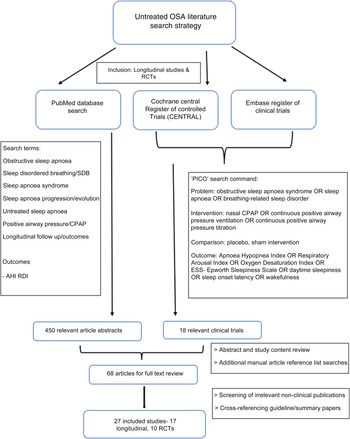
We also manually searched the reference lists of individual journals and consensus papers to detect additional eligible studies. Abstracts of suitable titles were obtained, after which the respective articles were reviewed for suitability for full-text retrieval. Appropriate reports discovered by citation tracking were also considered. Figure 1 illustrates the literature database search and subsequent article selection process.
RCT = randomised, controlled trial; SDB = sleep-disordered breathing; CPAP = continuous positive airway pressure; AHI = Apnea Hypopnea Index; RDI = Respiratory Disturbance Index; PICO = Problem, Intervention, Comparison, Outcome

Outcome measures and data extraction
All included studies were retrieved, and data relevant to the analysis were compiled independently by two reviewers. These data comprised study details such as study design, sample size, demographic details of the patients, duration of follow up, and outcome measures pre- and post-treatment with their respective 95 per cent confidence interval (CI), standard deviation and odds ratio as appropriate.
Study end points included pre-study and post-study or intervention polysomnographic respiratory indices (Apnea Hypopnea Index, Respiratory Disturbance Index). The primary focus of our study was to evaluate progression of patients with untreated mild OSA and predictors of progression. Secondary objectives included evaluating similar progression in patients with moderate to severe OSA for comparative analysis.
Assessment of evidence quality
Quality of research studies included in our systematic review was evaluated with reference to established grading criteria such as the Newcastle Ottawa Scale. All included studies individually scored highly in the domains of cohort selection and outcome. Although comparability of cohorts across studies was not achievable because of the heterogeneity of the recruited study population, we ensured that each study was consistent in controlling for OSA severity cut-offs. This was with reference to established international guidelines on grading of severity levels of polysomnographic indices for OSA.
Statistical analysis and approach
All statistical analysis was performed using Stata® statistical software (version 16.1, 2020). Longitudinal studies were analysed separately to determine the temporal progression of OSA, in addition to examining the effect of possible predictors of OSA change. Further meta-analysis of the data obtained from control or placebo arms of randomised trials was performed separately to evaluate the pattern and range of changes in untreated OSA in controlled settings.
Results
Study characteristics
The initial PubMed search command yielded 450 relevant article abstracts. The Problem, Intervention, Comparison, Outcome database search format yielded a further 18 relevant Cochrane registered trials that were examined for content relevance and validity of treatment arms. After careful screening and appraisal of the studies returned, 68 articles were shortlisted for full text review. Following careful screening of irrelevant publications and non-clinical studies, coupled with appraisal and cross-referencing with existing literature and guideline papers, 41 articles were excluded. Hence, a total of 27 articles were selected for inclusion in our systematic review. This comprised 17 longitudinal studies and 10 RCTs.
Randomised, controlled trials
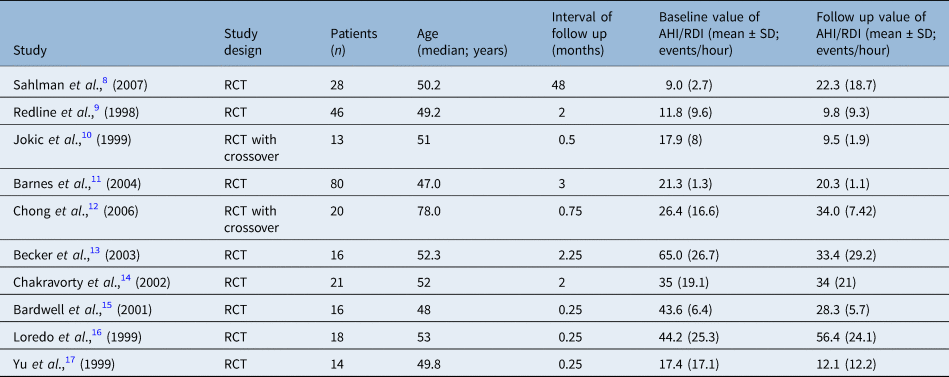
A total of 10 RCTs met the inclusion criteria (Table 1). These were RCTs that assessed OSA interventions against placebo. We included only the control or placebo arm of these RCTs in our analysis, as this group of patients received repeat polysomnography despite being untreated. These provided a measure of untreated OSA progression. However, because of the study design, most RCTs returned from our search were conducted over a period of three months or less. These were excluded from our final analysis as our main aim was to study natural progression of OSA as a chronic disease, and short periods of study less than three months are not sufficient to demonstrate clinical progression. Hence, the only RCT included is from Sahlman et al.Reference Sahlman, Pukkila, Seppä and Tuomilehto8 (baseline mild OSA cohort) with a follow-up period of 48 months.
Summary of randomised, controlled studies evaluated for inclusion

AHI = Apnea Hypopnea Index; RDI = Respiratory Disturbance Index; SD = standard deviation; RCT = randomised, controlled trial
Longitudinal studies
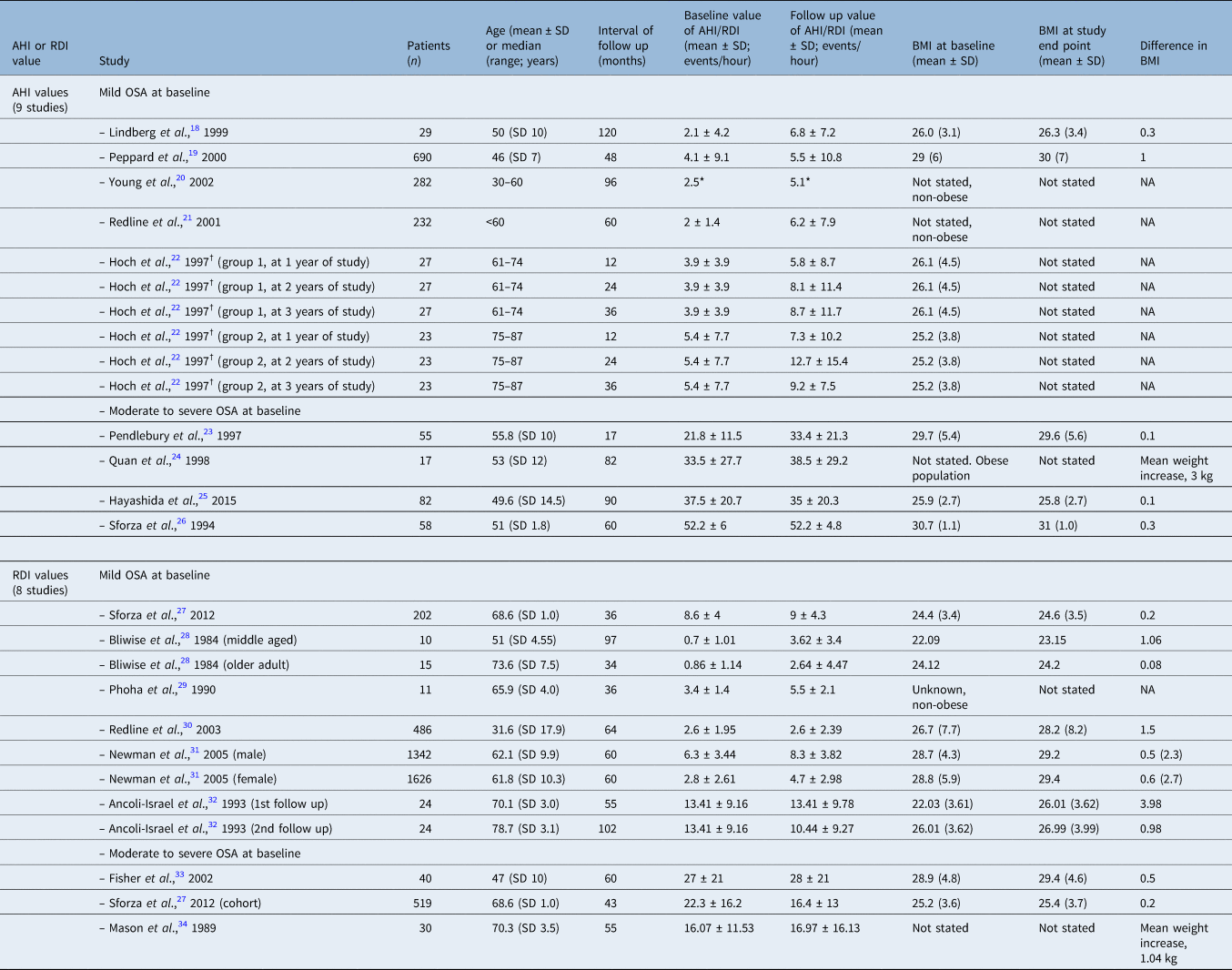
A total of 17 longitudinal studies (publication range, 1989–2015) were included in pooled longitudinal analysis of untreated OSA. These included patients of various ethnicities (Asian, Caucasian) and a wide age range (40–85 years). Ten studies that reported mild OSA cohorts at baseline and 7 studies that reported moderate to severe OSA cohorts at baseline were included. A total of 5777 patients (4976 mild OSA, 801 moderate or severe OSA at diagnosis) across 17 longitudinal studies were included. The characteristics of the included longitudinal studies are summarised in Table 2.
Summary of included longitudinal studies

*No SD provided for values; †patient groups of differing age ranges reported separately in the study by Hoch et al. An age range/median age is provided for all studies. AHI = Apnea Hypopnea Index; RDI = Respiratory Disturbance Index; SD = standard deviation; BMI = body mass index; OSA = obstructive sleep apnoea; NA = not available
Objective outcomes
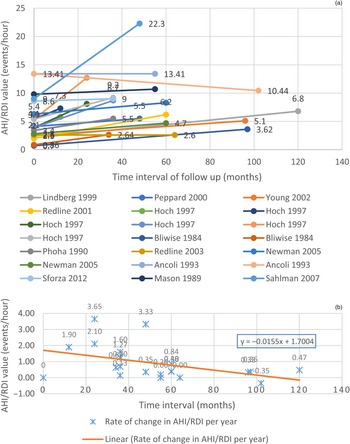
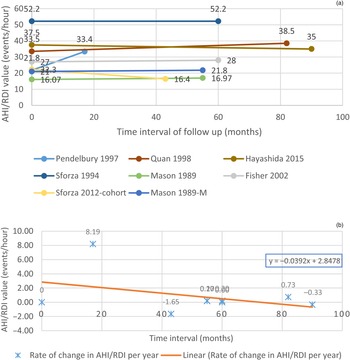
Given the heterogeneity of the studies, these pooled polysomnographic values were plotted against a time axis to illustrate the temporal relationship of OSA severity and progression. The plots (Figures 2–5) combine all polysomnographic respiratory indices (Apnea Hypopnea Index, Respiratory Disturbance Index).
(a) Progression of obstructive sleep apnoea on polysomnography showing pre- and post-study Apnea Hypopnea Index (AHI) or Respiratory Disturbance Index (RDI) values in mild obstructive sleep apnoea, and (b) AHI or RDI rate of change in mild obstructive sleep apnoea.

(a) Progression of obstructive sleep apnoea on polysomnography showing pre- and post-study Apnea Hypopnea Index (AHI) or Respiratory Disturbance Index (RDI) values in moderate to severe obstructive sleep apnoea, and (b) AHI or RDI rate of change in moderate to severe obstructive sleep apnoea.

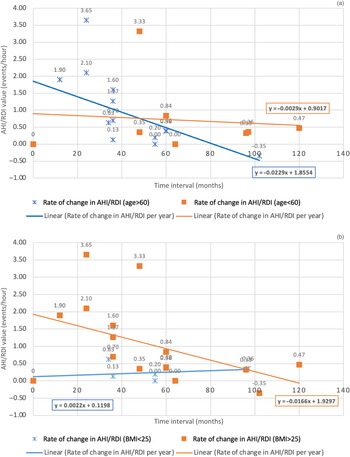
Overall rate of obstructive sleep apnoea Apnea Hypopnea Index (AHI) or Respiratory Disturbance Index (RDI) change for mild obstructive sleep apnoea grouped by (a) age and (b) body mass index (BMI).

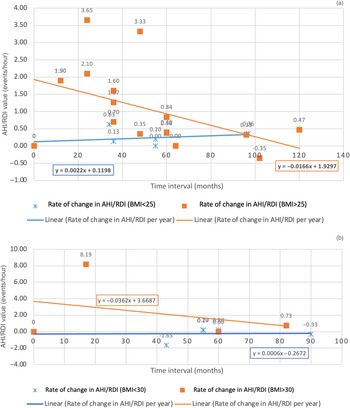
Overall rate of obstructive sleep apnoea Apnea Hypopnea Index (AHI) or Respiratory Disturbance Index (RDI) change for moderate to severe obstructive sleep apnoea grouped by (a) age and (b) body mass index (BMI).

Trends of change
Mild, moderate and severe OSA was defined as baseline values of Apnea Hypopnea Index equal to or more than 5 to less than 15, equal to or more than 15 to less than 30, and equal to or more than 30, respectively. For the mild OSA subgroup, the mean Apnea Hypopnea Index pre-study was 5.21 and post-study was 8.03. The mean rate of Apnea Hypopnea Index increase was 0.0531/month over a median follow-up interval of 53.1 months (range, 12–120 months). Although untreated mild OSA does show gradual increase in Apnea Hypopnea Index or Respiratory Disturbance Index over the years, this rate of increase of Apnea Hypopnea Index or Respiratory Disturbance Index slowly plateaus. The trend for untreated mild OSA shows an overall decrease in rate of change over time (down-sloping regression line, gradient = −0.0155).
For the moderate to severe OSA subgroup, the mean Apnea Hypopnea Index pre-study was 28.9 and post-study was 30.3. The mean rate of Apnea Hypopnea Index increase was 0.0235/month over a median follow-up interval of 57.8 months (range, 17–90 months).
Similar to mild OSA, patients with untreated moderate to severe OSA do show a slow increase of Respiratory Disturbance Index and Apnea Hypopnea Index over the years, and this rate of increase plateaus later on. However, the tapering of increase in this group occurs over a faster period. The greater magnitude of negative regression gradient (0.0392) as compared with the mild OSA group (0.0155) illustrates this. The trend for untreated moderate to severe OSA shows an overall decrease in rate of change over time (Figure 3).
We summarised the estimated rates of OSA progression across various OSA severity groups at various time points. Table 3 summarises these values.
Summary of OSA progression rates for patients with baseline mild and moderate to severe OSA

OSA = obstructive sleep apnoea
Predictors of rate change over time
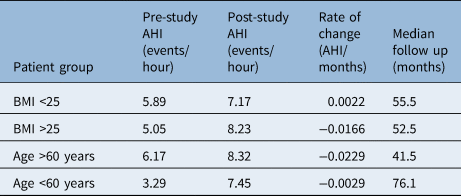
Within each OSA severity subgroup, patients were further stratified based on their baseline body mass index (BMI) and age subgroups. In the mild OSA group, the older adult patient subgroup comprised patients aged more than 60 years, while a BMI more than 25 defined the overweight patient subgroup (Figure 4). For mild OSA patients, patients aged more than 60 years and with BMI more than 25 are less likely to progress in disease, as shown by the negative gradient in rate of progression over time (negative gradient of −0.0229 and −0.0166, respectively). Conversely, patients who had lower BMI of less than 25 showed higher likelihood of OSA progression as demonstrated by the positive gradient (Figure 4) in rate of OSA progression over time (gradient, 0.0022). Positive gradient denotes that as the years progress, there is continual increase in rate of Apnea Hypopnea Index progression per year. These are summarised in Table 4.
Summary of changes in AHI and rate of change, stratified by age and BMI groups (mild OSA cohort)

AHI = Apnea Hypopnea Index; BMI = body mass index
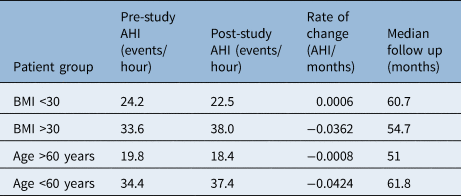
The same graphical approach was applied to the moderate to severe OSA severity subgroup. Figure 5 illustrates the age and BMI subgroup analysis. As the majority of patients with a baseline moderate to severe OSA severity were not of normal weight, a BMI more than 30 was used to define the obese subgroup for analysis. For moderate to severe OSA patients, younger and obese subgroups are less likely to progress in disease severity, as shown in the decrease in rate of OSA progression over time (negative gradient of −0.0424 and −0.0362 in Figure 5). Non-obese patients with BMI less than 30 showed a mild increase in overall rate of OSA progression (gradient, 0.0006) (Table 5).
Summary of changes in AHI and rate of change, stratified by age and BMI groups (moderate to severe OSA cohort)

AHI = Apnea Hypopnea Index; BMI = body mass index
Comparison of rate of obstructive sleep apnoea progression
Within each OSA severity subgroup, an unpaired t-test was performed to determine if there was a significant change between pre-study and post-study Apnea Hypopnea Index or Respiratory Disturbance Index score.
For mild OSA, the mean pre-study score was 5.21 and mean post-study score was 8.03. The mean difference was 2.36 (t (36) = 2.19, p = 0.0348), indicating a statistically significant progression in untreated mild OSA.
For moderate to severe OSA, mean pre-study score was 28.9 and mean post-study score was 30.3. The mean difference was 1.44, (t (12) = 0.218, p = 0.831). Hence, there was no significant progression in untreated moderate to severe OSA.
We were unable to compare if there were differences between the rate of change of mild OSA versus moderate to severe OSA because all studies included in our review only presented summarised data, which was not usable for analysis between groups.
Discussion
At present, a few older longitudinal studies have individually tracked the progression and effects of untreated OSA over time without conclusive evidence of natural temporal progression.Reference Sahlman, Pukkila, Seppä and Tuomilehto8,Reference Redline, Adams, Strauss, Roebuck, Winters and Rosenberg9 This has shown mixed results depending on the age of the population studied. Some studies showed no progression of mild OSA, some showed limited, non-clinically significant progression of mild OSA and some showed reduced Apnea Hypopnea Index in the population. However, such studies have limited application by way of reference because of heterogeneous patient populations and outcome measures. Patients of varying ages, demographic backgrounds, baseline co-morbidities and even OSA severity constitute the patient profile of each epidemiological study. Large population studies (e.g. Wisconsin Sleep Cohort, Cleveland Family Study) may also be limited because of selection bias intrinsic to inclusion of only middle-aged study populations, along with potential regression to the mean resulting from the selection of participants with evidence of substantial OSA at baseline.Reference Young, Peppard and Gottlieb20 Our study mitigates this effect by pooling the data from multiple large population studies and thereafter performing analysis after stratifying the patients by clinically relevant criteria, such as baseline OSA severity, age and BMI. Table 2 further illustrates that there was no significant weight gain or increase in BMI in these cohorts of patients. Mean increase in BMI in the mild OSA group over a median follow up of 53.1 months was 1.02, while the corresponding BMI increase in the moderate to severe OSA group was 0.24 over a median follow up of 57.8 months. The changes in Apnea Hypopnea Index or Respiratory Disturbance Index would thus more likely reflect natural OSA progression rather than being because of significant weight gain.
Pooled data from mild OSA studies in our analysis showed that mean Apnea Hypopnea Index increased from 5.21 to 8.03 events/hour at a median follow-up interval of 53.1 months (4.5 years). This represents an almost 50 per cent increase from baseline Apnea Hypopnea Index value. Although our study found this increase of Apnea Hypopnea Index value to be statistically significant, it is important to note that within the limits of our analysis, in spite of the Apnea Hypopnea Index value increase, mild OSA does not progress in categorical severity to become moderate OSA. This differs from what is reported in the literature; Sahlman et al.Reference Sahlman, Pukkila, Seppä and Tuomilehto8 reported that almost 50 per cent of untreated mild OSA patients developed moderate or severe OSA (mean Apnea Hypopnea Index value increase, 13.3) after 4 years. Part of the findings by Sahlman et al. can be explained by the associated BMI increase by 0.9 points (31.5 to 32.4) in their patient group, suggesting a strong link between worsening OSA and weight gain. In addition, Lindberg et al.Reference Lindberg, Elmasry, Gislason, Janson, Bengtsson and Hetta18 reported that 72 per cent of untreated mild OSA patients progressed by at least a 50 per cent increase in Apnea Hypopnea Index after 10 years.
As our median follow-up interval is only 53.1 months, it is not possible to fully substantiate whether mild OSA can develop into moderate or severe OSA. Further long-term studies can be useful to evaluate this point, because if mild OSA is proven to progress ultimately to moderate or severe OSA, it justifies the treatment of mild OSA in order to avoid progression and avoid the complications associated with moderate to severe OSA.Reference Fu, Xia, Yi, Xu, Guan and Yin2 Hence, at present, from a disease progression standpoint, changes in respiratory indices may be insufficient to guide clinical practice on treatment initiation and intensity.
Similarly, our findings showed that patients with moderate to severe OSA progress at a slower rate compared with those with mild OSA. In the study by Berger et al.,Reference Berger, Berger and Oksenberg35 of 160 untreated snorers and obstructive sleep apnoea adult male patients, it was found that primary snorers and patients with mild to moderate obstructive sleep apnoea had a significant increase in Apnea Hypopnea Index over a mean period of 5 years. Pendlebury et al.Reference Pendlebury, Pépin, Veale and Levy23 similarly reported up to a 50 per cent increase in Apnea Hypopnea Index over an even shorter period of just 17 months (Apnea Hypopnea Index, 21.8 to 33.4). It suggests that in this group (baseline moderate OSA), the rate of progression may slow or even plateau over time. However, patients with severe obstructive sleep apnoea had an insignificant change in Apnea Hypopnea Index. We postulate that this may be secondary to a ‘ceiling effect’, where the severity of OSA ceases to affect disease progression when OSA severity reaches a certain level. The ceiling effect is described in fields such as cardiology (effect of exercise on reducing hypertension risk attenuates after reaching a certain level of intensity or frequency)Reference Montero, Breenfeldt-Andersen, Oberholzer and Haider37 and neurology (effect of stroke severity on motor recovery outcomes).Reference Lee, Kim, Sohn, Shin, Oh and Lee38 In the context of OSA, the ceiling effect has been reported in the effect of extreme obesity on cardiovascular risk,Reference Marotta, Borel, Galerneau, Tamisier, Bonsignore and Pepin39 and quality of life outcomes in low OSA risk patients.Reference Yang, Hla, McHorney, Tavighurst, Badr and Weber40
Our findings showed that patients with lower BMI at diagnosis tend to be at higher risk of more rapid OSA progression. Although this is not in keeping with the overall phenotype of OSA patients, it may suggest that this group of patients requires closer follow up after diagnosis. This could possibly be because of the different pathogenesis towards OSA for non-obese patients as proposed by Gray et al.Reference Gray, McKenzie and Eckert41 In their study of OSA in non-obese patients, Gray et al. found that this group of patients had a lower respiratory arousal threshold compared with obese OSA patients, suggesting that beyond anatomical and weight pre-disposition, this group of non-obese patients have other non-anatomical contributors towards upper airway obstruction. Given that mild OSA patients with BMI less than 25 or aged less than 60 years have higher likelihood of progression, closer clinical surveillance and earlier treatment may be indicated.
A few studies examining OSA progression reported regression in OSA severity with time. These include studies by Ancoli-Israel et al.,Reference Ancoli-Israel, Kripke, Klauber, Parker, Stepnowsky and Kullen32 Sforza et al. Reference Sforza, Addati, Cirignotta and Lugaresi26 and Hayashida et al. Reference Hayashida, Kobayashi, Namba, Ueki, Nakayama and Ito25 On further analysis of the Ancoli-Israel et al.,Reference Ancoli-Israel, Kripke, Klauber, Parker, Stepnowsky and Kullen32 study in 1993, when controlled for BMI, there was no significant change in Respiratory Disturbance Index or sleep indices over 8.5 years of follow up. This suggested that the reported OSA regression may have been potentially caused by reduction in BMI over the study time period. The effect of BMI on OSA progression was also noted in the study by Sforza et al., which attributed the lack of OSA progression in their population to a predominantly non-obese study population (90 per cent), which would not be reflective of the general population. Age-related weight gain is a known phenomenon that has been attributed to changes in adipokine (such as leptin) modulation with increasing age.Reference Sasaki36 Hayashida et al. showed a slight decrease in post-study Apnea Hypopnea Index (37.5 to 35); however, this was not significant and largely attributed to a stable body weight. Only patients with up to 3 kg of body weight change were included in the study, which is unlikely to be representative of a natural patient population with untreated severe OSA at baseline. Hence, it suggests that the regression of OSA in these studies was confounded by lack of weight change. Thus, our study findings of an overall tapering in OSA increase rather than outright regression would be closer to the true pattern of untreated OSA changes over time.
We recognise that this systematic review is limited by the design and conduct of the available studies in the current literature. Unfortunately, not many longitudinal studies stratify patients according to baseline OSA severity, nor do they report exact values of change in polysomnographic indices. Furthermore, most randomised studies are designed to be completed over a short time interval. For these reasons, the findings presented in our review may not be fully reflective of the temporal effect on OSA progression across each severity level as yet. Nonetheless, it does provide some insight into the trends of OSA progression and help with the identification of at-risk patient groups.
At present, it is still difficult to decide to treat mild OSA from the disease progression standpoint, as even though mild OSA does progress, it does not progress to moderate or severe OSA. Treatment of mild OSA at present should still be guided by symptom relief and quality of life improvement. Another aspect that can guide treatment decision is to evaluate whether untreated mild OSA is associated with any cardiovascular or metabolic co-morbidities. However, at present, this aspect still requires further research evidence to evaluate.
Conclusion
Patients diagnosed with OSA show disease progression if left untreated, although the rate of disease progression tapers over time. Patients diagnosed with mild OSA are likely to taper at a slower rate, when compared against patients with moderate to severe OSA at baseline. At present, although mild OSA does progress, it has not been found to progress across category into moderate OSA. It is therefore difficult to justify the treatment of mild OSA from the standpoint of disease progression. Advanced age (more than 60 years) appears to be a protective factor against disease progression for mild OSA patients. This represents a group of patients in whom closer clinical surveillance and intensive treatment may be indicated.
Supplementary material
The supplementary material for this article can be found at https://doi.org/10.1017/S0022215122002419.
Acknowledgements
We would like to acknowledge the contributions of Ms Hao Ying, senior statistician at Health Science Research Unit, Singapore General Hospital, for initial statistical consultation and input on concept and design of conduct for this systematic review.
Competing interests
None declared