

The Liverpool City-region Health is Wealth Commission
…within a stone’s throw of prosperous, money-making Liverpool – of clubs, cafés, banks, commercial places; the Reform Club, the Conservative Club, places of wealth and ambition … one could imagine no darker face of squalor, no deeper fringe of suffering, of helpless, hopeless poverty, so near to hope, comfort and activity… (Liverpool Daily Post report on Scotland Road, 1855)
Introduction
The Liverpool City-region Health is Wealth Commission is a cross-sector initiative, championed by the University of Liverpool and a range of key partners. It was established in March 2007 to investigate health-related and economic issues across the city-region, to examine ways in which local productivity might be driven forward through improved health, and specifically to address the outwardly contradictory relationship between Liverpool’s continued economic growth and its disproportionately poor public health status.
Its work builds on a long history of investigation into the co-relation between ‘health’ and ‘wealth’. Indeed, the effect of economic status on the health of the ‘labouring population’ formed the basis of Liverpool-born Dr William Duncan’s arguments in his 1847 Report on Sanitation, which went on to influence Sir Edwin Chadwick’s celebrated report and, in-turn, Government’s first foray into ‘public health’.
The Commission’s investigations took place, however, at a time when the relationship between the two concepts has become increasingly complex.
Historically, there has perhaps been a working assumption that the most effective way to improve health and ‘quality of life’ is through increased wealth and raised material living standards. In fact, although economic growth remains critically important for the very poorest countries in the world, evidence suggests that amongst the richer countries, there is no comparative tendency for health or social issues to be necessarily improved with increased affluence.Reference Wilkinson1 In its report published just last month, the World Health Organisation (WHO)’s Commission on Social Determinants of Health states:
…Increasingly the nature of the health problems rich and poor countries have to solve are converging. The development of a society, rich or poor, can be judged by the quality of its population’s health, how fairly health is distributed across the social spectrum, and the degree of protection provided from disadvantage as a result of ill-health.2
It is simply no longer enough to assume that economic growth and increased affluence will improve health, happiness or well-being.
Instead, there is a growing focus on – and acknowledgement of – the effects of inequality on health; of how relative deprivation and poverty within societies and of how differences in income within social structures – be they countries, cities or more local communities – relate directly to a number of social measures, including health, crime and educational achievement. The WHO report recognises that:
… Within countries there are dramatic differences in health that are closely linked with degrees of social disadvantage. These inequities in health, avoidable health inequalities, arise because of the circumstances in which people grow, live, work, and age, and the systems put in place to deal with illness. The conditions in which people live and die are, in turn, shaped by political, social, and economic forces…3
Social inequalities and the individual’s perception of social status have been shown to have a profound effect on health and wellbeing; where greater inequality exists, so the individual’s perception of status within that hierarchy is affected. Increased income inequality has led to less social mobility and, in many areas, ‘residential segregation’,Reference Wilkinson4 with less social and geographical mixing and low or no sense of community. The Commission recognises that much of this inequality cannot be addressed at a city-region level and must be tackled by central government. Its brief, however, was to focus specifically on actions and interventions that can be delivered at a local level, and it has therefore endeavoured to address these issues as far as possible within that brief.
The Commission’s work also takes place at a time when there is an increasingly global economic focus, and when global issues around the environment, climate change and sustainability are taking social and political precedence. The conservation of depleting resources sits squarely against the very ‘over-consumption’ that is acknowledged as contributing so much to the ‘higher end’ of the inequality gap. The changes that governments will need to make in response to these issues will undoubtedly have a profound impact worldwide, but the impact is likely to be significantly differential, and it is likely that those with the lowest incomes, least social capital or least material wealth will be worst hit. Already, the UK has experienced the effects of peak oil prices, and with recent data released by the consumer watchdog Eenergywatch showing one in six UK households living in ‘fuel poverty’, spending over a tenth of total income on heating and utility bills.5 As might be expected, vulnerable groups have been the most exposed, with figures from Age Concern estimating the current average annual fuel bill for 65 to 74-year-olds as £1000, a rise of 15% for a single pensioner.6 Liverpool has the highest rate in the country of people over 65 living without heating (29%) and the Commission welcomes Liverpool PCT’s commitment to tackling the City’s problems with fuel-poverty in its recently published three-year strategy, working in partnership with Liverpool City Council’s Housing team.
Throughout its investigations, the Commission has been keenly aware of the importance of education, both in terms of its relationship with inequality and deprivation, but also in terms of its critical role in personal and social development, of raising aspiration, encouraging social mobility and creating life opportunities. Approximately 1 in 3 children in the UK are currently living below the poverty line (where the household income is lower than 60% or less of the UK average, with adjustments for family size) and recent research from the Child Poverty Action Group shows that, by 3 years old, poorer children may be up to a year behind children from wealthier homes in terms of cognitive development and ‘school readiness’. This early inequality continues, as shown by statistics released last month by the Department for Children, Schools and Families, revealing that 45% of children eligible for free school meals failed to get a GCSE at grade C or better in 2006/07, compared with just 24% of pupils generally.7
The Commission recognises that ‘education’ must go beyond literacy, skills and qualifications, and that through strengthening the city-region’s commitment to quality and equality in education, there is a real opportunity to influence the experience of every individual in terms of foundational upbringing, self-perception, cultural awareness and social understanding. It hopes that implementation of its recommendations as set out in this report can contribute to creating an environment in which this can happen, but within its limited timeframe it has focused primarily on skills and training development, encouraging social enterprise and improving links between the city-region’s academic institutions and the local community.
Despite its significant economic growth over recent years, substantial European investment, Liverpool’s status as 2008’s European Capital of Culture and major physical developments, such as Grosvenor’s ‘Liverpool One’ project, it is clear that not all of the city-region’s population are benefiting from its economic progress. A third of its population continues to live in the top 10 most deprived districts in the country,8 according to their placing in the 2007 Index of Multiple Deprivation, which also ranks Liverpool as the most deprived city in England. In its ‘Cities Outlook 2008’ report, the Centre for Cities describes Liverpool as a ‘city of contrasts’, highlighting its disproportionately high rate of benefit claimancy against its position as best annual earnings growth rate (up 5.6% since 2002), and ranking Liverpool as the third most ‘unequal’ City in the country.9
It is this contradiction in economic performance and health status on which the Health is Wealth project is predicated. During its investigations, it was necessary for the Commission to keep firmly in mind how major projects in Liverpool City Centre might certainly make a significant contribution to the City-region’s economic wealth, employment and its growing retail and tourism industries, but always to consider the conflicting impact projects such as these might have on sub-urban centres across the City-region, and subsequently their potential to widen the inequality gap.
The Commission understands that this potential contradiction between commercial interests and social equality is not simply going to go away, but believes that with the right interventions, it can be better managed and controlled. In making its recommendations, it hopes to stimulate a renewed interest in the ‘neighbourhood’ approach and in building strong and productive social communities, to promote growth and development with appropriate consideration of the sustainability agenda, and to stress the importance of education, aspiration and opportunity.
The Commission was set four core questions.
• What can be done to achieve greater commitment to improving health among local people and businesses?
• How can the region reduce health inequalities and better use the talents that remain underused as a result?
• How can the region better exploit its assets as an internationally-renowned centre for health science for the benefit of local people?
• What can be done to maximise the regional economic benefit of the health services sector?
In its search for answers, the Commission has considered a wide range of expert testimony, written evidence and statistical analysis. It has been inspired by the huge amount of good work already going on across the city-region, but has also needed to face-up to some harsh truths: generations of families dependent on benefits; spiralling problems with obesity and alcohol misuse, and above all the creation of a super underclass; an invisible army of people socially disconnected and cut off from the opportunities being created on their own doorsteps.
Key themes and recommendations
Recognising that it would be impossible to tackle all of these issues in its short lifetime, after a year of investigation, the Commission identified six key themes on which to focus: Alcohol, Smoking & Obesity; Incapacity Benefit; Wellbeing at Work; Beyond the Built Environment; Procurement; and Knowledge Capital.
Alcohol, Smoking & Obesity
Certainly, the prevalence of preventable illness and mortality in the city-region and – by virtue of its preventability – the significance of contributory lifestyle factors such as alcohol, smoking, diet and physical exercise, has been a cross-cutting theme throughout the Commission’s investigations.
Alcohol-misuse and its associated health and social impacts have been particular areas of concern for the Commission throughout its tenure; our launch in fact coincided with the publication of a national profiling exercise, which placed Liverpool as second in England for hazardous alcohol consumption levels.
Plenary, statistical and research-based evidence supported the Commission’s concern. Data presented by our colleagues at the Northwest Public Health Observatory showed that over 900 people are dying each year in the city-region due to alcohol-related conditions. On average, 16 months of life is lost for men due to alcohol misuse and almost a year for women, 85% above the England average.
Despite recent successes with Liverpool’s ‘Smoke Free’ and Knowsley’s ‘Fags Ends’ programmes, smoking prevalence in the city-region remains well above the national average, and evidence presented to the Commission also highlighted increasing levels of obesity within the city-region as a key issue, with an estimated economic cost to Liverpool alone in terms of extra health services and lost work days put at £23 million.
The Commission strongly believes that all three issues – alcohol, smoking and obesity – must be targeted as priorities if future health prospects for the city-region are to improve. As such, the Commission has recommended that a coordinated ‘Health Improvement Plan’ for the city-region be developed, through which resources can be specifically focused on delivering and evaluating a unified and targeted strategy against the health impacts of alcohol, smoking, poor diet and lack of physical activity across the city-region.
We have also recommended the introduction of area-based non-statutory Licensing Advisory Forums, designed to assess local health and social impacts of licence applications, and support the development of a ‘healthy food’ award and accreditation scheme, through which businesses that produce and prepare foods ‘healthily’, or who provide healthy food options for their employees, are rewarded and promoted.
Incapacity Benefit
The city-region’s worklessness profile, and in particular its claimant rate for Incapacity Benefit (IB) emerged as an early concern for the Commission, and has continued to figure as a cross-cutting theme throughout its investigations to date. Whilst issues with IB are by no means confined to the Liverpool City-region, it is the acuteness of the problem here that concerns the Commission, with four of the six local authorities ranking in the top 20 for the highest levels of IB/SDA claimants. February 2007 figures show 107,660 of the city-region’s working age population claiming IB/Severe Disablement Allowance, representing a staggering 11% of the city-region’s working age population, accounting for over a quarter of claimants in the Northwest and 5% of the England total.10
The Commission is very much aware that there are huge social, cultural and individual psychological barriers that must be overcome in tackling worklessness in the city-region, and particularly in addressing dependency on Incapacity Benefit. Whilst this is a challenging prospect, the Commission believes that the scale of the issue requires a determined and long-term commitment from partners to undertake a robust and thorough – but sensitive – examination of the wide-ranging issues surrounding IB, and the contributory factors to benefit dependency.
The Commission is also very much aware that other city-regions are facing similar associated issues to a greater or lesser degree. In his session with the Commission, Sir Howard Bernstein highlighted similar difficulties with worklessness and IB across Manchester, perhaps hardly surprising given that an estimated 10.2% of the working age population in the North West region are claiming IB (400,000 people),11 and that of the top 100 areas in England in terms of numbers of people claiming IB, 32 are within the Northwest.12
The Commission has recommended the establishment of a ‘Northwest Works Task Force’ to work together with partners across the whole Northwest region in undertaking a sensitive and thorough examination of the causes of and contributors to worklessness, to identify areas of best practice, and to determine positive routes for change.
Wellbeing at Work
The potential social and economic impacts of improved occupational and work-based health have recently been reviewed in Dame Carol Black’s high-profile national policy report ‘Working for a Healthier Tomorrow’. According to the report, approximately 175 million working days were lost to illness in the UK in 2006, an average of 3% of the workforce are off work sick at any one time, and the annual cost of sickness absence and worklessness to the national economy is over £100 billion – greater than the current annual budget for the NHS.
The Commission proposes to respond to the challenges set out by Dame Carol’s report by pro-actively positioning the Liverpool City-region at the forefront of the work-related health agenda. In what Professor Cary Cooper called a ‘UK first’, it has recommended the development of a comprehensive ‘Wellbeing at Work Charter’, promoting the Liverpool City-region as a place where skills are developed and potential is realised, where good management and communication are fostered, and where workplace culture is predicated on respect.
To support the charter, the Commission has recommended the creation of a shared Occupational Health Service scheme, particularly for those SMEs and social enterprises that may otherwise struggle to provide those services, and a city-region-wide accreditation programme to recognise and commend good practice in promoting work-based health and well-being.
Beyond the Built Environment
The Liverpool City-region is experiencing record levels of investment in the renewal of its urban fabric. In addition to the dramatic physical transformation of Liverpool City Centre and other economic hot spots, initiatives such as the New Heartlands Housing Market Renewal programme and the transfer of former local authority housing stock to new Registered Social Landlords is driving a significant programme of building and construction in neighbourhoods across the city-region.
The design, layout and quality of the built environment has an enormous impact on health and well-being. In his hugely influential 1850 report ‘The Physical Causes of The High Mortality Rate in Liverpool’ the great health reformer Dr William Duncan focused heavily on the living conditions of the city’s poor. At that time, 25% of the population lived in airless basement dwellings with as many as 30 people sharing a single room. Conditions have changed dramatically from Duncan’s time, but Liverpool and Merseyside continue to top national league tables with regard to low life expectancy, ill-health, sub-standard housing and economic deprivation.
Based on the evidence it has heard to date, the Commission believes that the principle of designing-for-health – recognising the intrinsic benefits of sufficient daylight, natural ventilation, adequate space and attractive views – could and should be embraced by all those involved in the design of new housing, offices/work spaces, schools and public facilities.
The Commission believes that it is possible for the city-region to take a national lead in putting health and well-being at the centre of urban planning, and has recommended the development of a Designing for Health and Wellbeing good practice guide. In particular, the Commission recognises the critical importance of urban parks, and their role in creating healthier and more sustainable ‘neighbourhoods’. As such, it has also recommended that that a Parks Task Group is established to lead a high-profile public debate on the future of our parks and the establishment of new management models and approaches.
Procurement
Throughout its deliberations, ‘The Power of the Public Purse’ has been a concept of particular interest to the Commission. Given that the public sector accounts for approximately 39%13 of the city-region’s employment, that the NHS itself is the second largest direct employer within the city-region and that there are imminent large-scale construction programmes scheduled for its two major hospitals (£400 million at Royal Liverpool Hospital and £120 million at Alder Hey Children’s Hospital), it is perhaps hardly surprising that looking at innovative ways to achieve a ‘multiple bottom line’ effect – maximising the potential social and economic benefits of large-scale public sector spend on the city-region – has emerged as a priority.
Evidence presented to the Commission suggests that, all too often, public sector procurement decisions on the ground remain governed by narrowly commercial considerations, with procurement targets set nationally and decisions determined largely by price. Furthermore, evidence has identified widespread uncertainty amongst both purchasers and suppliers as to the legality of incorporating social clauses into procurement contracts, particularly in relation to EU regulations.
Therefore, in another UK first, the Commission has worked towards bringing together all public agencies to agree a common ‘Procurement Concordat’. The Concordat is designed to stimulate, develop and adopt best practice in sustainable procurement, and specifically to create local employment and training opportunities and support social enterprise. The organisations represented on the Commission itself will take a leadership role in the process and, along with other key stakeholders, including the Royal Liverpool University Hospital, they have pledged to be the first signatories, as well as using their collective influence to engage the support of other key partners.
Knowledge Capital
The Liverpool City-region of course contains an extraordinary wealth and concentration of world-class health and bioscience institutions. One of the key outputs from the Commission’s work must be to ensure that its combined knowledge-based assets better serve the interests of the city-region’s people. The Commission recognises and applauds the excellence of the city-region’s current offer and capacity, but feels that there remains a limited opportunity for this academic excellence to be applied practically or for it to exert a tangible influence on local policy and practice.
In support of this objective, the Commission has already made significant steps towards the development of an institute to study, in partnership with the University of Liverpool and Liverpool PCT, those conditions and illnesses that are caused through, or accelerated by, inequality and deprivation. The first research programme planned for the institute, in partnership with Liverpool PCT, will be to assess the effectiveness of the interventions laid out in the PCT’s Strategic Plan for the improvement of health in the city over the next 3 years.
It is hoped that the development of the Institute will not only help to focus academic resources for the benefit of the local community, but that it will also contribute to strengthening the City-region’s international presence by establishing Liverpool as a benchmark for how Universities and the National Health Service can work in partnership to improve health and well-being and promote economic development in a modern city-region.
The Commission envisages that the Institute will work locally with local people and investigate local issues, but will also share results internationally in a spirit of co-operation and partnership, equally bringing that international perspective back to the city-region to further develop its knowledge economy.
Conclusion
In making these recommendations, the Commission hopes that it has identified clear routes through which the fundamental health and economic issues that sit behind its four core questions might be addressed. The Commission hopes that it has also successfully met its own challenge: to make innovative, deliverable and evidence-based recommendations that will enable positive change and achieve sustainable impact.
The Commission recognises that whilst the publication of this report marks the end of its investigations, it also marks just the beginning of the delivery process. It hopes that its partners and stakeholders will now follow up its proposals in the same spirit of openness and positive engagement with which it has endeavoured to work, and that the recommendations made within the IMPACT analysis will assist them in determining the most effective next steps. The level of passion and commitment it has seen from partners and contributors to delivering positive change makes the Commission confident that this will happen. In handing over its recommendations to its partners, the Commission has reminded them of its own adopted mantra: Doing nothing is not an option.
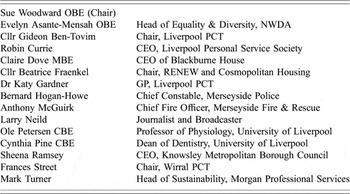
Commissioners

A full text of the Commission’s Final Report is available to download in pdf from its website: www.healthiswealthcommission.org.uk
The Commission welcomes the publication of the WHO’s recently published findings on the Social Determinants of Health and, in particular, its recommendations to improve living conditions, to protect workers, to ‘place health and health equity at the heart of urban governance and planning’, and to ‘invest in the global sharing of evidence on social determinants of health and health equity’.14
Whilst recognising that, by their nature, these issues will require cooperative global action from central government, the Commission hopes that its own proposals under Wellbeing at Work, Beyond the Built Environment and Knowledge Capital can contribute towards the WHO’s objectives, and go some way to addressing those inequalities that have such a real and significant impact on the lives of local people.
By taking action on these issues now, the Commission very much hopes that its work might help to position once again the Liverpool City-region as a pioneer in innovative approaches to public health.
One of the principles behind establishing the Commission was for the city-region to create and take an opportunity to ‘sort out its own problems’ – finding local solutions to local issues, in an investigation funded and supported entirely from within the city-region.
In the same spirit, the Commission has called for its partners and stakeholders to re-affirm their commitment to the future health, prosperity and wellbeing of all of citizens by supporting its call for a celebration of 2010 as The Year of Wellbeing – a positive, unified and public statement of the Liverpool City-region’s continued commitment to health, to wealth and to wellness.
Acknowledgement
This paper is based on a lecture given by Susan Woodward at the 20th annual meeting of the Academia Europaea, held in Liverpool, UK, in September 2008.
Susan Woodward, OBE, chairs the Health is Wealth Commission. The former Managing Director of ITV Granada and Director of Regional Affairs ITV plc runs her own creative consultancy. In 2001, she was appointed Creative Director for the 2002 Commonwealth Games in Manchester where she was responsible for the Opening and Closing Ceremonies, for which she was awarded an OBE for services to Broadcasting and the Commonwealth Games. In 2003, she was appointed Creative Director for the City of Liverpool, tasked with securing the city the title of European Capital of Culture 2008. In 2005 she was awarded the Business Woman of the Year Award for the North West of England. She is a Board Director of several public/private ventures, including The Manchester Board established by Government to tackle the toughest problems that cause poor health and low educational attainment. She is also a non-executive Director of the University of Liverpool.
Clare Devaney, MA(Cantab), MCIPR, is a strategic communications consultant who has spent ten years working across Liverpool’s public and private sectors, specialising in public affairs, economic development and regeneration policy. Previously, she managed the £54 million Sector Development project on behalf of European Objective 1, and, in 2003, she masterminded the first ever in-depth Merseyside Economic Review. She has managed several key regeneration projects, including the Housing Market Renewal bid for the Kensington area of Liverpool, the largest of its kind in the UK and credited as ‘best practice’ by ODPM. Clare’s latest role has been as Project Manager for the Liverpool City-region Health is Wealth Commission.