Introduction
In the past five decades a large number of helminthecological studies have been carried out on the interaction of intrinsic factors, mainly host susceptibility, and extrinsic factors, mainly host exposure, with the helminth community of small mammals. In the case of the wood mouse Apodemus sylvaticus (Rodentia, Muridae) these studies have been conducted primarily in European countries, starting with that of Lewis (Reference Lewis1968) to those of Abu-Madi et al. (Reference Abu-Madi, Behnke, Lewis and Gilbert2000) and Behnke et al. (Reference Behnke, Gilbert, Abu-Madi and Lewis2005) in the UK, or that of Fuentes et al. (Reference Fuentes, Sáez, Trelis, Galán-Puchades and Esteban2004) and Eira et al. (Reference Eira, Torres, Vingada and Miquel2006) in the Iberian Peninsula. However, none of these studies has considered any extrinsic effects concerning ecosystem perturbations, either naturally or deliberately induced. Until now, only the studies carried out by the PAF (parasites and fire) research group of Universitat de València have analysed the dynamics of the helminth parasite population in small mammals (insectivores and rodents) captured in Mediterranean ecosystems affected by wildfires (Galán-Puchades & Fuentes, Reference Galán-Puchades and Fuentes1996; Galán-Puchades et al., Reference Galán-Puchades, Fuentes, Cerezuela, Fons and Mas-coma1998, Reference Galán-Puchades, Fuentes, Cerezuela, Fons and Mas-Coma1999; Fuentes et al., Reference Fuentes, Sainz-Elipe and Galán-Puchades2005, Reference Fuentes, Sainz-Elipe and Galán-Puchades2007; Sainz-Elipe et al., Reference Sainz-Elipe, Galán-Puchades and Fuentes2007). These studies have shed more light on the use of helminth community dynamics of the wood mouse as an indicator of two processes, namely host recolonization and ecosystem regeneration after a wildfire.
In the burned area, the fire erases the shrub vegetation which, in turn, alters the soil conditions and decreases vertebrate and invertebrate populations. Moreover, during the post-fire regeneration process various changes of the wood mouse population and its helminth community have to be expected, mainly concerning the host population dynamics and the infection pressure of certain parasite species, including a possible loss of host immunity. Consequently, the direct effects of the fire and the changes produced in the burned area during the regeneration process may alter the host/parasite relationship, reinforcing the proposal by Poulin (Reference Poulin1998) and Combes (Reference Combes2001) that parasites play important roles in the regulation of populations and communities of their hosts.
In this sense, the study by Fuentes et al. (Reference Fuentes, Sainz-Elipe and Galán-Puchades2007), carried out in the Spanish Serra Calderona Natural Park 5 years after the wildfire, postulated various features of the helminth community dynamics of the wood mouse as biological tags (as defined by MacKenzie & Abaunza, Reference MacKenzie and Abaunza1998) of the environmental impact of a wildfire and the regeneration process, as previously proposed by Galán-Puchades & Fuentes (Reference Galán-Puchades and Fuentes1996) and Galán-Puchades et al. (Reference Galán-Puchades, Fuentes, Cerezuela, Fons and Mas-coma1998, Reference Galán-Puchades, Fuentes, Cerezuela, Fons and Mas-Coma1999) in the eastern Pyrenees.
Following the methodology proposed by Galán-Puchades et al. (Reference Galán-Puchades, Fuentes, Cerezuela, Fons and Mas-Coma1999), the aims of this study were: (1) to continue the study by Fuentes et al. (Reference Fuentes, Sainz-Elipe and Galán-Puchades2007) on the impact of a great wildfire and its repercussions on the wood mouse population biology and its helminth community in the Spanish Serra Calderona Natural Park – a Mediterranean ecosystem in regeneration 10 years after a wildfire; and (2) to confirm that these conditions prove the ability of the parasites to tolerate environmental stressors and the effects on their transmission strategies. The prevalence, mean abundance, aggregation and diversity of helminthiasis among mice captured from control (non-burned) and impact (burned) sites have been analysed to correlate host population alterations in perturbed zones with possible changes in the structure of its helminth community, to determine how affected sites recover by means of an ‘impact level-by-time’ study, and to establish the possible use of helminths as biological tags in this regeneration process.
Materials and methods
The study area, a Mediterranean ecosystem, the Serra Calderona Natural Park, is located in the Valencian Community, Spain (39°35′–39°51′N, 0°15′–0°43′W). This mountain range, which comprises approximately 52,000 ha of forests and cultivated land which had been left untended, suffered a large wildfire at the end of the summer of 1992, devastating a total of 9500 ha.
In February 1994, the winter of the second post-fire year (PFY), a multidisciplinary project concerning the post-fire recolonization dynamics of small mammals and the study of their helminth parasites as biological tags in the process of post-fire regeneration was initiated.
Zoological and helminthological procedures
Three trapping stations were set up within the study area for annual–seasonal follow-ups, two in the burned area and one in the control area. The control area presents the same ecological conditions as the burned areas before the fire and is situated in a straight line about 6 km away from the burned areas in order to minimize nearness effects resulting from the mobility of the small mammals. The two burned biotopes are considered as one, because both enclaves are very close and have a great ecological similarity. Thus, the negative effect of the sampling method for the helminthological study is minimized. A comprehensive description of the trapping method and study procedures was previously provided by Fuentes et al. (Reference Fuentes, Galán-Puchades and Cerezuela1998, Reference Fuentes, Cerezuela and Galán-Puchades2000) and Galán-Puchades et al. (Reference Galán-Puchades, Fuentes, Cerezuela, Fons and Mas-Coma1999). The trapping method used to capture small mammals was based on the square plot (quadrant) technique, using hand-made wire-mesh traps and the capture-release method. On a seasonal basis, i.e. four times annually at intervals of no more than 3 months, 55 traps were placed at night within a distance of 10–15 m, forming a square in each of the three study biotopes. The trapping took place during three consecutive days, checking each trap every 24 h. The captured animals were identified at species level and weighed, sexual activity was determined and the animals were then released at the place of capture.
The annual capture percentage of the wood mouse in each area (burned and control) was analysed to determine possible differences due to the post-fire regeneration process.
Dead individuals and fewer than 10% of specimens captured alive were dissected and used for the helminthological study. All helminths were collected, preserved and studied as previously described by Fuentes et al. (Reference Fuentes, Cerezuela and Galán-Puchades2000). Their specific identification was based on their morphology and morphometry. However, a number of specimens could not be specifically classified due to their limited development.
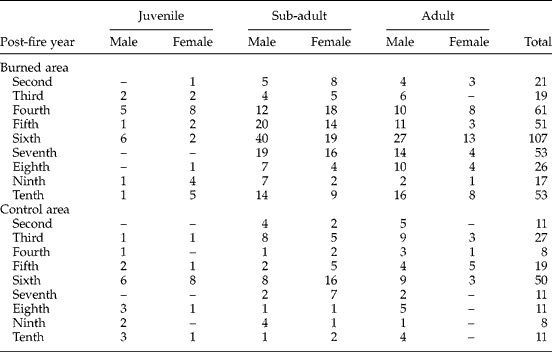
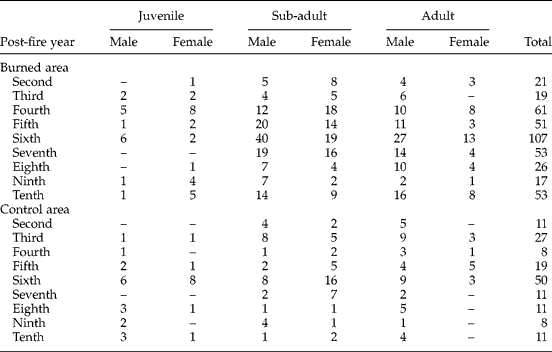
Five hundred and sixty-four wood mice, captured prior to September 2002, the summer of the tenth PFY, were studied. Four hundred and eight individual hosts originated from the burned area and 156 from the control area. Capture year of the hosts, their age and sex, for the burned and the control areas, are summarized in table 1.
The number of Apodemus sylvaticus analysed in Serra Calderona from the burned and the control area, from the second to the tenth post-fire year.
Helminth community analysis
A global comparison of the burned and the control area was conducted. The analysis of the helminth community composition and structure for both areas was carried out considering each particular biological cycle and calculating the prevalence, mean abundance, median intensity and range.
As proposed by Fuentes et al. (Reference Fuentes, Sainz-Elipe and Galán-Puchades2007), two different biological cycles for helminths were considered: helminths classified as FES, which have a free-environmental infectious stage for the wood mouse, and helminths classified as no-FES, which have at least one invertebrate as intermediate host. The analysis takes into account the number of hosts parasitized by at least one FES or no-FES helminth species.
According to Bush et al. (Reference Bush, Lafferty, Lotz and Shostal1997): prevalence is the number of hosts infected with one or more individuals of a particular parasite species divided by the number of hosts examined for that parasite species, and it is expressed as a percentage; mean abundance is the total number of individuals of a particular species in a sample of a particular host species divided by the total number of hosts of that species examined, including both infected and uninfected hosts, i.e. the average abundance of a parasite species among all members of a particular host population; median intensity is the median number of individuals of a particular species in a single infected host, i.e. the median number of individuals in an infrapopulation. As Aznar et al. (Reference Aznar, Badillo and Raga1998) proposed, median intensity values are provided to maximize the amount of meaningful, non-redundant data about infection statistics, particularly because some species are aggregated among hosts.
Where possible, standard non-parametric tests – chi-squared (χ2) and Mann–Whitney (U) tests – were applied (Sokal & Rohlf, Reference Sokal and Rohlf1981), and statistical significance was established at P < 0.05.
The analysis of the helminth community components was carried out by means of calculating the frequency of occurrence of the number of helminth species, the abundance index (excluding those parasite species for which the wood mouse acts as an intermediate host) (Bush, Reference Bush1973; Pence & Eason, Reference Pence and Eason1980), as well as the frequency distribution of helminths, and distinguishing between ‘component’ species (prevalence ≥ 10%) and ‘rare’ species (prevalence < 10%) (Bush et al., Reference Bush, Aho and Kennedy1990).
The frequency distribution of helminth species was calculated by means of two indices: the Lefkovitch index (L), calculated according to Lefkovitch (Reference Lefkovitch1966), ranging from − 1 (positive binomial or uniform distribution), 0 (Poisson or random distribution) to +1 (negative binomial or aggregated distribution); and Poulin's index of Discrepancy (D), calculated according to Poulin (Reference Poulin1993), ranging from a minimum value of 0, when there is not aggregation, to a maximum of 1, when aggregation is at its theoretical maximum.
Helminth community diversity describes the composition of a community in terms of the number of species present and some factor that weights the relative evenness of distribution of each species (Bush et al., Reference Bush, Lafferty, Lotz and Shostal1997). Its analysis was completed using the Shannon index (H′) (Pielou, Reference Pielou1975; Magurran, Reference Magurran1988), Simpson index (D′) (Simpson, Reference Simpson1949), expressed as 1 − D′ (Magurran, Reference Magurran1988), Berger–Parker index (d) (Berger & Parker, Reference Berger and Parker1970; May, Reference May, Cody and Diamond1975), expressed as 1 − d (Magurran, Reference Magurran1988), and Shannon evenness (E) (Pielou, Reference Pielou1969; Magurran, Reference Magurran1988). A t-test was used to compare statistical differences between the values of Shannon index in both areas (Magurran, Reference Magurran1988), and statistical significance was established at P < 0.05.
The helminth infracommunity structure study was established through the analysis of the number of helminths, number of helminth species, the Brillouin index (HB) (Pielou, Reference Pielou1975; Magurran, Reference Magurran1988), Brillouin index for infected hosts only and percentage of infected hosts.
The role played by intrinsic (host age and sex) and extrinsic (site, season and year of capture) factors in determining the species richness (expressed through the number of helminth species), the helminth community diversity (expressed by the Brillouin index) and worm burden (expressed by the helminth abundance) was analysed.
The period of capture (i.e. season of capture associated with the year of capture) was considered as an independent variable as seasonal effects are strongly related to each PFY. Also, the analysis was undertaken individually for each area because, in this way, the effect of the fire and regeneration process can be regarded from another point of view, i.e. showing the influence of intrinsic and extrinsic factors on each area separately.
The analysis of the global helminth prevalence, as dependent variable, was carried out using a binary logistic regression (infected = 1; uninfected = 0) and intrinsic and extrinsic factors as independent variables. The analysis of species richness, helminth diversity and helminth abundance was performed using a multifactorial general linear model (GLM). As the number of helminths was highly aggregated, the helminth abundance of each infracommunity was normalized by the ln(x+1) transformation for this GLM analysis.
Statistical analyses were carried out using StatView 5.0 (SAS Institute Inc., Cary, North Carolina, USA), SPSS 15.0 for Windows (SPSS Inc., Chicago, Illinois, USA) and QP 3.0 (Rózsa et al., Reference Rózsa, Reiczigel and Majoros2000) software packages.
Results
The annual evolution of the wood mouse population is very similar in both areas, fluctuating in tandem. However, the wood mouse capture percentage in the burned area was always higher than in the control area, with statistically significant differences in five out of nine study years (4th, 5th, 7th, 8th and 10th PFYs).
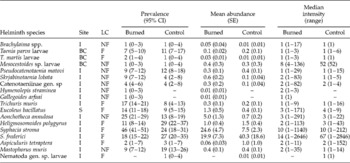
In Serra Calderona as a whole, 471 of a total of 564 (83.5%) wood mice analysed were parasitized with 17 helminth species (table 2). Nine of the helminth species were classified as FES, while eight were classified as no-FES; 73.4% of the individuals analysed were infected with FES helminths, whereas 42.4% were infected with no-FES helminths. This difference was statistically significant (χ2 = 110.103; df = 1; P < 0.0001). The mean species richness (average number of parasite species/host) was 1.74 (SE = 0.06), and the values of the diversity indices of the helminth community were H′ = 1.31, 1 − D′ = 0.63, 1 − d = 0.53 and E = 0.45.
Selected characteristics of the helminth fauna of all wood mice in the burned and in the control area. CI, confidence interval; SE, standard error; LC, life cycle; F, FES; NF, no-FES; I, intestine; BC, body cavity; S, stomach.

The helminth community in the burned area
In the burned area, 350 of a total of 408 individual hosts analysed (85.8%) were parasitized by 16 species: one trematode, seven cestodes and eight nematodes (table 2). Syphacia stroma was the helminth with the highest prevalence and mean abundance, while S. frederici presented the highest individual infrapopulation values. Of the individuals analysed, 76.2% were infected with FES helminths, and 43.1% were infected with no-FES helminths. This difference was statistically significant (χ2 = 91.448; df = 1; P < 0.0001).
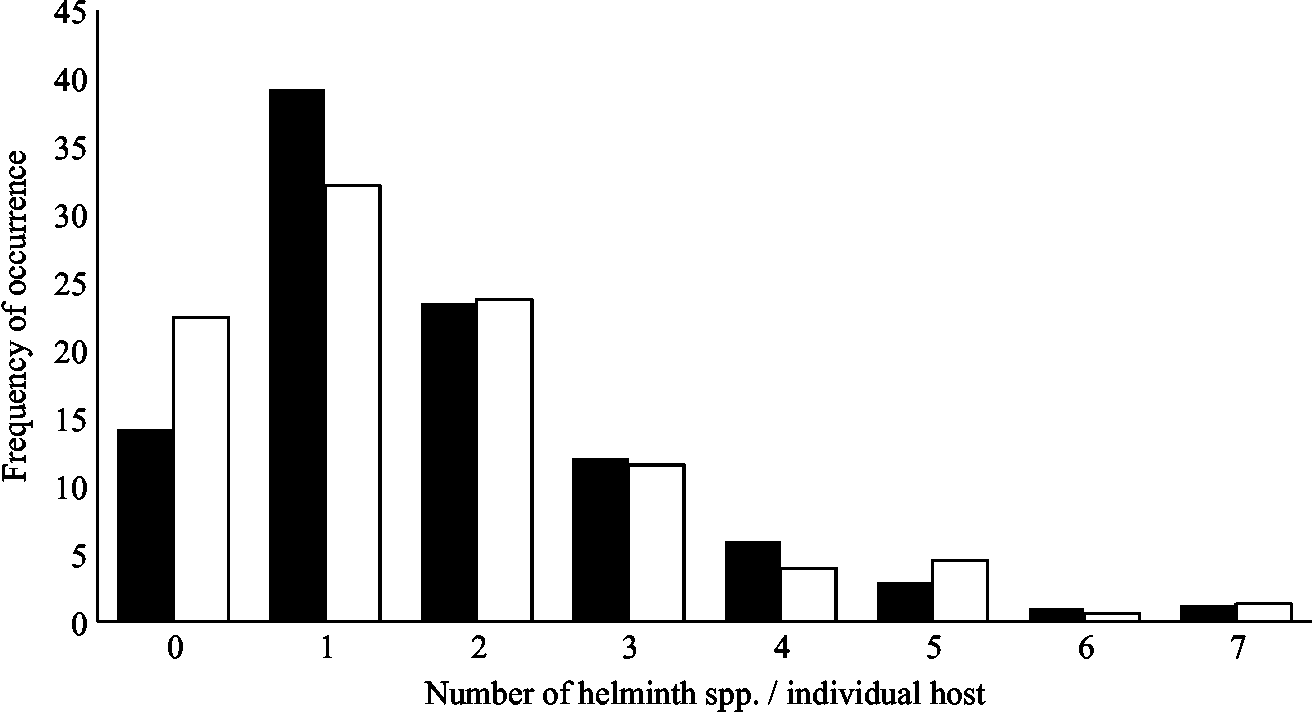
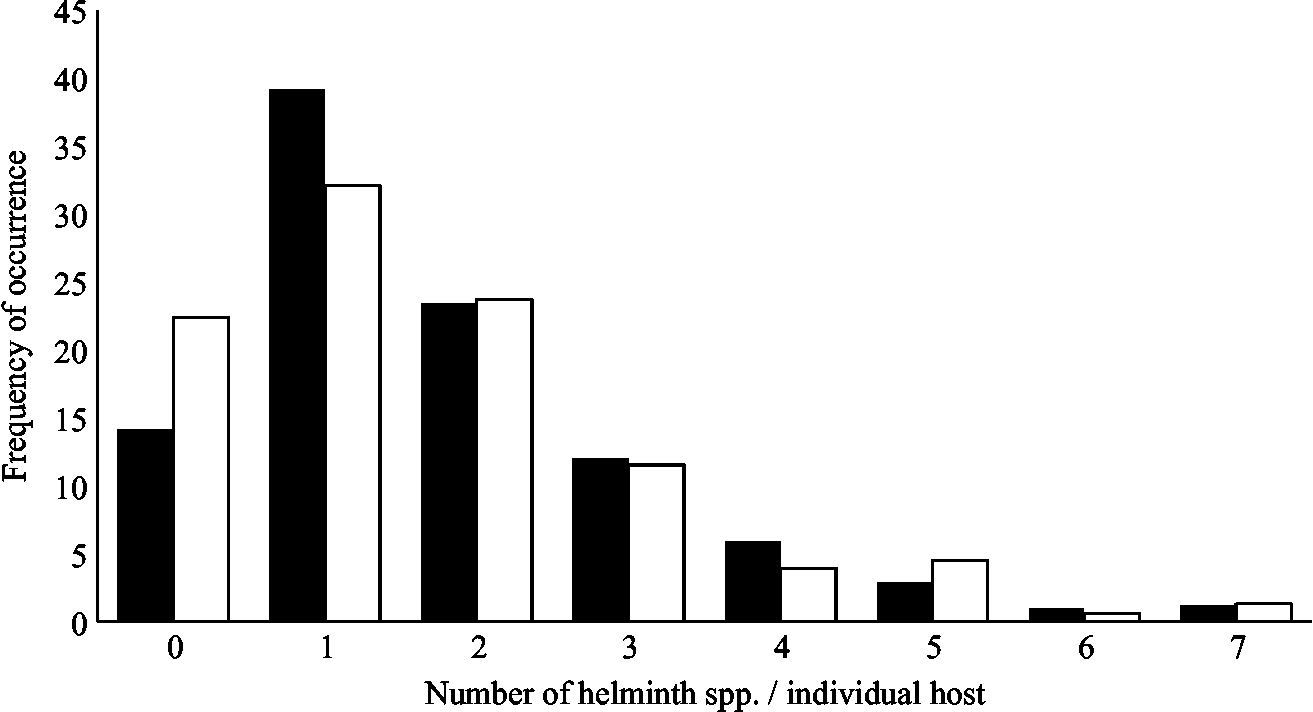
More than 50% of hosts were parasitized by one or two helminth species, with infracommunities of up to seven species (fig. 1). Moreover, the frequency in the number of different helminth species in each host differs from an aggregated distribution (L = 0.09; D = 0.41).
Frequency of occurrence of the number of helminth species present in each specimen of Apodemus sylvaticus in the burned (black bars) and in the control (white bars) area.
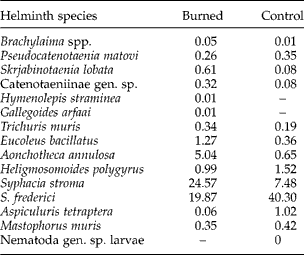
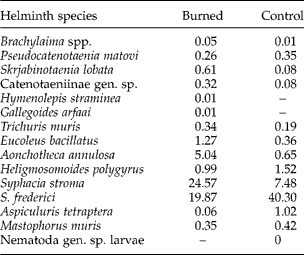
The analysis of the abundance index (table 3) makes it possible to establish the following helminth community structure: S. stroma, S. frederici, Aonchotheca annulosa and Eucoleus bacillatus as dominant species; Heligmosomoides polygyrus, Skrjabinotaenia lobata, Mastophorus muris, Trichuris muris and Pseudocatenotaenia matovi as co-dominant species; and Aspiculuris tetraptera, Brachylaima spp., Hymenolepis straminea and Gallegoides arfaai as successful immigrant species. The three cestode larval stages are not considered in this study as the wood mouse acts as an intermediate host.
Abundance index of the wood mouse helminth community in the burned and in the control area.
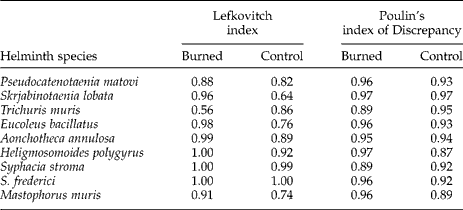
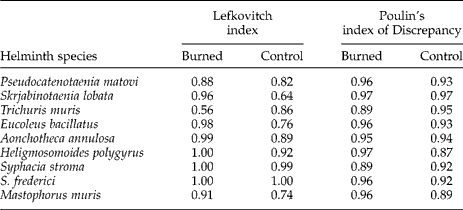
All dominant and almost all co-dominant species present a frequency distribution corresponding to an aggregated distribution, as expressed by their values of the Lefkovitch index and Poulin's index of Discrepancy (table 4).
Lefkovitch index and Poulin's index of Discrepancy of the wood mouse helminth community component species in the burned and in the control area.
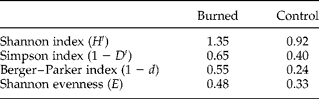
The values of the Shannon, Simpson, Berger–Parker and Shannon evenness indices (table 5) reflect the diversity of the helminth community.
Diversity characteristics of the helminth community of Apodemus sylvaticus from Serra Calderona determined by areas of origin, burned and control.
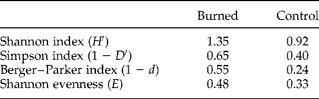
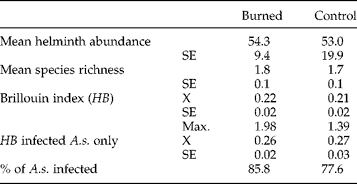
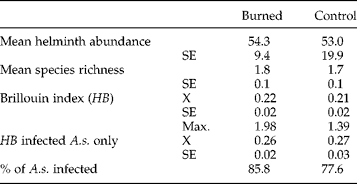
Table 6 shows the diversity of the infracommunities (determined by the Brillouin index), values for each infracommunity in the study, and values for infected hosts only.
Diversity characteristics of the infracommunities of helminths of Apodemus sylvaticus (A.s.) from Serra Calderona determined by areas of origin.
The helminth community in the control area
In the control area, 121 of a total of 156 individual hosts analysed (77.6%) were parasitized by 15 species: one trematode, five cestodes and nine nematodes (table 2). The absence of H. straminea and G. arfaai, when compared with the burned area, deserves mentioning. The global prevalence of parasitism was lower than in the burned area, and this difference was statistically significant (χ2 = 4.957; df = 1; P = 0.026). Heligmosomoides polygyrus was the helminth with the highest prevalence, while S. frederici presented the highest mean abundance and the highest individual values for infrapopulations. The FES helminth infection rate was 66.0% for the individuals analysed, whereas 40.4% were infected with no-FES helminths. This difference was statistically significant (χ2 = 19.580; df = 1; P < 0.0001). Moreover, the difference between the FES helminth infection rates in the two areas was statistically significant (χ2 = 5.503; df = 1; P = 0.0188). Comparing the helminth species of the two areas analysed, statistically significant differences were found between the prevalences of T. muris (χ2 = 6.011; df = 1; P = 0.014), A. annulosa (χ2 = 8.843; df = 1; P = 0.003), H. polygyrus (χ2 = 27.065; df = 1; P < 0.0001), S. stroma (χ2 = 21.273; df = 1; P < 0.0001), S. frederici (χ2 = 4.808; df = 1; P = 0.028) and M. muris (χ2 = 9.620; df = 1; P = 0.002), and the mean abundance of T. muris (U = 28,960.0; P = 0.007), A. annulosa (U = 27,907.0; P = 0.002), H. polygyrus (U = 25,852.5; P < 0.001), S. stroma (U = 24,827.5; P < 0.001), S. frederici (U = 28,661.0; P = 0.010) and M. muris (U = 28,778.0; P = 0.002).
Similar to the burned area, almost 50% of hosts presented either one or two helminth species, with infracommunities of up to seven species (fig. 1). However, two differences were detected: the percentage of non-parasitized mice was clearly higher in the control area than in the burned area, and the frequency in the number of different helminth species was higher in the burned than in the control area, being closer to an aggregated distribution in the control than in the burned area (L = 0.21; D = 0.47).
The analysis of the abundance index values (table 3) makes it possible to establish a similar helminth community structure as the one found in the burned area. Heligmosomoides polygyrus and A. tetraptera have become dominant species, while A. annulosa and E. bacillatus have become co-dominant species, and S. lobata has become a successful immigrant species.
The analysis of the frequency distributions for the various helminth populations, as expressed by their values of the Lefkovitch index and Poulin's index of Discrepancy (table 4), shows changes in the aggregation of various species with respect to the burned area.
The lower helminth community diversity of the control area when compared with the burned area is reflected in the values of the diversity indices (table 5). Moreover, the value of H′ was significantly different in the two areas (t = 3626; df = 246; P < 0.001).
The study of the infracommunity diversity (table 6) reveals a similar species richness and diversity (determined by the Brillouin value index) in the two areas studied, but with slightly higher values in the area affected by the fire.
Intrinsic and extrinsic factors
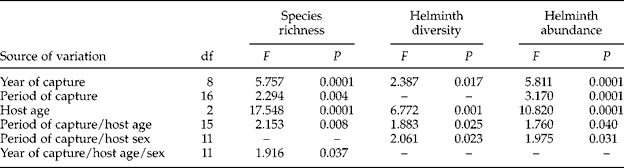
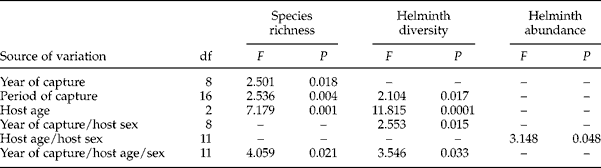
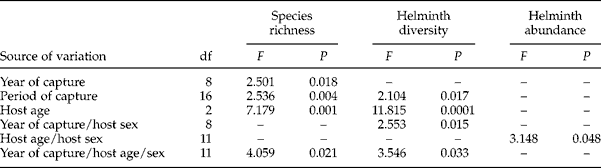
The analysis of the wood mouse sub-populations determined by host age presented the highest helminth prevalence, abundance and diversity, and species richness in adults, and the lowest in juveniles in both areas. The variation in the sub-populations determined by the period of capture showed fluctuations in both areas, which are more irregular in the burned area, reaching their highest and lowest values in the second and in the tenth PFY, respectively. Concerning host gender, no marked differences were detected. The binary logistic regression (table 7) and the multifactorial GLM analysis (tables 8 and 9) confirm several of the above-mentioned results. The PFY influences helminth prevalence, abundance and diversity, and species richness in the burned area more strongly than in the control area. Host age affects the variation in species richness and helminth diversity in both areas, while this factor affects helminth prevalence only in the control area and helminth abundance only in the burned area. Moreover, combinations of intrinsic and extrinsic factors analysed interacted significantly with the helminth community in both areas in other ways than those mentioned above.
Logistic regression models for global helminth prevalence of Apodemus sylvaticus from Serra Calderona burned and control areas by year and period of capture, host age and host sex, expressed by χ2 values with associated probabilities (P) for the model created, including independent variables. Only statistically significant values are reported. df, degrees of freedom.

Species richness and helminth diversity and abundance in Apodemus sylvaticus from Serra Calderona burned area by year and period of capture, host age and host sex, through a multifactorial general linear model (GLM), expressed by F-statistic values with associated probabilities (P). df, degrees of freedom. Only statistically significant values are reported.
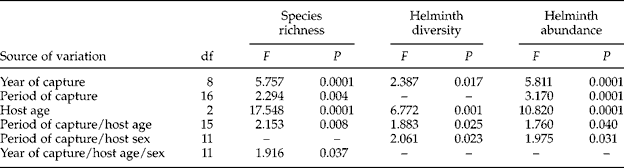
Species richness and helminth diversity and abundance in Apodemus sylvaticus from Serra Calderona control area by year and period of capture, host age and host sex, through a multifactorial general linear model (GLM), expressed by F-statistic values with associated probabilities (P). df, degrees of freedom. Only statistically significant values are reported.
Helminth community changes after the 2nd to 5th post-fire year period
When comparing the results of the present study with those obtained by Fuentes et al. (Reference Fuentes, Sainz-Elipe and Galán-Puchades2007) in the period from the second to the fifth PFY in this Mediterranean enclave, some noteworthy changes in the helminth community of A. sylvaticus are detectable. In the burned area: (1) after ten PFYs, slight decreases, without statistical significances, of the helminth community diversity, of the global prevalence (85.8 versus 89.5%) as well as of the prevalence and the parasitic burden of the helminth population of component species; (2) the new report of the tapeworm G. arfaai and the reaffirmed dominance of S. stroma; (3) the frequency distribution of the helminth species in each individual host becomes more random, and the infracommunities of the wood mouse are more often made up of one helminth species only; (4) the loss of dominance of H. polygyrus, which becomes a co-dominant species is the only change in the helminth community structure; (5) M. muris increases its aggregation, while T. muris decreases its aggregation. Changes in the control area after the fifth PFY include: (1) the report of T. martis larvae; (2) the slight decrease of the global prevalence, helminth burden and helminth diversity. The behaviour of the helminth populations remains unchanged during this new study period.
Discussion
The annual evolution analysis of the wood mouse population shows a higher density of this host in the burned area, although these populations fluctuate in tandem in both areas. A fact which – after detailed studies of the host population dynamics – will reaffirm the role of A. sylvaticus as a post-fire colonizer in the regeneration process in this Mediterranean enclave, as postulated by Fuentes et al. (Reference Fuentes, Galán-Puchades and Cerezuela1998). However, while future zoological studies will confirm the role of the wood mouse in the post-fire regeneration process, this higher density of mice in the burned area will be reflected as a higher host aggregation in the perturbed area, which will affect host–helminth relationships.
The helminthfauna detected in A. sylvaticus in Serra Calderona Natural Park agrees, as reported by Fuentes et al. (Reference Fuentes, Cerezuela and Galán-Puchades2000, Reference Fuentes, Sainz-Elipe and Galán-Puchades2007), with the results of Feliu et al. (Reference Feliu, Renaud, Catzeflis, Hugot, Durand and Morand1997) for this host species in the Iberian Peninsula. The limited resources of this mountain range ecosystem, in comparison with continental Spain on the whole, may explain the absence of certain helminths in this enclave. However, the number of helminth species detected, as well as the prevalence and species richness values, are higher than those reported from other enclaves recently studied in the Iberian Peninsula by Portolés et al. (Reference Portolés, Granel and Esteban2000), Fuentes et al. (Reference Fuentes, Sáez, Trelis, Galán-Puchades and Esteban2004) and Eira et al. (Reference Eira, Torres, Vingada and Miquel2006).
The absence of H. straminea and of G. arfaai in the control area, and the low prevalences and intensities in the burned area, stand out, because both species are generally more common in the Iberian Peninsula – a fact which can be explained by the low number of individual hosts analysed in the control area.
As Fuentes et al. (Reference Fuentes, Sainz-Elipe and Galán-Puchades2007) postulated 5 years after the fire, differences detected between the two areas, analysed in terms of percentages and mean abundances of global parasitism as well as FES helminth species, suggest that the changes in these variables can be related to the post-fire regeneration process. According to Arneberg et al. (Reference Arneberg, Skorping, Grenfell and Read1998) and Arneberg (Reference Arneberg2001), the aggregation of hosts in the burned area leads both to the higher prevalence of parasitism in general and to the transmission of helminths with a direct life cycle in particular.
No significant differences were detected in mean species richness values and the helminth community components in both areas. Nevertheless, the elevated frequency of uninfected wood mice in the control area reflects once again the lower global prevalence in this area.
The slight decrease of global prevalence, abundance and diversity of the helminth community of the wood mouse in both areas, burned and control, after ten PFYs, when compared with the study carried out by Fuentes et al. (Reference Fuentes, Sainz-Elipe and Galán-Puchades2007) until the fifth PFY, may be explained by the larger number of individual hosts analysed. However, other observed changes in this helminth community in the burned area only, especially those concerning prevalences and parasitic burden, also reflect the fact that the burned area gradually resembles the control area.
The analysis of the frequency distribution of helminth species revealed, without significant differences between the two calculated indices (L and D), that dominant as well as co-dominant species, even 10 years after the wildfire, showed changed parameters reflecting the lasting environmental impact of the perturbation on the host population. The importance of these changes is related to the destabilizing capacity which each helminth species exercises on its host in the post-fire regeneration area. A high-level aggregation of parasites is associated with the stability of the host–parasite relationship, whereas low-level aggregation is associated with destabilization (Dobson, Reference Dobson1988; Dobson & Hudson, Reference Dobson and Hudson1992; Shaw & Dobson, Reference Shaw and Dobson1995). Thus, according to the results obtained in both areas, eight of the nine component species do not seem to contribute to the host population destabilization since their aggregation parameters increased in the burned area. Trichuris muris is the only helminth species suffering from a reduced aggregation and may thus be responsible for the destabilized wood mouse population in the burned area.
The higher level of aggregation of almost all component helminth species in the burned area may be caused, as Wilson et al. (Reference Wilson, Bjørnstad, Dobson, Merler, Poglayen, Randolph, Read, Skorping, Hudson, Rizzoli, Grenfell, Heesterbeek and Dobson2001) suggested, by a variety of factors, such as heterogeneities in host populations and/or infection pressure. On the other hand, the helminth transmission mode, in general, does not seem to affect the aggregation level, and the optimal distribution of helminths should reveal the co-evolutionary adaptive processes between parasites and hosts (Morand & Krasnov, Reference Morand and Krasnov2008). Consequently, if the aggregation level is not related to the helminth life cycle and each helminth species has an optimal distribution in its stabilized host population, the changes in the frequency distribution of helminth species in the burned area, either the loss or the increase of aggregation level, can still be considered, even 10 years after the fire, as another potential effect of the wildfire and the post-fire regeneration process, respectively.
The diversity analysis of A. sylvaticus in both areas, at helminth community level and at infracommunity level, presented a slightly higher diversity, abundance and species richness in the post-fire regeneration area. The values of the diversity indices, those biased towards species richness (H′ and HB) as well as those biased towards dominance (D′ and d), showed a higher diversity in the burned area. Also, the values of E showed a higher evenness, i.e. lower dominance and higher diversity, in the burned area. However, these diversity values were lower than those reported by Fuentes et al. (Reference Fuentes, Sainz-Elipe and Galán-Puchades2007).
The burned area is less stabilized, which leads to a greater diversity and can, in turn, also be related to the post-fire succession of this Mediterranean forest ecosystem. A suppression of host defence systems is likely to occur during this regeneration process as a result of the helminth diversity increase, and subsequently favours a higher abundance and the presence of co-occurring species, an increase of species richness, as suggested by Krasnov et al. (Reference Krasnov, Poulin, Morand, Morand, Krasnov and Poulin2006).
However, the irregular but lasting decrease of the species richness and the helminth community diversity in the burned area, revealed by the analysis of the wood mouse infracommunities determined by year and period of capture, indicates once again that the burned area progressively resembles the control area. According to Arneberg et al. (Reference Arneberg, Skorping, Grenfell and Read1998) and Arneberg (Reference Arneberg2001), this loss of diversity in the helminth community seems to be related to the host population increase, a long-term development taking place in the burned area along the regeneration process.
The higher helminth prevalence, abundance and diversity, and species richness values in the adult sub-populations agree, as previously reported by Fuentes et al. (Reference Fuentes, Sainz-Elipe and Galán-Puchades2007), with other studies concerning A. sylvaticus in the UK and the Iberian Peninsula, and with the hypothesis that host longevity ( = host age) might also be an important factor that determines the diversity of parasites, as a consequence of the continued accumulation of parasites in long-lived hosts (Morand, Reference Morand, Poulin, Morand and Skorping2000).
Host sex does not directly interact with the helminth community of the wood mouse. However, various combinations of intrinsic and extrinsic factors, including host sex, have different effects determining helminth abundance and diversity, as well as species richness, in the two areas analysed.
The comparison between the results obtained from the burned area (after a 10-year regeneration process) and the control area, ecologically alike and located in the same enclave, strongly confirms that the differences found in the helminth community of the wood mouse are due to the wildfire and the post-fire regeneration process. The changes that took place during this period in the wood mouse population and its helminth community alter the host–helminth relationship in the burned area.
Our findings show that after an environmental disaster, which implies an alteration of the host population dynamics, the behaviour of helminth species might be related to: (1) their pre-catastrophe presence and their biological cycles; (2) the host's immunological condition as well as the potential change of the host dynamics; and (3) the direct effects of the perturbation and the processes related to the re-establishment of the ecological balance of a devastated ecosystem, strongly influenced by the climatic conditions in this period.
Simultaneous and periodical studies carried out in burned and control areas have been demonstrated to be appropriate when analysing the changes in helminth communities of small mammals caused by a perturbation. In this sense, and after the analysis of the second to the tenth PFY, the biological tags of the regeneration process after a wildfire in Mediterranean ecosystems, postulated by Fuentes et al. (Reference Fuentes, Sainz-Elipe and Galán-Puchades2007), are corroborated: the higher total prevalence and helminth abundance in a burned area; the positive effect on the transmission of direct biological cycles, especially ageohelminths, as a consequence of a higher host aggregation; the unaltered population distribution of helminth species dominant before the perturbation; and the greater helminth diversity in the perturbed area.
To cast more light on the long-term regeneration process following environmental disasters, such as wildfires in Mediterranean ecosystems or similar ecological perturbations, future studies centred on the individual regeneration process of each component species of the helminth community, as well as analyses of host dynamics in perturbed and control areas, will have to be carried out.
Acknowledgements
This study has been supported by projects CGL2007-61173/BOS and BOS 2000-0570-C02-02, Ministerio de Ciencia y Tecnología, PB87-0135 and PB92-0517-C02-01, Ministerio de Educación y Ciencia, Madrid, Spain; GV05/001, Conselleria d'Empresa, Universitat i Ciència, Generalitat Valenciana, Spain; UV-AE 20060233 and UV97-2216 of the Universitat de València, Spain; CPE/073, Institució Valenciana d'Estudis i Investigació, València, Spain. S.S.-E. received a personal postgraduate scholarship from the Fundació La Caixa, Barcelona, Spain. We would also like to thank the Conselleria de Medi Ambient de la Generalitat Valenciana, València (Spain) for permission to carry out field studies.