Introduction
Sexual assault, a term that includes child and adult sexual abuse, rape and intimate partner sexual violence, is a global public health concern (Dartnall & Jewkes, Reference Dartnall and Jewkes2013; Abrahams et al. Reference Abrahams, Devries, Watts, Pallitto, Petzold, Shamu and García-Moreno2014) with the potential for a wide range of physical and mental health consequences (Gilbert et al. Reference Gilbert, Widom, Browne, Fergusson, Webb and Janson2009; Jina & Thomas, Reference Jina and Thomas2013). Among the mental health consequences, there is a particularly robust association between sexual assault and the development of post-traumatic stress disorder (PTSD) (Kessler et al. Reference Kessler, Sonnega, Bromet, Hughes and Nelson1995; Maniglio, Reference Maniglio2009; Breslau et al. Reference Breslau, Kessler, Chilcoat, Schultz, Davis and Andreski1998; Chen et al. Reference Chen, Murad, Paras, Colbenson, Sattler, Goranson, Elamin, Seime, Shinozaki and Prokop2010). The fact that not all of those who experience sexual assault go on to develop PTSD has made identifying the predictors of PTSD development among those exposed to sexual assault a research priority. This kind of research has practical application because although interventions exist to prevent PTSD after sexual assault (Kearns et al. Reference Kearns, Ressler, Zatzick and Rothbaum2012; Rothbaum et al. Reference Rothbaum, Kearns, Price, Malcoun, Davis, Ressler, Lang and Houry2012) they are resource-intensive, highlighting the importance of understanding that who is most in need of treatment.
Prior research has identified a range of predictors of PTSD among sexual assault survivors including socio-demographics (younger age, female, less education), assault characteristics (perpetrator known to victim, high perceived threat, violence), prior mental disorders, prior trauma history, and post-assault cognitions including self-blame (Nishith et al. Reference Nishith, Mechanic and Resick2000; Ullman & Filipas, Reference Ullman and Filipas2001; Ozer et al. Reference Ozer, Best, Lipsey and Weiss2003; Ullman et al. Reference Ullman, Filipas, Townsend and Starzynski2007; Maikovich et al. Reference Maikovich, Koenen and Jaffee2009; Najdowski & Ullman, Reference Najdowski and Ullman2009; Armour et al. Reference Armour, Shevlin, Elklit and Mroczek2012; Möller et al. Reference Möller, Bäckström, Söndergaard and Helström2014). However, methodological limitations may have biased assessments of these predictors, as many prior studies were based on clinical or other self-selected samples of sexual assault survivors (Ullman et al. Reference Ullman, Filipas, Townsend and Starzynski2007; Armour et al. Reference Armour, Shevlin, Elklit and Mroczek2012; Möller et al. Reference Möller, Bäckström, Söndergaard and Helström2014). Although community surveys have been used to address this problem, the majority of community surveys assess PTSD based on the ‘worst event’ method. That is, respondents are asked whether they have experienced a number of different traumatic events (TEs) and then asked to identify their worst event. PTSD is then assessed in relation to the worst event. This approach often overestimates conditional risk of PTSD in relation to sexual assault because worst traumas are atypical and presumably have a higher risk of PTSD compared with more typical traumas (Breslau et al. Reference Breslau, Kessler, Chilcoat, Schultz, Davis and Andreski1998; Norris et al. Reference Norris, Murphy, Baker, Perilla, Rodriguez and Rodriguez2003). In the present study, this problem was addressed by assessing PTSD in relation to a computer-generated random TE selected from among the respondent's lifetime TEs. The results here are thus reported in relation to a representative sample of sexual assaults that more accurately reflect the range of such experiences in the population.
One further limitation of prior population-based studies is that they came largely from high-income countries, limiting generalizability of findings. The present study examines prevalence and predictors of PTSD related to randomly selected sexual assaults in general population samples of women in 11 high-, middle- and low-income countries in the WHO World Mental Health (WMH) Survey Initiative (http://www.hcp.med.harvard.edu/wmh).
Methods
Samples
The WMH surveys are community epidemiological surveys using consistent field procedures and instruments (Kessler & Üstün, Reference Kessler and Üstün2008). The data reported here come from a subset of 12 WMH surveys in 11 countries (see Table 1) that used an expanded assessment of sexual assault. A total of 17 970 women in these surveys were asked about lifetime TE exposure. Those who reported TE exposure had one lifetime occurrence of one TE selected using a probability procedure (their randomly selected TE). Sexual assault was the randomly selected TE for 411 women. These cases were weighted by the inverse of their probability of selection to generate a representative sample of sexual assaults. Each survey was based on household residents using a multi-stage clustered area probability sample design. Response rates ranged from 50.6% (Belgium) to 97.2% (Colombia) and had a weighted mean of 71.4% across surveys. WMH sampling procedures are described in more detail elsewhere (Heeringa et al. Reference Heeringa, Wells, Hubbard, Mneimneh, Chiu, Sampson, Berglund, Kessler and Üstün2008).
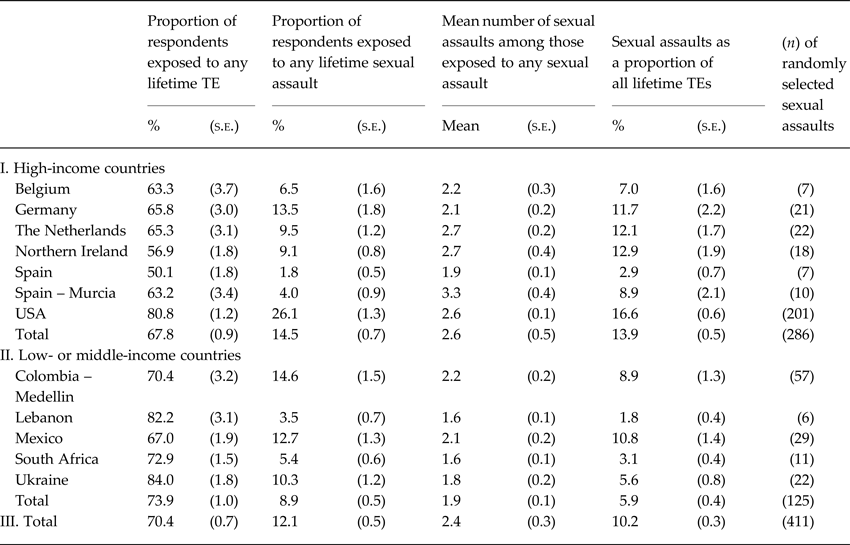
Distribution of lifetime exposure to TEs and sexual assault among part II female respondents in the participating WMH surveys (n = 17 970) a

a A total of 17 970 women were asked about lifetime TE exposure in these 12 surveys. Eight additional surveys also asked about lifetime TEs but were excluded because there were no cases of PTSD associated with randomly selected sexual assaults in those surveys. The numbers of randomly selected sexual assaults were small in these surveys: Brazil (n = 4), Colombia (n = 26), Israel (n = 13), Japan (n = 4), Peru (n = 17), Romania (n = 5), France (n = 8), Italy (n = 7). Male respondents were excluded because of the small number across surveys whose randomly selected event was a sexual assault victimization (n = 32)
Field procedures
Interviews were administered face-to-face by trained lay interviewers in respondent homes. All procedures contributing to this work comply with the ethical standards of the relevant national and institutional committees on human experimentation and with the Helsinki Declaration of 1975, as revised in 2008. The interview schedule was developed in English and translated into other languages using an extensive WHO protocol that involved forwards translation, the convening of an expert panel to review the translation and conduct pre-testing and cognitive interviewing, then independent backwards translation with emphasis on conceptual rather than literal equivalence (Harkness et al. Reference Harkness, Pennell, Villar, Gebler, Aguilar-Gaxiola, Bilgen, Kessler and Üstün2008). Interviews were in two parts. Part I, administered to all respondents, assessed core Diagnostic and Statistical Manual of Mental Disorders IV (DSM-IV) mental disorders (n = 51 002 respondents across all surveys). Part II assessed additional disorders and correlates, including questions about TEs and PTSD, and was administered to 100% of Part I respondents who met lifetime criteria for any Part I disorder and a probability subsample of other Part I respondents (n = 25 819). Part II respondents were weighted to adjust for differential within and between household selection, selection into Part II, and deviations between the sample and population demographic–geographic distributions (Heeringa et al. Reference Heeringa, Wells, Hubbard, Mneimneh, Chiu, Sampson, Berglund, Kessler and Üstün2008).
Measures
TEs
Part II respondents were asked about lifetime exposure to 27 types of TEs in addition to exposure to ‘any other’ TE and to a private TE that the respondent did not want to name out of embarrassment. A listing of the TEs can be found elsewhere (Benjet et al. Reference Benjet, Bromet, Karam, Kessler, McLaughlin, Ruscio, Shahly, Stein, Petukhova, Hill, Alonso, Atwoli, Bunting, Bruffaerts, Caldas-de-Almeida, de Girolamo, Florescu, Gureje, Huang, Lepine, Kawakami, Kovess-Masfety, Medina-Mora, Navarro-Mateu, Piazza, Posada-Villa, Scott, Shalev, Slade, ten Have, Torres, Viana, Zarkov and Koenen2016). Information was obtained on age when the TE first happened and number of lifetime occurrences. One occurrence of one lifetime TE was selected for each respondent from among the TEs reported using a probability procedure. Retrospective reports were used to assess PTSD associated with this randomly selected TE.
Characteristics of sexual assaults
Two of the TE questions asked about sexual assault. The preamble in introducing these questions was: ‘The next two questions are about sexual assault. The first is about rape. We define this as either having sexual intercourse with you or penetrating your body with a finger or object when you did not want them to either by threatening you or using force, or when you were so young that you didn't know what was happening. Did this ever happen to you?’ The next question asked: ‘Other than rape, were you ever sexually assaulted, where someone touched you inappropriately, or when you did not want them to?’ Respondents for whom rape or sexual assault was their randomly selected TE were then asked: their age when they first experienced the sexual assault; the identity of the perpetrator (spouse/partner, parent/guardian, step-relative, other relative, anyone else that the respondent knew, and a stranger); whether the assault was a repeated or one-time occurrence; and whether, as they looked back on it, ‘realistically (emphasis in original) was there anything you could have done to prevent this from happening?’
Mental disorders
Lifetime mental disorders were assessed with the Composite International Diagnostic Interview (CIDI) (Kessler & Üstün, Reference Kessler and Üstün2004), a fully structured interview administered by trained lay interviewers. The CIDI assessed lifetime DSM-IV mood disorders (major depressive disorder, dysthymic disorder, bipolar disorder), lifetime anxiety disorders [panic disorder, agoraphobia, specific phobia, social phobia, generalized anxiety disorder, prior (to the randomly selected TE) PTSD, and separation anxiety disorder], disruptive behaviour disorders (attention-deficit/hyperactivity disorder, oppositional-defiant disorder, conduct disorder, and intermittent explosive disorder), and substance disorders (alcohol abuse with or without dependence; drug abuse with or without dependence). Age-of-onset (AOO) of each disorder was assessed using special probing techniques shown experimentally to improve recall accuracy (Knauper et al. Reference Knauper, Cannell, Bruce and Kessler1999). This allowed us to determine based on retrospective AOO reports whether each respondent had a history of each disorder prior to the age of occurrence of the randomly selected TE. DSM-IV organic exclusion rules and diagnostic hierarchy rules were used (other than for ODD, which was defined with or without CD, and substance abuse, which was defined with or without dependence). Agoraphobia was combined with panic disorder because of low prevalence. Dysthymic disorder was combined with major depressive disorder for the same reason. These aggregations resulted in information being available on 14 prior (to age of the randomly selected TE) lifetime disorders (one of which was prior PTSD). As detailed elsewhere (Haro et al. Reference Haro, Arbabzadeh-Bouchez, Brugha, de Girolamo, Guyer, Jin, Lepine, Mazzi, Reneses, Vilagut, Sampson and Kessler2006), generally good concordance was found between these CIDI diagnoses and blinded clinical diagnoses based on clinical reappraisal interviews with the Structured Clinical Interview for DSM-IV (SCID).
PTSD
Blinded clinical reappraisal interviews with the SCID conducted in four WMH countries found CIDI-SCID concordance for DSM-IV PTSD to be moderate [area under the curve (AUC) = 0.69] (Haro et al. Reference Haro, Arbabzadeh-Bouchez, Brugha, de Girolamo, Guyer, Jin, Lepine, Mazzi, Reneses, Vilagut, Sampson and Kessler2006). Sensitivity and specificity were 0.38 and 0.99, respectively, resulting in a likelihood ratio positive (LR+) of 42.0, which is well above the threshold of 10 typically used to consider screening scale diagnoses definitive (Altman et al. Reference Altman, Machin, Bryant and Gardner2000). Consistent with the high LR+, the proportion of CIDI cases confirmed by the SCID was 86.1%, suggesting that the vast majority of CIDI/DSM-IV PTSD cases would independently be judged to have DSM-IV PTSD by trained clinicians.
Other predictors of PTSD
Seven classes of predictors were investigated. The first three were described above: characteristics of the sexual assault, perceived preventability, and respondent's history of prior DSM-IV mental disorders. The fourth was socio-demographics: age, education, marital status, each defined at the time of the randomly selected TE, and gender. The final three were vulnerabilities present at the time of the TE: prior lifetime history of sexual assault; exposure to other lifetime TEs; and exposure to each of 12 childhood (occurring before age 18) family adversities [including three types of interpersonal loss (parental death, parental divorce, other separation from parents), four types of parental maladjustment (mental illness, substance misuse, criminality, violence), three types of maltreatment (physical abuse, sexual abuse, neglect), and two other childhood adversities (CAs; life-threatening respondent physical illness, family economic adversity)]. Details on measurement of the CAs are presented elsewhere (Kessler et al. Reference Kessler, McLaughlin, Green, Gruber, Sampson, Zaslavsky, Aguilar-Gaxiola, Alhamzawi, Alonso, Angermeyer, Benjet, Bromet, Chatterji, de Girolamo, Demyttenaere, Fayyad, Florescu, Gal, Gureje, Haro, Hu, Karam, Kawakami, Lee, Lépine, Ormel, Posada-Villa, Sagar, Tsang, Üstün, Vassilev, Viana and Williams2010).
Analysis methods
As noted above, each randomly selected TE was weighted by the inverse of its probability of selection. For example, a respondent who reported three TE types and two occurrences of the randomly selected type would receive a TE weight of 6.0. The product of the Part II weight with the TE weight was used in analyses, yielding a sample that is representative of all lifetime TEs occurring to all respondents. Respondents with a randomly selected sexual assault are the focus of this report. The sum of the consolidated weights across this subset of respondents was standardized in each country for purposes of pooled cross-national analysis to equal the observed number of respondents with randomly selected sexual assaults.
Logistic regression was used to examine predictors of PTSD after the randomly selected sexual assault pooled across surveys, including dummy control variables for surveys. Predictors were entered in blocks, beginning with socio-demographics (Model 1), followed in sequence by sexual assault characteristics (Model 2), prior TE and CA exposure (Model 3), and prior mental disorders (Model 4). We also evaluated interactions of sexual assault characteristics and perceived preventability with prior vulnerability factors (Model 5). We evaluated the significance of between-survey differences in coefficients with interaction tests. Statistical significance was evaluated using 0.05-level two-sided tests. The design-based Taylor series method (Wolter, Reference Wolter2007) implemented in the SAS software system (SAS Institute, 2011) was used to adjust for weighting and clustering. Design-based Wald F tests were used to evaluate significance of predictor sets.
Once the final model (Model 5) was estimated, a predicted probability of PTSD was generated for each respondent from model coefficients. A receiver operating characteristic (ROC) curve was then calculated from this summary-predicted probability (Zou et al. Reference Zou, O'Malley and Mauri2007) to quantify overall prediction accuracy (Hanley & McNeil, Reference Hanley and McNeil1983). We used the method of replicated 10-fold cross-validation with 20 replicates (i.e. 200 separate estimates of model coefficients) to correct for the overestimation of prediction accuracy when both estimating and evaluating model fit in a single sample (Smith et al. Reference Smith, Seaman, Wood, Royston and White2014).
Results
TE exposure
A weighted 70.4% of female respondents across surveys reported lifetime TE exposure (Table 1). Sexual assaults were reported by 12.1% of female respondents, ranging from 1.8% in Spain to 26.1% in the USA, with a mean of 2.4 occurrences per respondent. These assaults accounted for 10.2% of all lifetime TEs among women.
Prevalence of PTSD associated with sexual assault
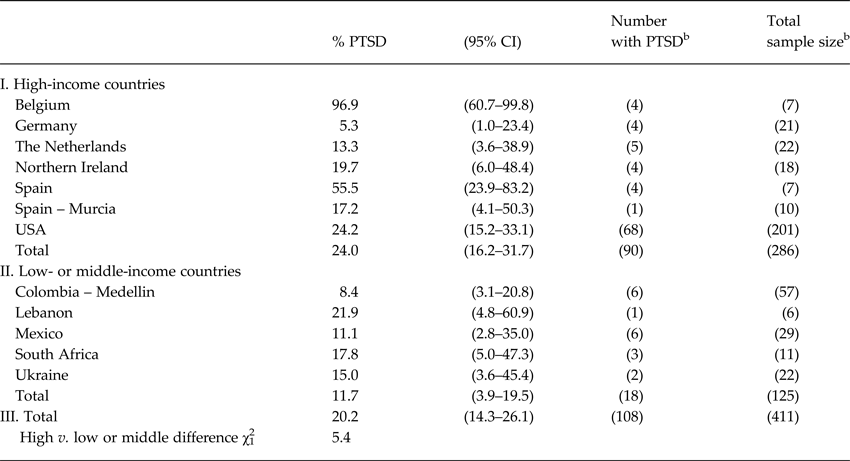
Prevalence of PTSD associated with the randomly selected sexual assaults averaged 20.2% (n = 108) across surveys (Table 2) and was significantly higher in high-income than in low-/middle-income countries (24.0% v. 11.7%; χ2 1 = 5.4, p = 0.020).
Prevalence of DSM-IV/CIDI PTSD associated with sexual assault among female respondents with randomly selected sexual assault by survey (n = 411) a

a Each respondent who reported lifetime exposure to one or more TEs had one occurrence of one such experience selected at random for detailed assessment. Each of these randomly selected TEs was weighted by the inverse of its probability of selection at the respondent level to create a weighted sample of TEs that was representative of all TEs in the population. The randomly selected sexual assaults were the subset of these randomly selected TEs involving sexual assault. The sum of weights of the randomly selected sexual assaults was standardized within surveys to sum to the observed number of female respondents whose randomly selected TE was a sexual assault. The n reported in the last column of this table represents that number of respondents. The results reported here are for the surveys where at least one female respondent with a randomly selected sexual assault met DSM-IV/CIDI criteria for PTSD related to that TE. Eight surveys were excluded because there were no cases of PTSD associated with the randomly selected sexual assault: Brazil (n = 4), Colombia (n = 26), Israel (n = 13), Japan (n = 4), Peru (n = 17), Romania (n = 5), France (n = 8), Italy (n = 7). Male respondents were excluded because of the small number of men across surveys whose randomly selected TE was sexual assault (n = 32)
b The reported sample sizes are unweighted. The unweighted proportions of respondents with PTSD do not match the prevalence estimates in the first column because the latter were based on weighted data.
Predictors of PTSD
Models 1 and 2
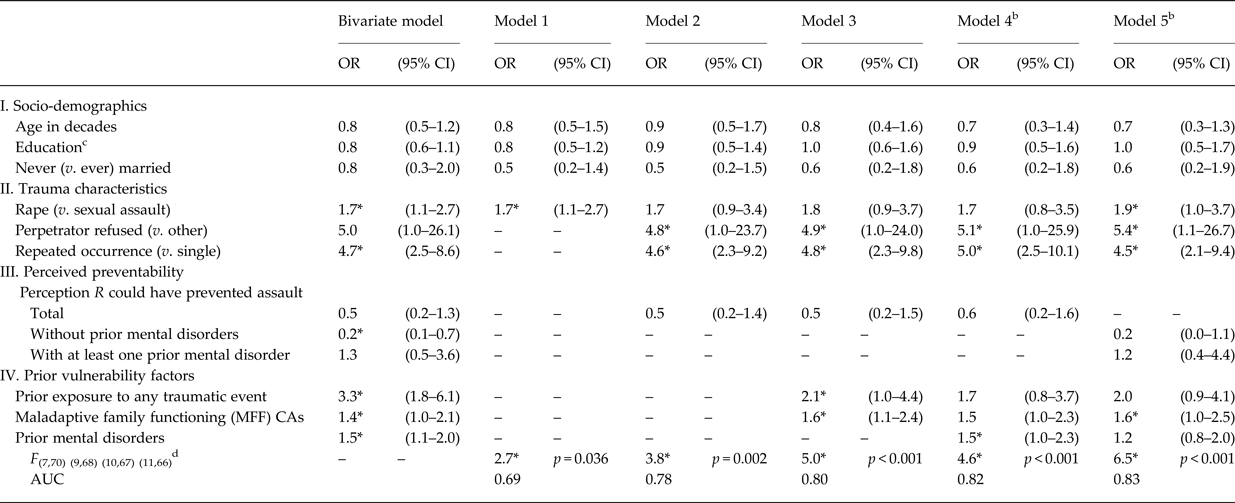
Respondent age, education, and marital status at time of assault were not significant predictors of PTSD (Table 3). Two sexual assault characteristics were associated with elevated odds of PTSD: the identity of the perpetrator, with respondents refusing to disclose this identity (5.3% of respondents) having significantly elevated odds of PTSD [odds ratio (OR) 4.8; 95% confidence interval (CI) 1.0–23.7], and repeated occurrences (42.4% of respondents) associated with significantly elevated odds (OR 4.6; 95% CI 2.3–9.2). The distinction between rape and other sexual assault was not significant in Model 2, although rape had higher odds of PTSD in the model that did not control for other assault characteristics. Perceived preventability was not a significant predictor of PTSD. We elaborated the model to include a control for number of years between age at assault and age at interview (to adjust for biased recall related to length of the recall period) and found it was not significant (OR 0.9; 95% CI 0.7–1.2).
Associations of socio-demographic, trauma characteristics, and prior stressors with PTSD (n = 411) a

*Significant at the 0.05 level, two-sided test
a Models were based on weighted data. See the text for details. Each model included dummy variable controls for WMH survey
b Model 4 was expanded to evaluate six interactions between two characteristics of the trauma (repeated occurrence; R could have prevented) and three prior stress measures (any prior TE; number of MFF CA's, and prior mental disorders). The global significance associated for these six interaction terms was F 6,71 = 1.1; p = 0.36. Individual significance was associated twice, using traditional p values and again using p values adjusted for false discovery rate (FDR): Repeated occurrence × any prior TE (p = 0.70; p FDR = 0.99); repeated occurrence × number of MFF CA's (p = 0.91; p FDR = 0.99); repeated occurrence × prior mental disorders (p = 0.30; p FDR = 0.81); R could have prevented × any prior TE (p = 0.99; p FDR = 0.99); R could have prevented × number of MFF CA's (p = 0.41; p FDR = 0.81); R could have prevented × prior mental disorders (p = 0.023; p FDR = 0.14)
c Values for education ranged from 1 to 4 (low, low average, high average, and high) using a country-specific coding scheme
d Design-based F tests were used to evaluate significance of predictor sets, with numerator degrees of freedom equal to number of predictors and denominator degrees of freedom equal to number of geographically clustered sampling error calculation units containing randomly selected sexual assaults across surveys (n = 249) minus the sum of primary sample units from which these sampling error calculation units were selected (n = 173) and one less than the number of variables in the predictor set, resulting in 76 denominator degrees of freedom in evaluating bivariate associations and fewer in evaluating multivariate associations
Model 3
Preliminary analyses of the joint associations between prior exposure to the 29 TEs and PTSD after the focal sexual assault found that the most stable specification had a single predictor for prior exposure to any TE (71.6% of respondents). Net of the predictors in Model 2, this dichotomy had OR 2.1; 95% CI 1.0–4.4 predicting PTSD. Preliminary analyses of the joint associations between CAs and PTSD after the focal sexual assault found that a count of maladaptive family functioning CAs (27.5% of respondents had 1 and 29.7% 2+) was the most parsimonious measure, with OR 1.6; 95% CI 1.1–2.4.
Model 4
Preliminary analyses of the joint associations between prior lifetime DSM-IV/CIDI disorders and PTSD after the focal sexual assault found that a count of number of mental disorders (57.4% of respondents had 0, 22.1% 1, and 20.4% 2+) was the most parsimonious measure, with OR 1.5; 95% CI 1.0–2.3. The introduction of this variable into Model 4 led to the OR for prior TEs to become non-significant, suggesting that the association of prior TEs with PTSD was partly mediated by intervening mental disorders.
Model 5
We investigated interactions of trauma characteristics and perceived preventability with prior vulnerability factors. The only significant interaction was between prior mental disorders and perceived preventability of the assault (χ2 1 = 6.0, p = 0.016). Perceived preventability was associated with reduced odds of PTSD among respondents with no history of prior mental disorders (OR 0.2; 95% CI 0.1–1.1) and increased odds of PTSD among those with such a history (OR 1.2; 95% CI 0.4–4.0), neither of which is significant even though the difference between the two is significant. However, the inverse association of perceived preventability with PTSD among respondents with no prior mental disorder was significant in the bivariate model (OR 0.2; 95% CI 0.1–0.7). Caution is needed in interpreting this result, though, as the set of six interactions was not significant overall (F 6,71 = 1.1, p = 0.36) and the interaction between perceived preventability and prior mental disorder was only significant at the 0.14 level when we adjusted for multiple comparisons using the false discovery rate method (Benjamini & Hochberg, Reference Benjamini and Hochberg1995). The distinction between rape and other sexual assault was also significant in this model.
Consistency and strength of overall model predictions
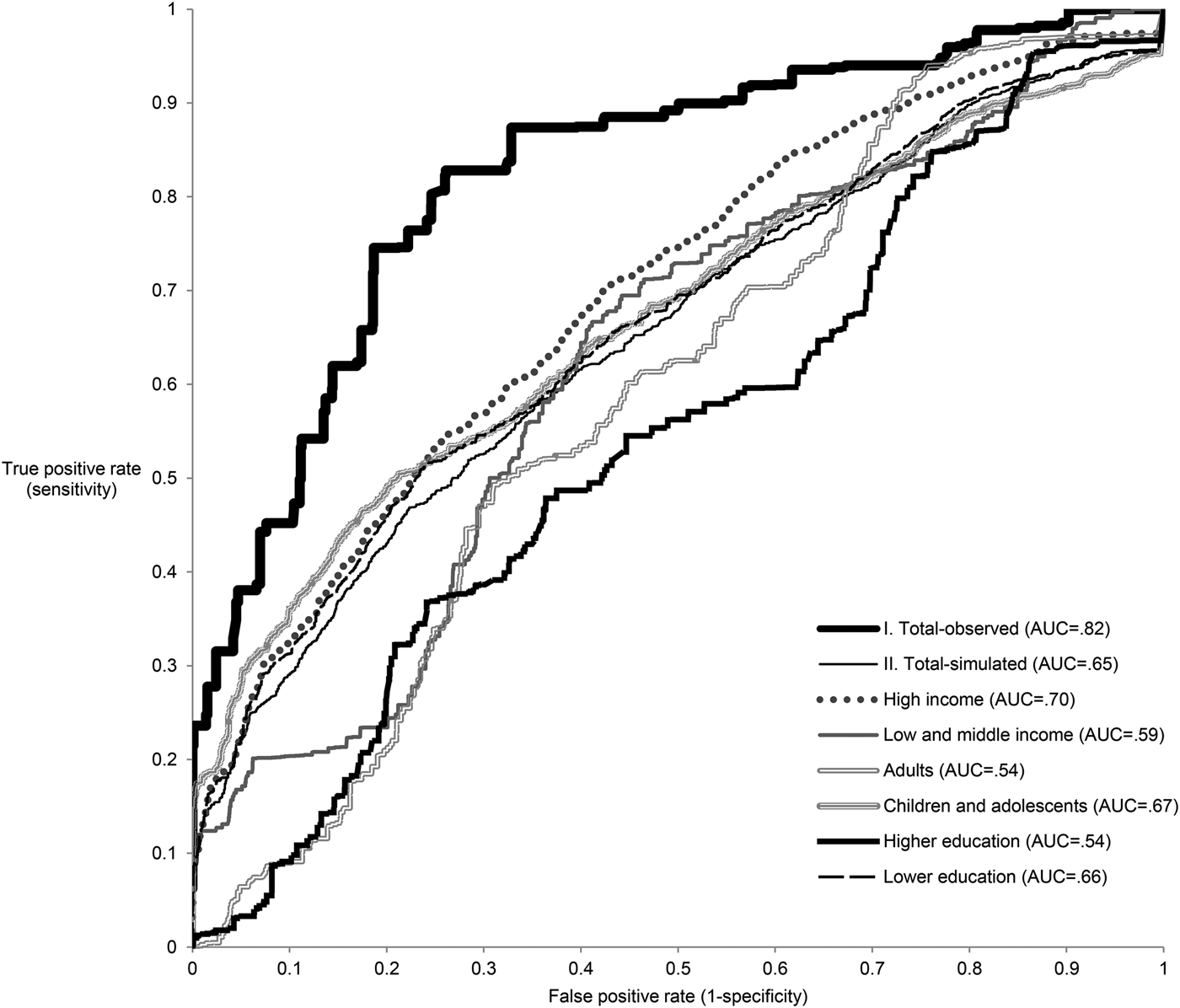
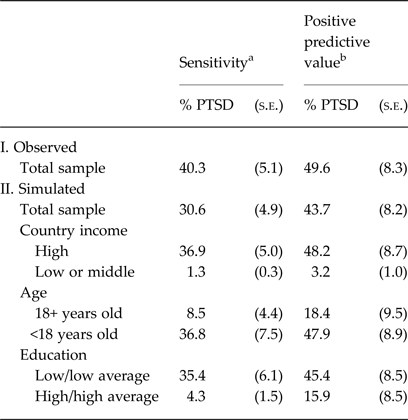
We compared overall model fit in subsamples by calculating individual-level predicted probabilities from Model 5, estimating ROC curves from these predicted probabilities (Fig. 1), and calculating subsample AUCs. As noted earlier, we adjusted for overfitting by estimating AUC with 20 simulated replicates of 10-fold cross-validated predictions. AUC was 0.83 in the total observed sample, 0.64 in the total simulated sample, and 0.54–0.69 in simulated subsamples defined by respondent sex, age, and education. Although the latter AUC values are weak-to-intermediate overall, the steep slope of the simulated ROC curves when the false negative rate is low means that we would expect a high proportion of cases in other samples to be found by focusing on respondents with high predicted risk. Specifically, we estimate that 30.6% of all women with PTSD (sensitivity) would be found among the 10% of women with highest predicted risk if the model coefficients were applied to an independent sample (compared with an observed 40.3% in the WMH data) (Table 4). Among the 10% of women with highest predicted risk, we would expect 43.7% (49.6% in the WMH data) to develop PTSD in the absence of a targeted preventive intervention (positive predictive value).
Receiver operating characteristic curves for the prediction equation in the total sample and subsamples.

Observed sensitivity and positive predictive value of PTSD in the top 10th percentile of predicted PTSD in the total sample and projected values of these statistics in independent samples based on 20 replications of 10-fold cross-validation

As model fit would be weaker if the coefficients from this model were applied to an independent sample, 20 replicates of 10-fold cross-validation were used to simulate the expected values of sensitivity and positive predicted value in an independent sample if the coefficients estimated in the current sample were applied to that hypothetical sample. See Smith et al. (Reference Smith, Seaman, Wood, Royston and White2014) for a discussion.
a Sensitivity is the proportion of all PTSD found among the 10% of respondents with the highest predicted probabilities based on Model 5 in Table 3
b Positive predictive value is the prevalence of PTSD among respondents in the row who are among the 10% in the total sample with the highest predicted probabilities based on the Model 5 in Table 3
Sensitivity analysis
Given that AUC was lower for respondents with adult than child–adolescent ages of exposure and those with low/low-average educations in low-/middle-income countries, we elaborated the final model (Table 3, Model 5) to include interactions between each of these three potentially important specifiers and the significant predictors in the final model. While global interactions were significant with both age-at-exposure and county income, only one interaction was significant in each set (prior TEs with age-at-exposure; could have prevented with country income) and both of those interactions were highly unstable (OR 42.7; 95% CI 3.5–525.5 for TEs × older age-at-exposure; OR 208.2; 95% CI 11.7–3721.0 for could have prevented × high country income) and replicated cross-validated model performance was not improved by using this more complex specification than Model 5.
Discussion
These results should be considered in light of the study limitations. One significant limitation relates to the sample of sexual assault survivors. This was not large enough to allow the development of a fine-grained prediction model, and due to the low prevalence of sexual assaults among males in the sample, this analysis could focus on women only. A second significant limitation is the cross-sectional nature of the data with reliance on retrospective reporting of sexual assaults and mental disorders. Sexual assaults are known to be quite substantially under-reported (Williams, Reference Williams1994; Widom & Morris, Reference Widom and Morris1997) with unknown effects on the estimates of associated mental health outcomes. The use of face-to-face interviews may have increased the likelihood of non-disclosure of sexual assaults. Retrospective reports of mental disorders also underestimate prevalence (Takayanagi et al. Reference Takayanagi, Spira, Roth, Gallo, Eaton and Mojtabai2014) and may result in inaccuracies in onset timing (Simon & Von Korff, Reference Simon and Von Korff1995). Recall of prior lifetime TE exposures and/or mental disorders may also have differed among those with PTSD v. those without PTSD (Zoellner et al. Reference Zoellner, Foa, Brigidi and Przeworski2000; Brewin, Reference Brewin2011). It is difficult to determine the effects of these multiple biases on the predictive modelling but they underscore the fact that this study must be considered exploratory in nature with confirmation required in prospective designs. A third important limitation is that the WMH surveys did not assess other potentially important predictors of PTSD following sexual assault, such as perceived life threat, other post-assault cognitions, and social factors.
Nonetheless, this is a rare general population study of PTSD associated with a representative sample of sexual assaults, and the largest such study to date. We are aware of only one prior study of randomly selected traumas and PTSD: the Detroit Area Survey of Trauma (Breslau et al. Reference Breslau, Kessler, Chilcoat, Schultz, Davis and Andreski1998). The Detroit study, based on 59 sexual assault survivors, found higher PTSD prevalence of 49% among rape survivors and 24% among other sexual assault survivors, compared with 20.2% for rape and sexual assault combined in this study. The higher prevalence of PTSD in the Detroit study may reflect its setting (urban Detroit) and lower up age bound. The other important difference is that this is an international study and we found PTSD prevalence in general (i.e. not just among sexual assault survivors) to be lower in the lower income countries, bringing the average prevalence of PTSD across countries down. It should be noted that this cross-national pattern is not confined to PTSD but is evident in the prevalence of many of the mental disorders assessed in the WMH surveys; it may reflect a wide range of methodological and/or substantive factors (Scott et al. Reference Scott, de Jonge, Stein and Kessler2018).
We found that perpetrator identity was a significant predictor of PTSD, although only the undisclosed (refused) type. If we assume that refused disclosure is indicative of a perpetrator who is known to the victim, then this finding is consistent with prior research showing greater PTSD risk when perpetrators are intimates of victims (Ullman et al. Reference Ullman, Filipas, Townsend and Starzynski2006; Temple et al. Reference Temple, Weston, Rodriguez and Marshall2007; Campbell et al. Reference Campbell, Dworkin and Cabral2009), possibly due to feelings of shame and self-blame. Although we did not find elevated PTSD risk associated with other known perpetrators (e.g. spouse, relatives), this may be due to the inclusion in models of an indicator of repeated occurrence of the assault, as repeat assaults are usually perpetrated by intimates of victims.
It is notable that we did not find prior sexual assaults associated with increased PTSD risk, which is inconsistent with prior studies (Nishith et al. Reference Nishith, Mechanic and Resick2000; Chen et al. Reference Chen, Murad, Paras, Colbenson, Sattler, Goranson, Elamin, Seime, Shinozaki and Prokop2010). But we did find that a wide range of prior trauma exposures, including but not limited to prior sexual assaults, were significant predictors of PTSD. It is also noteworthy that maladaptive family functioning CAs were independent predictors of PTSD; sexual assault by a family member was included in the composite scale of these CAs. But our detailed preliminary modelling of both the TE data and CAs data suggest that the role of prior sexual assault history is difficult to disentangle from other related TEs and CAs, consistent with prior research (Mullen et al. Reference Mullen, Martin, Anderson, Romans and Herbison1993, Reference Mullen, Martin, Anderson, Romans and Herbison1996).
We found that respondent perception that they could have prevented the assault was associated with reduced risk of PTSD among women without prior mental disorder, but no such protective effect was found among women with prior mental disorder. Counterfactual theory (Roese, Reference Roese1997) poses that after events that provoke negative emotions, people reflect on how things might have been different. These reflections take the form of either ‘upwards counterfactuals’ that focus on how things could have turned out better (‘if only…’) or ‘downwards counterfactuals’ that focus on how things could have turned out worse (‘at least…’) (Roese, Reference Roese1997). Upwards counterfactual thinking is hypothesized to be distressing in the short term but adaptive in the longer term because it leads to the development of behavioural intentions that generate a sense of future control (Roese, Reference Roese1997). Research among sexual assault survivors has not generally supported this hypothesis (Branscombe et al. Reference Branscombe, Wohl, Owen, Allison and N'gbala2003; Miller et al. Reference Miller, Handley, Markman and Miller2010), but at least one study (not among sexual assault survivors) suggests that whether upwards counterfactuals are adaptive may depend on mental health status (Markman & Miller, Reference Markman and Miller2006). This might explain why we found that positive endorsement of an item tapping counterfactual preventability thinking was associated with reduced risk of PTSD only among women without prior mental disorder. But this needs confirmation in a prospective study of sexual assault survivors utilizing more comprehensive assessment of counterfactual preventability cognitions.
The final result of note is that our multivariate model suggests that 40.3% (30.6% in the simulation) of sexual assault victims with PTSD would be found among the 10% of victims with highest predicted risk, and that 49.6% (43.7% in the simulation) of those in the model-classified highest risk group would go on to develop PTSD. These findings are consistent with other more general studies showing that PTSD can be predicted in the peritraumatic period from information about pre-trauma risk factors, trauma characteristics, and early trauma responses (Galatzer-Levy et al. Reference Galatzer-Levy, Karstoft, Statnikov and Shalev2014; Kessler et al. Reference Kessler, Rose, Koenen, Karam, Stang, Stein, Heeringa, Hill, Liberzon and McLaughlin2014; Karstoft et al. Reference Karstoft, Galatzer-Levy, Statnikov, Li and Shalev2015). These expectations are, of course, based on the possibly incorrect assumption that the associations found here in the retrospective WMH data would also hold in prospective analyses. We are unable to evaluate the plausibility of this assumption here, but the results are nonetheless useful in showing strong enough associations to warrant future prospective studies that test and refine this kind of model.
In conclusion, given the limitations of the retrospective data, the value of this study is less in the specific predictors identified by our model than in the fact that our study shows that it might be possible in a prospective analysis to develop a prediction model that targets sexual assault victims at high risk of developing PTSD. If this ability of multivariate modelling to predict those at risk of PTSD following sexual assault is borne out in prospective data, it will be of great practical value in the development of screening assessments to identify those sexual assault survivors most in need of preventive interventions. This is a necessary step in optimizing the clinical utility of the resource-intensive preventive interventions for sexual assault survivors.
Acknowledgments
This work was carried out in conjunction with the World Health Organization World Mental Health (WMH) Survey Initiative, which is supported by the National Institute of Mental Health (NIMH; R01 MH070884 and R01 MH093612-01), the John D. and Catherine T. MacArthur Foundation, the Pfizer Foundation, the US Public Health Service (R13-MH066849, R01-MH069864, and R01 DA016558), the Fogarty International Center (FIRCA R03-TW006481), the Pan American Health Organization, Eli Lilly and Company, Ortho-McNeil Pharmaceutical, Inc., GlaxoSmithKline, and Bristol-Myers Squibb. The authors thank the staff of the WMH Data Collection and Data Analysis Coordination Centres for assistance with instrumentation, fieldwork, and consultation on data analysis. None of the funders had any role in the design, analysis, interpretation of results, or preparation of this paper. A complete list of all within-country and cross-national WMH publications can be found at http://www.hcp.med.harvard.edu/wmh/. The Mental Health Study Medellín – Colombia was carried out and supported jointly by the Center for Excellence on Research in Mental Health (CES University) and the Secretary of Health of Medellín. The ESEMeD project is funded by the European Commission (Contracts QLG5-1999-01042; SANCO 2004123, and EAHC 20081308), the Piedmont Region (Italy), Fondo de Investigación Sanitaria, Instituto de Salud Carlos III, Spain (FIS 00/0028), Ministerio de Ciencia y Tecnología, Spain (SAF 2000-158-CE), Departament de Salut, Generalitat de Catalunya, Spain, Instituto de Salud Carlos III (CIBER CB06/02/0046, RETICS RD06/0011 REM-TAP), and other local agencies and by an unrestricted educational grant from GlaxoSmithKline. The Lebanese National Mental Health Survey (L.E.B.A.N.O.N.) is supported by the Lebanese Ministry of Public Health, the WHO (Lebanon), National Institute of Health/Fogarty International Center (R03 TW006481-01), Sheikh Hamdan Bin Rashid Al Maktoum Award for Medical Sciences, anonymous private donations to IDRAAC, Lebanon, and unrestricted grants from AstraZeneca, Eli Lilly, GlaxoSmithKline, Hikma Pharmaceuticals, Janssen Cilag, Lundbeck, Novartis, and Servier. The Mexican National Comorbidity Survey (MNCS) is supported by the National Institute of Psychiatry Ramon de la Fuente (INPRFMDIES 4280) and by the National Council on Science and Technology (CONACyT-G30544- H), with supplemental support from the PanAmerican Health Organization (PAHO). The Northern Ireland Study of Mental Health was funded by the Health & Social Care Research & Development Division of the Public Health Agency. The Psychiatric Enquiry to General Population in Southeast Spain – Murcia (PEGASUS-Murcia) Project has been financed by the Regional Health Authorities of Murcia (Servicio Murciano de Salud and Consejería de Sanidad y Política Social) and Fundación para la Formación e Investigación Sanitarias (FFIS) of Murcia. The South Africa Stress and Health Study (SASH) is supported by the US National Institute of Mental Health (R01-MH059575) and National Institute of Drug Abuse with supplemental funding from the South African Department of Health and the University of Michigan. Dr Stein is supported by the Medical Research Council of South Africa (MRC). The Ukraine Comorbid Mental Disorders during Periods of Social Disruption (CMDPSD) study is funded by the US National Institute of Mental Health (RO1-MH61905). The US National Comorbidity Survey Replication (NCS-R) is supported by the National Institute of Mental Health (NIMH; U01-MH60220) with supplemental support from the National Institute of Drug Abuse (NIDA), the Substance Abuse and Mental Health Services Administration (SAMHSA), the Robert Wood Johnson Foundation (RWJF; Grant 044708), and the John W. Alden Trust. The funders had no role in the design and conduct of the study; collection, management, analysis, and interpretation of the data; preparation, review, or approval of the manuscript; and the decision to submit the manuscript for publication. The WHO WMH Survey collaborators are Sergio Aguilar-Gaxiola, M.D., Ph.D., Ali Al-Hamzawi, M.D., Mohammed Salih Al-Kaisy, M.D., Jordi Alonso, M.D., Ph.D., Laura Helena Andrade, M.D., Ph.D., Corina Benjet, Ph.D., Guilherme Borges, ScD, Evelyn J. Bromet, Ph.D., Ronny Bruffaerts, Ph.D., Brendan Bunting, Ph.D., Jose Miguel Caldas de Almeida, M.D., Ph.D., Graca Cardoso, M.D., Ph.D., Somnath Chatterji, M.D., Alfredo H. Cia, M.D., Louisa Degenhardt, Ph.D., Koen Demyttenaere, M.D., Ph.D., John Fayyad, M.D., Silvia Florescu, M.D., Ph.D., Giovanni de Girolamo, M.D., Oye Gureje, Ph.D., D.Sc., FRCPsych, Josep Maria Haro, M.D., Ph.D., Yanling He, M.D., Hristo Hinkov, M.D., Chi-yi Hu, Ph.D., M.D., Yueqin Huang, M.D., MPH, Peter de Jonge, Ph.D., Aimee Nasser Karam, Ph.D., Elie G. Karam, M.D., Norito Kawakami, M.D., DMSc, Ronald C. Kessler, Ph.D., Andrzej Kiejna, M.D., Ph.D., Viviane Kovess-Masfety, M.D., Ph.D., Sing Lee, Ph.D., Jean-Pierre Lepine, M.D., Daphna Levinson, Ph.D., John McGrath, M.D., Ph.D., Maria Elena Medina-Mora, Ph.D., Jacek Moskalewicz, DrPH, Fernando Navarro-Mateu, M.D., Ph.D., Beth-Ellen Pennell, M.A., Marina Piazza, M.P.H., Sc.D., Jose Posada-Villa, M.D., Kate M. Scott, Ph.D., Tim Slade, Ph.D., Juan Carlos Stagnaro, M.D., Ph.D., Dan J. Stein, FRCPC, Ph.D., Margreet ten Have, Ph.D., Yolanda Torres, M.P.H., Dra.HC, Maria Carmen Viana, M.D., Ph.D., Harvey Whiteford, Ph.D., David R. Williams, M.P.H., Ph.D., Bogdan Wojtyniak, Sc.D.
Declaration of Interest
In the past 3 years, Dr Kessler received support for his epidemiological studies from Sanofi Aventis, was a consultant for Johnson & Johnson Wellness and Prevention, and served on an advisory board for the Johnson & Johnson Services Inc. Lake Nona Life Project. Kessler is a co-owner of DataStat, Inc., a market research firm that carries out healthcare research. The other authors report no biomedical financial interests or potential conflicts of interest. In the past 3 years, Dr Stein has received research grants and/or consultancy honoraria from AMBRF, Biocodex, Cipla, Lundbeck, National Responsible Gambling Foundation, Novartis, Servier, and Sun.