Introduction
When assisted reproductive technology is used to treat human infertility, normal fertilization is identified by the presence of two pronuclei 16–18 h after insemination. However, following conventional in vitro fertilization (IVF) or intracytoplasmic sperm injection (ICSI), 2–8% of zygotes show a single pronucleus, defined as abnormal fertilization (Staessen and Van Steirteghem, Reference Staessen and Van Steirteghem1997; Kang and Rosenwaks, Reference Kang and Rosenwaks2008). Several possible mechanisms have been suggested as the origin of 1PN zygotes, including parthenogenesis, gynogenesis, androgenesis and asynchronous pronuclear appearance (Staessen et al., Reference Staessen, Janssenswillen, Devroey and Van Steirteghem1993; Nagy et al., Reference Nagy, Janssenswillen, Janssens, De Vos, Staessen, Van de Velde and Van Steirteghem1998; Rosenbusch, Reference Rosenbusch2014), a single pronucleus including both the maternal and paternal genomes (Levron et al., Reference Levron, Munne, Willadsen, Rosenwaks and Cohen1995), early pronuclei fusion (van der Heijden et al., Reference van der Heijden, van den Berg, Baart, Derijck, Martini and de Boer2009) and premature pronuclear breakdown (Azevedo et al., Reference Azevedo, Pinho, Silva, Sa, Thorsteinsdottir, Barros and Sousa2014). If 1PN zygotes were derived from parthenogenesis, gynogenesis, or androgenesis, then these embryos may result in a haploid embryo or spontaneous diploidization and may therefore be not suitable for clinical use. But the other mechanisms may not negate the result in abnormal embryos, and maybe use in the clinic.
However it is difficult to identify the origin of 1PN embryos under optical microscopes, so these 1PN embryos are widely considered to be unsuitable for transfer to patients, and consequently are typically discarded, especially those from ICSI cycles (Mateo et al., Reference Mateo, Parriego, Boada, Vidal, Coroleu and Veiga2013; Azevedo et al., Reference Azevedo, Pinho, Silva, Sa, Thorsteinsdottir, Barros and Sousa2014). Interestingly, some studies have reported that the transfer of embryos derived from 1PN zygotes result in normal births, in both IVF and ICSI (Staessen et al., Reference Staessen, Janssenswillen, Devroey and Van Steirteghem1993; Barak et al., Reference Barak, Kogosowski, Goldman, Soffer, Gonen and Tesarik1998; Gras and Trounson, Reference Gras and Trounson1999; Dasig et al., Reference Dasig, Lyon, Behr and Milki2004; Reichman et al., Reference Reichman, Jackson and Racowsky2010). Lately, with the improvement of blastocyst culture and cryopreservation technology, 1PN embryos are beginning to be selected for blastocyst culture and are used in fresh cycles, or are cryopreserved for subsequent use in frozen–thawed cycles; this practice has led to normal births from both IVF and ICSI (Itoi et al., Reference Itoi, Asano, Shimizu, Honnma and Murata2015; Bradley et al., Reference Bradley, Traversa, Hobson, Gee and McArthur2017; Capalbo et al., Reference Capalbo, Treff, Cimadomo, Tao, Ferrero, Vaiarelli, Colamaria, Maggiulli, Orlando, Scarica, Scott, Ubaldi and Rienzi2017; Mateo et al., Reference Mateo, Vidal, Parriego, Rodriguez, Montalvo, Veiga and Boada2017; Xie et al., Reference Xie, Tang, Hu, Ouyang, Gu, Gong, Leng, Zhang, Xiong, Lu and Lin2018). Notability, the majority of children born from blastocyst embryos transfer (ET) involved preimplantation genetic testing (PGT) technology, particularly those from ICSI cycles (Bradley et al., Reference Bradley, Traversa, Hobson, Gee and McArthur2017; Capalbo et al., Reference Capalbo, Treff, Cimadomo, Tao, Ferrero, Vaiarelli, Colamaria, Maggiulli, Orlando, Scarica, Scott, Ubaldi and Rienzi2017; Mateo et al., Reference Mateo, Vidal, Parriego, Rodriguez, Montalvo, Veiga and Boada2017; Xie et al., Reference Xie, Tang, Hu, Ouyang, Gu, Gong, Leng, Zhang, Xiong, Lu and Lin2018). It has not yet been established whether PGT should be used for all 1PN transfers. Due to the limited number of studies related to 1PN ET, as well as the low numbers of cases described in existing studies, there is still controversy over the use of 1PN embryos in the clinic. To address these issues, we retrospectively studied the clinical outcomes of 1PN ET in both fresh and frozen–thawed IVF and ICSI cycles in the Third Hospital, attached to Beijing University, between January 2014 and June 2018. The study is the first to describe a detailed analysis of the results of 1PN transfer with an adequate number of cases, and provides valuable suggestions for future clinical work.
Materials and methods
Patients and cycles
The current study was a retrospective analysis of the clinical outcomes of embryos showing zygotic stages with 1PN. In total, 73,971 fresh embryo transfers, and 36,697 frozen–thawed embryo transfers in patients undergoing IVF-ET and ICSI-ET were included. The fresh cycles involved the transfer of 113 and 70 1PN cleavage-stage embryos (1PN cleavage fresh) in IVF and ICSI cycles, respectively. The frozen–thawed cycles involved the transfer of 196 and 59 1PN blastocyst-stage embryos (1PN blast frozen) in IVF and ICSI cycles, respectively. Cases involving rescue ICSI cycles (after failure of IVF fertilization), in vitro maturation cycles, PGT cycles, and artificial oocyte activation cycles were excluded.
Laboratory protocols
Controlled ovarian hyperstimulation for oocyte retrieval was performed by standard procedures as described previously (Liu et al., Reference Liu, Ma, Li, Jin, Li, Huang, Feng and Qiao2012). The oocytes were retrieved between 36 and 38 h after hCG administration and insemination were performed with either conventional IVF or ICSI. For IVF, oocytes were inseminated 3–4 h after oocyte retrieval. Spermatozoa were collected by the swim-up technique, using 100,000 motile spermatozoa per insemination dish. For ICSI, cumulus cells of oocytes was stripped 2 h after retrieval, and ICSI was performed as previously described (Palermo et al., Reference Palermo, Joris, Devroey and Van Steirteghem1992). Normal fertilization was evaluated 16–19 h after insemination based on the presence of two pronuclei (2PN). The zygotes were divided into 2PN, >2PN, non-pronuclear (0PN) and 1PN groups and cultured. Available embryos were transferred at day 3 after oocyte retrieval. Supernumerary transferable D3 embryos (including 1PN embryos) were continuously cultured to the blastocyst stage in the fresh cycles; Embryos were vitrification on either day 5 or day 6 if a transferable blastocyst formed. The protocols of vitrification were performed as previously described (Chen et al., Reference Chen, Zheng, Yan, Qiao and Liu2013). To assess the developmental potential of cleavage-stage 1PN embryos, we compared transferable blastocyst and blastulation rates between supernumerary cleavage-stage 1PN and 2PN embryos. The cycles in which at least one cleavage-stage 1PN embryo was observed were compared with cycles with cleavage-stage 2PN embryos obtained in the same IVF or ICSI cycles.
Transferable embryos were defined by day 3 cleavage-stage embryos with ≥4 cells and ≤30% fragmentation. Embryos that developed to the blastocyst stage were scored using the grading system of Gardner et al. (Reference Gardner, Lane, Stevens, Schlenker and Schoolcraft2000). Transferable blastocysts were defined by blastocysts reaching a score of ≥3 BB. Clinical pregnancy rate (PR) was confirmed by the detection of a gestational sac through transvaginal ultrasound examination at 5 weeks after transfer. The implantation rate (IR) was determined by dividing the number of gestational sacs by the number of embryos transferred. The miscarriage rate (MR) was determined by dividing the number of miscarriage cycles by the number of transferred cycles. Live birth rate (LBR) was determined by dividing the number of live delivery cycles by the number of transferred cycles.
Cycle matches
Control groups were set up for fresh cycles (113 cycles with cleavage-stage embryos in IVF and 70 in ICSI, 2PN cleavage fresh) and cryopreservation-warming cycles (196 cycles with blastocyst-stage embryos in IVF and 59 in ICSI, 2PN blast frozen) to study the effect of 1PN transfer. Control groups were used to research whether or not the outcomes of 1PN transfer were related to the source of embryos derived from 1PN zygotes. Accordingly, the characteristics of patient were aligned between the 1PN groups and the control groups. The inclusion criteria for control groups were: (1) matched by number of oocytes retrieved, female age, infertility cause and insemination technology (IVF or ICSI) between the 1PN groups and control groups; and (2) transfer of embryos just from 2PN zygote during the same period as in the 1PN group.
Statistical analysis
All date were analyzed with the Statistical Package for the Social Sciences software (SPSS, version 17.0; SPSS, Inc., Chicago, IL, USA). Categorical variables were evaluated with chi-squared tests while continuous variables were compared using analysis of Student's t-test (the basic characteristics of the patients). A P-value <0.05 was considered statistically significant.
Results
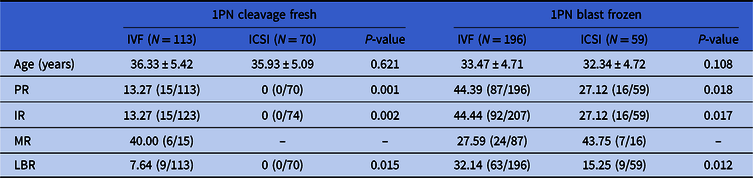
Pregnancy outcomes are show in Table 1. When ICSI cycles were compared with IVF cycles, we found that the PR, IR or LBR in IVF were higher than those in ICSI, both for 1PN cleavage fresh and 1PN blast frozen groups (Table 1).
Outcome of 1PN embryo transfer

Data represent % (n/N) or mean ± standard deviation (SD). PR: clinical pregnancy rate; IR: implantation rate; MR: miscarriage rate; LBR: live birth rate.
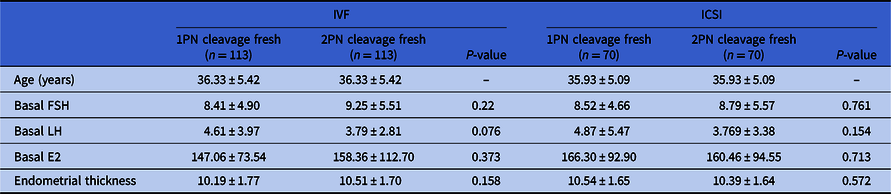
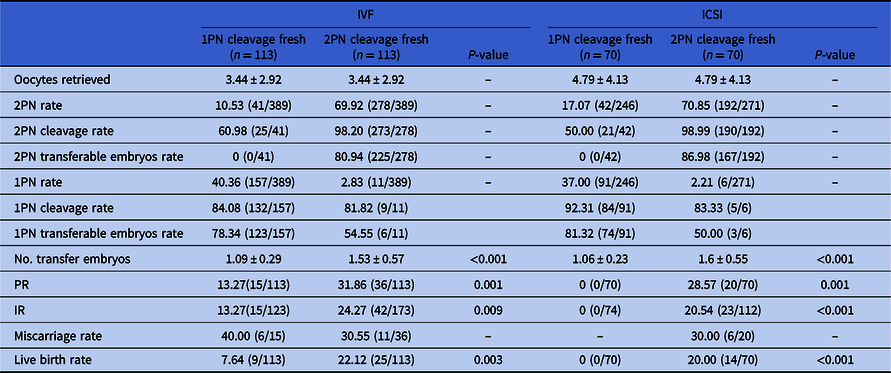
Although there were no differences in terms of patient characteristics [age, basal follicle-stimulating hormone (FSH), basal luteinizing hormone (LH), basal oestradiol (E2), endometrial thickness] between the 1PN cleavage fresh and 2PN cleavage fresh groups (Table 2), the PR, IR and LBR in the 1PN cleavage fresh group were lower than those in the 2PN cleavage fresh group, both for IVF and ICSI (Table 3).
Patient characteristics of 1PN and 2PN embryos in fresh cycles
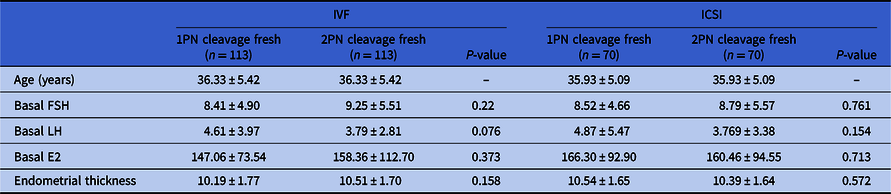
Data represent mean ± standard deviation (SD).
Comparison of embryo transfer outcomes in fresh cycles
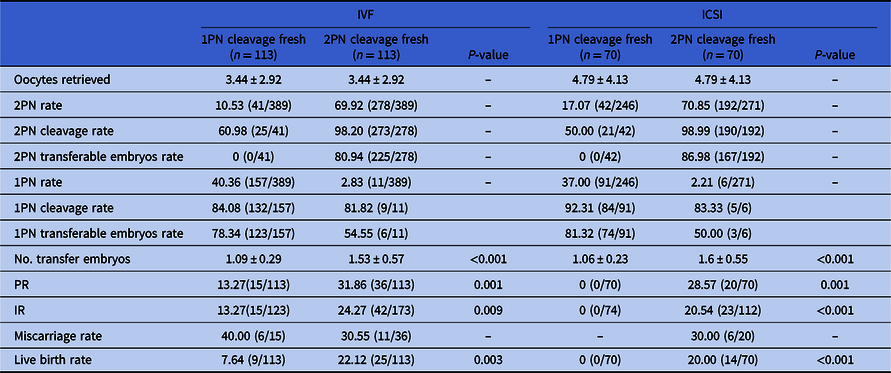
Data represent % (n/N) or mean ± standard deviation (SD). PR: clinic pregnancy rate; IR: implantation rate; MR: miscarriage rate; LBR: live birth rate.
Fresh cleavage-stage 1PN embryos that remained after transfer and that were further cultured to blastocysts had a lower blastocyst formation rate and transferable blastocyst rate than 2PN embryos, both for IVF and ICSI. 1PN embryos in ICSI had a lower blastocyst formation rate and transferable blastocyst rate than in IVF (Table 4).
Comparison of blastocyst culture outcomes between 1PN embryos and 2PN embryos

Data represent % (n/N)
a Comparison of outcomes between 1PN in IVF and 1PN in ICSI.
For frozen–thawed cycles, in IVF, the PR, IR and LBR in the 1PN blast frozen group were comparable with the 2PN blast frozen group (PR, 44.39% vs. 49.49%, respectively; P = 0.312; IR, 44.44% vs. 44.75%, respectively; P = 0.947; LBR, 32.14% vs. 37.24%, respectively, P = 0.289), while in ICSI, the PR, IR and LBR of the 1PN blast frozen group were lower than those of the 2PN blast frozen group (PR, 27.12% vs. 52.54%, respectively; P = 0.005; IR, 27.12% vs. 45.33%, respectively; P = 0.030; LBR, 15.25% vs. 40.68%, respectively; P = 0.002) (Table 5).
Comparison of embryo transfer outcomes in frozen–thawed cycles

Data represent N, % (n/N) or mean ± standard deviation (SD). PR: clinic pregnancy rate; IR: implantation rate; MR: miscarriage rate; LBR: live birth rate.
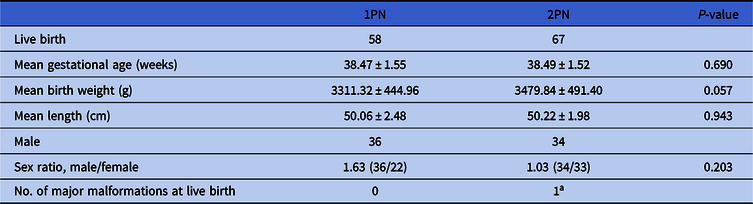
There were, in total, 86 live babies born after 1PN transfers and none of these presented with any major malformations (Table 6). We examined the neonatal data from the 1PN blast frozen group in IVF cycles compared with the 2PN blast frozen group in IVF cycles (Table 7). No statistical differences were evident in terms of birth gestational age (38.47 ± 1.55 vs. 38.49 ± 1.52 weeks), weight of singletons (3311.32 ± 444.96 g vs. 3479.84 ± 491.40 g) or length (50.06 ± 2.48 vs. 50.22 ± 1.98 cm).
Neonatal outcomes of 1PN embryo transfer

Data represent % (n/N) or mean ± standard deviation (SD).
Comparison of neonatal blastocyst transfer outcomes between 1PN embryos and 2PN embryos in IVF
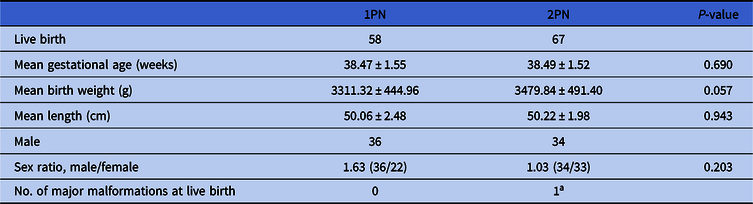
Data represent mean ± standard deviation (SD).
a Left hydronephrosis.
Discussion
During the complicated process of human fertilization, the formation of the female and male pronuclei is commonly synchronized (identified by the presence of 2PN). Pronucleus breakdown is also commonly synchronized without actual fusion of the pronuclear envelopes. Therefore, we should not find a single pronucleus during normal fertilization. However, approximately 2–8% of zygotes show a single pronucleus in human-assisted reproduction and are normally identified as cases of abnormal fertilization. As previously mentioned, several mechanisms have been suggested to account for the production of a 1PN zygote. According to the mechanisms involved (e.g. asynchronous pronuclear appearance, premature pronuclear breakdown), 1PN embryos may develop into normal embryos and result in healthy babies. In line with this, some studies have reported that 1PN embryos show normal diploidy and result in healthy offspring. In this study, 1PN embryo transfers resulted in pregnancies in fresh and frozen–thawed IVF and ICSI cycles; the fact that we generated 86 healthy babies clearly demonstrated that some 1PN embryos are normal and can be used successfully in the clinic.
Some studies have shown that 1PN zygotes have a poorer potential for embryo development, compared with 2PN embryos (Bradley et al., Reference Bradley, Traversa, Hobson, Gee and McArthur2017; Itoi et al., Reference Itoi, Asano, Shimizu, Honnma and Murata2015). Indeed, 1PN zygotes and cleavage embryos have been found to contain abnormal chromosomes after genetic analysis, particularly those arising from ICSI (Rosenbusch, Reference Rosenbusch2014). The high rate of abnormal chromosomes in such embryos might result in poorer embryo development. In this study, the IR of 1PN cleavage embryos was lower, and the 1PN blastocyst formation rate, were both significantly reduced in IVF and ICSI compared with 2PN embryos, as noted in earlier reports (Itoi et al., Reference Itoi, Asano, Shimizu, Honnma and Murata2015; Bradley et al., Reference Bradley, Traversa, Hobson, Gee and McArthur2017).
As mentioned above, 1PN cleavage embryos are associated with a high rate of chromosome abnormalities, both in IVF and ICSI; this may result in poor IR when cleavage-stage embryos are transferred. Many studies have reported that the IR of 1PN cleavage-stage embryos is very low; for example, Reichman et al. (Reference Reichman, Jackson and Racowsky2010) reported an IR of only 6.4% and 1.3% from IVF or ICSI, respectively. It is also known that embryos with chromosomal abnormalities will more likely fail to culture to the blastocyst stage (Kroener et al., Reference Kroener, Ambartsumyan, Briton-Jones, Dumesic, Surrey, Munne and Hill2012; Vega et al., Reference Vega, Breborowicz, Moshier, McGovern and Keltz2014), and that blastocyst culture is an effective method for selecting ‘normal’ embryos. In a study by Itoi et al. (Reference Itoi, Asano, Shimizu, Honnma and Murata2015), IR reached 30.30% (11/33) after the transfer of 1PN blastocysts in IVF, resulting in nine deliveries with no malformations. The outcome from Itoi et al. was acceptable in clinic use. We observed a similar outcome in the IVF cycles of our present study: the IR for 1PN embryos was lower than that of 2PN embryos for cleavage-stage embryo transfers, while the IR was comparable between 1PN and 2PN for blastocyst-stage embryo transfers. The rate of blastocyst formation and the number of transferable blastocysts after cleavage-stage 1PN embryo culture were lower than for cleavage-stage 2PN embryo culture. Based on the above results, we strongly suggest that 1PN embryos should be cultured to blastocyst and transfer.
However, our ICSI study gave a very different outcome. For ICSI, the IR of 1PN embryos was lower than that of 2PN embryos for blastocyst transfer; similarly, the IR of 1PN embryos in ICSI was lower than that in IVF in terms of blastocyst transfer. The precise reasons for these differences between IVF and ICSI are not clear. Some studies have shown that the rate of chromosomal abnormalities in 1PN zygotes and cleavage embryos was higher in ICSI than that in IVF (Sultan et al., Reference Sultan, Munne, Palermo, Alikani and Cohen1995; Staessen and Van Steirteghem, Reference Staessen and Van Steirteghem1997; van der Heijden et al., Reference van der Heijden, van den Berg, Baart, Derijck, Martini and de Boer2009; Yan et al., Reference Yan, Li, Shi, Feng, Gao and Chen2010). Such differences ‘should’ have been eliminated according to the ‘blastocyst culture’ hypothesis, but it appears that this theory does not apply to ICSI. Liao et al. (Reference Liao, Zhang, Cheng, Ouyang, Lin, Gu, Lu, Gong and Lu2009) found that blastocyst culture is an effective method with which to eliminate abnormal karyotypes in 1PN embryos, particularly haploids. However, the same study stated that the ability to reach the blastocyst stage is not a responsible approach for other abnormalities (mosaicism or aneuploidy). In line with this, the genetic analysis of 1PN cleavage embryos, from 11 studies, showed overall ‘other chromosomal abnormalities’ rates (excluding haploids) of 40.44% (91/225) in ICSI, which was higher than the 24.03% encountered in IVF (Rosenbusch, Reference Rosenbusch2014). Consequently, these ‘other chromosomal abnormalities’ reduced the efficiency of blastocyst culture in ICSI cycles. Other studies might provide other clues. For example, Lin et al. (Reference Lin, OuYang, Zhou, Gu, Yuan, Li, Liu, Liu and Lu2007) noted that 1PN blastocysts might also originate from parthenogenetic embryos, due to the fact that haploid oocytes might undergo spontaneous duplication of the haploid genome during blastocyst development. Another study showed that 69.70% (23/33) of the 1PN zygotes in ICSI appeared to be uniparental compared with just 13.33% (6/45) in IVF (van der Heijden et al., Reference van der Heijden, van den Berg, Baart, Derijck, Martini and de Boer2009). In another study, Bradley et al. (Reference Bradley, Traversa, Hobson, Gee and McArthur2017) found that one in nine 1PN embryos from ICSI were ‘normal’ and had only a paternal contribution; in IVF, all 15 1PN embryos were biparental in IVF. Xie et al. (Reference Xie, Tang, Hu, Ouyang, Gu, Gong, Leng, Zhang, Xiong, Lu and Lin2018) further reported that four cases of uniparental inheritance were found in 14 ‘normal’ diploid blastocysts in ICSI. These findings seem to indicate that, compared with IVF, 1PN embryos from ICSI are more likely to originate from ‘diploid’ parthenogenetic embryos that are not effectively eliminated after blastocyst culture and resulted in a low PR following blastocysts transfer. These studies may explain some possible reasons why blastocyst culture alone is not sufficiently efficient to select normal 1PN embryos in ICSI cycles. Therefore, it could be suggested that 1PN embryos should undergo PGT after ICSI (involving confirmation of biparental inheritance) before transfer. Indeed, several studies have reported that healthy babies have been born from 1PN blastocyst transfer after PGT and ICSI (Bradley et al., Reference Bradley, Traversa, Hobson, Gee and McArthur2017; Capalbo et al., Reference Capalbo, Treff, Cimadomo, Tao, Ferrero, Vaiarelli, Colamaria, Maggiulli, Orlando, Scarica, Scott, Ubaldi and Rienzi2017; Mateo et al., Reference Mateo, Vidal, Parriego, Rodriguez, Montalvo, Veiga and Boada2017; Xie et al., Reference Xie, Tang, Hu, Ouyang, Gu, Gong, Leng, Zhang, Xiong, Lu and Lin2018). In our study, the IR was 27.12% for 1PN blastocyst transfer in ICSI, which could be acceptable in the clinic. However seven out of 16 pregnancies miscarried; this rate of miscarriage is unacceptably high. The LBR was also very low. Therefore, it is strongly recommended that 1PN embryos should undergo PGT after ICSI before embryo transfer. Collectively, our data suggest that, in IVF cycles, 1PN cleavage-stage embryos can be cultured to the blastocyst stage and be successfully transferred because blastocyst culture is an effective method with which to select ‘normal’ 1PN embryos for transfer. However, in ICSI, blastocyst culture is not effective enough to select ‘normal’ 1PN embryos and we strongly recommend that PGT is performed to identify diploid and biparental origin embryos prior to transfer.
Newborns arising from frozen–thawed blastocyst transfer showed that no statistical differences in birth weight and weeks of gestation when compared between 1PN and 2PN embryos in IVF and the all 1PN newborns reported in this study were healthy (from both IVF and ICSI cycles). A limited number of reports on neonatal outcomes of 1PN is currently available and other reports describing newborns from 1PN were inadequate as well. Therefore, the safety of 1PN transfer needs to be further explored with a larger sample size and long-term follow-up.
1PN transfer is of value, especially for older patients or patients with decreased ovarian reserve, as this increases the likelihood of pregnancy. Different strategies should be adopted for IVF and ICSI. In IVF, we suggest that embryos are cultured to the blastocyst stage and then transferred. In ICSI, PGT should be performed for all ICSI cases to identify embryos of diploid and biparental origin prior to 1PN embryo transfer. However, it should be emphasized that the transfer of 1PN embryo is the last choice, if any other 2PN embryo is available, and a genetic evaluation of the embryo before transfer is mandatory. All in all, according to our current findings, the transfer of 1PN embryos is safe and may result in healthy live births in IVF, but 1PN embryo transfer for ICSI needs to be treated with caution.
Financial support
This study was funded by the National Natural Science Foundation of China (Nos. 81671513 and 31701263)
Competing interests
There were no conflicts of interest.
Ethical standards
The study was approved by the Ethics Committee of Beijing University Third Hospital and was performed in accordance with relevant guidelines. All patients signed written informed consent.