INTRODUCTION
The racial and religious face of the United States (U.S.) has undergone a radical shift over the past 50 years. We have gone from a nation largely characterized as White and Black English speaking Judeo-Christians to a multi-ethnic, linguistic, and faith nation of people whose origins span the globe. Between 1965 and 2015, the Hispanic share of the U.S. population more than quadrupled going from 4 to 18%, while the Asian share grew from less than 1 to 6% (Pew Research Center 2015). Over this same period, we observe a roughly five-fold increase, from 5 to 23%, in the proportion of Americans that identify with non-Judeo-Christian faiths or no faith at all (Gallup Poll 2016). Between 1980 and 2011, the proportion of Americans who speak a language other than English at home nearly doubled, going from 11 to 21% (Ryan Reference Ryan2013; Suchan Reference Suchan2007).
The increasing racial, linguistic, and religious diversity of the U.S. has unfortunately allowed some political leaders to scapegoat immigrants and refugees as the cause of social problems in the U.S. The most notable example of this tactic is that of Republican, then, Presidential Candidate Donald Trump during the 2015–2016 American Presidential campaign. He often referenced Mexican immigrant criminality as a justification for his calls to construct a wall to keep undocumented immigrants out of the nation (British Broadcast Corporation 2016). He also frequently stoked fears of Muslim terrorists attacking the U.S., to garner support for his call to restrict refugees from Syria and Muslim immigrants more broadly (Politico Staff 2016). At the same time, progressive religious organizations and local congregations have taken the lead in challenging the framing of immigrants as the primary cause of the problems facing Americans (Democracy Now Reference Now2015; Sherwood Reference Sherwood2016). To that end, we are interested in the extent to which attending such congregations, whose leadership and congregational bodies are committed to serving and advocating for immigrants, associates with individuals rejecting anti-immigrant frames.
Religious organizations and congregations in the U.S. have a long history of pushing back against anti-immigrant and refugee sentiment (Nepstad Reference Nepstad2004; Smith Reference Smith2010). One of the best examples of such involvement was the presence and leadership of religious institutions at the May Day Protest of 2006 (Democracy Now 2006). These protests involved religious leaders, laity, and other immigrant rights activists participating in protest demonstrations in cities across the U.S. calling for policies that provided immigrants with a pragmatic path to citizenship (Democracy Now 2006). Protest participant Cardinal Roger M. Mahony from the Archdiocese of Los Angeles, encouraged his fellow Catholics to oppose laws such as HR-4437 aimed at profiling, detaining, and deporting immigrants. He stated that “immigration was not about politics, rather the way in which human beings treat one another,” while asserting that “all Americans are of immigrant ancestry and share universal citizenship” (Chavez Reference Chavez2013, 159).
For our purposes, the activism of religious leaders such as Cardinal Mahony raises questions about how common this type of speech and activism is within houses of worship and to what extent it associates with the frames that Americans have of immigrants. We examine these questions using the 2004 and 2008 National Politics Study to investigate the effect race has on who attends places of worship led by clergy who preach sermons about the immigrant experience and provide social programs for immigrants. We also examine the extent to which attending such congregations associates with Blacks, Whites, and Hispanics rejecting frames of immigrants threatening American economic security and culture.
The time frame between 2004 and 2008 is ideal for examining these questions given this period witnessed an increase in deportations. Between 2004 and 2013, deportations of non-criminal migrants increased by 62%, going from 148,000 to 240,000 (Gonzalez-Barrera and Krogstad Reference Gonzalez-Barrera and Krogstad2014). In response, the May Day protest of 2006, the largest immigrant rights protest in history at that time, took place during this period to oppose these deportations and support policies that assisted immigrants with obtaining citizenship. It is in this context that we examine the association between race, religion, and immigration attitudes in America.
ISSUE FRAMES AND IMMIGRATION
By issue frames, we refer to the way arguments are articulated so to resonate with and encourage a particular ideological interpretation of issues (Entman Reference Entman2007; Gross and D'Ambrosio Reference Gross and D'Ambrosio2004). Political and economic elites present issue frames through mass media in ways that often reinforce their disproportionate influence over policymaking and political culture (Gitlin Reference Gitlin1980; Gramsci and Buttigieg Reference Gramsci and Buttigieg1992). That is, these frames present a picture of the world suggesting that the existing social order keeps citizens physically secure and provides opportunities for social-economic mobility and creative expression (Gramsci and Buttigieg Reference Gramsci and Buttigieg1992). Alternatively, frames and counter-frames proposed by social justice organizations typically promote critical interpretations of social dynamics and seek to mobilize political action for more equitable policies (Zamora and Osuji Reference Zamora and Osuji2014).
The popular frames of undocumented Mexican immigrants as threats to the nation's economy, public safety, and health largely support the economic interests of large multi-national corporations. Such corporations lobby for and profit from free trade policies, which have enabled them to migrate to low wage nations while restricting the movement and subsequent employment options of low wage labor (Chomsky Reference Chomsky2014; Oliver Reference Oliver2007). On the cultural side, some political leaders accept Samuel Huntington's (Reference Huntington2004) assertion that the proliferation of the Spanish language represents a cultural threat to American identity as it prioritizes ethnicity over nation. Similarly, some political leaders pose Islam as a clash of civilizations potentially threatening to the U.S. Judeo-Christian cultural identity and to U.S. security (Cloud Reference Cloud2004; Huntington Reference Huntington2011).
Review of the Influence of Religious Settings on Public Opinion
It is not implausible that congregational context may have the potential to challenge American congregants’ acceptance of anti-immigrant frames. For many, religion provides an interpretive frame that helps make sense of one's experiences. Worship rituals, like sermons, often serve this function when clergy reference common stories to help congregants better understand their joys, sorrows, and obligations to others (Durkheim and Swain Reference Durkheim and Swain2008; Geertz Reference Geertz1973). In inspiring compassion for immigrants, Christian clergy often reference Jesus's parable of the Good Samaritan in which he argues that loving God involves showing compassion not only for members of one's own national and/or ethnic group, but for everyone. A substantive proportion of the worship-going population has the potential to hear such sermons given that between one-fifth and one-quarter of American worship-goers report hearing sermons about immigrants and/or immigration (Jackson et al. Reference Jackson, Hutchings, Brown and Wong2009; Pew Research Center 2010). Clergy who speak about immigration tend to take positions similar to that of Cardinal Mahony, as they are three to four times more likely to encourage their members to consider the experiences of immigrants and support immigrant rights than to restrict their access to and assimilation into the U.S. (Pew Research Center 2010).
The personal networks that develop within congregations, and the corresponding increased access to resources, known as social capital, has the capacity to build feelings of trust and reciprocity among members and with clergy (Coleman Reference Coleman1988; Putnam Reference Putnam2000). Such feelings facilitate congregants trusting and valuing the opinion of clergy and fellow congregants on immigration and other issues. The fact that roughly one-quarter of American congregations provide social services and/or are engaged in political activism on behalf of immigrant rights means that their congregants have opportunities to volunteer on projects aimed at building solidarity with and compassion for immigrants (Dudley and Roozen Reference Dudley and Roozen2001). Such sentiments are likely reinforced by clergy who tend to view aiding and politically advocating for the poor and marginalized as part of their congregation's ministry and consistent with their theological orientation (Dudley and Roozen Reference Dudley and Roozen2001; Pew Research Center 2010). Again, for us, this raises questions about the extent to which attending congregations with a commitment to immigrants informs and/or reinforces pro-immigration frames.
Political Worship Settings and Congregant Attitudes
A number of studies point to the potential of congregations with a commitment to immigrant rights to inform political attitudes and potentially challenge anti-immigrant frames (Campbell and Monson Reference Campbell and Monson2003; Djupe and Gilbert Reference Djupe and Gilbert2008; Pew Research Center 2010; Wald, Owen, and Hill Reference Wald, Owen and Hill1988). As stated earlier, clergy that engage in political talk and activism tend to challenge policies that perpetuate social inequalities and human suffering (Hadden Reference Hadden1969; Pew Research Center 2003; 2010; Public Religion Research Institute 2008). It follows that individuals who attend these types of congregations, regardless of religious faith, political partisanship, and standard demographic factors, tend to be more critical of restrictive immigration policies (Brown and Brown Reference Brown and Brown2017; Nteta and Wallsten Reference Nteta and Wallsten2012). Interestingly, a number of studies suggest that these effects may only hold true for Whites (Brown et al. Reference Brown, Brown, Phoenix and Jackson2016; Brown and Brown Reference Brown and Brown2015; Reference Brown and Brown2017; Brown, Brown, and Blasé Reference Brown, Brown and Blase2013; Brown, Kaiser, and Jackson Reference Brown, Kaiser and Jackson2014; Brown Reference Brown2010). The current study seeks to add clarity to understandings of the connection between race, religion, and perception of immigration frames via an exploratory study using the 2004 and 2008 National Politics Study. In doing so, we pursue the following research questions.
RESEARCH QUESTIONS
-
1. To what degree does race associate with attending worship settings that provide social services for and preach sermons about immigrants?
-
2. To what degree does attending such worship settings associate with the perceptions Whites, Black and Hispanics hold of immigrants?
SAMPLE
In testing the above hypotheses, we rely upon the pooled cross-sections of the National Politics Studies, which are based on a national representative sample of individuals in the U.S., aged 18 years or older where significant numbers of African-Americans reside, with a total sample size of 4,153. This data represents a panel with unique cases collected every two years between 2004 and 2008. In 2004, a total of 3,339 Americans were interviewed. The Survey Research Center Division within a research institute of a Midwestern public university went into the field in September of 2004 and concluded in February of 2005. In 2004 and 2008, the interviews were conducted by telephone. In 2008, a new cross-section of interviews was conducted between September of 2008 and February of 2009, with a total of 814 respondents. The present study restricts its analyses to its non-Hispanic White, African-American, and Hispanic respondents, which yields a total sample size of 3,184 respondents, with a roughly one-third of this sample representing each racial/ethnic group. In both waves, interviews were conducted in either English or Spanish, depending on the preference of the respondent. The overall response rate was 31%. A more detailed description of the study is provided by Jackson et al. (Reference Jackson, Hutchings, Brown and Wong2009).
Dependent Variable: Immigration Frames/Attitudes
The current study relies upon two dichotomous immigration frames that assess strongly held beliefs about the threat immigrants pose to American job availability and culture. The immigrant job threat variable assesses the extent to which people strongly disagree with the assertion that immigrants take jobs away from people who were born in America (1 = strongly disagree 0 = does not strongly disagree). The American cultural threat variable assesses the extent to which respondents strongly agree that immigrants make America more open to new ideas and culture (1 = strongly agree; 0 = does not strongly agree).
Independent Variables: Immigrant-Conscious Congregations
The Immigrant-Conscious Congregation variable assesses the extent to which respondents attended a worship setting that provided services for immigrants and delivered sermons about immigration. Respondents received a 0 on this scale if they attended worship services less than once a month (e.g., Non-Worship goers), 1, if they attended a worship setting that provided no services for immigrants and did not deliver at least one sermon about immigration during the past year, and 2, if their worship settings provided a service for immigrants and/or whose clergy delivered a sermon about immigrants and/or immigration.
Control Variables
Because of the importance of social-demographic characteristics to immigration attitudes, our multi-variate analyses account for age, gender, education, region, family income, employment status, and religious faith. We also account for year of study, political partisanship, and for Hispanics, immigration statusFootnote 1 , Footnote 2 , Footnote 3
STATISTICAL METHODOLOGY
Given that our dependent variables are dichotomous, we employ logit regression odds ratios to examine the relationship between attending immigration conscious congregations and immigration attitudes by racial/ethnic group reported in Tables 2 and 3. We also employ treatment analyses to assess the potential for causality in the relationship between attending immigrant conscious congregations and immigration attitudes in Table 2.Footnote 4
RESULTS
Race, Religion, and Immigration Policy Attitudes
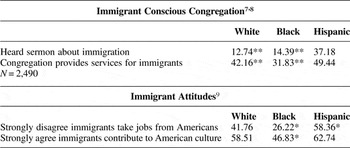
In the analyses presented in Table 1, Hispanics are more likely than Blacks and Whites to attend worship settings where their clergy preach sermons about immigration and/or their congregations provide services for immigrants. Hispanics are also more likely than others to strongly; disagree that immigrants take jobs from Americans and to agree that immigrants contribute to American culture.
Congregation type and immigrant attitudes by race: Cross-tabulation analyses

N = 3,184. **p < 0.01, *p < 0.05.
Immigration Sermons and Immigration Attitudes
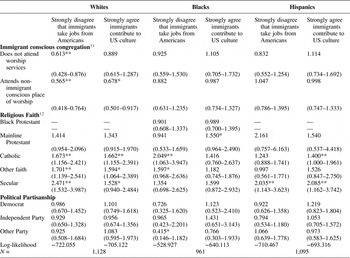
The logit regression analyses presented in Table 2 indicates that attending immigrant-conscious congregations has a very different relationship with the immigration attitudes of Whites than of Blacks and Hispanics. White worship-goers who attend non-immigrant conscious congregations are less likely to agree that immigrants contribute to American culture compared to Whites that attend immigrant-conscious congregations. Similarly, Whites that do not attend worship services or attend non-immigrant-conscious congregations are more likely to believe that immigrants take jobs from native-born Americans. In short, White attendees of immigrant-conscious congregations are more likely than other White worship-goers to reject anti-immigrant and accept pro-immigrant frames.
Relationship between exposure to political issue-based sermons and immigration policy attitudes among Whites: Logit regression analyses: Odds ratiosFootnote 10

Confidence intervals in parentheses; **p < 0.01, *p < 0.05.
These analyses also point to an association between religious faith and partisanship with immigration attitudes among Whites. White Catholics, Non-Christians, and secular individuals are more likely than Evangelicals to strongly agree that immigrants contribute to American culture and to strongly disagree that immigrants steal jobs from native-born Americans; the same is true of Democrats compared to Republicans.
In contrast to Whites, Table 2 also shows that attending immigrant-conscious congregations is unrelated to Black and Hispanic immigration attitudes. The remaining analyses shown in this table point to some fairly inconsistent relationships between religious faith and partisanship with immigration attitudes. Among Blacks, Catholics are more likely than Evangelicals to strongly disagree that immigrants take jobs from Americans. Among Hispanics, Catholics are more likely than Evangelicals to strongly agree that immigrants contribute to American culture. Secular Hispanics are more likely than Evangelicals to strongly agree that immigrants contribute to American culture and to strongly disagree that immigrants take jobs. Political partisanship is unrelated to Black and Hispanic immigration attitudes.
Race, Immigration Sermons, and Immigration Attitudes
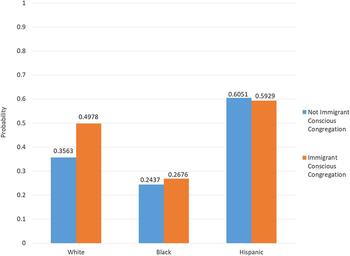
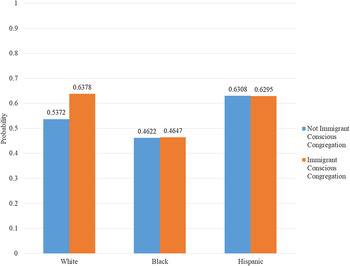
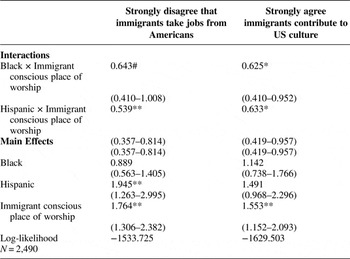
The interaction analyses presented in Table 3 and illustrated in Figures 1 and 2 suggest that attending immigrant-conscious congregations has a significantly stronger association with Whites rejecting negative immigration frames than it does for Hispanics and, to a lesser extent, Blacks.Footnote 5 More specifically, the odds ratio for the Hispanic × Immigration Congregation interaction term listed in Immigrant Jobs analyses of Table 3 is less than one and statistically significant. The main effect of attending an immigrant conscious congregation represents the likelihood that attending such congregation associates with a greater likelihood of strongly disagreeing that immigrants steal jobs from native-born Americans when the Hispanic coefficient is zero (e.g., White respondent). The immigrant-conscious congregation odds ratio is greater than one and significant, indicating that attending such congregations associate with Whites strongly disagreeing that immigrants steal jobs. Conversely, attending such congregations is unrelated to how Hispanics think about this issue. In short, attending immigrant-conscious congregations has a significantly stronger relationship with Whites rejecting the notion that immigrants steal jobs than is the case for Hispanic Americans and, to a lesser extent, Blacks (sig. = 0.054). Our remaining interaction analyses and probability estimates listed in Figures 1 and 2 suggest that attending immigration-conscious congregations has a significantly stronger relationship with Whites strongly agreeing with the assertion that immigrants contribute to American culture than it does for Blacks and Hispanics.
(Color online) Probability of strongly disagreeing that immigrants take jobs by immigrant congregation and race.

(Color online) Probability of strongly agreeing that immigrants contribute to American culture by immigrant congregation and race.

Moderating effect of race/ethnicity on the relationship between hearing sermons on political issues and immigration policy attitudes among worship-goers: Logit Regression analyses: Odds ratiosFootnote 13

Confidence intervals in parentheses; **p < 0.01, *p < 0.05, # < 0.1.
In sum, these analyses point out two main findings: Hispanics are more likely than are Blacks and Whites to attend immigrant-conscious congregations, reject negative immigrant frames, and accept positive immigrant frames; and attending immigrant-conscious congregations more strongly facilitates Whites rejecting negative immigrant frames and accepting positive frames than it does for Blacks and Hispanics.
DISCUSSION
The central questions we sought to answer in our study are: (1) What effect does race have on whom attends religious congregations concerned about immigrants? and (2) How may race differentially influence the relationship between attending these types of congregations and immigration attitudes? As an example, is it plausible to expect congregants of a church like Central United Methodist Church (UMC) located in Detroit, Michigan, to be more willing than others to empathize with immigrants? In imploring congregants and others to involve themselves in a New Sanctuary Movement by offering asylum seeking immigrants refuge in their congregation and homes, Reverend Rowe, pastor emeritus at Central UMC, and co-chair of Methodist Federation for Social Action, delivered a sermon outside of Central UMC on November 15, 2016 in which he stated:
“There was a sanctuary movement in ancient history in which our places of worship our sanctuaries were places people seeking refugee could find asylum. Somehow, they became places where only a few people sought asylum, and they weren't people who were in danger. They were the people that were already safe. But, the word sanctuary is not for us, the word sanctuary is not for people who look like me (White, middle class), the word sanctuary is for the people whose very lives are in danger every day. Open up the sanctuaries, and allow those in danger to come in (Warikoo Reference Warikoo2016).”
Reverend Rowe framed his church's commitment to immigrants as part of a long history of the Christian church's obligation to providing refuge to those in distress. In doing so, he challenged the dominant frame that immigrants are to be feared, by suggesting that Christians and all persons of good conscience are called to serve those in need, regardless of one's citizenship. Congregations like Central that present congregants with an alternative narrative that is more inclusive of out-groups often encourage members to juxtapose their assumptions about their own privilege and in-group identity to the faith teachings of love, justice, and mercy (Slessarev-Jamir Reference Slessarev-Jamir2011). The aim and mission of such congregations, is to implore congregants to see the other, particularly the marginalized other, as part of their in-group (Brown, Kaiser, and Daniels Reference Brown, Kaiser and Daniels2010; Slessarev-Jamir Reference Slessarev-Jamir2011). These alternative frames may also be persuasive given the trust that fellow congregants have the best interests of one another, their church, and society at large.
Like past work, our study suggests that attending congregations like Central in which clergy discuss social-political issues may be more persuasive for Whites than for Blacks and Hispanics (Brown and Brown Reference Brown and Brown2017; Brown et al. Reference Brown, Brown, Phoenix and Jackson2016). While Hispanics are more likely to attend congregations led by clergy with a commitment to discussing and serving immigrants, attending these congregations more strongly associates with White progressive views of immigrants than it does for Blacks and Hispanics. That is, Whites that attend these types of religious congregations are more likely than other worship-going Whites to strongly reject the anti-immigrant frame that immigrants take jobs from Americans and to strongly believe that immigrants contribute to American culture. For Blacks and Hispanics, attending such congregations is unrelated to their view of immigrants.
One way to understand these findings is that congregations like Central that allow for political deliberation and service to others, likely attract individuals who are open to sermons and political discussions that challenge dominant narratives that attempt to justify existing power relationships and contribute to the marginalization and exploitation of others. It is also likely that such discussions are particularly impactful for Whites because as the group that disproportionately benefits from American dominance, they are the principal target of dominant issue frames (Lopez Reference Lopez2015). As such, Whites may be led to believe that their family and racial group will be required to make large sacrifices when economic opportunities and political rights are extended to out-groups, such as immigrants. Religious congregations that allow members to question this narrative frame may serve as a safe space for such Whites to openly question how American Exceptionalism and privilege aligns with their faith teachings.Footnote 6
An alternative explanation emphasized in progressive worship spaces suggests that America's exceptional position in God's purview is dependent upon its collective willingness to extend or, at least, not restrict the freedom and economic opportunities of individuals and groups within America, those seeking refuge there, and the world over (Slessarev-Jamir Reference Slessarev-Jamir2011). Doing so is seen as consistent with God's will as it advances the well-being of all persons regardless of the nation-state in which they reside (Slessarev-Jamir Reference Slessarev-Jamir2011). Whites that attend these types of worship spaces likely have a greater opportunity relative to their counter-parts to hear and discuss alternative frames of the immigration debate that suggest immigrants are not motivated by criminal intentions, but rather are victims of economic and geo-political forces outside of their control and are thereby worthy of compassion and empathy. Our findings suggest that, even when considering political partisanship, religious faith, and a host of social-demographic factors, attending these types of congregations is potentially impactful on Whites’ immigration attitudes.
Conversely, the immigrant experience of Hispanics and/or their identification with undocumented immigrants may account for why Hispanics are more inclined to oppose anti-immigrant frames regardless of their religious beliefs. Even before hearing messages about immigrants in worship settings, Hispanic Americans are likely skeptical of immigrant frames that suggests their group weakens American culture and are aware of the economic forces that push them from their homelands. This is not to suggest that clergy within the congregations that Hispanics attend are apathetic to immigration. But, rather that the Hispanic immigrant experience likely plays a larger role than involvement in any one institution, religious or otherwise, in determining their views about immigrants.
The low economic status of Black Americans may make them susceptible to the dominant narrative of immigrants taking jobs from Americans and driving down wages. That is, perceived competition with Mexican immigrants in American cities over jobs and wages may lead Blacks to buy into the idea that immigrants are to blame for their job losses, wage declines, and stagnantly poor quality of life (Gay Reference Gay2006; Zamora and Osuji Reference Zamora and Osuji2014). The fact that Blacks have the lowest quality of life and are harmed more from economic recessions than are Whites and other Non-Blacks may make it particularly difficult for worship settings committed to immigrants to move Blacks to challenge whether immigrants take jobs and compromise American culture.
We recognize that survey data is limited in the extent to which it can explain attitude formation. Nonetheless, our sample and measures provides us with the unique ability to examine important questions about how religion may inform acceptance of immigrant frames used to justify immigration policies. To more fully understand the nature of these relationships, qualitative research is needed to examine differences in the content and interpretation of sermons about and social programs provided for immigrants in the congregations Blacks, Hispanics, and Whites attend.