





On 4 August 1892, the journal Nature reviewed A Handbook on the Management of Animals in Captivity in Lower Bengal, authored by the superintendent of the Calcutta Zoological Gardens (CZG), Ram Brahma Sanyal (1850–1908).Footnote 1 The reviewer applauded Sanyal’s achievement, in particular his detailed observations of animal behaviour. At the same time, the review was marked by the condescension toward Indian scholars typical of the time, describing Sanyal as one ‘of the very few natives of British India that have exhibited any taste for natural history’. These mixed feelings led the reviewer to write,
CONSIDERING the number of Zoological Gardens in Europe, and their long establishment, it is singular that it should have been left to the superintendent of a Zoological Garden at Calcutta, and to a native of India withal, to produce the first practical hand-book on the management of animals in captivity.Footnote 2
The last part of this sentence is still considered valid today. Sanyal has even been called, somewhat anachronistically, the ‘grandfather of zoo biology’.Footnote 3
In 1893 the Handbook was also reviewed by the Indian scholar Sarat Chandra Mitra (1863–1938) in the Journal of the Bombay Natural History Society. Mitra, known for his studies of Indian folklore, draws rather dissimilar conclusions from those of the reviewer for Nature. For Mitra, Sanyal represented living proof that Indians are, in fact, capable of pursuing studies in natural history – but have too long neglected it. While the British reviewer addressed a Western readership, Mitra appealed directly to the Indian public.Footnote 4 And unlike the (probably London-based) reviewer of Nature, Mitra had been a regular visitor to the CZG at least since the mid-1880s.
These two reviews of Sanyal’s Handbook may serve as pointers for sketching the issues this article seeks to address. How was it possible that ‘a native of India withal’, employed by a zoo far away from Western Europe (supposedly the birthplace of the modern zoo), could publish a book that was widely recognized as being practically useful for the husbandry of captive animals? What kind of knowledge did the Handbook produce and how? And can we map the spectrum of reception of the Handbook, given that it was read quite differently, as the two reviews, one metropolitan, one Indian, seem to indicate? What role did the specific colonial context of Calcutta, the capital of British India, play in this respect in the late nineteenth century?
These questions and the focus on Sanyal and his Handbook indicate the wider significance of this case study. How could a subaltern actor such as Sanyal be so innovative in a context defined by colonial hierarchies and systemic racism? This article will argue that two factors were decisive. First, the deeply practical character of Sanyal’s daily work as an animal keeper eventually enabled him to become an internationally recognized authority. Second, given the central position of the CZG as a hub of the international animal trade, Sanyal again played a decisive role in the emerging global network of zoos around 1900, overseeing animal shipments in all directions. But before we turn to Sanyal and his Handbook, we shall sketch the broader context of nineteenth-century zoo history.
The nineteenth-century zoo – a European invention?
The historiography on zoological gardens has boomed since the turn of the millennium. Scholars from fields such as urban history, colonial history, human–animal studies, environmental history and the history of science discovered the potential of zoo history, transcending more traditional and institutional histories.Footnote 5 In spatial terms, the vast majority of studies have focused on Western European zoos. The conventional narrative names the first zoos as those in Paris (1793) and London (1828). From 1830 to roughly 1860, around two dozen zoos were founded in Great Britain, the German lands, the Netherlands, Belgium and France. In these accounts, zoos outside Western Europe do not appear until the 1860s or even later.Footnote 6 The assumption is that the European model set the standard of what defines a modern zoo and that this model was then exported to the rest of the world.
What exactly characterized the European zoo? In the eyes of contemporaries and many current accounts, it was the transition from the princely menagerie of the early modern period (highly restricted access, ornamental) to the bourgeois zoo of the nineteenth century (in principle open to everybody, dedicated to science and public instruction).Footnote 7
It has long been recognized that the zoological garden is a global phenomenon.Footnote 8 Vernon Kisling proposes, by and large, a diffusionist model in which, since the late seventeenth century, menageries or holding stations (and later zoos) were established around the globe in sync with the colonial expansion of the European powers.Footnote 9 Animal historian Takashi Ito points to ‘long-range’ animal-trading networks in the early modern period in East Asia (reaching as far as the East African coast). And then asks, ‘what caused “the great divergence” in the history of animal collection’? The ‘birth of modern zoos’ becomes yet another example of East Asia falling behind the West in the course of the nineteenth century.Footnote 10
Until recently, there were hardly any ambitious case studies of non-Western zoos. The first important monograph in a Western language in this respect was Ian Miller’s 2013 book on the Tokyo Zoo. For Miller, the first Japanese zoo serves as a prism for reflecting issues of Japanese nationalism and national identity from its founding in 1882 through the post-war period.Footnote 11 Seeley and Skabelund criticize the Eurocentric framing of zoo historiography. Their case study examines the colonial zoos in Seoul and Taipei, founded by the Japanese invaders in the early twentieth century. It thus focuses mainly on the ‘colonized experience’ of Koreans and Taiwanese.Footnote 12 These valuable studies of East Asian zoos situate themselves within the fields of social and political history, rather than the history of science (specifically, the generation of knowledge about how to keep ‘exotic’ animals). That a non-European zoo, such as the Jardín Zoológico de Buenos Aires around 1910, might actually become a model for European zoos in terms of animal husbandry, thus inverting North–South hierarchies, has rarely been contemplated.Footnote 13 Zoo activist Sally Walker criticized the master narrative of the zoo being exclusively a product of nineteenth-century Europe. Her aim was to vindicate Sanyal and the CZG, yet she does not elaborate on the interrelated historical contexts in which they flourished.Footnote 14
This article will aim to reconstruct these contexts. It will focus on the network character of zoos, conceiving the evolution of the zoo (and the knowledge generated) as a dialectical, multidirectional process on a global scale, as well as on the hybrid character of British Indian natural history.
The beginnings of the Calcutta Zoological Garden
The CZG was officially inaugurated by the Prince of Wales on his visit to British India on 27 December 1875 and opened to the public in May 1876. It was by no means the first zoo-like institution in the Calcutta region.Footnote 15 The Barrackpore Menagerie (located north of Calcutta) was founded in 1803–4 by the colonial administrator, the Marquess Wellesley, and has been described as one of the oldest zoos in the world, pre-dating the London Zoo by two decades.Footnote 16 In 1854, the Bengal merchant and philanthropist Rajendra Mullick (1819–87) opened a zoo next to his ‘Marble Palace’.Footnote 17 Wajid Ali Shah (1822–87), the last king of Oudh (Awadh), in exile in Calcutta since the late 1850s, also disposed of a sizable menagerie open to the public.Footnote 18 Carl Louis Schwendler (1838–82, c.1868–c.1880), a German electrical engineer based in Calcutta, had his own private menagerie.Footnote 19
After several failed attempts in the 1860s, Calcutta finally had its own zoo, with Schwendler pushing to create it.Footnote 20 Schwendler was an active member of the Asiatic Society of Bengal, which eventually took up the matter together with the Agricultural Society. In 1875, the government of Bengal implemented the two societies’ proposal. A Management Committee (MC) consisting of five members was put in charge of the new institution. Many of the animals for the new zoo proceeded from the aforementioned animal collections: the Barrackpore Menagerie, Schwendler’s private menagerie and donations from Mullick. When Wajid Ali Shah died in 1887, the CZG acquired several animals from his collection, including a rhinoceros.Footnote 21
Calcutta, the capital of Britain’s most important colony, had long been a hub of long-range animal trade well before 1876.Footnote 22 Mullick, for example, had exchanged animals with the ZSL in the 1850s and 1860s.Footnote 23 Hence the CZG needs to be seen in this already existing colonial network of naturalists, institutions and trading routes. As this article will show, there were several European scholars who acted in one way or another as Sanyal’s teacher, supervisor, patron or scientific collaborator (in the CZG, the Asiatic Society, the Indian Museum, the Botanical Garden and the Calcutta Medical College).
From keeper to superintendent – Sanyal’s rise in the CZG
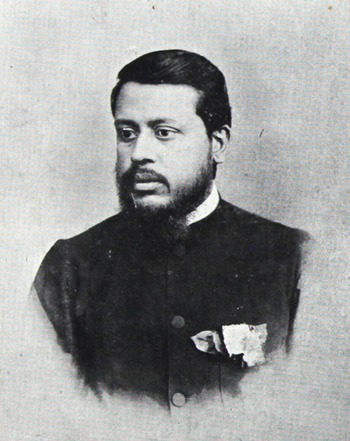
Ram Brahma Sanyal was born in 1850 in Berhampore, about two hundred kilometres north of Calcutta.Footnote 24 He ‘descended from one of the most respectable Vārendra Brāhmana families in the district of Murshidābād’ (Figure 1).Footnote 25 He came to Calcutta around 1870 to attend the Calcutta Medical College but did not graduate, purportedly due to problems with his eyesight. One of Sanyal’s teachers was George King (1840–1909, 1866–1898?), the director of the Calcutta Botanical Garden, who also taught botany at the Medical College. King was involved in planning the new zoo, responsible for its landscaping, and a member of the MC, which also included Schwendler and the colonial administrator Charles Edward Buckland (1847–1941, 1870–1904).
Ram Brahma Sanyal.

In this way, Sanyal found his way to the CZG. Upon his arrival, he took care of the zoo’s daily operations, looking after the animals and visitors. In September 1876, Sanyal was made head assistant, and in January 1877 he was asked to keep a ‘Daily Register’ of the animals, concerning their food and behaviour, and, from April 1878, a ‘Secretary’s Order Book’. These measures introduced by Sanyal’s superiors show that the MC was at pains to (micro-)manage the daily business of the CZG and that they closely watched Sanyal in his early years. Although they kept burdening him with more chores, their confidence in the Indian keeper was limited. From the start, the MC wanted a European to run the CZG, but apparently could not find one. The minutes of the committee meeting of 19 July 1877 claim that ‘Babu R.B. Sanyal is unfit to have the job of management of the Garden and that it is necessary to approve an European head Keeper’.Footnote 26 These racist criteria were typical of the scientific institutions of British India and even more so marked in the field of natural history.Footnote 27
In July 1878, Sanyal even resigned from his position. Alfred Woodley Croft (1841–1925, 1866–1897) had come to know Sanyal during his frequent visits to the zoo and offered him a position in the Bengal Education Service over which Croft presided. Yet Buckland would not let Sanyal go, because – we may assume – the MC was aware that it would have been very hard to replace him. ‘He was appointed acting superintendent in April 1879 and was made permanent in the post in April 1880.’Footnote 28 Sanyal remained at the helm of the zoo until his death in October 1908, despite his deteriorating health and repeated attempts to retire after 1902. Instead, the MC made Sanyal a member in 1902, twenty-six years after he had started to work for the zoo.
Ironically, the MC’s lack of confidence in Sanyal was an important factor that led to the extensive amount of detailed information that would eventually provide the empirical basis for the Handbook. The MC might not have obliged a European zoo director to keep daily records. The ‘Daily Register’ continued to grow, and Sanyal’s superiors saw it as an opportunity. In 1889, Steuart Colvin Bayley (1836–1925, 1856–1890), from 1887 the new lieutenant governor of Bengal, ‘suggested’ reworking the observations into a useful publication.Footnote 29
International recognition and zoo travels
The Handbook marked a turning point in Sanyal’s career, bringing him recognition in British India and internationally. He became a corresponding member of the ZSL in 1893 and published three short papers in the Proceedings of the Zoological Society of London (PZSL) between 1893 and 1895. All papers dealt with animals in the CZG, and a drawing by Sanyal accompanied one of them (Figure 2).
Semnopithecus, drawn by Sanyal.

Considered an authority on zoo management in British India, he was sent on two zoo missions in March 1894 and then in December 1902, providing practical advice to the zoos in Bombay (Mumbai) and Rangoon (Yangon, Myanmar).Footnote 30 And in 1898 he received an invitation to the Fourth International Congress of Zoology in Cambridge in late August.Footnote 31 His journey to Europe was often described as the highlight of his career, ‘one of the most cherished wishes of his life’.Footnote 32 Sanyal was in England between 21 June and 5 September, visiting the London Zoo numerous times and meeting several members of the ZSL, in particular its long-term secretary, Philip Lutley Sclater (1829–1913). The British zoologist, well up to date with the international development of zoos due to his frequent zoo travels, might have penned the Nature review of the Handbook in 1892.Footnote 33 After the congress, Sanyal travelled for several weeks through continental Europe, visiting the zoos in Hamburg (the municipal zoo as well as the Tierpark at Neue Pferdemarkt of the animal trader Carl Hagenbeck), Berlin and Vienna (both the Menagerie Schönbrunn and the Prater Vivarium), and also the zoos of Paris, Antwerp, Rotterdam, Amsterdam and Dresden. Earlier on, he had seen the zoo in Marseille (where he had disembarked) and the private estate at Woburn Abbey and its menagerie. He also visited some public aquariums (Brighton, Amsterdam, Hamburg and Berlin) as well as the Stazione Zoologica in Naples.
Upon his return from Europe, Sanyal published Notes on the Management of European Zoological Gardens. On seventeen pages, he discussed the virtues and, more timidly, the shortcomings of the zoos and aquariums he had visited. He assumed a deferential position and implicitly accepted the West–East hierarchy, as if only the CZG could learn from European zoos and not the other way round.Footnote 34 In January 1899, the British Government of India awarded him the honorary title of Rai Bahadur for his services.
Beyond his main occupation as superintendent of the CZG, Sanyal acted for many years as an agent, involved in the animal trade in South East Asia and beyond. The best-documented case is his work for the Melbourne Zoo, for which he obtained animals and organized exchanges with the CZG.Footnote 35 For several decades, Sanyal was in close contact with Dudley Le Souef (1856–1923), an Australian ornithologist, who succeeded his father, Albert, as director of the Melbourne Zoo in 1902. Since the 1880s, Dudley Le Souef had travelled several times to Calcutta on behalf of the Melbourne Zoo. In August of 1898, Le Souef and Sanyal met in Cambridge and later, in September, in Hamburg and Berlin, as they had set out to tour European zoos.Footnote 36
Sanyal and the scientific institutions of British Bengal
In 1899, Sanyal became an associate member of the Asiatic Society. Between 1897 and 1907, he read and then published five short articles in the Proceedings of the Asiatic Society of Bengal. In one session, he even ‘exhibited living specimens of the Egyptian Jerboa (Dipus yaculus)’, a small rodent.Footnote 37 Shortly before his death, Sanyal had proposed establishing a marine research station in Puri, on the Bay of Bengal (roughly five hundred kilometres south of Calcutta), possibly inspired by the aquariums he had visited on his European journey. The Asiatic Society supported his proposal, according to their obituary, but at the time it was not taken up.Footnote 38
The most important institution in Calcutta for the study of natural history was the Indian Museum (founded in 1814), initially serving as a repository for the Asiatic Society’s collections. During the nineteenth century, it morphed into an institution of the British Government, presenting its collections to the public in an impressive new building in 1875. Many of the carcasses from the CZG enriched the zoological collections of the Indian Museum. At least once, Sanyal himself was mentioned as a donor of specimens.Footnote 39 Sanyal used ‘the collection of skins in the possession of the Indian Museum’ for his Handbook.Footnote 40 Apparently, he also accessed its well-stocked library.
In 1894, Frank Finn (1868–1932, 1894–1903), a British ornithologist, came to work at the Indian Museum.Footnote 41 As he recalled in 1917, ‘I always took a keen interest in the Zoo affairs … all the time I was very friendly with our excellent late superintendent’.Footnote 42 Sanyal seemed well integrated into Bengal’s natural-history research networks, yet his collaboration with Finn stands out. In their writings, they described, on several occasions, how wild herons and cormorants colonized an island of the CZG, ousting each other (Figure 3).Footnote 43 Sanyal’s investigations on the heron colony received a friendly nod in the leading ornithological journal Ibis, referring to him as ‘the well-known Superintendent of the Calcutta Zoological Gardens’.Footnote 44
The bird Colony in the CZG.

In his ornithological works, Finn often referred to specimens he saw at the Calcutta Zoo, including observations that Sanyal communicated to him.Footnote 45 In 1906, Finn dedicated his Garden and Aviary Birds of India to Sanyal, calling him ‘my friend’, and in his later writings he always praised Sanyal as an outstanding naturalist.Footnote 46 It was Finn who proposed Sanyal for membership in the Asiatic Society (3 January 1899, elected 5 April 1899). Along with his nomination, Finn provided a short biography of Sanyal, applauding his research and, in particular, the Handbook, which ‘has been described in the pages of “Nature” as a remarkable production’.Footnote 47 The Handbook ‘is the best that has been published in any language, and reflects credit alike on the practical zoological attainments and command of English of the writer’. It is telling that Finn anchored his appreciation by referring to the Nature review and Sanyal’s ‘command of English’. In Finn’s framing, the Handbook transcends its Indian context (and the possible limitations of its Indian author).
Sanyal’s ‘command of English’ as a ‘marker’ of which scientific culture he belongs to was also used in a review of his second book, Hours with Nature (1896), in Nature. Similar to the review of the Handbook, the reviewer of Hours with Nature was full of praise for Sanyal yet patronising: ‘To criticise the English would obviously be unfair, seeing that the author is writing in a foreign tongue’. The reviewer also pointed out Sanyal’s alleged errors in zoological classification.Footnote 48
Throughout his career, Sanyal found himself in this liminal position, where Indian-based British scholars appreciated his talent as a zookeeper and zoologist, yet distanced themselves from him through their sense of superiority. In the preface, the MC granted Sanyal the authorship but pointed out that the Handbook was ‘on a plan drawn up by the Sub-Committee’ and that Buckland ‘has supervised the preparation of the work’.Footnote 49 Apart from Finn, King and Buckland, we should mention John Anderson (1833–1900, 1864–1886) and David Douglas Cunningham (1843–1914, 1869–1898). Finn recalls that Sanyal ‘had a particular loyal affection for Dr. Cunningham’.Footnote 50 His obituary maintained that ‘these two [Anderson and Cunningham] he looked on as his masters’.Footnote 51
John Anderson was the first curator of the Indian Museum, a professor of comparative anatomy at the Calcutta Medical College and the secretary of the MC in the early years of the CZG. In 1883, he published the first Guide to the Calcutta Zoological Gardens. Cunningham was professor of physiology at the Medical College and served on the MC of the zoo. Around 1895–6, Cunningham drew on the CZG and Sanyal for his research on snake venom and possible antidotes. In his experiments, the snakes, as well as the test animals (fowl, mongoose, goat, rhesus monkey), were from the zoo. Cunningham praised Sanyal for his ‘willing and intelligent co-operation’, which was crucial to conducting the experiments.Footnote 52 While in Cambridge in August 1898, he met with Alfredo Kanthack (1863–1898), an expert on snake venoms and chair of pathology at Cambridge University, who showed him around the ‘Pathological Museum’.Footnote 53 In 1899, Sanyal would conduct his own experiments and send the results to the inspector general of the Civil Hospital in Calcutta.Footnote 54
Sanyal’s scholarly articles, three in the PZSL and five in the Proceedings of the Asiatic Society of Bengal, were brief communications and amount to only about a dozen pages in total. They were all related to animals in the CZG, and, as in the Handbook, Sanyal appeared to be a precise observer. In some of the articles, he displayed a knowledge of the relevant Western literature, demonstrating that he belonged to the circle of recognized scholars. From today’s perspective, one article stands out. He described how an orang-utan made a kind of straw snare to pull food from the neighbouring cage.Footnote 55 In the history of primatology, the first observation of tool use in primates has been much disputed, including whether observations of primates in captivity count. Sanyal’s observation received little comment and had no wider impact.Footnote 56
We know less about his network with Indian scholars. Sanyal was acquainted with Sarat Chandra Mitra (the reviewer mentioned at the beginning of this article) and Mahendralal Sarkar (or Sircar) (1833–1904), a vocal advocate of building an Indian science in the late nineteenth century. Both applauded his Handbook as convincing proof that Indians were capable of producing valuable work in natural history.
Sanyal was well able to carve out a professional niche for himself within an institution controlled by the colonial government. His successful career owed to his capacity to insert himself into the intellectual environment, networks and institutional structure of British colonial science in Calcutta, particularly the Asiatic Society and the Indian Museum.
Care of zoo animals before the Handbook
Before we turn to the Handbook itself, we shall briefly ask to what extent the nineteenth-century zoo was a space for the production of zoological knowledge. The newly founded zoological gardens were supposed to be places to study ‘exotic’ fauna, yet, according to many critics, the zoos did not live up to these expectations. The interest of the scientific community of zoologists and related disciplines remained limited, and the zoo was mostly restricted to the supply of interesting (i.e. rare) animal corpses for the dissecting table of anatomists.Footnote 57
Knowledge on how to feed, house, keep and cure ‘exotic’ animals had not been on the official agenda. Yet zoos faced enormous difficulties in keeping their inmates alive and providing rudimentary living conditions. This kind of practical knowledge was, for the most part, spurious in the nineteenth century, generated in an unsystematic and haphazard way among zoo directors, assistants, keepers and veterinarians.
The last third of the nineteenth century, with the number of zoos rapidly proliferating, allowed for greater sharing of experiences with zoo animals. The PZSL (founded in 1833) and Der zoologische Garten (founded in 1859) have published a considerable number of articles on zoo animals. The PZSL often dealt with the dissection of dead zoo animals, breeding successes (including species hybridization) and the arrival of new animals at London Zoo. Der zoologische Garten is possibly the richest source for nineteenth-century zoo history.Footnote 58 Yet practical issues of animal keeping were rarely addressed. Many articles were based on short visits of a few hours or at best a day or two, such as when the German scholar Alexander von Svertschkoff visited the CZG in 1885.Footnote 59 Compared to Sanyal’s Handbook, these articles appear superficial.
Possibly the only comparable work to the Handbook is the work of Maximilian Schmidt (1834–88), a veterinarian and director of the Frankfurt Zoo (1859–85) and the Berlin Zoo (1885–8). Like Sanyal, he gathered data over an extended period. In the 1870s, Schmidt published on the diseases of pachyderms, monkeys, ungulates and marsupials. Although focused on veterinary issues, including dissection results, Schmidt did offer some practical advice on animal care – for example, on nutrition sustained by his own experiences in the Frankfurt Zoo. Schmidt’s publications remained fragmentary and did not find a wide readership. Of the planned multi-volume Zoologische Klinik, only two parts appeared, because they did not sell well.Footnote 60 This limited panorama of zoo literature before 1892 – that is, the lack of systematic and comprehensive accounts on zoo husbandry – seems to be one of the reasons why Sanyal’s Handbook was perceived as such an important novelty.
The Handbook – caring for zoo animals
The Handbook was published in the spring of 1892 by the Bengal Secretariat Press, a government press. Its content was based on many years of observations since the zoo’s opening in 1876 and consisted of two main sections. The first section contained 241 entries on mammals, the second 402 entries on birds.Footnote 61 The organizing principle was the individual species. The default structure of each entry started with a short section on the anatomy of the species in question, including a phenotypical description. Then the practical husbandry issues of housing, feeding, breeding, veterinary care and transport were addressed. ‘Length of life in captivity’ was another regular section. In communication among zoos, this was (and still is) a crucial criterion for the quality of care provided and thus for the zoo’s reputation.
The entries varied significantly in length. The longest ones carried on for several pages and deal, in today’s zoo idiom, mostly with ‘charismatic megafauna’ (five pages on the orang-utan, five on the lion and six on the tiger). Many other entries, in particular the ones about birds, were much shorter, mostly only half a page or just a few lines, and might not contain all the sections. Sanyal cited numerous works in natural history, most frequently those of William Thomas Blanford (1832–1905, 1854–1872) and his Fauna of British India (a multi-volume work begun in 1888).Footnote 62
The Handbook detailed what fauna had been exhibited in the CZG since its foundation. It also reflected the zoo’s position in the larger networks of animal trade in South East Asia and beyond. As we have seen, many animals came from existing menageries in the vicinity, either as donations or through purchases. Unsurprisingly, South, East, and South East Asian fauna were prominently presented. Roughly 40 per cent of the mammals and over 50 per cent of the birds were from British India (including Ceylon and the Himalaya region).Footnote 63 About twenty bird species stemmed from China (often sent via Singapore).Footnote 64 This might reflect the well-established trade routes between Calcutta and China (Canton/Guangzhou).
In the Handbook, Sanyal mentioned six different species of kangaroo and wallaby. Several of those specimens had lived in the CZG since 1882, probably owing to a large shipment of animals which Dudley Le Souef brought to Calcutta from Melbourne in late 1881 or early 1882.Footnote 65 The considerable number of marsupials reflected the decade-long close collaboration with the Melbourne Zoo. This connection left a lasting impact on the CZG’s animal collection. Visiting Calcutta in 1910, William Beebe, ornithologist and curator at the New York Zoo, noted, ‘Thanks to a regular system of exchange with Australian Zoological Gardens, marsupials are well represented, especially tree wallabies and kangaroos, which breed freely.’Footnote 66 African fauna were also exhibited (sometimes shipped via Zanzibar), including several species of monkey, such as the mandrill and the baboon, lions and jackals, among others, and a considerable number of African birds. The Hagenbeck Company, the leading animal trader globally around 1900, sold several African and South American animals to the CZG: ostriches, rheas, hyenas, capybaras and, in 1907, a hippopotamus at the exorbitant price of 18,000 marks.Footnote 67 In other words, the CZG was not only a prolific exporter of animals (in particular supplying the London Zoo, sometimes through exchanges) but also a receiver; that is, a client in the rapidly growing global animal trade of the late nineteenth century and the early twentieth.
In contrast to European or North American zoos, ‘classic’ zoo animals such as elephants were not considered exotic in India. ‘In proportion to its costliness, it is not an attractive animal, especially to the Indian public, and is therefore not always exhibited in the garden’.Footnote 68 Anderson had already remarked in 1883, ‘Their number in the gardens varies according as they are in demand for export or exchange.’Footnote 69 Indian elephants served as currency, as a token of exchange to procure other animals. Like many other zoos at the time, the CZG also served as a depot for animal traders and private citizens.Footnote 70 Animals en route to Europe might be kept for a certain period before shipping. The Handbook mentioned various examples, including the case of a polar bear, to which we shall return below.Footnote 71
The transport of ‘exotic’ animals over long distances, say from Hamburg to Calcutta or from Calcutta to London, constituted a major challenge for zoos, animal traders and circuses.Footnote 72 The fact that the CZG was a transnational hub in the animal trade explains the inclusion of the ‘transport’ section in the Handbook. Sanyal was an experienced animal sender, and vehicles such as trains and steamers were often mentioned.Footnote 73 This section was rich in practical advice. How should cages be constructed so that animals can neither escape nor hurt themselves? What food should be provided for the journey? The Handbook provided concrete examples of animal transports that went wrong, animals getting hurt or dying soon after arrival due to exhaustion. A hippopotamus had been shipped in ‘an ordinary box cage’ entirely unsuitable for the needs of the ‘aquatic animal’ and died due to overfeeding.Footnote 74
Another section was entitled ‘Observations on the habits of …’. ‘Habit’ was used in a broad sense by Sanyal: the way animals moved, which spaces they preferred within their enclosure, whether they were used to captivity or not, and how they interacted with their kind, with the keepers or with other species. The capybaras, for example, indulged ‘in frolicsome games’ with the Malayan tapir.Footnote 75
In the spirit of the Handbook, this section, too, was meant to provide practical advice for animal keepers, yet some of Sanyal’s observations may be understood as ethological in nature. Earlier, we mentioned his description of an orang-utan’s tool use in the CZG (described in one of his later articles, not in the Handbook). Historians pointed out that the zoo might be considered one of the birthplaces of ethology, citing examples mostly from the very early twentieth century.Footnote 76 Observing the habits of animals had always been postulated as one of the aims of the nineteenth-century zoo. Yet this research proposal had often been rejected because observations of zoo animals were obtained under the ‘artificial conditions’ of captivity.Footnote 77
In practice, ethological knowledge rather emerged (without a well-defined research programme in place) through the daily interaction of animal keepers with the creatures entrusted to them. Observations of animal behaviour in zoos were anything but rare in the period before 1914, but were often scattered and generally related to only one species. The ‘Observations on the habits of …’ were also a by-product of Sanyal’s everyday zookeeping, but stand out in terms of their sheer volume and the large number of species observed.
These observations often invoke emotions, likes and dislikes to interpret the behaviour of the animals. Sanyal displayed an impressive sensitivity to the needs and hardships of the animals (generally in the ‘Treatment in health’ or ‘Treatment in sickness’ sections). The Handbook was teeming with observations of captive animals experiencing discomfort or pain as well as practical advice on how to alleviate it. To treat an orang-utan suffering from paralysis, no ‘medicine was administered internally, but, to relieve the creature’s pain, camphor liniment and fomentation were applied at intervals’.Footnote 78 Treating, for instance, the ‘ulceration of the throat and mouth’ of the brown bear or the distention of the stomach of the gaur due to the fermentation of the grass ingested seems to have been a common practice in the CZG.Footnote 79 The veterinary advice for elephants was particularly detailed, mirroring the wealth of knowledge readily available in India at the time.Footnote 80 Even in unique situations, as the case of the polar bear demonstrates, Sanyal’s empathy for the suffering animal led him to act:
A polar bear is one of those animals which should never be acquired for exhibition in this climate. The animal here referred to was merely deposited by a dealer who had sent it to this country for sale, and every device that could be adopted to mitigate its sufferings was tried. It was placed in one of the coolest dens of the Carnivora House, and a bath was especially built for its comfort. During the hot weather fifteen seers of ice were daily given, which it enjoyed very much, often crouching upon a large block, or otherwise making the best use of it.Footnote 81
That animal keepers played a crucial role in the generation of zoo knowledge due to their direct and long-term engagement with captive animals is now commonplace in zoo history.Footnote 82 The lion keeper Félix Cassal at the Ménagerie of the Jardin des plantes in Paris in the 1790s, and ‘Mr. Sutton, the intelligent keeper’ of the London Zoo, on whom Charles Darwin relied when studying the emotions of apes in the early 1870s, are two well-known examples.Footnote 83 Yet there are still very few systematic studies on the role of zookeepers and their relationship with the animals entrusted to them.Footnote 84
To emphasize this once more: Sanyal’s role in the CZG was twofold: running the zoo and looking after the animals each day, serving as a superintendent and a keeper. That singled him out. As regards the nineteenth-century zoo, no other source addresses the well-being of zoo animals as systematically and comprehensively as the Handbook. Sanyal’s intimate knowledge of captive animals, as evidenced by his Handbook, invested him with widely recognized authority.
The uneven reception of the Handbook
Who was the intended readership of Sanyal’s magnum opus? In the later reception of the Handbook of the Management of Animals in Captivity in Lower Bengal, starting in the 1980s, it was always assumed to be intended as a guide for other zoological gardens. Yet already the title did not include the word ‘zoo’ but spoke of ‘animals in captivity’ more generally. In the preface, the MC described the Handbook ‘as a guide to those who may keep private collections of animals’. Sanyal wrote in the author’s preface, ‘Should this book fall into the hands of any European naturalist or manager of a vivarium, I trust that he will consider the fact that it is intended for India, where trained supervision is a desideratum.’Footnote 85 This modest attitude reflects his deference toward the European model, similar to the Notes he published in late 1898 on his European zoo tour mentioned above.
A number of contemporary newspaper reviews highlighted the Handbook’s utility for wealthy owners of private animal collections. One review was more specific, pointing to ‘many Indian princes and nobles’.Footnote 86 Mitra, too, quoted verbatim the objective of the MC in his 1893 review and mentioned ‘the numerous nobles and other persons who on a smaller scale keep collections of animals or birds in captivity’.Footnote 87 None of these early Indian reviews mentioned another zoo as a possible addressee. In 1892, there were a few zoos in British India that could be described as such (Madras, Bombay, Lahore). Still, the majority of animal-keeping institutions were (mostly private) menageries, particularly in the princely states. Among the most prominent ones was the Baroda Menagerie in Gujarat.Footnote 88 This nineteenth-century context was lost in the rediscovery of Sanyal and his Handbook in the late twentieth century.
At the end of Hours with Nature, there were three pages of praise for Sanyal’s Handbook, both published reviews from journals and newspapers, and letters from reputed scholars. It contains quotes from the reviews in Nature and the Journal of the Bombay Natural History Society, as mentioned at the beginning of this article. The scholars cited include Anderson, Buckland and Blanford, but also Mahendralal Sarkar.Footnote 89
Most reviews of Sanyal’s Handbook were published in Indian-based English-language newspapers. These reviews, apart from praising Sanyal himself, dutifully highlighted the role of the government of Bengal and the MC in the making of the Handbook. Apart from the Nature review, there seem to have been hardly any immediate reactions outside British India. The Handbook was not mentioned in the PZSL or in Der zoologische Garten, the two main international outlets for zoo news.
Given the context of its production, its intended audience was primarily in India. Indeed, very few Western libraries hold the 1892 edition of the Handbook.Footnote 90 Unsurprisingly, most of them are in England. In September 1898, Sanyal gave a copy to the director of the Amsterdam Zoo, Coenraad Kerbert, as a present.Footnote 91 US marine biologist Alexander Agassiz acquired the Handbook as early as February 1893 for the library of the Museum of Comparative Zoology at Harvard, of which he was the director.Footnote 92
After 1892–3, references to the Handbook in print became scarce. Instead, they focused on specific points made by Sanyal, such as that jackals have never bred successfully in the CZG or that a mongoose must be captured while young to tame it.Footnote 93 An n-gram with the keywords ‘Sanyal’ and ‘Handbook’ (based on digital repositories mainly in the Western world) suggests that the Indian zookeeper and his work fell into oblivion shortly after he died in 1908. Renewed interest in Sanyal and his importance for zoo history was ignited by the pioneering work of Sally Walker and Dilip Kumar Mittra in the late 1980s.Footnote 94 In 1995, a reprint of the Handbook was published by the Central Zoo Authority of India, containing additional texts by Walker and Mittra. Subsequently, there has been a certain hagiographic trend in the Indian media referring to Sanyal as the ‘unsung man of science’ or ‘the native who became zookeeper’.Footnote 95 By and large, these articles, geared toward the general public in India, only regurgitate the well-known narrative of Sanyal and his ‘path-breaking’ Handbook. They claim to vindicate a seminal figure in zoo history that had been forgotten or wilfully ignored.
Gustave Loisel and the secret reception of the Handbook
Yet, at the time, the book was also read outside British India within a small circle of zoo reformers, such as the already-mentioned P.L. Sclater. Due to their numerous zoo travels, Stanley S. Flower (1871–1946) and Gustave Loisel (1864–1933) had probably seen more zoos than anybody else in around 1910. They both heaped praise on Sanyal, his Handbook and the way he had run the CZG. Flower wrote that Sanyal ‘will always be remembered in connection with the Calcutta Zoological Garden’.Footnote 96 Flower was the long-time director of the Giza Zoo near Cairo (1898–1924). The Giza Zoo and the CZG exchanged animals, so Flower and Sanyal probably knew each other.Footnote 97
Loisel is generally referred to as the ‘first zoo historian’. The three volumes of his Histoire des ménageries, published in 1912, total 1,274 pages. Loisel’s initial agenda was to contribute to the reform of the menagerie of the Jardin des plantes in Paris by sampling ‘best practices’ from zoos around the world, also giving a nod to the CZG, Sanyal and his Handbook, ‘a work that is still highly regarded today [1912] by zoo directors’.Footnote 98
Yet Loisel’s appreciation of Sanyal went further than what he said in print. His papers consist of thousands of notes, handwritten excerpts, newspaper clippings, printed articles and images.Footnote 99 Dispersed all over Loisel’s papers are pages in blue ink written in another hand, always dealing with one species (Figure 4). These pages are word-for-word translations of individual entries in Sanyal’s Handbook. Loisel was fluent in a number of languages, including English. Yet, given the different handwriting and ink colour, he probably asked someone to translate the entries faithfully from the Handbook into French. Loisel intended to write another large-scale work, possibly a complete natural history, since most of his papers are ordered by animal species and genera. Loisel was widely read, yet for no other author did he go to the trouble of having writings translated. This secret reception of the Handbook might suggest that zoo reformers at least were more familiar with Sanyal than the published evidence suggests.
Loisel’s translation of Sanyal, ‘The yellow bellied weasel’.

One might even draw the line further to Lee Crandall (1887–1969) and his acclaimed The Management of Wild Mammals in Captivity, published in 1964. Crandall was a curator at The Bronx Zoo in New York for over sixty years (from 1908 to 1969). In his early years he was an assistant to William Beebe, who, as mentioned above, had visited the Calcutta Zoo in 1910. Crandall condensed, not unlike Sanyal, decades of practical experience of taking care of zoo animals. He cited the Handbook over fifteen times, mining it for information and even echoing Sanyal’s title in his own book.Footnote 100
In sum, the Handbook was mainly read in British India, yet, despite his peripheral position far from the leading European zoos, Sanyal reached some prominence in the West. A small circle of ‘zoo people’ were eagerly receptive of his innovative work at the CZG. Gustave Loisel in particular studied his contributions carefully. This suggests that in the late nineteenth century there was already an informal zoo network in place in which not only animals but also practical knowledge on zookeeping was exchanged.
Conclusions
This article has shown how a focus on a non-European zoo may enrich our vision of the zooscape of the long nineteenth century. Putting the limelight on Sanyal and the CZG helps to decentre the current zoo history, which has focused for too long on Western Europe. A seemingly peripheral zoo such as that in Calcutta became the site of extensive and innovative knowledge production on the husbandry of zoo animals. Sanyal’s Handbook provided an unprecedented wealth of practical information, presented in a systematic manner, including advice on nutrition, breeding, veterinary care and the logistics of animal transport, as well as detailed observations of animal behaviour. This raises the question, why was the Handbook written in Calcutta and not in Paris, London or Amsterdam, where venerable zoos were run by scientific societies? There is no straightforward answer, only a tentative response that takes into account three factors.
First, a personal factor would be Sanyal’s deep empathy for the animals entrusted to him, in combination with his capacity for precise observation and decades of hands-on experience. King, Anderson and Buckland appreciated Sanyal as a capable animal keeper, but kept him on a short leash in the early years of the CZG, in tune with the asymmetrical power structure and inherent racism of British India. As we have seen, Sanyal proved more than apt at navigating these serious obstacles and make a distinguished career within the colonial system. His intimate knowledge of animal keeping invested him with epistemological authority.
This leads us to the second institutional factor, the colonial context of the CZG in which the knowledge of the Handbook was produced. All of Sanyal’s superiors were British scholars or administrators, who obliged him to keep detailed records on animal husbandry on a daily basis from 1877 and then told him to turn them into a book around 1890. It was common practice also among European zoo directors to do their morning round to keep abreast of what was going on in the enclosures. Yet none of them amassed such detailed records. Sanyal, wedged into a position by his British superiors that did not correspond to that of a European zoo director, rather moved between the chores of a director (supervisor) and a zookeeper enmeshed in the daily business of animal care. It was this intermediate position that enabled Sanyal both to gather a wealth of practical experience and to spell it out in the Handbook.
Finally, a more contextual third factor would be the transitional character of the CZG as a holding station (for animals in transit) and important hub of the international animal trade around 1900. The large increase in the global shipping of ‘exotic’ animals required a new kind of expertise. Overseeing the sending and receiving of so many different species over long distances turned Sanyal into an expert of animal transport as well as allowing him to build an international network of his own. This article has furthermore shown that apart from the much-transited route between Calcutta and Europe there were other networks of animal trade. Mediated by Sanyal, the CZG established an important South–South connection with Australia, in particular with the Melbourne Zoo.
Western zoos were not the only pacemakers in zoo history. Rather, zoo management and what would later be called zoo biology were knowledges created through multi-directional exchanges. A stronger focus on non-Western zoos reveals how figures such as Ram Brahma Sanyal were crucial for the emergence of a global zoo network around 1900.
Acknowledgements
For valuable criticism, feedback and suggestions, I am most grateful to the two anonymous reviewers, as well as to Rohan Basu, Wessel Broekhuis, Pratik Chakrabarti, Catherine de Courcy, Helen Cowie, Shubhobroto Ghosh, D.R.M. Irving, Nicolás Kwiatkowski, John Lourdusamy, Dolores Martín Moruno, John Mathew, Saurabh Mishra, Chisa Mizobuchi, Daniel Phillips, Amanda Rees, Herman Reichenbach, Mary Sears, Teresa Segura-Garcia, Simool Sen and the authors of this special issue. Research for this article was supported by the project I+D+i PID2020-112514GB-C21, financed by AEI/10.13039/501100011033.


 Open access

