Introduction
Consanguinity is an important mechanism of differentiation in the human population. It alters genotypic frequencies and therefore the structure of the population (Cavalli-Sforza & Bodmer, Reference Cavalli-Sforza and Bodmer1971). There are geographical areas in the world where the average consanguinity of the population is still high. Modern consanguinity usually arises from sociological-related issues such as religion, social systems based on castes, population size, migration rates, geographical isolation and the number of generations since the population was founded (Wang et al., Reference Wang, Qian and Bittles2002; Cohen et al., Reference Cohen, Vardi-Saliternik and Friedlander2004; Patton, Reference Patton2005; Blanco Villegas & Fuster, Reference Blanco Villegas and Fuster2006; El-Kheshen & Saadat, Reference El-Kheshen and Saadat2013). All these factors can mean that a certain population has little gene exchange with other populations (Serre & Babron, Reference Serre and Babron1985; Rothhammer & Llop, Reference Rothhammer and Llop2004). High levels of consanguinity were found in the 1960s in some isolated populations in mainland Chile. For example Caleu, an isolated geographical area whose population has Spanish origins had an average coefficient of inbreeding (α) of 60.4×10⁻⁴ (Blanco & Covarrubias, Reference Blanco and Covarrubias1971) and Pehuenches, a Chilean native ethnical group, exhibited a high level of consanguinity (α=82.9×10⁻⁴), mainly due to land inheritance (Blanco & Chakraborty, Reference Blanco and Chakraborty1975). In contrast, due to an ancient Inca regulation, consanguineous marriages were unacceptable among the northern native ethnical groups of Chile such as the Aymaras (α=1.5×10⁻⁴) and Atacameños (α=4.1×10⁻⁴) in the same decade (Rothhammer & Llop, Reference Rothhammer and Llop2004).
In an inbred population, the gene pool is likely to reflect a founder effect. This is because of the change in the genotypic frequencies from one generation to another and the increase in the frequency of homozygotes. In turn this can potentiate the existence of uncommon genetic pathologies in the population, and also can influence reproductive and survival capabilities (Machado et al., Reference Machado, Bomfim, Souza, Soares, Santos, Acosta and Abe-Sandes2013a, Reference Machado, Bomfim, Souza, Soares, Santos, Acosta and Abe-Sandesb).
The present research was carried out in Robinson Crusoe Island, an isolated Chilean population, where 77% of the current infant population exhibits at least one founder surname. A high prevalence of Specific Language Impairment (SLI) has been described among islander children (Villanueva et al., Reference Villanueva, De Barbieri, Palomino and Palomino2008). This is the failure to normally develop language when the appropriate environment is provided (Law et al., Reference Law, Boyle, Harris, Harkness and Nye2000). The prevalence of SLI among islander children (35%) is higher than that reported for children from other countries and from the mainland (4–8%) (Tomblin et al., Reference Tomblin, Records, Buckwalter, Zhang, Smith and O'Brien1997a, Reference Tomblin, Smith and Zhangb; Shriberg et al., Reference Shriberg, Tomblin and McSweeny1999; De Barbieri et al., Reference De Barbieri, Maggiolo and Alfaro1999) and also for those children not originally from Robinson Crusoe Island but who lived in the island (4%) (Villanueva et al., Reference Villanueva, De Barbieri, Palomino and Palomino2008, Reference Villanueva, Jara and Palomino2010, Reference Villarroel, Lazo, Campusano, Pinto-Cisternas and Ballesteros2011).
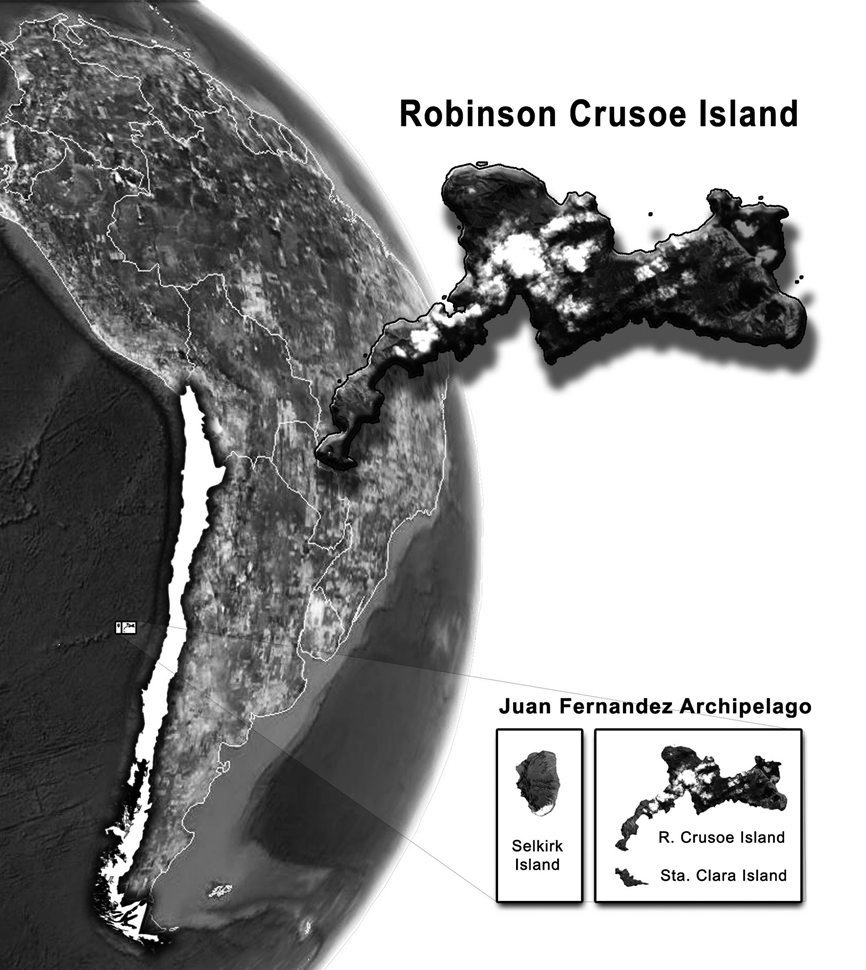
Robinson Crusoe Island is part of the Juan Fernandez Archipelago and is the only inhabited island in the archipelago. The archipelago is located 361 miles from the central coast of Chile (33° 37′ 56″ S; 78° 49′ 45″ W) (Brinck, Reference Brinck2005) and belongs governmentally to the Valparaiso region of Chile (see Fig. 1). The island was discovered in 1574 by the Spanish sailor Juan Fernandez. The first colonization took place in 1750. The island was later depopulated around 1850 by an order of the Chilean government. The current population comes directly from the last colonization, which occurred in 1881 with only eight families. These families comprised 37 European and Caucasian Chilean founders including ten children. Two of these male founders were siblings; the other six families were not related (Vicuña Mackenna, Reference Vicuña Mackenna1883; Orellana et al., Reference Orellana, Medina, Morel, Ruh, Hernández and Monleón1975; Schnyder, Reference Schnyder2004).
Geographic area studied: Robinson Crusoe Island, Juan Fernandez Archipelago, Chile.

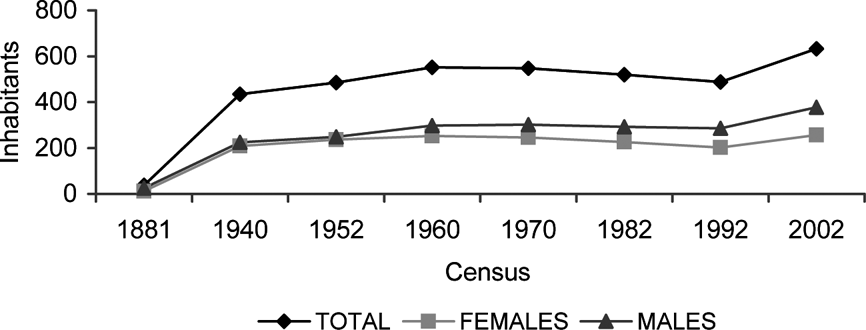
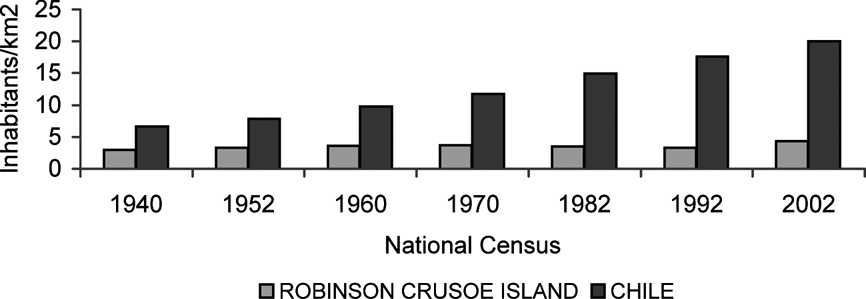
In 1902 the General Register Office was created. The 1940 Chilean census is the first official record providing information about the total population of the island (434 inhabitants). According to the most recent Chilean census (INE, 2002) the island's population was estimated at 633 inhabitants. The number of women was lower than the number of men, there being no evidence to explain this difference. This ratio has been increasing over the years (see Fig. 2). Following the initial population growth, the average population density on Robinson Crusoe Island remained very similar from 1940 to 1992, and lower than the average of the mainland region to which the island belongs governmentally (Valparaiso region), the region in Chile with the second highest density. While the total Chilean population density gradually increased over the study period (1940–2002), the population of the island decreased. However, it increased slightly over the last decade studied (1990–2000) (INE, 2002) (see Fig. 3).
Population development on Robinson Crusoe Island from 1881 to 2002.
Population density of Robinson Crusoe Island and Chile from 1940 to 2002.
The economy of the island is based almost exclusively on fishing, especially lobsters, endemic fish and golden crabs. In the last 15 years studied (1985–2000) there has been an increase in tourism-related businesses, which may explain the population growth in the decade 1990–2000. The people of Robinson Crusoe Island speak Spanish, the only official language in Chile. Both sea and air transport are very limited on the island. Only one vessel per month brings food and other basic goods. Recently an aerodrome for small aeroplanes was built which, due to climate conditions, has to close several times throughout the year.
Given the geographic isolation of this population and the documented founder effect on language impairment prevalence (Villanueva et al., Reference Villanueva, Jara and Palomino2010), the aim of the present study was to determine rates of consanguinity, the average coefficients of inbreeding (α), the types of consanguineous marriages, and inbreeding between 1900 and 2000 on Robinson Crusoe Island.
Methods
The study used a retrospective research design to assess the total number of marriages registered on Robinson Crusoe Island over the ten decades from 1900 to 2000. The data were taken from a village genealogy compiled by the research group from birth records going back to the last colonization. The genealogical records, which are organized into surname groups, were supplemented with any additional data that could be found in civil and family records of births, marriages and deaths. The records of individuals from 1900 to 2000 were classified into the eight founder families with four to six generations since the foundation date.
Rates of consanguinity, average inbreeding coefficient (α coefficient or Bernstein coefficient) and the percentage of different types of consanguineous marriages were calculated (Cavalli-Sforza & Bodmer, Reference Cavalli-Sforza and Bodmer1971). Uncle–niece and/or aunt–nephew marriages (M12, F=1/8), and those between first cousins (M22, F=1/16), first cousins once removed (M23, F=1/32), half first cousins (M221/2, F=1/32), second cousins (M33, F=1/64), second cousins once removed (M34, F=1/128), half second cousins (M331/2, F=1/128), and even third cousins (M44, F=1/256) were considered for the purposes of this research, because extensive genealogies were available over six generations (Cavalli-Sforza & Bodmer, Reference Cavalli-Sforza and Bodmer1971; Varela et al., Reference Varela, Ainsua and Fariña2001).
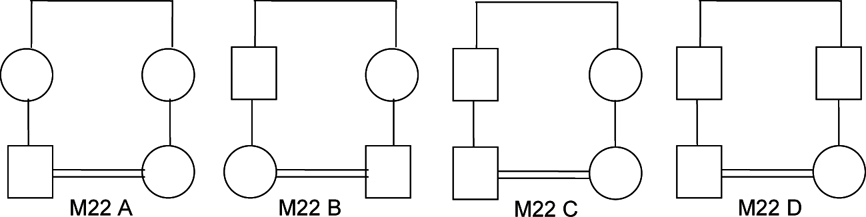
According to the type of analysis, the calculations were performed every 20 years for the period between 1900 and 2000. The ratio of marriages between first cousins and second cousins (M22/M33) was also calculated, as this is considered to be an important indicator of evolution of the structure of a population (Varela et al., Reference Varela, Ainsua and Fariña2001). The percentages of different types of first cousin marriages (M22A, M22B, M22C, M22D) were calculated to estimate non-random factors (Haldane & Moshinsky, Reference Haldane and Moshinsky1939) (see Fig. 4).
Types of first cousin consanguineous marriages. Squares, male; circles, female. Reproduced from Haldane & Moshinsky (Reference Haldane and Moshinsky1939).
The protocol of the study was approved by the Ethics Board of the School of Medicine, University of Chile.
Results
Today the founder families of Robinson Crusoe Island have between four and five generations born on the island. Between 1900 and 2000, 417 marriages were registered. The average consanguinity rate was 14.9% and the average coefficient of inbreeding (α) was 54.05×10⁻⁴. During the period analysed 62 marriages were consanguineous, and of seven different types. The absolute and relative frequencies of the different types of consanguineous marriages are given in Table 1. The most frequent consanguineous marriages were between second cousins (M33: 5.04% of the total marriages). The least frequent marriages were between half second cousins (M331/2: 0.48%). Temporal variation of the proportion of the different types of consanguineous marriages every 20 years is also shown in Table 1. It is possible to see a trend of increased consanguinity on the island over time. There was a clear increase in the relative proportion of M33 and M44 marriages, at the expense of a decrease in M22 marriages.
Absolute and relative frequencies of the different types of consanguineous marriages, Robinson Crusoe Island, 1901–2000
The relative frequencies of M331/2 (half second cousin) marriages decreased throughout the period studied. There were no marriages between uncles and nieces or aunts and nephews (M12) in the 100 years analysed. In consanguineous marriages between first cousins (n=17), the highest frequency was between cousins who were the offspring of two brothers (M22D: 47%). The other relation values were: M22A, 5.9%; M22B, 35.3%; M22C, 11.8%.
The average first cousin/second cousin (M22/M33) ratio from 1941 to 2000 was 1.11. There were no second cousin marriages between 1900 and 1940. The M22/M33 ratio for the next period (1941–1960) was 2.67. From 1961 to 1980 the ratio was 0.57. For the last 20-year period (1981–2000) the ratio was 0.09. The variation of the inbreeding coefficient between 1900 and 2000 in 20-year periods is shown in Table 2. This shows a gradual increase until reaching maximum values in the decennia 1981–2000 (values above 96.84×10⁻⁴).
Variation of the coefficient of inbreeding (α) every 20 years, Robinson Crusoe Island, 1901–2000
a α (×10–4).
Discussion
In Chile, consanguinity rates have been analysed in several native populations (Mapuches, α=57.9×10⁻⁴; Pehuenche, α=82.9×10⁻⁴), non-native Chilean populations living in urban areas (Viña del Mar, α=3.3×10⁻⁴; La Serena, α=5.43×10⁻⁴), non-native Chilean populations living in rural areas (Olmue, α=37×10–4) and in the population living on Easter Island, where the α value was 5.6×10⁻⁴ (Quezada & Barrantes, Reference Quezada and Barrantes1973; Champin et al., Reference Champin, Rothhammer, Blanco and Palomino1976; Villarroel et al., Reference Villanueva, Newbury, Jara, De Barbieri, Mira, Palomino and Fernández1978; Zuñiga, Reference Zuñiga1978; Cruz Coke, Reference Cruz-Coke1989). All of the above populations show a tendency for α values to decrease over the years, which is as expected for expanding populations with no restriction on marriages. In contrast, the average consanguinity on Robinson Crusoe Island constantly increased from 1900 to 2000. At the beginning of the XXI century, 77% of the population has at least one parent who was descended from the founder families. This may be due to the low rate of immigration to the island and the stability of the size of the population, which has grown slowly with slight differences in density throughout the study decades (see Figs 2 and 3).
The number of consanguineous marriages among the islanders has increased due to a growing number of second cousin and third cousin marriages. The period from 1941 to 2000 showed the highest number of consanguineous marriages. This reflects the fact that during this period the population grew to comprise at least two generations born on the island. Before 1941 there were only four marriages between first cousins.
On the other hand, during the same period the native population of mainland Chile had opposite social behaviours. North Chilean Amerindians (Aymaras [α=1.5×10⁻⁴] and Atacameños [α=4.1×10⁻⁴]) have always been characterized by low degrees of consanguinity because of their social structure, where consanguineous marriage is considered a taboo. In contrast, southern Chilean Amerindian (Mapuches [α=57.9×10⁻⁴] and Pehuenches [α=82.9×10⁻⁴]) encouraged consanguineous marriages. Currently, among these latter groups there is still a high tendency to encourage certain types of first cousin mating due to their matri- or patrilineal social system (see Fig. 4) (Rothhammer & Llop, Reference Rothhammer and Llop2004). There is no evidence that on Robinson Crusoe Island there was a preferred mating. However, the present study observed a higher frequency of matings between the offspring of brother pairs. This may primarily be due to the sex distribution on the island (Fig. 2) as there are no known cultural, religious or land-ownership factors involved in the choice of spouses.
The most two common types of consanguineous marriages in the world population are those between (a) first cousins and (b) second cousins. In the population of Robinson Crusoe Island first cousin mating and second cousin mating together represent over 60% of the total consanguineous marriages. These types of marriages involve spouses with the highest degree of consanguinity. Thus they contribute with a high load to homozygosity as the spouses are most likely to share ancestral chromosomes.
Nevertheless, the number of matings between individuals with shared relatives more than two generations back increased noticeably from 1940 to 2000. This explains the growing tendency of the observed consanguinity on the island and may be, in part, due to the growing size of the population.
The average values of the consanguinity rate (14.9%) and the coefficient of inbreeding (54.05×10⁻⁴) on Robinson Crusoe Island during the period 1900–2000 were higher than those registered in other non-native small areas of Chile over the same period of time (Rothhammer & Llop, Reference Rothhammer and Llop2004). A large part of the observed consanguinity can be explained by the geographical isolation of the island and its poor transport links. Certainly, improved transport between the island and the mainland would be expected to break down this isolation. However, if this hypothetical improvement did happen, there would be other factors to take into consideration. First, the island is small in size with a difficult geography to live in. It has a volcanic origin with almost no flat surfaces or plateaus. Second, it has been declared a World Heritage Site by UNESCO and thus most of the areas on the island cannot be used for housing. These two issues restrict immigration to the island. Finally, because of the lack of tertiary education on the island, young adults have to leave to go to the mainland for further education opportunities.
Despite the suggestions from some scientists in the early 1960s about the uniqueness of the population structure of the island (Orellana et al., Reference Orellana, Medina, Morel, Ruh, Hernández and Monleón1975), no systematic studies have been carried out in this population, as they have in other Chilean islands such as Easter Island (Cruz-Coke, Reference Cruz-Coke1989). This study found a high level of consanguinity, primarily accounted for by first and second cousin marriages. The unique characteristic of the island – its small current population, originating from just a few families, with small rate of gene flow – could explain the observed high and increasing consanguinity. The population structure of Robinson Crusoe Island offers an unparalleled opportunity to study the underlying causes of genetic pathologies on the island.
Acknowledgments
The authors are extremely grateful to the inhabitants of Robinson Crusoe Island who agreed to participate in this study. They would like to thank the Mayor of the Ilustre Municipalidad de Juan Fernandez for his infinite assistance in the development of this research and the authorities of Armada de Chile for allowing travel to Robinson Crusoe Island. Monica Garcia is thanked for her work on the genealogical records, and also Dr Dianne Newbury and Dr Adrian Fuente for their comments on the original manuscript, and Professor A. Bakr Rabie for his encouragement of this project. The work was specifically funded by Vicerrectoria de Investigacion, Universidad de Chile (www.uchile.cl), UCHILE DID TNAC 01-02/01, UCHILE DI MULT 05-05/02 grants. The authors declare no conflict of interest.