

Introduction
Mosquito-borne diseases take a heavy toll on human lives. Due to its blood-sucking behaviour, a female mosquito is able to transmit pathogens and parasites that cause serious diseases including malaria, filariasis, dengue haemorrhagic fever, Japanese encephalitis, yellow fever and chikungunya. These emerging and resurging diseases result in high burden of disease that reflects inadequate implementation and/or impact from current control measures (WHO, 2009).
According to the latest estimates, there were about 207 million cases of malaria in 2012 and an estimated 0.62 million deaths (WHO, 2014). In India, 0.2 million deaths have been reported to occur annually due to malaria (Dhingra et al., Reference Dhingra, Jha, Sharma, Cohen, Jotkar, Rodriguez, Bassani, Suraweera, Laxminarayan and Peto2010).
Medically important species of mosquito belong to three genera: Anopheles; Aedes; Culex. About 455 named species and 40 unnamed members of complexes recognized as distinct morphological or genetic species of Anopheles have been identified (Harbach, Reference Harbach2007). In India, about 58 species of Anopheles are prevalent, of which six are primary vectors of malaria and four are secondary vectors (Nagpal and Sharma, Reference Nagpal and Sharma1995). The six primary vectors are distributed as follows: Anopheles culicifacies in rural areas, An. stephensi in urban settings, An. fluviatilis in plains and foothills, An. minimus in foothills of the northeast, An. dirus in jungles of northeastern states and An. sundaicus in the islands (Andaman and Nicobar) (Dev and Sharma, Reference Dev, Sharma and Manguin2013). Anopheles stephensi Liston (Diptera: Culicidae), the primary urban vector, has been reported to account for about 15% of the incidents of malaria in India (Reference Shetty, Raghunath and NayakShetty, 2002a ).
Anopheles stephensi was classified as two geographical races based on the number of ridges on the egg float; urban An. stephensi was regarded as the type form and the rural variety as mysorensis. Later, several examinations revealed the presence of three variants: type form; mysorensis; intermediate (Sweet and Rao, Reference Sweet and Rao1937; Rao et al., Reference Rao, Sweet and Subba Rao1938). The numbers of ridges for the variants are 14–22 (type form), 9–15 (mysorensis) and 12–17 (intermediate). The type and intermediate forms have been found in urban and semi-urban areas and reported to be vectors; the mysorensis form has been found to be predominant in rural areas and reported as a non-vector (Subbarao et al., Reference Subbarao, Vasantha, Adak, Sharma and Curtis1987; Shetty et al., Reference Shetty, Madhyastha, Ghosh and Rajashree1999). The type form has been found to be exclusively domestic in all seasons, whereas mysorensis occupies the outdoor niche during monsoon and post-monsoon seasons with a spillover into domestic sites during summer periods of ecological stress (Nagpal et al., Reference Nagpal, Srivastava, Kalra and Subbarao2003).
Due to urbanization, there is a surge in construction activity. This creates ideal conditions for mosquito breeding, and the migration from endemic areas accounts for the high number of incidents of mosquito-borne diseases; therefore, either the parasites or the vectors should be controlled. The strategy adopted to curtail mosquito-borne disease transmission in urban settings is through anti-larval operations (Tiwari et al., Reference Tiwari, Ghosh, Ojha, Dash and Raghavendra2010). There is a widespread use of insecticides because they are effective, convenient to apply and economical.
Indiscriminate application of insecticides leads to the development of resistance. Susceptibility studies act as a resource in resistance surveillance, which provides baseline data for programme planning, insecticide dose selection, detection of resistant individuals at an early stage, and continuous monitoring of the effect of insecticides on resistance (WHO, 1981; National Research Council, 1986). The determination of general resistance spectra is the first stage in the investigation of any insecticide-resistant population (Hemingway, Reference Hemingway1981). For this purpose, the indigenous mosquito species should be collected and their minimum effective dosages such as LC50 and LC90 values for different insecticides should be evaluated. Based on the results obtained in the laboratory, an effective optimum dosage for field applications can be determined. The status of insecticide susceptibility/resistance has to be reviewed periodically to either continue or discontinue specific insecticides. Vector control operations require monitoring insecticide susceptibility to determine dosage, establish baseline levels for future resistance work, and evaluate the effects of insecticides on disease incidence and vector behaviour.
Therefore, the aim of the present work was to study the ecological variations in An. stephensi based on the egg-float ridge numbers in different populations, and also their resistance status under laboratory conditions to two insecticides: chlorpyrifos (an organophosphate insecticide) and propoxur (a carbamate insecticide).
Materials and methods
Anopheles stephensi – strains and maintenance
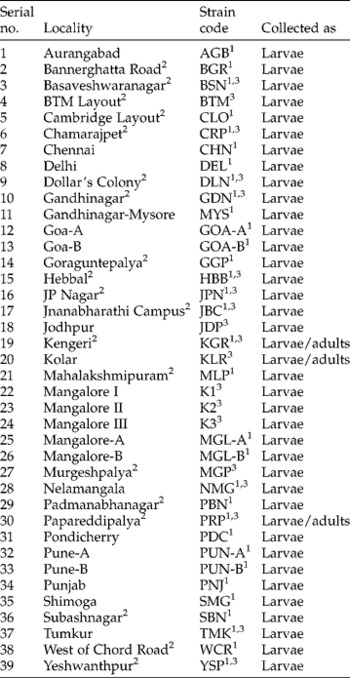
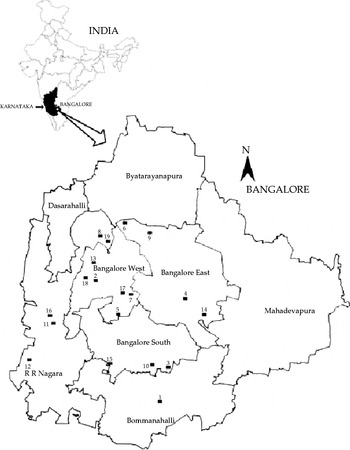
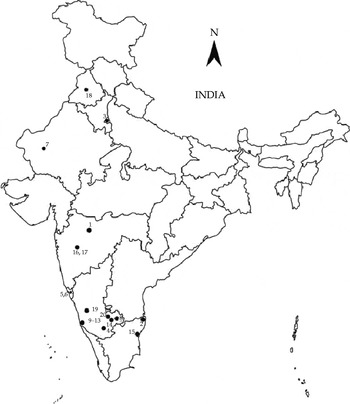
A total of 39 strains of An. stephensi from various parts of India (Table 1) were used in this study, of which 19 were from Bangalore (Fig. 1) and 20 from other parts of the country (Fig. 2). Colonies were maintained in the insectary following the procedure of Shetty (Reference Shetty1983), in cages with iron frames covered with cotton mosquito net. Adults were fed with 10% sucrose solution on soaked sterilized cotton, and females were provided with blood meal on restrained mice 5 days after their emergence. Water-filled plastic cups lined with filter paper were placed inside the cages for oviposition. Gravid females laid eggs 48 h after taking the blood meal. The eggs were kept for 72 h to ensure complete hatching. Larvae were reared in white enamel pans containing filtered tap water and fed with powdered yeast tablets on a regular schedule throughout the larval period. To avoid scum formation, water in the pans was changed every day. Pupation began 8–10 days after hatching. Pupae were transferred into wide-mouthed bottles and emerging adults were released into their respective cages. These stocks were maintained at a temperature of 25 ± 1 °C with relative humidity of 75 ± 5% and 10 h of photoperiod throughout the course of investigations.
Strains of Anopheles stephensi collected from different geographical regions of India

1 Strains used for larval bioassay.
2 Strains from Bangalore.
3 Strains used for egg-float ridge number studies.
Map of Bangalore, Karnataka, showing the mosquito collection sites. 1, Bannerghatta Road; 2, Basaveshwaranagar; 3, BTM Layout; 4, Cambridge Layout; 5, Chamarajpet; 6, Dollar's Colony; 7, Gandhinagar; 8, Goraguntepalya; 9, Hebbal; 10, JP Nagar; 11, Jnanabharathi Campus; 12, Kengeri; 13, Mahalakshmipuram; 14, Murgeshpalya; 15, Padmanabhanagar; 16, Papareddipalya; 17, Subashnagar; 18, West of Chord Road; 19, Yeshwanthpur.

Map of India showing the mosquito collection sites. 1, Aurangabad; 2, Chennai; 3, Delhi; 4, Gandhinagar-Mysore; 5, Goa-A; 6, Goa-B; 7, Jodhpur; 8, Kolar; 9, Mangalore I; 10, Mangalore II; 11, Mangalore III; 12, Mangalore A; 13, Mangalore B; 14, Nelamangala; 15, Pondicherry; 16, Pune-A; 17, Pune-B; 18, Punjab; 19, Shimoga; 20, Tumkur.

Egg-float ridge number
For each strain, the fresh (unhatched) eggs laid by the blood-fed females, along with the filter paper provided for oviposition, were placed under the microscope for counting the egg-float ridge numbers (10 × magnification, LABO, Bioplan XL, Jupiter Scientific Company, Salem, Tamil Nadu, India). Based on the number of ridges on the egg floats, the strains were grouped into type (14–22 ridges), mysorensis (9–15) and intermediate (12–17). The percentage distribution of ridges in each strain was calculated according to the procedure of Shetty et al. (Reference Shetty, Madhyastha, Ghosh and Rajashree1999).
Insecticides
Two insecticides were used in the present study: chlorpyrifos (an organophosphate insecticide) and propoxur (a carbamate insecticide).
Chlorpyrifos (21.5% E.C.) is one of the most commonly used insecticides in agriculture, horticulture and mosquito control. It is non-systemic and kills by direct contact or ingestion. The IUPAC nomenclature is O, O-diethyl O-3,5,6-trichloro-2-pyridylphosphorothioate with the molecular formula of C9H11Cl3NO3P. It acts on the nervous system of insects by inhibiting acetylcholinesterase.
Propoxur (Baygon – 2% E.C.) is a crystalline derivative of carbamic acid. It is a non-systemic, contact and stomach poison and used against mosquitoes in outdoor areas. Propoxur is one of the chemicals that has, to a large extent, replaced DDT in mosquito control (McEwen and Stephenson, Reference McEwen and Stephenson1979). It has residual poisonous or toxic activity when it is in direct contact with the target pest (Hartley and Kidd, Reference Hartley and Kidd1983). The IUPAC nomenclature is 2-isopropoxyphenyl methylcarbamate with the molecular formula of C11H15NO3. It has been approved by and registered with the Central Insecticide Board and Registration Committee, the Ministry of Agriculture, Government of India, the WHO, and Environmental Protection Agency, USA, for use against household pests including mosquito. As with other carbamates, propoxur blocks the production and action of cholinesterase, paralyzing the nervous system of insects and causing a rapid ‘knockdown’ effect.
Larval bioassays
Susceptibility tests were carried out according to the procedure of WHO (2005). Different concentrations (mg/l) of chlorpyrifos were prepared in denatured alcohol (98 ml absolute alcohol+2 ml ethyl methyl ketone) and propoxur in water. A total of 25 late third-instar larvae were transferred into glass bottles, each containing the test concentration (249 ml of dechlorinated tap water+1 mg/l stock concentration), with four replicates. Mortality was assessed after 24 h. Mortality data from bioassays were corrected by natural control mortality using Abbot's formula (Abbott, Reference Abbott1925); LC50 and LC90 were calculated by log-dose probit analysis (Finney, Reference Finney1971). We set up a control by adding 1 ml of denatured alcohol/water to 249 ml water. If more than 10% of the larvae pupated during the course of the experiment, the test was discarded. The tolerance/resistance ratio was calculated by dividing the LC50/LC90 value of a strain by the LC50/LC90 value of the least resistant strain for each insecticide (Boike et al., Reference Boike, Rathburn, Floore, Rodriguez and Coughlin1989).
Results
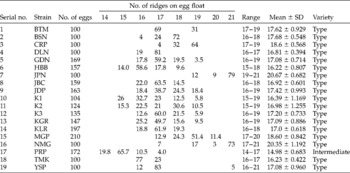
The various strains of An. stephensi used in this study along with the strain codes are presented in Table 1. The ridges on the egg floats of the 19 strains were counted and the percentage distribution calculated for each strain. Based on the number of ridges, each strain was classified as type form, intermediate form or mysorensis. Of the 19 strains studied, 18 (BTM, BSN, CRP, DLN, GDN, HBB, JPN, JBC, JDP, K1, K2, K3, KGR, KLR, MGP, NMG, TMK and YSP) were classified as type form. The PRP strain was classified as intermediate form (Table 2).
Percentage distribution of egg-float ridge numbers for the different strains of Anopheles stephensi

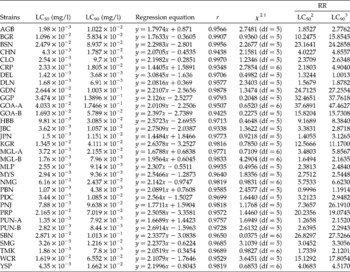
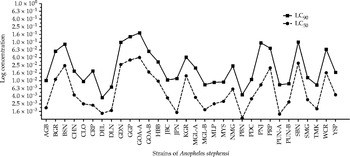
Larval susceptibility status to chlorpyrifos is presented (Table 3 and Fig. 3). Among the strains, GOA-A showed the highest LC50 value (4 × 10− 2mg/l) followed by GGP (3.474 × 10− 2mg/l), SBN (2.871 × 10− 2mg/l), GDN (2.644 × 10− 2mg/l) and BSN (2.479 × 10− 2mg/l); the lowest LC50 was shown by PBN (1.07 × 10− 3mg/l) followed by PUN-A (1.35 × 10− 3mg/l), DEL (1.42 × 10− 3mg/l), JPN (1.5 × 10− 3mg/l) and DLN (1.68 × 10− 3mg/l). The GOA-A strain showed the highest LC90 value (1.7466 × 10− 1mg/l), followed by GGP (1.3896 × 10− 1mg/l), SBN (1.013 × 10− 1mg/l), GDN (1.003 × 10− 1mg/l) and PNJ (9.638 × 10− 2mg/l); the lowest LC90 value was shown by DEL (3.68 × 10− 3mg/l), followed by PBN (4.38 × 10− 3mg/l), DLN (6.91 × 10− 3mg/l), TMK (7.80 × 10− 3mg/l) and PUN-A (7.92 × 10− 3mg/l). χ2 values were found to be non-significant at P< 0.05.
LC50, LC90, regression equation, coefficient of correlation, χ2 and tolerance/resistance ratio (RR) values of chlorpyrifos for the different strains of Anopheles stephensi

1 Statistically non-significant (P< 0.05).
2 Tolerance RR50= LC50 of a strain/LC50 of the PBN strain.
3 Tolerance RR90= LC90 of a strain/LC90 of the DEL strain.
Susceptibility status of different strains of Anopheles stephensi to chlorpyrifos.

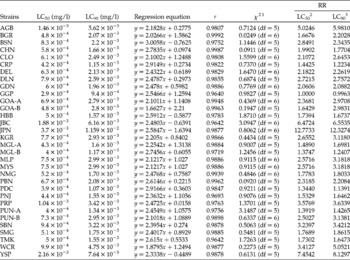
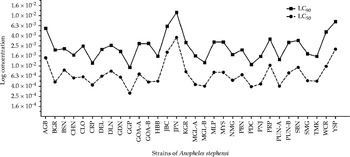
Larval susceptibility status to propoxur is presented (Table 4 and Fig. 4). Among the strains, JPN showed the highest LC50 value (3.7 × 10− 3mg/l), followed by YSP (2.16 × 10− 3mg/l), JBC (1.88 × 10− 3mg/l), AGB (1.46 × 10− 3mg/l) and PRP (1.04 × 10− 3mg/l); GGP showed the lowest LC50 value (2.9 × 10− 4mg/l), followed by PDC (3.9 × 10− 4mg/l), MGL-B and PUN-A (4 × 10− 4mg/l) and CRP (4.2 × 10− 4mg/l). JPN showed the highest LC90 value (1.159 × 10− 2mg/l), followed by YSP (7.64 × 10− 3mg/l), JBC (6.16 × 10− 3mg/l), AGB (5.62 × 10− 3mg/l) and WCR (4.75 × 10− 3mg/l); GGP showed the lowest LC90 value (9.4 × 10− 4mg/l), followed by PDC (1.07 × 10− 3mg/l), CRP (1.15 × 10− 3mg/l), MGL-B (1.17 × 10− 3mg/l) and PUN-A (1.34 × 10− 3mg/l). χ2 values were found to be non-significant at P< 0.05.
LC50, LC90, regression equation, coefficient of correlation, χ2 and tolerance/resistance ratio (RR) values of propoxur for the different strains of Anopheles stephensi

1 Statistically non-significant (P< 0.05).
2 Tolerance RR50= LC50 of a strain/LC50 of the GGP strain.
3 RR90= LC90 of a strain/LC90 of the GGP strain.
Susceptibility status of different strains of Anopheles stephensi to propoxur.

For chlorpyrifos, the LC50 values ranged from 1.07 × 10− 3 to 4 × 10− 2mg/l and the LC90 values ranged from 3.68 × 10− 3 to 1.7466 × 10− 1mg/l. Its mean ± SD LC50 value was 9.57 × 10− 3± 0.0109mg/l and its LC90 value was 3.91 × 10− 20.044 mg/l. For propoxur, the LC50 values ranged from 2.9 × 10− 4 to 3.7 × 10− 3mg/l and the LC90 values ranged from 9.4 × 10− 4 to 1.159 × 10− 2mg/l. Its mean ± SD LC50 value was 8.2 × 10− 4± 0.00066 mg/l and its LC90 value was 2.8 × 10− 3± 0.0022 mg/l (Table 5).
Range, mean±SD and confidence limits (CL) of LC50 and LC90 for chlorpyrifos and propoxur

For chlorpyrifos, the lowest LC50 tolerance values were 1.26 (PUN-A), 1.32 (DEL), 1.40 (JPN), 1.56 (DLN) and 1.64 (MGL-B); the highest values were 37.68 (GOA-A), 32.46 (GGP), 26.82 (SBN), 24.71 (GDN) and 23.16 (BSN) (Table 3). The lowest LC90 tolerance values were 1.19 (PBN), 1.87 (DLN), 2.12 (TMK), 2.15 (PUN-A) and 2.16 (MGL-B); the highest values were 47.46 (GOA-A), 37.76 (GGP), 27.52 (SBN), 27.25 (GDN) and 26.19 (PNJ) (Table 3). The LC50 tolerance values ranged from 1.26 to 37.68, with a mean ± SD of 8.9526 ± 10.198. The LC90 tolerance values ranged from 1.19 to 47.46, with a mean ± SD of 10.6484 ± 11.9642 (Table 6).
Range, mean±SD and confidence limits (CL) of LC50 and LC90 resistance ratios for chlorpyrifos and propoxur

For propoxur, the lowest LC50 tolerance values were 1.34 (PDC), 1.37 (MGL-B), 1.39 (CRP), 1.44 (CRP) and 1.48 (MGL-A); the highest values were 12.77 (JPN), 7.45 (YSP), 6.47 (JBC), 5.02 (AGB) and 3.57 (PRP). The lowest LC90 tolerance values were 1.13 (PDC), 1.22 (CRP), 1.24 (MGL-B), 1.42 (PUN-A) and 1.64 (PNJ); the highest values were 12.32 (JPN), 8.12 (YSP), 6.55 (JBC), 5.98 (AGB) and 5.05 (WCR) (Table 4). The LC50 tolerance values ranged from 1.34 to 12.77, with a mean ± SD of 2.8361 ± 2.3066. The LC90 tolerance values ranged from 1.13 to 12.32, with a mean ± SD of 3.0720 ± 2.3443 (Table 6).
From the present study, we found that the strains BGR, BSN, GDN, GGP, GOA-A, GOA-B, KGR, PRP, SBN and WCR were resistant (>10-fold tolerant to chlorpyrifos), while all were susceptible to propoxur except JPN, with a tolerance level of 12.77. The results indicate that the strains of An. stephensi were more susceptible to propoxur than to chlorpyrifos.
Discussion
The marked differences in the behaviour of An. stephensi had led to the existence of biological races being proposed. Two populations, type form and mysorensis, were reported on the basis of differences in egg length, width and number of ridges on the egg float (Sweet and Rao, Reference Sweet and Rao1937). Puri (Reference Puri and Boyd1949) designated them as sub-species; however, Rutledge et al. (Reference Rutledge, Ward and Bickley1970) found the two forms to be sympatric and interbreeding and thus considered them variants and not sub-species. Classification of the vector into ecological variants has a propounding effect on disease transmission (Shetty et al., Reference Shetty, Madhyastha, Ghosh and Rajashree1999). The type and intermediate forms that are predominant in urban and semi-urban areas have been reported to be vectors, while mysorensis, reported to be predominant in rural areas, has been determined to be a non-vector (Sweet and Rao, Reference Sweet and Rao1937; Rao, Reference Rao1984; Subbarao et al., Reference Subbarao, Vasantha, Adak, Sharma and Curtis1987; Shetty et al., Reference Shetty, Madhyastha, Ghosh and Rajashree1999). The result of the present study is in accordance with the earlier reports where type and intermediate forms have been found in urban and semi-urban areas. In the Jiroft district of Iran, An. stephensi was the mysorensis form, where the ridge number ranged from 10 to 14 (Mehravaran et al., Reference Mehravaran, Vatandoost, Oshaghi, Abai, Edalat, Javadian, Mashayekhi, Piazak and Hanafi-Bojd2012).
Wide use of insecticide treatments is indispensable in almost all crop and public health programmes, especially those for vector control. The rational use of insecticides depends on a broad knowledge of the susceptibility and irritability levels of malaria vectors. This knowledge enables us to take all necessary precautions to prevent the occurrence of resistance, and to prepare in advance a plan for coping with it at the early stages of its development in the field (Vatandosst and Borhani, Reference Vatandosst and Borhani2004).
To indicate a strain is resistant, a 10-fold increase in LC50 is necessary for mosquito larvae, while a 4-fold increase is sufficient for adult mosquito in comparison with the susceptible control (Brown and Pal, Reference Brown and Pal1971). In the present study, a maximum 37.68-fold tolerance was observed in GOA-A compared with the least resistant strain (PBN) for chlorpyrifos and a 12.77-fold tolerance in JPN compared with the least resistant strain (GGP) for propoxur. Based on the results, it is clear that the tolerance values for chlorpyrifos and propoxur among many strains show more than a 10-fold tolerance, indicating resistance to these insecticides. The correlation coefficient (r) indicates that the observed values fall around the regression line. The r values are strong when placed between 0.8 and 1.0. All the r values obtained in the present study are >0.9, indicating close proximity to the regression line.
Insecticide susceptibility studies have been carried out in different species of mosquito for both larvae and adults derived from the Cauvery basin and its tributaries from Thalakaveri to Makedatu in Karnataka (Reference ShettyShetty, 2002b ). Susceptibility studies for various classes of insecticides, including organochlorines, organophosphates, carbamates, synthetic pyrethroids and botanicals, have been carried out on three major mosquito vector species (Ghosh et al., Reference Ghosh, Rajasree, Priyalakshmi and Shetty2002; Kashyap and Shetty, Reference Kashyap and Shetty2011; Shetty et al., Reference Shetty, Zin, Hariprasad and Minn2006, Reference Shetty, Vasanth and Sanil2007, Reference Shetty, Minn, Zin and Juanita2010, Reference Shetty, Sanil and Shetty2012). The genetic basis of chlorpyrifos (Chandrakala and Shetty, Reference Chandrakala and Shetty2006) and propoxur (Sanil and Shetty, Reference Sanil and Shetty2010) resistance and their cytological basis (Shetty et al., Reference Shetty, Hariprasad, Sanil and Zin2013) have been studied. The susceptibility status of An. stephensi to DDT, BHC, propoxur, malathion, fenthion and deltamethrin (Mukhopadhyay et al., Reference Mukhopadhyay, Karmakar, Hati and Dey1997) has been reported in India. Anopheles stephensi from southern Iran (Manouchehri and Yaghoobi-Ershadi, Reference Manouchehri and Yaghoobi-Ershadi1988), An. pulcherrimus from southeast Iran (Zahirnia et al., Reference Zahirnia, Vatandoost, Nateghpour and Djavadian2002) and Russia (Sorokin et al., Reference Sorokin, Adamishina, Stepnov, Ivanova and Ermishev Iu1991), and An. sacharovi from Iran (Yaghoobi-Ershadi et al., Reference Yaghoobi-Ershadi, Namazi and Piazak2001) have been found to be susceptible to the propoxur treatment.
Adults of An. culicifacies from Surat, India (Raghavendra et al., Reference Raghavendra, Verma, Srivastava, Gunasekaran, Sreehari and Dash2010) and Anopheles gambiae from Nigeria have been found to be susceptible to propoxur (Olayemi et al., Reference Olayemi, Ande, Chita, Ibemesi, Ayanwale and Odeyemi2011); Anopheles maculipennis from Turkey has been found to be resistant (Akiner, Reference Akiner2014). Larvae of An. stephensi and Anopheles subpictus from Gujarat and Rajasthan, India (Tikar et al., Reference Tikar, Mendki, Sharma, Sukumaran, Vee, Prakash and Parashar2011) have been found to be tolerant to chlorpyrifos (0.025 mg/l). Anopheles dthali and An. fluviatilis from southern Iran (Hanafi-Bojd et al., Reference Hanafi-Bojd, Vatandoost and Jafari2006) and An. gambiae from Bénin, West Africa (N'Guessan et al., Reference N'Guessan, Boko, Odjo, Chabi, Akogbeto and Rowland2010) have been found to be susceptible to chlorpyrifos-methyl; An. sinensis from the Republic of Korea has been reported to be resistant to chlorpyrifos (Chang et al., Reference Chang, Yoo, Shin, Lee, Roh and Park2013). Mixed results from different parts of the world are a serious concern, and underline the importance of monitoring and understanding resistance levels and their mechanisms. From the present study, although some geographical strains showed resistance to both insecticides, An. stephensi was found to be more susceptible to propoxur than to chlorpyrifos. Baseline information from this experiment will serve as a guide for future application of insecticides to different strains of An. stephensi.
The first step is to assess trends in frequency of the resistance gene(s) through susceptibility tests, and to investigate the efficacy of insecticides using bioassays. The most effective insecticides giving 100% possible kill should be used in rotation in vector control programmes (Kasap et al., Reference Kasap, Kasap, Alptekin, Luleyap and Herath2000). Application of inappropriate insecticides without an understanding of the prevailing resistance mechanisms may lead to control failure. Hence, periodic monitoring of insecticide resistance status is an important criterion in vector control programmes (Shetty et al., Reference Shetty, Sanil and Shetty2012). The rate at which an insecticide becomes ineffective depends on the selection pressure for resistance, which is determined by monitoring, and how often and for how long the insecticide is being used (Hudson, Reference Hudson1983).
Conclusion
The type form of An. stephensi was found in urban and semi-urban areas and the intermediate form in semi-urban localities. The forms are usually vectors, and are distributed throughout the urban localities in and around Bangalore. The different strains across India showed that they were more susceptible to propoxur than to chlorpyrifos. Hence, propoxur can be preferred and used ahead of chlorpyrifos. Close cooperation is necessary among health, agriculture and ecosystem analysts to understand insecticide use. The data provided in the bioassays provide the preliminary information important for subsequent investigations into the mechanisms of resistance.
Acknowledgements
This paper was supported by financial assistance from the Department of Science and Technology (DST) New Delhi, to Professor N.J. Shetty.