Significant outcomes
-
Cholecystokinin B receptor genotype presented a heterosis effect, where both homozygotes displayed higher anxiety in comparison with heterozygotes.
-
In addition to anxiety, depressiveness and suicidal thoughts as well as Affective Neuroscience Personality Scales FEAR and SADNESS were associated with the cholecystokinin B receptor genotype.
Limitations
-
Currently, the functional significance of the rs2941026 locus has not been described.
Introduction
Anxiety is based on a variety of chemical neuroanatomical processes (Panksepp, Reference Panksepp1998), which currently remain insufficiently explained. All major neurotransmitter systems are involved in anxiety, and these are modulated by a number of neuropeptides that are co-released with more widespread transmitter molecules, especially at higher levels of neural activity, and with higher specificity of localisation (Hökfelt et al., Reference Hökfelt, Barde, Xu, Kuteeva, Rüegg, Maitre, Risling, Kehr, Ihnatko, Theodorsson, Palkovits, Deakin, Bagdy, Juhasz, Prud’homme, Mechawar, Diaz-Heijtz and Ögren2018). Indeed several neuropeptides have been implicated in anxiety regulation (Panksepp and Harro, Reference Panksepp, Harro and Panksepp2004; Griebel and Holmes, Reference Griebel and Holmes2013; Gupta and Prabhavalkar, Reference Gupta and Prabhavalkar2021). Amongst neuropeptides, cholecystokinin (CCK) attracted particular interest owing to findings that CCK receptor agonists elicited panic attacks in healthy volunteers (de Montigny, Reference de Montigny1989; Bradwejn et al., Reference Bradwejn, Koszycki and Bourin1991a) and more potently in patients with panic disorder (Bradwejn et al., Reference Bradwejn, Koszycki and Meterissian1990; Abelson et al., Reference Abelson, Nesse and Vinik1991; Bradwejn et al., Reference Bradwejn, Koszycki and Shriqui1991b). In parallel, anxiogenic effects were observed in animal models (Harro et al., Reference Harro, Põld and Vasar1990b). These effects were blocked by CCKB receptor antagonists both in animals and humans (Harro et al., Reference Harro, Vasar and Bradwejn1993). Several pharmaceutical companies developed selective non-peptide CCKB receptor antagonists for the treatment of anxiety, but controlled trials failed to show any efficacy in the treatment of either panic disorder or generalised anxiety disorder (Adams et al., Reference Adams, Pyke, Costa, Cutler, Schweizer, Wilcox, Wisselink, Greiner, Pierce and Pande1995; Kramer et al., Reference Kramer, Cutler, Ballenger, Patterson, Mendels, Chenault, Shrivastava, Matzura-Wolfe, Lines and Reines1995; Pande et al., Reference Pande, Greiner, Adams, Lydiard and Pierce1999).
However, CCK has consistently been found to elicit anxiogenic-like effects in primates and in rodents (Harro, Reference Harro2006), and more recently in zebrafish (Matsuda et al., Reference Matsuda, Yoshida, Watanabe, Yokobori, Konno and Nakamachi2020), whereas neuropeptide Y-deficient zebrafish that display anxiety-like behaviour have higher levels of CCK gene expression (Shiozaki et al., Reference Shiozaki, Kawabe, Karasuyama, Kurachi, Hayashi, Ataka, Iwai, Takeno, Hayasaka, Kotani, Komatsu and Inui2020). Thus, CCK may have played an anxiety-regulating role already before water-to-land transition. In humans, panic attacks elicited by administration of CCK-4 are accompanied by activation of a variety of anxiety-related brain areas, most notably the rostral anterior cingulate cortex, but also medial prefrontal and dorsolateral prefrontal cortex (Leicht et al., Reference Leicht, Mulert, Eser, Sämann, Ertl, Laenger, Karch, Pogarell, Meindl, Czisch and Rupprecht2013), a response also observed in terms of cingulate glutamate release as measured by magnetic resonance spectroscopy (Zwanzger et al., Reference Zwanzger, Zavorotnyy, Gencheva, Diemer, Kugel, Heindel, Ruland, Ohrmann, Arolt, Domschke and Pfleiderer2013).
CCKB receptors have also been reported to contribute to anxiety-related behaviours beyond pharmacological challenges. CCKB receptor levels are higher in suicide victims as shown independently by either receptor binding (Harro et al., Reference Harro, Marcusson and Oreland1992) or gene expression (Sherrin et al., Reference Sherrin, Heng, Zhu, Tang, Lau and Tan2004) studies. Rats with high anxiety levels in elevated plus-maze had higher baseline levels of CCKB receptors (Harro et al., Reference Harro, Kiivet, Lang and Vasar1990a), and an increase in CCKB receptor levels was observed in stressful conditions (Harro et al., Reference Harro, Löfberg, Rehfeld and Oreland1996). Additionally, in rats, social stress elicited CCK release in the medial prefrontal cortex (Becker et al., Reference Becker, Zeau, Rivat, Blugeot, Hamon and Benoliel2008), and in mice, activation of CCKB receptors in prefrontal cortex was found to be both necessary and sufficient for behavioural deficits induced by social defeat (Vialou et al., Reference Vialou, Bagot, Cahill, Ferguson, Robison, Dietz, Fallon, Mazei-Robison, Ku, Harrigan, Winstanley, Joshi, Feng, Berton and Nestler2014). In another study on rats, administration of pentagastrin, a CCKB receptor agonist, into the lateral amygdala impaired the recovery from conditioned fear (Erlich et al., Reference Erlich, Bush and LeDoux2012). Furthermore, experimental overexpression of CCKB receptors was demonstrated to lead to a persistent increase in anxiety in mice (Chen et al., Reference Chen, Nakajima, Meacham and Tang2006).
While the mechanism of CCKB receptor upregulation has not been clarified, several lines of evidence suggest that endogenous CCK release can be reducing anxiety or act as a safety signal (Wiertelak et al., Reference Wiertelak, Maier and Watkins1992; Rovira-Esteban et al., Reference Rovira-Esteban, Gunduz-Cinar, Bukalo, Limoges, Brockway, Müller, Fenno, Kim, Ramakrishnan, Andrási, Deisseroth, Holmes and Hájos2019; Ballaz et al., Reference Ballaz, Bourin, Akil and Watson2020) and administration of CCK-8 can be stress-protective (Sadeghi et al., Reference Sadeghi, Radahmadi and Reisi2015). Such contradictory results suggest that the significance of the CCK signal is qualitatively context-dependent. Indeed, in CCKB receptor-deficient mice, the behavioural phenotypes were not only strongly dependent on housing conditions but also differed by sex (Abramov et al., Reference Abramov, Raud, Innos, Lasner, Kurrikoff, Türna, Puussaar, Okva, Matsui and Vasar2008). Administration of CCK-8 into the dorsal periaqueductal grey matter elicited opposite effects in anxiety tests if the location of injection site was ventrolateral versus dorsolateral (Vázguez-León et al., Reference Vázquez-León, Campos-Rodríguez, Gonzalez-Pliego and Miranda-Páez2018). CCK expression in the basket cells of the hippocampus was found downregulated after stress at an early age but recovered after further stress in adulthood (Gruber et al., Reference Gruber, Gilling, Albrecht, Bartsch, Çalışkan, Richter-Levin, Stork, Heinemann and Behr2015). Another study observed that optogenetic stimulation of basal amygdalar CCK-positive interneurons facilitated fear extinction, whereas photosilencing had an opposite effect (Rovira-Esteban et al., Reference Rovira-Esteban, Gunduz-Cinar, Bukalo, Limoges, Brockway, Müller, Fenno, Kim, Ramakrishnan, Andrási, Deisseroth, Holmes and Hájos2019).
If trait-wise high anxiety were related to the CCK system, then it would be expected to find genetic variation in genes encoding CCK prepropeptide or CCK receptors. Polymorphisms in the CCK system genes have indeed been found to be associated with several anxiety-related phenotypes. Several variants, most notably the (CT)n microsatellite in the 5′ regulatory region of CCKBR (Kennedy et al., Reference Kennedy, Bradwejn, Koszycki, King, Crowe, Vincent and Fourie1999; Binkley et al., Reference Binkley, King, Poonai, Seeman, Ulpian and Kennedy2001; Hösing et al., Reference Hösing, Schirmacher, Kuhlenbäumer, Freitag, Sand, Schlesiger, Jacob, Fritze, Franke, Rietschel, Garritsen, Nöthen, Fimmers, Stögbauer and Deckert2004), −36C/T in CCK (Wang et al.,Reference Wang, Valdes, Noyes, Zoega and Crowe1998; Maron et al., Reference Maron, Nikopensius, Kõks, Altmäe, Heinaste, Vabrit, Tammekivi, Hallast, Koido, Kurg, Metspalu, Vasar, Vasar and Shlik2005; Kofoed et al., Reference Kofoed, Woldbye, Hansen, Hansen, Knudsen, Bolwig and Rehfeld2010), and −215C/A in CCKBR have been associated with panic disorder. Another short tandem repeat in the CCK gene 5′ regulatory region together with a downstream −188A/G was less frequent in panic disorder and downregulated the transcription of CCK (Ebihara et al., Reference Ebihara, Ohba, Hattori, Yamada and Yoshikawa2003). Additionally, functional polymorphisms in the CCKBR have been observed to increase the receptor-mediated second messenger signalling of anxiolytic drugs (Kopin et al., Reference Kopin, McBride, Gordon, Quinn and Beinborn1997). A polymorphism in the CCK promoter region, −196G/A, was associated with suicidal behaviour in a Japanese sample (Shindo and Yoshioka, Reference Shindo and Yoshioka2005). Another group found associations between 12 single nucleotide polymorphisms (SNP) in the CCKBR gene and suicide attempts (Sears et al., Reference Sears, Wilson and Fitches2013). Thus, several variants in the CCKBR have been associated with anxiety, but the results have been inconsistent, not surprisingly so owing to different sampling strategies (Zwanzger et al., Reference Zwanzger, Domschke and Bradwejn2012).
A study on procedural pain and anxiety in children found the rs2941026 in the intragenic region of the CCKBR gene to be associated with trait anxiety (Ersig et al., Reference Ersig, Schutte, Standley, Leslie, Zimmerman, Kleiber, Hanrahan, Murray and McCarthy2017). Interestingly, this work suggested that the A-allele was associated with lower trait anxiety in children but transmitted more often from parents to children with higher trait anxiety in a family-based transmission disequilibrium test. We decided to investigate this CCKBR variation further in a broader context of negative affectivity and in a sample highly representative of the target group. We used the measures of trait and state anxiety, but additionally included measures of depressiveness, suicidal thoughts and personality.
Methods
Study sample
This investigation is based on the Estonian Children Personality, Behaviour and Health Study (ECPBHS). The ECPBHS participants were first sampled in 1998 as part of the European Youth Heart Study (EYHS) that had school as a sampling unit using probability proportional to school size (by the number of students in respective grade); the participation rate of invited students was 79.1% (Harro et al., Reference Harro, Eensoo, Kiive, Merenäkk, Alep, Oreland and Harro2001). The EYHS was later incorporated into the longitudinal ECPBHS; at age 25, 79.2% of the original sample was retained. Thus far, data from the younger birth cohort have been collected at ages 9, 15, 18 and 25. The older birth cohort was first measured at age 15 and has received follow-ups at ages 18, 25 and 33. Details concerning follow-up data collection have been described elsewhere (Tomson-Johanson et al., Reference Tomson-Johanson, Kaart, Kiivet, Veidebaum and Harro2020). Written informed consent was obtained from the study participants and in the case of subjects under 18 years of age, from their parents. The study was approved by the Ethics Review Committee on Human Research of the University of Tartu (license numbers: 49/30, 151/11, 197T-14, and 235/M/20) and was conducted in accordance with the Declaration of Helsinki.
Anxiety measurement
Anxiety was measured with the Estonian language version of the Spielberger State-Trait Anxiety Inventory (STAI; Spielberger et al., Reference Spielberger, Gorsuch, Lushene, Vagg and Jacobs1983). STAI measures two aspects of anxiety: STAI-S (state) addresses how the participant is feeling while filling in the questionnaire (in our case, during the visit to the laboratory); STAI-T (trait) queries how the participant usually feels, thus addressing anxiety as a personality disposition. State anxiety (STAI-S) data were available at ages 15 and 18 for the younger birth cohort, at age 25 for both birth cohorts and at age 33 for the older birth cohort. Trait anxiety (STAI-T) data were available at age 18 for the younger birth cohort, at age 25 for both birth cohorts and at age 33 for the older birth cohort.
Affective neuroscience personality scales
An adaptation (Harro et al., Reference Harro, Laas, Eensoo, Kurrikoff, Sakala, Vaht, Parik, Mäestu and Veidebaum2019) of the short version of the Affective Neuroscience Personality Scales (ANPS) questionnaire (Davis et al., Reference Davis, Panksepp and Normansell2003) was used to measure personality traits. The ANPS was administered at age 25 for the younger birth cohort and age 33 for the older birth cohort.
Measures of depressiveness
Depressiveness was measured with the self-report format of the Montgomery – Åsberg Depression rating scale (MÅDRS; Montgomery and Åsberg, Reference Montgomery and Åsberg1979) at ages 18 and 25 for both birth cohorts and age 33 for the older birth cohort.
Measures of suicidal thoughts
For measures of suicidal thoughts, we analysed the ‘Suicidal thoughts’ question from the MÅDRS questionnaire, which describes to what extent the study participants consider life worth living. To measure the frequency of suicidal thoughts at ages 15 for the younger birth cohort and at 18 for both birth cohorts, we used a question in the ECPBHS lifestyle questionnaire inquiring how often the participants experienced suicidal thoughts. In this measure, lower scores indicate experiencing suicidal thoughts more often.
Genotyping of CCKBR rs2941026
Genomic DNA was extracted from venous blood samples with the Qiagen QIAmp® DNA Blood Midi Kit. Genotyping of rs2941026 was conducted by real-time polymerase chain reaction (RT-PCR) using a TaqMan® pre-designed SNP genotyping assay (Applied Biosystems; Foster City, CA, USA) C__15866557_10, that contains specific primers and fluorescent probes. Genotyping reactions were performed in a total volume of 10 µl with approximately 25 ng of template DNA. The RT-PCR components and final concentrations were as follows: 1:5 5 × HOT FIREPol® Probe qPCR Mix Plus (ROX) (Solis BioDyne) and 1:20 80 × TaqMan Primers Probe. The context sequence [VIC/FAM] was as follows: CAGAAGGAAATTTTTCTAAACTCAA[A/G]AAGGGAAAGTTGGAATAAATTGTAA. Reactions were performed on the Applied Biosystems ViiA™ 7 real-time PCR system. The amplification procedure consisted of initial denaturation at 95°C for 15 s and 60°C for 1 min. Each reaction plate included a positive and negative control. There were no inconsistencies in the genotyping results. Genotyping was performed blind to all phenotypic data.
Statistical analysis
Linear mixed-effects regression models were used to evaluate the association between the CCKBR rs2941026 genotype and anxiety, depressiveness and suicidal thoughts longitudinally. For state anxiety, the baseline was 15 years of age, and follow-up points were at ages 18, 25 and 33. For trait anxiety, depressiveness and suicidal thoughts, the baseline was 18 years of age, and follow-up points were at ages 25 and 33. In these models, CCKBR rs2941026 genotype (A/A, A/G, G/G) and sex were defined as independent variables and time was treated as a continuous variable. For trait anxiety, the STAI-T score, and for state anxiety, the STAI-S score, were used as the outcome variables, respectively, and A/G heterozygotes were defined as the reference group. For depressiveness and suicidal thoughts, the MÅDRS items and item scores were used as outcome variables, and A/A homozygotes were defined as the reference group. We used a random intercept model that allows individual variations at baseline values. Unstructured variance–covariance structure and the restricted maximum likelihood method were used for model estimation. Mixed model coefficients of categorical variables can be interpreted as the conditional mean difference in outcome variable scores with respect to the reference group. The linear mixed model for age accounts for intra-individual changes in time as random effects by drawing the intercepts and slopes of individual trajectories distribution. Maximum likelihood estimation in a mixed model uses all available observations and is, therefore, more efficient than repeated-measures ANOVA, which requires an equal number of observations at all time points and a constant covariance between the time points. The coefficient of age represents the linear slope of change in the outcome variable with each additional year of age. Linear mixed model analyses were conducted in R 4.0.3. Cross-sectional analyses were carried out by Factorial Analysis of Variance (ANOVA), with CCKBR rs2941026 genotype and sex as independent variables. ANOVA with LSD post hoc analyses was carried out to compare the mean levels of measures on anxiety, ANPS, depressiveness and suicidal thoughts between the CCKBR genotype groups and to estimate the respective effect sizes. The statistical significance p-value cut-off for analysis was set at 0.05. Analysis of Variance was conducted on IBM SPSS Statistics 27. Data that have been used in these analyses are available from the authors upon reasonable request.
Results
CCKBR rs2941026 genotype distribution
We were able to successfully genotype 1232 subjects. The distribution of the A/A, A/G and G/G genotypes of the CCKBR rs2941026 were 22.5%, 50.4% and 27.1%, respectively. Genotype frequencies were in Hardy–Weinberg equilibrium. The A-allele frequency was 0.477, and the allele frequencies were in accordance with the National Centre for Biotechnology Information database (A-allele frequency 0.474 for Estonia). There was no significant difference in the distribution of genotype frequencies between male (A/A = 122, 21.6%; AG = 281, 49.6%; GG = 163, 28.8%) and female (A/A = 155, 23.3%; A/G = 340, 51.1%; G/G = 171, 25.7%) subjects (χ2 test, p = 0.44).
Trait and state anxiety
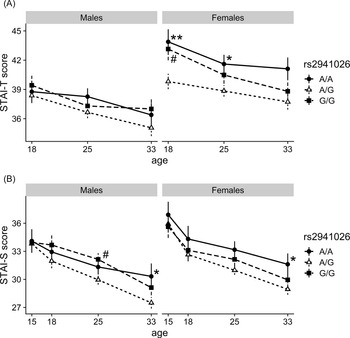
Longitudinally, trait anxiety decreased at a rate of 0.33 points (95% CI [0.26, 0.40]) and state anxiety at a rate of 0.45 points (95% CI [0.37, 0.51]) per year. Females had higher scores for trait and state anxiety (Fig. 1). Linear mixed-effects regression models revealed that both A/A and G/G homozygotes had higher anxiety as compared to heterozygotes (Table 1).
An association between CCKBR rs2941026 genotype and trait anxiety scores (A) from 18 to 33 years of age in male and female subjects and an association between CCKBR rs2941026 genotype and state anxiety (B) scores from 15 to 33 years of age in male and female subjects. * - Statistically significant differences of the A/A genotype group from the A/G genotype group cross-sectionally at the corresponding age. # - Statistically significant differences of the G/G genotype group from the A/G genotype group cross-sectionally at the corresponding age.

Estimated main effects (mean and 95% CI) of the ECPBHS sample in anxiety measurements between CCKBR rs2041026 genotype from 18 to 33 years of age for trait anxiety and 15 to 33 years of age for state anxiety according to the linear mixed effects regression model

Here and elsewhere, A/G genotype was used as the reference group.
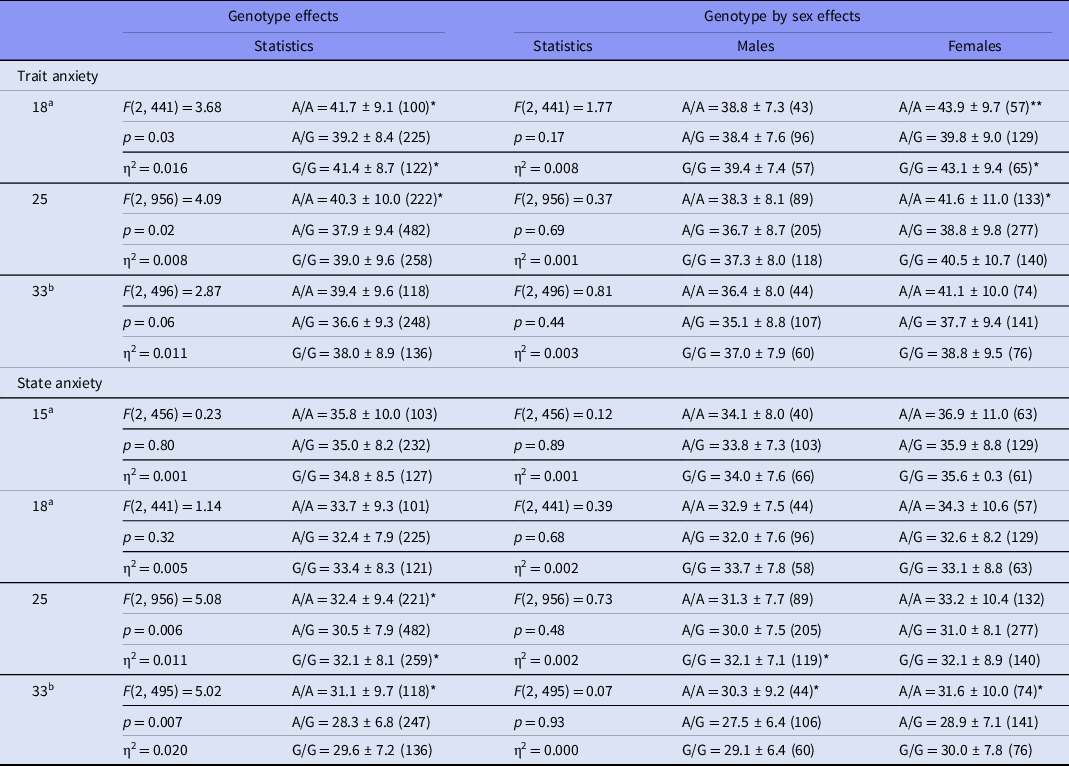
Cross-sectionally at ages 18, 25 and 33, associations between trait anxiety and the CCKBR genotype were statistically significant at ages 18 and 25, and there was a trend of association at age 33 (Table 2). At age 18, both homozygotes had higher scores for trait anxiety as compared to heterozygotes. At age 25, only the difference between A/A homozygotes and A/G heterozygotes remained statistically significant. The effects of CCKBR on trait anxiety derived from females, but the interaction between the genotype and sex was not statistically significant.
Anxiety scores (mean and SD) at the ages of 15, 18, 25 and 33 of the ECPBHS sample by CCKBR rs2941026 genotype and sex (n)

*p < 0.05, **p < 0.01 significant difference as compared to the mean value of the CCKBR rs2941026 A/G genotype by the LSD method.
a Data available for the younger cohort only.
b Data available for the older cohort only.
State anxiety was cross-sectionally analysed at ages 15, 18, 25 and 33 (Table 2). Genotype effects on state anxiety emerged at ages 25 and 33. At age 25, both homozygotes had higher state anxiety as compared to heterozygotes. By age 33, only the difference between A/A homozygotes and heterozygotes remained statistically significant. For state anxiety, genotype effects are derived from males as well as females.
The affective neuroscience personality scales
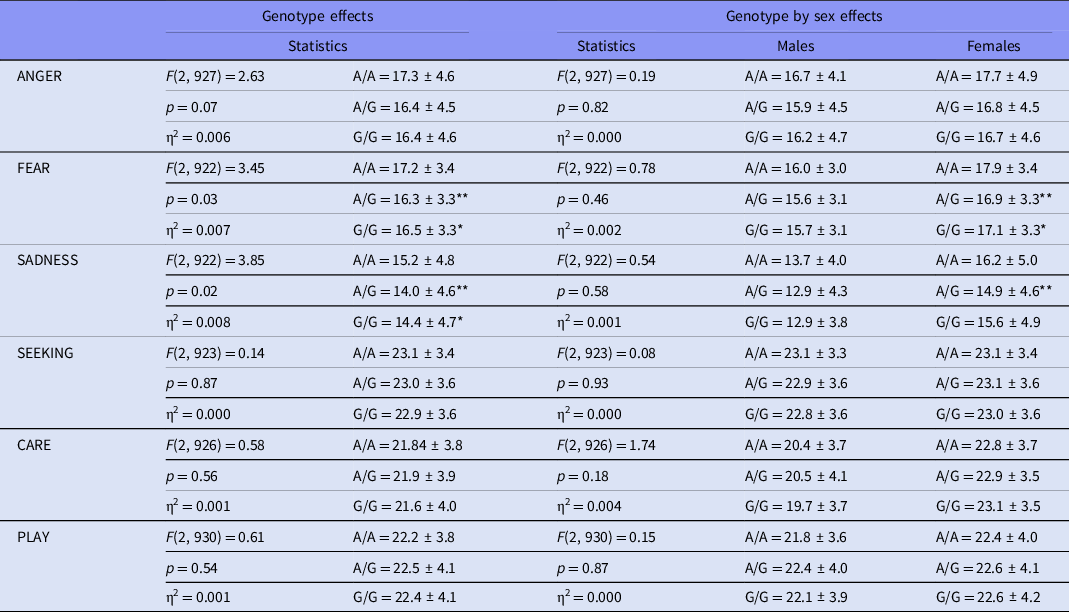
The CCKBR genotype was associated with FEAR and SADNESS, and there was a trend of association with ANGER in the ANPS (Table 3). Genotype-wise, A/A homozygotes had statistically significantly higher scores as compared to heterozygotes and G/G homozygotes. As with trait anxiety, the genotype effects derived from females, yet there was no statistically significant interaction effect between genotype and sex.
The effect of CCKBR genotype on the affective Neuroscience personality scales

Mean ± SD * p < 0.05, **p < 0.01 difference from A/A genotype in the same sex.
Genotype frequencies: Males, A/A = 84, A/G = 202, G/G = 114; Females, A/A = 133, A/G = 262, G/G = 139; Total, A/A = 217, A/G = 463, G/G = 253.
Depressiveness
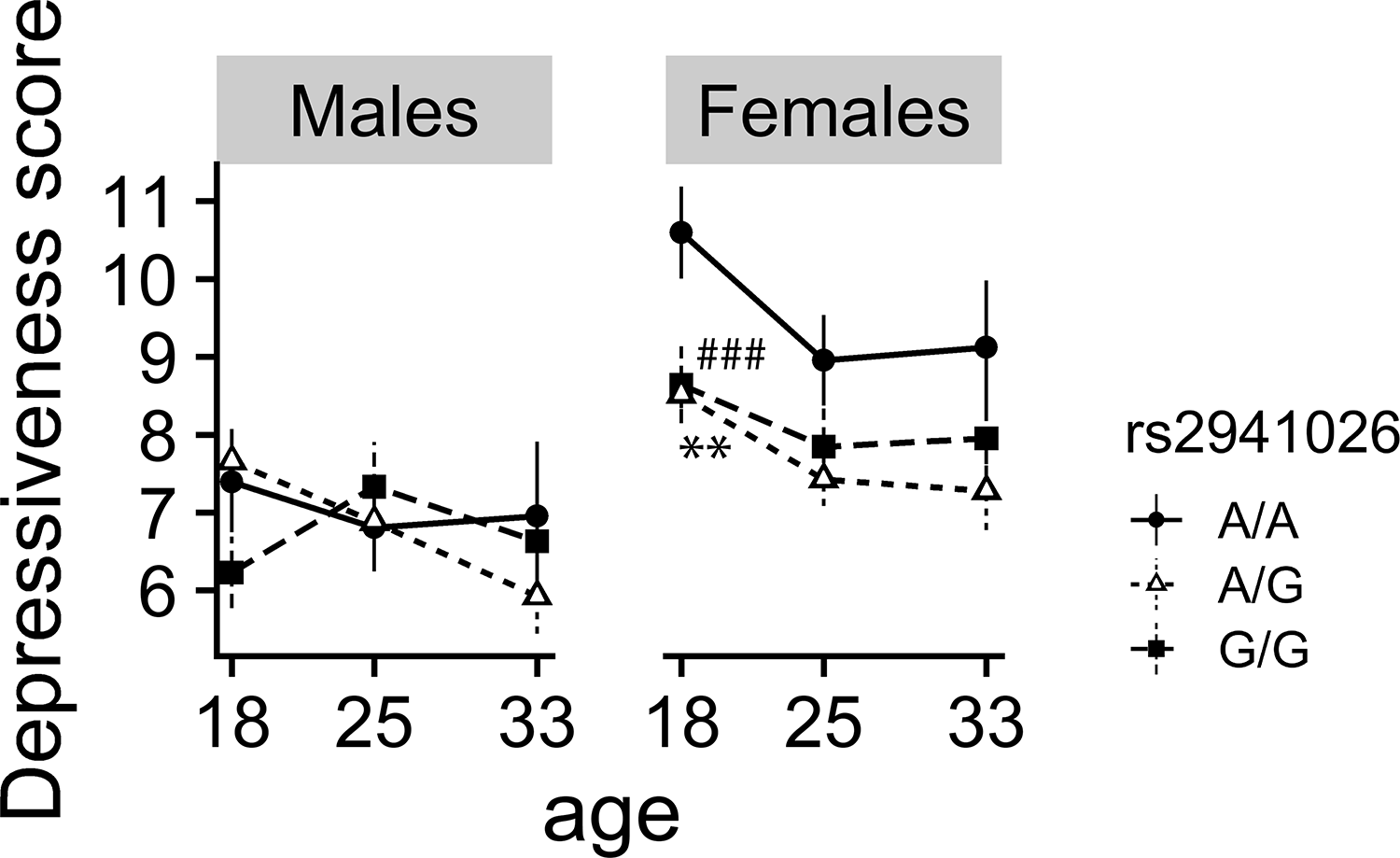
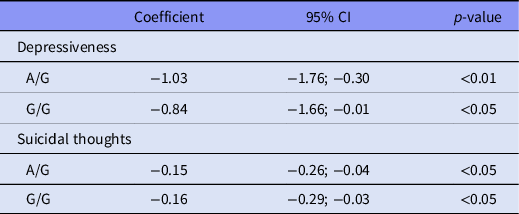
Longitudinally, depressiveness scores decreased by 0.11 points (95% CI [0.08, 0.15]) per year. Female participants had higher depressiveness (Fig. 2). Genotype-wise, according to the mixed-effects regression model, A-allele homozygotes had higher depressiveness as compared to heterozygotes and G-allele homozygotes (Table 4).
An association between CCKBR rs2941026 genotype and depressiveness score from 18 to 33 years of age in male and female subjects. * - Statistically significant difference of the A/G genotype group from the A/A genotype group cross-sectionally at the corresponding age. # - Statistically significant difference of the G/G genotype group from the A/A genotype group cross-sectionally at the corresponding age.

Estimated main effects (mean and 95% CI) of the ECPBHS sample in depressiveness and suicidal thoughts measurements between CCKBR rs2041026 genotype from 18 to 33 years of age according to the linear mixed effects regression model

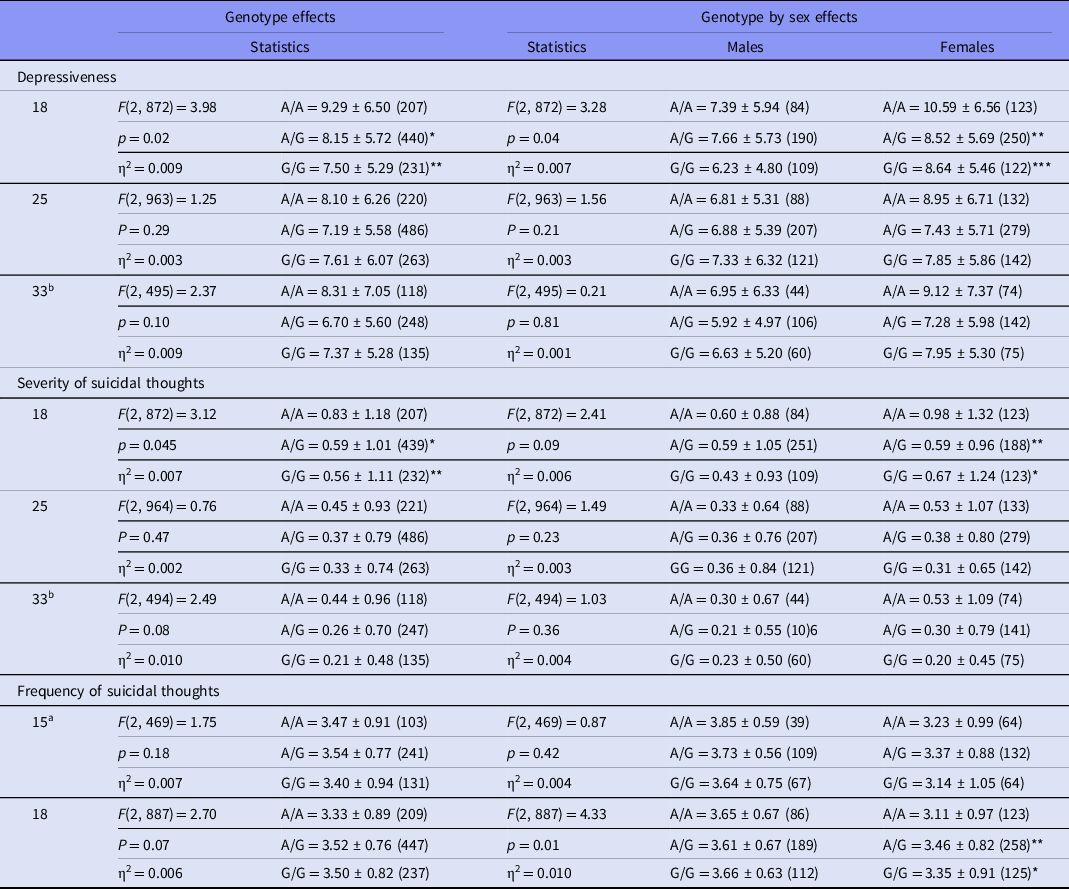
Cross-sectionally at ages 18, 25 and 33, the associations between depressiveness and the CCKBR genotype were statistically significant at age 18, where A/A homozygotes had the highest depressiveness (Table 5). This genotype effect was derived from females, and for this outcome, an interaction effect between genotype and sex was statistically significant.
Depressiveness scores (mean and SD) at ages 18, 25 and 33 of the ECPBHS sample by CCKBR rs2941026 genotype and sex (n)

Mean ± SD * p < 0.05; **p < 0.01; ***p < 0.001 significant difference as compared to the mean value of the CCKBR rs2941026 A/A genotype by the LSD method.
a Data available only for the younger birth cohort.
b Data available only for the older birth cohort.
Suicidal thoughts
Longitudinally, the extent of suicidal thoughts decreased at a rate of 0.03 points (95% CI [0.03, 0.04]) per year. There was a tendency for females to report a greater extent of suicidal thoughts (Fig. 3). We could see in the linear mixed-effects regression models, that heterozygotes and G-allele homozygotes experienced suicidal thoughts to a lesser extent as compared to A-allele homozygotes (Table 4).
An association between CCKBR rs2941026 genotype and frequency of suicidal thoughts from 18 to 33 years of age in male and female subjects. * - Statistically significant difference of the A/G genotype group from the A/A genotype group cross-sectionally at the corresponding age. # - Statistically significant difference of the G/G genotype group from the A/A genotype group cross-sectionally at the corresponding age.

Cross-sectional analysis revealed a significant association with the prevalence of suicidal thoughts at age 18, where A/A homozygotes had the highest extent of suicidal ideation as compared to the other two CCKBR genotypes (Table 5). There was no association at ages 25 or 33. This effect emerged from females, and even though not statistically significant, a trend of association can be seen for the interaction between genotype and sex.
Cross-sectional analysis on the frequency of suicidal thoughts at ages 15 and 18 revealed statistical significance for association with the genotype at age 18, where A/A homozygotes reported having suicidal thoughts more often as compared to heterozygotes and G/G homozygotes (Table 5). This effect derived from females, and there was an interaction effect between genotype and sex.
Discussion
This study demonstrates a consistent association of a variation in the CCKBR gene (rs2941026) with anxiety, anxiety-related aspects of personality, depressiveness and suicidal thoughts. These associations were similarly persistent in young adulthood and more robust in females. A previous study (Ersig et al., Reference Ersig, Schutte, Standley, Leslie, Zimmerman, Kleiber, Hanrahan, Murray and McCarthy2017) has reported that the A-allele of the CCKBR rs2941026 was associated with trait anxiety, and indeed we have found that A/A homozygotes had significantly higher trait anxiety levels, while the A/G heterozygotes had the lowest trait anxiety. In this birth cohort representative longitudinal sample, we also observed that A-allele homozygosity led to higher and heterozygosity to lower levels of anxiety-related personality traits, depressiveness and suicidal thoughts. Longitudinally, the levels of trait and state anxiety, as well as depressiveness and suicidality, decreased in both males and females. There is currently limited knowledge on the longitudinal nature of anxiety-related traits, but some evidence does exist for anxiety and depression to decrease with age (Jorm, Reference Jorm2000).
In this study, females reported higher levels of negative affectivity-related traits. Both population-based and clinical evidence shows that women report higher anxiety and depressiveness (McLean and Anderson, Reference McLean and Anderson2009; Parker and Brotchie, Reference Parker and Brotchie2010). As for ANPS, females have previously been shown to score higher on the anxiety-related FEAR and SADNESS scales (Pingault et al., Reference Pingault, Falissard, Côté and Berthoz2012) and while the rate of completed suicide is higher in males (Canetto and Sakinofsky, Reference Canetto and Sakinofsky1998), a meta-analysis conducted in 2019 on adolescents and young adults concluded that females present a higher risk for suicide attempt (Miranda-Mendizabal et al., Reference Miranda-Mendizabal, Castellví, Parés-Badell, Alayo, Almenara, Alonso, Blasco, Cebrià, Gabilondo, Gili, Lagares, Piqueras, Rodríguez-Jiménez, Rodríguez-Marín, Roca, Soto-Sanz, Vilagut and Alonso2019). It has been proposed that female vulnerability for the onset of anxiety and depression is regulated by sex-specific genetic risk factors (Altemus et al., Reference Altemus, Sarvaiya and Epperson2014). In this regard, it is noteworthy that the associations observed between CCKBR rs2941026 and anxiety-related traits were more pronounced in females.
Indeed, both age and sex are factors associated with the state of the CCK system. For example, differences between the sexes in anxiety development have been described in mice, where females had stronger fear conditioning and more generalisation of context (Keiser et al., Reference Keiser, Turnbull, Darian, Feldman, Song and Tronson2017), whereas males may have higher CCK upregulation in response to stress (Karisetty et al., Reference Karisetty, Khandelwal, Kumar and Chakravarty2017). Also in studies on rats, CCK concentrations were significantly higher in males and increased with age in both sexes, while the levels of mRNA showed a decrease in older male rats (Miyasaka et al., Reference Miyasaka, Ohta, Masuda, Kawanami, Matsumoto and Funakoshi1995), as does the CCK-B receptor binding (Harro and Oreland, Reference Harro and Oreland1992). Findings in humans have been similar (Flint et al., Reference Flint, Bradwejn, Vaccarino, Gutkowska, Palmour and Koszycki2002). These age-related alterations are unlikely to be related to neurodegeneration as neither CCK levels nor CCK-B receptor binding was found to be changed in Alzheimer’s disease (Löfberg et al., Reference Löfberg, Harro, Gottfries and Oreland1996).
The measure of trait anxiety is part of a broader concept of negative affectivity, which includes anxiety- and depression-related internalising phenotypes (Knowles and Olatunji, Reference Knowles and Olatunji2020). In addition to trait anxiety, we observed an association with state anxiety, which was not found in the previous study concerning CCKBR rs2941026. One study in mice has observed that a CCKB antagonist reduced state but not trait anxiety (Belzung et al., Reference Belzung, Pineau, Beuzen and Misslin1994); however, the differential involvement of the CCK system in trait and state anxiety has overall not been extensively explored. The general interconnections between anxiety, depression and the ANPS have however been described previously (Montag et al, Reference Montag, Widenhorn-Müller, Panksepp and Kiefer2017; Fuchshuber et al., Reference Fuchshuber, Hiebler-Ragger, Kresse, Kapfhammer and Unterrainer2019). Trait anxiety is in strong association with both SADNESS and FEAR scales of the ANPS (Davis et al., Reference Davis, Panksepp and Normansell2003). Given the known association of the CCK system with panic disorder, it may be worth pointing out that the original denomination for the underlying neural circuit of the SADNESS scale was PANIC, referring to the neurophysiology of fear of social loss (Panksepp and Watt, Reference Panksepp and Watt2011). To the best of our knowledge, no research has explicitly studied the association between CCK system gene polymorphisms and personality dimensions. Personality has however been observed to impact CCK receptor agonist sensitivity. Social introversion has been shown as a predictor for CCK-4 induced panic in patients with panic disorder (Koszycki et al., Reference Koszycki, Zacharko and Bradwejn1996), and aggression and suspicion were found to predict discomfort as a response to a low dose of CCK-4 administration (Radu et al., Reference Radu, Ahlin, Svanborg and Lindefors2003). Lack of assertiveness, detachment, embitterment, verbal aggression, physical aggression, irritability, somatic anxiety and stress susceptibility has also been found to predict CCK-4 induced panic response in healthy volunteers (Tõru et al., Reference Tõru, Aluoja, Võhma, Raag, Vasar, Maron and Shlik2010).
Interestingly, the CCK system gene variants have not been identified by any anxiety-related genome-wide association studies (GWAS) despite several anxiety-related GWAS having reached sample sizes of up to hundreds of thousands of individuals (Li et al. Reference Li, Luo, Gu, Hall, Mclntosh, Zeng, Porteous, Hayward, Li, Yao, Zhang and Luo2018; Levey et al. Reference Levey, Gelernter, Polimanti, Zhou, Cheng, Aslan, Quaden, Concato, Radhakrishnan, Bryois and Sullivan2020; Hill et al., Reference Hill, Weiss, Liewald, Davies, Porteous, Hayward, Mclntosh, Gale and Deary2020; Wendt et al., Reference Wendt, Pathak, Levey, Nuñez, Overstreet, Tyrrell, Adhikari, De Angelis, Tylee, Goswami, Krystal, Abdallah, Stein, Kranzler, Gelernter and Polimanti2021). In the birth cohort representative samples investigated herewith, the CCKBR rs2941026 heterozygotes had the lowest level of anxiety. The heterosis effect observed herein proposes certain variations in the CCK system as possibly anxiety-protective. The dichotomous nature of the CCK system in the emergence of anxiety has been suggested previously. CCKB receptor blockade in itself is rather behaviourally activating than anxiolytic (Harro, Reference Harro2006), and can alter adaptation to novelty in a manner that is distinct in subjects with different baseline expressions of novelty-related traits (Ballaz et al., Reference Ballaz, Akil and Watson2007). While several recent studies have confirmed that higher CCK-ergic activity can be related to higher anxiety, other experiments have continued to provide evidence of CCK as a safety signal. For example, recently, the anxiety-like behaviour in Otsuka Long-Evans Tokushima fatty rats was linked to higher densities of CCK-positive neurons in several brain areas (Ochi et al., Reference Ochi, Fujita, Goto, Nguyen, Le, Matsushita, Ono, Nishijo and Urakawa2020), and in a study of stress resilience, sensitive animals in a model of post-traumatic stress disorder developed higher immediate-early gene expression in CCK-positive interneurons in hippocampus and basolateral amygdala (Regev-Tsur et al., Reference Regev-Tsur, Demiray, Tripathi, Stork, Richter-Levin and Albrecht2020). In contrast, in experiments with rats, freezing behaviour on exposure to a cat was reversed by a CCKB receptor agonist (Farook et al., Reference Farook, McLachlan, Zhu, Lee, Moochhala and Wong2004), and in another study, CCK-4 administration had an anxiolytic-like effect specifically in extensively handled animals (Greisen et al., Reference Greisen, Bolwig and Wörtwein2005). The role of CCK in anxiety states may depend on the context and previous experiences. Interestingly, CCK mRNA expression was shown to emerge in many nerve cells following auditory stimulation with conspecific song in zebra finches (Lovell and Mello, Reference Lovell and Mello2011). In rats, learned fear (but not confrontation with the resident in learned safety) increased CCK release in the prefrontal cortex (Becker et al., Reference Becker, Thiébot, Touitou, Hamon, Cesselin and Benoliel2001), yet friendly social interactions in the resident-intruder tests led to relatively lower CCK levels in the brain of the intruders (Panksepp et al., Reference Panksepp, Burgdorf, Beinfeld, Kroes and Moskal2004). Selectively in mice susceptible to social stress, social defeat caused ΔFosB induction in the medial prefrontal cortex, and viral overexpression of ΔFosB in the prelimbic area rendered mice more susceptible to social defeat (Vialou et al., Reference Vialou, Bagot, Cahill, Ferguson, Robison, Dietz, Fallon, Mazei-Robison, Ku, Harrigan, Winstanley, Joshi, Feng, Berton and Nestler2014). In resilient mice, social defeat downregulated CCKB receptor mRNA, while overexpression of ΔFosB upregulated CCKB receptor mRNA expression. Further experiments with local infusion of CCK-8 or a CCKB receptor antagonist and optogenetic manipulation of specific prelimbic projection neurons have suggested that CCKB receptors mediate an anxiogenic-like and depressogenic-like effect via separate projections, to basolateral amygdala and nucleus accumbens, respectively (Vialou et al., Reference Vialou, Bagot, Cahill, Ferguson, Robison, Dietz, Fallon, Mazei-Robison, Ku, Harrigan, Winstanley, Joshi, Feng, Berton and Nestler2014). CCK, via CCKB receptors, has a direct excitatory effect on GABA-ergic interneurons in the basolateral amygdala (Chung and Moore, Reference Chung and Moore2007). More recent studies suggest that in this brain region, neurons that express CCKB receptors comprise a molecularly heterogenous population of excitatory and inhibitory neurons (Bowers and Ressler, Reference Bowers and Ressler2015), and further research should establish whether and how CCKB receptor-mediated regulation of the balance between excitation and inhibition in the amygdala is driven by context.
The sample of the ECPBHS consists of individuals of European descent, hence the described associations might not be found in other ethnicities. The previously reported association of CCKBR rs2941026 with trait anxiety was found in a study that was based on White/non-Hispanic individuals in Midwestern USA (Ersig et al., Reference Ersig, Schutte, Standley, Leslie, Zimmerman, Kleiber, Hanrahan, Murray and McCarthy2017). Another factor in the interpretation of the present findings is that the functional meaning of the intronic CCKBR rs2941026 variant has not been described, yet intronic region polymorphisms are known for having an effect on gene expression or being associated with other regulatory polymorphisms (Cooper, Reference Cooper2010). Indeed the fine tuning of CCKB receptor expression related to anxiety can be speculated as regulated by non-coding RNAs in the intronic region (e.g. Rearick et al., Reference Rearick, Prakash, McSweeny, Shepard, Fedorova and Fedorov2011; Mills et al., Reference Mills, Chen, Ueberham, Arendt and Janitz2016) that could explain the heterosis effect. The size of observed effects is modest and bears no immediate consequence for clinical practice. Yet, for a single SNP, these effects are substantial and highlight the significance of CCK neurotransmission in anxiety in this well-defined population. The GTEx Portal does not report the CCKBR rs2941026 polymorphism as resulting in a significant difference in gene expression in the brain (https://gtexportal.org/home/snp/rs2941026). This indeed would not be expected to be found with a polymorphism for which a heterosis effect is predominant. However, the CCKBR rs2941026 A-allele that was somewhat more anxiety-related in this study was found related to higher expression of CCKBR in a few tissues, most significantly in the skin. This suggests a functionality of this variation, but its nature remains to be clarified.
Conclusively, we report that a variation in the CCKB receptor gene is persistently associated with trait as well as state anxiety, anxious personality, depressiveness and suicidal thoughts in young adults, these associations being more prominent in females. These results further support a role of the neuronal CCK system in anxiety regulation.
Acknowledgements
This study was supported by the Estonian Research Council (PRG1213 and IUT42-2), the European Commission Horizon 2020 Programme Projects CoCA (no 667302) and Eat2beNICE (no 728018). We are grateful to the participants of the ECPBHS and to the ECPBHS Study Team.
Author contributions
AL designed and wrote the manuscript and along with DM analysed and interpreted the data. DM, TK and TV critically reviewed and edited the manuscript. JH designed, wrote and edited the manuscript. All authors critically reviewed the content and approved the final version for publication.
Financial support
This study was supported by the Estonian Ministry of Education and Research (PRG1213 and IUT42-2), the European Commission Horizon 2020 Programme Projects CoCA (no 667302) and Eat2beNICE (no 728018).
Conflict of interest
None.