




No CrossRef data available.
Taking hold of some kind of life: How developmental tasks relate to trajectories of well-being during the transition to adulthood
Published online by Cambridge University Press: 01 December 2004
Abstract
The purpose of this study was to examine how successes and difficulties with various developmental tasks of early adulthood relate to the course of well-being. Three waves of national panel data spanning ages 18–26 were drawn from the Monitoring the Future study (N = 3518). Based on self-reports, respondents were assigned scores (succeeding, maintaining, or stalling) to reflect progress in seven domains of developmental tasks: education, work, financial autonomy, romantic involvement, peer involvement, substance abuse avoidance, and citizenship. We identified trajectory groups of well-being (based on self-esteem, self-efficacy, and social support) that reflect diverging trajectories during the transition: steady–high versus high–decreasing, and low–increasing versus steady–low. Logistic regression analyses were conducted to predict membership in the diverging well-being trajectory groups as a function of developmental task domain scores. Maintaining or gaining a salutary trajectory of well-being across the transition was found to be a function of more success and less stalling across the developmental tasks, specifically in the work, romantic involvement, and citizenship domains. Compensatory effects (e.g., succeeding in education compensated for not succeeding in work) and threshold effects (e.g., succeeding in both achievement and affiliation domains was necessary for a salutary trajectory) were also found.This study was supported in part by a grant from the National Institute on Drug Abuse (DA01411). The authors thank Dante Cicchetti, Kate Fiori, Jennifer Maggs, Wayne Osgood, and Arnold Sameroff for helpful comments and suggestions and Ginny Laetz and Tanya Hart for assistance with the preparation of this article.
Information
- Type
- Research Article
- Information
- Copyright
- © 2004 Cambridge University Press

Trying to “take hold of some kind of life” is a good description of the overarching developmental task of late adolescence and early adulthood. The many specific tasks of this time regarding, for example, achievement (e.g., implementing education and work goals) and affiliation (e.g., romantic and peer involvements) center around connecting with future roles and the world at large. Although most young people succeed with this overarching task, others falter and flounder, eventually experiencing difficulties with functioning in and adjustment to adulthood roles. This is to be expected, at least to some extent, among those who already were having difficulties in adolescence. The added stressors of the transition to adulthood may overwhelm already compromised coping capacities. In contrast, those doing well prior to the transition have the foundation for taking on the challenges and opportunities of new social roles and contexts; their successes with the many tasks of early adulthood are likely to accumulate as they take hold of their lives. However, this transition can serve as more than simply a consolidator of previous successes and difficulties with adaptation. It can be a turning point: some young people who falter and flounder during the transition come from the ranks of well-functioning adolescents; likewise, some troubled adolescents demonstrate a turnabout through successful experiences with the new opportunities and tasks of this transition.
In the present study, we follow national samples of young people from ages 18 through 26 and examine how successes and difficulties with negotiating normative developmental tasks during the transition to adulthood relate to continuity and discontinuity in well-being. The understanding of continuities and discontinuities in well-being within the general population provides an important backdrop for which to consider the course of psychopathology during the transition to adulthood. Before providing an overview of the study, below we set the stage by considering issues of continuity and discontinuity during the transition to adulthood, and the developmental tasks of early adulthood.
Continuity and Discontinuity During Transition to Adulthood
The transition from adolescence to adulthood is a critical one, both in terms of contributing to discontinuity in adjustment (Schulenberg & Zarrett, in press) and influencing subsequent adult functioning (Clausen, 1991). Diversity in life paths becomes clearer during this transition (Shanahan, 2000; Sherrod, Haggerty, & Featherman, 1993), and interindividual variability in the timing and content of developmental milestones increases (Cohen, Kasen, Chen, Hartmark, & Gordon, 2003; Elder, 1998). The emergence of new roles and social contexts provides increased opportunities for successes and difficulties, which in turn, may engender discontinuity in functioning and adjustment between adolescence and early adulthood (e.g., Aseltine & Gore, 1993; Petersen, 1993; Schulenberg, Maggs, & O'Malley, 2003; Schulenberg, O'Malley, Bachman, & Johnston, 2000, in press).
Although it is clear that continuity in functioning and adjustment prevails before, during, and after this transition, there is also important discontinuity. Consistent with the findings that the transition to adulthood is marked by increased well-being (e.g., Aseltine & Gore, 1993; Schulenberg et al., 2000, in press), much of this discontinuity relates to reversals among young people who had difficulties during adolescence (e.g., Moffitt & Caspi, 2001). With the transition come new roles, with opportunities for young people to flourish, in contrast to the sometimes stifling experiences of high school. But there is also discontinuity as it relates to reversals among young people who were functioning well during adolescence (e.g., Bardone, Moffitt, Caspi, & Dickson, 1996). It is likely that these cases represent, at least to some extent, a developmental mismatch between the needs or desires of the individual and the opportunities afforded by the expanded context associated with the transition (e.g., Eccles, Lord, Roeser, Barber, & Hernandez–Jozefowicz, 1997; Schulenberg et al., 2003). It is of both theoretical and practical importance to identify and understand this type of discontinuity (Rutter, 1996). In particular, consistent with a developmental sciences perspective, temporally proximal causes of psychopathology and mental health can be as powerful as distal causes (Lewis, 1999). It is not always the case that roots of adulthood dysfunction extend back to childhood and adolescence (Cicchetti & Rogosch, 2002; Schulenberg et al., 2003).
Developmental Tasks of Early Adulthood
Historically, developmental tasks have been defined as socially, psychologically, and biologically determined activities or goals that individuals are expected to accomplish at certain ages or stages of life (Havighurst, 1952). The content and timing of such tasks are functions of biological capabilities and socially constructed norms and expectations (Heckhausen, 1999; Neugarten & Datan, 1973; Oerter, 1986). Although such conceptualizations allow for some variation in the content, timing, and salience of tasks by gender, social capital, culture, and historical period (Hogan & Astone, 1986; Marini, 1985), a narrow interpretation of the task construct may be too prescriptive for most contextually oriented developmental perspectives (e.g., Baltes, Lindenberger, & Staudinger, 1998; Brandtstädter & Lerner, 1999). We offer a descriptive rather than a prescriptive interpretation of the concept of developmental tasks, focusing on the normative activities and goals of various periods in the life course (Schulenberg et al., 2003). In this regard, normative refers to what many people within a given social context or ecological niche commonly do, rather than what they should do. Clearly, in addition to social and biological tasks and timetables, individual development is also idiosyncratic and regulated by goals unique to each person (Heckhausen, 1999; Nurmi, 1993; Oerter, 1986).
Havighurst (1952) identified culturally defined developmental tasks that individuals need to accomplish during certain age ranges. He viewed difficulties that arose during adolescence and early adulthood in terms of an inability or unwillingness to accomplish the necessary tasks. According to Erikson (1968), after the identity quest of adolescence, the major task of early adulthood is the quest for intimacy. Masten and colleagues (e.g., Masten, Hubbard, Gest, Tellegen, Garmezy, & Ramirez, 1999; Shiner & Masten, 2002) highlight work, education, romance, and peer-related developmental tasks during late adolescence and early adulthood. Similarly, Schulenberg et al. (2003) provide a framework for grouping developmental tasks into three interrelated domains: achievement, affiliation, and identity. In addition, it has been argued that citizenship also represents a major developmental task during this time (e.g., Youniss & Yates, 1997); indeed, an important part of the decentering process of late adolescence and early adulthood is to try to see “the bigger picture” and to understand how one fits into the community and world at large. Another key task of late adolescence and early adulthood is adopting a “healthy lifestyle” and getting beyond youthful excess in terms of risky behaviors and especially substance use (e.g., Jessor, Donovan, & Costa, 1991; Newcomb & Bentler, 1988; Schulenberg et al., 2003). In particular, although substance use during late adolescence and early adulthood can sometimes reflect normative exploratory behavior, continued excessive use likely reflects maladaptive coping and may interfere with negotiating developmental tasks (Baumrind, 1987; Cicchetti, 1999; Schulenberg et al., 2003, in press). Finally, financial independence is a clear marker of adulthood (Arnett, 2000).
In short, the major and typically quite visible tasks of the transition relate to connections to peers and romantic partners, work and education, citizenship, healthy lifestyle, and financial independence. Given these salient and multiple developmental tasks during the transition to adulthood, it is likely that one's successes and difficulties in negotiating the various tasks relate to one's overall well-being.
Overview of Present Study
Our purpose is to examine how the course of well-being during the transition to adulthood relates to successes and difficulties in negotiating the various developmental tasks involving affiliation, achievement, meaningfulness, health, and financial independence. Given this broad research question, we take a global approach to construct definition and analyses. We use three waves of national panel data (from the Monitoring the Future [MTF] study) that span ages 18 through 26.
Developmental task domains
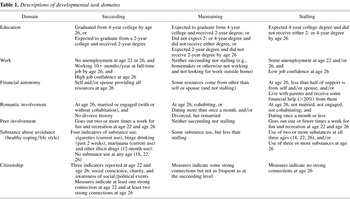
Drawing from the literature discussed previously, we focus on seven domains of developmental tasks, including education, work, financial independence, romantic involvement, peer involvement, substance use avoidance, and citizenship. Education and work refer to the broader achievement domain, and romantic involvement and peer involvement refer to the broader affiliation domain. Based on self-report survey data, individuals were assigned a score of 3, 2, or 1, in each of the seven domains, indicating whether they were succeeding, maintaining, or stalling, respectively (details provided below).
Trajectories of well-being
We take a pattern-centered approach to defining different trajectories of well-being during the transition. This general strategy draws from Magnusson's (1995) pattern-centered holistic approach to studying change (see also Cairns & Cairns, 1994; Schulenberg, Wadsworth, O'Malley, Bachman, & Johnston, 1996) and Elder's (1998) conceptualizations regarding social life course. It serves to highlight how variables interrelate within individuals across time and allows for the identification of differential change. Using national panel data, we identified four different trajectories of well-being based on levels at ages 18, 22, and 26: (a) a steady–high well-being trajectory group, (b) a high–decreasing well-being trajectory group, (c) a low–increasing well-being trajectory group, and (d) a steady–low well-being trajectory group. Well-being includes self-esteem, self-efficacy, and social support (details provided below).
Models linking successes and difficulties in developmental tasks with the course of well-being
Our analytic strategy was to use the developmental tasks scores (3 = succeeding, 2 = maintaining, 1 = stalling) to predict diverging trajectories of well-being (i.e., steady–high vs. high–decreasing, low–increasing vs. steady–low). Three models linking domain task scores with the course of well-being were considered, including additive, main effects, and compensatory models.
In the additive model, the seven domain scores were averaged to form a single predictor. This model is consistent with various risk accumulation models in developmental psychopathology, which posit that combinations of risk factors, rather than any single risk factor, cause negative outcomes (e.g., Bry, McKeon, & Pandina, 1982; Newcomb & Bentler, 1989; Sameroff & Seifer, 1995). The additive model assumes that the domains are interchangeable in terms of their impact on the course of well-being; that is, to the extent that this model holds true, maintaining or gaining a salutary trajectory of well-being during the transition to adulthood is a function of succeeding in as many domains as possible, regardless of content of the domain.
In the main effects model, each domain score is used as a possible predictor of the course of well-being. This model does not assume that the seven domain scores are interchangeable but rather that each potentially contributes uniquely to the course of well-being, allowing for the consideration that, on average across individuals, some domains are more crucial to the course of well-being than are others.
In the compensatory models, we considered whether success in one domain compensated for a lack of success in another related domain in terms of the impact on the well-being trajectories. Consistent with the notion of selection, optimization, and compensation in life span development research (e.g., Baltes, 1997; Wiese, Freund, & Baltes, 2000), individuals actively select life domains on which to focus their attention, with the hope that success in selected domains can compensate for less attention to, or success in, other domains. Accordingly, we examined whether education and employment (both concerning achievement) operated in a compensatory fashion, whether romantic and peer involvement (both concerning affiliation) operated in a compensatory fashion, and whether the broader domains of achievement and affiliation operated in a compensatory fashion. In the compensatory model analyses, we also considered “threshold effects,” that is, the case in which succeeding in one domain is insufficient to counter the effect of not succeeding in the other.
Together, these three alternative models provide a broad-based approach to understanding how developmental tasks relate to trajectories of well-being. These models reflect varying depths of analysis, with the additive model findings potentially providing a more parsimonious view, the main effects model findings providing a more nuanced view, and the compensatory model findings serving to qualify some of the findings from the other two models.
Method
Three waves of national panel data spanning ages 18–26 from the MTF project were used. MTF is an ongoing cohort-sequential longitudinal study designed to understand the epidemiology and etiology of substance use, and more broadly behavior and psychosocial development, from adolescence through adulthood. The project has surveyed nationally representative samples of approximately 17,000 high school seniors each year in the United States since 1975 using questionnaires administered in classrooms. Approximately 2,400 individuals are randomly selected from each senior year cohort for follow-up. Follow-up surveys are conducted on a biennial basis, using mailed questionnaires. More detailed descriptions of the study design and procedures can be found in Bachman, O'Malley, Schulenberg, Johnston, Bryant, and Merline (2002); in Johnston, O'Malley, Bachman, and Schulenberg (2004); and on the study Web site (monitoringthefuture.org).
Sample
The panel sample used in the present study consisted of 18 consecutive cohorts of respondents who were surveyed as high school seniors (Wave 1, age 18) in 1977 through 1994 and who participated in follow-up surveys 3 or 4 years post-high school (Wave 2, age 21–22) and 7 or 8 years post-high school (Wave 3, age 25–26). (The biennial follow-up surveys begin 1 year post-high school for one random half of each cohort, and 2 years post-high school for the other half. For these analyses, the two random halves were combined.)
The emphasis on the diverging trajectories of well-being across the three waves made it desirable to restrict the sample to respondents present at all three waves. Although retention rates for any one follow-up survey averaged 77%, this more demanding restriction resulted in a retention rate of just under 60%. Consistent with what has been found in previous attrition analyses with similar panel samples from the MTF project, we found that compared to those excluded, those retained in the longitudinal sample were more likely to be female, White, higher on high school grade-point average and parental education level, and lower on high school truancy and senior year substance use (e.g., Schulenberg et al., 1996, 2000).
Because the well-being measures are located on only one of the six questionnaire forms (questionnaire forms are distributed randomly within schools at senior year), only one-sixth of the sample was available for the present study. This included 3,518 weighted cases (4,433 unweighted cases)1
Senior year drug users are oversampled for follow-up, so weighting is necessary to recapture population estimates.
Measures
Developmental task domains
Rating individuals in their progress toward developmental tasks can be a complex and sometimes tenuous process (Cohen et al., 2003). To some extent, the ratings are subjective and based on normative expectations. Nevertheless, many of these normative expectations about the tasks of adulthood tend to be shared widely among young people (e.g., Arnett, 2001). Furthermore, although there can be a quality of idealized progression in developmental tasks ratings (cf. Oerter, 1986), we view the progression as reflecting ongoing person–context interaction, consistent with our multidirectional view of development (e.g., Schulenberg et al., 2003). As we discussed earlier, we view the tasks as descriptive rather than as prescriptive, and we have tried to use neutral terminology to reflect this.
Based on available information in the survey regarding the seven developmental task domains, each respondent in the total sample was assigned a score in each domain: 1 = stalling, 2 = maintaining, and 3 = succeeding. These categories are mutually exclusive and each respondent was placed in one category per domain. In general, the two extreme categories were defined first, leaving the middle category for the remainder of the sample. Our goal was to include at least 20% of the sample in each category; in practice, as indicated below, it was not always possible to meet this goal.2
The cutoff points for the stalling, maintaining, and succeeding categories were based on the entire sample, not just those in the top and bottom thirds in terms of well-being at age 18. This was done to keep our cutoff points closer to population estimates.
Descriptions of developmental task domains

Education domain ratings were based on a match between respondents' educational expectations at age 18 and their actual attainment by age 26.3
Given our data, this is the only domain for which we could combine earlier expectations with later attainments.
Work domain ratings were based on employment history and respondents' confidence in keeping or finding employment during early adulthood. Those classified as succeeding (28%) had no unemployment at ages 22 and 26, and at age 26 were employed for at least 10 months of the year and expressed high job confidence. Those classified as stalling (14%) had some unemployment (i.e., looking for work but unable to find it) at ages 22 or 26, and expressed low job confidence. Those classified as maintaining (58%) were in between the two.
Financial autonomy domain ratings focused on the respondents' financial resources at age 26. Those classified as succeeding (41%) received no financial support from others, whereas those classified as maintaining (29%) received some (but less than half) support from others. Those classified as stalling (29%) received at least half of their financial support from others, and/or were living with parents and receiving some financial help from them.
Romantic involvement domain ratings focused on marriage and dating at age 26. Those classified as succeeding (51%) were married or engaged (cohabiting or not) and had no history of divorce. Those classified as maintaining (31%) were cohabiting (but not engaged), dating more than once per month, or divorced and remarried by age 26. Those classified as stalling (18%) were not married, not engaged, not cohabiting, and dating once a month or less.
Peer involvement domain ratings focused on the average frequency of evenings out with friends for fun and recreation across ages 22 and 26. Those who went out at least twice a week over the past year at both age 22 and 26 were classified as succeeding (32%), and those who went out less than once a week at both age 22 and 26 were classified as stalling (21%). Those classified as maintaining (47%) were in between the two.
Substance abuse avoidance domain ratings refer to substance use between ages 18 and 26.4
Ideally, additional measures of healthy coping and lifestyle would be included, but such measures were not available. We note that substance use is an important indicator of the extent to which one's overall coping and lifestyle is healthy (e.g., Hawkins, Catalano, & Miller, 1992; Schulenberg et al., 1996).
The citizenship domain was viewed in terms of connections to the broader world, and ratings focused on three indicators at ages 22 and 26: social conscience, donations to charity, and awareness of current social and political events. Those who reported strong connections in at least one indicator at age 22 and at least two indicators at age 26 were classified as succeeding (31%), those who reported no strong connections in any indicators at age 26 were classified as stalling (22%), and those classified as maintaining (47%) were in between the two.
In general across the domains, the stalling category contained the smallest proportions of the sample (ranging from 13.5% for work to 28.6% for financial autonomy), reflecting perhaps both our conservative definitions of stalling as well as our use of a general population (rather than clinically based) sample. Some significant gender differences were found in the domains: in the succeeding category, men were overrepresented in peer involvement and financial autonomy, and women were overrepresented in romantic involvement, substance use avoidance, and citizenship; in the stalling category, men were overrepresented in financial autonomy, romantic involvement, substance use avoidance, and citizenship, and women were overrepresented in peer involvement. With regard to the correlations among the domains, the strongest were between financial autonomy and work (.19). All other correlations, although sometimes significant, were relatively small (between −.10 and .10). This suggests that across most of the seven developmental task domains, success in each domain is relatively independent of success in the others.5
Although these low correlations may be due in part to the restricted range of possible scores, preliminary analyses based on some related measures with more response options did not reveal higher intercorrelations.
Overall well-being
As discussed in the Introduction, well-being tends to increase during the transition to adulthood. Drawing from the work of Ryff and colleagues (e.g., Ryff & Keyes, 1995) on the construct of well-being in middle adulthood, and based on our previous analyses (Schulenberg et al., 2000, in press), overall well-being was considered in terms of three interrelated constructs: self-esteem, self-efficacy, and social support. Self-esteem (based on Rosenberg, 1965) was measured with eight items (e.g., “I take a positive attitude toward myself”) with α coefficients ranging from .84 to .87 across the three waves. General self-efficacy (similar to Nowicki & Strickland's, 1973, internal locus of control subscale) was measured with five items (e.g., “when I make plans, I am almost certain that I can make them work”) with α coefficients ranging from .65 to .73 across the three waves. Social support (similar to Newcomb & Bentler, 1988) was measured with six items (e.g., “there is always someone I can turn to if I need help”) with α coefficients ranging from .68 to .76 across the three waves. Cross-sectional exploratory factor analyses of the three scales indicated one underlying dimension at each wave, and α coefficients for this overall scale exceeded .75 at each of the three waves.
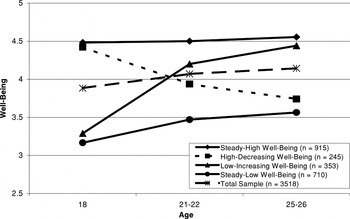
Because of our emphasis on continuities and discontinuities in well-being during the transition, we limited our focus to respondents in the top one-third and bottom one-third of the sample in overall well-being at Wave 1 and then tracked their courses of well-being across the transition (the Wave 1 middle third was too ambiguous in terms of describing courses of well-being as continuous or discontinuous). Four trajectory groups were formed based on trichotomy cutoff scores at ages 22 and 26 (cutoff scores were based on the total sample to help us keep closer to population estimates). These four groups are defined below and illustrated in Figure 1.

Well-being during the transition for the different well-being groups.
The steady–high well-being trajectory group included respondents who were in the top one-third at Wave 1 (age 18) and then in the top two-thirds at both age 22 and age 26 (n = 915; 26% of total sample).
The high–decreasing well-being trajectory group included respondents who were in the top one-third at Wave 1 (age 18) and then in the bottom one-third at age 22 and/or age 26 (and not in the top one-third at age 26; n = 245, 7% of total sample).
The low–increasing well-being trajectory group included respondents who were in the bottom one-third at age 18 and then in the top one-third at age 22 and/or age 26 (and not in the bottom one-third at age 26; n = 353, 10% of total sample).
The steady–low well-being trajectory group included respondents who were in the bottom one-third at Wave 1 (age 18) and then in the bottom two-thirds at both age 22 and age 26 (n = 710, 20% of total sample).
The well-being means across time for these four well-being trajectory groups are shown in Figure 1. The steady–high and steady–low groups represent continuity across the transition in terms of both their absolute and relative well-being scores; the high–decreasing and low–increasing groups represent discontinuity. Based on repeated measure ANOVAs, well-being increased significantly over time for the total sample, and the trajectories for all four groups differed significantly from the total sample mean. In particular, the steady–high group increased at a significantly faster rate than the high–decreasing group (a follow-up test revealed that well-being declined significantly for the latter group), and the low–increasing group increased at a significantly faster rate than the steady–low group. Based on chi-square analyses, the well-being trajectory groups did not differ significantly by gender, ethnicity, or cohort, but they did by parents' educational level: the steady–high group was significantly higher than the steady–low and low–increasing groups, but not the high–decreasing group.
Analysis plan and preliminary analyses
Logistic regression analyses were conducted to predict membership in the well-being trajectory groups as a function of the domain scores.6
The selection of this analysis strategy is warranted given the research questions and data. Nevertheless, despite the implied causal ordering in the analyses, it is very likely that there are reciprocal influences between success or difficulties in the domains and the course of well-being.
Given that within the two pairs of trajectory groups, the well-being scores were slightly but significantly different at age 18 (see Figure 1), it was necessary to include initial well-being as a predictor in the analyses. In comparing preliminary analyses that did not include initial well-being as a predictor with the analyses reported below, it is noteworthy that the odds ratios for the domains were not different between the two series of analyses. Thus, although initial well-being was found to be a significant predictor, it did not serve to attenuate the impact of the domains, suggesting that initial well-being and success/difficulty in the developmental task domains contributed independently to divergences in well-being during the transition.
Gender and gender interactions with the domain scores were included in preliminary logistic regression analyses. Because none of the gender interactions was significant, they are not included in the analyses reported here. Thus, although there were some gender differences in the extent of succeeding/stalling in the various developmental task domains (as summarized previously), these differences did not contribute to gender differences in the impact of the domains on divergences in well-being during the transition to adulthood.
Results
The findings regarding the three conceptual models (i.e., additive, main effects, compensatory) are presented next.
Additive models
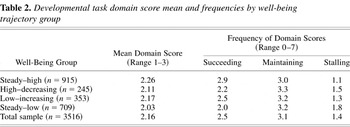
A key assumption of the additive models is that the domains are interchangeable in terms of their impact on the course of well-being. We created a mean domain score across the seven developmental tasks, with this mean score ranging from 1.0 (stalling in all domains) to 3.0 (succeeding in all domains). As shown in the first column of Table 2, the mean scores for the steady–high, high–decreasing, low–increasing, and steady–low well-being groups were 2.26, 2.11, 2.17, and 2.03, respectively (the total sample mean was 2.16). As shown in the other columns in Table 2, out of the seven domains, the steady–high and steady–low groups were succeeding in an average of 2.9 and 2.0 domains, respectively, and stalling in 1.1 and 1.8 domains, respectively. The two remaining groups were similar in their frequencies of succeeding and stalling. Thus, each well-being trajectory group was found to be succeeding, on average, in at least two domains, and stalling, on average, in at least one domain, with succeeding being more common than stalling for all groups.
Developmental task domain score mean and frequencies by well-being trajectory group

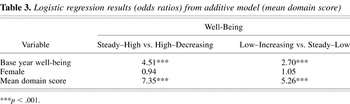
To predict membership in the well-being trajectory groups as a function of mean developmental task domain scores, we conducted two logistic regression analyses, each examining diverging pairs of trajectory groups. As shown in the first column in Table 3, in predicting membership in steady–high versus high–decreasing groups, the odds ratio for the mean domain score was significant, indicating that those with higher mean domain scores were more likely to be in the steady–high well-being group than in the high–decreasing group. Specifically, the odds ratio of 7.13 indicates that for each unit increase in the domain mean score—say, increasing from an average of stalling in half the domains and maintaining in the other half to an average of succeeding in half the domains and maintaining in the other half—the odds of being in the steady–high rather than high–decreasing group increased 7.13 times (by 713%). Likewise, as shown in the second column in Table 3, the significant odds ratio of 5.26 indicated that those with higher mean domain scores were more likely to be in the low–increasing well-being group than in the low steady group. In the two analyses, base year well-being contributed significantly and positively to the likelihood of being in the more salutary well-being group. Gender was not a significant predictor in either analysis.7
In addition to considering the mean domain scores, we considered the sum of succeeding domains separately and the sum of stalling domains separately in the logistic regression analyses to determine whether one or the other was more central to divergences in well-being. Both analyses yielded similar findings consistent with what was found in the mean domain score analyses: greater success and less stalling were associated with more salutary trajectories of well-being.
Logistic regression results (odds ratios) from additive model (mean domain score)

Main effects models
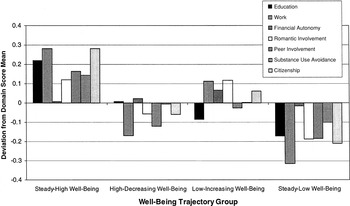
In contrast to the additive models, the main effects models allow for the consideration of whether some domains are more central to multifinality in well-being than are other domains. In these analyses, each of the seven domain scores was used as a predictor. Before we describe the findings, it is helpful to consider Figure 2, which illustrates deviations from mean scores for each domain by well-being trajectory group. As shown, the steady–high group was uniformly above the mean on all domain scores, and the steady–low group was uniformly below the mean on all domain scores. The high–decreasing and low–increasing groups showed mixed patterns.

Profiles of developmental task domain scores for well-being trajectory groups.
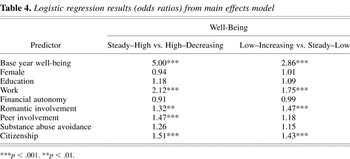
The logistic regression findings are presented in Table 4. In considering the significant predictors, the work, romantic involvement, peer involvement, and citizenship domains were found to distinguish the steady–high group from the high–decreasing group (the odds ratio for substance use avoidance was close to significance, p < .07); similarly, the work, romantic involvement, and citizenship domains were found to distinguish the low–increasing group from the steady–low group. That is, in terms of predicting a salutary trajectory of well-being—regardless of whether one started with relatively high or low well-being—succeeding in the work, romantic involvement, and citizenship domains were found, on average, to be particularly salient. In addition, for maintaining a high level of well-being, succeeding in the peer involvement domain (and, to some extent, in the substance use avoidance domain) was also found to be salient. These findings suggest the advantage of the main effects model in highlighting which developmental task domains are, on average, more central to predicting multifinality in well-being during the transition.
Logistic regression results (odds ratios) from main effects model

Compensatory models
Consistent with the idea of selection, optimization, and compensation in development (Baltes, 1997; Wiese et al., 2000), it is difficult to succeed in all domains of one's life simultaneously, and it may thus be functional to focus one's efforts to succeed in selected domains that may compensate for not succeeding in other domains. Informed particularly by Wiese et al. (2000), we tested this general hypothesis in the compensatory models by considering succeeding in the achievement-related domains (education and work) and the affiliation-related domains (romantic involvement and peer involvement). We limit our attention to these two broad domains because achievement and affiliation tasks are conceptualized as particularly central to the transition to adulthood (e.g., Masten et al., 1999; Schulenberg et al., 2003) and because work and education often reflect alternative achievement activities and, likewise, romantic and peer involvement often reflect alternative affiliation connections. Compensatory effects were examined by testing whether succeeding in one domain (e.g., education) compensated for not succeeding in a related domain (e.g., work), that is, is succeeding in only one domain equivalent to succeeding in both domains in terms of maintaining or gaining a salutary trajectory of well-being?
We also examined threshold effects, which can be conceptualized as the opposite of compensatory effects. It may be that succeeding in only one of two related domains is not sufficient for maintaining or gaining a salutary trajectory of well-being; rather, one needs to succeed in both related domains (i.e., succeeding in only one domain is equivalent to succeeding in neither domain). Finally, we also considered compensatory and threshold effects at a broader level, across both achievement- and affiliation-related domains (e.g., does succeeding in achievement compensate for not succeeding in affiliation?). More details about the testing for compensatory and threshold effects are provided below.
Succeeding within achievement and affiliation domains
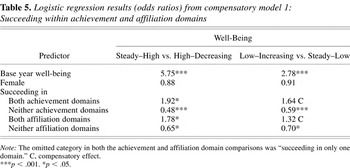
In the first model, we included dummy variables to compare the effect on the diverging well-being trajectories of succeeding in only one of the achievement domains (education or work) with the effect of succeeding in both and with the effect of succeeding in neither. Likewise, we included dummy variables to compare the effect of succeeding in only one of the affiliation domains (romantic or peer involvement) with the effects of succeeding in both and of succeeding in neither. As shown in the first column of Table 5, in the steady–high versus high–decreasing analysis, there was no evidence for compensatory or threshold effects: succeeding in both achievement domains rather than in only one domain significantly increased the odds of being in the steady–high trajectory group, and succeeding in neither achievement domain rather than in only one domain significantly decreased the odds of being in the steady–high trajectory group; this same pattern held for the affiliation domains as well.
Logistic regression results (odds ratios) from compensatory model 1: Succeeding within achievement and affiliation domains

As shown in the second column of Table 5, in the low–increasing versus steady–low analysis, compensatory effects were found within the achievement domains and within the affiliation domains. The effect of succeeding in both achievement domains (education and work) was equivalent to the effect of succeeding in just one of the domains (education or work) (i.e., odds ratio of 1.64 was not significant), whereas the effect of succeeding in neither achievement domain rather than in only one domain significantly decreased the odds (odds ratio of .59 was significant) of being in the low–increasing trajectory group. Likewise, for the affiliation domains, the effect of succeeding in both (romantic involvement and peer involvement) was equivalent to the effect of succeeding in only one (romantic involvement or peer involvement), whereas the effect of succeeding in neither affiliation domain rather than in only one significantly decreased the odds of being in the low–increasing trajectory group. Thus, for those with relatively low well-being at age 18, compensatory effects were found such that to maximize the odds of having an increased trajectory of well-being during the transition, it was sufficient to succeed in one of the two achievement domains and in one of the two affiliation domains. Simply, succeeding in work compensated for not succeeding in education (and vice versa), and succeeding in romantic involvement compensated for not succeeding in peer involvement (and vice versa).
Succeeding across achievement and affiliation domains
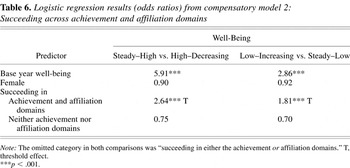
The second model sought to determine whether compensatory effects operated across the achievement and affiliation domains. Dummy variables were again created to compare the effect on the diverging well-being trajectories of succeeding in only one of these broad domains (achievement or affiliation) with the effects of succeeding in both and in neither (individuals were placed in the achievement-succeeding group if they were succeeding in the education and/or work domains, and in the affiliation-succeeding group if they were succeeding in romantic and/or peer involvement domains). As shown in the first column in Table 6, a threshold effect was found between achievement and affiliation in the steady–high versus high–decreasing analysis: succeeding in both the broader achievement and affiliation domains, rather than succeeding in only one, significantly increased the odds of being in the steady–high group (and succeeding in one rather than in neither was not a significant predictor). As shown in the second column of Table 6, similar evidence indicated a threshold effect in the steady–low versus low–increasing comparison.
Logistic regression results (odds ratios) from compensatory model 2: Succeeding across achievement and affiliation domains

Summary
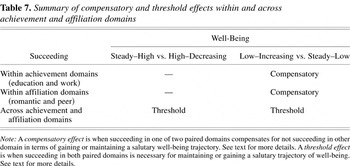
Overall, compensatory and threshold effects serve to qualify somewhat the findings from the main effects models. As summarized in Table 7, compensatory effects were found only in the steady–low versus low–increasing comparison, both within the achievement and within the affiliation domains, indicating that compensatory effects come more into play for gaining a salutary well-being trajectory than for maintaining one during the transition to adulthood. But threshold effects across the achievement and affiliation domains were found in both comparisons, indicating that succeeding in at least one of the two achievement domains and in at least one of the two affiliation domains was important for either maintaining or gaining a salutary trajectory of well-being.8
We also considered compensatory and threshold models in which the critical feature was “not stalling” (rather than succeeding) in the developmental task domains. Results from these analyses are largely consistent with the results shown here that focused on succeeding; in particular, compensatory effects again were more common in the low–increasing versus steady–low comparison than in the steady–high versus high–decreasing comparison.
Summary of compensatory and threshold effects within and across achievement and affiliation domains

Discussion
As a major life transition, the transition to adulthood can reflect pervasive change in nearly all aspects of life. Such challenges to developmental systems can result in reorganization, either promoting successful advances in development or maladaptive changes (Cicchetti & Rogosch, 2002; Sameroff, 2000; Sroufe & Rutter, 1984). Normative developmental tasks, based on expectations that vary culturally and historically, provide the foundation in which behaviors are considered adaptive or maladaptive (Masten & Curtis, 2000) and thus offer an important backdrop for understanding the origins and course of mental health and psychopathology across life. This highlights the dynamic quality of adaptive and maladaptive behaviors, focusing attention on the ongoing interaction between individuals and changing contexts. Indeed, it is likely that the associations we found between the extent of success with the tasks and the course of well-being are functions of reciprocal processes, in which ongoing interactions with the contexts represented by the various task domains depend on, and then contribute to, levels of well-being across the transition to adulthood. Maladaptive (as well as adaptive) negotiation of the various tasks is as much a function of the individual characteristics as it is of contextual characteristics. For example, success with work-related tasks depends heavily on employment opportunities. A mismatch between expectations and opportunities can contribute to maladaptive avoidance of life tasks (Mortimer, Zimmer-Gembeck, Holmes, & Shanahan, 2002). At the same time, emergent psychopathology may also contribute to difficulties in negotiating the various tasks.
Summary and Integration
As shown in this study, how well one negotiates the various tasks involved with the transition is related to the course of one's well-being. Using US national panel data, we examined the course of well-being from the senior year of high school through the subsequent 8 years as a function of success and difficulties with developmental tasks in the domains of education, work, financial autonomy, romantic involvement, peer involvement, substance abuse avoidance, and citizenship. Taking a pattern-centered approach, we focused on students in the top and bottom thirds of the sample in terms of initial well-being, placing them into groups of diverging trajectories of well-being across the transition. Three conceptual models were considered in the analyses: additive, main effects, and compensatory models. These models varied in terms of how the domain scores were used to predict multifinality in two sets of comparisons, including among those with initially high well-being scores (steady–high vs. high–decreasing trajectory groups) and those with initially low well-being scores (low–increasing vs. steady–low trajectory groups). In this section, we first summarize and discuss the findings separately for the two sets of comparisons, and then integrate the findings to highlight implications for the understanding of development and psychopathology during the transition to adulthood.
Steady–high versus high–decreasing well-being trajectories
Near the end of high school, these two groups had relatively high well-being (in the top third of the sample at age 18) and then diverged across the transition. Those in the steady–high group (26% of the total sample) maintained their high level of well-being across the transition, reflecting continuity; and those in the high–decreasing group (7%) reflected discontinuity because during early adulthood their well-being significantly decreased (reflecting mean level change), and they were in the bottom third of the sample (reflecting a drop in relative rank ordering).
Based on the additive model, where it was found that that the average score across the seven developmental task domains predicted this divergence in well-being, greater success across the various developmental tasks was associated with maintaining a high level of well-being across the transition. More specifically, based on the main effects model (i.e., each domain score was included separately as a predictor in the model), success in the work, romantic involvement, peer involvement, and citizenship domains was more central to maintaining a high level of well-being, whereas success in the other domains, particularly education and financial autonomy (substance use avoidance was just short of significance, p < .07), was not as central. These main effects findings were qualified to some extent by findings from the compensatory models, where the focus was on interactions within and across the broader domains of achievement (work and education) and affiliation (romantic and peer involvement). Although there was no evidence of compensatory effects, there was evidence of a threshold effect across the achievement and affiliation domains, indicating that succeeding in both achievement and affiliation domains was necessary for maintaining a high level of well-being across the transition (i.e., succeeding in only achievement or affiliation domains was as detrimental as not succeeding in both domains in terms of the odds of maintaining a high well-being trajectory).
Clearly, decreased well-being during this transition is not normative, especially among those with relatively high well-being in high school (and, indeed, the 7% of the sample following this trajectory would likely have been missed in traditional variable-centered analyses). Identifying and understanding such relatively small groups reflecting discontinuity in mental health can help illustrate the full range of adaptive and maladaptive reactions to life tasks (Cicchetti & Rogosch, 2002; Schulenberg et al., 2003). The compensatory model findings just summarized suggest that across the broader achievement and affiliation developmental tasks, maintaining a salutary well-being trajectory is somewhat of a “high wire” act. Of course, individuals in these two trajectory groups are likely to have, at least initially, more personal and contextual resources to successfully take on the high wire act. In a way, the high–decreasing group represents the opposite of resilience (cf. Masten, 2001; Luthar & Zelazo, 2003); not only do the members of this group begin with relatively high well-being, we found that they also have relatively high parent education. For this group, the new social roles and contexts may pose extreme stressors or challenges where balance is lost; likewise, their personal resources may be limited by emerging psychopathology. Although our study cannot address this possibility, it is noteworthy that the onset of some psychotic and mood disorders such as schizophrenia, bipolar disorder, and borderline personality disorders coincides with the transition to adulthood, from the late teens to early 30s (Grimes & Walker, 1994; Trull, 2001).
Low–increasing versus steady–low well-being trajectories
These two well-being trajectory groups began with relatively low well-being scores (in the bottom third of the sample in senior year of high school). The steady–low group (20% of the total sample) remained relatively low in well-being throughout the transition, reflecting continuity. The low–increasing group (10%) reflected discontinuity, in that well-being for this group increased both in terms of mean level (mean increase was significantly greater than increase for total sample) and rank ordering (increased to top third of sample) during the transition. Based on the additive model findings, a greater overall level of success across the various developmental tasks was associated with increased odds of having an increased, rather than steady–low, trajectory of well-being. More specifically, based on the main effects model findings, greater success in the employment, romantic, and citizenship domains was particularly salient for gaining an increased well-being trajectory.
These main effects findings were qualified by the evidence from the compensatory models regarding compensatory effects within the achievement and affiliation domains: those who succeeded in one or the other of the two achievement domains (work or education) were as likely as those who succeeded in both to gain an increased well-being trajectory; likewise, those who succeeded in one or the other of two affiliation domains (romantic or peer involvement) were as likely as those who succeeded in both to gain an increased well-being trajectory. These compensatory effects indicate that gaining an increased well-being trajectory is more a matter of some success, rather than pervasive success, in the achievement and affiliation domains, a finding that is distinct from what was found for the initially high well-being groups (where no compensatory effects were found). Still, similar to what was found for the initially high well-being groups, there was a threshold effect operating across the achievement and affiliation domains, indicating that at least some success in both of these domains was necessary for gaining an increased well-being trajectory.
Although increased well-being reflected the normative trend, those in the low–increasing group showed a particularly steep assent during the transition. Perhaps those in this group, compared to the steady–low group, had more opportunities in the new social roles and contexts to use their talents and to connect positively with others, and such successful interactions accumulated to promote increased well-being; research on resiliency suggests that positive assets such as finding a job or making connections to others can offset ongoing risks (Masten, 2001; Rutter, 1996). Likewise, it may be the case that the pretransitions contexts were dysfunctional, and in this sense, the low–increasing group represents a resilient group for which the experiences during transition to adulthood served as a positive turning point (cf. Luthar & Zelazo, 2003). The compensatory effects for this group described above are consistent with a selection, optimization, and compensation model (e.g., Baltes, 1997), whereby individuals actively select domains in which to focus and thus can compensate for domains that may receive less attention. It may be that this active negotiation of tasks, or executive functioning (Eccles et al., 1997), contributes to, or otherwise reflects, resilience.
Integration
In the two additive model comparisons, success and difficulties with the developmental tasks of early adulthood were associated with multifinality in well-being during the transition to adulthood, both among those with relatively high initial well-being and among those with relatively low initial well-being. Thus, consistent with the literature on accumulated risk in the developmental psychopathology literature, the more success and less stalling with the various early adulthood developmental task domains, the greater the likelihood of maintaining or gaining a salutary trajectory of well-being across the transition.
Similarly, in the two main effects model comparisons, success in negotiating developmental tasks concerning work, romantic involvement, and citizenship was significantly related to maintaining or gaining a salutary well-being trajectory during the transition to adulthood. That these three task domains were found to be predictive of multifinality in well-being regardless of starting point indicates the primacy of these tasks during the transition to adulthood (e.g., see Arnett, 2000, 2001; Masten et al., 1999; Oerter, 1986; Youniss & Yates, 1997). The peer involvement task domain was also predictive in the steady–high versus high–decreasing analysis, suggesting the importance of this domain, in addition to the romantic involvement domain, for maintaining a high level of well-being during the transition (Collins & van Dulmen, in press). In both comparisons, the education, financial autonomy, and substance abuse avoidance domains were not found to significantly predict divergences (although substance abuse avoidance was just short of significance in the first comparison). This does not mean that they are unimportant to the course of well-being during the transition, but simply that they were not found to be critical to predicting multifinality in well-being. Indeed, considering Figure 2, it is clear that the steady–high and steady–low trajectory groups were different in the extent of success in education and substance use avoidance. Ongoing substance abuse, in particular, is likely to be a key component of difficulties with the transition to adulthood (Baumrind, 1987; Jessor et al., 1991; Schulenberg et al., 2003), often commingling with other psychopathologies (Cicchetti, 1999).
Thus, based on the additive and main effects models, there appears to be a good deal of symmetry in terms of what predicts salutary trajectories of well-being, regardless of starting levels. But this was not the case with the compensatory models, where we found evidence for compensatory effects among those with initially low well-being but not among those with initially high well-being. This finding for those with initially low well-being represents a hopeful account of the multiple pathways to mental health during the transition to adulthood: although the main effect findings discussed above highlight the importance of succeeding in work and in romantic involvement for gaining an increased trajectory of well-being, succeeding in education was found to compensate for not succeeding in work (and vice versa), and succeeding in peer involvement was found to compensate for not succeeding in romantic involvement (and vice versa).
Finally, the findings suggest that the association between success in the various developmental task domains and the course of well-being during the transition was not dependent on initial well-being. Because the diverging trajectory groups were slightly but significantly different in initial well-being, it was necessary to include initial well-being in the regression analyses. In each case, although initial well-being contributed significantly to predicting the course of well-being, it did not contribute to a decrease in the effects of the developmental task domain scores. This consistent finding across all analyses argues for viewing successes and difficulties in the developmental tasks of early adulthood as offering unique and developmentally proximal contributions to the course of well-being (Schulenberg et al., 2003).
Strengths, limitations, and future directions
An important strength of this study was the use of national panel data spanning an 8-year period between late adolescence and early adulthood. In particular, the use of national panel data to construct and study life paths over time represents a powerful approach to understanding continuity and discontinuity that is possible only through large-scale survey research (e.g., Jackson & Antonucci, 1994; Schulenberg et al., 2000). Of course, such large-scale efforts must be complemented with more intensive efforts (e.g., clinical interviews) to provide a fuller understanding of the course of mental health and psychopathology during the transition to adulthood.
Because the sample included only those who graduated from high school, generalizability to those who dropped out of high school may be limited. Future research could improve on the study by starting earlier in adolescence to gain a better “before” picture, as well as an even more representative sample. Although the use of multiple waves of panel data represents an important strength, the 4-year lag between the waves suggests some lack of precision in specifying the well-being trajectories and developmental task domains. In addition, we were limited to measures available in the data set, a common and perhaps forgivable limitation of long-term national panel studies (Brooks–Gunn, Phelps, & Elder, 1991). The transition to adulthood is multifaceted, a quality not fully captured in the characteristics we selected to reflect tasks typical of this transition. A more comprehensive consideration of transitional tasks and experiences may yield more powerful links between the experiences and changes in well-being. Furthermore, as discussed previously, it is likely that well-being and negotiation of developmental tasks are reciprocally related over time, and it is important for future analyses to determine how these two moving targets interrelate (e.g., Masten & Curtis, 2000). Finally, future research in this area would do well to consider a longer, less normative time frame for assumption of adulthood roles.
Conclusions
Documenting continuities and discontinuities in functioning in the general population across the transition to adulthood, and major life transitions in general, provides an essential backdrop for understanding the course of mental health and psychopathology across the life span. In particular, attending to extreme cases (in this case, discontinuities in well-being) allows for a fuller understanding of the range of pathways reflecting risk and resiliency (Cicchetti & Rogosch, 2002). The transition out of high school and into early adulthood is associated with increased well-being for most individuals, and clearly, continuity in well-being prevails across the transition. Based on national panel data, we found that for over 80% of the sample (i.e., the steady–high and steady–low trajectories, along with those in the middle third of sample in terms of initial well-being), the course of well-being from age 18 to age 26 reflected continuity. But embedded within this transition are opportunities for deflections of existing developmental pathways: dysfunctional young adults can come from the ranks of seemingly well-functioning adolescents, and troubled adolescents can become exemplary young adults. We identified a group of 7% of the sample whose well-being decreased across the transition, going from relatively high to relatively low well-being across the transition, and thus running counter to the normative trend. For this decreased well-being group, it appears that the source of this discontinuity relates to difficulties with the various developmental tasks of early adulthood, particularly work, romantic and peer involvement, and citizenship, suggesting at least some developmentally proximal roots of adulthood difficulties in adjustment. Likewise, we identified a group of 10% of the sample who had relatively low well-being during late adolescence and then experienced a turnabout in the well-being across the transition, a turnabout that was found to be related to succeeding in such developmental tasks as employment, romantic involvement, and citizenship. For this group, the experiences of early adulthood served as a positive turning point in the course of well-being.
References
REFERENCES
Arnett, J. J.
(2000).
Emerging adulthood: A theory of development from late teens through
the twenties.
American Psychologist
55,
469–480.Google Scholar
Arnett, J. J.
(2001).
Conceptions of the transition to adulthood: Perspectives from
adolescence through midlife.
Journal of Adult Development
8,
133–143.Google Scholar
Aseltine, R. H., &
Gore, S.
(1993).
Mental health and social adaptation following the transition from
high school.
Journal of Research on Adolescence
3,
247–270.Google Scholar
Bachman, J. G.,
O'Malley, P. M.,
Schulenberg, J. E.,
Johnston, L. D.,
Bryant, A. L., &
Merline, A. C.
(2002).
The decline of substance use in young adulthood: Changes in social
activities, roles, and beliefs.
Mahwah, NJ:
Erlbaum.
Baltes, P.
(1997).
On the incomplete architecture of human ontogeny: Selection,
optimization, and compensation as foundation of developmental
theory.
American Psychologist
52,
366–380.Google Scholar
Baltes, P. B.,
Lindenberger, U., &
Staudinger, U. M.
(1998).
Life-span theory in developmental psychology. In
R. M. Lerner (Ed.),
Handbook of child psychology: Vol. 1. Theoretical models of human
development (pp.
1029–1143).
New York:
Wiley.
Bardone, A. M.,
Moffitt, T.,
Caspi, A., &
Dickson, N.
(1996).
Adult mental health and social outcomes of adolescent girls with
depression and conduct disorder.
Development and Psychopathology
8,
811–829.Google Scholar
Baumrind, D.
(1987).
A developmental perspective on adolescent risk taking in
contemporary America. In
C. E. Irwin, Jr. (Ed.),
Adolescent social behavior and health (pp.
93–125).
San Francisco, CA:
Jossey–Bass.
Brandtstädter, J., &
Lerner, R. M. (Eds.)
(1999).
Action and self-development: Theory and research through the life
span.
Thousand Oaks, CA:
Sage.
Brooks–Gunn, J.,
Phelps, E., &
Elder, G. H., Jr.
(1991).
Studying lives through time: Secondary data analyses in
developmental psychology.
Developmental Psychology
27,
899–910.Google Scholar
Bry, B. H.,
McKeon, P., &
Pandina, R. J.
(1982).
Extent of drug use as a function of number of risk factors.
Journal of Abnormal Psychology
91,
273–279.Google Scholar
Cairns, R. B., &
Cairns, B. D.
(1994).
Lifelines and risks: Pathways of youth in our time.
New York:
Cambridge University Press.
Cicchetti, D.
(1999).
A developmental psychopathology perspective on drug abuse. In
M. D. Glantz &
C. R. Hartel (Eds.),
Drug abuse: Origins and interventions (pp.
97–117).
Washington, DC:
American Psychological Association.
Cicchetti, D., &
Rogosch, F. A.
(2002).
A developmental psychopathology perspective on adolescence.
Journal of Consulting and Clinical Psychology
70,
6–20.Google Scholar
Clausen, J. A.
(1991).
Adolescent competence and the shaping of the life course.
American Journal of Sociology
96,
805–842.Google Scholar
Cohen, P.,
Kasen, S.,
Chen, H.,
Hartmark, C., &
Gordon, K.
(2003).
Variations in patterns of developmental transitions in the emerging
adulthood period.
Developmental Psychology
39,
657–669.Google Scholar
Collins, W. A., &
van Dulmen, M.
(in press).
Friendships and romance in emerging adulthood: Assessing
distinctiveness in close relationships. In
J. J. Arnett &
J. Tanner (Eds.),
Advances in emerging adulthood.
Washington, DC:
American Psychological Association.
Eccles, J. S.,
Lord, S. E.,
Roeser, R. W.,
Barber, B. L., &
Hernandez–Jozefowicz, D. M.
(1997).
The association of school transitions in early adolescence with
developmental trajectories through high school. In
J. Schulenberg,
J. L. Maggs, &
K. Hurrelmann (Eds.),
Health risks and developmental transitions during adolescence (pp.
283–320).
New York:
Cambridge University Press.
Elder, G. H., Jr.
(1998).
The life course and human development. In
W. Damon (Series Ed.) &
R. M. Lerner (Vol. Ed.),
Handbook of child psychology: Vol. 1. Theoretical models of human
development (pp.
939–991).
New York:
Wiley.
Erikson, E. H.
(1968).
Identity, youth and crisis.
New York:
Norton.
Grimes, K., &
Walker, E.
(1994).
Childhood emotional expressions, educational attainment, and age at
onset of illness in schizophrenia.
Journal of Abnormal Psychology
103,
784–790.Google Scholar
Havighurst, R.
(1952).
Developmental tasks and education.
New York:
McKay.
Hawkins, J. D.,
Catalano, R. F., &
Miller, J. Y.
(1992).
Risk and protective factors for alcohol and other drug problems in
adolescence and early adulthood: Implications for substance abuse
prevention.
Psychological Bulletin
112,
64–105.Google Scholar
Heckhausen, J.
(1999).
Developmental regulation in adulthood: Age-normative and
sociostructural constraints as adaptive challenges.
New York:
Cambridge University Press.
Hogan, D. P., &
Astone, N. M.
(1986).
The transition to adulthood.
Annual Review of Sociology
12,
109–130.Google Scholar
Jackson, J. S., &
Antonucci, T. C.
(1994).
Survey methodology in life-span human development research. In
S. H. Cohen &
H. W. Reese (Eds.),
Life-span developmental psychology: Methodological contributions (pp.
65–94).
Hillsdale, NJ:
Erlbaum.
Jessor, R.,
Donovan, J. E., &
Costa, F.
(1991).
Beyond adolescence: Problem behavior and young adult development.
New York:
Cambridge University.
Johnston, L. D.,
O'Malley, P. M.,
Bachman, J. G., &
Schulenberg, J. E.
(2004).
National survey results on drug use from the Monitoring the Future
study, 1975–2003: Vol. I. Secondary school students. Vol. II.
College students and adults ages 19–45
(NIH Publication Nos. 04-5507 & 04-5508).
Bethesda, MD:
National Institute on Drug Abuse.
Lewis, M.
(1999).
Contextualism and the issue of continuity.
Infant Behavior & Development
22,
431–444.Google Scholar
Luthar, S. S., &
Zelazo, L. B.
(2003).
Research on resilience: An integrated review. In
S. S. Luthar (Ed.),
Resilience and vulnerability: Adaptation in the context of
childhood adversities (pp.
510–549).
New York:
Cambridge University Press.
Magnusson, D.
(1995).
Individual development: A holistic, integrated model. In
P. Moen,
G. H. Elder, Jr. &
K. Luscher (Eds.),
Examining lives in context: Perspectives on the ecology of human
development (pp.
19–60).
Washington, DC:
American Psychological Association.
Marini, M. M.
(1985).
Determinants of the timing of adult role entry.
Social Science Research
14,
309–350.Google Scholar
Masten, A. S.
(2001).
Ordinary magic: Resilience processes in development.
American Psychologist
56,
227–238.Google Scholar
Masten, A. S., &
Curtis, W. J.
(2000).
Integrating competence and psychopathology: Pathways toward a
comprehensive science of adaptation in development.
Development and Psychopathology
12,
529–550.Google Scholar
Masten, A. S.,
Hubbard, J. J.,
Gest, S. D.,
Tellegen, A.,
Garmezy, N., &
Ramirez, M.
(1999).
Competence in the context of adversity: Pathways to resilience and
maladaptation from childhood to late adolescence.
Development and Psychopathology
11,
143–169.Google Scholar
Moffitt, T. E., &
Caspi, A.
(2001).
Childhood predictors differentiate life-course persistent and
adolescent-limited antisocial pathways among males and females.
Development and Psychopathology
13,
355–375.Google Scholar
Mortimer, J. T.,
Zimmer-Gembeck, M. J.,
Holmes, M., &
Shanahan, M. J.
(2002).
The process of occupational decision making: Patterns during the
transition to adulthood.
Journal of Vocational Behavior
61,
439–465.Google Scholar
Neugarten, B. L., &
Datan, N.
(1973).
Sociological perspectives on the life cycle. In
P. B. Baltes &
K. W. Schaie (Eds.),
Life-span developmental psychology (pp.
53–69).
New York:
Academic Press.
Newcomb, M. D., &
Bentler, P. M.
(1988).
Impact of adolescent drug use and social support on problems of
young adults: A longitudinal study.
Journal of Abnormal Psychology
97,
64–75.Google Scholar
Newcomb, M. D., &
Bentler, P. M.
(1989).
Substance use and abuse among children and teenagers.
American Psychologist
44,
242–249.Google Scholar
Nowicki, S., &
Strickland, B. R.
(1973).
A locus of control scale for children.
Journal of Consulting and Clinical Psychology
40,
148–154.Google Scholar
Nurmi, J. E.
(1993).
Adolescent development in an age-graded context: The role of
personal beliefs, goals, and strategies in the tackling of
developmental tasks and standards.
International Journal of Behavioral Development
16,
169–189.Google Scholar
Oerter, R.
(1986).
Developmental tasks through the life span: A new approach to an
old concept. In
P. B. Baltes,
D. L. Featherman, &
R. M. Lerner (Eds.),
Life span development and behavior
(Vol. 7, pp.
233–271).
Hillsdale, NJ:
Erlbaum.
Petersen, A. C.
(1993).
Creating adolescents: The role of context and process in
developmental trajectories.
Journal of Research on Adolescence
3,
1–18.Google Scholar
Rosenberg, M.
(1965).
Society and the adolescent self-image.
Princeton, NJ:
Princeton University Press.
Rutter, M.
(1996).
Transitions and turning points in developmental psychopathology: As
applied to the age span between childhood and mid-adulthood.
International Journal of Behavioral Development
19,
603–626.Google Scholar
Ryff, C. D., &
Keyes, C.
(1995).
The structure of psychological well-being revisited.
Journal of Personality and Social Psychology
69,
719–727.Google Scholar
Sameroff, A. J.
(2000).
Developmental systems and psychopathology.
Development and Psychopathology
12,
297–312.Google Scholar
Sameroff, A. J., &
Seifer, R.
(1995).
Accumulation of environmental risk and child mental health. In
H. E. Fitzgerald &
B. M. Lester (Eds.),
Children in poverty: Research, health, and policy issues (pp.
233–258).
New York:
Garland.
Schulenberg, J. E.,
Maggs, J. L., &
O'Malley, P. M.
(2003).
How and why the understanding of developmental continuity and
discontinuity is important: The sample case of long-term consequences
of adolescent substance use. In
J. T. Mortimer &
M. J. Shanahan (Eds.),
Handbook of the life course (pp.
413–436).
New York:
Plenum Press.
Schulenberg, J.,
O'Malley, P. M.,
Bachman, J. G., &
Johnston, L. D.
(2000).
“Spread your wings and fly”: The course of health and
well-being during the transition to young adulthood. In
L. Crockett &
R. Silbereisen (Eds.),
Negotiating adolescence in times of social change.
New York:
Cambridge University Press.
Schulenberg, J. E.,
O'Malley, P. M.,
Bachman, J. G., &
Johnston, L. D.
(in press).
Early adult transitions and their relation to well-being and
substance use. In
F. Furstenberg,
R. Rumbaut, &
R. Settersten (Eds.),
On the frontier of adulthood (MacArthur network edited volume).
Chicago:
University of Chicago Press.
Schulenberg, J.,
Wadsworth, K. N.,
O'Malley, P. M.,
Bachman, J. G., &
Johnston, L. D.
(1996).
Adolescent risk factors for binge drinking during the transition to
young adulthood: Variable- and pattern-centered approaches to
change.
Developmental Psychology
32,
659–674.Google Scholar
Schulenberg, J. E., &
Zarrett, N. R.
(in press).
Mental health during emerging adulthood: Continuities and
discontinuities in course, content, and meaning. In
J. J. Arnett &
J. Tanner (Eds.),
Advances in emerging adulthood.
Washington, DC:
American Psychological Association.
Shanahan, M. J.
(2000).
Pathways to adulthood in changing societies: Variability and
mechanisms in life course perspective.
Annual Review of Sociology
26,
667–692.Google Scholar
Sherrod, L. R.,
Haggerty, R. J., &
Featherman, D. L.
(1993).
Introduction: Late adolescence and the transition to adulthood.
Journal of Research on Adolescence
3,
217–226.Google Scholar
Shiner, R. L., &
Masten, A. S.
(2002).
Transactional links between personality and adaptation from
childhood through adulthood.
Journal of Research in Personality
36,
580–588.Google Scholar
Sroufe, L. A., &
Rutter, M.
(1984).
The domain of developmental psychopathology.
Child Development
55,
17–29.Google Scholar
Trull, T. J.
(2001).
Structural relations between borderline personality disorder
features and putative etiological correlates.
Journal of Abnormal Psychology
110,
471–481.Google Scholar
Wiese, B. S.,
Freund, A. M., &
Baltes, P. B.
(2000).
Selection, optimization and compensation: An action-related
approach to work and partnership.
Journal of Vocational Behavior
57,
273–300.Google Scholar
Youniss, J., &
Yates, M.
(1997).
Community service and social responsibility in youth.
Chicago:
University of Chicago Press.
Descriptions of developmental task domains
Well-being during the transition for the different well-being groups.
Developmental task domain score mean and frequencies by well-being trajectory group
Logistic regression results (odds ratios) from additive model (mean domain score)
Profiles of developmental task domain scores for well-being trajectory groups.
Logistic regression results (odds ratios) from main effects model
Logistic regression results (odds ratios) from compensatory model 1: Succeeding within achievement and affiliation domains
Logistic regression results (odds ratios) from compensatory model 2: Succeeding across achievement and affiliation domains
Summary of compensatory and threshold effects within and across achievement and affiliation domains
 You have
Access
- 251
- Cited by