Introduction
Personal listening devices are capable of producing high output levels that can cause hearing loss.Reference Portnuff1,Reference Portnuff, Fligor and Arehart2 Listeners are frequently unaware that a hearing loss is developing.Reference Levey, Fligor, Ginocchi and Kagimbi3 Given the extensive spread of personal listening devices, particularly as a result of their integration into mobile phones, dangerous levels of noise exposure may begin at an increasingly early age, especially among users who listen at high volumes for long periods of time, putting young people at a substantial risk for future noise-induced hearing loss.Reference Hussain, Chou, Zettner, Torre, Hans and Gauer4 The World Health Organization (WHO) estimates that more than one billion young people worldwide could be at risk of hearing loss due to unsafe listening practices, and that nearly half of all teenagers and young adults in middle- and high-income countries are exposed to unsafe sound levels from the use of personal listening devices.5
This study aimed to determine the knowledge of first year health sciences students at the University of the Free State, Bloemfontein, South Africa, in 2018, regarding hearing loss and symptoms attributable to personal listening devices, and their practices concerning, and symptoms experienced as a result of, the use of personal listening devices.
Materials and methods
This was a cross-sectional study of all first year medical and allied health professions students at the University of the Free State in 2018. The data were collected by means of anonymous self-administered questionnaires. These were distributed to and completed by students during one of their classes as arranged with their lecturer, and collected immediately after completion. The questionnaire included questions on the students’ knowledge of hearing loss, symptoms that could be caused by extensive use of personal listening devices, students’ use of personal listening devices and symptoms experienced after using personal listening devices.
Participants were asked which of the following symptoms could be caused by extensive use of personal listening devices: ringing noise in the ears, temporary hearing loss, permanent hearing loss, hypersensitivity to sound, distortion of sound, headaches and soreness of ears. The following distractor options were included in the list of symptoms that could be caused by extensive use of personal listening devices: perspiration, loss of vision, heart palpitations, runny nose and toothache.
A pilot study was performed on the second year dietetics and nutrition class of 2018 using the same methodology as the main study. The results were not included in the main study. After studying responses from the pilot study, minor changes were made regarding the phrasing of the questionnaire.
Descriptive statistics, namely frequencies and percentages for categorical data, and medians for numerical data, were calculated. Differences between groups were determined using the chi-square or Fisher's exact test, as appropriate.
Permission to perform the study was obtained from: the Heads of the Schools of Clinical Medicine and Allied Health Professions, the Dean of the Faculty of Health Sciences, the Dean of Student Affairs, and the Vice-Rector for Research of the University of the Free State. The study was approved by the Health Sciences Research Ethics Committee of the University of the Free State (approval number: UFS-HSD2018/0143/2905). Consent was assumed when the participant voluntarily completed the questionnaire. Participant anonymity was guaranteed as no identifying personal information was required. Students who were under the age of 18 years at the time of the study were excluded as they could not give informed consent. We also excluded those students who knew they had a hearing impairment.
Results
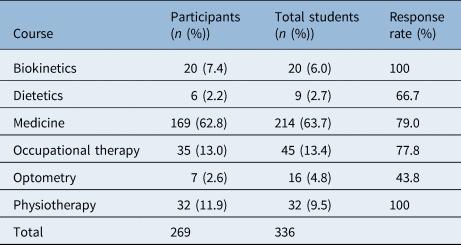
The questionnaire was completed by 269 (80.1 per cent) of the target population of 336 students. There were 73 (27.1 per cent) male and 196 (72.9 per cent) female participants. The median age of the participants was 19.5 years (range, 18.3–28.8 years). The participant numbers and response rates by course of study are shown in Table 1.
Participant numbers and response rates by course

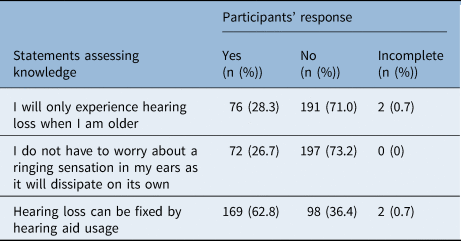
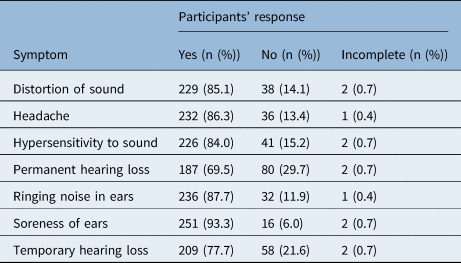
More than a quarter of participants felt that they would only experience hearing loss when they were older and that they do not have to worry about a ringing sensation in their ears, while over 60 per cent felt that hearing loss could be fixed by using a hearing aid (Table 2). Male students were significantly more likely than female students to think that they would only experience hearing loss when older (41.1 per cent vs 23.5 per cent, p = 0.0089) and that they did not have to worry about a ringing sensation in their ears (36.6 per cent vs 23.5 per cent, p = 0.0454). Although not statistically significant, males were also more likely to feel that hearing loss could be fixed by using a hearing aid (71.2 per cent vs 59.7 per cent, p = 0.1956). Most participants were able to identify symptoms that could be caused by extensive use of personal listening devices (Table 3), but there was relatively poor knowledge that extensive personal listening device use could cause hearing loss.


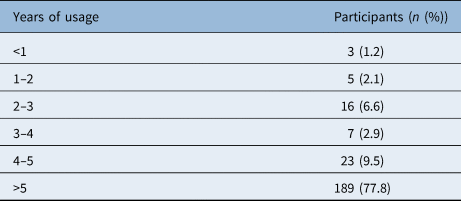
Personal listening devices were used by 244 participants (90.7 per cent). Earphones were used by 213 (87.3 per cent) of these participants, headphones by 117 (48.0 per cent) and speakers by 180 (73.8 per cent). All 3 types of personal listening devices were used by 86 participants (35.2 per cent). The majority of participants had been using personal listening devices for more than five years (Table 4).

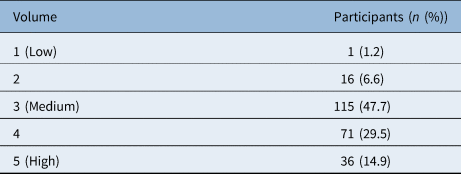
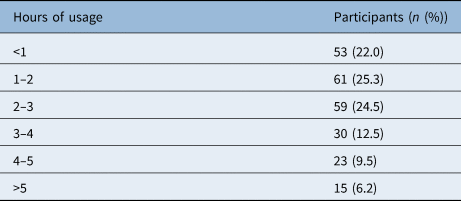
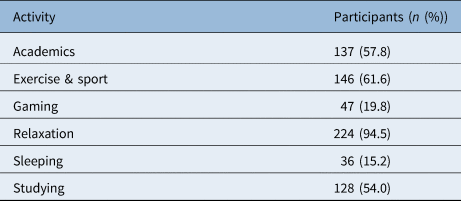
Although most participants used their personal listening devices at a medium or lower volume (Table 5), 14.9 per cent listened at a high volume and more than half used their personal listening devices for more than 2 hours per day (Table 6). There was no significant difference between males and females with regard to the type of personal listening device used, the duration of use, or volume level (p > 0.05). Personal listening devices were most commonly used for relaxation (Table 7). Male participants were significantly more likely to use personal listening devices for gaming than female participants (46.0 per cent vs 10.3 per cent, p < 0.001).


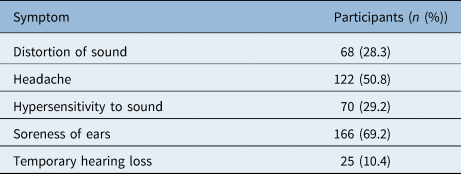
At least one symptom that the participants thought was attributable to the use of personal listening devices was reported by 202 participants (84.2 per cent), with soreness of the ears being the most common symptom (Table 8).

Discussion
The use of personal listening devices at high volumes for long periods of time has been implicated in causing noise-induced hearing loss.Reference Portnuff1 More than a quarter of participants in this study thought that they would only experience hearing loss when they were older and that they did not have to worry about tinnitus, with these misconceptions being more common in male participants. In a study conducted at West Virginia University, 75 per cent of students surveyed believed that they would not lose their hearing until they were older and 44 per cent believed that hearing loss could be fixed with the use of hearing aids.Reference Rawool and Colligon-Wayne6 A study among medical students in Delhi found that male students were less likely to perceive risks associated with personal listening device use than females.Reference Basu, Garg, Singh and Kohli7 While most of the symptoms that could be caused by extensive use of personal listening devices were well-known by participants, almost 30 per cent of participants did not know that a permanent hearing loss could occur.
Personal listening devices were used at a low to medium volume by more than half the participants, and for 3 hours or less a day by 71.8 per cent of participants. Self-reported listening levels and duration have been found to be an accurate means of estimating individual noise levels.Reference Sulaiman, Husain and Seluakumaran8–Reference Portnuff, Fligor and Arehart10 This moderate use of personal listening devices by most participants is similar to the findings of other studies on personal listening device use in students.
However,Reference Portnuff1,Reference Portnuff, Fligor and Arehart2,Reference Hussain, Chou, Zettner, Torre, Hans and Gauer4,Reference Basu, Garg, Singh and Kohli7,Reference Portnuff, Fligor and Arehart10–Reference Ahmed, Fallah, Garrido, Gross, King and Morrish12 14.9 per cent of participants used their personal listening devices at high volumes and 6.2 per cent used them for more than 5 hours per day. This is in keeping with previous studies which found that a significant number of personal listening device users are exposed to sounds at a level that could increase their risk of acquiring hearing loss. In contrast, more than half of personal listening device users at a New York college exceeded recommended sound exposure limits.Reference Levey, Levey and Fligor13 Longer usage times have been associated with significantly worse hearing levels.Reference Hutchinson Marron, Marchiondo, Stephenson, Wagner, Cramer and Wharton9
In keeping with most other studies, we did not find a significant difference between males and females with regard to the duration of personal listening device use or the volume at which it was used,Reference Hutchinson Marron, Marchiondo, Stephenson, Wagner, Cramer and Wharton9,Reference Hoover and Krishnamurti11,Reference Levey, Levey and Fligor13 although some studies have reported that males used personal listening devices for longer durations and at louder volumes.Reference Hussain, Chou, Zettner, Torre, Hans and Gauer4,Reference Basu, Garg, Singh and Kohli7,Reference Torre14,Reference Lee, Lim, Kuan, Teo, Tan and Low15
Safe listening levels depend on the intensity and duration of exposure.Reference Levey, Fligor, Ginocchi and Kagimbi3,5 The highest safe exposure level is considered to be 85 dBA for up to a maximum of 8 hours, with the permissible time for safe listening decreasing as the sound level increases. Users of personal listening devices typically set the volume between 75 and 105 dB.5 An 8-hour equivalent continuous exposure level of greater than 75 dBA was associated with a higher incidence of tinnitus and difficulty in hearing others immediately after personal listening device use, and those who had used personal listening devices for more than 4 years had significantly higher thresholds at 8 kHz and above.Reference Sulaiman, Husain and Seluakumaran8
The use of personal listening devices in noisy environments results in listeners increasing the volume in an attempt to drown out outside noise.Reference Portnuff, Fligor and Arehart2,Reference Hussain, Chou, Zettner, Torre, Hans and Gauer4,Reference Hoover and Krishnamurti11 Headphones were used by 48 per cent of participants. Using headphones that completely seal the ear allows the user to block out background noise and listen at lower levels, even with high levels of background noise.Reference Portnuff, Fligor and Arehart2,Reference Levey, Fligor, Ginocchi and Kagimbi3 The use of insert earphones is associated with listening at louder volumes.Reference Diviani, Zanini, Amann, Chadha, Cieza and Rubinelli16
• Personal listening devices can produce high output levels that can cause hearing loss
• It is estimated that nearly half of young adults in middle- and high-income countries are exposed to unsafe sound levels from personal listening device use
• Most study participants had been using personal listening devices for more than 5 years, at medium to high volumes, for more than 2 hours per day
• There is a need for an educational programme to inform students about safe listening practices
The most prevalent symptoms experienced by participants as a result of using personal listening devices was soreness of the ears, similar to other studies,Reference Hoover and Krishnamurti11 with audiological symptoms being less frequent. Nevertheless, almost 30 per cent of participants reported having audiological symptoms, suggesting that they are at risk for developing hearing loss. This highlights the need to educate students about the risk of hearing loss associated with personal listening devices.
Educational interventions aimed at informing individuals of the dangers of personal listening device use should include the provision of information on: the effects of hearing loss, symptoms that may be an early indication of hearing loss (e.g. tinnitus), and measures that can be taken to reduce exposure to loud sounds such as reducing the volume and time of exposure.Reference Levey, Fligor, Ginocchi and Kagimbi3 The knowledge that using personal listening devices might lead to hearing loss may be an important driver of behaviour change.Reference Diviani, Zanini, Amann, Chadha, Cieza and Rubinelli16
Challenges that have been identified include the following: people are unlikely to see a need to change their listening habits if they do not perceive their listening level as problematic; even those who are willing to try hearing-protective interventions are uncertain about their effectiveness in reducing the risks and are thus less likely to use them; and people mostly use the earphones or headphones supplied with personal listening devices, even though the type of earphone used is associated with the listening level and is essential to the prevention of hearing loss.Reference Diviani, Zanini, Amann, Chadha, Cieza and Rubinelli16 Those who are at most risk are often the least concerned about their hearing.Reference Ahmed, Fallah, Garrido, Gross, King and Morrish12
The Make Listening Safe initiative was launched by the WHO in 2015.17 This global initiative aims to reduce the risk of hearing loss due to unsafe exposure to sounds in recreational settings by: regulating exposure to loud sounds through personal audio systems, undertaking a public awareness campaign to change listening behaviours, and developing a regulatory framework for safe listening in recreational settings. In order to achieve the first objective, the WHO and International Telecommunication Union developed their global standard for safe listening devices and systems, which limits the intensity and duration of a user's exposure as a percentage of a reference standard. In addition, they provide information on how safely a user is listening and provide recommendations for safe listening.17,18
Regarding the limitations of this study, we did not measure the sound intensity generated by the personal listening devices to determine the noise exposure, and we did not perform audiological tests on the participants to objectively determine and document the degree of hearing loss. Participants were not examined to determine if symptoms that they attributed to use of personal listening devices were caused by use of these devices. This study was carried out on health sciences students, who may be more knowledgeable than students in other disciplines regarding hearing loss.
In conclusion, although most participants could identify symptoms that could be caused by extensive use of personal listening devices, many had misconceptions regarding hearing loss and hearing aids. Many participants used personal listening devices at high volumes and for long time periods. There is a need for an educational programme to inform students about safe listening practices.
Competing interests
None declared