Introduction
Acheulean bifacial tools are considered to be one of the greatest enigmas of the African Early Stone Age and European Lower Palaeolithic (Wymer Reference Wymer1982: 102). They appear in the archaeological record from 1.76 million years ago and persist for over one million years, representing an extensive period of technological stasis associated with a variety of hominin species, landscapes and environments (Asfaw et al. Reference Asfaw, Beyene, Suwa, Walter, White, WoldeGabriel and Yemane1992; Quade et al. Reference Quade, Levin, Semaw, Stout, Renne, Rogers and Simpson2004; Lepre et al. Reference Lepre, Roche, Kent, Hardman, Quinn, Brugal, Lenoble and Feibel2011). Wrapped within this technological enigma are overly large handaxes, whose excesses in both size and weight have confounded archaeologists as to the exact purpose behind their production (Wynn Reference Wynn1995). Here we present the recently discovered Palaeolithic site of Wadi Dabsa, Saudi Arabia, and the recovery of a large Acheulean handaxe. The rich lithic assemblage from Wadi Dabsa not only yields evidence of how hominin populations may have adapted to varied landscapes and conditions during their dispersals out of Africa, but also provides insight into how such large bifacial tools may have been used.
There is clear evidence that the Arabian Peninsula was host to Acheulean hominins throughout the Early to Middle Pleistocene (c. 2 Mya–200 kya), and that these hominins occupied landscapes and environments close to water and raw material sources in the interior and coastal regions of the Peninsula (Petraglia Reference Petraglia2003; Field & Lahr Reference Field and Lahr2005; Bailey et al. Reference Bailey, Flemming, King, Lambeck, Momber, Moran, Al-Sharekh and Vita-Finzi2007, Reference Bailey, Devès, Inglis, Meredith-Williams, Momber, Sakellariou, Sinclair, Rousakis, Al Ghamdi and Alsharekh2015; Petraglia & Rose Reference Petraglia and Rose2009; Petraglia et al. Reference Petraglia, Drake, Alsharekh, Petraglia and Rose2009; Groucutt & Petraglia Reference Groucutt and Petraglia2012). It is not clear whether a land bridge would have existed across the southern end of the Red Sea at periods of low sea level during the Pliocene or Early Pleistocene. The long-term rotation of the Arabian Plate away from Africa might imply progressive widening of the sea channel and therefore the possible existence of a land bridge at some earlier time. Accommodation of plate motions by crustal deformation, however, mainly occurs in the Afar depression and along the Arabian escarpment, rather than in the area of the Red Sea Channel; there are too many uncertainties concerning the topographic impact of tectonic and volcanic activity at this early period to be certain. Nonetheless, by the Middle Pleistocene, and certainly from approximately half a million years ago, analysis of isotopic composition in deep sea cores and from tectonic modelling of palaeocoastlines shows that a narrow and shallow sea connection to the Indian Ocean persisted for long periods during lower sea levels in the Hanish Sill region. This would have afforded the possibility of sea crossings of no more than 4km. A very extensive area of potentially attractive coastal lowland would also have been exposed on both sides of this channel (Siddall et al. Reference Siddall, Rohling, Almogi-Labin, Hemleben, Meischner, Schmeltzer and Smeed2003; Bailey Reference Bailey, Petraglia and Rose2009; Lambeck et al. Reference Lambeck, Purcell, Flemming, Vita-Finzi, Alsharekh and Bailey2011; Rohling et al. Reference Rohling, Grant, Roberts and Larrasoaña2013; Bailey et al. Reference Bailey, Devès, Inglis, Meredith-Williams, Momber, Sakellariou, Sinclair, Rousakis, Al Ghamdi and Alsharekh2015).
The significance of Arabia in the dispersal and evolution of hominins out of Africa is, however, much debated, due to the lack of chronological certainty for many of its prehistoric sites; and although the use of the ‘Southern Dispersal Route’ (involving a crossing of the southern Red Sea and the southern Arabian Peninsula) during the Pleistocene is plausible, the lack of significant genetic input from within modern populations in Arabia suggests that these migrations involved small populations (Cabrera et al. Reference Cabrera, Abu-Amero, Larruga, González, Petraglia and Rose2009). Regardless of their size, these groups would have migrated into, and along, what are now the Red Sea and Gulf of Aden coastlines. These regions, in particular those along the southern Red Sea coast with their added increment of territory available at lower sea levels, would have presented hominins with a productive landscape of fauna, water and raw material sources comparable to those already experienced in the Horn of Africa. They would also have acted as refugia during periods of hyperaridity, when the Arabian interior would have become uninhabitable (Petraglia & Rose Reference Petraglia and Rose2009; Winder et al. Reference Winder, Devès, King, Bailey, Inglis and Meredith-Williams2015).
The DISPERSE Project and Wadi Dabsa
The DISPERSE Project is concerned with the impact of sea-level change and active tectonics on the early landscapes of human evolution and hominin dispersal within Africa and beyond (Bailey et al. Reference Bailey, King, Devès, Hausmann, Inglis, Laurie, Meredith-Williams, Momber, Winder, Alsharekh and Sakellariou2012, Reference Bailey, Devès, Inglis, Meredith-Williams, Momber, Sakellariou, Sinclair, Rousakis, Al Ghamdi and Alsharekh2015; Devès et al. Reference Devès, Sturdy, King, Godet and Bailey2014; Inglis et al. Reference Inglis, Sinclair, Shuttleworth, Hausmann, Al Maamary, Budd, Meredith-Williams, Alsharekh, Al Ghamdi and Bailey2014a & b; Kübler et al. Reference Kübler, Owenga, Rucina, Reynolds, Bailey and King2016). Work has concentrated in particular on the southern Red Sea and the south-western Arabian escarpment; on reconstruction of prehistoric landscapes on land and underwater; and on survey and investigation of Palaeolithic sites and later coastal middens in their landscape setting. This regional focus is informed by the hypothesis that south-western Arabia was an early centre of hominin settlement and a primary stepping-stone for range expansion out of Africa. This hypothesis is based on the presence of similar tectonic and volcanic landscapes that were advantageous in the earliest centres of human evolution in the East African Rift, proximity and accessibility to the Rift across a narrow sea-crossing for long periods of the Pleistocene and on relatively beneficial climatic conditions and ecological diversity (King & Bailey Reference King and Bailey2006; Bailey et al. Reference Bailey, Flemming, King, Lambeck, Momber, Moran, Al-Sharekh and Vita-Finzi2007, Reference Bailey, King, Devès, Hausmann, Inglis, Laurie, Meredith-Williams, Momber, Winder, Alsharekh and Sakellariou2012, Reference Bailey, Devès, Inglis, Meredith-Williams, Momber, Sakellariou, Sinclair, Rousakis, Al Ghamdi and Alsharekh2015; Reynolds et al. Reference Reynolds, Bailey and King2011; Winder et al. Reference Winder, King, Devès and Bailey2013, Reference Winder, Devès, King, Bailey, Inglis and Meredith-Williams2015).
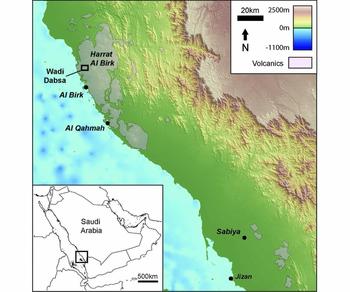
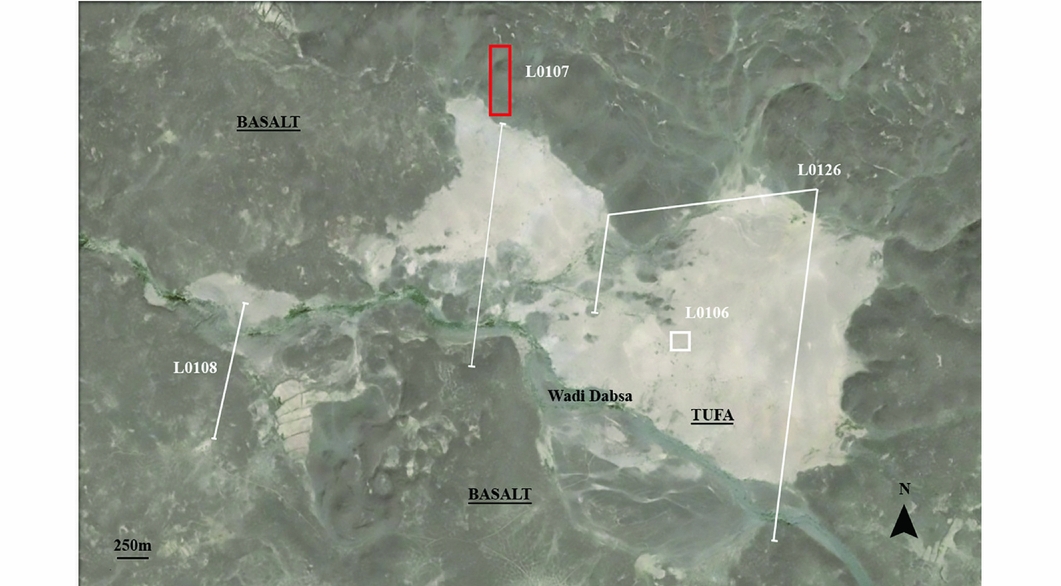
The Harrat Al Birk is an extensive series of basaltic flows that extend along the present-day coastline for approximately 100km, and stretch inland for around 30km, where they meet the basement rocks of the foothills of the Western Arabian Escarpment (Dabbagh et al. Reference Dabbagh, Emmerman, Hötzl, Jado, Lippolt, Kollman, Moser, Rauert, Zötl, Jado and Zötl1984; Prinz Reference Prinz1984). Wadi Dabsa, at present a seasonally flowing watercourse running for approximately 7km to the sea, drains the western edge of the Harrat (Figures 1 & 2). In its upper reaches, the wadi flows through a small basin within the basalt, the base of which has been almost completely covered by tufa deposition, around 1km2 in total. The tufa was deposited during a past period of consistent flow of carbonate-rich water, possibly fed by a number of small tributaries draining the surrounding slopes, and forming a series of dams and pools (Inglis et al. Reference Inglis, Foulds, Shuttleworth, Alsharekh, Al Ghamdi, Sinclair and Bailey2015). The tufa formation suggests perennial water flow, and, given the limited catchment of the basin, may be linked to past spring activity, rather than runoff. Regardless of the source, the presence of large volumes of water would have made the locality particularly attractive to hominins in the past—something that is evidenced by the extraordinary accumulation of archaeological material recovered during survey of the area.
Location of Wadi Dabsa on the south-western coastline of the Arabian Peninsula.

Wadi Dabsa and associated geology and archaeological transects. L0107 (red highlight) indicates the location where the large handaxe was found.

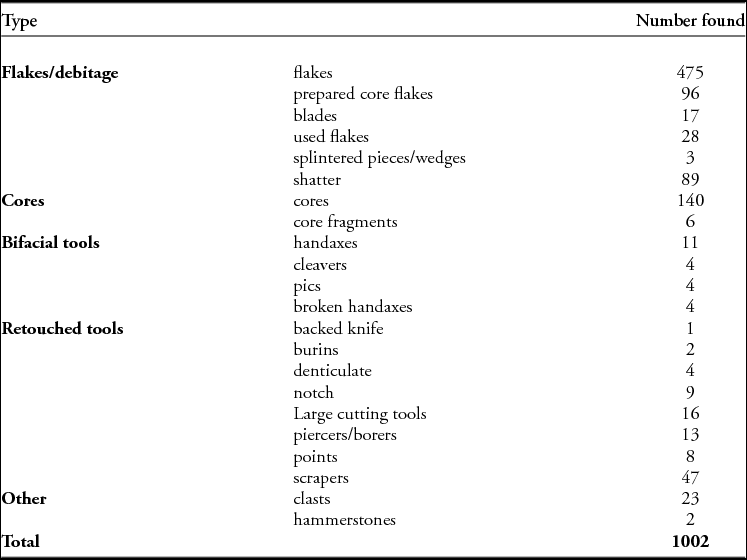
Survey of the basin resulted in the surface collection of artefacts along a number of transects across the tufa and surrounding basalt. Intensive survey using 5 × 5m grid squares was also carried out at site L0106, where a dense lithic scatter was discovered extending over about 100m2 of the tufa surface, near to an area where the basalt outcrops through the tufa. Over 900 artefacts were collected from the survey area across a 40 × 50m area, which represents approximately a quarter of the total extent of this scatter. In total, 1002 lithic artefacts were recovered from within the Wadi Dabsa basin, including the surrounding basalt outcrops and the tufa. These display predominantly Early Stone Age/Lower Palaeolithic and Middle Stone Age/Middle Palaeolithic affinities, although several Later Stone Age artefacts produced exclusively from quartz were also found along the southern edge. The assemblage primarily consists of flake debitage, but also includes a large number of cores and several retouched tools (Table 1). Wadi Dabsa is the most artefact-rich location found thus far. Here we provide an initial analysis of the Acheulean material and its importance for elucidating early hominin landscape use within the Arabian Peninsula.
Distribution of artefact types within the Wadi Dabsa assemblage.

The Acheulean assemblage of Wadi Dabsa
A number of cores and retouched tools within the assemblage are typical of the Acheulean, including discoidal and simple flake cores with episodes of parallel working, as well as bifaces and large cutting tools. Nineteen of the artefacts can be classified as handaxes, cleavers or fragments thereof. Most of these tools were produced on large flakes, sourced either by deliberate flaking from large cores, or by selection of local, naturally produced exfoliation flakes. This method of production shares close similarities to other Acheulean sites within the Arabian Peninsula (Petraglia et al. Reference Petraglia, Drake, Alsharekh, Petraglia and Rose2009; Shipton et al. Reference Shipton, Parton, Breeze, Jennings, Groucutt, White, Drake, Crassard, Alsharekh and Petraglia2014), although the majority of the tools illustrate an intense focus on reduction of the tip, rather than the butt. High-quality basalts—almost certainly sourced from the surrounding lava fields—appear to be the predominant raw material of choice, with andesite used in much lower quantities. The local basalt from the lava fields, however, appears to vary in its porosity and density, with finer-grained materials to the north, and poorer-quality material along the southern edge (Inglis et al. Reference Inglis, Foulds, Shuttleworth, Alsharekh, Al Ghamdi, Sinclair and Bailey2015). The predominance of higher-quality raw materials within the assemblage, therefore, appears to indicate that the hominins present at the site carefully selected the better materials available.
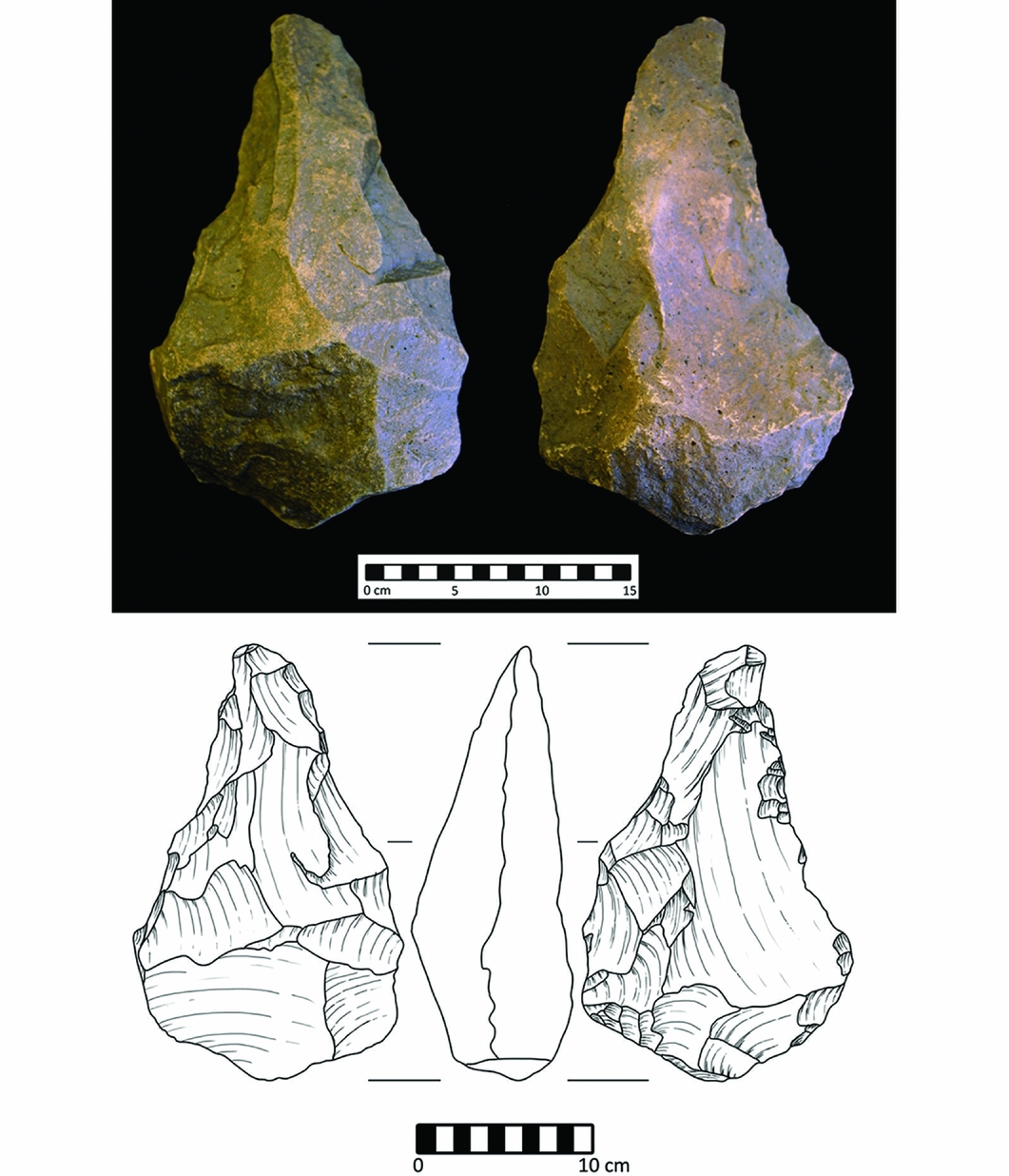
Within the assemblage, however, a single large bifacially worked tool stands out as anomalous (Figure 3). This was recovered during surface collection along a 250m transect at L0107, stretching from the north-western edge of the tufa to the top of a basalt jebel that overlooks the basin and wadi. It is 265mm long, weighs 3598g and was produced from either a very large basalt flake or, more probably, a natural exfoliation flake. On the basis of its size, it was originally interpreted as a large, abandoned roughout or core. Its appearance shares affinities with Victoria West cores and with examples of cores developed on bifacial tools, albeit of a much larger size (DeBono & Goren-Inbar Reference DeBono and Goren-Inbar2001; Sharon & Beaumont Reference Sharon, Beaumont, Goren-Inbar and Sharon2006; Sharon Reference Sharon2007, Reference Sharon2009). Limited preparation of the ventral surface and a lack of any additional examples from the site, however, preclude this interpretation. Furthermore, the large scar on the ventral surface appears to be a natural exfoliation surface, rather than an intentional removal. Evidence of bifacial retouch on the upper two-thirds using a heavy, hard hammer, and extensive working of the tip, probably using a smaller hard hammer, indicate the imposition of a working edge. This suggests that the artefact should be considered a finished tool, as opposed to an abandoned roughout, especially given that the pattern of reduction is closely comparable to similar examples of tip preparation seen on other bifaces recovered from the site.
Top) photograph of the large handaxe from Wadi Dabsa; bottom) illustration of the handaxe, including profile view. Photograph by A. Shuttleworth; illustration by F. Foulds.

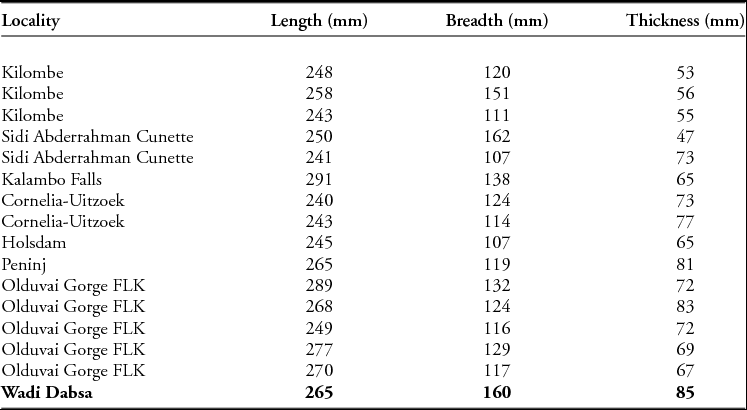
Metrical analysis of large cutting tools (e.g. Sharon Reference Sharon2007) indicates that the large biface from Wadi Dabsa is well above average in terms of its size, even if it is not the largest currently known. A number of bifaces measuring at least 250mm have been found in both Europe and Africa, most notably those from Cuxton, Olorgesailie, Olduvai Gorge (site FLK), Isimila and the Furze Platt giant, all of which provide examples surpassing 300mm (Issac Reference Isaac1977: 134; MacRae Reference MacRae1987; Roe Reference Roe, Leakey and Roe1994: 207; Wenban-Smith Reference Wenban-Smith2004; Cole et al. Reference Cole, McNabb, Bushozi, Bates, Kwekason, Nash and Toms2016). A comparison of the Wadi Dabsa handaxe with several of these known large handaxes (Table 2) demonstrates that this new example fits well within the range of these previously collected artefacts, although it is generally broader and thicker than most. While the size of the large handaxe from Wadi Dabsa is comparable to others, it is rare that such tools approach weights of 3000g or more, with only a few known examples from Africa (Kelley Reference Kelley1959; Sharon Reference Sharon2007; Petraglia & Shipton Reference Petraglia and Shipton2008). The excessive weight of the example from Wadi Dabsa would certainly have made it difficult to wield in the hand, begging the question of how and for what purpose this tool may have been used.
A comparison of the large handaxe with other known handaxes of length greater than 240mm. Data based on Leakey and Roe (Reference Leakey and Roe1994) and Gowlett (Reference Gowlett2013).

Discussion
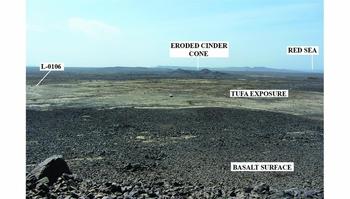
In the context of the wider Acheulean occupation of the Arabian Peninsula, Wadi Dabsa is comparable to sites such as Wadi Fatima and Dawādmi to the north, and those recently discovered in the Nefud Desert (Petraglia et al. Reference Petraglia, Drake, Alsharekh, Petraglia and Rose2009; Shipton et al. Reference Shipton, Parton, Breeze, Jennings, Groucutt, White, Drake, Crassard, Alsharekh and Petraglia2014; Jennings et al. Reference Jennings, Shipton, Breeze, Cuthbertson, Antonio Bernal, Oshan Wedage, Drake, White, Groucutt, Parton, Clark-Balzan, Stimpson, al Omari, Alsharekh and Petraglia2015). It can also be added to the wider evidence for the Acheulean occupation of the Red Sea region produced by the DISPERSE Project and previous studies (Zarins et al. Reference Zarins, Whalen, Ibrahim, Morad and Khan1980, Reference Zarins, Murad and Al-Yaish1981; Inglis et al. Reference Inglis, Sinclair, Shuttleworth and Alsharekh2013, Reference Inglis, Sinclair, Shuttleworth, Hausmann, Al Maamary, Budd, Meredith-Williams, Alsharekh, Al Ghamdi and Bailey2014a & b, Reference Inglis, Foulds, Shuttleworth, Alsharekh, Al Ghamdi, Sinclair and Bailey2015). The location of Wadi Dabsa at the confluence of several tributaries and the potential presence of a larger body of water conform to the expectation that Acheulean sites are associated with water sources (Potts et al. Reference Potts, Behrensmeyer and Ditchfield1999; Shipton Reference Shipton2011). This is unsurprising, given that hominin ranges would have been constrained by access to fresh water (Hardaker Reference Hardaker2011). The surrounding basalt jebels would have provided expansive views of the surrounding landscape extending as far as the Red Sea coastline (Figure 4), which are equivalent to viewsheds reported for Wadi Fatima and Dawādmi (Petraglia et al. Reference Petraglia, Drake, Alsharekh, Petraglia and Rose2009).
View from the top of a basalt jebel at the northern extent of L0107, looking south over the basalt surface and tufa exposure. Adapted from Inglis et al. (Reference Inglis, Foulds, Shuttleworth, Alsharekh, Al Ghamdi, Sinclair and Bailey2015). Photograph by R. Inglis.

The presence of large cutting tools (such as handaxes) produced on large flakes also conforms to descriptions of other Acheulean assemblages within Arabia. Although these cutting tools were produced using the abundant local raw materials, Wadi Dabsa displays clear evidence for the preferential selection of good-quality stone—specifically basalt clasts sourced to the north of the basin, which display a more cohesive cryptocrystalline structure compared to that available along the southern edge. This provides some evidence that the local hominins had a clear appreciation of the variability in the conchoidal fracture properties of the lithic materials available to them. The presence of a Large Flake Acheulean at Wadi Dabsa, which is close to other Near and Middle Eastern sites that have been linked to similar knapping strategies seen at, for example, Gesher Benot Ya'aqov, suggests that these represent a new wave of Acheulean-using hominins dispersing from Africa (Martínez-Navaro & Rabinovich Reference Martínez-Navarro and Rabinovich2011). If this is the case, then Wadi Dabsa could expand this hypothesis to include the Arabian Peninsula.
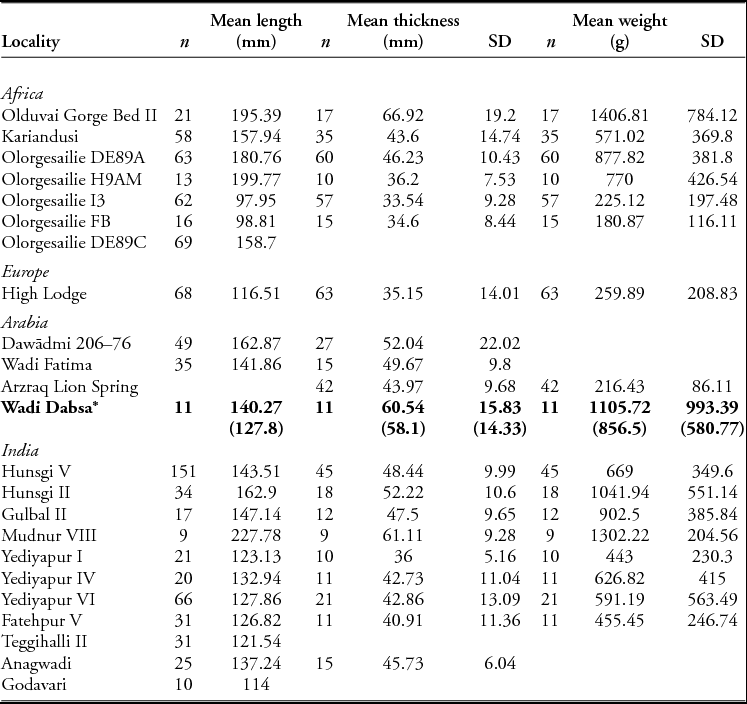
The size and weight of the Wadi Dabsa handaxes fall within the range of variation generally recorded for the Acheulean (Table 3). In terms of shape, however, the handaxes found at Wadi Dabsa, including the large handaxe described above, show clear and repeated focus on reduction and finishing of the tip, leaving the butt minimally worked. This suggests an active selection of a particular handaxe form. Variability in biface shape has long been a central topic within Lower Palaeolithic research. It has been suggested that variation in the shape of bifaces can often be explained by the need to establish and preserve a sharp cutting edge (Lycett Reference Lycett2008). A suite of factors, however, continues to be acknowledged as influencing handaxe shape, including raw material selection, social pressures and the individual (e.g. Ashton & McNabb Reference Ashton, McNabb, Ashton and David1994; Callow Reference Callow, Leakey and Roe1994; Gamble Reference Gamble, Ashton, Healey and Pettitt1997; White Reference White1998; Kohn & Mithen Reference Kohn and Mithen1999; Spikins Reference Spikins2012; Foulds Reference Foulds, Foulds, Drinkall, Perri, Clinnick and Walker2014). Among the bifaces from Wadi Dabsa, as well as the lithic artefacts from other sites examined as part of the DISPERSE Project, an emphasis on the creation of a good working edge is notable. It remains to be seen whether this was due to functional requirements, raw material affordance or the cultural transmission of specific methods of lithic manufacture in general.
A comparison of the mean length, thickness and weight of the Wadi Dabsa handaxes, with examples from Europe, Africa, India and the Arabian Peninsula. (* Figures in brackets provide the average and standard deviations for the Wadi Dabsa assemblage following removal of the large handaxe.) Data based on Petraglia et al. (Reference Petraglia, Drake, Alsharekh, Petraglia and Rose2009) and Shipton et al. (Reference Shipton, Parton, Breeze, Jennings, Groucutt, White, Drake, Crassard, Alsharekh and Petraglia2014).

The large handaxe presented here currently represents a unique find within the Arabian Peninsula, and is the largest handaxe from this region currently known to the authors. It falls within the range of variation seen amongst other examples of overly large tools, despite its excessive weight. The occurrence of only a single large biface at Wadi Dabsa, however, is more in keeping with the context in which such bifaces have been discovered in Europe, where they are generally found as single occurrences. That large handaxes are generally found in isolation, however, may present a false indication of their individuality. It is clear from African sites, where such large tools are found in assemblages (e.g. at Olduvai and Isimila—Roe Reference Roe, Leakey and Roe1994; Cole et al. Reference Cole, McNabb, Bushozi, Bates, Kwekason, Nash and Toms2016), that multiple, similar examples can occur. This may also be the case at Cuxton, where at least four handaxes over 200mm in length were recovered by Tester (Shaw & White Reference Shaw and White2003; Cole Reference Cole2011), complementing the two large bifaces found during excavation by Wenban-Smith (Reference Wenban-Smith2004).
The key question regarding the large handaxe is why it was produced. Several functional explanations have been posited on the phenomenon of large bifaces, including their role as digging tools, as expressions of knapping skill and as artefacts incorporated into some form of social display (Wymer Reference Wymer1968: 225, Reference Wymer1982: 103; Kohn & Mithen Reference Kohn and Mithen1999). None of these theories has been convincingly proven. The large handaxe from Wadi Dabsa does not appear to represent the work of a highly skilled knapper wishing to demonstrate the extent of their abilities, whereas those used to support this hypothesis tend to be exquisitely worked (Wenban-Smith Reference Wenban-Smith2004). Prime examples are the biface from Furze Platt and the ficron and cleaver from Cuxton, which exhibit careful and controlled knapping to create a relatively well-thinned and symmetrical edge.
The excessive size and weight of the Wadi Dabsa biface leads us to believe that it was too large and unwieldy to be used in the hand—an observation that has been made of similar large tools (Wymer Reference Wymer1968, Reference Wymer1982; Roe Reference Roe1981). Furthermore, it is unlikely that the maker intended to carry it from site to site. This suggests that either its use as a hand-held butchery tool, as is often proposed for handaxes, was unlikely, or alternatively, that our impressions of size and weight are significantly different to those of the hominins who made them (Wenban-Smith Reference Wenban-Smith2004). Conversely, it might be a large, bifacial core. As discussed above, however, the lack of additional examples and limited preparation appear to preclude this hypothesis. Despite the lack of extensive reduction used to form its overall shape, it seems reasonable to suggest that this large handaxe was made for a clear utilitarian purpose. This is supported by the fact that it conforms closely to other handaxes within the assemblage, most notably in the increased reduction intensity around the tip to create a cutting edge. It may perhaps have been employed as a static tool, with hominins resting the handaxe on the ground, secured between an individual's legs, and resources brought down on the tip for processing. In this way it could have been used to process faunal remains to access meat and marrow. Sites such as Isimila, Elandsfontein and Doornlaagte have provided examples of similar tools that were found on their edges when excavated, as if pressed into the ground (Wymer Reference Wymer1982: 103). While this is certainly plausible for the Wadi Dabsa handaxe, its recovery as part of an unstratified surface collection find from within the basalt fields means that this possibility cannot be substantiated. Microwear analysis of the tip will be required to determine whether it was used for a specific material or in a particular fashion.
Conclusion
Wadi Dabsa presents a highly concentrated area of Acheulean activity within the Arabian Peninsula. It provided a wide range of resources, including raw materials for tool production and a fresh water source that would have attracted animals suitable for hunting. These resources were essential for hominin dispersal from the Red Sea shoreline and deeper into the Arabian Peninsula. The site is made more extraordinary by the large quantity of artefacts recovered, suggesting either the repeated or intensive use of this locality. The large handaxe adds to the complexity and difficulty of interpreting this newly discovered site, as well as representing a significant addition to the known catalogue of these enigmatic bifacial tools. While it is geographically unique, being the only example currently known from within the Arabian Peninsula, its unusually excessive weight highlights its unique nature in comparison to similar overly large tools. The use of such large bifaces is still a mystery, and it is hoped that the Wadi Dabsa specimen can contribute to this debate, as well as furthering discussion regarding their dispersal throughout the Acheulean world.
Acknowledgements
We thank HRH Prince Sultan bin Salman bin Abdul Aziz, President of the Saudi Commission for Tourism and National Heritage (SCTH), Kingdom of Saudi Arabia; Ali Al-Ghabban, Vice-President; and Abdullah Al Saud, Director General, for granting fieldwork permission, as well as their interest in, and support of, our work in Saudi Arabia. Grateful thanks are also extended to Abdullah Al Zahrani, SCTH Riyadh, Saeed Al Karni, Director of Antiquities in Asir, and Haider Al Mudeer, as well as to the staff of the SCTH offices in Abha and Sabiya.
The January 2015 fieldwork was carried out as part of the DISPERSE Project, funded by European Research Council Advanced Grant 269586, under the ‘Ideas’ Specific Programme of FP7 to Geoff Bailey and Geoffrey C.P. King. For generous additional funding for the fieldwork, we thank the Gerald Averay Wainwright Fund for Near Eastern Archaeology, University of Oxford, and the Department of Archaeology Research Fund, University of York. This is DISPERSE contribution number 37.