Despite being a dominant explanation for variation in judicial independence in democratic regimes, the “insurance” model of independence is in fact the subject of few comparative studies. While Ginsburg (Reference Ginsburg2003) and Llanos et al. (Reference Llanos2016) look at handfuls of new democracies in Asia, Africa, and Latin America, the only attempt at a broad comparison of the insurance model in the democratic world is Aydın’s (Reference Aydın2013) single cross-section of democracies in the 2000s.Footnote 1 Remaining the first and only examination of the insurance model across a wide number of democracies, Aydın’s work is important and influential; in fact, because its substantive findings accord with previous work arguing that competition’s effects on judicial independence are reversed in hybrid regimes (Popova Reference Popova2010; VonDoepp and Ellet Reference VonDoepp2011), it potentially both calls into question a significant amount of work on independence in emerging democracies and bridges existing research across regime type. The degree to which it questions existing work and bridges this divide, however, is dependent on the critical question of how one conceptualizes and measures democracy, as stretching the core concept of democracy beyond its limits raises significant barriers to understanding both regime type and many intersecting phenomena (Collier and Levitsky Reference Collier1997). In this essay, I argue that the always important matter of conceptualizing democracy is in fact even more salient when assessing the relationship between political competition and judicial independence. To illustrate this empirically, I replicate the analysis in Aydın (Reference Aydın2013), demonstrating that the substantive implications of the sole cross-national analysis of the insurance model in democracies are highly contingent on how one conceptualizes democracy.
I. The Insurance Model(s)
Few readers are likely unfamiliar with the insurance model of judicial independence, for some time the “leading framework to investigate this issue” (VonDoepp and Ellet Reference VonDoepp2011, 148; see also Vanberg Reference Vanberg2015). Like other proposed explanations for judicial independence, the insurance model must address the puzzle of why political actors would ever want to create or maintain judiciaries able to check their powers. The insurance model focuses on how an independent judiciary’s potential benefits can outweigh its costs. Although an independent judiciary is costly, it is like an insurance policy in that it offers real benefits against some significant future risk: while (more) independent courts limit executive discretion, they also provide significant benefits, increasing the stability of policy overtime (Stephenson Reference Stephenson2003) and decreasing the costs of losing office (Epperly Reference Epperly2013).
Specifically, the insurance model is an electorally focused account of the development of independent judiciaries, looking at the calculations democratic executives make concerning the costs and benefits of independent judiciaries, conditional on the competitiveness of the electoral arena. According to the insurance framework, political leaders make cost-benefit analyses of the value of independent courts, weighing their medium- to long-term insurance benefits against their short-term ability to constrain leaders. The key factor influencing this analysis is the competitiveness of the political environment: in political environments characterized by low levels of electoral competition, when those in power expect to hold office well into the future, the potential benefits that independent courts offer to those out of office are outweighed by the potential costs they impose on policy making in the present. The predicted result is low(er) levels of judicial independence. Conversely, in highly competitive electoral environments in which those in power are not confident that their grip on elected office is secure into the future, the costs paid in the present are outweighed by the benefits that will accrue once out of power (Ginsburg Reference Ginsburg2003). The predicted result is higher levels of independence, as insurance against downside risk.
In an important contribution to the insurance framework, Aydın (Reference Aydın2013, 107) contends that this conventional insurance account of democratic judicial independence is incomplete, as “the impact of political competition on judicial independence changes across advanced and developing democracies.” Tracing this logic out with references to Pakistan and Ecuador, she contends that the cost-benefit analysis facing leaders differs in developing democracies, as the short-term benefits of a subservient judiciary are far greater. According to Aydın, the incentives facing leaders in new democracies are more akin to those theorized by Popova (Reference Popova2010) in competitive authoritarian regimes: lower public support for courts and less transparent executive-judicial relations means that leaders are unlikely to face punishment for undermining independence (see also Vanberg Reference Vanberg2005). This, coupled with shorter time horizons, induces leaders in new democracies to prefer dependent courts. Thus, Aydın hypothesizes a differential relationship between competition and independence: positive in stable, advanced democracies and negative in new, unconsolidated democracies. Aydın, following Popova, complicates our understanding of the insurance framework’s logic, namely, that the benefits of independent courts are not constant. Popova contends that their benefits are minimal in competitive authoritarian regimes; Aydın extends this logic to developing democracies. For both scholars, in effect the premium one must pay for insurance in the present (independent courts) is too large to warrant any potential gains one reaps later.
Thinking explicitly of the insurance-like aspects of the logic foregrounds the expected utility calculation fundamental to insurance accounts and further clarifies Aydın’s (Reference Aydın2013) key contribution. Although never formally defined or modeled, an expected utility calculation on the part of leaders is implicit in all existing work (Epperly Reference Epperly2017), whereby the utility of judicial independence is determined by expectations regarding the likelihood of losing office. This expected utility calculation consists of three factors relevant for leaders: the likelihood of losing office in the future, the magnitude of risks being insured against, and the costs of insurance. Previous work looks at only the first parameter, considering the electoral arena’s competitiveness as a clear indicator of the perceived likelihood of losing office. Aydın makes the point that we cannot consider the costs associated with paying insurance to be constant. She argues that in developing democracies the cost of insurance—independent courts—is simply too high.
Despite an important focus on the costs paid to buy the insurance policy of independent courts (namely, the inability to then utilize courts against challengers), like previous work, Aydın’s does not consider that the magnitude of risk might also vary, implicitly holding it constant across consolidated and developing democracies. Returning to the insurance analogy is instructive: just as the cost of flood insurance varies across different property owners, so does the magnitude of risk being insured against. Recognizing this is vital for our understanding of the insurance model across varieties of democratic (and nondemocratic) regimes, because just as the price of the premiums that leaders must pay for insurance can vary across regime type, so too can the risks associated with losing power. It is for this reason that careful conceptualization of democracy, while always important, is particularly vital in insurance accounts of judicial independence.
II. Conceptualizing Democracy
A careful consideration of democracy, focusing on the importance of clearly conceptualizing the phenomenon, is particularly critical for empirical work employing insurance accounts of judicial independence for three reasons. Each relates to one of the three parameters of the expected utility calculation underpinning the insurance logic, and each is important for both comparisons across levels of democracy (Aydın Reference Aydın2013) and across democracy/dictatorship (Popova Reference Popova2010).
The first of these is the half of the calculation considered in previous research utilizing the insurance model: the likelihood of losing power as a result of electoral loss. Recall that this is fundamental to insurance accounts, as it is precisely because those in power perceive they might lose elections in the short to medium term that they pay the insurance premium of more independent judiciaries. If the nature of electoral competition is different in consolidated and emerging democracies, as Aydın (Reference Aydın2013) contends, then one is forced to consider that the effects of such competition might vary. This is also true across democratic and autocratic regimes with similar levels of electoral competition, where elections are of a different character in autocratic regimes: neither free nor fair, with results manipulated by fraud, the strategic use of “administrative resources,” and other problems (Schedler Reference Schedler2002). Indeed, the different nature of the electoral arena is one of the fundamental reasons we ought avoid the “conceptual stretching” that occurs when, like Aydın, one considers “democracies with adjectives” as democratic regimes (Collier and Levitsky Reference Collier1997).
The second parameter of insurance accounts directly affected by conceptualizations of democracy and regime type is Aydın’s (Reference Aydın2013) recognition that the costs of insurance might vary across democracies. Like Popova (Reference Popova2010) on competitive authoritarian regimes, Aydın makes an important contribution, recognizing a previously ignored component fundamental to the framework’s logic. It also highlights why clearly conceptualizing democracy is critical when employing insurance accounts: the costs of insurance directly affect leaders’ expected utility calculations regarding the attractiveness of independent judiciaries. Both scholars contend that costs vary according to democratic characteristics, meaning that clearly conceptualizing democracy is crucial, as the more that different democracies (or autocracies) change the costs (or benefits) associated with independent courts, the more the logic of the framework shifts across regime context. Therefore, how we conceptualize regimes—be it within or across democracies or dictatorships—becomes vital not only to how we think about insurance accounts but also to making correct inferences from empirical models.Footnote 2
The third parameter is the magnitude of risk insured against. As noted, existing accounts looking solely at democratic regimes consider this magnitude constant across democracies; this is true even of Aydın’s (Reference Aydın2013) work theorizing differential costs. This is problematic because the risks associated with losing office (such as being targeted by politicized prosecution, imprisoned, exiled, or killed) are far from constant across consolidated and developing democracies or across democratic and competitive authoritarian regimes. Indeed, this becomes clear if focusing on Aydın’s conceptualization of developing democracies (those scoring poorly on civil liberties in Freedom House’s assessment). Similarly, competitive authoritarian regimes are widely regarded as ones in which leaders fear losing office (Thompson and Kuntz Reference Thompson2006), and leaders do so in no small part because outgoing incumbents commonly face greater risks than democrats (Levitsky and Way Reference Levitsky2010).
Theses differential risks are discernible in the Archigos data set, which includes whether individual leaders were punished after leaving office (Goemans, Gleditsch, and Chiozza Reference Goemans2009), that is, whether they were exiled, imprisoned, or killed by those replacing them as state leaders. Since 1960, only 5% of leaders in the most consolidated democracies (using Aydın’s measures) were punished in such ways after leaving office, while in developing democracies this rate was three times higher (for a discussion of the relationship between independence and posttenure fate, see Epperly [Reference Epperly2013]). Comparing democracies to electoral autocracies, differences are also stark: 34% of former leaders in the latter are punished after leaving office. If the downside risk of personal punishment after losing power is dissimilar in developing and consolidated democracies as well as in democracies and competitive authoritarian regimes, then proper and consistent conceptualization and measurement of democracy is vital and cannot be done solely by considering whether elections are present in a given state.
III. Replicating “Judicial Independence across Democratic Regimes”
Aydın (Reference Aydın2013) uses a variation of the most commonly used dichotomous democracy measure, introduced by Alvarez et al. (Reference Alvarez1996) and further developed by Cheibub, Gandhi, and Vreeland (Reference Cheibub2010). They consider regimes meeting four conditions as democratic: chief executives are elected (directly or indirectly), legislatures are popularly elected, multiple parties compete in elections, and alternation in power occurs. This fourth criterion is critical, as it is the sole factor delineating hegemonic, electoral, and competitive authoritarian regimes (Schedler Reference Schedler2002; Levitsky and Way Reference Levitsky2010) from democracies (Boix, Miller, and Rosato Reference Boix2013). The logic is that we can only know whether a given regime is democratic after power is relinquished owing to electoral loss. After alternation occurs, one can then trace the democratic character of the regime backward to where the incumbent party obtained power according to the rules by which they relinquished it.
Recognizing that lawful transitions are fundamental to democracy, consolidated or otherwise, Cheibub et al. (Reference Cheibub2010) also recognize the observational equivalence between (1) popular incumbent parties ceaselessly winning elections for long periods after democratization—for instance, Sweden from 1936 to 1976 or Botswana today—and (2) competitive authoritarian regimes, where elections occur but it remains unclear whether incumbents would relinquish power were they to lose. Wary of false positives, Cheibub et al. classify these as nondemocracies. However, recognizing that this equivalence is an issue for regimes such as Botswana, they code regimes having the first three but not the fourth characteristic as nondemocratic but flag them with a type2 variable to indicate that excluding them from the population of democratic regimes represents potential type II errors (whereas inclusion could produce type I errors). Almost universally, those relying on this conceptualization of democracy consider type2 regimes as autocracies, as for 2 decades scholars have recognized that contested elections alone cannot determine whether a state is democratic: over half of the post–Cold War autocratic country-years have elections in which an opposition party competes but which remain mired in fraud, abuse of office, and disqualification of opponents (Roessler and Howard Reference Roessler2009).Footnote 3 And yet precisely this distinction remains critical for the only existing cross-national analysis of insurance in democracies, as Aydın’s (Reference Aydın2013) analysis is predicated on the first three but not the crucial fourth condition for democracy.
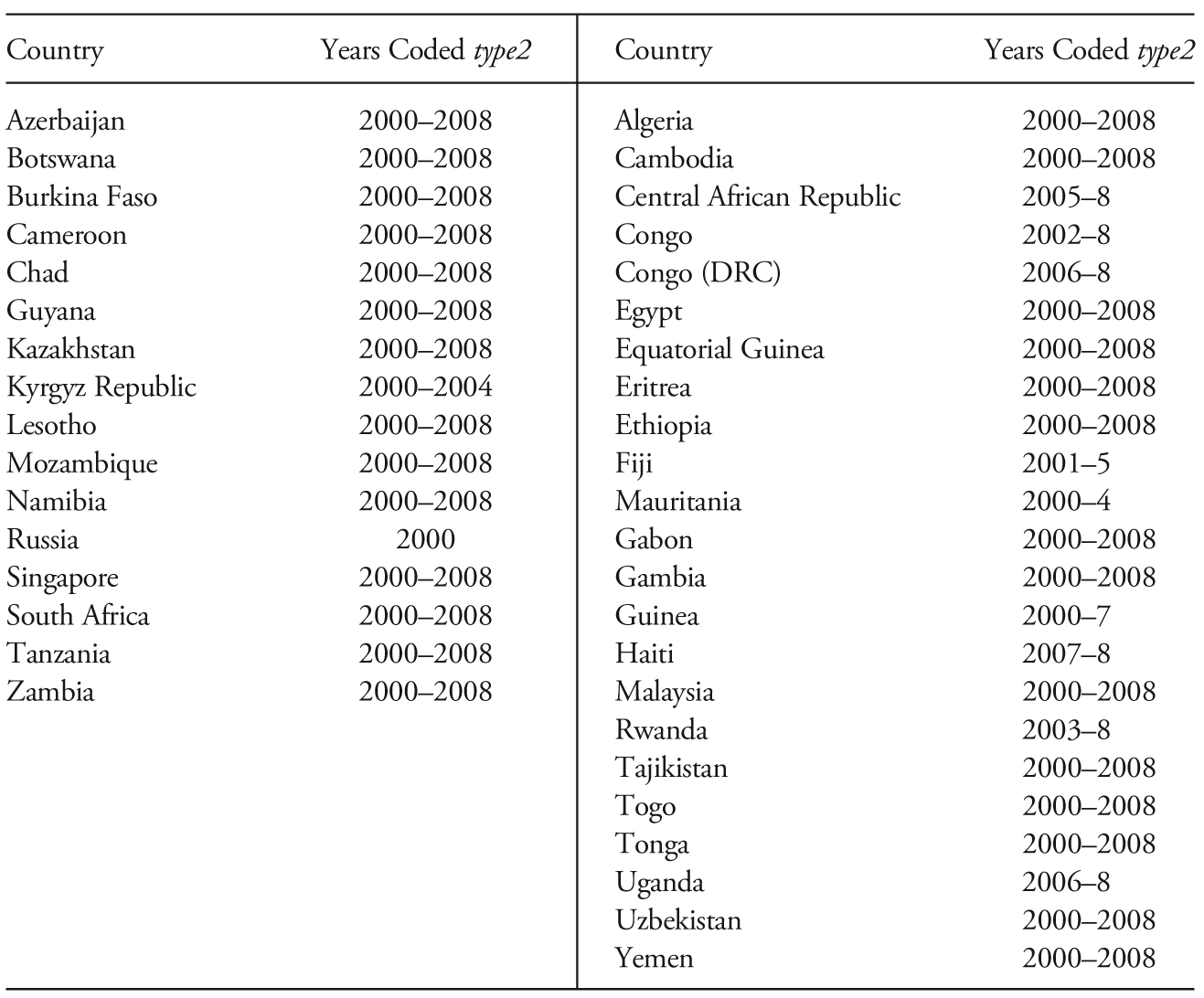
The fourth condition of alternation in power means potentially democratic regimes like Botswana remain coded as autocracies (until alternation later occurs and recoding is possible), so that regimes like Azerbaijan, Kazakhstan, and Russia are not erroneously considered democratic. Aydın (Reference Aydın2013), however, considers these three regimes, and 13 others, democracies for her analysis based on their being flagged with the type2 variable (pers. comm., May 22, 2017). This means that over 15% of her 97 observations are regimes not considered democracies by either the standard dichotomous operationalization of the term or most comparative politics scholars, as most of these states are archetypal examples of competitive authoritarian regimes. Aydın, in effect, makes the trade-off of including these regimes and risking type I errors so as to not risk type II errors. Practically, such a decision means one is more worried about excluding some subset of potentially democratic regimes than that their inclusion would bias results if they are outliers with regard to key covariates. Theoretically, the conflation of democratic and competitive authoritarian regimes presents a problem for properly conceptualizing democracy, vitally important for insurance accounts.
This conflation raises two potential problems. The first is the problem of conceptual stretching (Collier and Levitsky Reference Collier1997), specifically regarding mechanisms by which competition works differently in developing democracies. Implicitly, Aydın considers empirically whether competition works differently in competitive authoritarian and democratic regimes, while she theoretically focuses on new democratic regimes and the difficulties associated with democratic consolidation. The second is bias: if type2 regimes show systematic differences on key covariates, there is strong evidence to reject the assumption that they are comparable to developing democracies. Instead, it suggests—as comparative politics scholars contend (Schedler Reference Schedler2002; Levitsky and Way Reference Levitsky2010)—that these are fundamentally different regime types, questioning their inclusion in studies of democracy.
States flagged as type2 regimes are listed in table 1, with the left side noting the 16 type2 regimes included in Aydın (Reference Aydın2013). Given the wide geographic variation, table 1 allows readers to assess the face validity of classifying type2 regimes as democracies. The right side of table 1 illustrates an ancillary concern: conditional on classifying type2 regimes as democracies, Aydın fails to include nearly two dozen type2 regimes in her analysis, for reasons that remain unclear (pers. comm., May 23, 2017).Footnote 4 Notably, this includes Egypt, which, according to Aydın’s conceptualization of regime type, is a democracy. Egypt is also, however, the quintessential case study of how judicial politics operates in nondemocracies (Rosberg Reference Rosberg1995; Moustafa Reference Moustafa2007), to the point of being the foundation on which many seek to craft a generalizable account of the politics of courts in authoritarian regimes (Ginsburg and Moustafa Reference Ginsburg2008). Even though, empirically, it was excluded for indeterminate reasons, it remains highly worrying conceptually that the very country that most defines our understanding of nondemocratic judicial politics would be considered democratic in the only existing cross-national analysis of the insurance model in democracies.Footnote 5
States Coded as type2 Regimes for the 2000–2008 Period Analyzed by Aydın (Reference Aydın2013) in the Cheibub, Gandhi, and Vreeland (Reference Cheibub2010) Data Set

Note.—The left side shows type2 regimes included in Aydın; the right side shows type2 regimes omitted from her analysis.
To what degree do democracies and type2 regimes look different on the key covariates—electoral competition and development of democracy—that Aydın (Reference Aydın2013) analyzes? To measure competition in democracies, Aydın uses the difference between seats of the government and the largest opposition party, averaged over 2000–2008, subtracting from 1 to create a competition ratio in which 1 is maximally competitive. To assess democratic consolidation/development, she uses subcomponents of Freedom House scores, removing those directly captured by her key covariate and outcome. Thus, after removing the rule of law, electoral processes, political pluralism, and participation and functioning of government, she aggregates scores for freedom of expression and belief, associational and organizational rights, and personal autonomy and individual rights.Footnote 6
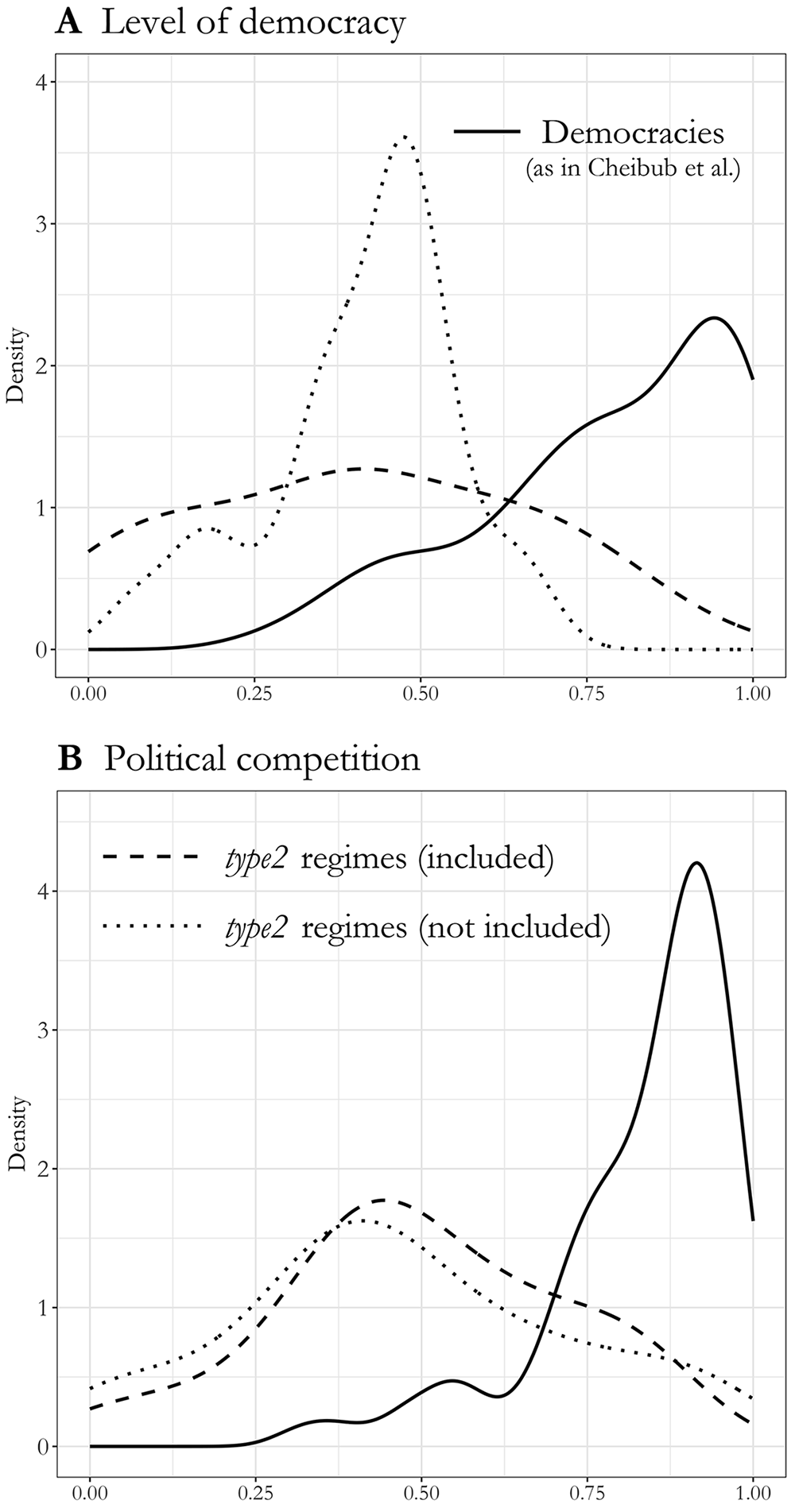
Figure 1 plots distributions of key covariates from Aydın (Reference Aydın2013), showing cases coded as democracies (solid lines) by Cheibub et al. (Reference Cheibub2010) as well as type2 regimes included and excluded from her analysis (dashed and dotted lines, respectively). Both figure 1A showing democratic consolidation and figure 1B showing competition suggest type2 regimes are highly dissimilar to those that standard practice considers democracies: mean values for included type2 regimes on democratic consolidation and competition are .40 (.41 for those not included) and .50 (.47 for those not included), respectively, contrasted to mean values for consolidation and competition in democracies of .78 and .83.
Level of democracy and political competition from Aydın (Reference Aydın2013). Solid lines, distributions for 81 cases following standard dichotomous coding. Dashed lines, the distribution for 16 type2 regimes included by Aydın. Dotted lines, the 23 type2 regimes omitted from her analysis.

This discussion of figure 1 and the visualizations in the figure demonstrate that classifying type2 regimes as “normal” democracies is problematic on both a theoretical (as many are archetypal competitive authoritarian regimes) as well as an empirical level (as key covariates appear drawn from different distributions). Notably, the many type2 regimes not included—the majority of which are classically considered autocracies—look far more similar to the included type2 regimes than those states classified by Cheibub et al. (Reference Cheibub2010) as democracies.Footnote 7 This leads to the question of how the empirical results from Aydın (Reference Aydın2013) hold up when employing a conventional measure of regime that does not consider such regimes democratic.
Aydın (Reference Aydın2013) averages a yearly subjective measure of judicial independence developed by the World Economic Forum’s Global Competitiveness Report for 2003–8. It asks experts the degree to which the judiciary “is independent from political influences of members of government, citizens or firms.” Unlike commonly used subjective measures (Ríos-Figueroa and Staton Reference Ríos-Figueroa2012), here the government’s undue influence is considered alongside other actors that would be unaffected by the insurance logic.Footnote 8
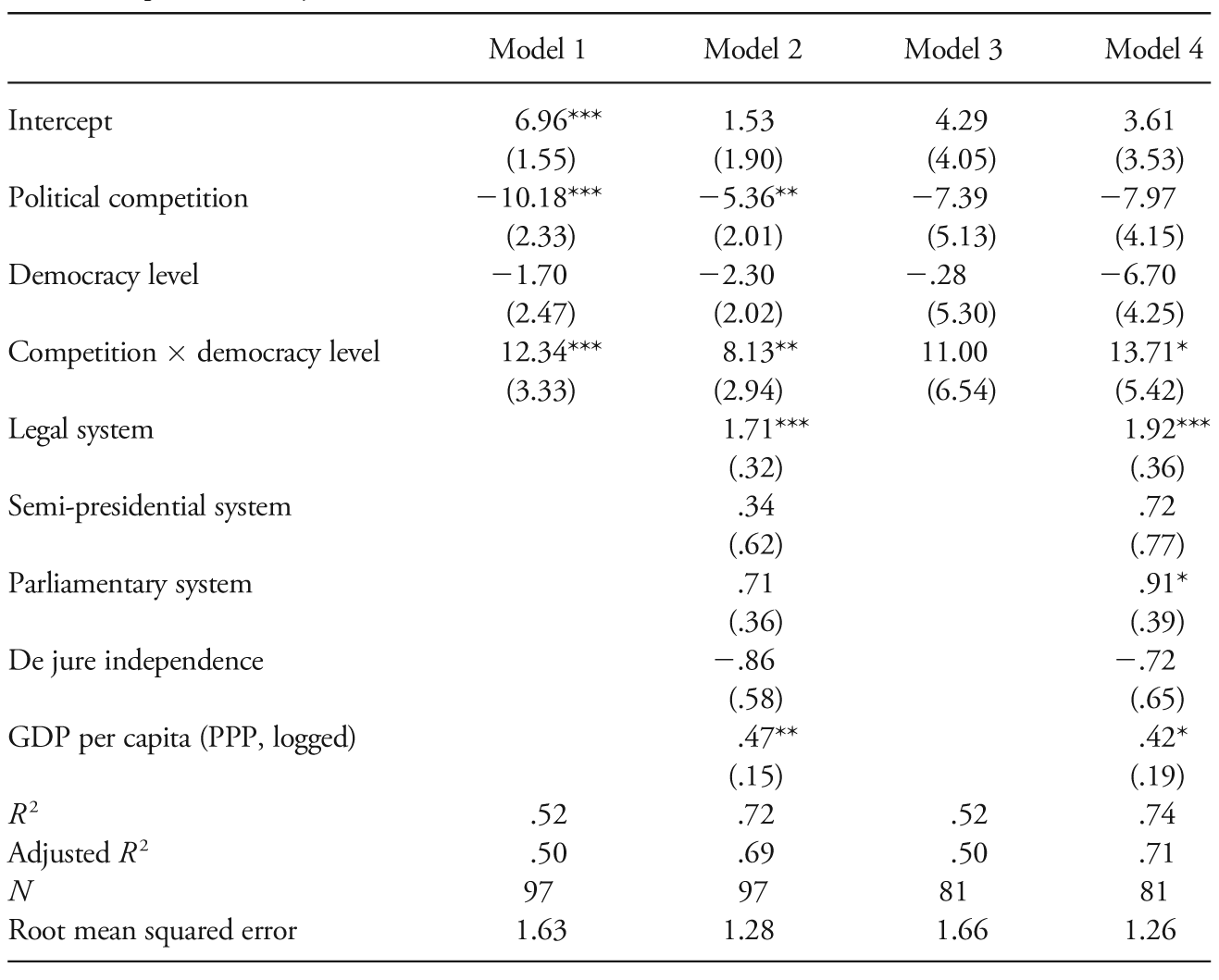
Table 2 both reproduces Aydın’s (Reference Aydın2013) results and fits models to data excluding the 16 type2 regimes from the analysis.Footnote 9 Recall that she finds higher levels of competition associated with more independence, but this effect is conditioned by democratic development. If her findings are not a function of including type2 regimes with divergent distributions of key covariates, one would expect similar results when omitting these observations, perhaps with some slight changes in levels of statistical significance due to having 15% fewer observations. Note, however, that in Aydın key covariates reach
 levels of significance, so there is no reason to expect dissimilar results if the remaining data fit the hypothesized data-generating process.
Replication of Aydın (Reference Aydın2013)

Note.—Models 1 and 2 replicate linear models presented in Aydın (Reference Aydın2013). Models 3 and 4 omit 16 type2 regimes. Standard errors in parentheses. PPP = Purchasing Power Parity.
*. p < .05.
**. p < .01.
***. p < .001.
Models 1 and 2 in table 2 replicate Aydın’s (Reference Aydın2013) two models, in which type2 regimes are classified as democracies; models 3 and 4 are fit only to observations coded as democracies according to Cheibub et al. (Reference Cheibub2010), that is, excluding type2 regimes from the population of democracies and instead classifying them as autocracies. While key covariates are highly significant in models 1 and 2, the ability to consistently estimate their effects disappears in models 3 and 4. Comparing terms in models 1 and 3, estimates significant at the
level of significance fail to reach more lenient
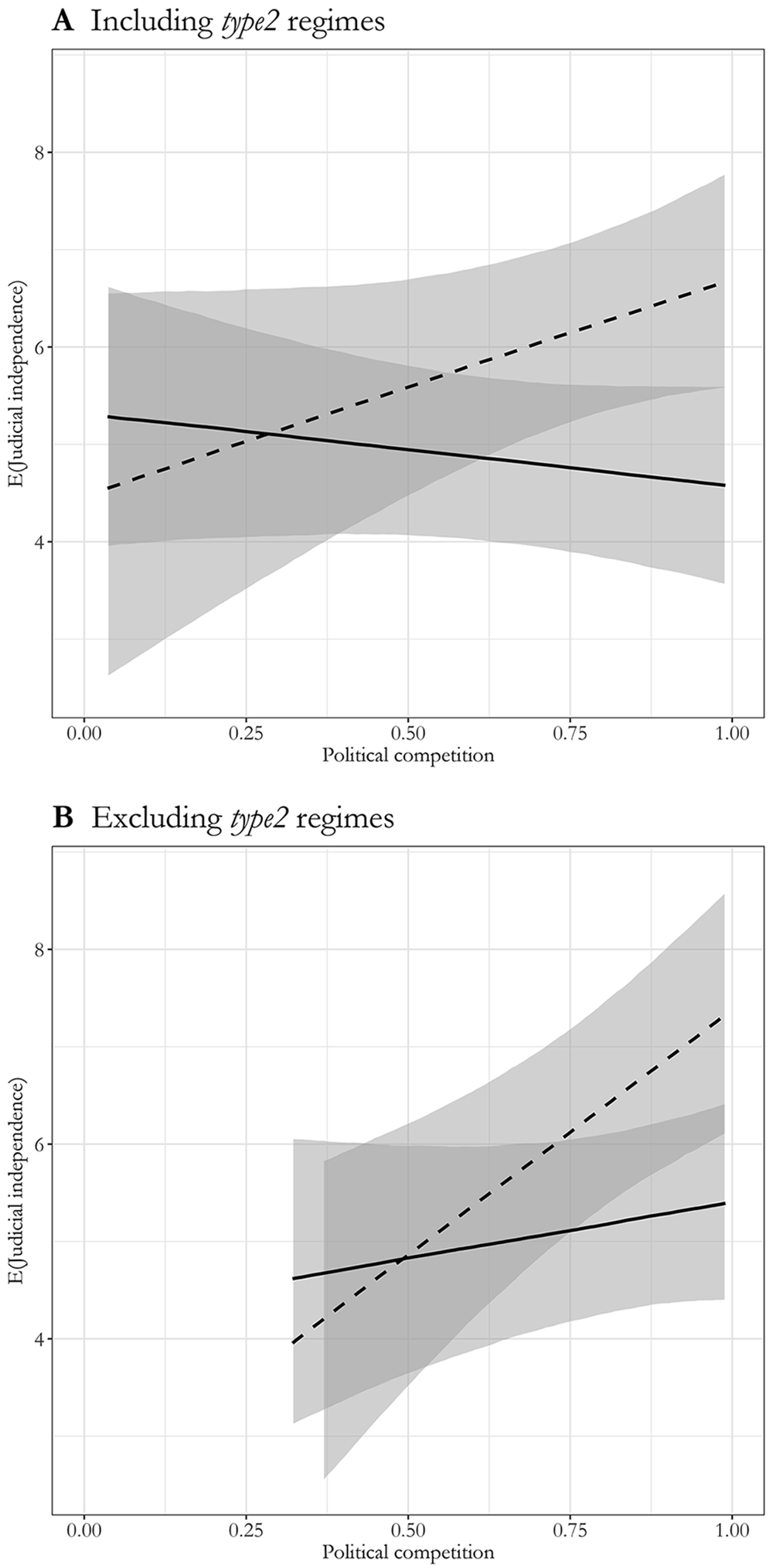
 levels, with the exception of the interaction term in model 4, suggesting that no longer does the relationship theorized and found by Aydın hold. Even in model 4, however, the negative effects of the constituent term for democracy level explode, meaning that any substantive effects of the interaction term are indeterminate (as the large value magnifies uncertainty around estimates), as shown in figure 2.
Expected values of independence from models 2 and 4. Competition varies from its observed minimum to maximum. Democracy is set to first (solid lines) and third (dashed lines) quartile values. Shaded gray areas are 95% confidence intervals.

Changes in the substantive, rather than statistical, significance of Aydın’s (Reference Aydın2013) results can be used to further assess how including type2 regimes affects conclusions. Each plot in figure 2 shows expected values of independence as competition varies from its observed minimum to maximum, interacted with lower (solid lines) and higher (dashed lines) levels of democracy; 95% confidence intervals are shaded gray. Figure 2A follows Aydın’s analysis in which type2 regimes are classified as democracies and shows expected values of independence from model 2; figure 2B shows expected values from model 4, which follows convention and excludes type2 regimes from the population of democratic states. In both, low levels of democracy are set to first quartile values, while high levels are set to third: these values are used rather than minimums and maximums to not focus on extreme cases, as figure 1 shows data are largely grouped at moderate to high levels of both, and data are very sparse to nonexistent at extreme low levels of both covariates. Figure 2B further illustrates this: after excluding type2 regimes, in no observations is competition less than .32.
Figure 2A largely corroborates Aydın’s analysis: at the first quartile level of democracy, competition is associated with slightly lower levels of independence (although considering uncertainty, this is unclear). The reverse is true when democracy is at the third quartile. Figure 2B , however, is further evidence that results are largely driven by classifying type2 regimes as democratic, as here the relationship in developing democracies is reversed: competition has a slight positive effect in developing democracies. However, after taking into account uncertainty around point estimates, in neither plot are there clear differences between low and high democracies, as confidence intervals always overlap, further questioning the theorized distinction between consolidated and developing democracies.
I engage with and examine Aydın (Reference Aydın2013) at length because the work is vitally important, advancing a theoretical conception of the insurance model counter to previous studies and still the only published research analyzing insurance across democracies. The evidence above, however, questions the conditional relationship Aydın advocates: after excluding the 15% of observations that are type2 regimes from her analysis of democratic states, her estimates go from being significant at the
level to not reaching even
levels of statistical significance. More importantly, substantive effects predicted by the model for developing democracies are indeterminate (with overlapping confidence intervals) at best and in fact reversed at worst.
This analysis questions but does not refute Aydın’s theoretical account: competition’s effects in emerging democracies remain undetermined. Furthermore, these results suggest that Aydın’s account looks far more akin to Popova’s (Reference Popova2010), as Popova argues the very electoral authoritarian regimes appearing to drive Aydın’s results are where we should expect competition to undermine judicial independence. This highlights that further research is necessary, research explicitly engaging important conceptual issues, not least how to conceptualize levels of democratic consolidation. This research ought to carefully theorize what attributes of democracy matter or, put differently, how democratic institutions matter. This requires attention to the specifics of democratic rule, closely linking what we consider conceptually vital about democracy with how to measure it.
IV. Implications
Despite being the conventional account of independence across democracies, the solitary cross-national examination is Aydın’s (Reference Aydın2013) contribution, important as the first systematic study of the insurance framework and because it forwards a conditional relationship that challenges insights from the qualitative research on insurance in emerging democracies (Ginsburg Reference Ginsburg2003).
Although the implications of this essay are empirical and conceptual rather than theoretical, they remain important. First, comparative law and courts scholars need to think more carefully about the theoretical implications of chosen measures. I show that how one conceptualizes democracy is especially vital when examining insurance. This is because the three parameters of the expected utility calculation at the heart of the insurance model are inextricably linked to regime characteristics: while all scholars recognize that the likelihood of losing office varies, following Popova (Reference Popova2010), Aydın (Reference Aydın2013) contends that the costs of independent courts vary. Unrecognized by either or existing accounts, however, is that the magnitude of risk being insured against also varies. If one considers any regime with contested elections as democratic, one is implicitly assuming this third parameter is identical, despite strong evidence to the contrary.
This ties into the second, empirical, implication: such assumptions drive the implications of our models and lead to conclusions heavily dependent on them. That the statistical significance of Aydın’s (Reference Aydın2013) findings disappears when these regimes are excluded suggests the possibility of different underlying data-generating processes across regime type. That substantive results are reversed when following conventional practice by classifying type2 regimes as autocracies further supports this possibility. Given that Aydın’s analysis remains the only cross-national work on competition in democracies, that these results are dependent on an idiosyncratic operationalization of democracy is important.
The third implication is both conceptual and empirical: scholars should remain skeptical of the purported relationship between competition and independence within and across regime type—within democracies because the results presented here suggest that our understanding is driven by how we conceptualize democracy, and across regime type because these results, along with the work of Popova (Reference Popova2010) and Epperly (Reference Epperly2017), suggest that while competition might matter in autocracies, how it might matter remains open. Despite being the dominant explanation for independence (VonDoepp and Ellet Reference VonDoepp2011; Vanberg Reference Vanberg2015), the insurance framework requires more, not less, analysis.