Eulecanium Cockerell (Hemiptera: Coccidae) comprises ~50 species and subspecies globally; most species in this genus are important economic pests that are distributed worldwide (Hamon and Williams Reference Hamon and Williams1984; Ben-Dov Reference Ben-Dov1993; Hodgson Reference Hodgson1994; Ben-Dov et al. Reference Ben-Dov, Miller and Gibson2010). They feed on the sap of plants and excrete a sticky substance (honeydew) that induces sooty mould growth (Tang Reference Tang1977; Xie et al. Reference Xie, Xue and Zheng2006). Due to great economic losses in fruit trees and woody ornamentals, Eulecanium species have been extensively studied for decades (Hamon and Williams Reference Hamon and Williams1984; Tang Reference Tang1991; Hodgson Reference Hodgson1994; Wang Reference Wang2000, Reference Wang2001; Li et al. Reference Li, Jia, Qiao, Li and Zhou2002; Zhang Reference Zhang2004; Xie et al. Reference Xie, Xue and Zheng2006). A high degree of morphological similarity is found among the different taxa of Eulecanium species (Hodgson Reference Hodgson1994; Ben-Dov and Hodgson Reference Ben-Dov and Hodgson1997), and preparation of slides is time-consuming, both of which make Eulecanium species difficult to identify. The taxonomic keys are based on the adult female stage; thus, the identification of nymphs is usually impossible, because of a general absence of taxonomic keys.
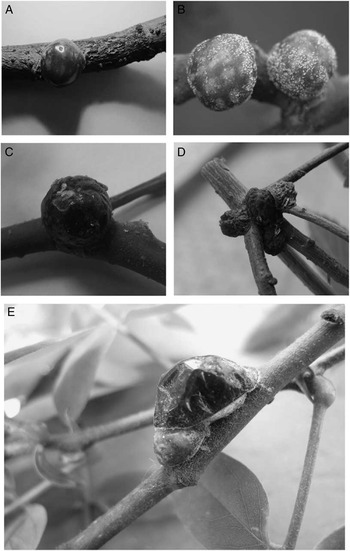
In China, E. giganteum Shinji and E. kuwanai Kanda, two morphologically similar species, are sympatrically distributed in the northern regions, and each is polyphagous on many of the same hosts (Fig. 1). Although E. giganteum was recorded in Morioka of Japan (Shinji Reference Shinji1935) and the Primorsky Krai of Russia (Borchsenius Reference Borchsenius1955; Danzig Reference Danzig1980), there have been no documented sightings in these regions in recent decades. In contrast, they have been found in the northern area of China (Tang Reference Tang1991; Wang Reference Wang2001; Xie et al. Reference Xie, Xue and Zheng2006). All have the same life history type of one generation per year. They overwinter as second instar nymphs on twigs. The crawlers emerge in early April and grow quickly. The second instar nymphs mature to mate in May, and the population size of newly hatched crawlers rapidly increases in June. From June to September, large numbers of crawlers feed on leaves and damage host plants; the second instar nymphs then return to the twigs for winter dormancy (Xie Reference Xie1998; Wang Reference Wang2000). For the reasons mentioned above, it is difficult to distinguish these two species, because they often appear together on the same host plants and even on the same twigs.
Different appearance of adult females of Eulecanium giganteum and Eulecanium kuwanai. (A) E. giganteum; (B) E. kuwanai; (C) dead individual of E. giganteum; (D) dead individual of E. kuwanai; (E) larger individual is E. giganteum smaller individual is E. kuwanai.

Owing to the serious damage they cause to garden trees, E. giganteum was listed in the catalogue of quarantine pests for plants imported to the People’s Republic of China in 2007. Although the size and colouration of the adult female body were important traits for delimiting these two morphologically similar species (Xie Reference Xie1998), these traits are not always stable. Variations in the shape, size, and colouration of the adult female body on different host plants have been observed in Eulecanium species (Ben-Dov and Hodgson Reference Ben-Dov and Hodgson1997). Tang (Reference Tang1991) recognised two distinct species, since dead individuals of E. kuwanai versus E. giganteum are wrinkled versus smooth. Moreover, sympatric occurrence and overlap of the host range render classification of the two taxa more difficult. Shi and Lü (Reference Shi and Lü1989) determined that E. giganteum and E. kuwanai are two different ecological types (wrinkled and smooth individuals) of the same species, with the different phenotypes resulting from varying population densities. The accurate identification of these two morphologically similar species, especially at immature stages, will require a new tool.
The barcode region of the cytochrome oxidase I (COI) gene is a proven, useful marker for effectively discriminating between closely related insects (Hebert et al. Reference Hebert, Penton, Burns, Janzen and Hallwachs2004a, Reference Hebert, Stoeckle, Zemlak and Francis2004b; Hajibabaei et al. Reference Hajibabaei, Janzen, Burns, Hallwachs and Hebert2006; Mikkelsen et al. Reference Mikkelsen, Schander and Willassen2007; Lee et al. Reference Lee, Kim, Lim, Choi, Kim and Kim2011). There are also some studies that have identified scale insects using the COI gene (Ball and Armstrong Reference Ball and Armstrong2007; Pieterse et al. Reference Pieterse, Muller and Jansen van Vuuren2010; Park et al. Reference Park, Suh, Hebert, Oh and Hong2011; Abd-Rabou et al. Reference Abd-Rabou, Shalaby, Germain, Ris, Kreiter and Malausa2012; Beltra et al. Reference Beltra, Soto and Malausa2012; Deng et al. Reference Deng, Yu, Zhang, Hu, Zhu and Wu2012; Sethusa et al. Reference Sethusa, Millar, Yessoufou, Jacobs, van der Bank and van der Bank2014). Thus, the barcode region of the COI gene was selected as a potential marker for delimiting these two species. The 28S gene was analysed to expand the amount of information available for species identification (Deng et al. Reference Deng, Yu, Zhang, Hu, Zhu and Wu2012; Sethusa et al. Reference Sethusa, Millar, Yessoufou, Jacobs, van der Bank and van der Bank2014).
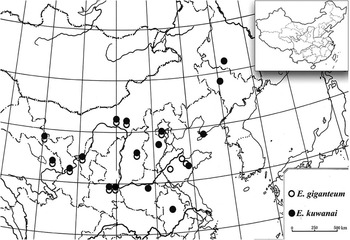
In this study, we collected E. giganteum and E. kuwanai individuals from 19 different locations in China (Fig. 2). COI and 28S rDNA sequences were obtained to classify these two morphologically similar species. One aim of this work was to determine whether morphological identification of E. giganteum and E. kuwanai based on dorsum morphology (wrinkled or smooth) during the post-reproductive stage is consistent with the results of molecular identification. The other goal was to confirm that molecular identification is effective for classifying crawlers and eggs. For describing in detail materials and methods, see Supplementary Appendix A.
Sampling sites in China. Detail sampling information is shown in Supplementary Appendix B.

A total of 192 COI sequences were obtained. The final length of the constructed COI sequence was 718 base pairs. The frequencies of adenine (A) and thymine (T) were high (A=41.8%, C=12.6%, G=6.8%, T=38.8%), and no insertions or deletions were observed. The intraspecific divergences of E. giganteum sequences were 0–0.98%, with a mean divergence of 0.32%. For E. kuwanai, the intraspecific divergence range was identical to that of E. giganteum, with 0.47% mean divergence. The interspecific divergence of COI sequences varied from 7.23% to 8.34%, with a mean value of 7.60%. A 28S amplicon was recovered from 192 individuals. The final alignment of the 28S sequence was 897 base pairs in length. The mean intraspecific divergence of E. kuwanai (0.038%) was greater than that of E. giganteum (0.00%), with an average interspecific variation of 1.30%.
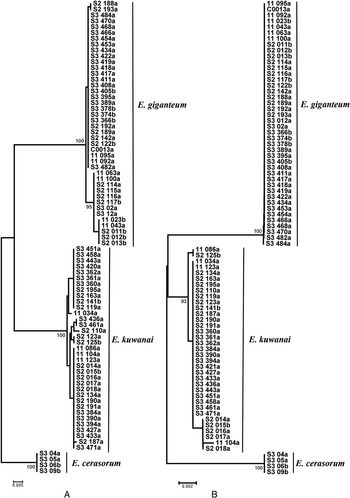
In the COI neighbour-joining tree (Fig. 3A), all individuals were split into two clusters with high bootstrap values (>90). One cluster was comprised of four haplotypes from 96 E. giganteum COI sequences, while the other included six haplotypes from 96 COI E. kuwanai sequences. The 28S neighbour-joining tree (Fig. 3B) was almost identical to that of the COI sequence, indicating that both E. kuwanai and E. giganteum were identified unambiguously. Based on all of the intraspecific pairwise distances, the cutoff values of COI (0.84%) and 28S (0.11%) were obtained using the TaxonDNA programme. The proportions of successful identifications using “best match” and “best close match” all reached 100% of the samples for COI and 28S genes. As predicted, all individuals identified by the habitus of post-reproductive females (wrinkled or smooth) were consistent with the molecular identification results (Supplementary Appendix B).
(A) COI and (B) 28S neighbour-joining trees of these two Eulecanium species, using Kimura-2-parameter distance. Bootstrap values for each haplogroup are calculated in MEGA4.0 with 1000 replicates and species are shown in the right column. Some identical sequences from same locations are removed in order to construct simplified trees.

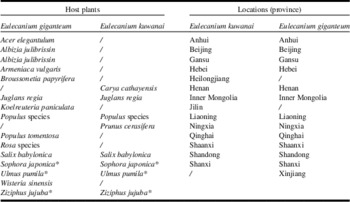
According to the information in Table 1, the distribution of these two species overlapped almost everywhere except for in three provinces (Heilongjiang, Jilin, and Xinjiang). The distribution limit of E. kuwanai was further north than that of E. giganteum, and E. giganteum individuals were observed in Heilongjiang and Jilin. In contrast, Xinjiang was not included within the western distribution range of E. kuwanai, even though there were many potential host plants, such as Sophora japonica Linnaeus (Fabaceae), Ulmus pumila Linnaeus (Ulmaceae), and Ziziphus jujube Miller (Rhamnaceae), in that area. Comparing host ranges, E. giganteum had a greater host range (15 species) than that of E. kuwanai (eight species). However, S. japonica, U. pumila, and Z. jujuba were the main host plants for both of these two species.
A comparison of locations in China and host plants of Eulecanium species.

/ The locations where E. giganteum or E. kuwanai are not recorded.
* Main host plants for these two species.
In this study, two morphologically similar species of Eulecanium were identified based on the mitochondrial COI gene and ribosomal 28S DNA sequences. In the COI sequence analysis, the interspecific divergence between these two closely related species was 7.60%, whereas intraspecific variation was very low (mean 0.39%). High interspecific variation and low intraspecific variation were also observed in other scale insects such as Ceroplastes Gray (Hemiptera: Coccidae) species (12.19% and 0.42%, respectively; Deng et al. Reference Deng, Yu, Zhang, Hu, Zhu and Wu2012) and armored scales and mealybugs (10.09% and 0.97%, respectively; Park et al. Reference Park, Suh, Hebert, Oh and Hong2011). A significant decrease in genetic variation from congeneric individuals to conspecific individuals indicated that a clear barcoding gap existed and could be used to differentiate these two species. In other genera, two closely related species were reported to differ by 2% in Planococcus Ferris (Hemiptera: Pseudococcidae) (Rung et al. Reference Rung, Scheffer, Evans and Miller2008) and 5% in Ceroplastes (Deng et al. Reference Deng, Yu, Zhang, Hu, Zhu and Wu2012), suggesting that the 7.60% interspecific divergence in COI between E. kuwanai and E. giganteum could be used to correctly classify them. According to the TaxonDNA results of the COI and 28S sequences, all individuals were identified correctly. Our results suggest that E. kuwanai and E. giganteum were identified successfully using molecular identification methods, and that they are not two different ecological types (wrinkled versus smooth individuals) of the same species. It is impractical to distinguish these two species based on the habitus of post-reproductive females, since species identification requires accurate and efficient methods for identifying organisms in various developmental stages. Molecular identification using the COI and 28S genes can be used to identify Eulecanium species correctly.
Eulecanium giganteum seriously threatens jujube production in Xinjiang, which is the main jujube production area of China and contained more than 300 000 ha of production area in 2012 (Li and Xu Reference Li and Xu2013). Although E. kuwanai has not been reported in Xinjiang so far, the possibility of E. kuwanai being introduced into Xinjiang still exists. Jujube is an important host plant for E. kuwanai. Sympatric occurrence of these two species were observed in other regions, excluding Heilongjiang, Jilin, and Xinjiang, indicating the ecological niche of E. kuwanai is similar to that of E. giganteum. It is necessary to provide a rapid and accurate diagnostic method to identify these two species for quarantine, to prevent further invasions into non-infested areas of China. Most specimens collected in the field are not suitable for slide mounting, because the typical teneral stage is rather short and followed by a general swelling of the body and a hardening of the dorsum (Hodgson Reference Hodgson1994). Molecular techniques provide an effective and rapid method to distinguish the immature individuals. Further studies that include specimens of E. giganteum and E. kuwanai from their type localities are needed to verify true conspecificity of the individuals used in this study.
Acknowledgements
This project was supported by the National Natural Science Foundation of China (31372151, 31272350) and the Fundamental Research Funds for the Central Universities (BLYJ201305). We are grateful to the following people who helped us to collect Eulecanium individuals: Xi-Na Xia (Shanghai Administrative and Directive Station for Afforestation, Shanghai, China) and Ying Wang and Xiu-Wei Liu (Northeast Forestry University, Harbin, China).
Supplementary material
To view supplementary material for this article, please visit http://dx.doi.org/10.4039/tce.2015.42