INTRODUCTION
Research suggests that young adults in North America listen to approximately 18.4 hours of music every week (Levey, Levey, & Fligar, Reference Levey, Levey and Fligor2011). In a survey of media use in 15 European Union member countries with participants who were at least 15 years old, 61.3% of the participants reported that they listened to music every day, while 40% of the correspondents claimed not to read any books (European Commission, 2002). Songs can provide large quantities of language input (Schwarz, Reference Schwarz2013). Although there is a wealth of research investigating vocabulary learning through reading (e.g., Horst, Reference Horst2005; Webb, Reference Webb2007; Webb & Chang, Reference Webb and Chang2015a), there is little research investigating vocabulary learning through listening to songs.
Studies focused on student self-reports and teacher experiences revealed several benefits of using songs as a source of second language (L2) input (Kerekes, Reference Kerekes, Nunan and Richards2015; Lems, Reference Lems2001; Richards, Reference Richards1969). For example, listening to songs is a pleasurable activity that can be motivating for learners (Richards, Reference Richards1969; Tegge, Reference Tegge2018). An international survey of language teachers’ use of songs in classrooms revealed that teachers often use songs to practice listening comprehension and introduce new vocabulary while creating an enjoyable environment for learning (Tegge, Reference Tegge2018). Use of songs has been shown to reduce foreign language classroom anxiety (FLCA) and facilitate language learning (Dolean, Reference Dolean2016). Abbott (Reference Abbott2002) suggests that the rhythmical characteristics of songs can also assist learner’s memory when learning a new language.
There have been several studies that have investigated learning vocabulary through listening to L2 songs (Coyle & Gracia, 2014; Milton, 2008; Tegge, Reference Tegge2015). These studies used a combination of deliberate preteaching of the target words with the help of actions and visual aids (Coyle & Gracia, 2014), or direct L1 translation of the target words (Milton, 2008; Tegge, Reference Tegge2015), while using songs as the medium for vocabulary instruction. Surprisingly, Medina (Reference Medina1993) is the only study to empirically investigate L2 incidental vocabulary learning from listening to songs in a controlled setting, without any deliberate attention or teaching of the target words. This study provided evidence that songs may potentially contribute to L2 vocabulary growth. However, the amount of vocabulary learning that occurred from listening to the song was not made clear and a children’s song rather than a popular song was used as the listening material. Popular songs have the potential to be a useful source of language input due to their repetitive and conversation-like characteristics (Murphey, Reference Murphey1992a). Moreover, they are likely listened to by a very large number of language learners from a wider range of ages.
The current study explores incidental vocabulary acquisition through listening to two pop songs and seeks to determine whether lexical knowledge is retained two weeks after exposure. Three aspects of vocabulary knowledge (spoken-form recognition, form-meaning connection, and collocation recognition) were measured to provide a rigorous assessment of the potential learning that may occur through listening to songs. In addition, because people tend to listen to the same song multiple times (Abbott, Reference Abbott2002; Kerekes, Reference Kerekes, Nunan and Richards2015; Lems, Reference Lems2001; Tegge, Reference Tegge2018), the effects of repeated listening to a single song on learning gains was also examined. Earlier research exploring repeated reading and repeated reading while listening (Horst & Meara, Reference Horst and Meara1999; Webb & Chang, Reference Webb and Chang2012a) found that repeated exposure to the same source of input can increase vocabulary learning. Finally, the relationship between the frequency of occurrence of the target items in the songs and vocabulary gains was examined. Earlier studies of incidental vocabulary learning have indicated that frequency of occurrence contributes to incidental vocabulary learning from other sources of input including reading texts (Webb, Reference Webb2007) and listening to passages (Van Zeeland & Schmitt, Reference Van Zeeland and Schmitt2013b).
BACKGROUND
INCIDENTAL VOCABULARY LEARNING
Incidental vocabulary acquisition involves learning words as the by-product of an activity that is not deliberately designed for that purpose (Gass, Reference Gass1999; Hulstijn, Reference Hulstijn and Robinson2001; Loewen, Reference Loewen2015). Researchers believe that it is responsible for most first language (L1) vocabulary growth (Nation, Reference Nation2001; Webb & Nation, Reference Webb and Nation2017). However, when learning a second language (L2) in non-English-speaking communities where individuals are not naturally exposed to large quantities of L2 input, deliberate teaching and learning of the L2 may be responsible for the majority of L2 vocabulary learning (Laufer, Reference Laufer2003).
Nation (Reference Nation2006) investigated the vocabulary size needed to understand different types of English discourse. He suggested that learners need to know the most frequent 6,000 to 7,000 word families to understand spoken discourse and the most frequent 8,000 to 9,000 word families to understand written discourse. More recently, studies have suggested that knowledge of the 3,000 most frequent word families might be sufficient for comprehension of spoken discourse (Van Zeeland & Schmitt, Reference Van Zeeland and Schmitt2013a; Webb & Rodgers, Reference Webb and Rodgers2009a, Reference Webb and Rodgers2009b). Nevertheless, research indicates that most learners in the English as a foreign language (EFL) context are unable to learn the most frequent 3,000 words let alone the most frequent 8,000 to 9,000 words (Webb & Chang, Reference Webb and Chang2012b). This suggests there is value in finding new ways to fuel L2 vocabulary growth. Learning vocabulary incidentally through encountering larger amounts of L2 input in different types of spoken and written discourse may provide the greatest potential to promote L2 vocabulary growth (Webb & Nation, Reference Webb and Nation2017).
INCIDENTAL VOCABULARY LEARNING THROUGH LISTENING
Prior to entering formal schooling, vocabulary development in children is dependent on listening (Vidal, Reference Vidal2011). L1 learners have the advantage of rich input environments with plenty of opportunities to learn incidentally through listening. Learners of EFL do not have the advantage of rich input environments. This has led researchers in recent years to investigate the amount of incidental vocabulary learning that can occur through listening to sources of input that are available to learners in poor input environments. For example, Van Zeeland and Schmitt (Reference Van Zeeland and Schmitt2013b) investigated L2 incidental vocabulary learning through listening to several different sources of spoken input including listening passages from television talk shows, television interviews, and informal lectures. Their results indicated an overall vocabulary learning gain of 29.2% (7.05 words) immediately after listening and 19% (4.58 words) two weeks after listening.
English language as a source of spoken academic discourse is used internationally in symposiums, academic conferences, and lectures, which has led researchers to further examine incidental vocabulary learning from this source of listening input (Long & Richards, Reference Long, Richards and Flowerdew1994). Vidal (Reference Vidal2003) examined incidental vocabulary learning through academic listening. The results indicated learning gains of 16.01% after listening, and 8.2% of the gains were still retained after four weeks. In a follow-up study, Vidal (Reference Vidal2011) compared incidental vocabulary learning through reading academic texts and listening to academic lectures. She found significant gains in both learning methods. Large learning gains of 15.5% were found through listening on the immediate posttest and learning gains of 7.8% were still retained four weeks later. Taken together, Van Zeeland and Schmitt’s (2013) and Vidal’s (Reference Vidal2003, Reference Vidal2011) studies reveal the potential for listening to contribute to L2 vocabulary growth.
Another source of language input is L2 songs. Songs have the potential to be a valuable resource for vocabulary learning for six reasons. First, they can provide large quantities of language input. Lindgren and Muñoz (Reference Lindgren and Muñoz2013), looked at different sources of out-of-school exposure to the foreign language (FL). Internet use, watching films with or without subtitles, playing video games, reading and speaking in the FL, and listening to music in the FL were among the sources of FL input. The target FL was English for most of the participants in this study, and the participants reported that listening to music was the most common type of L2 exposure outside the classroom. In another study, a survey taken from 374 Flemish Dutch-speaking students from 12 different primary schools, reported that listening to music in English was by far the most common source of exposure to the English language, and more than 90% of the participants listened to music more than three times per week (Kuppens, Reference Kuppens2010).
Second, corpus-driven studies analyzing pop songs suggest that these songs are repetitive and conversation-like and that the mean speed of speech of 75.49 words per minutes was half the speed of spoken discourse (Murphey, Reference Murphey1992b). These characteristics along with the “song-stuck-in-my-head phenomenon” or the “din in the head,” which is uncontrollably rehearsing the song in one’s head (Murphey, Reference Milton1990), gives songs the potential to be an effective source of input for vocabulary learning.
Statistical learning approach to language learning suggests that language learners can gradually learn individual words and sequences of words through repeated encounters with these items in input (Romberg & Saffran, Reference Romberg and Saffran2010). This approach brings us to the third reason why songs may have the potential to be a valuable source of language input. Individuals tend to listen to the same song multiple times (Kerekes, Reference Kerekes, Nunan and Richards2015; Richards, Reference Richards1969). In a study investigating repeated listening to a story, researchers found that after a single exposure, learners began to show some knowledge of the target vocabulary items. However, as the number of exposures to the story increased, their depth of knowledge of the target vocabulary items increased as well, and they could use the target items more accurately in retelling the story (Penno, Wilkinson, & Moore, Reference Penno, Wilkinson and Moore2002). Other research investigating repeated reading and repeated reading while listening to a single text also indicated that as the number of exposures increased, so did knowledge of vocabulary items (Horst & Meara, Reference Horst and Meara1999; Webb & Chang, Reference Webb and Chang2012a). Thus, repeated listening to songs may potentially increase vocabulary learning.
Fourth, many of the same words are encountered in different songs. A corpus analysis of 50 pop songs indicated that 25% of the corpus was composed of just 10 different words (“you, I, me, my, the, to, a, and, gonna, and love” [Murphey, Reference Murphey1992b, p. 771]). Studies have demonstrated that repeated encounters with targeted vocabulary items can foster vocabulary acquisition (Horst, Cobb, & Meara, Reference Horst, Cobb and Meara1998; Peters, Heynen, & Puimège, Reference Peters, Heynen and Puimège2016; Webb & Chang, Reference Webb and Chang2015b). Furthermore, as the number of encounters with the target vocabulary items increase, learners develop knowledge of different dimensions of the vocabulary items. For example, Van Zeeland and Schmitt (Reference Van Zeeland and Schmitt2013b) found that knowledge of spoken-form recognition needed fewer exposures to the target vocabulary items and was developed prior to grammar and form-meaning connection. From this study, they also concluded that 15 or more encounters with the target words were needed for adequate learning to take place from listening sources of language input. Taken together, the large amount of time spent listening to songs (Kuppens, Reference Kuppens2010; Levey, Levey, & Fligar, Reference Levey, Levey and Fligor2011) and the frequent encounters with words within/between songs suggest that songs have the potential to provide the repeated encounters that are needed for vocabulary learning to take place.
Fifth, songs can also assist memory in language acquisition. In a study of the spectural analysis of electroencephalograms, Verrusio et al. (2015) found that listening to Mozart increased the brain wave activity linked to memory. Maess et al. (2001), using magnetoencephalography demonstrated that music and melodic patterns are processed in the same area of the brain as language. Based on these parallels between the processing of music and language, researchers suggest that the rhythmical arrangement of language in songs can lead to deeper processing and better retention of words (Abbott, Reference Abbott2002; Kerekes, Reference Kerekes, Nunan and Richards2015; Lems, Reference Lems2001).
Sixth, it has been demonstrated that the use of songs in FL classrooms tends to decrease anxiety levels in high-anxiety classrooms (Dolean, Reference Dolean2016). FLCA can cause frustration, skipping, and acting out, which can hinder the language learning process (Horwitz, Horwitz, & Cope, Reference Horwitz, Horwitz and Cope1986). Thus, if songs are found to be a valuable source of language input, they might also be considered an effective teaching tool that provides a tranquil learning environment fostering L2/FL learning.
Medina (Reference Medina1993) investigated learning gains from listening to a song and compared it to listening to a spoken version of the story. In this study there were four conditions: listening to a song with illustrations, listening to a spoken rendition of the song with illustrations, listening to a song with no illustrations, and listening to a spoken rendition with no illustrations. The results revealed that there were no statistically significant differences between groups. Nevertheless, the descriptive statistics showed that there were higher learning gains for the song with illustrations group, and that the song with no illustration group performed better than the spoken rendition with no illustration group. These finding led Medina to conclude that listening to songs may potentially contribute to L2 vocabulary learning. However, the study was limited to listening to a children’s storybook song. Thus, it is unclear whether songs that are typically found on the radio, and are perhaps the most likely type of songs listened to by L2 learners, can contribute to incidental vocabulary learning. Medina’s study was also limited to a very small sample size (N = 48) with groups made up of 12 participants each. Furthermore, Medina’s (1993) study investigated the extent to which the form-meaning connection of target words was learned. However, vocabulary knowledge is multidimensional and there are several different types of lexical knowledge that can be gained (Nation, Reference Nation2013; Richards, Reference Richards1976; Schmitt, Reference Schmitt1994). For example, orthography, syntax, grammatical function, collocations, and form-meaning connection are all different aspects of vocabulary knowledge, and each one can be isolated and measured separately to more accurately evaluate the extent of learning (Webb, Reference Webb2005, Reference Webb2007). Consequently, it would be useful to examine which other aspects of lexical knowledge may be learned through listening to songs. For example, knowledge of the spoken forms of individual words and sequences are also likely to be learned through listening to songs.
RESEARCH QUESTIONS
1. Does listening to songs contribute to L2 incidental vocabulary learning?
2. To what extent does listening to songs increase knowledge of spoken-form recognition, form-meaning connection, and collocation recognition?
3. To what extent does the number of times participants hear a song affect incidental learning of spoken-form recognition, form-meaning connection, and collocation recognition?
4. What is the relationship between frequency of occurrence and spoken-form recognition, form-meaning connection, and collocation recognition?
METHOD
PARTICIPANTS
A total of 300 students in grades five (N = 151) and six (N = 149) from a public school in central Thailand took part in this study. Their ages ranged from 10 to 14 (M = 11.45, SD = .72). All participants had studied English for a minimum of five years and their teachers reported that they were at a similar level of proficiency. Nevertheless, for an accurate indication of their vocabulary knowledge, the participants completed the 1,000 and 2,000 levels of a bilingual (English and Thai) version of the Vocabulary Levels Test (VLT) available on Paul Nation’s website (http://www.victoria.ac.nz/lals/about/staff/paul-nation). The participants achieved low scores on both the first (M = 8.57, SD = 4.36) and second (M = 4.39, SD = 2.88) levels of the VLT. A correct response on the VLT represents knowledge of 33.3 words (Webb and Chang, Reference Webb and Chang2015a), thus the participants in this study had knowledge of approximately 430 of the most frequent 2,000 words indicating that they were all at a beginner level of English proficiency.
The school had randomly assigned the participants to one of four classes in each grade. The classes in each grade level were randomly assigned to one of four conditions for this study. Kolmogorov-Smirnov test of normality indicated that the participants were normally distributed among groups (p > .05) with respect to their proficiency level as indicted by their VLT scores.
Prior to starting the study, written consent stating that involvement in the study was voluntary and that participants could withdraw from the study at any time was obtained from the guardians of the participants. Verbal consent was also obtained from the participants.
RESEARCH INSTRUMENTS
Songs
Two English songs were selected as the learning material for the study. The song “Every Breath You Take” by The Police (1983) was used for the first part of the study (Song A).Footnote 1 “Die a Happy Man” by Thomas Rhett (2015) was used for the second part of the study (Song B).Footnote 2 Several criteria were considered for selecting the target songs. First, it was important that the participants had not heard the songs prior to the study. This helped to ensure that the learning gains could be attributed to the learning conditions, which increased the internal validity of the study (Nation & Webb, Reference Nation2011). Second, the target songs needed to be age appropriate and interesting to the participants. Nation (Reference Nation2007) suggested that for incidental vocabulary learning to take place, materials need to be interesting to the learners. This should motivate learners and foster learning. Based on communications with the participants’ teachers prior to starting the study, the first two criteria were likely to be met by the two songs selected. Third, the target songs needed to include a sufficient number of single-word items and collocations that were likely to be unknown to participants. Fourth, for optimum learning, 95% of the vocabulary items need to be within the learner’s previous knowledge (Nation, 2007).
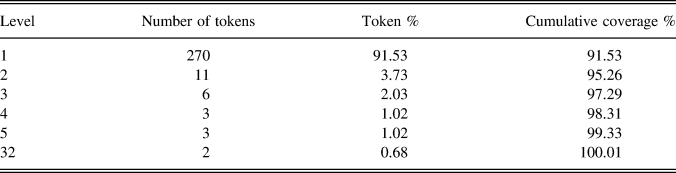
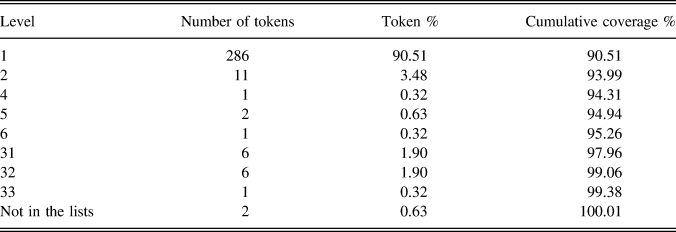
The lyrics of each song were analyzed with the computer software program Range (Heatley & Nation, Reference Heatley and Nation2002) and Nation’s (2017) British National Corpus/Corpus of Contemporary American English (BNC/COCA) word family lists. The Range analysis indicates the vocabulary difficulty level of each song based on the lexical frequency of its words (Nation & Webb, Reference Nation and Webb2011). The analysis (see Tables 1 and 2) indicated that the participants needed to know at least the most frequent 2,000 word families to reach 95% lexical coverage of the songs for optimal unassisted incidental vocabulary learning (van Zeeland & Schmitt, 2013a). In comparison to the results of the VLT, the analysis indicated that many of the words in the songs were likely to be unknown.
Lexical frequency profile: “Every Breath You Take”

Lexical frequency profile: “Die a Happy Man”

However, it is likely that many L2 songs heard by beginner EFL learners include a proportion of unknown words that exceeds 5%. A corpus-based study by Tegge (Reference Tegge2017), which involved the analysis of 408 songs from recent U.S. Billboard charts and 635 songs selected by language teachers, suggested that to reach 95.1% coverage of popular songs, knowledge of the most frequent 3,000 word families plus proper known was needed. Thus, although the lexical coverage of the songs selected in this study suggests that they may be difficult to understand, they likely represent ecologically valid listening materials.
Target words
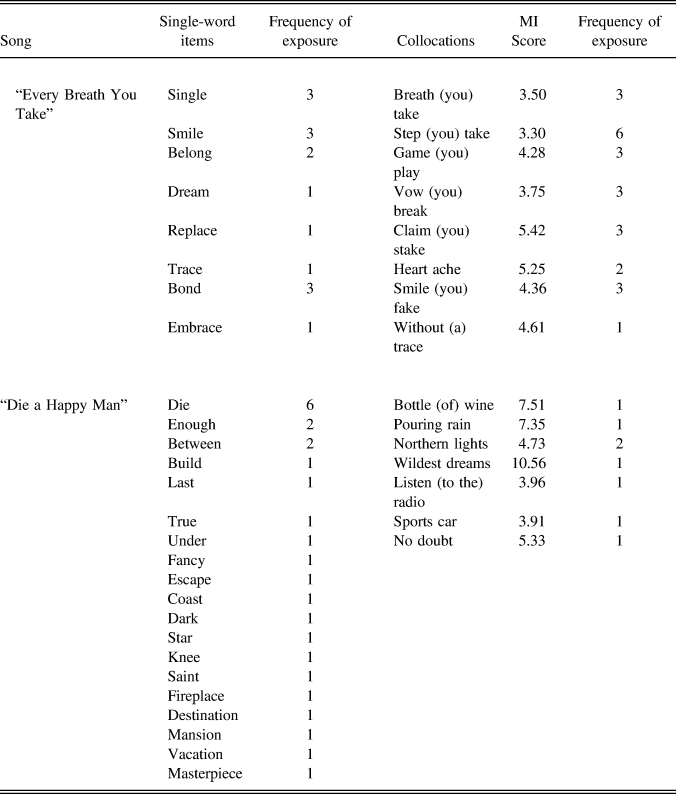
Eight single-word items and eight collocations were selected as the target items for Song A. The target items in Song B were 19 single-word items and 7 collocations. All the collocations had mutual information (MI) scores above 3. The MI score is a “statistical measure of relatedness: the probability of two events occurring together compared to their occurring independently” (Beran, Reference Beran2000, p. 274). A MI score above 3 indicates that the two words that make up the collocation are highly related (Hunston, Reference Hunston2002). The target items for the two songs are shown in Table 3.
Target single-word items and collocations

DEPENDENT MEASURES
A 69-item multiple-choice vocabulary test was designed using the guidelines outlined by Nation and Webb (Reference Nation and Webb2011). This test was used for the pretest, immediate posttest, and delayed posttest to track and compare the progress of the participants throughout the study. The test included three sections each measuring a different aspect of vocabulary knowledge. Because listening to songs is an aural task, the cues in the test were presented in aural form. The participants were asked to listen for the questions and the options of the multiple-choice tests from a recording and mark their responses on a test sheet. Each question comprised four options, including an “I don’t know” option. Research suggests that in multiple-choice tests, three options (the correct answer and two distracters) are sufficient and that the quality of the test is determined by how well the distracters are made as opposed to how many distracters are included (Nation & Webb, Reference Nation and Webb2011). Prior to starting the study, the test was reviewed by several English- and Thai-speaking individuals who were not involved in the study to determine the quality of the items and the clarity of the instructions.
1. Spoken-form recognition
Section A of the test examined spoken-form recognition of the single-word items. This section included 8 multiple-choice items for Song A and 19 multiple-choice items for Song B. The two distracters for the multiple-choice test options in this section were both nonsense words. Using nonsense words ensured that the participants did not recognize the distracters. These words were created by changing the first letter of a low-frequency word so that they would look and sound like real words in English. The number of syllables was controlled to match the target words so that the participants would not dismiss the distracters based on word length. The distracters contained the same word parts and belonged to the same part of speech as the target words. Once all distracters were created they were checked by a Thai/English speaker to avoid correspondence with any L1 words.
For this section, participants were instructed in their L1 to select the word they recognized. An example question is shown in (I). All participants listened to the same recording of the test in which there was a 2-second gap between options and a 4-second gap between questions. The time frame was based on Van Zeeland and Schmitt’s (2013b) study of incidental vocabulary learning through listening.
(I) Spoken-form recognition test:
The participant sees on paper:
คำถามนี้จะเป็นตัววัดความสามารถในการรับรู้
แบบทดสอบการรับรู้:จงเลือกคำตอบที่ถูกต้องจากเสียงที่ได้ฟัง
1. (A) □ (B) □ (C) □ (D) ฉันจำอะไรไม่ได้เลย
At the same time the participant hears on the recording
“Number one [1sec.] A, Corsal [2 sec.] B, Single [2 sec.] C, Pustic [2 sec]”
2. Form-meaning connection
Section B of the test examined form-meaning connection of the single-word items. This section included 8 multiple-choice items for Song A and 19 multiple-choice items for Song B. In this section, the participants heard the target words and were asked to circle the corresponding Thai translation of the word from three options they were presented with on the test sheet. An example question is provided in (II). The two distracters in this section included a word that was the answer to another question on the test, and a word that was in the same song as the target word but was not used as a target item on the test. The participants were given 10 seconds to respond to each question followed by a 4-second gap between each question.
(II) Form-meaning connection test:
The participant sees on paper:
B. การแปล:จงเลือกคำที่มีความหมายที่ถูกต้องจากเสียงที่ได้ฟัง
1. (A)ความฝัน (B) ลมหายใจ (C) โอบกอด (D) ไม่ทราบ
At the same time the participant hears on the recording
“Number one [1sec.] Embrace”
3. Collocation recognition
Section C of the test examined participants’ knowledge of collocation recognition. The test included eight multiple-choice items for Song A and seven multiple-choice items for Song B. In each question, participants heard the target collocation and two distracters and were asked to select the sequence that they recognized. Because the concept of collocation is difficult for L2 learners to understand (Webb & Kagimoto, 2011), prior to starting the recording, an example question with an answer that was familiar to the participants was given to the participants. The example and one question from this section is provided in (III).
The distracters in this section included (a) the node word of the target collocation together with a collocate of another node word on the test, and (b) the node word of the target collocate and another word from the song. Each question in this section was repeated twice with 4-second gaps between each question.
(III) collocation recognition test:
This example was written on the class board and explained prior to starting this section of the test:
A) Sing a song B) Sing a food C) Sing a ball
D) I don’t remember any of these.
The test question:
The participant sees on paper
C. จับคู่:จงจับคู่ของคำที่ถูกต้องจากเสียงที่ได้ฟัง
1. (A) □ (B) □ (C) □ (D) ฉันจำอะไรไม่ได้เลย
At the same time the participant hears on the recording
“Number one [1sec.] A, Bottle of dress [2 sec.] B, Bottle of wine [2 sec.] C, Bottle of car [2 sec]”
PROCEDURE
The data was collected over five 60-minute sessions and each session was separated by a week. The participants were assessed in groups throughout the study. In the first week, all participants completed the VLT, a demographic information form, and the pretest for both songs. In week two, the preexisting classes were randomly assigned to a control group (C) (n = 37 for Song A and n = 26 for Song B) or one of the three experimental groups: E1 (n = 33 for Song A and n = 15 for Song B ), E3 (n = 48 for Song A and n = 41 for Song B) , and E5 (n = 41 for Song A and n = 62 for Song B). There were eight groups in total (four at grade five level and four at grade six level), two control groups (one at grade five level and one at grade six level), and six experimental groups (three at grade five level and three at grade six level).
In week two, the experimental groups completed the posttest immediately after listening to Song A. The experimental groups varied in the number of times they listened to the song. E1 listened to the song once, E3 listened to the song three times, and E5 listened to the song five times. The control group completed the immediate posttest for Song A without listening to the song.
In week three, participants repeated the procedure from week two for Song B. In week four, the participants completed the delayed posttest for Song A, and in week five they completed the delayed posttest for Song B.
ANALYSIS
SPSS (Version 24) for MacOS was used to analyze the data. Before running any analysis, the data from the participants who missed any of the testing sessions (pretest, immediate posttest, and delayed posttest) was removed and marked as missing. To answer the first, second, and third research questions, all data were scored dichotomously with 1 for a correct response and 0 for an incorrect response. Because real words were used in this study, correct responses were expected for some of the items on the pretest. To answer the first and second research questions, repeated measures ANOVA were used to compare scores within each group (experimental and control) at different times of testing (pretest, immediate posttest, and delayed posttest). To answer the third research question, MANCOVA with the pretest scores as covariate was used to determine whether the four groups differed significantly in their vocabulary learning gains across the three sections of the test for both songs. To answer the fourth research question, each item on the test was scored individually as not learned (incorrect on the pretest and incorrect on the posttests), guessed (correct on the pretest and incorrect on the posttests), known (correct on the pretest and the posttests), and learned (incorrect on the pretest and correct on the posttests). Next, the data from the not learned and learned scores were used in Pearson’s r to assess the relationship between frequency of occurrence and learning gains.
RESULTS
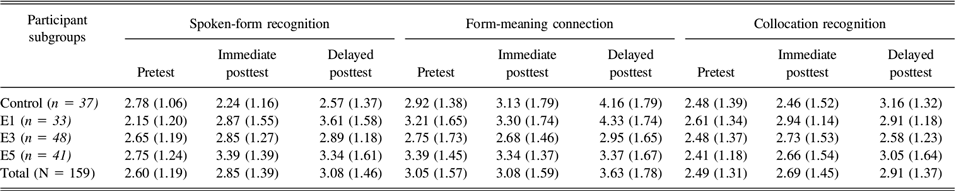
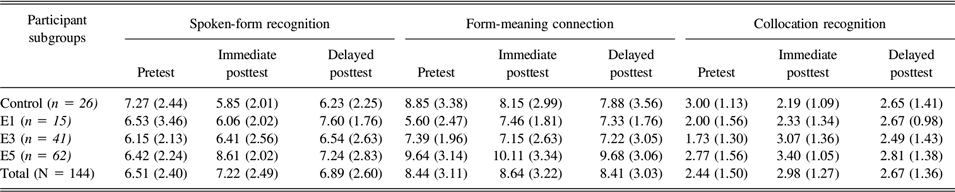
The descriptive statistics of vocabulary test scores for each song on each section of the test are presented in Tables 4 and 5. To answer the first and second research questions, repeated measures ANOVA were used to compare scores within each group (experimental and control) at different times of testing (pretest, immediate posttest, and delayed posttest).
Descriptive statistics of vocabulary test scores for Song A

Note. Maximum score on all sections of the test was 8.
Descriptive statistics of vocabulary test scores for Song B

Note. Maximum score on spoken-form recognition and form-meaning connection was 19 and the maximum score on collocation recognition was 7.
SONG A
On the spoken-form recognition section of the test, for the experimental groups there was a significant difference between scores from the pretest to the immediate posttest and from pretest to the delayed posttest, F(4, 238) = 2.53, p = .041 with partial η2 = .041 (small effect size). The analysis for the control group indicated that there was no significant difference between the pretest and immediate posttest, and the pretest and delayed posttest F(1.61, 58.24) = 2.33, p = .11.
On the form-meaning connection section of the test, for the experimental groups there was no significant difference between scores from the pretest to the immediate posttest and from pretest to the delayed posttest F(4, 238) = 2.09, p = .082. For the control group there was a significant difference between scores from the pretest to the immediate posttest, and from pretest to the delayed posttest, F(2, 72) = 7.28, p = .001 with partial η2 = .168 (large effect size).
On the collocation recognition section of the test, for the experimental groups there was no significant difference between scores from the pretest to the immediate posttest and from pretest to the delayed posttest F(4, 238) = .64, p = .63. For the control group there was a significant difference between scores from the pretest to the immediate posttest, and from pretest to the delayed posttest, F(2, 72) = 3.19, p = .047 with partial η2 = .081 (medium effect size).
The pairwise comparison between pretest and immediate posttest scores indicated that for the spoken-form recognition section of the test, there was a significant increase for experimental groups with medium effect size (d = .373) and a significant decrease for control groups with medium effect size (d = .485). In addition, a significant increase was found between pretest and delayed posttest for experimental groups with medium effect size (d = .508). On the form-meaning connection section, a significant increase was found for the control groups between pretest to delayed posttest with a large effect size (d = .778). No other significant differences were found in the pairwise comparisons.
SONG B
On the spoken-form recognition section of the test, for the experimental groups there was a significant difference between scores from the pretest to the immediate posttest and from the pretest to the delayed posttest, F(4, 230) = 4.498, p = .002 with partial η2 = .073 (medium effect size). The analysis for the control group indicated that there was no significant difference between the pretest and immediate posttest and between the pretest and delayed posttest F(1.50, 30.03) = 2.23, p = .136.
On the form-meaning connection section of the test, for the experimental groups there was no significant difference between scores from the pretest to the immediate posttest and from pretest to the delayed posttest F(4, 230) = 1.96, p = .10. The analysis for the control group also revealed that there was no significant difference between scores from the pretest to the immediate posttest and from the pretest to the delayed posttest, F(2, 40) = 2.79, p = .073.
For the collocation recognition section of the test, for the experimental groups, the results indicated that there was a significant difference between the pretest and immediate posttest and between the pretest and delayed posttest F(3.01, 172.99) = 7.26, p = .000. The analysis for the control group indicated that there was no significant difference between the pretest and immediate posttest and between the pretest and delayed posttest F(1.51, 30.32) = 1.55, p = .228.
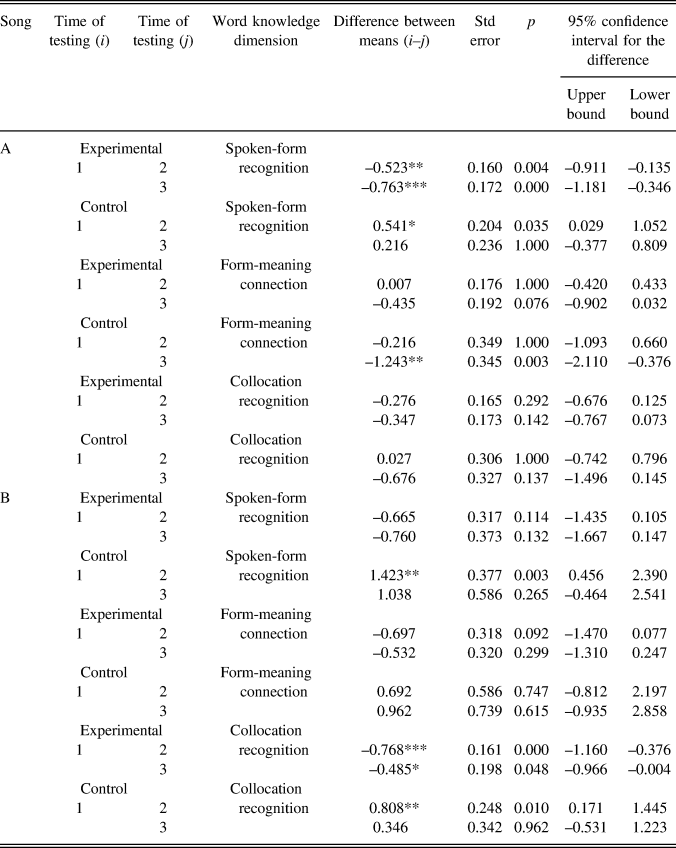
The pairwise comparison between pretest and posttest on the spoken-form recognition section of the test indicated that there was a significant decrease with large effect size (d=.704) for the control group. On the collocation recognition section of the test, the results from pretest to immediate posttest indicated a significant increase with large effect size (d = .598) for the experimental groups and a significant decrease with large effect size (d = .72) for the control group. The comparison between pretest and delayed posttest for the collocation recognition section of the test, also showed a significant increase with small effect size (d = .251) for the experimental groups. There were no other significant differences found in the other pairwise comparisons. The pairwise comparisons between pretest and immediate posttest scores and between pretest to delayed posttest scores are shown in Table 6.
Pairwise comparison for different sections of the tests

Note . Test time 1= Pretest, 2 = Immediate posttest, 3 = Delayed posttest.
* p < .05, ** p < .01, ***p < .001
To answer the third research question, MANCOVA was used to determine whether the four groups differed significantly in their vocabulary learning gains across the three sections of the test for both songs.
SONG A
The results indicated an overall statistically significant difference (F (9, 365.2) = 2.09; p < .05; Wilk’s Lambda = 0.885; partial η2 = 0.04) on the immediate posttest. When the results for different sections of the test were considered separately, there was a significant difference found for spoken-form recognition (F (3, 155) = 4.74; p < .01; partial η2 = 0.086) with a medium effect size. However, no significant differences were found between groups in the other two sections of the test. Post-hoc comparisons using the Bonferroni test for the spoken-form recognition section indicated a statistically significant difference between the control and E5 group (p = .002) with a large effect size (Cohen’s d = .90).
On the delayed posttest, the MANCOVA realized an overall statistically significant difference between the groups on the delayed posttest (F (9, 365.2) = 3.39; p < .005; Wilk’s Lambda = .822; partial η2 = .063). When the results for different sections of the test were considered separately, there were significant differences with medium effect sizes for spoken-form recognition (F (3, 155) = 3.50; p < .05; partial η2 = .065) and form-meaning connection (F (3, 155) = 5.29; p < .005; partial η2 = .095), however a significant difference was not found for collocation recognition.
Post-hoc comparisons using the Bonferroni test for spoken-form recognition indicated a statistically significant difference between the control group and E1 (p = .02, d = .69). The post-hoc comparison for form-meaning connection indicated a statistically significant difference between the control group and E3 (p = .008, d = .69). A statistically significant difference was also found between E1 and E3 on the form-meaning connection section of the test (p = .016, d = .68).
SONG B
The results indicated an overall statistically significant difference (F (9, 328.7) = 9.05; p < .001; Wilk’s Lambda = .583; partial η2 = .164). When the results for the different sections of the test were considered separately, a significant difference with a large effect size was found for spoken-form recognition (F (3, 140) = 13.03; p < .001; partial η2 = .222), a significant difference with a medium effect size was found for form-meaning connection (F (3, 140) = 4.68; p < .005; partial η2 = .093), and a significant difference with a large effect size was found for collocation recognition (F (3, 140) = 10.72; p < .001; partial η2 = .19).
Post-hoc comparisons using the Bonferroni test indicated a statistically significant difference between the control group and E5 (p = .00, d = 1.39), E1 and E5 (p = .017, d = .97), and E3 and E5 (p = .00, d = .82) in the spoken-form recognition section. The results for the form-meaning connection section indicated a statistically significant difference between E3 and E5 (p = .007, d = .58). The results for the collocation recognition section indicated a statistically significant difference between the control group and E3 (p = .00, d = 1.23) and between the control group and E5 (p = .00, d = 1.07).
For the delayed posttest, the results showed that there were no significant differences in learning gains from pretest to delayed posttest among the groups for Song B.
To answer the fourth research question, Pearson’s r correlation coefficients between frequency of occurrence and learning gains for each group (Control, E1, E3, and E5) at each grade level (five and six) were examined for the immediate posttest and delayed posttest in each section of the test. On the immediate posttests, there was a moderate and positive correlation between the frequency of occurrence and test scores for E3 at the grade five level on the spoken-form recognition section of the test (r = .545, n = 15, p < .05). There was also a moderate and positive correlation between the frequency of occurrence and test scores on the immediate posttest for E3 at the grade six level on the spoken-form recognition section of the test (r = .424, n = 22, p < .05).
On the delayed posttests, there was a moderate and negative correlation between the frequency of occurrence and test scores for E5 at the grade five level on the form-meaning connection section of the test (r = .392, n = 21, p < .05). The relationship between frequency of occurrence and test scores were insignificant for all the other groups in the study.
DISCUSSION
This study expanded on earlier research by providing empirical evidence that incidental vocabulary acquisition can occur through listening to popular songs. The present study provided a more in-depth assessment of the extent to which incidental vocabulary acquisition through listening to songs can occur by measuring learning gains of spoken-form recognition, form-meaning connection, and collocation recognition. Moreover, the songs used in this study may reflect more ecologically valid L2 spoken input because popular songs are more likely to be listened to by learners than children’s songs. Furthermore, the effects of repeated exposures to a song was also investigated. Research has shown that incidental vocabulary learning is likely to increase through repeated reading (Horst & Meara, Reference Horst and Meara1999), repeated listening (Penno, Wilkinson, & Moore, Reference Penno, Wilkinson and Moore2002), and repeated reading while listening (Webb & Chang Reference Webb and Chang2012a). Finally, the relationship between frequency of occurrence of target items encountered in the songs and vocabulary learning was also examined.
CAN LEARNERS GAIN VOCABULARY KNOWLEDGE THROUGH LISTENING TO SONGS?
In answer to the first research question, the results indicated an overall gain in vocabulary knowledge of 3.29% (.30 words) for Song A and an overall gain of 8.67% (1.64 words) for Song B from pretest to immediate posttest for the experimental groups. In contrast the mean scores for the control group regressed by 1.21% (.01 words) for Song A and by 7.46% (1.42 words) for Song B from the pretest to the immediate posttest. The results from pretest to delayed posttest of the experimental groups revealed a gain of 6.37% (.51 words) for Song A and 4.27% (.81 words) for Song B. The results of the control group from pretest to delayed posttest revealed a gain of 6.91% (.55 words) for Song A and a 5.17% (.98 words) regression for Song B. Because the results from the delayed posttest showed an increase from the immediate posttest across both experimental and control groups, these findings cannot be solely attributed to the treatments. These increases from immediate to delayed posttests may have been caused by a learning effect from taking the immediate posttest (Webb & Chang, Reference Webb and Chang2018; Webb, Newton, & Chang, Reference Webb, Newton and Chang2013) or vocabulary-related episodes where students may have discussed the vocabulary they heard on the songs after the immediate posttest (Nation, Reference Nation2013).
It is interesting to note that the incidental vocabulary learning gains were more than twice as large for Song B (1.64 words) than Song A (.30 words) on the immediate posttest. There are several reasons that can explain the larger vocabulary gains for Song B on the immediate posttests. First, as the students became more familiar with learning through listening to songs, their ability to incidentally learn words through listening to songs may have improved (Webb & Chang, Reference Webb and Chang2012a). It is intuitively logical that learning with a new discourse type would improve over time. Moreover, research does suggest that the proportion of vocabulary learning gains does tend to be considerably larger through reading multiple texts than through reading a single text (Webb & Chang, Reference Webb and Chang2015b). Second, differences between the two songs may have also caused the variance in the results. Song A had 8 target single-word items and 8 target multiword items while Song B had 19 single-word items and 7 multiword items on the test. The higher number of items in the second song provided the participants with more chances to learn new vocabulary and more opportunities to demonstrate their learning gains on the test. A third possible reason for the improved performance on Song B is simply that differences between the target words may have influenced vocabulary learning (Laufer, Reference Laufer, Coady and Huchin1997; Webb, Reference Webb and Chappelle2014; Webb & Chang, Reference Webb and Chang2012a). For example, it is possible that the set of target items for Song B was easier to learn than the set of items for Song A.
From the overall findings in this study we can conclude that learners can incidentally learn L2 vocabulary through listening to songs. The relatively small learning gains may lead some to dismiss the results as not being meaningful. However, research has shown that incidental vocabulary learning gains tend to occur in small increments and that learners need to be exposed to large quantities of input with repeated exposures to vocabulary items for considerable learning to take place (Nagy, Herman, & Anderson, Reference Nagy, Herman and Anderson1985; Webb & Nation, Reference Webb and Nation2017). Earlier studies of incidental vocabulary acquisition have also found small learning gains. Van Zeeland and Schmitt (Reference Van Zeeland and Schmitt2013b) found an overall gain of 29.2% (7.05 words) in vocabulary knowledge from listening to text; Horst, Cobb, and Meara (Reference Horst, Cobb and Meara1998) found a gain of 10.26% (4.62 words) from reading a graded reader; and Peters and Webb (Reference Peters and Webb2018) found a gain of 8.31% (3.97 words) on a test of meaning recall and 13.95% (3.95 words) on a test of meaning recognition from watching one television program.
In fact, there is an argument that the size of the gains in this study are substantial. Research has typically investigated incidental vocabulary acquisition with higher proficiency learners with larger vocabulary sizes. Research suggests that there’s a direct relationship between vocabulary size and learning gains (Penno, Wilkinson, & Moore, Reference Penno, Wilkinson and Moore2002; Peters, Heynen, & Puimège, Reference Peters, Heynen and Puimège2016; Vidal, Reference Vidal2003, Reference Vidal2011; Webb & Chang, Reference Webb and Chang2015a), and that learners with larger vocabulary sizes need fewer encounter with target words for learning to take place (Zahar, Cobb, & Spada, Reference Zahar, Cobb and Spada2001). The findings in the present study indicated that incidental vocabulary learning can occur through listening to songs even when learners have a very small vocabulary size. Research with other discourse types would suggest then that with more proficient learners, the gains made through listening to songs are likely to be greater.
TO WHAT EXTENT DOES LISTENING TO SONGS AFFECT KNOWLEDGE OF SPOKEN-FORM RECOGNITION, FORM-MEANING CONNECTION, AND COLLOCATION RECOGNITION?
In answer to the second research question, the results indicated that for Song A the experimental groups demonstrated a significant gain of 6.53% (.52 words) for spoken-form recognition and no significant gains/regression for form-meaning connection and collocation recognition from pretest to immediate posttest. Furthermore, for Song B the experimental groups demonstrated a significant gain of 10.97% (.76 words) for collocation recognition between the pretest and immediate posttest. However, they demonstrated no significant gains on the spoken-form recognition and form-meaning connection aspects of vocabulary knowledge for this song.
From these findings, we can conclude that learners have the potential to incidentally learn the spoken forms of single-word items and the spoken forms of collocations through listening to songs. The result for single-word items is consistent with earlier research. Van Zeeland and Schmitt (2013b) found that learners gained knowledge of spoken-form recognition before knowledge of form-meaning connection for individual words and that the number of exposures needed to be higher to gain knowledge of form-meaning connection than spoken-form recognition. Another reason why the participants were unable to gain knowledge of form-meaning connection is that the context in which the target words are encountered may have a large impact on learning this aspect of vocabulary knowledge. Research suggests that students have a better chance of learning new vocabulary items from more informative contexts (Nagy, Herman, & Anderson, Reference Nagy, Herman and Anderson1985; Webb, Reference Webb2008). Because the meanings of words in songs may be less salient than in many other forms of spoken and written text, it may be that gaining knowledge of form-meaning connection through listening to L2 songs is particularly challenging.
The positive gains found on the collocation recognition section of the test are also consistent with earlier studies. Webb and Chang (Reference Webb and Chang2018) explored incidental learning of collocations through different modes of input. They found that EFL students were able to make gains in knowledge of 16% (2.58 words) of the spoken forms of collocations through listening to a graded reader. They concluded that listening may play a more important role in gaining knowledge of collocation than single-word items. The value of listening to learning collocation might be due to the prosodic forms of collocations (Lin, Reference Lin2012). This makes collocations more salient during listening than reading (Webb & Chang, Reference Webb and Chang2018). Furthermore, further emphasis of rhythms and stresses in songs may make collocations even more salient. Perhaps songs have the potential to be a valuable source of L2 input for learning collocations.
DOES THE NUMBER OF TIMES A SONG IS HEARD AFFECT INCIDENTAL VOCABULARY LEARNING?
In answer to the third research question, the results indicated that E5 significantly outperformed the control group on the spoken-form recognition section of the test for Song A. However, no significant differences were detected on the other two sections of the test between groups for this song. The results for Song B on the spoken-form recognition section of the test indicated that E5 also significantly outperformed the other three groups in the study (control, E1, and E3). Together, the results of the two songs clearly indicate that listening to a song five times may have a positive impact in gaining knowledge of the spoken forms of individual words.
The results for the other two sections of the test indicated that listening to a song multiple times may also increase the other two aspects of vocabulary knowledge. For Song B, E5 significantly outperformed E3 on the form-meaning connection section of the test, and E3 and E5 gained greater knowledge of collocation than the control group.
From these results, we can conclude that repeated listening to songs has a positive effect on learning different aspects of vocabulary knowledge although the variation in findings for form-meaning connection and collocation recognition may be affected to a lesser degree by the number of times a song is heard than spoken-form recognition. The results are supported by earlier studies that have shown that repeated reading (Horst & Meara, Reference Horst and Meara1999; Webb & Chang, Reference Webb and Chang2012a), repeated listening (Penno, Wilkinson, & Moore, Reference Penno, Wilkinson and Moore2002), and repeated reading while listening (Webb & Chang, Reference Webb and Chang2012a) enhanced vocabulary learning as the number of times texts are heard or listened to increased.
WHAT IS THE RELATIONSHIP BETWEEN FREQUENCY OF OCCURRENCE AND INCIDENTAL VOCABULARY LEARNING THROUGH LISTENING TO SONGS?
In answer to the fourth research question, the results indicated that in the E3 groups in which the frequency of exposure ranged from 3 to 18, there was a significant correlation between number of exposures and learning gains on the spoken-form recognition test. However, no significant relationships were found in the E1 and E5 groups where frequency of exposure ranged from 1 to 6 and 5 to 30. This finding is consistent with the results of Van Zeeland and Schmitt’s (2013b) earlier study of incidental vocabulary learning through listening. They found that acquisition of spoken form started to occur from around seven encounters with target words. Thus, in the E1 group the amount of learning that had occurred after six encounters was not much greater than the amount of learning that occurred after one encounter. In addition, Van Zeeland and Schmitt (Reference Van Zeeland and Schmitt2013b) found that participants in their study made greater gains in vocabulary knowledge after 11 encounters with target words than after 7 encounters, while no significant differences were found between 11 and 15 encounters. This explains why significant results were found in the E3 groups where the amount of learning for the more frequent words (9 and 18 encounters) were greater than the amount of learning that took place for less frequent words (3 and 6 encounters). Furthermore, the lack of a significant relationship between frequency of occurrence and learning in the E5 groups was perhaps due to a similar amount of learning that took place for the less frequent words (5 and 10 encounters) and for the more frequent words (15 and 30 encounters).
LIMITATIONS AND FUTURE RESEARCH
Several limitations of this study should be noted. First, there were only two songs used in this study, and the results indicated different learning gains between the songs. Thus, it would be useful to conduct further research with more songs to try to determine which characteristics of songs facilitate learning.
Second, in this study the participants had a very limited vocabulary size. Research investigating incidental vocabulary acquisition through other sources of input suggests a positive relationship between vocabulary size and vocabulary gains (Peters, Heynen, & Puimège, Reference Peters, Heynen and Puimège2016; Vidal, Reference Vidal2003, Reference Vidal2011). Thus, in future studies it would be useful to investigate incidental vocabulary learning through listening to songs with participants of different vocabulary sizes to get a better indication of how listening to songs may contribute to vocabulary learning.
Third, in this study to evaluate the relationship between number of exposures and learning gains in a controlled setting, participants were asked to listen to the same song multiple times in one session. This design may be ecologically problematic because while listeners may listen to the same song multiple times, they may typically do so over time with intervals between listening. Furthermore, outside of the classroom, learners would repeatedly listen to the songs that they enjoy and not necessarily to the songs that others have selected for them. Consequently, in the current study repeatedly listening to a song that was selected for this study may have led to the participants losing focus and interest in the activity. Nation (Reference Nation2007) suggests that learner’s interest in activities and materials used for teaching can affect learning. Thus, in future studies it would be useful to investigate spaced listening to songs where participants are exposed to the target songs over a longer period with intervals between listening sessions.
CONCLUSION
The present study provided in-depth empirical support for the potential of incidental vocabulary learning through listening to songs. These findings have curricular implications. If songs do contribute to second or FL acquisition, learners and teachers can use songs as a source of L2 input inside and outside of the classroom to increase vocabulary learning. The repeated occurrence of single-word and multiword items within songs may also make them a relatively effective type of L2 input for vocabulary learning. Moreover, the short length of songs may help teachers to fit them rather easily into a classroom-based vocabulary learning program. However, as other researchers have suggested there is still a need for research exploring extensive listening in the EFL context to better understand the extent to which available sources of input such as songs can be used effectively for language learning (Rodgers, Reference Rodgers2016; Webb, Reference Webb, Nunan, Richards and Eds.2015). Furthermore, the studies investigating exposure to songs and music have taken place in North American (Levey, Levey, & Fligar, Reference Levey, Levey and Fligor2011) or European (European Commission, 2002; Lindgren & Muñoz, 2013) contexts, thus it would be useful to investigate the extent to which learners in other contexts such as Asia, Africa, and South America listen and utilize songs for language learning.