‘Symmetry’ is a term which is used in all modern occidental languages and beyond, and was borrowed from ancient Greek, συμμϵτρία. Its common present-day meaning is, everywhere, more or less identical. In everyday language the term refers to an object or a shape which is designed in such a way that its parts are invariant under a point reflection through its centre (point symmetry or central symmetry) or under a reflection over a line (line, mirror or reflectional symmetry). Similarly, we speak of axial symmetry if a body remains unchanged if rotated around an axis. Definitions of symmetry in other disciplines are much more complex, but all of them refer to a basic concept expressed in mathematics as referring to an entity that is invariant under several transformations (Ritter and Gründer Reference Ritter and Gründer1998, 746–751; Hahn Reference Hahn1989; Hon and Goldstein Reference Hon and Goldstein2008, 179–294).
Architecture and Symmetriae
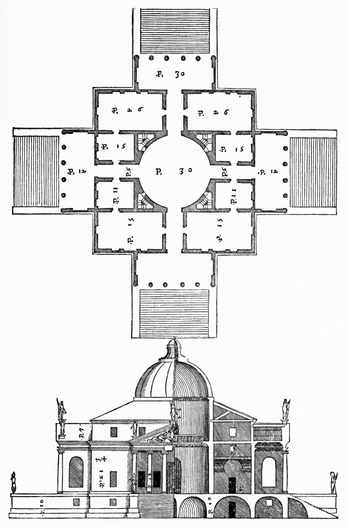
Many facades and ground plans of historical buildings are (more or less precisely) conceived in the manner of mirror symmetry (Figure 1). This is because, in ancient times, and again since the Renaissance, line symmetry was a very important aesthetic ideal – an ideal that was radically revised only with the architecture of Art Nouveau (Jugendstil) and later on when asymmetrical forms of buildings were explicitly favoured.Footnote 1 Therefore, a structure like that of the Villa Rotonda near Vicenza, designed and built by Andrea Palladio from 1566 onwards and based on geometrical proportioning by circle and square, is often considered to be by far one of the most perfect buildings ever constructed. It expresses both harmony and beauty in the most exemplary manner. Consequently, one could be forgiven for believing that symmetry has one and the same meaning in art and architecture as well as in other disciplines, especially as the Swiss theologian and philosopher Johann Georg Sulzer defined it in 1774 in his Allgemeine Theorie der schönen Künste (General Theory of the Fine Arts), the first German encyclopaedia to treat all aspects of aesthetics: ‘[…] man braucht es [das Wort Symmetrie d.V.] aber gemeiniglich in zeichnenden Künsten, um die Art der Anordnung auszudrüken, wodurch ein Werk in zwey gleiche, oder ähnliche Hälften getheilt wird’ [‘One uses the word symmetry generally in the graphic arts in order to express the design of a work divided in two halves of the same or similar shape’] (Sulzer Reference Sulzer1994 [1792], 422). For Sulzer, nature was accountable for this ideal, due to the symmetrical shape of animals and men, which was imitated in architecture (Reference Sulzer1994 [1792], 477).
Andrea Palladio: Villa Rotonda near Vicenza, woodcuts from his treatise I quattro libri dell’architettura, Venice 1570, p. 137.

But besides this common notion of symmetry, there existed, as Sulzer still knew, a different and, in fact, original meaning of the term: ‘Das Wort bedeutet […] nach seinem Ursprunge das gute Verhältnis der Theile eines Ganzen gegen einander’ (‘The word originally signifies the good relation between the parts of a whole’) (Sulzer Reference Sulzer1994 [1792], 477). In fact, the Greek word συμμϵτρία (symmetria) consists of two parts: σύν (syn) which means ‘together’ or ‘common’, and μέτρOν (metron) which means ‘measure’. Consequently, the original Greek meaning of the word was ‘sharing a common measure’, and this is exactly this meaning of the word as used by Plato in the Theaetetus (147d, 148a-b) and by Aristotle in the Metaphysics (11, 1061b1). They describe the lengths of the sides of a square as symmetric to each other in contrast to its diagonal which is not symmetric to the sides (the diagonal corresponds to the hypotenuse of a right-angled triangle and is therefore
 $c=\sqrt {{a^2} + {b^2}} $
). In the same way, Euclid in the Elements (X, 1) defines the sides of an isosceles triangle as συμμϵτρός because they have the same lengths. Even though Pliny the Elder believed there could be no corresponding expression in Latin, a correct translations of symmetria would be com-mensuratio or the derived forms com-mensus and com-mensurabilis. And, in fact, when the Dominican William of Moerbeke (ca. 1215–1286) translated the works of Archimedes from Greek to Latin in 1269, he used the term commensuratio to express the concept of symmetria (Hon and Goldstein Reference Hon and Goldstein2008, 75). But Pliny was also right, since it was Boethius (480–525) who came to coin the Latin word in his Institutio arithmetica some centuries later and he created this neologism to render literally the Greek meaning. From then on, the term commensuratio started on the success story.
If we want to understand the original term more precisely, we will, first of all, have to read Vitruvius’ De architectura libri decem (written ca. 33–22bc). Besides Galen, Varro and Pliny, he is the most important source for the word symmetria in ancient times (Fensterbusch Reference Fensterbusch1964; Howe and Dewar Reference Howe and Dewar1999). Vitruvius was a theoretician of architecture living at the time of the Emperor Augustus. In his treatise on good architecture, he followed the theoretical ideas established by the Pythagoreans, which were applied later to the aesthetic of Greek buildings. In these concepts, the term symmetria played an important role because it was considered the central condition for the beauty of architecture (but it is not to be confounded with beauty itself). Vitruvius (I,2,4) defines the term as follows: ‘Symmetry is a proper agreement between the members of the work itself, and relation between the different parts and the whole general scheme, in accordance with a certain part selected as standard.’ Obviously, the term symmetry originally had nothing to do with our common notion of mirror image, not even in the field of architecture. Astonishingly, in his treatise, Vitruvius does not say anything about architectural design and mirror images. In what follows we will try to understand what Vitruvius precisely intended to argue in this passage. He says that, first of all, one needs to select a standard measure (modulus), which stands in relation to the dimensions of the projected building itself. Commonly, this was the diameter of a column. Sometimes it was also the width of the triglyph, which is an element of the Doric frieze above the columns, consisting in a rectangular tablet with three vertical grooves alternating with metopes. Then this standard was subdivided or multiplied in order to establish the right measurements of all the other parts of the building. Consequently, all elements stood in a numeric and geometric relation to each other and to the whole. This phenomenon and its underlying rule were designated as symmetria by Vitruvius. The aim of symmetria was to establish a beautiful appearance.
What seems to be a simple rule results in an extraordinarily complicated procedure when applied to praxis. First, all the different architectonic elements in the same building needed to be put into innumerable relations to each other, all depending on the modulus. Second, any type and any style of building had a specific system of symmetriae: the symmetriae of a Doric temple were distinct from those of the Ionic, and buildings in Ionic style in turn differed from those in the Corinthian. Vitruvius describes a variety of different relations between the individual element of a building, and therefore the plural form symmetriae was often used (Nohl Reference Nohl1876, 130–131). Hence, the visual difference between temples was established not only on the basis of their different number of columns and indigenous forms of bases, capitals, entablatures and so on, but mainly because of their different symmetriae.
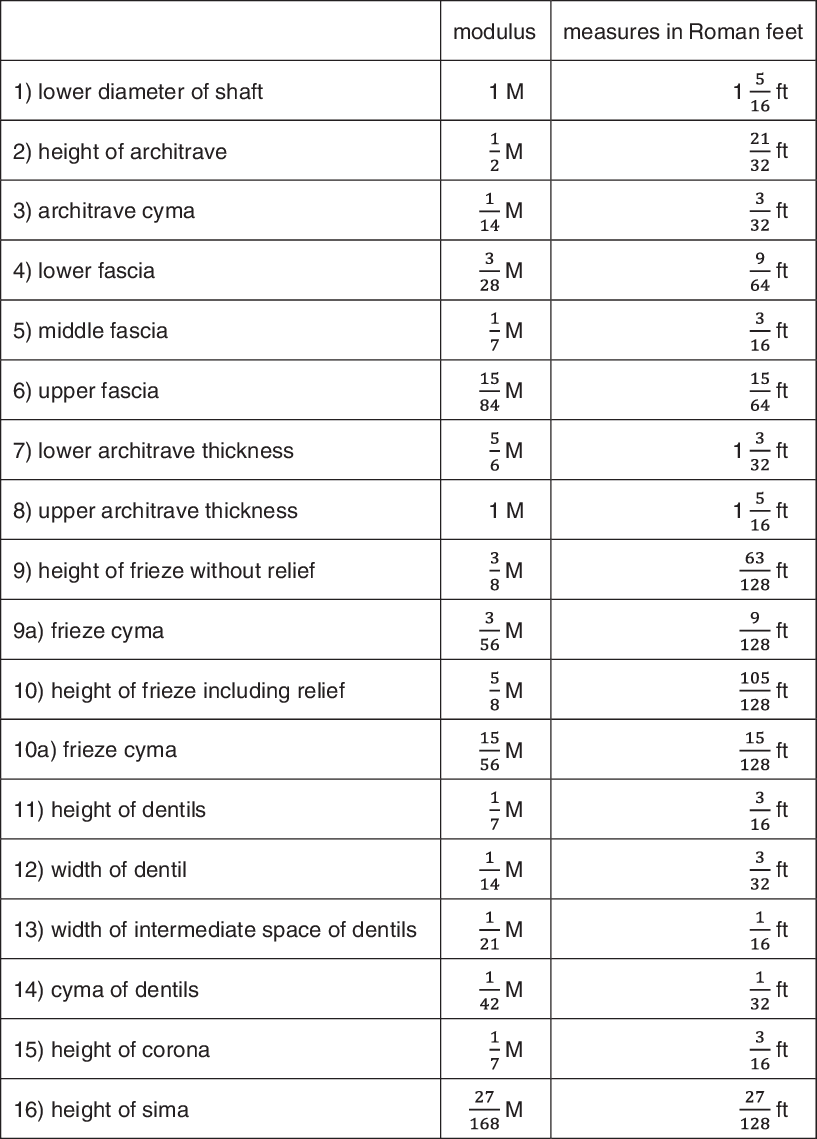
Vitruvius explains the system of the symmetriae at great length and in detail throughout his text, starting with Book III. These descriptions of sacral buildings are extremely accurate. For example, the Ionic temple had to follow a great variety of subdivisions of its modulus, which was the diameter of the column. Following Heinrich Knell, who was the first to discuss extensively the Vitruvian symmetriae and who connected them to the Roman foot, some of these partitions were quite simple, such as the half of the modulus (diameter of a column) used to measure the height of the architrave (Knell Reference Knell2008, 89-114). But the width, length and height of most of the smaller elements of the building had to follow complicated fractions of the modulus. The height of the upper fascia of the Ionic architrave, for example, was 15/84 parts. In the Vitruvian rules for the Ionic temple we have to ascertain a great variety of such strange fractions of the basic modulus: 15/56 for the height of the cymatium (a crowning moulding in classic architecture), 63/128 for the frieze and 27/168 for the sima (a rain gutter at the baseline of the roof). Transformed from the Roman foot into the metric system, this last fraction is only in the range of some few centimetres.
The graphic scheme in Figure 2 representing the diverse Vitruvian symmetriae of the Ionic temple suggests a two-dimensional system. But actually the symmetriae determined the whole building as a three-dimensional body and, of course, they could be found in any kind of building even if it was not designed in a mirror symmetrical way (in the modern sense of the word), such as the Erechtheion (ca. 420–406bc) on the Acropolis of Athens.
Vitruvius: Entablature of the ionic temple, drawing by Heiner Knell (Reference Knell2008).

Vitruvius: Display of the symmetriae of the ionic temple, drawing by Heiner Knell (Reference Knell2008).

By way of summary, one can say that symmetria meant the good and graceful relations in the measures between all elements of a building. This duality is very aptly expressed by the German word Ebenmaß which additionally conveys the positive ethico-moral notion, inherent in the classic term. Already in the Timeaus, Plato used the term symmetron in a metaphorical sense, to express the beauty and the good, and the terms ametron or asymmetron for the ugly and the bad. In aesthetic debates, the good symmetriae ensured the beauty of a building or of a human body. Plato, furthermore, insisted on the good and sane relation between body and soul, for which he used the very same word (symmetriais) (Hon and Goldstein Reference Hon and Goldstein2008, 94). Galen extended this conception when he used symmetria to define the health of a body as a smooth or suitable relation between warm and cold, and dry and humid (Kaiser Reference Kaiser and Beck1990, 48–78, 74–75).
In Vitruvius’ aesthetic system, symmetria is not the only important category. In his famous, but nonetheless somehow enigmatic, paragraph on the basics of architecture at the beginning of the first book, symmetria is linked to the Latin term ordinatio and to the Greek term eurythmia. Vitruvius unfortunately does not clearly distinguish these interdependent terms. Without discussing this contested passage in detail, we could say that ordinatio, symmetria and eurythmia are different aspects of the same aesthetic phenomenon. One could describe ordinatio as the principle, symmetria as the highly differentiated body of rules, and eurythmia as the pleasant effect of the commensurable proportioning upon the beholder (Kruft Reference Kruft1991, 26). As we learn from Vitruvius, symmetria is based on certain mathematical–geometrical rules. It does not constitute an immutable system, because symmetria has to be corrected as necessity arises by eurythmia which is a category of human perception.
Human Body and Symmetriae
Symmetria was a quality not restricted to mathematics, geometry or architecture. As adumbrated above, we learn from Plato, Pliny and others that it was a quality of the human body and hence also of sculpture. Likewise, the artistic composition of the human body had to follow the good symmetriae. In fact, for Vitruvius, the human body was the starting point for his reflections on architecture. Nature provided the harmonious proportions in shaping men. All limbs, such as arms, legs, hands, fingers and feet, were proportionally dependent on each other and only if this complex system followed the well-balanced symmetriae, was the human body then considered to be beautiful in its appearance. By anthropomorphic thinking, this concept was transferred from the human onto the architectonic body. This concept, which was expressed in Vitruvius’ famous passage on the homo bene figuratus, had to be followed also in architecture (Zöllner Reference Zöllner1987; Zöllner Reference Zöllner and Johannes2009, 145–161). The corpus of classic source material for the term symmetria in sculpture is inferior to that in architecture: the writings of Galen, Varro and Pliny convey the main information. Without discussing them in depth, we can say that symmetriae in sculpture had a very similar denotation to architecture. They served to describe or to shape a most perfect composition of a naked statue. Polycleitus, one of the most important sculptors of classical antiquity (fifth century bc), recorded his ratio symmetriae in his famous but lost Canon, and exemplified them in a male nude statue, probably the Doryphoros (Palagia and Politt Reference Palagia and Politt1996).
Secondary literature (criticism) frequently translates symmetria as proportion (Hon and Goldstein Reference Hon and Goldstein2008). But this oversimplifies matters considerably since Vitruvius in fact distinguishes explicitly between these two terms:
The planning of temples depends upon symmetria and architects must diligently apprehend its principle [ratio]. It arises from proportio which in Greek is called analogia. Proportio consists in taking a fixed module, in each case, both for the parts of a building and for the whole, by which the principle of symmetria is put into practice. For without symmetria and proportio no temple can be designed according to reason; that is, it has to follow an exact rule worked out after the fashion of the members of a finely-shaped human being. (Vitruvius III, 1, 1)
As we see, symmetria and proportio are linked with each other but they do not have the same meaning. Proportio relates to the establishment of the module depending on (the size of) the entire building. Symmetria, on the other hand, allows one to determine appropriately and evenly the position and size of all particular elements of the building in their three dimensions. Theoretically, it would be possible to establish the module of a building as an irrational number (e.g. setting the diameter of the column at
 $\sqrt 2 $
); in fact, the dimensions and positions of elements of mediaeval and renaissance architecture often corresponded to irrational numbers because often they were designed geometrically and not by algebra. But it would be a contradiction to establish irrational symmetriae between the single architectonic elements.
This takes me to the point that in order to understand Vitruvius, we should not employ the words proportio and symmetria as synonyms and furthermore we should also use the term ‘proportion’ more prudently.Footnote 2
Symmetria since the Renaissance
In medieval times, the concept of symmetria had fallen into complete oblivion because artists, craftsmen and patrons, neither in sculpture nor in architecture, were interested in it. When antique sources used the term, scholars translated it with the Boethian neologism commensuratio. Due to the re-discovery of the treatise of Vitruvius and its re-elaboration by Leon Battista Alberti (1404–1472), symmetria had an important rebirth in the Italian Renaissance (Alberti Reference Alberti1966; Günther Reference Günther2009; Lieb Reference Lieb2000). From then on, most of the ‘great’ architects studied the symmetriae of the columns and competed with each other in finding more beautiful and sophisticated solutions. Yet since the construction types of buildings were extensively modified since Antiquity, the symmetriae were not anymore used for the design of an entire temple, but mainly for the correct proportioning of the five types of columns now interpreted in a new way as Orders (Thoenes Reference Thoenes and Fagiolo1985, 261–271; Thoenes Reference Thoenes2002, 199–213; Günther Reference Günther and Fagiolo1985, 272–310).
The forms of the columns, renewed in the fifteenth century first by Filippo Brunelleschi (1377–1446) and Leon Battista Alberti in accordance with classic examples, played the most important role in the new kind of architecture all’antica. Thereafter, almost every important architect established his own interpretation of the symmetriae of the five Orders, changing slightly the measures of single elements or of the distance and relation between them, as handed down by Vitruvius. Alberti, as well as most of his followers, used the term proportioning (proportio) in place of symmetria(e) to describe this operation.
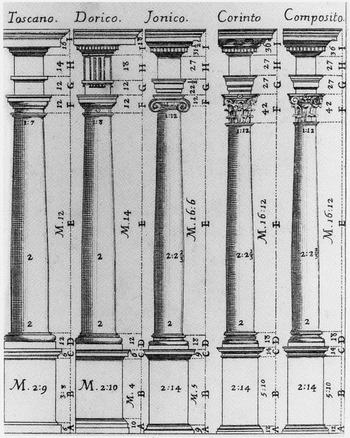
Since the treatise of Sebastiano Serlio (1475–1554), published in 1537, it became common to depict the different Orders of columns synoptically (Figure 3). The scheme after Giacomo Barozzi da Vignolaʼs (1507–1573) interpretation is a masterful and precisely plotted example (Figure 4). Modern comparative synoptic diagrams (Figure 5) elucidate the great variety in interpreting the symmetriae of the very same Ionic Order by later architects, but we will not discuss them in detail (Chitham Reference Chitham1985; Chitham Reference Chitham1987).
Sebastiano Serlio: Synoptical depiction of the five orders of columns, xylography of his treatise Libro quarto …. Regole generali di architettura di Sebastiano Serlio sopra le cinque maniere degli edifici, cioè, Thoscano, Dorico, Ionico, Corinthico, e composito: con gli essempi de l’antiquita, Venetia 1537;

Giacomo Barozzi da Vignola: Synoptical depiction of the five orders of columns, copper engraving.

Modern comparison of different solutions for the ionic order from Vitruvius to William Chambers in synoptical depiction; along Robert Chitham (Reference Chitham1987).

From Symmetria to the Modern Concept of Mirror Symmetry
But when and how did this antique concept of symmetria as commensurability change into our modern notion of symmetry as a mirror-imaged correspondence of elements? Walter Kambartel has drawn our attention to the French architect and theorist Claude Perrault (1613–1688), best known for his participation in the design of the east façade of the Louvre in Paris and for his rigorous cool classicism (Kambartel Reference Kambartel1972: 37–63; Petzet Reference Petzet2000; Herrmann Reference Herrmann1973). Besides his influential architecture, he also achieved fame and success as a physician and anatomist, as well as an author who wrote treatises on physics and natural history. But Perrault (Reference Perrault and McEwen1993) contributed also to the discussion of beauty and correctness of the classical orders with his treatise Ordonnance des cinq espèces de colonnes selon la méthode des anciens from 1683. Contrary to his colleague Nicolas-François Blondel (ca. 1618–1686), Perrault was of the opinion that beauty was not based on divine and everlasting rules (beautez positive) which could be found only in the ruins of ancient temples, but that beauty was based on time-dependent changing agreements undertaken by humans (beautez arbitraires). He, therefore, felt free to propose a system of quite simple and integral values for the module in order to proportion the columns, instead of the complicated system of the Vitruvian symmetriae described above. Equally well known is his translation of the Ten Books of Vitruvius into French, written at the instigation of Jean-Baptiste Colbert (1819–1683), the famous French Minister of Finance, who was also an important promoter of culture and Superintendent of Buildings (Blunt Reference Blunt1980, 321–326). Perraultʼs annotated translation was published in 1673 and again in 1684. It is considered to be the best and most important French translation of this classic text (Perrault Reference Perrault1673; Perrault Reference Perrault1684; Perrault Reference Perrault1967). As Kambartel demonstrated, Perrault here used the modern notion of axial-symmetry. In his comments on Vitruvius’ famous passage on the basic elements of architecture (I, 2, 1-5), he distinguished between a ‘Symmetria […] en Grec & en Latin’ and a ‘Symmetrie en François’ (Perrault Reference Perrault1673, 10, note 3). In his translation, Perrault uses the first term to describe the complex Vitruvian system of subdividing the measures of the Orders of columns and employs the word proportion instead of symmetria for it, while Vitruvius (III, 1, 1), as we have seen, clearly distinguished proportio, ‘quae graece analogia dicitur’ from symmetria. Perraultʼs ‘Symmetrie en François’ instead describes mirror-imaged ground plans as well as façades (Figure 1). Hence, there occurs a radical reinterpretation in the concept of symmetry.
As Wolfgang Herrmann has pointed out, this new and somewhat simplified concept of symmetry in fact emerged into general use in France much earlier than Perrault in the work of the architects Pierre Le Muet (1591–1669) and Louis Savot (1570–1640). In their respective treatises of 1623 and 1624, they too employed the term to describe the correspondence of architectonic elements on the right and on the left side of the central axis of a façade.Footnote 3 The French mathematician, physicist, philosopher, and religious thinker Blaise Pascal (1623–1662) also used the word symmetry in the sense of correspondence (Hon and Goldstein Reference Hon and Goldstein2008, 125–127). Apparently, in seventeenth-century France, this was already the common meaning of the word. Only when scholars faced up directly to the Vitruvian source, as did Perrault, did the discrepancy between the classic concept of symmetria and the current notion of symmetry in their own time come to light.
But Perrault and his French colleagues even had important Italian precursors in the fifteenth and sixteenth centuries. First of all, we here have to mention Leon Battista Alberti. Even though Alberti was entirely familiar with the Vitruvian concept of symmetria, he rejected the use of this and other terms borrowed from Greek such as eurythmia, taxis, diathesis, or oikonomia, although they played a cardinal role in Vitruvius’ definition of the fundamentals of architecture. Alberti criticised Vitruvius’ use of those words and concepts, because in his opinion they were difficult to understand. Wanting to avoid a mixture of Greek and Latin terminology, Alberti searched for alternative terms. Instead of symmetria, used by Vitruvius 79 times (Nohl Reference Nohl1876, 130–131), Alberti preferred proportio (proportion), which is not identical to the same word in the Vitruvian nomenclature, as was stated above. In parallel to Vitruvius, who saw the beauty of a human or of an architectonic body founded in its good symmetriae, Alberti described the beauty of a building based on its good proportions. In addition, regarding the localization of the architectonic elements, Alberti claimed the ‘correspondence principle’. Windows and doors had to be constructed in the same manner but in odd numbers, with the middle ones accentuated by their larger dimensions. Giora Hon and Bernard Goldstein in their meticulous study point out that Alberti used the word respondere, found in Vitruvius in the context of his symmetriae but related it to the concept of correspondence (Hon and Goldstein Reference Hon and Goldstein2008, 112–113). This aesthetic principle was the leading idea of Alberti in his original project for the façade of the Rucellai palace in Florence (Figure 6). The front of the building is designed in complete correspondence to architectonic elements on the left and on the right side of the slightly wider apertures on the middle axis. It is thus obvious that it was Alberti who provided a description of a distinct precept which was later called axial symmetry or mirror symmetry.
Leon Battista Alberti: Palazzo Ruccellai, first project of 1455; along Franco Borsi, Reference Borsi1975.

From Alberti onward, the term proportio began to replace the Vitruvian concept of symmetria. Albrecht Dürerʼs (1471–1528) Vier Bücher von menschlicher Proportion (1528) is an early example for that semantic development (Dürer and Steck Reference Dürer and Steck1969). As treatises on architecture in the sixteenth century were more and more often illustrated with woodcuts or copper engravings, many of them commented on the discussions on beauty and on correct proportioning by featuring buildings showing an axial correspondence. An instance of this can be observed in the Italian architect and theorist Sebastiano Serlio (Reference Serlio1584), who in his Fourth Book on architecture, published for the first time in 1537, explicitly claimed that symmetry (simmetria) and proportioned correspondence (corrispondenza proportionata) were the very same thing. Vincenzo Scamozzi (1548–1616) published his L’idea della architettura universale in Venice in 1615. It was the last comprehensive treatise on architecture. In it he commented on the Vitruvian passage (I, 2) as follows:
Correspondence which the Greeks and Latins called symmetry concerns the general form of the building as well as the distribution of its parts; they have an appropriate disposition and correspondence with the whole and with each other, just as the parts of a well made and proportioned natural body. (Scamozzi Reference Scamozzi1997)
Any subtle differentiation of symmetria, proportio, distribution, disposition and corrispondenza made by Vitruvius and by Alberti has here disappeared. The passage prepares the way for the new concept of axial symmetry or mirror symmetry considered as a guarantee for beauty. As we have seen, the concept was explored by the French architects in the seventeenth century. Apparently, the term French Symmetry (Symmetrie en François) for this concept was Claude Perraultʼs invention. It arose from a strong national aplomb, which dominated the cultural climate in the years of the reign of Louis XIV and finally resulted in the Quarrel of the Ancients and the Moderns. This public debate, provoked by Claudeʼs younger brother, Charles Perrault (1628–1703), concerned the problem of the authority and dominance of the cultural products of Antiquity, on one hand, and the independence and proper cultural values of the Moderns, on the other (Rigault Reference Rigault1965; Mayer Reference Mayer2012). Insisting on a modern concept of axial symmetry, anticipated by his Italian colleagues, Perrault inscribed the so-called French Symmetry in the vast cultural discussions of his time. At the end, the much more complicated Vitruvian concept fell into disuse and disappeared into oblivion, while the simplified concept of correspondence-symmetry had a monumental success in all disciplines, not merely in architecture.
About the Author
Hans W. Hubert, Prof. Dr., studied art history, classical archaeology, philosophy and library science in Berlin (Freie Universität). He spent 18 years in various academic positions in Italy (Florence, Bologna and Rome). He is a distinguished scholar of Italian architecture and art from the medieval to early modern periods and their impact on and relation to art theory. His published books and articles focus mainly on late mediaeval as well as Renaissance architecture and sculpture. He was awarded several fellowships, among them one at the Center for Advanced Study in the Visual Arts (CASVA) in Washington, DC. Having filled positions at several universities in Germany, in 2005 he accepted a professorship at the Department of Art History at the Albert Ludwig University in Freiburg (Germany). He is involved in the Collaborative Research Centre (CRC) 1015 ‘Otium. Boundaries, Chronotopes and Practices’ as well as the CRC 948 ‘Heroes, Heroisations, Heroisms’.