Introduction
Ehlers–Danlos syndrome describes a group of inheritable connective tissue disorders involving defects in collagen and connective tissue synthesis. It is typically characterised by joint laxity, skin hyperextensibility and tissue fragility. It has been classified in numerous ways, with the latest 2017 classification describing 13 subtypes.Reference Malfait, Francomano, Byers, Belmont, Berglund and Black1 The different subtypes all have their own associated genetic basis, unknown in some cases, and each subtype has major and minor clinical criteria (determined based on a criterion's diagnostic specificity).Reference Malfait, Francomano, Byers, Belmont, Berglund and Black1
Ehlers–Danlos syndrome can affect multiple organ systems, with musculoskeletal, vascular and gastrointestinal symptoms being common.Reference Callewaert, Malfait, Loeys and De Paepe2,Reference Kishore, Backhouse, Rook, Butler, Osborne and Fikree3 However, there are relatively few reports of laryngological presentations of Ehlers–Danlos syndrome, and these predominantly consist of case reports and case series.
Patient-reported outcome measures are often used to characterise symptom severity and are also used to monitor treatment progress. In laryngology, tools such as the Eating Assessment Tool, Reflux Symptom Index and Voice Handicap Index are commonly used. The Eating Assessment Tool is a validated, self-administered, symptom-specific outcome questionnaire for dysphagia that is widely used in the initial assessment of dysphagia severity and subsequent monitoring of treatment effectiveness.Reference Belafsky, Mouadeb, Rees, Pryor, Postma and Allen4 The Reflux Symptom Index is a validated and self-administered tool for assessing the severity of laryngopharyngeal reflux.Reference Belafsky, Postma and Koufman5 The Voice Handicap Index is used to measure the psychosocial handicapping effects of voice disorders.Reference Jacobson, Johnson, Grywalski, Silbergleit, Jacobson and Benninger6 However, these tools have not been validated for patients with Ehlers–Danlos syndrome.
This study aimed to characterise the laryngological presentations of Ehlers–Danlos syndrome in our patient cohort and conduct a preliminary exploration of patient-reported outcome measures in this population. A literature review was performed to summarise the laryngological presentations of Ehlers–Danlos syndrome that have previously been described.
Materials and methods
Retrospective data were collected from patients with a diagnosis of Ehlers–Danlos syndrome who were seen in laryngology clinic by the senior author between 2005 and 2019. Only patients with a clinical diagnosis of Ehlers–Danlos syndrome (any subtype) prior to presentation at the laryngology clinic were included. Patients without record of laryngological presenting symptoms were excluded. Details of patient demographics, date of first presentation to the clinic, Ehlers–Danlos syndrome subtype, presenting symptoms and patient-reported outcome measures were collected. The patient-reported outcome measures used were the Eating Assessment Tool, Reflux Symptom Index and Voice Handicap Index. Microsoft Excel® spreadsheet software was used to analyse the data collected.
The literature search was conducted on 22 October 2020, on the PubMed/Medline (from inception to 22 October 2020) and Ovid Embase databases (1974 to 22 October 2020). The following Boolean search was performed: #1 "Larynx"[Mesh]; #2 “airway obstruction”[Mesh]; #3 “laryn*”[tw]; #4 "Ehlers-Danlos Syndrome"[Mesh]; #5 “EDS”[tw]; #6 “Ehlers-Danlos”[tw]; #7 “Ehler*”; #8 “Danlos”[tw]; #9 "Patient Reported Outcome Measures"[Mesh]; #10 “Patient Outcome Assessment”[Mesh]; #11 “Patient Reported Outcome Measure”[tw]; #12 “PROM*”[tw]; #13 #1 OR #2 OR #3; #14 #4 OR #5 OR #6 OR #7 OR #8; #15 #9 OR #10 OR #11 OR #12; #16 #13 AND #14; #17 #13 AND #14 AND #15.
Studies describing laryngological presentations in patients with Ehlers–Danlos syndrome were included. Conference abstracts and studies without full text were excluded. Search term #16 aimed to find studies with laryngological presentations of Ehlers–Danlos syndrome and search term #17 aimed to identify studies that described patient-reported outcome measures in this population.
This study only collected de-identified anonymised data and is classed as a service evaluation. Using the National Health Service Health Research Authority and UK Research and Innovation Medical Research Council decision tool,7 it was determined that ethical approval was not required for this study.
Results
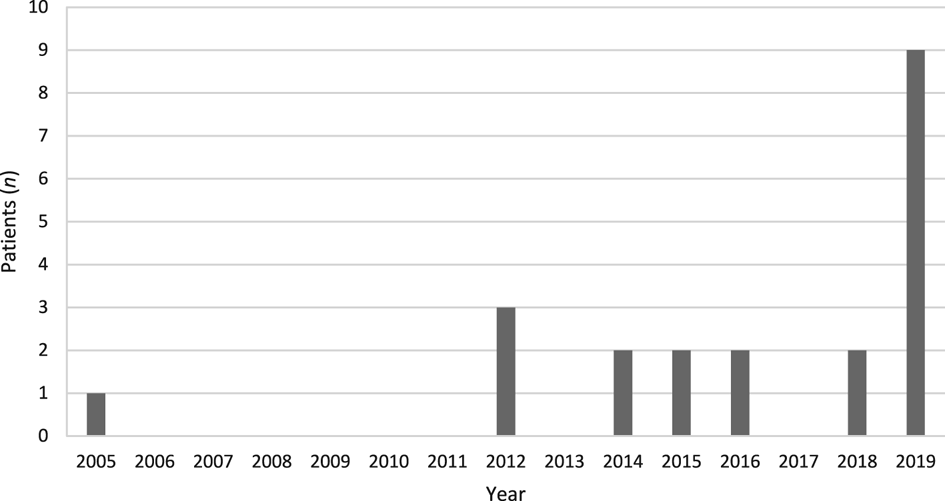
In total, 21 patients met the inclusion criteria for our case series: 3 males and 18 females, with a median age of 47 years (range = 16–67 years) at first presentation to the clinic. Nine patients first presented to the clinic in 2019, representing a substantial increase on previous years (Figure 1).
Chart showing the number of patients with Ehlers–Danlos syndrome presenting to the senior author's laryngology clinic by year.

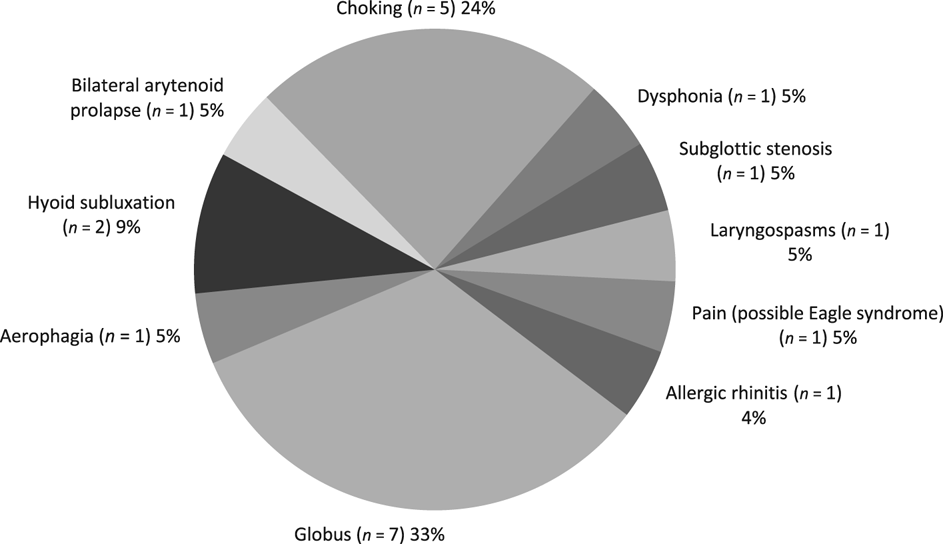
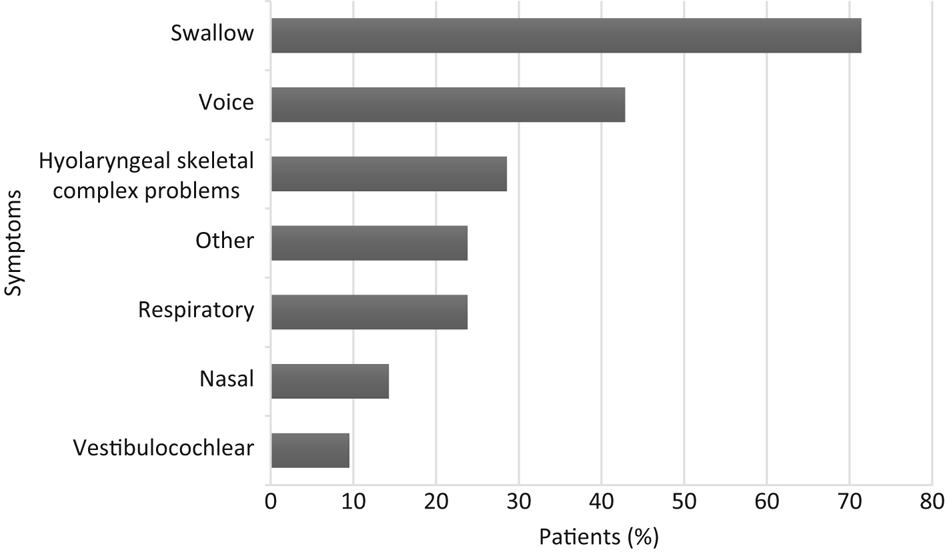
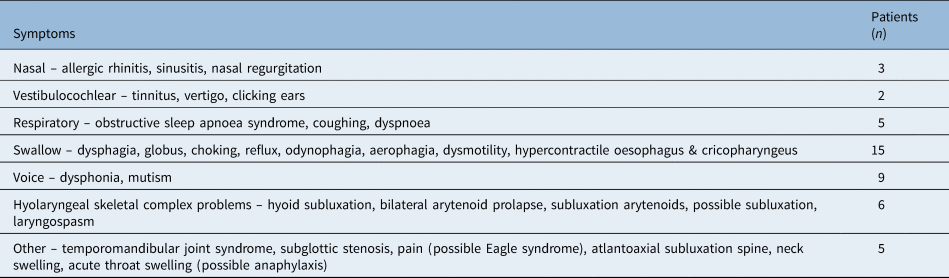
Twenty patients had a diagnosis of Ehlers–Danlos syndrome hypermobility; one patient had a diagnosis of Ehlers–Danlos syndrome dermatosparaxis. The commonest first presenting symptoms were globus (seven patients), choking (five patients) and hyoid subluxation (two patients) (Figure 2). All symptoms reported by patients were grouped (Table 1). This showed that symptoms related to swallowing were commonest (15 patients; 71.4 per cent), followed by voice symptoms (9 patients; 42.9 per cent), hyolaryngeal skeletal complex problems (6 patients; 28.6 per cent), respiratory symptoms (5 patients; 23.8 per cent), nasal symptoms (3 patients; 14.3 per cent), vestibulocochlear symptoms (2 patients; 9.5 per cent) and other symptoms (5 patients; 23.8 per cent) (Figure 3).
Chart showing the first presenting symptom reported by patients presenting to the senior author's laryngology clinic.

Chart showing the percentage of patients experiencing each symptom by group.

All laryngological symptoms reported by patients

Patient-reported outcome measures data were available for eight patients (38 per cent). The results showed large variations in the Reflux Symptom Index (median = 25.5; range = 0–33), Eating Assessment Tool score (median = 21.5; range = 0–35) and Voice Handicap Index (median = 21.5; range = 0–104).
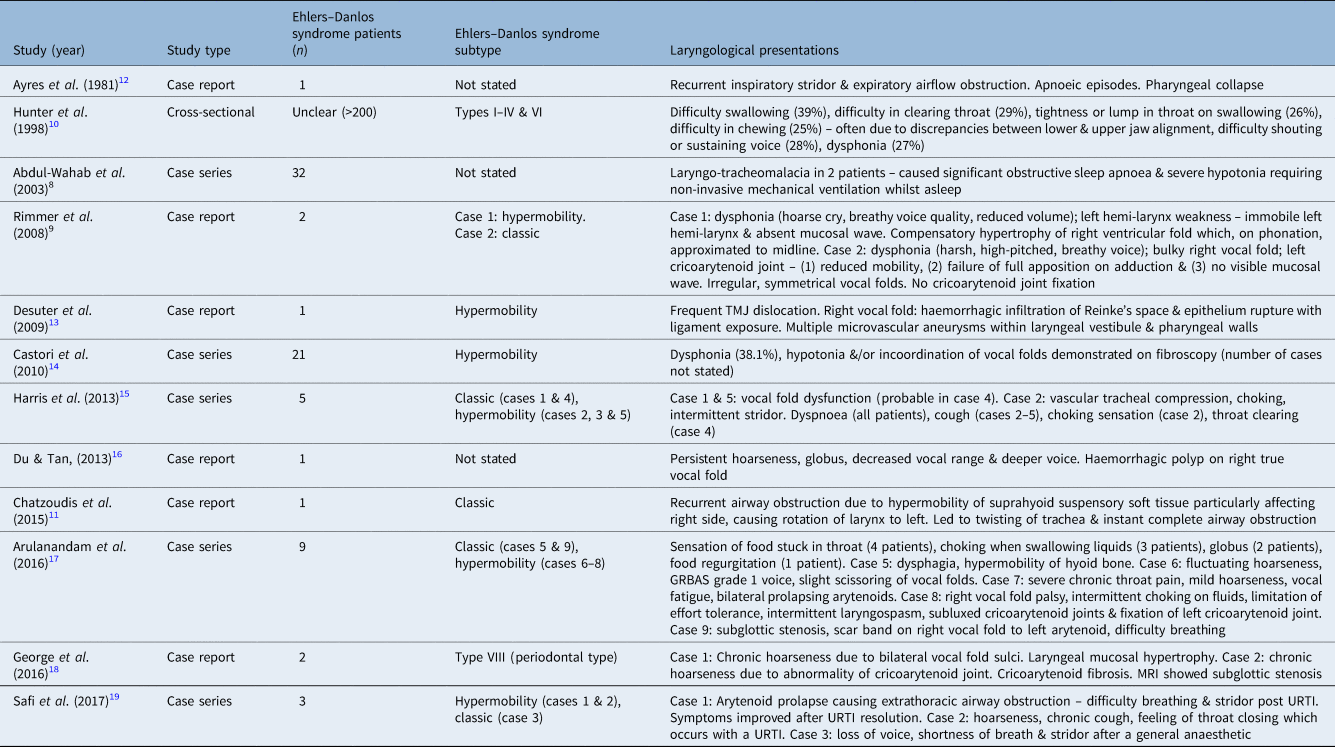
Search term #17 yielded six studies, of which only one described laryngological presentations in Ehlers–Danlos syndrome patients, but it did not have relevant patient-reported outcome measures data.Reference Abdul Wahab, Janahi, Eltohami, Zeid, Faiyaz Ul Haque and Teebi8 Search term #16 yielded 116 studies, of which 6 instances of study duplication were identified, and a further 4 studies were identified from reference lists. In total, 12 studies met our inclusion criteria, involving at least 278 patients with Ehlers–Danlos syndrome, of which at least 91 patients with laryngological presentations were reported. The results of the literature review are summarised in Table 2.Reference Abdul Wahab, Janahi, Eltohami, Zeid, Faiyaz Ul Haque and Teebi8–Reference Hirano20
Summary of laryngological presentations of disease in patients with Ehlers–Danlos syndrome from our literature review

TMJ = temporomandibular joint; GRBAS = grade, roughness, breathiness, asthenia and strain scale;Reference Hirano20 MRI = magnetic resonance imaging; URTI = upper respiratory tract infection
Discussion
Ehlers–Danlos syndrome is usually diagnosed in young adults, although clinical manifestations of the disease, including laryngological symptoms, may begin in childhood.Reference Rimmer, Giddings, Cavalli and Hartley9 Textbooks often report the prevalence of Ehlers–Danlos syndrome as 1 in 5000 births. A recent study in the Danish population also reported a prevalence of 1 in 5000 births.Reference Søborg, Leganger, Mortensen, Rosenberg and Burcharth21 However, this incidence increases with increased awareness amongst physicians, and a 2019 study found that diagnoses of Ehlers–Danlos syndrome and joint hypermobility syndrome have been steadily increasing over the past 27 years.Reference Callewaert, Malfait, Loeys and De Paepe2,Reference Demmler, Atkinson, Reinhold, Choy, Lyons and Brophy22 Our findings are consistent with this trend, as we report a substantial increase in the number of Ehlers–Danlos syndrome cases that presented to the laryngology clinic in 2019 compared with previous years (Figure 1).
In our case series, there was a large range in the ages of the patients presenting to the laryngology clinic, with a median age of 47 years. Of the 21 patients in our case series, 18 (85.7 per cent) were female and 3 (14.3 per cent) were male; in comparison, there were 73.9 per cent females and 26.1 per cent males in the Danish study.Reference Søborg, Leganger, Mortensen, Rosenberg and Burcharth21 In our literature review, Rimmer et al. reported two paediatric cases of Ehlers–Danlos syndrome with reported symptoms of dysphonia within 18 months of birth; these patients first presented to the paediatric voice clinic at ages 14 years and 6 years, respectively.Reference Rimmer, Giddings, Cavalli and Hartley9 Hunter et al. reported a mean age of 45.5 years (range = 1.5–80 years) in their study which asked patients with Ehlers–Danlos syndrome about difficulties with their voice.Reference Hunter, Morgan and Bird10 These examples in the literature suggest that whilst Ehlers–Danlos syndrome is usually diagnosed in young adults, clinicians should be aware of early laryngological signs of Ehlers–Danlos syndrome presenting in childhood, as well as late presentations, as demonstrated by the large age range.
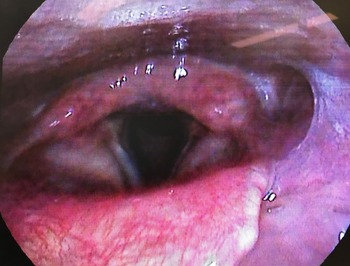
In our case series, swallowing and voice symptoms were reported in 71.4 per cent and 42.9 per cent of patients, respectively (Figure 3). This is higher than previous figures reported in the literature.Reference Hunter, Morgan and Bird10 The third most common group of presenting symptoms were hyolaryngeal skeletal complex problems (28.6 per cent). Ehlers–Danlos syndrome patients commonly experience musculoskeletal issues, which in the throat manifest as hyolaryngeal skeletal complex problems, as collagen defects are found throughout the body (Figure 4). The vocal folds are composed of epithelium, vocal muscle, and three layers of lamina propria consisting of different distributions of collagen, including collagen type I and type III, which are adversely affected in Ehlers–Danlos syndrome.Reference Bühler, Sennes, Tsuji, Mauad, Ferraz Da Silva and Saldiva23 Ehlers–Danlos syndrome may also affect synovial joints in the larynx, such as the cricoarytenoid joints, which have been reported to be affected in rheumatoid arthritis.Reference Kamanli, Gok, Sahin, Kaygusuz, Ardicoglu and Yalcin24
Image showing wide excursion of the arytenoids on sniffing in one of the patients in our case series.

Our literature review included case reports that also mention hyolaryngeal skeletal complex problems. Chatzoudis et al. reported a case of a 44-year-old woman with classical Ehlers–Danlos syndrome presenting with recurrent airway obstruction because of hypermobility of the suprahyoid suspensory soft tissues.Reference Chatzoudis, Kelly, Lancaster and Jones11 Ali et al. reported a case of a 48-year-old woman with Ehlers–Danlos syndrome type III (hypermobility type) presenting with dyspnoea and aphonia 1 day after anterior cervical discectomy.Reference Ali, Al Ahwel, Milad, Rehman, Safi and Assaly25 On direct laryngoscopy, the vocal folds appeared normal, but on inspiration, the arytenoids were observed to have hyperlaxity and obstruct the airway.Reference Ali, Al Ahwel, Milad, Rehman, Safi and Assaly25 However, neither of these studies reported patient-reported outcome measures data. In our case series, six patients (28.6 per cent) reported hyolaryngeal skeletal complex problems, including arytenoid prolapse, arytenoid subluxation and hyoid subluxation (Table 1). We had patient-reported outcome measures data for four of these patients, with median values of 29 (range = 0–33) on the Reflux Symptom Index, 28.5 (range = 0–35) on the Eating Assessment Tool and 21.5 (range = 0–32) on the Voice Handicap Index.
The term ‘Patient Reported Outcome Measures’ was indexed in the Ovid version of the Medline database in 2017, and was previously indexed under the term ‘Patient Outcome Assessment’. This perhaps explains the small number of studies reporting laryngological patient-reported outcome measures in patients with Ehlers–Danlos syndrome. In total, we had patient-reported outcome measures data for 8 of the 21 patients included in our study, showing a median Reflux Symptom Index of 25.5 (range = 0–33), median Eating Assessment Tool score of 21.5 (range = 0–35) and median Voice Handicap Index of 21.5 (range = 0–104). The large range in our patient-reported outcome measures data may suggest that our patients presented with varying degrees of symptom severity or that these symptoms had different effects on our patients’ quality of life. It could also be reflective of possible limitations of the Reflux Symptom Index, Eating Assessment Tool and Voice Handicap Index tools at assessing symptom severity in the Ehlers–Danlos syndrome population.
At present, no patient-reported outcome measure tools characterising laryngological symptoms have been validated in the Ehlers–Danlos syndrome patient cohort. This is important, as living with Ehlers–Danlos syndrome has a significant impact on a patient's quality of life. In one study, females with Ehlers–Danlos syndrome rated their physical functional health status as being worse than those with fibromyalgia on the Sickness Impact Profile.Reference Berglund and Nordström26 With the number of Ehlers–Danlos syndrome patients presenting to laryngology clinic possibly increasing (Figure 1), accurate tools to characterise symptom severity and its effects on patients’ quality of life are needed urgently.
Our study limitations include the small number of patients and the incomplete patient-reported outcome measures dataset from our patient cohort. The retrospective nature of our study does not allow us to monitor symptom progression, and future prospective studies involving patient-reported outcome measure assessments at multiple points in time are recommended. Furthermore, we used three different patient-reported outcome measure tools in our study that have not been validated in the Ehlers–Danlos syndrome patient cohort; hence, the effectiveness of these tools for characterising symptom severity is unknown.
• In our case series, swallowing symptoms were the commonest reported symptoms
• In Ehlers–Danlos syndrome, musculoskeletal issues in the throat can manifest as hyolaryngeal skeletal complex problems
• Patient-reported outcome measures are important for characterising symptom severity and its effects on quality of life
• At present, no patient-reported outcome measure tools characterising laryngological symptoms have been validated in Ehlers–Danlos syndrome patients
Conclusion
We present a case series characterising laryngological presentations of Ehlers–Danlos syndrome, with preliminary exploration of patient-reported outcome measures. We report a substantial increase in the number of Ehlers–Danlos syndrome patients seen in a laryngology clinic in 2019. Swallowing symptoms were the most common presenting complaint in our case series. Ehlers–Danlos syndrome patients commonly experience musculoskeletal issues, which in the throat manifest as hyolaryngeal skeletal complex problems, as reflected by the patients reporting such symptoms in our study and in our literature review. Future studies with larger patient numbers are required to validate the patient-reported outcome measures used in this study for Ehlers–Danlos syndrome patients.
Competing interests
None declared