The yellow-throated marten, Martes flavigula, is the only living species of the genus Martes found in subtropical and tropical forests (Harrison et al. Reference HARRISON, FULLER and PROULX2004). It is distributed throughout central and southern Asia in a wide variety of habitats. Despite its extensive geographical range, the ecology and behaviour of this species has so far received little attention, aside from a study of habitat use (Grassman et al. Reference GRASSMAN, TEWES and SILVY2005). Studies on other martens have shown that fruits are an important food resource (e.g. M. martes, Bermejo & Guitian Reference BERMEJO and GUITIAN2000; M. foina, Pandolfi et al. Reference PANDOLFI, DE MARINIS and PETROV1996). Thus, they are considered to be important potential seed dispersers (Corlett Reference CORLETT1998, Herrera Reference HERRERA1989, Willson Reference WILLSON1993), as confirmed by recent studies (M. melampus, Otani Reference OTANI2002; M. americana, Hickey et al. Reference HICKEY, FLYNN, BUSKIRK, GEROW and WILLSON1999; M. foina and M. martes, Schaumann & Heinken Reference SCHAUMANN and HEINKEN2002). Although no systematic study of the diet of M. flavigula has been conducted (Harrison et al. Reference HARRISON, FULLER and PROULX2004), it is known to be omnivorous and to consume fruit (Gao & Wang Reference GAO and WANG1987). To date, however, there has been no comprehensive study of frugivory and seed dispersal by M. flavigula (but see Corlett Reference CORLETT1998).
The present study reports on the seed dispersal behaviour of M. flavigula in a subtropical forest in central China based on faecal analyses, fruit morphology, and germination trials. Additionally, we tested the legitimacy of M. flavigula as a seed disperser by looking at the occurrence of viable apparently undamaged seeds in the faeces (Herrera Reference HERRERA1989). We also tested the effects of ingestion on seed germination, by comparing the proportion of defecated versus control seeds which germinated. The objective of this study was to establish: (1) What variety of seeds are transported by M. flavigula, and from which species? (2) Does fruit morphology affect fruit choice by M. flavigula? (3) What effects does gut passage have on germination?
The study was conducted in Hubei Houhe National Nature Reserve (N30°2′45″–8′40″, E110°29′25″–40′45″). The climate is subtropical, with a mean annual rainfall of 1814 mm and a mean air temperature of 11.5°C. The principal natural forest types within the reserve are coniferous, broad-leaved and bamboo. The dominant fruiting plants are members of the families Rosaceae, Moraceae and Cornaceae, which mature between August and November. Outside of these months, fruits are scarce (Song & Liu Reference SONG and LIU1999), although there are still some mature fruits available, such as Elaeagnus henryi, Fragaria orientalis and Hovenia dulcis. Plant names follow Flora Reipublicae Popularis Sinicae (Academia Sinica 2006). In addition to the yellow-throated marten, 20 other carnivore species have been reported from the area (Song & Liu Reference SONG and LIU1999). Recent studies (Thomas et al. Reference THOMAS, TIAN and GUI2004, Zhou et al., unpubl. data) indicate that black bear (Selenarctos thibetanus), hog badger (Arctonyx collaris), yellow-throated marten, Chinese ferret badger (Melogale moschata), Siberian weasel (Mustela sibirica), yellow-bellied weasel (M. kathiah), masked palm civet (Paguma larvata) and leopard cat (Felis bengalensis) are all quite common, but other species are rarely seen. Animal names follow Gao & Wang (Reference GAO and WANG1987).
Marten faeces were collected at 2-wk intervals, along 20 transects (2.72 ± 0.40 km long and 4 m wide) from September–November 2004, and April 2005–May 2006. Faeces were identified by size/diameter, shape, texture, nearby tracks/field-signs, e.g. presence of hair and characteristic odour. Marten faeces are smaller than bear faeces but usually larger than those of sympatric ferret badgers and weasels (faeces diameter: marten 5–20 mm; bear > 40 mm; ferret badgers and weasels < 10 mm). Yellow-throated marten faeces were easily distinguished from hog badger due to their characteristic odour and conformation. Similarly, they could be distinguished from those of leopard cat and civets by characteristic shape and odour, determined by comparing scats to a reference collection from zoo specimens as well as from feeding trials at the outset of the study. Additionally, the presence of hairs in the faecal samples could be also used to differentiate species. Although we used multiple techniques to differentiate samples, faeces that could not be identified categorically were excluded from the analyses. This minimized the probability of misidentifying marten faeces with those of other carnivores. Labelled samples were air-dried at room temperature in a south-east-facing window for 4 wk. In the laboratory, seeds were extracted from the faeces by sieving through a nylon mesh (0.5 mm) and then counted according to species. Seeds were identified against a reference collection and in consultation with specialists.
During 2005, the morphological characteristics of mature fleshy fruits from 23 species, consisting of 12 woody and six liana species, were measured. Another 31 fleshy-fruited species were found occasionally during the study, but were not included in the study because of the rarity of mature fruits of these plants at the study site. Characteristics measured included: length of fruit/seed, wet weight of fruit/seed, ripe fruit colour, number of seeds in a fruit, and percentage pulp from fresh weight. For each species, more than 200 ripe fruits were collected from 40 trees, and 100 fruits and 100 seeds (excepted for Actinidiaceae) were chosen and measured. For species belonging to the Actinidiaceae, due to small seed size, we measured five replicates of 50 seeds as a sampling unit to determine seed weight. In order to calculate percentage fruit-pulp, pulp was removed manually and the total wet mass of pericarp and seeds (MPS) was measured. The MPS was then subtracted from the wet mass of the fruit to obtain the wet mass of the fruit pulp. To estimate the efficacy of seed dispersal by M. flavigula, additional fruits were selected and the pulp removed by hand to be used in germination experiments. All seeds (N > 100 for each species) were air-dried at ambient temperature for a minimum of 4 wk and stored in an air-tight bag until the germination experiment could be conducted. As these data were not normally distributed, non-parametric tests were used to examine fruit and seed selection. Spearman rank correlations were performed to explore the relationship between the frequency of occurrence and morphological characteristics of the species of seeds found in each faecal sample. To test for morphological differences between foraged (i.e. occurring in faecal samples) vs. un-foraged fruits (i.e. occurring in the study site but not in faecal samples), we employed Mann–Whitney U-tests (except for fruit colour, which was tested using Chi-squared). Due to the seasonal ripeness of fruits in our study site (Song & Liu Reference SONG and LIU1999) M. flavigula shows seasonality in foraging patterns. Consequently, we used month as a sample unit to examine morphological differences between foraged vs. un-foraged fruits. The means of morphological characteristics for foraged vs. un-foraged fruits were calculated and compared using the Wilcoxon Signed Ranks test (WSR test). To ascertain selection of individual seeds within the same plant species, length and weight of dispersed seeds were compared with seeds collected from ripe fruits on the parental tree (using t-tests).
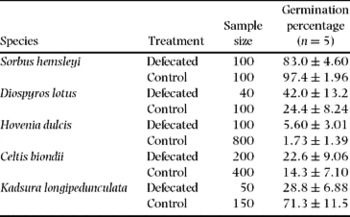
To assess the efficiency of seed dispersal by M. flavigula, we conducted a germination trial, where we compared the germination success of eight common species found in the faeces with seeds of the same species obtained directly from parent plants. This experimental design varied with the availability of ingested seeds (Table 1). Seeds were placed in Petri dishes containing moist filter paper. Five replicate sets of each species were placed in five incubators. All Petri dishes were inspected and watered daily and germinated seeds were counted and removed when the radicle reached 2 mm long and had a normal appearance, to reduce possible effects on ungerminated seeds. The germination process was monitored for 6 mo. In the last months, no visible live radicles were observed, except for 4 seeds of C. biondii and H. dulcis.
Percentage germination of seeds obtained from faeces of yellow-throated martens and from parental plants in Hubei Houhe National Nature Reserve, China.

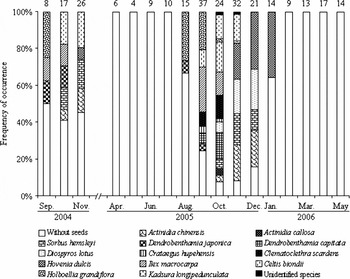
Overall, 38,643 seeds from 13 plant species were recovered from 120 of 276 faeces collected (with 4 seeds from undetermined species in addition). All seeds found in faeces were intact, except for some damaged seed coat remains of K. longipedunculata seeds in two samples. Seed-bearing faeces were collected between August and January; the number of seed-bearing faeces varied from the lowest (33%) in August 2005 to the highest (83%) in October 2005. Seeds were mainly defecated from September to December (92%). For the five species occurring most frequently, there was an overlap in the period of occurrence (Figure 1). Seeds present in greatest abundance were those of Actinidia chinensis (9262 seeds), followed by Sorbus hemsleyi (6980) and H. dulcis (3924).
Percentage of faeces with and without seeds of different key species for each month. Numbers above the bars indicate numbers of faecal samples.

Compared with control species, the colour of fruits eaten by yellow-throated martens showed significant evidence of selectivity (χ2[4] = 5.01, P = 0.013). Martes flavigula preferentially selected black, khaki and yellow fruits. No other statistically significant trends in fruit selection were observed (Spearman's rank correlation tests: r = 0.11–0.30, P = 0.35–0.74; Mann–Whitney tests: Z = 0.03–0.90, P = 0.38–0.97; WSR tests: Z = 0.94–1.15, P = 0.25–0.92), except for a positive trend in the numbers of seeds per fruit consumed, when corrected for months (WSR test: Z = 2.20, P = 0.028). Martes flavigula selected multi-seeded fruit species. Species rich in percentage of fruit-pulp (>50%) were favoured by M. flavigula, with the exceptions of Ilex macrocarpa and K. longipedunculata, which have relatively low percentages of fruit-pulp, but have very sweet fruits. The fruiting season of species eaten by yellow-throated martens appears to last for 2–3 mo (Figure 1). There was no selection for individual seeds within the same plant species (t-test: P > 0.05), except for the largest-seeded species (D. lotus), where only the smallest seeds were ingested (seed length: t = 3.48, P = 0.001; seed weight: t = 2.70, P = 0.008).
Six out of the eight principal seed species germinated. All seeds of I. macrocarpa and Holboellia grandiflora became infected by fungus within the first month, preventing germination. For A. chinensis, only a total of 32 seeds from the foraged and control samples germinated, hence it was not possible to undertake meaningful analyses. Ingestion and gut transit significantly enhanced germination of D. lotus, C. biondii and H. dulcis compared to the control samples (WSR test: P < 0.05). Conversely, gut transit inhibited the percentage of seeds germinating for S. hemsleyi and K. longipedunculata (WSR test: P < 0.05) (Table 1).
Faecal analysis revealed that fruits were the most common food item in the diet of M. flavigula between September and December. Previous studies on other Martes species also indicated that fruits are a major dietary component (e.g. M. martes, Bermejo & Guitian Reference BERMEJO and GUITIAN2000; M. foina, Pandolfi et al. Reference PANDOLFI, DE MARINIS and PETROV1996) reflecting seasonal patterns in fruit availability (Jordano Reference JORDANO and Fenner2000). In our study area, seed-bearing faeces peaked in October and November, coinciding with the fruiting season of preferred plant species (Song & Liu Reference SONG and LIU1999).
The finding that Martes flavigula selects black, khaki and yellow fruits is consistent with previous studies (Herrera Reference HERRERA1989, Willson Reference WILLSON1993). Otani (Reference OTANI2002) found that the Japanese marten appeared to favour fleshier fruits; here we observed that M. flavigula displayed a similar tendency, although this was not statistically significant. Similar fruit choice criteria have also been reported for other carnivorous mammals (Herrera Reference HERRERA1989). Preference for multi-seeded fruit species, and the occurrence of only the small seeds of the largest-seeded species in faeces, indicates that seed size could potentially limit seed dispersal by the yellow-throated marten. This might result from their relatively small gape, which may limit their capacity to ingest and masticate large seeds (Jordano Reference JORDANO and Fenner2000). Alternatively the cause may be from the trade-off between seed size and reward (Stevenson et al. Reference STEVENSON, PINEDA and SAMPER2005).
Gut transit in carnivores usually enhances, or is benign to seed germination (Traveset Reference TRAVESET1998). For D. lotus, C. cerasifera and H. dulcis germination was enhanced after gut passage. This may be a consequence of the reduction of the seed coat by abrasion and chemical decomposition (Schaumann & Heinken Reference SCHAUMANN and HEINKEN2002), thus increasing seed permeability to water and possibly oxygen (Traveset Reference TRAVESET1998). However, some recent studies have also shown that passage through carnivore guts sometimes inhibits seed germination (Graae et al. Reference GRAAE, PAGH and BRUUN2004); for example for the seeds of S. hemsleyi and K. longipedunculata this may be the case. This is probably due to the very thin seed coats of these two plants, which may get heavily reduced by abrasion and chemical decomposition during mastication and gut passage (Schaumann & Heinken Reference SCHAUMANN and HEINKEN2002), making them more susceptible to fungal infection (Graae et al. Reference GRAAE, PAGH and BRUUN2004).
Only a few seed coat remains were detected in faecal samples, indicating that, on the whole, yellow-throated martens were not destroying seeds during mastication and gut passage. This might be explained by the specific structure of carnivore sectorial teeth (Otani Reference OTANI2002). That seed germination occurred in six of the eight selected species supported the proposition that martens are legitimate seed-dispersers (to use the terminology of Herrera, Reference HERRERA1989). Frugivorous carnivores have frequently been described as the agents of long-distance seed dispersal (Corlett Reference CORLETT1998), due to their large home ranges and long gut retention times. Hickey et al. (Reference HICKEY, FLYNN, BUSKIRK, GEROW and WILLSON1999) showed that the American marten could transport seeds distances of 500 m or more. Likewise, M. flavigula could also serve as a long-distance seed disperser due to its relatively large home range size (7.2 ± 4.3 km2, Grassman et al. Reference GRASSMAN, TEWES and SILVY2005), and due to the long gut retention times observed in this genus (e.g. M. americana: 4–5 h, Hickey et al. Reference HICKEY, FLYNN, BUSKIRK, GEROW and WILLSON1999).
This study is the first systematic report of frugivory and the capacity for seed dispersal by M. flavigula in a subtropical forest. To further investigate the findings reported in this study, quantitative research on the microhabitat sites of faecal deposition versus plant establishment and seed predation should be conducted in order to evaluate the efficacy of the yellow-throated marten as a seed disperser. In tropical areas fruits are available throughout the year, but until now there have been no systematic studies on the diet of M. flavigula and their potential role as seed dispersers, despite them being very common in this habitat (Harrison et al. Reference HARRISON, FULLER and PROULX2004). Complementary studies in tropical areas are called for, in an effort to gain a more complete understanding of frugivory and seed dispersal by M. flavigula.
ACKNOWLEDGEMENTS
This study was financially supported by the 6th Framework Programme of the European Commission to S.Y. Zhang and supported from the Kadoorie Farm and Botanic Garden of Hong Kong to Y.B. Zhou. We are also indebted to the Trans-century training program foundation for the talents by the state education commission to X.M. Wang. We thank Professor Jin Chen, Professor Min Cao, Dr Feng Luo and Dr Zhan-Hui Tang for their assistance during field and lab work. We thank Professor Jian–Zhong Song for invaluable assistance in identification of prey, and Dr Lon I. Grassman for his help with reviewing literature. We also thank anonymous reviewers for constructive comments on the manuscript.