INTRODUCTION
Approximately 800 million people in the world are chronically hungry and a million more are living with micronutrient deficiency (FAO 2014). Many of these food-insecure and nutrient-deficient people live in forested regions (Sunderlin et al. Reference Sunderlin, Dewi, Puntodewo, Muller, Angelsen and Epprecht2008). Traditionally, forests have contributed to the production of food through ecosystem services and by providing wild foods (Mohamed-Katerere & Smith Reference Mohamed-Katerere and Smith2013; Vira et al. Reference Vira, Wildburger and Mansourian2015). However, with the development of ‘modern forestry science’, the paradigm of forest management has shifted towards commercial monoculture focusing on forest commodities such as timber or the conservation of biodiversity (Kennedy et al. Reference Kennedy, Thomas and Glueck2001). Yet studies continue to highlight the role of forests in food security. Forests not only supply a variety of foods such as fruits, vegetables, roots, nuts and meat, but also play a crucial role during food shortages and in the nutrition of poor people (Fay & Michon Reference Fay and Michon2005; Arnold et al. Reference Arnold, Powell, Shanley and Sunderland2011, p. 263). Moreover, forests also provide indirect contributions to food security by supplying fuelwood for household energy, provisioning ecosystem services and contributing to household income. The issue is therefore not whether forests contribute to food security or not; rather, the question is the extent to which ‘modern’ forest management practices have contributed to food security. As many of the world's poor depend on forests, it is important to explore how forests can improve food security.
The modern forest management paradigm in its informing of ‘new’ policies and institutions has failed to acknowledge the role of forests in food security in the first place by neglecting indigenous practices of obtaining food from forests. The emergence of debate regarding forest–food security connections gives recognition to and highlights the contributions of forests to food security. Vira et al. (Reference Vira, Wildburger and Mansourian2015) emphasized two challenges in this respect. First, under current approaches to forest governance such as community forestry, local people have limited access to forest resources in order to meet their basic food needs. These approaches have either promoted the commercial production of timber or focused on the conservation of biodiversity, both of which tend to restrict local populations from obtaining food from forests (Arnold et al. Reference Arnold, Powell, Shanley and Sunderland2011; Vira et al. Reference Vira, Wildburger and Mansourian2015). Second, improving forest–agriculture interactions in order to support food security is challenging because of the current disciplinary and management separation between the forest and agriculture sectors.
As the forest–food debate develops globally, even the most innovative practices relating to community-based forest management (CBFM) have come under critical scrutiny. CBFM has contributed to improve rural livelihoods (Agrawal et al. Reference Agrawal, Chhatre and Hardin2008) and has been appreciated for embracing indigenous practices as the foundations of its design and implementation (Gilmour & Fisher Reference Gilmour and Fisher1991). Thus, food security might have been assumed to be central to CBFM programmes (e.g. Arnold et al. Reference Arnold, Powell, Shanley and Sunderland2011). However, this does not seem to be the case, and recent studies have called for CBFM to respond to food security challenges and opportunities (Vira et al. Reference Vira, Wildburger and Mansourian2015). Hence, an important question emerges: why have the ‘successful’ CBFM programmes in many countries not made food security a central pillar?
This paper contributes in several ways to a wider debate on forest–food security linkages. The paper (1) reviews the policies and institutional factors determining the linkage between CBFM and food security; (2) assesses the role of ‘modern’ forestry science in guiding forest management policies and practices, thereby influencing the food security outcomes of CBFM; and (3) explores alternative knowledge pathways that might encourage conventional forestry science to be more sensitive to forest–food security linkages.
We draw on the World Food Summit's definition of food security that encompasses four dimensions – food availability, accessibility, utilization and stability (FAO 1996, p. 1) – and the work of Sen (1981) on poverty and hunger in India in order to offer deep insights into this issue. The notion of food security has shifted the debate of food security from the conventional production and supply-centric view towards an emphasis on distribution and access.
We analyse the community forest programme (CFP) of Nepal. Nepal's CFP is seen as successful because it has contributed to the restoration of once heavily degraded forests (Gautam et al. Reference Gautam, Webb, Shivakoti and Zoebisch2003; Niraula et al. Reference Niraula, Gilani, Pokharel and Qamer2013). The CFP has achieved an increased local supply of forest products (Thoms Reference Thoms2008), particularly fuelwood, which remains the principal source of household energy in rural Nepal (Malla Reference Malla2000). It has also contributed to the provisioning of ecosystem services that support subsistence farming (Adhikari et al. Reference Adhikari, Williams and Lovett2007; Marquardt et al. Reference Marquardt, Khatri and Pain2016). Yet the contribution of the CFP to poverty alleviation and equitable livelihood outcomes is more limited (Thoms Reference Thoms2008; Shrestha Reference Shrestha2012). Studies have raised concerns about equity in local decision-making and the beneficial distribution of the CFP (Neupane Reference Neupane2003; Shrestha & McManus Reference Shrestha and McManus2008; Sunam & McCarthy Reference Sunam and McCarthy2010). In the same way, management practices have been less attentive to the promotion and regulation of access to wild foods (Shrestha & Dhillion Reference Shrestha and Dhillion2006) and have often been restricted to traditional practices such as grazing, resulting in decreasing numbers of livestock (Malla Reference Malla2000; Adhikari et al. Reference Adhikari, Williams and Lovett2007; Dhakal et al. Reference Dhakal, Bigsby and Cullen2011). However, none of these studies explicitly articulate the linkage between community forests and food security.
Nepal offers a unique case for exploring the dimensions of forest–food security linkages. First, forests have played a crucial role in supporting subsistence farming, upon which a majority of the rural population still relies. Forests remain important sources of forage for maintaining livestock (Bajracharya Reference Bajracharya1983; Marquardt et al. Reference Marquardt, Khatri and Pain2016), which supply draught power for field ploughing, nutrients through milk and meat products and household income (Maltsoglou & Taniguchi Reference Maltsoglou and Taniguchi2004). Moreover, forests provide food (Bajracharya Reference Bajracharya1983; Shrestha & Dhillion Reference Shrestha and Dhillion2006). Traditionally, rural people had unrestricted access to wild foods such as root tubers, vegetables, fruits and spices (Shrestha & Dhillon Reference Shrestha and Dhillion2006; Pia et al. Reference Pia, Maharjan and Joshi2011), which used to be important dietary supplements during food-deficit periods.
Second, although the percentage of people living below the poverty line has decreased from 40 to 25% during last two decades, primarily because of remittances (Gartaula et al. Reference Gartaula, Niehof and Visser2012), many people still face food and nutrition insecurity (NPC 2013). A third of the population is still underfed, and half of children under 5 years of age suffer from undernourishment (NPC 2013). Food insecurity is more prevalent among specific social groups such as the Dalit (so-called low-caste groups) and Janajati (indigenous people) from remote mountain districts (NPC 2013). Food insecurity in Nepal is thus linked to social inequalities based on caste, gender and geography (Pain et al. Reference Pain, Ojha, Adhikari, Christoplos and Pain2014).
METHODS
This paper draws on fieldwork in two mountain districts of Nepal, a critical review of the policy and regulatory framework and approximately two decades of the authors’ research, policy and field experience in the Nepalese forest sector.
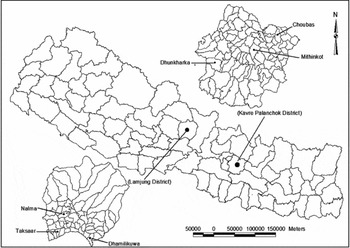
The fieldwork was conducted in the Kavrepalanchok (Kavre) and Lamjung districts in the mid-hills region of Nepal (Fig. 1). Community forestry has been widely implemented in the mid-hills region and has contributed to forest regeneration (Thoms Reference Thoms2008; Niraula et al. Reference Niraula, Gilani, Pokharel and Qamer2013). The majority of the population in these districts practices subsistence farming. The districts have mixed populations of different caste groups (i.e. Brahmin and Chhetri (higher caste) and Janajati and Dalit (lower caste), with the majority of the population of Janajati (ethnic minorities) primarily being Tamang and Gurung). Outmigration of youths as foreign labour to Persian Gulf countries, South Korea and Malaysia has become common, leading to an increased contribution of remittances to household incomes (NPC 2013).
Map showing the two research sites in Nepal.

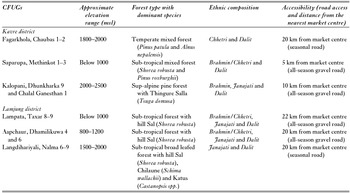
Six community forest user groups (CFUGs) – three from each district – were selected for detailed study based on their ethnic composition, elevational range, nature and type of forests and accessibility to markets (Table 1). The management plans of these six CFUGs were reviewed with respect to the CFP rules in relation to food security. Interviews were conducted with selected members of six CFUGs, with a particular focus on the executive committee members. Two focused group discussions (one CFUG from each district) were held with members of different marginalized groups, including women, Dalit, ethnic minorities and poor farmers.
Description of the selected community forest user groups. CFUG = Community forest user group. Source: CFUG management plans.

In addition, eight semi-structured interviews were also conducted with officials from District offices of sectoral ministries related to forestry and agriculture (District Forest Office, District Agriculture Development Office and District Livestock Development Office). Two group interviews were conducted with members of the Federation of Community Forest Users Nepal (FECOFUN) from both districts, focusing on the community forest management practices and food security.
A review of forestry policies and regulatory frameworks was also undertaken. This review focused on whether and how these policies and regulations have prioritized food security. Policies were critically reviewed under three categories: broader policies, legislative frameworks and operational frameworks. The broader policies include the two recent periodic development plans of Nepal (GoN 2015), Master Plan for the Forestry Sector (MPFS) (1989), which laid the foundation for the CFP in Nepal, and the recently drafted Forest Sector Strategy of Nepal (MFSC 2014). Under this legislative framework, two acts were explored: the Forest Act (1993) and the National Parks and Wildlife Conservation Act (1973). The operational frameworks included Forest Regulations (HMGN 1995), Community Forestry Guidelines (MOFSC 2009) and the proceedings of national community forestry workshops. Our review included the proceeding of the national community forestry workshops because the workshops played a significant role in shaping Nepalese forestry policy.
RESULTS
Policy and regulatory provisions
The relationship between forests and livelihoods was recognized in Nepal's planning framework by as early as 2000 through the poverty reduction strategy paper (NPC 2002). The two periodic plans (2010–2012 and 2013/14–2015/16) highlighted the significance of increasing forest productivity in order to address poverty (GoN 2010; GoN 2014) by focusing on enhancing the forest sector's contribution to the national economy. For example, the latest plan (GoN 2014) emphasized plantations and the promotion of forest-based enterprises (both timber and non-timber forest products). However, food security goals were not identified in terms of their linkages with forestry.
Forest policies, specifically the 1989 MPFS and national policy forums such as the national community forest workshops, have never explicitly referred to the issue of food security. The MPFS emphasized the protection of forests and the supply of fuelwood and timber, aiming at restoring degraded lands and restricting grazing (HMGN 1989, p. 148). The Forest Sector Strategy of Nepal (2014), which was developed through a relatively consultative process, has acknowledged that “community based forest management [can be] an entry point for integrated land-use contributing to food security, bio-energy, watershed and biodiversity conservation. . .” (MFSC 2014, p. 20). The recent forest policy – Forest Policy 2015 – has stressed optimizing the productivity of forests in terms of timber production through the promotion of ‘scientific forest management’ in order to spur economic growth. Yet the strategy failed to suggest concrete strategies and interventions in order to promote food security in the CFP.
The legislative framework that regulates forest management practices does not contain any provision for food security. The Forest Act (1993) does not contain any explicit legal provisions for the conservation and utilization of wild foods (HMGN 1993). Instead, it prohibits the use of forest land for agricultural purposes. Similarly, the National Park and Wildlife Conservation Act (GMGN 1973), which provides the legal basis for the conservation of approximately 23% of the country's forest area, restricts the use of forest products for local consumption. Food security potential is, in essence, regulated out of existence through legislation.
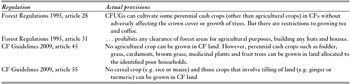
The Forest Regulations (1995) and Community Forestry Guidelines (2009) are restrictive in relation to agricultural use because the cultivation of perennial cash crops such as tea and coffee and grazing in forests (Table 2) are prohibited. These regulatory instruments have further limited the contributions of forests to food security.

The provisions in the implementation framework are restrictive with regards to grazing and cultivating cash crops (Table 1). They are silent on the promotion of forest foods and thus cannot explicitly highlight the benefits of forests to the livelihoods of local people (Ojha et al. Reference Ojha, Cameron and Kumar2009; Dhakal et al. Reference Dhakal, Bigsby and Cullen2011). These policy restrictions on forestry and the advancement of food security as an agenda only for the agriculture sector means that institutional boundaries have been created between forests and agriculture, with deep implications for food security.
Institutional divide on forest–food security linkages
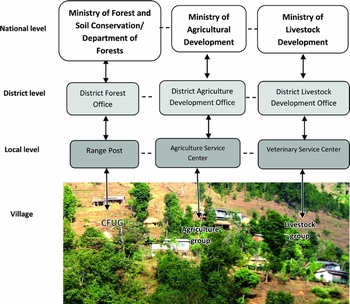
The policies and land use practices in Nepal have divided the land into forest and agriculture lands. Approximately 40% of the country is set aside as forestland, while only 21% is available for agriculture. Much of the land that is categorized as forest has restrictions on its use, as outlined above, limiting its contribution to food security. Consequently, government departments are divided into forest and agriculture sectors (Fig. 2) from the central to the local level. There are separate government ministries for forestry (Ministry of Forest and Soil Conservation) and agriculture (Ministry of Agriculture and Cooperatives), the latter recently having been further split into two ministries: the Ministry of Agriculture Development and the Ministry of Livestock Development (Fig. 2). Each ministry has offices at the district level that are responsible for implementing activities and providing technical services to the public through local units at the village level.
Institutional divides between forestry, agriculture and livestock sectors. CFUG = Community forest user group. Source: authors.

The division is not only limited by institutional structures, but also by professional boundaries. Three sectors, namely agriculture, forest and livestock, employ technical professionals who are trained in the specific disciplines of forestry, agricultural science and livestock husbandry. These professionals with specialized skills and roles rarely liaise with each other on the ground. The Livestock Development Officer from Lamjung, responding to our concerns regarding coordination among sectors, agreed that the “promotion of fodder trees and forage would support livestock husbandry. Though we have expertise in this field, currently we do not have the mandate to work in CF since it falls under DFO's jurisdiction” (interviewed in August 2015). This highlights the institutional boundaries and limitations of government agencies.
Linkage between the rules of CFUGs and food security
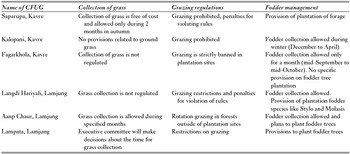
The management plans of the six CFUGs consist of few provisions to promote food security in the CFP. The plans prohibit grazing in all CFs (Table 3), and fines are imposed upon violation of these rules. Although some CFUGs have provisions for rotational grazing, these provisions are rarely practiced. The collection of ground grass is allowed in most CFs, but only at certain times of the year. A few CFUGs have made provisions for promoting fodder, but have not implemented them.
Provision of grazing and fodder management in community forest user group operational plans. CFUG = Community forest user group.

The restrictive rules and practices on the collection of fodder and grazing in CFs are mainly due to the priority given to conservation, including of trees that produce timber. In a focused group discussion, farmers from Chaubas in the Kavre district said that CFUGs imposed a ban on grazing in order to protect pine plantations and restore the land that had been barren for 20 years. One participant noted: “These pine trees were planted 30–35 years back. Before the plantation, the hills were open to grazing. As pine trees grew, the ground grass disappeared. These days, nobody comes to the forest for grazing. Grazing has become an old tale” (interviewed in July 2015).
None of the six CFUGs has management plans with specific provisions to promote wild food of any kind. An executive committee member of the Apchaur CFUG of Lamjung reported: “We have some edible products in the forest for example Ban Tarul [Dioscorea bulbifera] and Gittha [Dioscorea deltoidea]. However, these products are declining. I don't remember any discussion regarding the promotion of such wild food in CF even during the preparation of the management plan” (interviewed in August 2015). A leader of FECOFUN from the Lamjung district, who also worked as a facilitator in order to develop the CF management plan, tried to clarify this deficiency in the management plan. He noted that “the promotion of forest food was not on the agenda during the preparation of plans. It is primarily because this issue is not required by CF guidelines” (interviewed in August 2015).
On the other hand, the forestry officials believed that food security lies outside their disciplinary boundary. A forest officer from Lamjung remarked that community forestry is not meant to support livelihoods and food security. Instead, it is concerned with timber and biodiversity (interviewed in August 2015). The majority of the forest professionals held a similar view. A senior officer at the Department of Forest participating in the 6th CF Workshop in Kathmandu (16–18 June 2014) opposed discussion of the interrelation between CF and food security when the issue was raised by one of the co-authors of this paper in the same event. He opined that food security is a matter for the agriculture ministry and not related to forestry. He added that poverty reduction and food security are not the concerns of a forest official.
Such technocratic value has prevailed even at local-level institutions. There has been a techno-bureaucratic influence from the forest authority on the CFUG management plans. The representatives of FECOFUN from both districts were of the view that most of the local rules, in practice, are driven by the guidelines of the Forest Department. “In principle, the rules in the management plans are set by CFUGs, but in practice, they are written by forest technicians,” said one of the user members, who is also a FECOFUN representative of Lamjung (interviewed in August 2015).
The analysis shows that central-level policies and legislations have created institutional and attitudinal boundaries between forest and agriculture. The CFUG rules have reinforced this in CF implementation. In many cases, however, the rules are determined locally through negotiation between CFUG executive committee members and forest officers (Ojha Reference Ojha2008; Giri & Ojha Reference Giri and Ojha2011). Yet food security issues rarely surface in negotiations, as such issues are ‘officially’ allocated to the agriculture ministry. Forest users and government officials seem to have accepted and, in some cases, tolerated the fact that managing forests for food is not possible within the current policy climate.
DISCUSSION
Nepal's experience demonstrates that the contribution of community forests to food security has been limited due to an entrenched position among forest science, policy and local practices that has evolved and endured through time. The success of community forests has been applauded for its contribution to the recovery of the once degraded hill forests (Gautam et al. Reference Gautam, Webb, Shivakoti and Zoebisch2003; Niraula et al. Reference Niraula, Gilani, Pokharel and Qamer2013), resulting in an improved supply of forest products for domestic consumption, particularly fuelwood and timber (Adhikari et al. Reference Adhikari, Williams and Lovett2007; Thoms Reference Thoms2008), and the better provisioning of ecosystem services that support farming systems (Marquardt et al. Reference Marquardt, Khatri and Pain2016). However, such improvements in forest conditions have been achieved at the cost of restricting some traditional practices like grazing and the use of fodder and forage (Mahat 2000; Dhakal et al. Reference Dhakal, Bigsby and Cullen2011). Our study demonstrates the ways in which the CF rules and decisions have become barriers to food production, especially grazing and fodder collection, among land-poor people. Moreover, the CFP rules and practices were found not to encourage the promotion of wild foods. A historical analysis of forest policy in Nepal (Supplement 1; available online) shows that these policies and practices have been influenced by modern forestry science with a focus on either conservation goals or on generating revenue, even though the latter has not materialized in practice (Gilmour Reference Gilmour2016). Such a narrow framing of knowledge has served to propagate policies and regulations that tend to delink forests from agriculture. However, it has also been institutionalized into the forest bureaucracy, which favours the narrow and ‘modern’ view of scientific forestry, thereby failing to embrace the variety of forest ecosystem services that nurture the agro-ecological system.
Given this scenario, it is not easy to identify and suggest any specific policy solutions in order to enhance CF contributions to food security. Instead, what becomes important is to reframe the knowledge system in order to acknowledge multiple uses of forests by recognizing local knowledge and a community's management and use of forests. This would require catalysing a much-needed change in forest management thinking, policy and practices. The issue at stake is when and how key actors can begin to critically review the disconnect between CF and food security, and to draw on the evidence of the intertwined dimensions of food insecurity, such as availability and access to food (Sen Reference Sen1999). More specifically, how those who are most affected by this disconnect can be enabled to articulate a comprehensive food security-orientated community practice in order to challenge the conventional technical knowledge and bureaucratic practices that dominate current forest management practice and policy is a matter of great concern (Ojha Reference Ojha2013). Any effort at change must recognize the historically evolving context of local knowledge and local community forestry institutions in the wider political economy (Shrestha Reference Shrestha2012; Ojha Reference Ojha2014).
The science that drives modern forest conservation and management practices emerged in Western Europe in the eighteenth century (Scott Reference Scott1998). ‘Forest’ is defined as a special category of land that was largely managed for power and pleasure by kings and the ruling elites (Fay & Michon Reference Fay and Michon2005). The designation of large landscapes as a legal category of ‘forests’ suited colonial, political and economic interests. With the scientific disciplinary division and a bureaucratic framing (Ojha Reference Ojha2008), forest science has continued to focus on trees and timber or, in more recent times, forest biodiversity, leaving matters related to food almost entirely to the discipline of agriculture sciences. Such disciplinary divisions, which are manifested in various government structures, undervalue or even ignore the potential for the direct and indirect contributions of forests to food security. Forestry science education often considers agriculture activities as destructive to forests (and vice versa) and peasants as enemies (Westoby Reference Westoby1979). In light of the above, it is not surprising that forest management practices continue to focus on either strict conservation or commercial monoculture focusing only on timber production, a strategy that undermines the multi-dimensional roles of forest- and tree-based systems in contributing to food security (Shiva Reference Shiva1993).
There is a need for a broader definition of ‘forest’ that incorporates poverty and food insecurity, highlighting the role of forests in contributing to agro-ecological resilience and meeting the food and nutrition requirements of the poor (Fay & Michon Reference Fay and Michon2005; Michon et al. Reference Michon, de Foresta, Levang and Verdeaux2007). Several solutions have been proposed, such as integrated management of forests, trees and agriculture production (Padoch & Sunderland Reference Padoch and Sunderland2013) and integrated landscape management of agriculture and forests, incorporating diverse social values and their uses (Dewees Reference Dewees2013). Yet the current disciplinary division of land use (i.e. boundaries between forests and agriculture land) and sectoral division of government departments continue to hinder such integration. In the context of climate change, forests are being further separated from the food security agenda, particularly with the adoption of the Reducing Emission from Deforestation and Forest Degradation programme (e.g. Ojha et al. Reference Ojha, Khatri, Shrestha, Bushley and Sharma2013a). Questions pertaining to the management of forests by balancing different competing goals such as livelihoods (and food security), carbon sequestration and biodiversity have become paramount (Persha et al. Reference Persha, Agrawal and Chhatre2011).
A growing body of literature has delved into how policies and institutions emerge, function, change and improve in order to address the challenges related to linking forest management with livelihoods and food security (Colfer Reference Colfer2005; Fisher et al. Reference Fisher, Prabhu and McDougall2007). More operationalizing concepts of learning and innovation have emerged that draw on social and organizational learning fields (e.g. Schon Reference Schon and Blackmore2010), and on works that emphasize the integrated analysis of society and natural systems (Holling Reference Holling2001). We identify at least three overlapping pathways through which an integration of forests and food systems could occur. Firstly, dominant actors could become more reflective than in the past with regards to changing environmental and political contexts. A case in point is the emergence of CF policy itself following the Himalayan crisis in Nepal in the 1970s and 1980s, when some forest officials became open to different interpretations of the causes of deforestation in the Himalayas. This was in part facilitated by international forestry projects, but was more fundamentally triggered by a sense of crisis (Ojha et al. Reference Ojha, Cameron and Kumar2009).
Secondly, locally engaged critical intellectuals and researchers can help with the generation of alternative evidence, facts and knowledge, as found in the case of slum-dweller empowerment work in the Indian city of Mumbai (Patel et al. Reference Patel, Baptist and D'Cruz2012). Similar work in Nepal's forest sector also demonstrates the potential of critical action research in exposing conventional policy assumptions and critiquing conventional practice (Ojha Reference Ojha2013). The practice of critical action research in forestry (e.g. Ojha Reference Ojha2013) has the potential to simultaneously enable local communities and forest authorities to recognize the value of local knowledge and the limits of dominant knowledge systems, as well as to generate critical evidence in order to stimulate new thinking among policy makers.
Thirdly, employing an adaptive approach to learning and knowledge production can support the management of forests for multiple purposes. Adaptive and collaborative approaches provide the space for relevant actors, at different levels, to interact and negotiate the goals of resource management and to innovate institutional mechanisms that provide better ways of managing resources in order to meet changing local contexts (Ojha et al. Reference Ojha, Hall and Sulaiman2013b). This approach can help forestry stakeholders recognize diverse forms of knowledge and a variety of positions or interests that could be linked to forest management planning and decision-making processes, essentially providing a platform for integrating orthodox science with other forms of knowledge, such as traditional knowledge and the knowledge derived from local practices for improving food security outcomes. The iterative process of action and reflection provides a space to stakeholders to learn about institutions that can manage the resources over time. But as Ojha and colleagues (Reference Ojha, Khatri, Shrestha, Bushley and Sharma2013b) suggest, this approach is also fraught with a number of challenges related to power imbalances, mechanistic use of learning strategies and poorly framed deliberative practices. Any attempt to improve such a situation requires more transformational approaches in governance and practices (O'Brien Reference O'Brien2012).
CONCLUSION
The analysis of Nepal's community forestry shows that the new forest management policies, institutions and knowledge is yet to recognize the potential contribution of forest ecosystems to food security. Having said that, Nepal's CFP has been portrayed as an example of progressive forest policy, containing institutions that allow significant political space for local communities to manage forests. If such progressive policies and institutions are unable to accommodate the agenda of local livelihoods and food security, a serious question arises as to what can be expected in situations where local communities have limited space to take part in forest management and related decisions. This signals a need for a fundamental transformation of forest science and governance in order to connect CBFM systems and so achieve food security outcomes. A key direction for change is to explore and facilitate adaptive and transformational pathways for enhancing positive links between forests and food systems. Engaging with knowledge politics in such a way that critical evidence can be generated through practice by articulating alternative models of forest and agricultural landscape management is desirable. Key to this discussion is the issue of the recognition of local knowledge and how and the extent to which alternative facts and narratives regarding forest–food security linkages are articulated.
ACKNOWLEDGEMENTS
This paper draws on two separate studies. The empirical material was derived from research that is part of an Australian Centre for International Agricultural Research (ACIAR)-funded research project. Work of the first, third and sixth authors also draws on the Swedish Research Council-funded project entitled ‘Paying for ecosystem services: consequences and alternatives – PECA’. We are grateful to Madan Bashyal for his support in data collection, Kushal Pokharel for editorial input and to three anonymous reviewers for their constructive and valuable comments.
Supplementary material
To view supplementary material for this article, please visit http://dx.doi.org/10.1017/S0376892916000369