


%20--%3e%3c!DOCTYPE%20svg%20PUBLIC%20'-//W3C//DTD%20SVG%201.0//EN'%20'http://www.w3.org/TR/2001/REC-SVG-20010904/DTD/svg10.dtd'%3e%3csvg%20version='1.0'%20id='Layer_1'%20xmlns='http://www.w3.org/2000/svg'%20xmlns:xlink='http://www.w3.org/1999/xlink'%20x='0px'%20y='0px'%20width='64px'%20height='64px'%20viewBox='5.5%20-3.5%2064%2064'%20enable-background='new%205.5%20-3.5%2064%2064'%20xml:space='preserve'%3e%3cg%3e%3ccircle%20fill='%23FFFFFF'%20fill-opacity='0'%20cx='37.785'%20cy='28.501'%20r='28.836'/%3e%3cpath%20fill='%23595959'%20d='M37.441-3.5c8.951,0,16.572,3.125,22.857,9.372c3.008,3.009,5.295,6.448,6.857,10.314%20c1.561,3.867,2.344,7.971,2.344,12.314c0,4.381-0.773,8.486-2.314,12.313c-1.543,3.828-3.82,7.21-6.828,10.143%20c-3.123,3.085-6.666,5.448-10.629,7.086c-3.961,1.638-8.057,2.457-12.285,2.457s-8.276-0.808-12.143-2.429%20c-3.866-1.618-7.333-3.961-10.4-7.027c-3.067-3.066-5.4-6.524-7-10.372S5.5,32.767,5.5,28.5c0-4.229,0.809-8.295,2.428-12.2%20c1.619-3.905,3.972-7.4,7.057-10.486C21.08-0.394,28.565-3.5,37.441-3.5z%20M37.557,2.272c-7.314,0-13.467,2.553-18.458,7.657%20c-2.515,2.553-4.448,5.419-5.8,8.6c-1.354,3.181-2.029,6.505-2.029,9.972c0,3.429,0.675,6.734,2.029,9.913%20c1.353,3.183,3.285,6.021,5.8,8.516c2.514,2.496,5.351,4.399,8.515,5.715c3.161,1.314,6.476,1.971,9.943,1.971%20c3.428,0,6.75-0.665,9.973-1.999c3.219-1.335,6.121-3.257,8.713-5.771c4.99-4.876,7.484-10.99,7.484-18.344%20c0-3.543-0.648-6.895-1.943-10.057c-1.293-3.162-3.18-5.98-5.654-8.458C50.984,4.844,44.795,2.272,37.557,2.272z%20M37.156,23.187%20l-4.287,2.229c-0.458-0.951-1.019-1.619-1.685-2c-0.667-0.38-1.286-0.571-1.858-0.571c-2.856,0-4.286,1.885-4.286,5.657%20c0,1.714,0.362,3.084,1.085,4.113c0.724,1.029,1.791,1.544,3.201,1.544c1.867,0,3.181-0.915,3.944-2.743l3.942,2%20c-0.838,1.563-2,2.791-3.486,3.686c-1.484,0.896-3.123,1.343-4.914,1.343c-2.857,0-5.163-0.875-6.915-2.629%20c-1.752-1.752-2.628-4.19-2.628-7.313c0-3.048,0.886-5.466,2.657-7.257c1.771-1.79,4.009-2.686,6.715-2.686%20C32.604,18.558,35.441,20.101,37.156,23.187z%20M55.613,23.187l-4.229,2.229c-0.457-0.951-1.02-1.619-1.686-2%20c-0.668-0.38-1.307-0.571-1.914-0.571c-2.857,0-4.287,1.885-4.287,5.657c0,1.714,0.363,3.084,1.086,4.113%20c0.723,1.029,1.789,1.544,3.201,1.544c1.865,0,3.18-0.915,3.941-2.743l4,2c-0.875,1.563-2.057,2.791-3.541,3.686%20c-1.486,0.896-3.105,1.343-4.857,1.343c-2.896,0-5.209-0.875-6.941-2.629c-1.736-1.752-2.602-4.19-2.602-7.313%20c0-3.048,0.885-5.466,2.658-7.257c1.77-1.79,4.008-2.686,6.713-2.686C51.117,18.558,53.938,20.101,55.613,23.187z'/%3e%3c/g%3e%3c/svg%3e)
%20--%3e%3c!DOCTYPE%20svg%20PUBLIC%20'-//W3C//DTD%20SVG%201.0//EN'%20'http://www.w3.org/TR/2001/REC-SVG-20010904/DTD/svg10.dtd'%3e%3csvg%20version='1.0'%20id='Layer_1'%20xmlns='http://www.w3.org/2000/svg'%20xmlns:xlink='http://www.w3.org/1999/xlink'%20x='0px'%20y='0px'%20width='64px'%20height='64px'%20viewBox='5.5%20-3.5%2064%2064'%20enable-background='new%205.5%20-3.5%2064%2064'%20xml:space='preserve'%3e%3cg%3e%3ccircle%20fill='%23FFFFFF'%20fill-opacity='0'%20cx='37.637'%20cy='28.806'%20r='28.276'/%3e%3cg%3e%3cpath%20fill='%23595959'%20d='M37.443-3.5c8.988,0,16.57,3.085,22.742,9.257C66.393,11.967,69.5,19.548,69.5,28.5c0,8.991-3.049,16.476-9.145,22.456%20C53.879,57.319,46.242,60.5,37.443,60.5c-8.649,0-16.153-3.144-22.514-9.43C8.644,44.784,5.5,37.262,5.5,28.5%20c0-8.761,3.144-16.342,9.429-22.742C21.101-0.415,28.604-3.5,37.443-3.5z%20M37.557,2.272c-7.276,0-13.428,2.553-18.457,7.657%20c-5.22,5.334-7.829,11.525-7.829,18.572c0,7.086,2.59,13.22,7.77,18.398c5.181,5.182,11.352,7.771,18.514,7.771%20c7.123,0,13.334-2.607,18.629-7.828c5.029-4.838,7.543-10.952,7.543-18.343c0-7.276-2.553-13.465-7.656-18.571%20C50.967,4.824,44.795,2.272,37.557,2.272z%20M46.129,20.557v13.085h-3.656v15.542h-9.944V33.643h-3.656V20.557%20c0-0.572,0.2-1.057,0.599-1.457c0.401-0.399,0.887-0.6,1.457-0.6h13.144c0.533,0,1.01,0.2,1.428,0.6%20C45.918,19.5,46.129,19.986,46.129,20.557z%20M33.042,12.329c0-3.008,1.485-4.514,4.458-4.514s4.457,1.504,4.457,4.514%20c0,2.971-1.486,4.457-4.457,4.457S33.042,15.3,33.042,12.329z'/%3e%3c/g%3e%3c/g%3e%3c/svg%3e)
Introduction
The genus Acinetobacter are a ubiquitous gram-negative, aerobic, non-lactose-fermenting coccobacilli organism that can survive in the environment, on biological surfaces, and indwelling devices.Reference Espinal, Marti and Vila1 Acinetobacter species have emerged as important agents of nosocomial infections and less commonly the cause of sporadic community-acquired infections.Reference Antunes, Visca and Towner2 Acinetobacter baumannii is the most significant Acinetobacter species due to its propensity to develop carbapenem resistance, referred to as carbapenem-resistant A. baumannii (CRAb). CRAb is a difficult-to-treat organism that affects patients globally, particularly vulnerable patients with ventilator dependence, indwelling devices, and intensive care unit (ICU) stay. It has caused outbreaks in both acute and long term care facilities.Reference Boutzoukas and Doi3 Although initially recognized as a cause of ventilator-associated pneumonia, CRAb has since been associated with a broad spectrum of infections, including bacteremia, skin and soft tissue infections, endocarditis, osteomyelitis, and urinary tract infections.Reference Russo and Serapide4
The bla OXA-23-like carbapenemase family, including variants such as bla OXA-23, bla OXA-223, and bla OXA-241, is the most common variant associated with carbapenem resistance in Acinetobacter baumannii globally, while bla NDM-1 is an emerging and increasingly common mechanism of carbapenem resistance in A. baumannii.Reference Shi, Cheng and Liu5–Reference Karakonstantis, Tziolos, Paneta and Kritsotakis7 In the present study, we investigated the genomic epidemiology of CRAb isolates within a single health system in Los Angeles, California.
Materials and methods
Acinetobacter baumannii isolates and whole genome sequencing (WGS)
All CRAb isolates were collected at an academic medical center which included three acute care hospitals in Los Angeles from 2019 through the first quarter (Q1) of 2026. Of these, thirty isolates were selected for genomic surveillance by WGS either randomly or due to suspicion of nosocomial transmission. The detailed methods of WGS and Bioinformatics were described previously and in Supplemental Material.Reference Price, Realegeno and Mirasol8
Review of electronic medical records and clinical data abstraction
The electronic medical records (EMR) of all patients whose isolates underwent genomic surveillance were reviewed by infectious disease physicians, who abstracted demographic, clinical, and epidemiologic data from the time of index infection. This study was reviewed by the UCLA Human Research Protection Program and received Institutional Review Board exemption.
Results
Clinical characteristics and outcomes
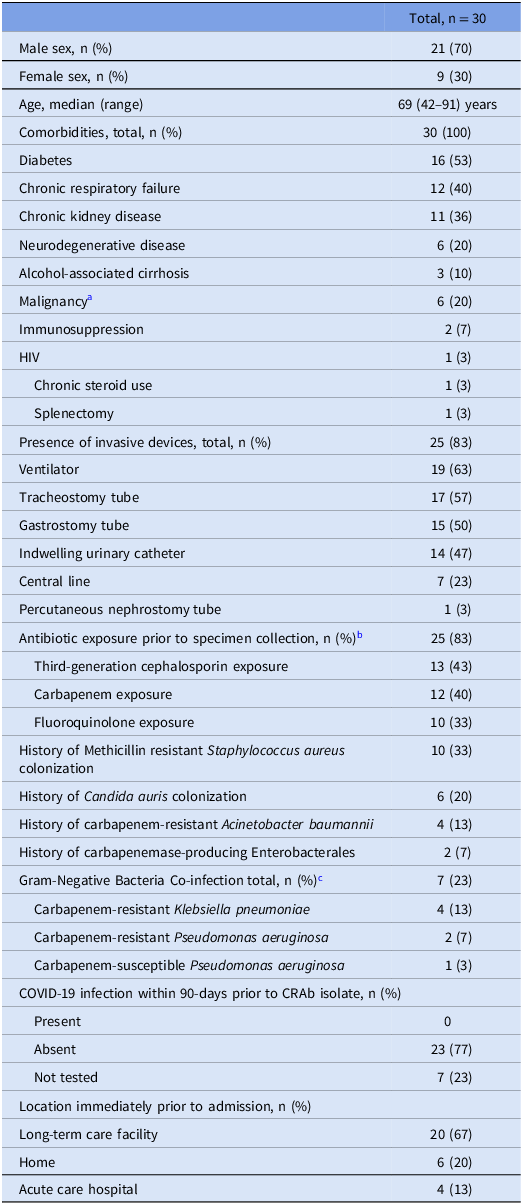
A total of 224 CRAb isolates were identified at our institution from 2019-Q1 2026 (Figure S1). Of these, 13.39% (30/224) underwent analysis and review. All patients included in the analysis had at least one comorbidity, as listed in Table 1, with diabetes, chronic respiratory failure, and chronic kidney disease being the most common. Three patients were immunocompromised per CDC/ACIP definitions, including one with CD4 count <200 from HIV infection, one with chronic steroid use (>20 mg daily prednisone for >14 days), and one with history of splenectomy. Most patients presented to the hospital from a long-term care facility (LTCF) (67%) with 63% of the same patient population discharging to an LTCF.
Clinical and epidemiologic characteristics of patients with carbapenemresistant Acinetobacter baumannii

Table 1. Long description
A table with 30 rows and 25 columns detailing the clinical and epidemiologic characteristics of patients with carbapenem-resistant Acinetobacter baumannii. The table includes data on sex, age, comorbidities, presence of invasive devices, antibiotic exposure, history of specific colonizations, COVID-19 infection status, and location immediately prior to admission. Key columns include male sex, female sex, age median, comorbidities such as diabetes, chronic respiratory failure, and chronic kidney disease, presence of invasive devices like ventilators and tracheostomy tubes, antibiotic exposure prior to specimen collection, history of various colonizations, COVID-19 infection status, and location prior to admission. Notable trends include a high prevalence of diabetes, chronic respiratory failure, and chronic kidney disease among the patients, as well as a significant number of patients with a history of antibiotic exposure and presence of invasive devices.
a Includes head and neck cancer, bladder cancer, myelodysplastic syndrome, prostate cancer, and hepatocellular cancer. None of these patients were receiving immunosuppressive therapy at the time of their CRAb infection.
b Defined as antibiotics received within 90-days prior to collection of culture growing CRAb isolate documented in chart. There are four cases listed as unknown due to lack of documents or details including antibiotic administration prior to collection.
c Co-infection defined as additional organisms isolated from same culture as identified CRAb and treated accordingly. Multidrug resistant defined as resistant to >3 antimicrobial drug classes.
Isolates were collected from a variety of sources including respiratory (18), blood (5), wounds (4), intra-abdominal (2), and urine (1) (Table S1). Eighteen of thirty (60%) patients received CRAb-specific antimicrobial therapy; the remainder were considered colonized or cured with source control alone. The most prescribed combination therapy was sulbactam-durlobactam with meropenem (3/18 (17%)), while cefiderocol 4/18 (24%) was the most commonly prescribed monotherapy (figure S2). Of the 30 patients, six (20%) died during their hospitalization.
Genetic diversity, resistome, and phylogenetics
We analyzed thirty CRAb isolates. Nine different sequencing types (STs), based on Oxford groups, were identified, while two were novel STs (Figure 1). STs were not consistent with and any epidemiological indications such as LTCFs, year, or community. Interestingly, we found several highly genetically related isolates across different facilities and communities throughout the six-year study period. However, despite the genetic diversity among clinical isolates, there was a high degree of homogeneity in their AMR gene profiles, with 90% co-expressing bla OXA-23, bla OXA-66, and bla ADC-25, 86.67% arm(A), and 70% tet(B). Additionally, SNP analysis revealed the isolates from two ICU patients in adjacent rooms differed by 0 SNPs, confirming nosocomial transmission (Figure S3). Two other patients admitted at the same ICU also had genetically related isolates that differed by 25 SNPs. Although their hospital stays were more than 30 days apart, both patients were from the same SNF, suggesting possible intra-SNF transmission.
Diversely isolated A. baumannii complex samples display genotypic and phenotypic antimicrobial resistance patterns. Feature frequency profile via Jensen-Shannon divergences phylogenetic tree constructed from K-mer alignment. ST: sequence type; NST: new sequencing type; N/A: not applicable; year: year of isolation. Prior residence includes long-term acute care (LTAC), skilled nursing facility (SNF), outside hospital (OSH), home derived (HD), donor derived (DD). Antibiotic susceptibility results were from micro-broth dilutions and the presence of resistance genes from WGS results of each isolate are displayed.

Correlation between genotypic and phenotypic antimicrobial resistance profiles
Presence of specific AMR genes including bla OXA-23, bla NDM, and tet(B) were highly predictive of phenotypic susceptibility profiles. The combination of bla OXA-23, bla OXA-66, and bla ADC-25 was the predominant β-lactamase, with all isolates harboring this combination (100%, 27/27) demonstrating resistance to all tested cephalosporins, carbapenems, and ampicillin/sulbactam when susceptibility results were available. Additionally, bla NDM-1 was identified in four isolates (1 in 2023, 1 in 2025 and 2 in 2026), all of which (100% 4/4) demonstrated resistance to all cephalosporins, carbapenems, and ampicillin/sulbactam antibiotics, however all four isolates also contained bla OXA-23, bla OXA-66, and bla ADC-25. The presence of non- bla OXA-23 genes (bla OXA-64 and bla OXA-223) showed less of a resistance phenotype with either imipenem or ampicillin/sulbactam susceptibility. Tet(B), when present, was highly predictive (90.5%, 19/21) of minocycline resistance by AST.
Discussion
This study demonstrates that the majority of sequenced isolates with CRAb had respiratory infections and recent exposure to LTCFs. Our study provides evidence of nosocomial transmission given the genetic relatedness of isolates from patients in adjacent ICU rooms and from patients admitted from the same regional SNF. However, because isolates were randomly chosen and only thirty isolates were sequenced, these findings may not capture all nosocomial transmission events or fully represent the CRAb population across our hospital system. Rather, they likely reflect a highly resistant sub-population of CRAb isolates in our region. Expansion of whole-genome sequencing to all CRAb isolates is needed to fully characterize its epidemiological dynamics.
Antibiotic decision making at our institution was highly variable depending on the year of treatment, guideline recommendations at the time, individual patient characteristics, available antimicrobials and susceptibility testing. In addition, regimens were changed over the course of treatment for many patients. We observed a significant increase in the use of novel antimicrobials and in combination therapy after 2024, with the most common regimens being sulbactam-durlobactam plus meropenem and cefiderocol plus minocycline, which we attribute to the Infectious Diseases Society of America treatment guidelines published in 2024.Reference Tamma, Heil and Justo9
Despite high genetic diversity, the most prevalent AMR gene combination identified in our CRAb isolates were bla OXA-23, bla OXA-66, and bla ADC-25, in which bla OXA-23 is the primary driver of carbapenem resistance among our clinical isolates. We also observed that the combination of bla ADC-25 and bla OXA-64 conferred only weak carbapenem resistance, characterized by resistance to meropenem and susceptibility to imipenem. This pattern is consistent with prior reports indicating that weak carbapenem resistance associated with bla OXA-51-like and is driven by specific amino acid substitutions.Reference Takebayashi, Findlay and Heesom10 Interestingly, the presence of bla ADC-25 and bla OXA-223 conferred carbapenem resistance while retaining susceptibility to ampicillin/sulbactam. Additionally, we identified four bla NDM-1 positive CRAb, originating from two SNFs, one LTAC, and one donor-derived infection in recent years. This is concerning given the increasing global prevalence of metallo-β-lactamase positive CRAb, with bla NDM being the most prevalent.Reference Karakonstantis, Tziolos, Paneta and Kritsotakis7 In conclusion, our study demonstrates that CRAb persists across LTCFs, hospital settings, and the broader community of Southern California with substantial genomic diversity but homogeneous antimicrobial resistance profiles. Continuous genomic surveillance is instrumental in characterizing this major pathogen to help guide infection prevention and patient management.
Acknowledgments
We thank the staff at the UCLA Clinical Microbiology Laboratory and the UCLA Molecular Microbiology and Pathogen Genomics (MMPG) Laboratory for their technical assistance.
Supplementary material
The supplementary material for this article can be found at https://doi.org/10.1017/ash.2026.10894
Financial support
None.
Competing interests
None.


 Open access

