Management Implications
The potential to use the soilborne fungus, Athelia rolfsii for the biological control of Vincetoxicum rossicum (pale swallowwort) and Vincetoxicum nigrum (black swallowwort) plants was evaluated after initially being associated with a decline in the V. rossicum population in a county park in upstate New York. Pathogenicity of A. rolfsii to varying ages of flowering plants of both Vincetoxicum spp. and survival of the resting body of the fungus (sclerotia) between seasons was demonstrated. This information extended the northernmost range of the fungus, which was thought to only survive between seasons in subtropical and tropical environments. Studies of the epidemic annually for 4 yr noted limited spread and highly localized, spatial aggregation of diseased plants between years. We therefore expect low potential for making significant reductions in Vincetoxicum populations in either natural or agricultural habitats without deliberate and widespread redistribution of the fungus. However, the survival of sclerotia between seasons in New York, the difficulty in preventing the spread of sclerotia to undesired locations, and the likely broad host range of the New York isolate of the pathogen, including many dicotyledonous, economically important species (vegetables and field crops), further discounts the feasibility of using A. rolfsii for the biological control of Vincetoxicum spp.
Introduction
Pale swallowwort [Vincetoxicum rossicum (Kleopow) Barbar.; syn.: Cynanchum rossicum (Kleopow) Borhidi] and black swallowwort [Vincetoxicum nigrum (L.) Moench; syn.: Cynanchum louiseae Kartesz & Gandhi] (Apocynaceae) are herbaceous perennial vines from Europe that have become invasive in northeastern North America (DiTommaso et al. Reference DiTommaso, Lawlor and Darbyshire2005). Both species establish and grow under a broad range of conditions across various habitats (Averill et al. Reference Averill, DiTommaso, Mohler and Milbrath2011, Reference Averill, DiTommaso, Whitlow and Milbrath2016; Magidow et al. Reference Magidow, DiTommaso, Ketterings, Mohler and Milbrath2013; Sanderson et al. Reference Sanderson, Day and Antunes2015) and have become especially problematic in New York, New England, and Ontario, Canada (DiTommaso et al. Reference DiTommaso, Lawlor and Darbyshire2005). Vincetoxicum spp. are primarily managed with broad-spectrum herbicides (Averill et al. Reference Averill, DiTommaso and Morris2008; DiTommaso et al. Reference DiTommaso, Milbrath, Bittner and Wesley2013; Mervosh and Gumbart Reference Mervosh and Gumbart2015), although the cost, inaccessibility of some habitats to equipment, and non-target effects in natural areas present logistical issues with this approach. Mechanical control can reduce or eliminate seed production but must be done annually for suppression of Vincetoxicum populations to eventually occur (Averill et al. Reference Averill, DiTommaso and Morris2008; Biazzo and Milbrath Reference Biazzo and Milbrath2019). A relatively recent release of the moth Hypena opulenta (Christoph) (Lepidoptera: Erebidae) has yet to document impact on Vincetoxicum populations (Bourchier et al. Reference Bourchier, Cappuccino, Rochette, des Rivières, Smith, Tewksbury and Casagrande2019).
A potential biotic control for Vincetoxicum spp. is the fungal pathogen Athelia rolfsii (Curzi) C. C. Tu & Kimbr. (syn.: Sclerotium rolfsii Sacc.). Athelia rolfsii is a soilborne basidiomycete with a broad host range, infecting more than 600 plant species (Mullen Reference Mullen2006), including vegetables, field crops, and ornamentals (Kousik et al. Reference Kousik, Ikerd and Mandal2016; Paul et al. Reference Paul, Hwang, Nam, Lee, Lee, Yu, Kang, Lee, Go and Yang2017; Punja Reference Punja1985; Punja and Sun Reference Punja and Sun2001). The pathogen can survive in soil by forming masses of highly melanized hyphae known as sclerotia (Cilliers et al. Reference Cilliers, Herselman and Pretorius2000; Punja Reference Punja1985; Ristaino et al. Reference Ristaino, Perry and Lumsden1991). The sclerotia germinate, and the resultant mycelia penetrate host tissue (Bateman Reference Bateman1972; Kritzman et al. Reference Kritzman, Chet and Henis1977). The sclerotia are hence the primary inoculum for the disease (Harlton et al. Reference Harlton, Levesque and Punja1995; Mullen Reference Mullen2006). Disease symptoms are usually associated with characteristic signs of A. rolfsii, including white, string-like mycelia and golden-brown sclerotia (Iquebal et al. Reference Iquebal, Tomar, Parakhia, Singla, Jaiswal, Rathod, Padhiyar, Kumar, Rai and Kumar2017; Keinath and DuBose Reference Keinath and DuBose2017). Disease caused by A. rolfsii is more prevalent in warm-temperate, tropical, and subtropical regions (Punja Reference Punja1985), as the pathogen favors warm climates with high humidity (Moore Reference Moore1926; Punja Reference Punja1985; Sun et al. Reference Sun, Sun, Deng, Zhu, Duan and Zhu2020).
Athelia rolfsii was observed infecting and killing V. rossicum in a county park in western New York, leading to population decline (Gibson et al. Reference Gibson, Castrillo and Milbrath2012). Earlier reports of this pathogen in New York involved disease on ornamentals (USDA 1960) and corn (Zea mays L.; Hanlin et al. Reference Hanlin, Foudin, Berisford, Glover, Jones and Huang1978). The more recent strain A. rolfsii VrNY, isolated from diseased plants at the county park, was highly virulent to seedlings of V. nigrum and V. rossicum, but pathogenicity to adult plants was not assessed (Gibson et al. Reference Gibson, Castrillo and Milbrath2012). Following initial but limited host range tests, the isolate VrNY was considered for potential as a Vincetoxicum mycoherbicide, because the grasses little bluestem [Schizachyrium scoparium (Michx.) Nash] and corn were non-hosts, nor was the isolate virulent to the legume soybean [Glycine max (L.) Merr.], although it was virulent to some other broadleaf species (Gibson et al. Reference Gibson, Vaughan, Biazzo and Milbrath2014). Thus, A. rolfsii could be promising for Vincetoxicum control in specific habitats such as no-till corn and soybean fields (DiTommaso et al. Reference DiTommaso, Lawlor and Darbyshire2005) and organic improved pastures and hayfields due to their reliance on grasses and legumes. Various non-specific pathogens have been investigated for weed management in specific environments (Bourdôt et al. Reference Bourdôt, Hurrell and Saville2011; Shaheen et al. Reference Shaheen, Abu-Dieyeh, Ash and Watson2010; Tang et al. Reference Tang, Zhu, He, Qiang and Auld2011, 2013). Such use would need to be balanced against the potential threat to other plants. For example, Southern blight caused by A. rolfsii has recently been reported to cause substantial losses to table beets (Beta vulgaris L. subsp. vulgaris) in New York (Pethybridge et al. Reference Pethybridge, Sharma, Silva, Bowden, Murphy, Knight and Hay2019). Additional study of A. rolfsii’s pathogenicity and biology was therefore needed.
The objectives of this study were to: (1) assess the pathogenicity of A. rolfsii to V. rossicum and V. nigrum and characterize differences in host susceptibility of different developmental ages of flowering stems; (2) quantify the spatiotemporal spread of Southern blight in an infested area of V. rossicum; and (3) determine whether A. rolfsii sclerotia can survive over winter and cause disease the subsequent season in upstate New York.
Materials and Methods
Pathogenicity Testing
Pathogenicity testing was conducted on flowering plants of V. nigrum and V. rossicum using inoculum consisting of two representative A. rolfsii isolates (AR1 and AR2). AR1 and AR2 were isolated from diseased V. rossicum at the epidemic in Powder Mills Park, Pittsford, NY (43.0413°N, 77.4781°W). In brief, symptomatic tissues were removed from 20 diseased V. rossicum stems and surface-sterilized in 2% sodium hypochlorite for 1 min, followed by rinsing in sterile water. After drying, small pieces at the junction of the diseased and healthy section of the stem (5 mm2) were placed on 2% water agar (Hardy Diagnostics, Santa Maria, CA) + 0.02% ampicillin (Sigma-Aldrich, St Louis, MO), followed by incubation at 25 C for 24 h before a hyphal-tip was transferred to potato dextrose agar (PDA; Hardy Diagnostics). Fungal identification was conducted by observation of the morphological characteristics (Punja Reference Punja1985) and DNA extraction followed by species-specific PCR (Jeeva et al. Reference Jeeva, Mishra, Vidyadharan, Misra and Hegde2010). DNA was extracted from mycelia scraped from PDA plates. Lyophilized mycelia (25 mg) were ground to a fine powder in 2-ml microcentrifuge tubes using two 4.5-mm zinc-plated spherical balls (Daisy premium grade BBs, Rogers, AR) in a TissueLyser (Qiagen, Valencia, CA). DNA was extracted using the Wizard Genomic DNA Extraction kit (Promega, Madison, WI) according to the manufacturer’s instructions. A 540-bp PCR product within the internal transcribed spacer (ITS) region was amplified with the primer pair SCR-F/SCR-R using the reaction conditions described by Jeeva et al. (Reference Jeeva, Mishra, Vidyadharan, Misra and Hegde2010). PCR products were visualized on a 1% agarose gel.
Mature rootstocks of V. nigrum (Bear Mountain State Park, Rockland County, NY; 41.2996°N, 73.9699°W) and V. rossicum (Robert G. Wehle State Park, Jefferson County, NY; 43.8744°N, 76.2660°W) were collected in the fall of 2015, stored at 4 C until the following spring, then planted into 14-cm-diameter, 1.9-L pots containing a soilless mix (Metro-Mix 560, Sun Gro Horticulture Distribution, Bellevue, WA) and 15-9-12 N-P-K slow-release fertilizer (Osmocote Plus, Scotts-Sierra Horticultural Products, Marysville, OH). Plants were grown outdoors for one summer at the USDA-ARS laboratory in Ithaca, NY; dormant stored again at 4 C; and then grown beginning in the spring of 2017 until needed for pathogenicity tests. Plants bearing two age classes of stems were assessed: (1) recently regrown plants (June, greenhouse) with succulent stems, and (2) plants that had been grown outdoors through August and then transferred to a greenhouse for 2 to 4 wk with hardened stems.
Three plants of each Vincetoxicum species with succulent stems or five plants of each species with hardened stems were inoculated with each A. rolfsii isolate. Inoculum was introduced by placing 5 g of colonized barley (Hordeum vulgare L.) grains at the base of the stems of each plant. Barley was first autoclaved three times at 2-d intervals before inoculation with A. rolfsii. The grain was then inoculated by placing 10 colonized mycelial plugs (7-mm diameter) of each A. rolfsii isolate into separate 1-L plastic containers. The same number of plants for each species and isolate served as controls and received 5 g of noncolonized barley. After inoculation, each plant was covered in clear plastic bags for 48 h and then placed in a misting chamber for 24 d. Growth chamber conditions were 25 C with 12 h of light at 820 lux (110 W fluorescent mercury bulbs, Philips, Andover, MA) and a mist water temperature of 22.7 C. Relative humidity was maintained at >90% for 4 h d−1. Plants were removed from pots and evaluated for disease intensity and plant height (cm). Disease intensity was evaluated by two measures: the incidence of diseased stems/total number of stems × 100 (%) and disease severity (average height of nodes where all leaves were wilted/total height of stems × 100). Seedpod production was not assessed, because it was early in development for the succulent stem plants, and the inoculation of hardened stem plants occurred after seedpod dehiscence was already in progress. To confirm the association of A. rolfsii isolates with the disease symptoms observed, isolations were conducted from 10 randomly selected stems within each experiment as described earlier. The entire experiment was repeated for each of the two ages of stems.
Preliminary analyses indicated no differences between the two repetitions of a particular experiment (P > 0.05), and thus the data were combined. Each experiment was a completely randomized block design, and each block was allocated to three or five separate benches within the misting chamber. Analyses were conducted separately for the two age classes and the two A. rolfsii isolates within each age-class experiment, with factors of Vincetoxicum species (V. rossicum and V. nigrum) and inoculation treatment (inoculated or noninoculated), and three or five replicate plants per treatment as the random variable. The effect of treatment was analyzed using one-way ANOVA. Analyses were conducted with the software Genstat v. 17.2 (Hemel Hempstead, UK).
Spatiotemporal Attributes of Southern Blight in Vincetoxicum rossicum
The incidence and spatiotemporal attributes of the Southern blight epidemic in V. rossicum in Powder Mills Park were annually assessed in each of 4 yr (September 22, 2016, October 10, 2017, September 16, 2018, and September 20, 2019). Disease assessments were conducted along two linear transects positioned across the disease foci. Transects were composed of 16 sampling locations separated by 1 m. The beginning of each transect was separated by 3 m. Each transect was considered as a data set, the sampling location as a sampling unit, and immature stems (<10 cm in height including seedlings) and mature stems (>10 cm in height) as individuals. At each sampling unit, all mature stems were counted within a 50 cm by 50 cm quadrat positioned over the center of the linear transect. Immature stems were counted within a 25 cm by 25 cm quadrat. A census sampling was therefore conducted at each annual assessment providing two data sets with 16 sampling locations (N = 16) and variable individuals per sampling unit. From each sampling location, diseased and healthy stems of each type were counted and used to calculate disease incidence for each sampling unit as p i = x i /n i , where x is the number of diseased stems in the ith sampling unit (i = 1, 2, 3, …, N) containing n stems. Thus, the overall incidence for each data set was calculated as p = ∑x/Nn, where N is the total number of sampling units on each data set and n is the number of stems in each sampling unit. A diseased stem was defined as one with Southern blight symptoms (necrotic, bleached lesions and wilted leaves) and A. rolfsii signs (white mycelia and golden-brown sclerotia). Seedpod production was not assessed, because dehiscence was already well underway in the field at the time of sampling.
Ordinary and median run analyses were used to quantify the spatial patterns of Southern blight in V. rossicum among sampling units in each year. A run was defined as a sequence of one or more identical binary states, preceded and followed by the alternative or not, such as missing data (Gibbons Reference Gibbons1976). For this analysis we classified sampling units as 1 if at least one diseased stem was observed and 0 if only healthy stems were found. For median runs, the sampling units were classified as 1 or 0 if their mean incidence of diseased stems was above or below the median incidence of the data set, respectively. Following conversion to binary data, a run was again defined as a succession of like events. A Z-statistic was used to determine whether the observed number of runs was significantly (P ≤ 0.05) different from the expected number of runs under a null hypothesis of randomness with a one-sided test (Gibbons Reference Gibbons1976; Madden et al. Reference Madden, Louie, Abt and Knoke1982). Analyses were conducted in the R system (R Core Team 2019) using a function developed to perform both types of run analyses with the equations described by Gibbons (Reference Gibbons1976) and Madden et al. (Reference Madden, Louie, Abt and Knoke1982).
The spatial distribution of Southern blight incidence on V. rossicum mature stems was also analyzed using the Spatial Analysis by Distance IndicEs (SADIE) method (Winder et al. Reference Winder, Alexander, Holland, Woolley and Perry2001, Reference Winder, Alexander, Griffiths, Holland, Wooley and Perry2019) to calculate the distance to regularity including a correction for local clustering (Li et al. Reference Li, Madden and Xu2012; Perry and Dixon Reference Perry and Dixon2002). Descriptions of the theory underpinning SADIE have been presented previously (Perry Reference Perry1995, Reference Perry1998; Perry et al. Reference Perry, Winder, Holland and Alston1999). In brief, SADIE uses a transportation algorithm to calculate the minimum distance needed to move spatially referenced data to regular and crowded spatial patterns using the same number of sampling units. The observed and calculated distances to regularity are then compared with random simulations based on resampling of the locations of diseased sampling units to calculate the index of aggregation (I a). For all simulations, 250 randomizations were used. Randomness is supported when I a = 1. A value of I a > 1 suggests an aggregated pattern; and I a < 1 indicates a regular pattern. A two-sided test for aggregation was used to assess the deviation of the index of aggregation (I a) from the null hypothesis of no spatial dependence (Perry et al. Reference Perry, Winder, Holland and Alston1999).
The spatiotemporal characteristics of the Southern blight epidemic in V. rossicum were analyzed using disease incidence on mature stems obtained from an additional grid matrix consisting of 16 contiguous 25 by 25 cm quadrats arranged in an 8 by 8 square pattern. Within each quadrat, disease incidence was quantified using census sampling. A null hypothesis of a lack of association between spatial patterns in subsequent years was tested. Local association (χ k ) was first quantified by performing comparisons between clustering indices for each of the two assessment times using SADIE. Overall association (X) was then calculated as the mean of the local clustering indices obtained between each of the assessments within each grid matrix. Clustering indices represent the net distance that individuals need to move at each sampling unit to achieve regularity. Significance of X was tested by the maximum number of randomizations with local association values for each sampling unit with a two-tailed test (Winder et al. Reference Winder, Alexander, Holland, Woolley and Perry2001; Xu and Madden Reference Xu and Madden2004, Reference Xu and Madden2005). Small-scale spatial autocorrelation was accounted for at both time periods using the Dutilleul adjustment (Dutilleul et al. Reference Dutilleul, Clifford, Richardson and Hemon2008).
Survival and Pathogenicity of Overwintered Athelia rolfsii
Athelia rolfsii isolates collected from diseased V. rossicum stems at the epidemic site in Powder Mills Park in August 2017 and 2018 were randomly selected to produce sclerotia on each of 10 PDA plates per isolate. Abundant golden-brown to dark brown sclerotia were produced after 10 d, which were collected by scraping from the PDA plate surface and dried in a laminar flow cabinet for 24 h. The diameter of the sclerotia ranged between 2 and 2.5 mm.
The sclerotial survival experiment was conducted at two locations. The first location was the epidemic site at Powder Mills Park. The second location was a mown, permanent pasture in Ithaca, NY (42.4428°N, 76.4431°W). The soil type at the Powder Mills Park location is a mix of Arkport (coarse-loamy, mixed, active, mesic Lamellic Hapludalfs), Dunkirk (fine-silty, mixed, active, mesic Glossic Hapludalfs), and Colonie (mixed, mesic Lamellic Udipsamments) soils, i.e., very fine sandy loam on a 20% to 60% slope. The soil type at the Ithaca location is an Eel silt loam (0% to 2% slope; fine-loamy, mixed, superactive, mesic Fluvaquentic Eutrudepts) (NRCS 2021). Groups of 30 randomly selected sclerotia were placed into 70 by 70 mm organza fabric mesh bags and sewn closed. Pairs of labeled bags were placed inside a 10 cm by 10 cm by 5 cm wire-mesh cage, to protect them from rodents, and the cage was sunk 2 cm into the ground. One bag was covered by soil to a depth of 2 cm and the second bag was placed on the soil surface (0 cm). The cage was secured to the ground with sod staples. Thirty-two cages containing 64 labeled bags of sclerotia were deployed at each location in mid-October in a 4 by 8 grid with cages separated by 30 cm. The experiment was conducted in each of two seasons (2017–2018 and 2018–2019), and newly isolated sclerotia were deployed each year. Four replicate cages were randomly retrieved at eight sampling dates during the first year of the experiment: November 20 and December 14, 2017; March 5, April 16, May 14, June 18, July 16, and August 13, 2018. Sampling dates in the second experiment were: November 19 and December 3, 2018; March 4, April 8, May 13, June 17, July 15, and August 12, 2019. The experimental design was thus a 2 by 2 by 2 by 8 factorial design (location, year, burial depth, and sampling month, respectively). Each treatment was replicated four times for a total of 256 individual experimental units.
At each sampling, recovered sclerotia were cleaned and placed on 2% water agar + ampicillin plates within 24 h. Surface sterilization consisted of 10% sodium hypochlorite for 1 min followed by three rinses in sterile water, then drying in a laminar flow cabinet for 3 h before plating and incubation at 20 C for 48 h in the dark. The number of intact sclerotia recovered were counted. The incidence (%) of viable sclerotia (at least 1 mycelial fragment at least the length of the sclerotium) was calculated following examination under a stereo microscope at 60× magnification. In addition, 30 sclerotia that were stored in the laboratory at 20 C were also plated at each field sampling date to assess viability as nondeployed controls.
Data on the number of viable sclerotia of an initial 30 (field data only) were analyzed with a generalized linear mixed model with a binomial distribution, a logit link, and an error term for the cage (PROC GLIMMIX, SAS v. 9.4, SAS Institute, Cary NC). Stepwise removal of nonsignificant interaction terms was done to determine the best model for each parameter. Preselected groups of means were compared using Fisher’s protected LSD test with the SLICE option and a modified Bonferroni correction (based on the actual number of comparisons made for each parameter rather than all possible comparisons) (SAS v. 9.4, SAS Institute).
In the second year of the study, additional sclerotia were placed at the Powder Mills Park location to evaluate virulence to V. nigrum and V. rossicum after overwintering. A total of 300 sclerotia were placed in organza mesh bags (30 per bag) on the soil surface. Sclerotia were deployed on October 17, 2018, and collected on August 12, 2019. Upon retrieval, sclerotia were cleaned in the same manner as described earlier for the overwintering studies.
Two pathogenicity experiments were conducted using the remaining 120 intact sclerotia. In the first experiment, V. nigrum and V. rossicum were seeded on August 13, and seedlings were transplanted into 10-cm-diameter pots on September 9, 2019. After 14 d, 20 V. nigrum and 20 V. rossicum seedlings were inoculated by placing one overwintered sclerotia at the soil and stem interface. An additional 10 plants of each species were inoculated in the same manner using sclerotia stored in the laboratory at room temperature for the same 10-mo period. Ten V. nigrum and 10 V. rossicum seedlings served as noninoculated controls. All plants were placed in a mist chamber at 25 C with a 16-h photoperiod and misted for 4 h d−1 for 20 d. The entire experiment was repeated with V. nigrum and V. rossicum seeded on September 9 and transplanted on October 2.
The experimental design was a completely randomized block with factors including either Vincetoxicum spp. with overwintered or control A. rolfsii sclerotia. Noninoculated control plants of each Vincetoxicum spp. were also included. Five blocks were defined as separate benches within the misting chamber, with each block containing two to four plants per treatment. The data from each of the experiments were analyzed separately with replicate as a random effect using one-way ANOVA. Analyses were conducted with Genstat v. 17.2.
Results and Discussion
Pathogenicity Testing
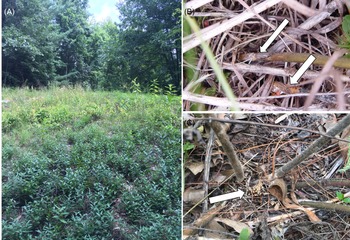
Vincetoxicum rossicum plants at the original epidemic location appeared wilted (Figure 1A) with bleached, necrotic lesions extending from the stem line (Figure 1B) with copious numbers of golden-brown sclerotia (Figure 1C). The isolation frequency of A. rolfsii from diseased V. rossicum stems collected at the epidemic in Powder Mills Park was 100%. On PDA, cultures were white to off-white and grew rapidly, reaching the diameter of the petri plate (90 mm) in 3 d. Abundant sclerotia (1.6 to 2.5 mm in diameter) were formed on PDA after 4 to 5 d, which changed color from white to golden to dark brown within 5 d. Clamp connections were also present in the hyphae. These morphological traits and the amplification of a 540-bp PCR product using A. rolfsii–specific primers (Jeeva et al. Reference Jeeva, Mishra, Vidyadharan, Misra and Hegde2010) confirmed the identity of two selected isolates (AR1 and AR2) as A. rolfsii. These studies therefore reconfirmed the presence of A. rolfsii causing disease in V. rossicum at the Powder Mills Park location (Gibson et al. Reference Gibson, Castrillo and Milbrath2012, 2014). Athelia rolfsii is distinguished from other members of the genus, Athelia delphinii Welch and Athelia coffeicola Stahel, by the distribution of sclerotia on artificial media, sclerotial size, concatenated sequences of the ITS, and a portion of the large subunit (LSU) region of the rDNA. Sclerotia were distributed across the surface of PDA plates and not limited to production in ringlike structures, as is the case with A. delphinii and A. coffeicola. Moreover, sclerotial sizes measured in this study were also within the reported range of A. rolfsii, whereas A. delphinii and A. coffeicola are reported to both have larger sclerotia (3 to 5 mm in diameter) (Okabe and Matsumoto Reference Okabe and Matsumoto2003; Punja and Sun Reference Punja and Sun2001).
(A) Southern blight epidemic caused by Athelia rolfsii, (B) bleached necrotic lesions at the base of Vincetoxicum rossicum stems (marked with arrows) typical of Southern blight, and (C) A. rolfsii sclerotia (marked with an arrow) associated with the diseased stems.

Inoculation with A. rolfsii significantly increased disease incidence (>72%) and severity (>8.5%) for adult V. nigrum and V. rossicum plants of either stem age or isolate compared with control plants (P < 0.001; Tables 1 and 2) but did not differ between V. nigrum and V. rossicum. Stem height was not significantly affected by inoculation (Tables 1 and 2). Athelia rolfsii was reisolated in all samples from inoculated plants, while disease was not observed in the noninoculated controls (Tables 1 and 2). We did not collect data on seedpod or seed production, because our experiments were too early or too late in the plants’ development to accurately assess seed set. Averill et al. (Reference Averill, DiTommaso, Mohler and Milbrath2011) showed a predictive relationship between August stem length and total fecundity of V. nigrum and V. rossicum, suggesting that plants of similar stem height would produce a similar number of seeds. However, premature death of stems from infection can prevent seed maturation (LRM, personal observation) and presumably reduce viable seed numbers. Therefore, quantifying the effects of infection on reproduction at different stages of Vincetoxicum development remains to be determined.
Pathogenicity of two Athelia rolfsii isolates to flowering Vincetoxicum nigrum and Vincetoxicum rossicum with young succulent stems, combined over two replicated growth chamber experiments. a

a Means within columns followed by the same letter are not significantly different (P = 0.05) by LSD.
b LSD: P = 0.05.
Pathogenicity of two Athelia rolfsii isolates to flowering Vincetoxicum nigrum and Vincetoxicum rossicum with late-summer hardened stems combined over two replicated growth chamber experiments. a

a Means within columns followed by the same letter are not significantly different (P = 0.05) by LSD.
b LSD: P = 0.05.
Previous pathogenicity tests reported by Gibson et al. (Reference Gibson, Castrillo and Milbrath2012, 2014) used 2- to 8-wk-old Vincetoxicum seedlings and resulted in 60% to 100% mortality after 3 to 5 wk. Results from these assays, therefore, are analogous to those reporting similar levels of pathogenicity irrespective of growth stage in other plant species, such as sweet potato [Ipomoea batatas (L.) Lam.] (Chandra Paul et al. Reference Chandra Paul, Hwang, Nam, Lee, Lee, Yu, Kang, Lee, Go and Yang2017). Some variation in aggressiveness can occur between A. rolfsii isolates across a broad range of hosts, including cowpea [Vigna unguiculata (L.) Walp.] (Adandonon et al. Reference Adandonon, Aveling, van der Merwe and Sanders2005) and sweet potato (Chandra Paul et al. Reference Chandra Paul, Hwang, Nam, Lee, Lee, Yu, Kang, Lee, Go and Yang2017). Similar findings have also been documented for other soilborne fungi (e.g., Sclerotinia sclerotiorum (Lib.) de Bary in canola [Brassica napus L.]; Irani et al. Reference Irani, Heydari, Javan-Nikkhah and Ibrahimov2011). Additional research would be needed to quantify variation in virulence and aggressiveness within the A. rolfsii population associated with the Southern blight epidemic in V. rossicum.
Spatiotemporal Attributes of Southern Blight in Vincetoxicum rossicum
The average incidence of Southern blight in mature stems remained relatively stable across the observation years (12.1%, 12.3%, 11.5%, and 12.9%, in 2016, 2017, 2018, and 2019, respectively). Similarly, the average number of mature stems over time also showed little evidence of reductions at this disease incidence with 19, 22, 27, and 27 per 0.25-m2 quadrat. The average incidence of Southern blight in immature stems was significantly lower than mature stems, ranging from 0.1% in 2016 to 1.1% in 2017, although we cannot say how many immature stems had died and disappeared before our annual assessments. The average number of immature stems per 0.0625-m2 quadrat did decline over this period from 15, 4, 9, and 8 in 2016, 2017, 2018, and 2019, respectively.
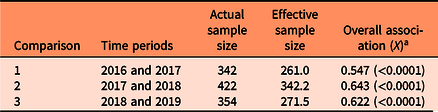
The distribution of Southern blight incidence was aggregated according to all statistics in each year (Table 3). By SADIE, the Ia increased in magnitude in both transects from 2016 to 2019 by an average of 65%. Spatial aggregation was also detected by ordinary and median run analyses with increases in the magnitude of the Z-statistics for both tests in transect 1 (Table 3). A temporal trend toward an increasing frequency of spatial aggregation of Southern blight was also depicted in the grid matrices (Table 4). Significant (P < 0.001) spatial associations were detected between the local clustering indices at successive assessments of disease incidence in the grid-based assessments. Spatial patterns in the subsequent year were therefore significantly associated with the spatial position of diseased stems at the earlier assessments (Table 4). Small-scale aggregation of diseased individuals is also typical of other soilborne diseases such as Sclerotinia crown rot (Scott et al. Reference Scott, Gent, Pethybridge and Hay2014) and Sclerotinia flower blight (Pethybridge et al. Reference Pethybridge, Hay and Gent2010) of pyrethrum [Tanacetum cinerariifolium (Trevir.) Sch. Bip.], and lettuce drop (Hao and Subbarao Reference Hao and Subbarao2005, Reference Hao and Subbarao2006). Spatiotemporal small-scale autocorrelation of soilborne diseases also is typically spatially associated with inoculum density (Dillard and Grogan Reference Dillard and Grogan1985; Pethybridge et al. Reference Pethybridge, Hay and Gent2010).
Analysis of the spatial distribution of Southern blight caused by Athelia rolfsii in Vincetoxicum rossicum at Powder Mills Park, Pittsford, NY, from 2016 to 2019, using Spatial Analysis by Distance IndicEs and ordinary and median run analyses. a

a Ia is the index of aggregation derived from Spatial Analysis by Distance IndicEs (SADIE). Z-statistics for ordinary (ORA) and median run analyses (MRA).
*P < 0.05.
**P < 0.01.
***P < 0.001.
Spatiotemporal analysis of Southern blight epidemics in Vincetoxicum rossicum at Powder Mills Park, Pittsford, NY, using the association function of Spatial Analysis by Distance IndicEs.

a Associated probability values calculated using a two-tailed test indicated in parentheses.
Survival and Pathogenicity of Overwintered Athelia rolfsii Sclerotia
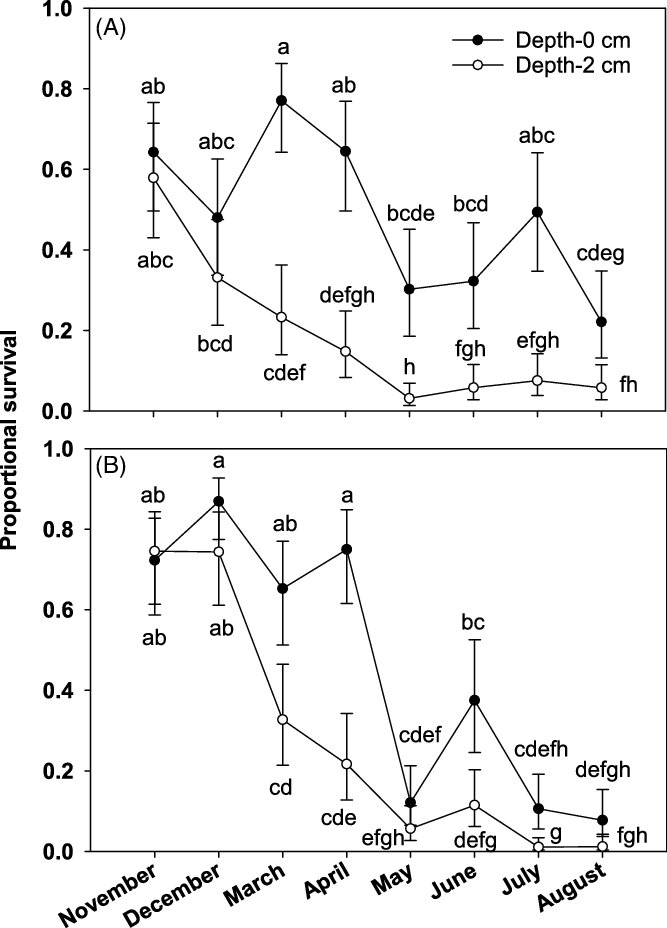
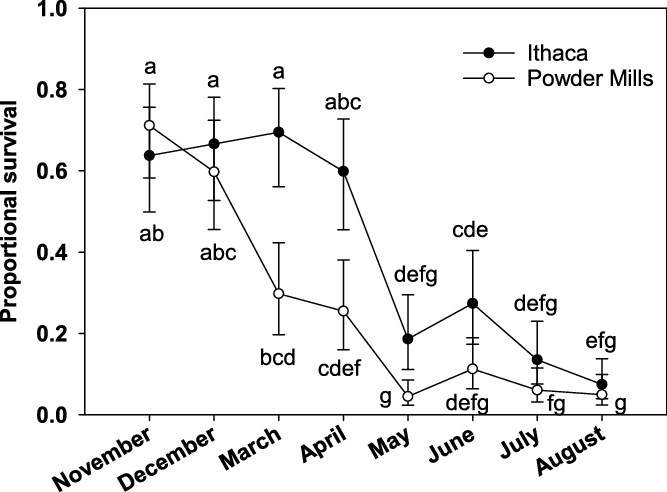
Monthly survival of sclerotia of A. rolfsii varied over time for the 2 yr of the study depending on the burial depth of the sclerotia (year by burial depth by sampling month interaction; P = 0.009; Figure 2). Survival of sclerotia after 1 mo (November) in the first year was 58% to 64%, and survival did not significantly decline for sclerotia on the soil surface (0 cm) until August (22%; Figure 2A). In contrast, survival for sclerotia buried at 2 cm had significantly declined by April (15%), with 6% survival by August (Figure 2A). Survival was significantly higher for surface-placed sclerotia than buried sclerotia throughout spring and summer (Figure 2A). A similar change in survival over time generally occurred in the second year of the study. However, survival of sclerotia was only 8% (0 cm) or 2% (2 cm) by August and did not differ between the two burial depths at that time (Figure 2B). Survival of sclerotia also varied only slightly over time by site (location by month interaction; P = 0.008). Specifically, survival was greater at the Ithaca location in March than at Powder Mills Park (Figure 3). Sclerotia stored and germinated in the laboratory had an average 80% to 85% survival for all months and years of the study.
Mean (±95% confidence interval, back-transformed) monthly proportion of surviving sclerotia of Athelia rolfsii at two burial depths during (A) 2017–2018 and (B) 2018–2019, averaged over sites. Means within each year denoted by the same letter are not different (Fisher’s protected LSD test with Bonferroni correction, P > 0.05).

Mean (±95% confidence interval, back-transformed) monthly proportion of surviving sclerotia of Athelia rolfsii at two field sites, averaged over years and burial depth. Means denoted by the same letter are not different (Fisher’s protected LSD test with Bonferroni correction, P > 0.05).

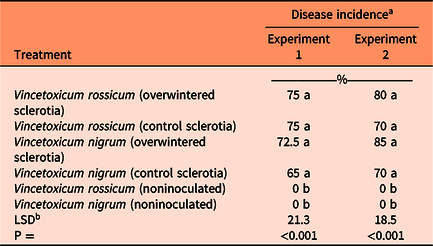
Forty percent of deployed sclerotia for the overwintered pathogenicity studies were intact and suitable for testing. Overwintered sclerotia were still pathogenic to V. rossicum and V. nigrum, and disease incidence was not significantly different between species or between overwintered sclerotia and control sclerotia stored in the laboratory for the same period (Table 5). No noninoculated plants showed disease symptoms.
Incidence (%) of Southern blight caused by Athelia rolfsii in Vincetoxicum nigrum and Vincetoxicum rossicum seedlings following inoculation of potted plants with sclerotia that had overwintered in Pittsford, NY, and those stored at room temperature (“control”).

a Means followed by the same letter are not significantly different (P = 0.05) by LSD.
b LSD: P = 0.05.
There are many factors that may influence the survival of A. rolfsii sclerotia between seasons, including abiotic and biotic factors, likely responsible for the broad range of reports in sclerotial survival times. For example, several studies have reported survival of sclerotia of up to 10 mo (Beute and Rodriguez-Kabana Reference Beute and Rodriguez-Kabana1981; Edmunds and Gleason Reference Edmunds and Gleason2003). However, a broad range of survival over the 10-mo period from 28% to 73% is reported (e.g., Beute and Rodriguez-Kabana Reference Beute and Rodriguez-Kabana1981). Sclerotial size has been shown to be a significant factor in soilborne fungi, such as S. sclerotiorum (Alexander and Stewart Reference Alexander and Stewart1994). Sclerotia with a smaller surface to volume ratio are less susceptible to degradation, hypothesized to be due to reduced exposure of the cortex to environmental conditions and microbial degradation (Alexander and Stewart Reference Alexander and Stewart1994). In this study, sclerotia used were in the range of 2 to 2.5 mm in diameter to discount this potential confounding factor. Soil texture may also significantly affect sclerotial survival. Studies by Alexander and Stewart (Reference Alexander and Stewart1994) reported lower sclerotial survival in soils with higher clay content. In this study, sclerotial survival varied only slightly over time between Ithaca and Powder Mills, both of which had sandy or silt loam soils.
Burial depth has also been found to have variable effects on sclerotial survival. For example, survival of A. rolfsii sclerotia was longer on the soil surface than when buried at 5- to 15-cm depth (Smith et al. Reference Smith, Jenkins, Punja and Benson1989). A subsequent study in Iowa found that sclerotial survival was not significantly affected by burial depth until June and July, and the magnitude of this difference between soil surface and burial depth varied with location (Edmunds and Gleason Reference Edmunds and Gleason2003). Xu et al. (Reference Xu, Gleason, Mueller, Esker, Bradley, Buck, Benson, Dixon and Monteiro2008) also found the effect of sclerotial burial varied significantly on overwintering success depending upon site and region. In this study, burial of sclerotia was at 2 cm to reflect minimal disturbances in soil in natural ecosystems, whereas the deeper burial depths (5 to 15 cm) in other studies aimed to reflect tillage.
In general, these results are contrary to the general findings of Xu et al. (Reference Xu, Gleason, Mueller, Esker, Bradley, Buck, Benson, Dixon and Monteiro2008), which suggested the inability of A. rolfsii to tolerate low temperatures limits the northern range of this fungus. However, with local changes in temperature and rainfall over the last 12 yr influencing seasonal patterns and a trend toward less severe winters and earlier spring onset, these factors may have influenced the ability of this pathogen to survive in upstate New York (Monahan et al. Reference Monahan, Rosemartin, Gerst, Fisichelli, Ault, Schwartz, Gross and Weltzin2016).
The use of plant pathogens for weed control has ranged from the deliberate introduction of highly specific, foreign pathogens (classical approach; Winston et al. Reference Winston, Schwarzländer, Hinz, Day, Cock and Julien2014) to the use of existing pathogens with variable host ranges (often as bioherbicides; Winston et al. Reference Winston, Schwarzländer, Hinz, Day, Cock and Julien2014). In the latter case, there has been an increase in reports of plant pathogens naturally infecting and being evaluated for the control of invasive plants, including Bipolaris spp. (leaf-spotting fungi) for Japanese stiltgrass [Microstegium vimineum (Trin.) A. Camus] (Kleczewski and Flory Reference Kleczewski and Flory2010; Warren and Bradford Reference Warren and Bradford2021), and the soilborne fungi Verticillium spp. for the control of tree-of-heaven [Ailanthus altissima (Mill.) Swingle] (Brooks et al. Reference Brooks, Wickert, Baudoin, Kasson and Salom2020; Schall and Davis Reference Schall and Davis2009). In addition, sclerotia-producing fungi, including isolates of A. rolfsii, have been investigated for broadleaf plant control in turf (Shaheen et al. Reference Shaheen, Abu-Dieyeh, Ash and Watson2010), pasture (Bourdôt et al. Reference Bourdôt, Hurrell and Saville2011), rice (Tang et al. Reference Tang, Zhu, He, Qiang and Auld2011), and old-field and forest habitats (Tang et al. Reference Tang, Kuang and Qiang2013; Zhang et al. Reference Zhang, Yang, Zhu, Li, Zhang, Li, Song and Qiang2019).
While the New York–sourced isolate of A. rolfsii may pose a risk to many broadleaf species co-occurring in natural areas infested with Vincetoxicum species, it was suggested that the pathogen could have potential in managing Vincetoxicum infestations in no-till corn and soybean fields or pastures (Gibson et al. Reference Gibson, Vaughan, Biazzo and Milbrath2014). Isolate VrNY was not virulent to some grasses and soybean (Gibson et al. Reference Gibson, Vaughan, Biazzo and Milbrath2014). The results of this and previous studies (Gibson et al. Reference Gibson, Castrillo and Milbrath2012, 2014) support the continued pathogenicity of A. rolfsii to different life stages of V. nigrum and V. rossicum. However, the disease dynamics over the 4 yr of study at the original discovery site, including a relatively stable disease incidence and very localized aggregation, suggests minimal pathogen and disease spread in this environment. This means that large areas of an infestation would likely need to be inoculated regularly with A. rolfsii sclerotia for effective control. The likelihood of A. rolfsii moving from the original inoculation site via surface water runoff or in soil on machinery, the ability of the sclerotia to overwinter in upstate New York and thus persist in treated fields if rotated to other crops, and the broad host range of the isolate together suggest that crops may be at unacceptably high risk for disease. The recent reemergence of Southern blight in susceptible crops in New York while the Vincetoxicum studies were underway, such as table beets that experienced losses of 5% to 25% (Pethybridge et al. Reference Pethybridge, Sharma, Silva, Bowden, Murphy, Knight and Hay2019), illustrates the high risk this pathogen poses to broad-acre cropping systems. Athelia rolfsii isolates from V. rossicum could infect table beets, and table beet isolates of the pathogen could infect Vincetoxicum species (SJP, unpublished data). Thus, the use of A. rolfsii for Vincetoxicum biological control is not recommended at this time.
Acknowledgments
This research was funded by the U.S. Department of Agriculture, Agricultural Research Service, and the USDA, National Institute of Food and Agriculture Hatch project NYG-625424, managed by Cornell AgriTech at the New York Agricultural Experiment Station, Cornell University, Geneva, NY. No conflicts of interest have been declared. Thanks to Carol Southby who originally discovered the dying swallowwort; Carol Bowden, Sean Murphy, and Audrey Klein (Cornell University) for excellent technical support; and Françoise Vermeylen and Erika Mudrak (Cornell University) for statistical advice. We are also grateful to the Monroe County Parks Department and Cornell University Farm Services for use of the field sites. Mention of trade names or commercial products in this publication is solely for the purpose of providing specific information and does not imply recommendation or endorsement by the USDA. USDA is an equal opportunity provider and employer.