COVID-19 is a pandemic viral disease caused by severe acute respiratory syndrome-coronavirus-2. Initially thought to primarily be a respiratory disease, it is now clear that multiple systems can be affected. Cardiac involvement occurs in 10% of COVID-19 hospitalised patients,Reference Tomasoni, Italia and Adamo1 and may be as high as 25% in the critically ill.Reference Clerkin, Fried and Raikhelkar2 Although children are generally less severely affected, previously healthy children can develop a multisystem inflammatory syndrome.Reference Cheung, Zachariah and Gorelik3 Little is known about the effects of COVID-19 in children with existing cardiomyopathy and heart failure.
Case reports
Patient 1 is a 14-year-old female with dilated cardiomyopathy who presented with exercise intolerance, shortness of breath, and nausea with vomiting. Left ventricular ejection fraction was decreased from 30% to 13%, and she was admitted for inotropic support. After being admitted for 2.5 weeks, she developed COVID-19 after her father became positive. She went on to develop altered mental status, hypotension, tachycardia, and lactic acidosis. A few days later, she developed episodes of haemodynamically significant ventricular tachycardia and was electively cannulated onto venoarterial extracorporeal membrane oxygenation. Given concerns of reactivation of COVID-19 with immunosuppression, transplant listing was postponed. She was converted to a left ventricular assist device, and received 10 mg/kg of methylprednisolone coming off bypass with a 4-day steroid wean to prevent the systemic inflammatory response observed in some COVID-19 adults receiving ventricular assist devices (unpublished case experience). She ultimately underwent successful heart transplantation 7.5 weeks after her COVID-19 diagnosis.
Patient 2 is a male with familial TTN-associated dilated cardiomyopathy, who first presented to cardiology with poor feeding and lethargy at 5 weeks of age. At presentation, he was COVID-19 positive and had severe left ventricular dilation and an ejection fraction of 18%. Multiple family members had COVID-19 – although he was afebrile and had no respiratory symptoms. He was started on milrinone and amiodarone for significant atrial arrhythmias. He was listed for heart transplant but inactivated after 5 months when his ejection fraction improved to 39% and he was transitioned to oral heart failure medications.
Patient 3 is a 2-month-old male with a prenatal diagnosis of restrictive cardiomyopathy who had an apneic event at home. He was COVID-19 positive upon admission screening. His systolic function had decreased from 51% to 39%. Due to a persistent troponin leak and ST segment elevation, he was listed and ultimately underwent successful transplant after 4 months.
Patient 4 is a 16-year-old female with a history of subaortic membrane resection with a baseline ejection fraction of 11% but minimal heart failure symptoms, maintained on oral medications. She developed low-grade fever with cough and tested positive for COVID-19 after her mother also tested positive. She developed fatigue, without other symptoms. We made no changes to her medications, and performed daily video visits until her symptoms improved a week later.
Discussion
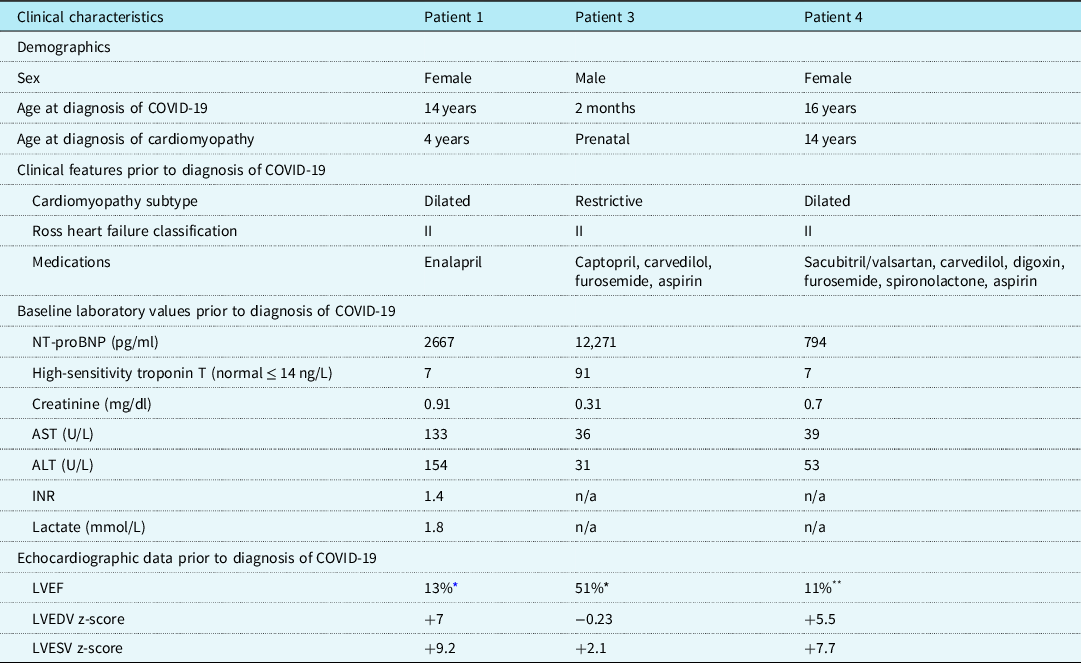
These four cases capture all known cases of COVID-19 among our ˜500 heart failure patients during the spring of 2020 (Table 1). They describe the breadth of our experience in treating paediatric patients with known or emerging heart failure and COVID-19. These cases demonstrate a wide spectrum of presentation that can occur in children and introduce the difficulties in determining COVID-19 effects versus independent worsening of underlying disease.
Baseline patient characteristics before COVID-19. We did not include patient 2 because we do not have a pre-COVID-19 baseline – his initial presentation was with both heart failure and COVID-19.

ALT = alanine aminotransferase; AST = aspartate aminotransferase; INR = international normalized ratio; LVEDV = left ventricular end-diastolic volume; LVEF = left ventricular ejection fraction; LVESV = left ventricular end-systolic volume; NT-proBNP = N-terminal pro b-type natriuretic peptide.
* Ejection fraction measured by 5/6 area length method.
** Ejection fraction measured by biplane Simpson method.
COVID-19 can be seen concurrently with cardiogenic shock as was seen in patient 1 and has been described in the adult literature.Reference Fried, Ramasubbu and Bhatt4 Patient 1 deteriorated from a cardiac perspective, without overt respiratory failure symptoms or evidence of myocarditis from COVID-19 infection which is a known feature.Reference Clerkin, Fried and Raikhelkar2 We believe most of her instability was from progression of cardiomyopathy. Patient 4’s presentation shows that mild COVID-19 can occur in the paediatric heart failure population. Patients 2 and 3 did not show any obvious symptoms of COVID-19 disease; however, illustrate that any illness can cause an acute exacerbation of an underlying chronic illness. None of the patients had other organ system involvement or any indication of sequelae from COVID-19 on follow-up.
COVID-19 continues to present unique challenges to the paediatric heart failure population. Our approach was to consider each case individually and we did not issue any generalised recommendations. Further studies will be necessary to determine the longitudinal outcomes and optimal management of paediatric heart failure patients during the COVID-19 pandemic.
Acknowledgements
The authors are grateful to H.L. and the medical team for their contributions to this manuscript.
Financial support
This research received no specific grant from any funding agency, commercial or not-for-profit sectors.
Conflicts of interest
None.
Ethical standards
This work does not involve human and/or animal experimentation.