Introduction
Airway haemangiomas can involve any site, from the nares to the tracheobronchial tree. However, they most typically affect the subglottis, and lesions at this site account for 1.5 per cent of all congenital laryngeal anomalies. Although initially asymptomatic, following proliferation they may lead to symptoms such as biphasic stridor, feeding difficulties, respiratory distress, barking cough, hoarseness and acute airway obstruction.Reference O-Lee and Messner1, Reference Saetti, Silvestrini, Cutrone and Narne2
The treatment of airway haemangiomas, and in particular subglottic haemangiomas, remains a contentious issue. The ideal treatment would not only maintain the airway and promote lesion regression but also be minimally invasive, as haemangiomas ultimately involute spontaneously. A variety of treatment modalities have been tried to date, including observation, systemic and intralesional corticosteroids, tracheostomy, vincristine, and endoscopic and open resection. The use of interferon, laser, radiotherapy, cryotherapy and embolisation has also been documented.Reference O-Lee and Messner1, Reference Al-Sebeih and Manoukian3 The success of all these treatments has varied, and they are not without adverse and potentially serious consequences.
Open resection offers definitive treatment, particularly for single, well defined subglottic haemangiomas. However, it involves a surgical procedure and requires post-operative admission to the paediatric intensive care unit for a number of days. In the case of multiple subglottic haemangiomas, surgery would be extremely challenging.
More recently, Léauté-Labrèze et al. have demonstrated dramatic results with the use of propranolol to treat cutaneous infantile capillary haemangiomas.Reference Léauté-Labrèze, Dumas de la Roque, Hubiche, Thambo and Taïeb4 This has focused our attention on this modest drug with the potential to radically alter infantile capillary haemangioma management.
Here, we report the case of an infant presenting with a severe, multicentric, transglottic airway haemangioma successfully treated with propranolol.
Case report
A five-week-old female infant presented with symptoms of feeding difficulties and increased work of breathing. Born at term via an elective Caesarean section, there was no prenatal history of note apart from intra-uterine growth retardation.
Clinical examination revealed the presence of biphasic stridor with increased work of breathing. Chest auscultation was unremarkable apart from transmitted upper respiratory tract sounds. Oxygen saturation monitoring at the time showed intermittent desaturations to 85 per cent at their lowest, with improvement on administration of adrenaline nebulisers and systemic dexamethasone.
Chest radiography revealed no signs of an infective process, but did show evidence of extrinsic compression 1 cm above the carina. Notably, the patient was also found to have haemangiomas affecting the right orbit and scalp.
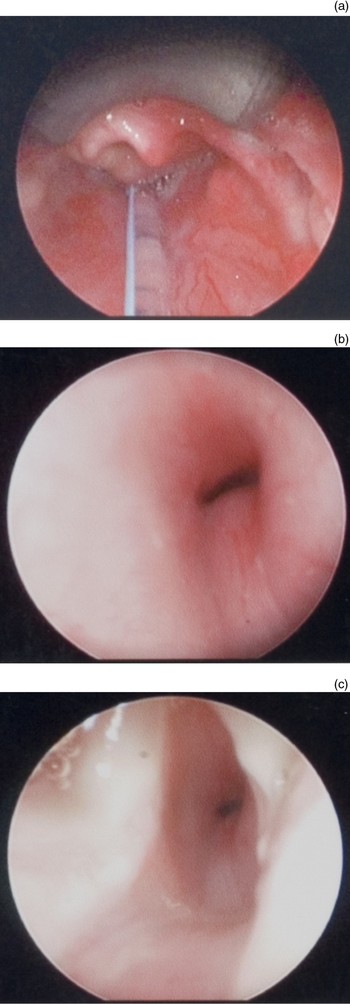
Urgent laryngotracheobronchoscopy was arranged. This revealed a multicentric haemangioma involving the posterior pharyngeal wall and left supraglottis and extending down to involve the subglottis, with two separately defined lesions in the latter region (Figure 1). Following the laryngotracheobronchoscopy, the patient was continued on systemic steroids to help maintain the airway (dexamethasone 250 µg/kg initially, reduced to 150 µg/kg the following day).
Views from initial laryngotracheobronchoscopy, showing a multicentric haemangioma extending from the left supraglottis down to involve the subglottis.

A contrast-enhanced computed tomography scan was done to check for other pathology. Results confirmed narrowing in the subglottic region, with a number of small, aberrant blood vessels anterior to the trachea extending to the subglottis. There were no other vascular abnormalities or masses noted within the mediastinum.
Following cardiology review and a normal echocardiogram, the child was commenced on propranolol 0.5 mg/kg split over a bi-daily dose. This was increased to 1 mg/kg over the next 10 days, as tolerated, with close monitoring of blood pressure, pulse and capillary glucose level. Over this time, the patient was continued on dexamethasone (100 µg/kg). Clinically, the patient's symptoms improved, with only mild stridor and occasional desaturations when unsettled.
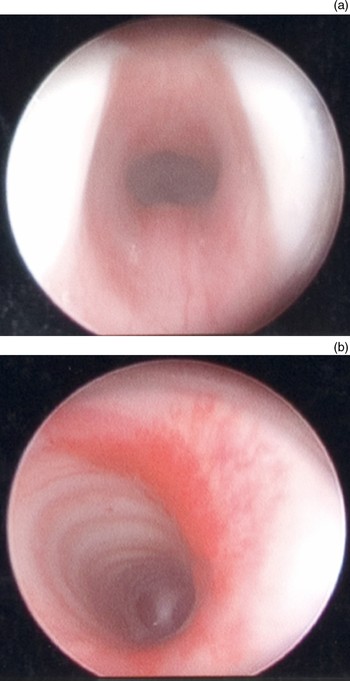
A repeated laryngotracheobronchoscopy was performed one week after commencement of propranolol, and showed a marked reduction in the bulk of the haemangioma, with minimal subglottic stenosis (Figure 2). Although there was still some evidence of capillaries, the dramatic reduction in tumour size over just two weeks of propranolol administration was incredible. The 2nd scope was performed one week following the commencement of propranolol. Over the following five days, the steroid dosage was tapered off, whilst the dose of propranolol was increased to 2 mg/kg (total daily dose) administered twice daily.
Views from second laryngotracheobronchoscopy undertaken one week after initiation of propranolol, showing marked reduction in the bulk of the haemangioma, with minimal subglottic stenosis.

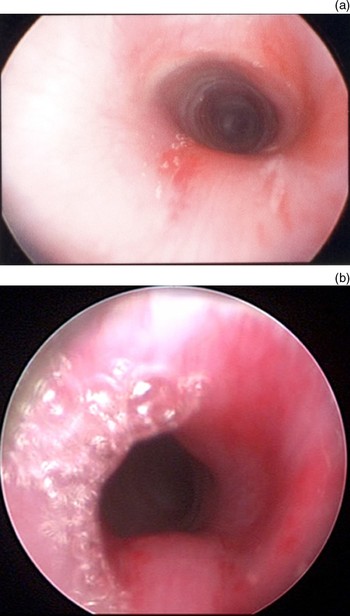
Subsequent laryngotracheobronchoscopies performed three and 13 weeks after commencement of propranolol demonstrated significant regression of the haemangioma (Figure 3). The patient remained asymptomatic and tolerated the drug well. No side effects were noted.
Views from subsequent laryngotracheobronchoscopies undertaken (a) three and (b) 13 weeks after initiation of propranolol, showing continued regression of the haemangioma.

Discussion
Haemangiomas of infancy are the most common type of vascular tumour arising from endothelial hyperplasia. Often confused with other malformations of vascular origin, they are not present at birth but instead proliferate rapidly in the first year of life. This proliferative phase, lasting from eight to 18 months, marks the initial part of their natural growth pattern, and is followed by a slower period of regression (the involution phase).Reference Al-Sebeih and Manoukian3, Reference Rahbar, Nicollas, Roger, Triglia, Garabedian and McGill5 Despite subglottic haemangiomas being benign tumours, in the absence of appropriate diagnosis and treatment mortality rates of 50 per cent have been reported.Reference Bailey, Froehlich and Hoeve6
A variety of methods have been used to treat airway haemangiomas to date. The conservative option of observation is suitable only in the minority of patients without significant respiratory or feeding difficulties.Reference Rahbar, Nicollas, Roger, Triglia, Garabedian and McGill5 Long-term systemic steroid use has been found to have variable success. Cushing syndrome, hypertension, delayed wound healing, immunosuppression and growth retardation are just some of the adverse effects reported.Reference Rahbar, Nicollas, Roger, Triglia, Garabedian and McGill5, Reference Bitar, Mourkarbel and Zalzal7, Reference George, Sharma, Jacobson, Simon and Nopper8 In an attempt to try to reduce systemic morbidity, the more focused use of intralesional steroids has been tried, with mixed results.Reference Bitar, Mourkarbel and Zalzal7 However, this method often involves prolonged intubation, and its associated risks may be deemed unacceptable by many.
The use of tracheostomy was first described in 1940 by Suehs and Herbur and gained popularity thereafter, with many recommending its use whilst awaiting natural involution of the lesion.Reference Suehs and Herbur9 However, the associated mortality rates, reported as 1–3 per cent, and the risks of accidental decannulation and mucus-plugging could not be ignored.Reference Rahbar, Nicollas, Roger, Triglia, Garabedian and McGill5, Reference Bailey, Froehlich and Hoeve6
Endoscopic laser treatment of haemangiomas, mainly using the CO2 laser, has been reported for nearly 30 years.Reference Healy, McGill and Friedman10 As with other modes of treatment, its reported efficacy has varied. The main risks include high recurrence rates (with the subsequent need for multiple treatments), subglottic stenosis and tracheostomy.Reference Brodsky, Yoshpe and Ruben11, Reference Chatrath, Black, Jani, Albert and Bailey12
Sharp was the first to describe successful surgical excision of a haemangioma from the trachea.Reference Sharp13 Since then, surgery has evolved to include methods for both open and endoscopic resection, with documented success. However, one of the main complications related to these procedures is subglottic stenosis, with its associated morbidity.Reference Rahbar, Nicollas, Roger, Triglia, Garabedian and McGill5, Reference Bailey, Froehlich and Hoeve6
None of the aforementioned treatments are without their risks and complications. The recent use of propranolol by Léauté-Labrèze et al. has shown exciting potential in the area of haemangioma treatment.Reference Léauté-Labrèze, Dumas de la Roque, Hubiche, Thambo and Taïeb4 In our patient, the use of propranolol was also found to be successful, and showed a similar result within the airway: both the extent and bulk of the lesion were reduced, with a simultaneous marked reduction and eventual resolution of symptoms. Simultaneous reduction in the scalp and orbital lesions was also noted. More recently, further evidence for the successful use of propranolol has come from Denoyelle et al. and Buckmiller et al., who demonstrated the effectiveness of propranolol in treating otherwise treatment-resistant haemangiomas affecting the subglottis and trachea, respectively.Reference Denoyelle, Leboulanger, Enjolras, Harris, Roger and Garabedian14, Reference Buckmiller, Dyamenahalli and Richter15
Haemangiomas have a complex composition, including endothelial cells, dendritic cells, pericytes, fibroblasts and mast cells. During the proliferative phase, growth is controlled by proangiogenic factors, predominantly vascular endothelial growth factor and basic fibroblast growth factor. Conversely, the involution phase is associated with apoptosis of cells, resulting in regression.
The proposed basis for the success of propranolol in treating haemangiomas is threefold: (1) vasoconstriction causes a colour change and palpable softening of the lesion; (2) decreased expression of proangiogenic growth factor genes halts proliferation, and (3) activation of apoptosis encourages the death of capillary endothelial cells and involution.Reference Léauté-Labrèze, Dumas de la Roque, Hubiche, Thambo and Taïeb4 The use of propranolol in infants is thought to be safe; however, it is necessary to monitor blood pressure, pulse and capillary blood glucose concentration during therapy. Such monitoring was highlighted by Siegfried et al. as an important safeguard against complications associated with hypotension, bradycardia and hypoglycaemia.Reference Siegfried, Keenan and Al-Jureidini16
The use of propranolol in the treatment of airway infantile haemangiomas has the potential to revolutionise the management of this condition. There are still significant issues to clarify, such as the correct dosage and the duration of treatment. As regards dose, 2 mg/kg total daily dose appears to work extremely well without adverse effects; however, an even smaller dose may well be equally efficient. At present, the current opinion is that patients should remain on propranolol for at least one year, after which time the treatment should be withdrawn slowly. Our patient tolerated the treatment very well, with no side effects. However, care should be taken during the first few days of treatment, with monitoring in hospital and cardiology support. This monitoring should then continue in the community following discharge.
• Haemangiomas of the airway can cause obstruction which can potentially be life-threatening
• Treatment of airway haemangiomas, in particular subglottic haemangiomas, has remained a contentious issue
• Recent reports have demonstrated dramatic results with the use of propranolol for treatment of infantile capillary haemangiomas; this drug is thought to halt proliferation and activate apoptosis, promoting regression of the haemangioma
• The use of propranolol in infants is thought to be safe; however, it is necessary to monitor blood pressure, pulse and capillary glucose level during therapy
Our case study adds further support for the use of propranolol in treating paediatric airway haemangioma. Propranolol has the additional benefit of treating not only subglottic but also supraglottic and multicentric haemangiomas of the airway, demonstrating its potential to become a valuable therapeutic option for this condition.
As with every new intervention, it is hoped that most centres will start reporting their experiences with this treatment in the years to come. Assessment of clinical outcomes in larger patient groups will help to establish the lowest efficient dose, the minimum length of treatment and the magnitude of potential side effects.