Introduction
Sarcopenia is a progressive, systemic skeletal muscle disease characterized by the loss of muscle mass and function. Sarcopenia is associated with various disorders, including cardiovascular diseases (Gao et al., Reference Gao, Cao, Ma, Gao, Luo, Zhu, Li and Zhou2022) and diabetes (Yuan & Larsson, Reference Yuan and Larsson2023), apart from an increased mortality rate (Cruz-Jentoft & Sayer, Reference Cruz-Jentoft and Sayer2019). Low muscle strength and physical performance, prevalent in patients with sarcopenia, are associated with increased healthcare costs, which adds to the economic burden faced by the patient and society (Mijnarends et al., Reference Mijnarends, Luiking, Halfens, Evers, Lenaerts, Verlaan, Wallace, Schols and Meijers2018). Therefore, sarcopenia is a significant public health problem that requires appropriate care and attention.
The European Working Group on Sarcopenia in Older People (EWGSOP) has been conducting research using common terminology and diagnostic criteria for sarcopenia to increase accurate interpretation and understanding of its research findings (Cruz-Jentoft et al., Reference Cruz-Jentoft, Baeyens, Bauer, Boirie, Cederholm, Landi, Martin, Michel, Rolland, Schneider, Topinkova, Vandewoude and Zamboni2010, Reference Cruz-Jentoft, Bahat, Bauer, Boirie, Bruyere, Cederholm, Cooper, Landi, Rolland, Sayer, Schneider, Sieber, Topinkova, Vandewoude, Visser and Zamboni2019). Expert consensus on the definition and diagnostic criteria of sarcopenia has been ascertained in Asia as well (Chen et al., Reference Chen, Liu, Woo, Assantachai, Auyeung, Bahyah, Chou, Chen, Hsu, Krairit, Lee, Lee, Lee, Liang, Limpawattana, Lin, Peng, Satake, Suzuki and Arai2014, Reference Chen, Woo, Assantachai, Auyeung, Chou, Iijima, Jang, Kang, Kim, Kim, Kojima, Kuzuya, Lee, Lee, Lee, Lee, Liang, Lim, Lim and Arai2020). The Asian Working Group for Sarcopenia (AWGS) introduced the concept of possible sarcopenia (p-sarcopenia), along with the diagnostic criteria suitable for Asians. P-sarcopenia is defined as low performance based on measurements of grip strength (grip strength; men: <28 kg, women: <18 kg) or the 5-time chair stand test (≥12 s) (Chen et al., Reference Chen, Woo, Assantachai, Auyeung, Chou, Iijima, Jang, Kang, Kim, Kim, Kojima, Kuzuya, Lee, Lee, Lee, Lee, Liang, Lim, Lim and Arai2020), which indicates a high likelihood of being diagnosed with sarcopenia. Diagnosis of p-sarcopenia using grip strength measurements is a useful method that can be used on-site since it is simple and safe to use. Accordingly, some previous studies diagnosed p-sarcopenia using grip strength in accordance with the AWGS diagnostic criteria and reported data on comparisons with the non-possible sarcopenia (np-sarcopenia) population (Lim & Kong, Reference Lim and Kong2022; Luo et al., Reference Luo, Liu, Zhang, Hu, Jin and Liu2023, Reference Luo, Liu, Shen, Zhang and Liu2024).
Previous research has shown that approximately 14 per cent of hospitalized patients under the age of 65 have sarcopenia (Churilov et al., Reference Churilov, Churilov, Brock, Curtain, Murphy, Muthukrishnan, Macisaac and Ekinci2021). In community-dwelling adults aged 40 and older, the prevalence is estimated to be around 10 per cent. Among individuals aged 65 and above, p-sarcopenia has been associated with physical inactivity and sedentary behavior (Gao et al., Reference Gao, Cao, Ma, Gao, Luo, Zhu, Li and Zhou2022; Yao et al., Reference Yao, Wang, Yang, Ren, Li and Wang2022), but it may occur at an earlier stage as well (Cruz-Jentoft et al., Reference Cruz-Jentoft, Bahat, Bauer, Boirie, Bruyere, Cederholm, Cooper, Landi, Rolland, Sayer, Schneider, Sieber, Topinkova, Vandewoude, Visser and Zamboni2019), among middle-aged adults in association with other diseases (Liang et al., Reference Liang, Shang and Pei2023).
However, most of the previous studies on sarcopenia have primarily examined aging-related primary sarcopenia, while studies on sarcopenia among older adults have focused mostly on falls (Scott et al., Reference Scott, Sanders, Aitken, Hayes, Ebeling and Jones2014; Zhang et al., Reference Zhang, Huang, Dou, Wang, Zhang, Yang, Wang, Xie, Zhou and Zeng2020), depressive symptoms (Lee & Lee, Reference Lee and Lee2023), and the quality of life (QOL) (Beaudart et al., Reference Beaudart, Demonceau, Reginster, Locquet, Cesari, Cruz Jentoft and Bruyere2023). Even though sarcopenia can also occur in middle-aged adults, studies on the association between sarcopenia and health-related variables in middle-aged adults are scarce (Bhat et al., Reference Bhat, Ireland, Shah, Gondhalekar, Mandlik, Kajale, Katapally, Bhawra, Damle and Khadilkar2024).
Therefore, this study aimed to identify the association between p-sarcopenia and fall risk, depression, and QOL in middle-aged and older adults.
Methods
Data collection and participants
The present study used data from the Korean Longitudinal Study of Aging (KLoSA), which focuses on Koreans aged ≥45 years living in households selected through multistage stratified probability sampling based on geographical areas to ensure national representativeness. A total of 10,254 individuals participated in interviews conducted by trained interviewers. The household response rate was 70.7 per cent, while the individual response rate within households was 75.4 per cent. For this study, we analyzed data from 10,181 participants aged 45–85 years, excluding individuals receiving antidepressant medication and those without grip strength measurements, from the initial 2006 KLoSA survey sample. We utilized secondary data from the first to sixth waves of the KLoSA panel survey, with all measures and testing procedures based on this dataset. Detailed information about the survey methodology, including sampling procedures and data-collection protocols, is available on the panel survey organization’s website: https://survey.keis.or.kr/eng/klosa/klosa01.jsp.
The mean (±standard deviation) age of the participants was 61.69 (±11.11) years. The retrospective study was approved by the Institutional Review Board of Sungkyunkwan University (SKKU-2024-04-001). Based on an age of 65 years and muscle strength criteria, we classified individuals into the p-sarcopenia and np-sarcopenia groups. Out of the 10,181 participants, 4,132 (40.59%) were classified into the p-sarcopenia group. Among the 4,437 male participants, the p-sarcopenia group included 259 middle-aged men (9.57%) and 709 older men (40.96%). Among the 5,744 female participants, the p-sarcopenia group included 514 middle-aged women (15.38%) and 1,154 older women (48.06%).
In this study, we used grip strength measurement data to differentiate the groups. Grip strength was measured in units of kg using a dynamometer (NO6103; TANITA, Japan). The test was performed in a sitting position with the elbow flexed at 90° on both the right and the left sides. The mean grip strength was calculated from the grip strength on both sides (Min et al., Reference Min, Lee, Park, Cho, Park and Min2012). Differentiation between the p-sarcopenia and non-p-sarcopenia groups using grip strength was performed based on the AWGS criteria (<28 kg for men and < 18 kg for women) (Chen et al., Reference Chen, Woo, Assantachai, Auyeung, Chou, Iijima, Jang, Kang, Kim, Kim, Kojima, Kuzuya, Lee, Lee, Lee, Lee, Liang, Lim, Lim and Arai2020).
Fall risk was assessed based on the self-reported number of falls experienced during the past 2 years. Depression was measured as self-reported depression using a single binary (yes/no) item, which asked whether the participant had experienced persistent depressive mood during the past year (Irwin et al., Reference Irwin, Artin and Oxman1999). In accordance with the WHOQOL group (1995), this study measured QOL based on how individuals perceive and evaluate their own lives. Specifically, we used five items assessing respondents’ satisfaction with their health status, economic status, relationship with spouse, relationship with children, and overall QOL. Each item was rated on a scale from 0 to 100. This approach was developed by the KLoSA research team.
Demographic characteristics included sex, age, marital status, highest education level, economic activity, and income level. The highest education level was divided into less than high school and high school or higher. Economic activity was divided into currently employed and unemployed. The income level was divided into <6 and ≥6 million won.
Physical health factors included smoking status, regular exercise, and the number of diagnosed diseases. Smoking status included the following categories: nonsmoker, quit smoking for 1 year or longer, and quit smoking for less than a year. Presence of regular exercise was ascertained based on a cutoff of exercise for more than 1 h/week. The number of diagnosed diseases was ascertained based on the incidence of cancer, hypertension, diabetes, cardiac disease, pulmonary disease, arthritis or rheumatism, and liver disease, and it was classified as <3 and ≥3.
Statistical analyses
Descriptive statistics were used to compare the characteristics of participants between groups by age (<65 or ≥ 65 years) and grip strength (men: <28 kg; women: <18 kg). Continuous and categorical variables were compared between the groups using an independent t-test and χ2 test, respectively.
Logistic regression analysis was performed to compare the adjusted mean and 95 per cent confidence interval (CI) of experience of falling and depression between the groups, after adjusting for age, sex, and body mass index (BMI). We considered a p-value of <0.05 as statistically significant for the comparison between the p-sarcopenia and np-sarcopenia groups. Linear regression analysis was performed to compare the adjusted mean and 95 per cent CI of the QOL score between groups. All analyses were performed using STATA version 15 (Stata Corp, USA).
Results
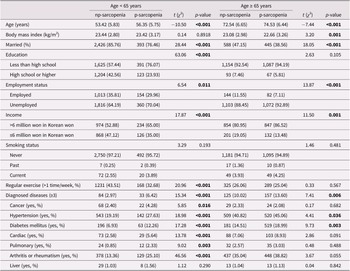
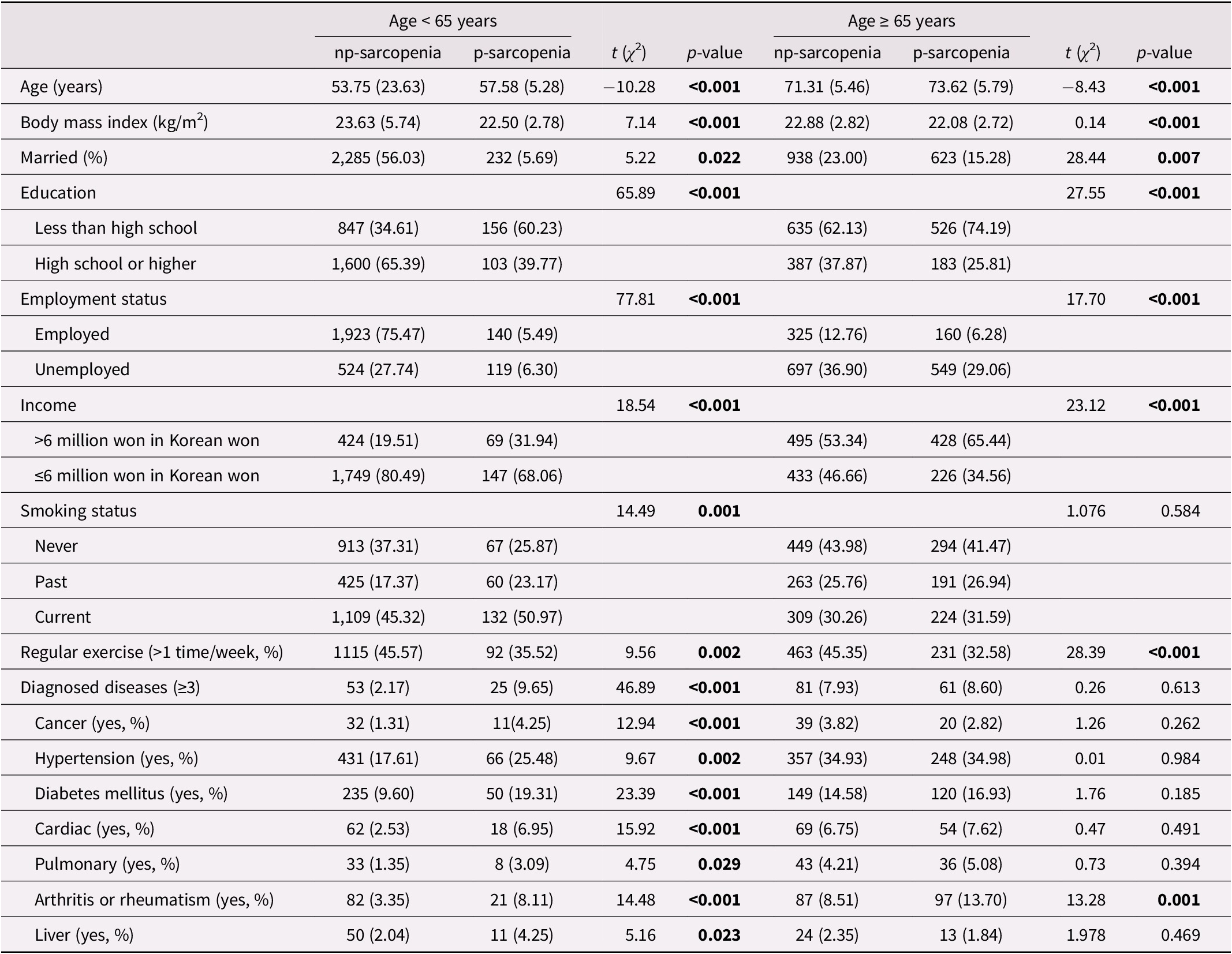
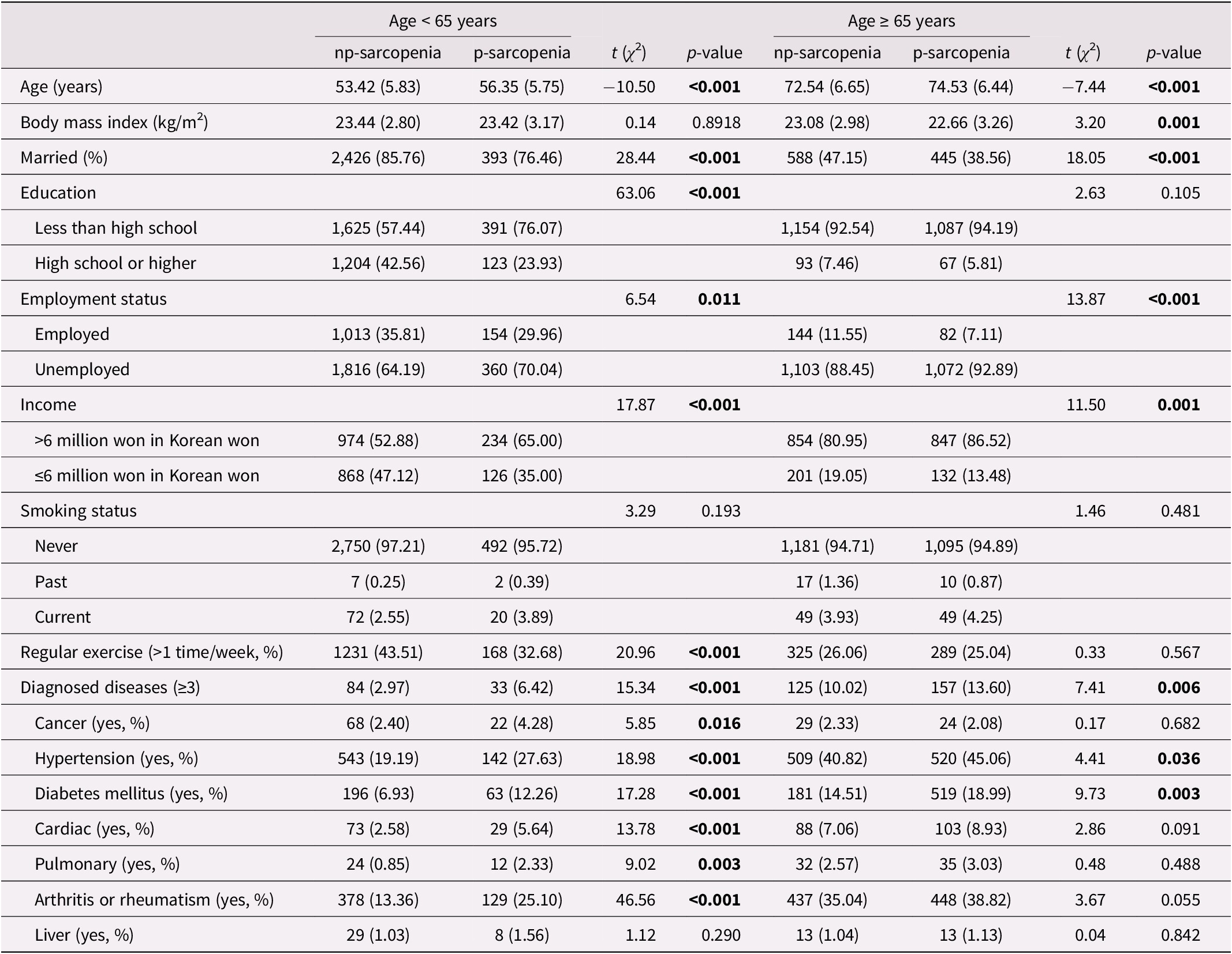
Patient characteristics are described in Tables 1 and 2. The mean (±standard deviation) age of the participants was 54.12 (±5.81) and 72.26 (±5.71) years for men and 53.87 (±5.91) and 73.49 (±6.62) years for women.
Characteristics of the male participants
Note: p-sarcopenia = possible sarcopenia; np-sarcopenia = non-possible sarcopenia. Bolded values indicate statistical significance at p < .05.
Characteristics of the female participants
Note: p-sarcopenia = possible sarcopenia; np-sarcopenia = non-possible sarcopenia. Bolded values indicate statistical significance at p < .05.
Both middle-aged and older adult men exhibited a significantly higher mean age, lower BMI, higher percentage of patients with an unmarried status, lower education level, higher percentage of unemployed patients, lower income, and lower percentage of patients performing physical activity at least once a week in the p-sarcopenia group than in the np-sarcopenia group (p < 0.05 for all). Additionally, middle-aged men exhibited higher percentages of current smokers and those with ≥3 diagnosed diseases, and a higher prevalence of cancer, hypertension, diabetes, cardiac diseases, pulmonary diseases, arthritis or rheumatism, and liver disease in the p-sarcopenia group than in the np-sarcopenia group (p < 0.05). In contrast, older men showed a significantly higher prevalence of arthritis or rheumatism in the p-sarcopenia group than in the np-sarcopenia group (p = 0.001) but no significant differences in smoking status and the percentage of patients with ≥3 diagnosed diseases (cancer, hypertension, diabetes, cardiac diseases, pulmonary diseases, and liver disease) (p > 0.05).
Both middle-aged and older adult women showed a significantly higher mean age, higher percentage of patients with an unmarried status, lower education level, lower income, and higher percentage of patients with ≥3 diagnosed diseases, especially hypertension, in the p-sarcopenia group than in the np-sarcopenia group (p < 0.05). Additionally, middle-aged women showed a significantly lower percentage of patients performing physical activity at least once a week and a higher prevalence of cancer, hypertension, diabetes, cardiac diseases, pulmonary diseases, and arthritis or rheumatism in the p-sarcopenia group than in the np-sarcopenia group (p < 0.05). Meanwhile, older women showed significantly lower BMI in the p-sarcopenia group than in the np-sarcopenia group (p < 0.001) (Table 2).
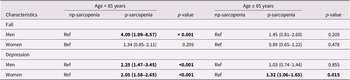
Among middle-aged men, the fall risk was significantly higher, by 4.09 times, in the p-sarcopenia group than in the np-sarcopenia group (95% CI: 1.99–8.57), but there was no difference among older men, middle-aged women, and older women (p < 0.05) (Table 3).
Odds ratios for falls and depression, according to sex and age
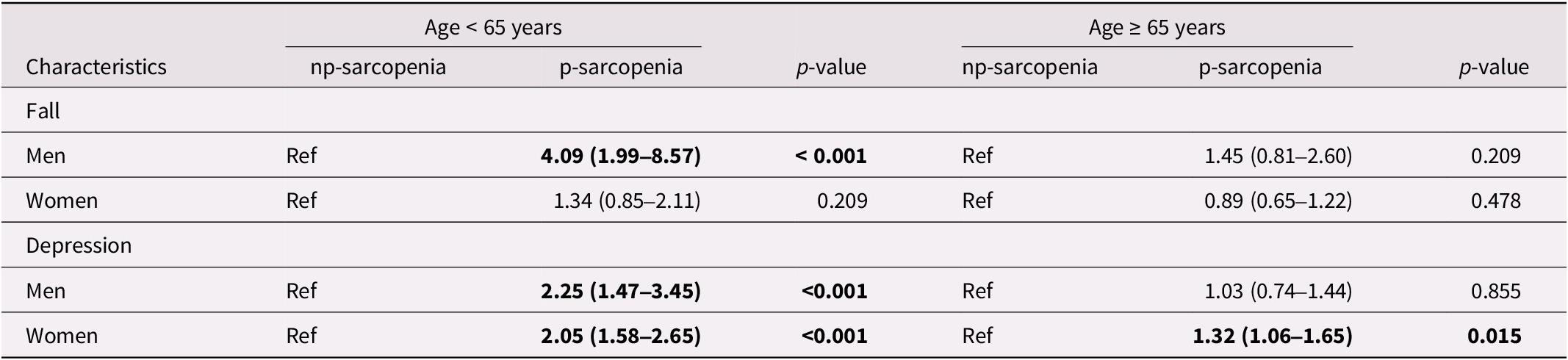
Notes: Regression analysis with adjustment for age, body mass index and education [the adjusted mean, (95% confidence interval, CI)].
p-sarcopenia = possible sarcopenia; np-sarcopenia = non-possible sarcopenia; Ref = reference. Bolded values indicate statistical significance at p < .05.
Depression rates were significantly higher among middle-aged men (by 2.25 times; 95% CI: 1.47–3.45) and middle-aged women (by 2.05 times; 95% CI: 1.58–2.65) in the p-sarcopenia group than in the np-sarcopenia group (Table 3). Older adult men showed no difference in depression rates between the groups, whereas the older women in the p-sarcopenia group showed significantly higher depression rates (by 1.32 times; 95% CI: 1.06–1.65), than those in the np-sarcopenia group.
Among middle-aged men and women, there were significant differences between the p-sarcopenia and np-sarcopenia groups in QOL scores for perceived health status (−9.25 vs. −7.74 points), perceived economic status (−8.33 vs. −8.03 points), relationship with spouse (−2.49 vs. −3.69 points), relationship with children (−2.51 vs. −3.69 points), and overall QOL (−7.22 vs. −4.91 points) (p < 0.001) (Table 4). Among older adult men and women, there was a significant difference between the p-sarcopenia and np-sarcopenia groups in the QOL score for perceived health status (−4.09 vs. −2.32 points). There were no significant differences between the p-sarcopenia and np-sarcopenia groups in the QOL scores for other parameters (p > 0.05) (Table 4).
Association between QOL and low muscle mass, according to sex and age
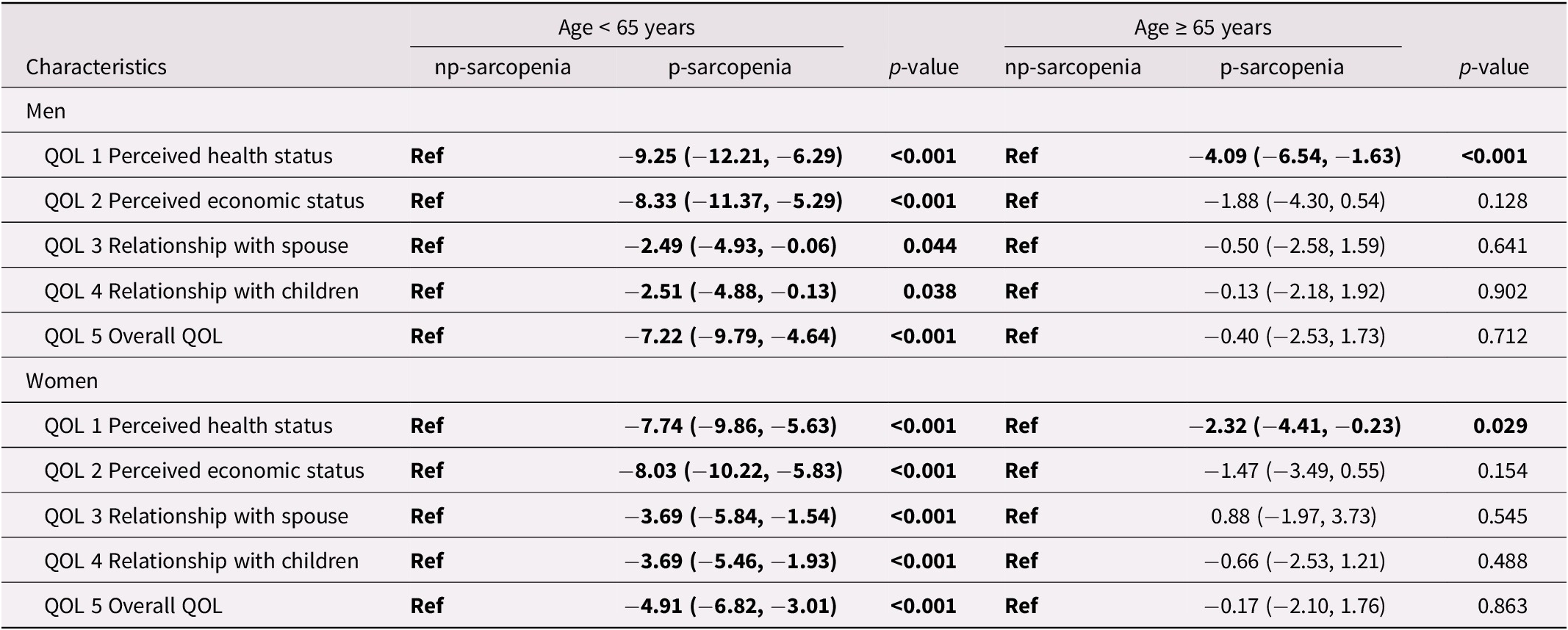
Notes. Regression with adjusted age, body mass index, and education.
p-sarcopenia = possible sarcopenia; np-sarcopenia = non-possible sarcopenia; QOL = quality of life; PS = possible sarcopenia; Ref. = reference. Bolded values indicate statistical significance at p < .05.
Discussion
The findings of the present study showed that the individuals in the p-sarcopenia group had poor physical health status, including health behaviors, than those in the np-sarcopenia group. The p-sarcopenia group also showed a higher odds ratio (OR) for falls and depression and a lower QOL than the np-sarcopenia group. In particular, the middle-aged individuals in the p-sarcopenia group showed more prominent results than those in the np-sarcopenia group. Therefore, our findings indicated the need for healthcare assistance for not only older adults with p-sarcopenia, but also for middle-aged adults with p-sarcopenia.
In this study, the middle-aged individuals in the p-sarcopenia group showed a higher percentage of patients with ≥3 diagnosed diseases and lower participation in physical activities than those in the np-sarcopenia group. Sarcopenia can be divided into primary and secondary sarcopenia; the decreased muscle mass that appears in middle-aged individuals is generally defined as secondary sarcopenia and is different from aging-related primary sarcopenia (Gao et al., Reference Gao, Cao, Ma, Gao, Luo, Zhu, Li and Zhou2022; Yao et al., Reference Yao, Wang, Yang, Ren, Li and Wang2022). Secondary sarcopenia is caused by diagnosed diseases or temporary inactivity, such as after surgery, and it may appear acutely or with prolonged hospitalization. Generally, muscle mass and strength reach peak levels during young adulthood and then plateau before decreasing, subsequently leading to sarcopenia (Liang et al., Reference Liang, Shang and Pei2023). However, a temporary decrease in physical activities due to factors such as the treatment of chronic disease or surgery can cause a decrease in muscle mass, which is nonlinear and can be more significant than a decrease that is caused by aging (Lieffers et al., Reference Lieffers, Mourtzakis, Hall, McCargar, Prado and Baracos2009; Muscaritoli et al., Reference Muscaritoli, Lucia, Molfino, Cederholm and Rossi Fanelli2013). Such muscle loss can be exponential (up to 2–15% per 100 days), while the cross-sectional area of muscle decreases by 3.5–4.2 per cent in 5 days (Prado et al., Reference Prado, Sawyer, Ghosh, Lieffers, Esfandiari, Antoun and Baracos2013). Partial recovery of such secondary sarcopenia is possible, but it still requires special care since there is a high risk of recurrence and various health issues may arise during the recovery process (Wall et al., Reference Wall, Dirks, Snijders, Senden, Dolmans and van Loon2014). In particular, a recent review study reported that the rate of decrease in muscle strength is faster than that of muscle mass (Cruz-Jentoft & Sayer, Reference Cruz-Jentoft and Sayer2019), which indicates a greater need for managing the decrease in muscle strength caused by chronic disease. According to a previous study with a 22-year long-term follow-up, the major predictors of a decrease in muscle strength were high-intensity occupational characteristics during middle-age years, being overweight, smoking, cardiovascular disease, hypertension, diabetes, and asthma (Stenholm et al., Reference Stenholm, Tiainen, Rantanen, Sainio, Heliovaara, Impivaara and Koskinen2012). These results support the findings of this study. In the present study, individuals in the p-sarcopenia group had more diagnosed diseases than those in the np-sarcopenia group, and both middle-aged and older adult individuals in the p-sarcopenia group showed lower physical activity, which was consistent with the association between low physical activity and p-sarcopenia reported in previous studies (Roubenoff & Hughes, Reference Roubenoff and Hughes2000). Therefore, there is an even greater need for physical activities aimed at improving muscle strength and preventing its decrease, especially muscle strengthening exercises for middle-aged and old adults with p-sarcopenia.
In the present study, the middle-aged individuals in the p-sarcopenia group showed higher ORs for falls and depression than those in the np-sarcopenia group. A previous study on p-sarcopenia in older adults also reported lesser upper and lower body strength, aerobic endurance, lower body flexibility, agility, and dynamic balance, and a greater fall risk compared with healthy individuals (Lim & Kong, Reference Lim and Kong2022). According to a previous review on falls and muscle strength, a lower upper body strength was associated with an approximately 1.5 times higher fall risk (Moreland et al., Reference Moreland, Richardson, Goldsmith and Clase2004). While the present study did not investigate various gait-related physical fitness factors, known fall-related factors including various medications and diagnosed diseases such as cardiopulmonary disease, depression, osteoarthritis, and diabetes were investigated. In this study, the fall-related factors were considered the reason why the middle-aged individuals in the p-sarcopenia group, which had more diagnosed diseases, had a higher incidence of a fall than those in the np-sarcopenia group (Berry & Miller, Reference Berry and Miller2008; Gale et al., Reference Gale, Cooper and Aihie Sayer2016; Pfortmueller et al., Reference Pfortmueller, Lindner and Exadaktylos2014; Welmer et al., Reference Welmer, Rizzuto, Laukka, Johnell and Fratiglioni2017). However, no significant difference in fall experience was observed between the p-sarcopenia and np-sarcopenia groups among middle-aged and older women. This finding differs somewhat from previous studies that highlighted an elevated fear of falling among individuals with p-sarcopenia and sarcopenia (Lim & Kong, Reference Lim and Kong2022; Merchant et al., Reference Merchant, Chen, Wong, Ng, Shirooka, Lim, Sandrasageran and Morley2020). This was because previous studies were based on outcomes regarding the fear of falling, whereas the present study investigated fall incidences. Moreover, some studies reported that the fear of falling increases owing to gait-related balance problems, more so than muscle strength (Binda et al., Reference Binda, Culham and Brouwer2003), and thus, additional analysis is needed. Nonetheless, we concluded that it is important to provide healthcare for not only older adults but also middle-aged adults since the findings in the present study showed a higher rate of falls among middle-aged individuals in the p-sarcopenia group than among those in the np-sarcopenia group.
In the present study, the middle-aged individuals in the p-sarcopenia group showed a higher rate of depression and significantly lower QOL than those in the np-sarcopenia group. The association between sarcopenia and depression has been reported (Li et al., Reference Li, Tong, Ma, Bao and Yue2022), and generally higher rates of lack of exercise, inflammatory factors, and hormonal disruption of the hypothalamic–pituitary–adrenal axis have been reported as common risk factors for depression and lower QOL (Hallgren et al., Reference Hallgren, Herring, Owen, Dunstan, Ekblom, Helgadottir, Nakitanda and Forsell2016). Sarcopenia has been reported to have a short- and long-term effect on the decline in QOL (Tsekoura et al., Reference Tsekoura, Kastrinis, Katsoulaki, Billis and Gliatis2017; Veronese et al., Reference Veronese, Koyanagi, Cereda, Maggi, Barbagallo, Dominguez and Smith2022). West et al. (Reference West, Williams, Davis and Pasco2025), using the WHOQOL-BREF and defining probable sarcopenia according to the EWGSOP guidelines, reported that older adults with probable sarcopenia had more than 2.5 times higher odds of poor QOL across all domains – physical health, psychological well-being, social relationships, and environment (West et al., Reference West, Williams, Davis and Pasco2025). However, as this study was conducted in a European population and included only older adults, its findings may have limited generalizability to our Korean sample. In our study, participants with p-sarcopenia demonstrated significantly lower satisfaction across all five QoL indicators – perceived health status, perceived economic status, relationship with spouse, relationship with children, and overall QOL – with odds ratios ranging from 2.5 to 9. In particular, a previous cohort study comparing grip strength reported a positive association between muscle strength and QOL and a negative association between sarcopenia and QOL in men (Marques et al., Reference Marques, Confortin, Ono, Barbosa and d’Orsi2019). It indicated that low grip strength and sarcopenia can cause serious loss of health. In recent years, there have been reports of low QOL among not only patients with sarcopenia without other diagnosed diseases, but also patients with various diseases such as cancer (Nipp et al., Reference Nipp, Fuchs, El-Jawahri, Mario, Troschel, Greer, Gallagher, Jackson, Kambadakone, Hong, Temel and Fintelmann2018) and heart failure (Bekfani et al., Reference Bekfani, Pellicori, Morris, Ebner, Valentova, Steinbeck, Wachter, Elsner, Sliziuk, Schefold, Sandek, Doehner, Cleland, Lainscak, Anker and von Haehling2016). Our findings suggest that p-sarcopenia, particularly when accompanied by loss of muscle strength and other diagnosed conditions, is associated with an increased risk of falls and elevated depressive symptoms, all of which contribute to a decline in QOL. Notably, middle-aged individuals with p-sarcopenia appeared to be more adversely affected compared to their healthier counterparts in the same age group, and even more so than older adults. These results highlight the urgent need for early identification and the development of tailored intervention models specifically targeting middle-aged adults with sarcopenia. Given the varying exposure to chronic conditions among middle age groups, tailored health management focusing on muscle strength, endurance, and balance is particularly important. Moreover, for individuals who have already developed sarcopenia, regardless of age, we emphasize the need for muscle function enhancement interventions – such as resistance training – at least twice per week to mitigate further decline and improve overall QOL.
The present study had some limitations. Although the present study was a cohort study that represents the Korean population, there are difficulties in generalizing the findings according to demographic characteristics. Nevertheless, the present study performed sufficiently elaborate statistical analysis as the sample size was ≥10,000 and was significant in that it was designed to allow expandability as a future long-term follow-up study. Moreover, as a cross-sectional study using only baseline values from a cohort study, this study could not describe causal relationships. However, the study was significant in that it comprehensively identified various risk factors associated with p-sarcopenia, including not only physical characteristics such as diagnosed diseases, but also health behaviors such as physical activity, as well as falls, depression, and QOL. Lastly, the present study also has the limitation of comparing the characteristics of p-sarcopenia groups using only low muscle strength instead of comparing sarcopenia groups with consideration of muscle mass. Despite these limitations, the findings of the present study were consistent with those of other studies on sarcopenia using muscle mass or muscle mass and strength.
Conclusion
This study identified the association between p-sarcopenia and physical characteristics, fall risk, depression, and QOL in middle-aged and older adults. The findings showed that the p-sarcopenia group had a higher percentage of patients with ≥3 diagnosed diseases, falls, and depression rates, and lower overall QOL than the np-sarcopenia group, with the results even more prominent among the middle-aged individuals in the p-sarcopenia group. Therefore, the findings of this study highlight the need for managing sarcopenia in middle-aged adults to reduce its burden as a public health concern and promote the expansion of healthcare for secondary sarcopenia.
Data availability statement
Data used in this study are available at: https://survey.keis.or.kr/eng/klosa/databoard/List.jsp.
Authors contribution
J. Koo, S. K. Lim, and S. Kong drafted the manuscript. All authors have made substantial contributions to the conception or design of this study, or data acquisition, analysis, and interpretation, and all authors participated in revising the manuscript after critical review.
Financial support
This work was supported by the National Research Foundation of Korea, funded by the Korea Ministry of Science and ICT (grant RS-2024-00361477).
Competing interests
The authors declare none.
Ethics approval and consent to participate
Ethical review and approval were waived for this study (SKKU-2024-04-001) because the KLoSA does not include any variables that can identify a specific respondent, and all data are fully anonymized before accessed. Detailed information about the survey is available on the panel survey organization website (https://survey.keis.or.kr/eng/klosa/databoard/List.jsp).