Implications
Reducing the protein level in the diet of breeders is a promising dietary management being cost-effective and environmental friendly. This study revealed that reduced balanced protein diets had negative impacts on the feather condition in current generation whereas positive transgenerational effects on feather condition were observed. Favorable effects on the litter moisture and footpad dermatitis of broiler breeders on reduced balanced protein diets were observed as well.
Introduction
Broiler breeding companies aim to optimize broiler meat output per breeder, thus the breeder generation is expected to carry the rapid growth trait and be highly reproductive (De Jong and Guémené, Reference De Jong, Voorst, Ehlhardt and Blokhuis2011). Unfortunately, efficient growth and high laying performance are negatively correlated which is one of the broiler breeder paradoxes (Decuypere et al., Reference Decuypere, Bruggeman, Everaert, Li, Boonen, De Tavernier, Janssens and Buys2010). Ad libitum fed broiler breeders have a feed intake above their nutrient requirements (Etches, Reference Etches1996). This excess in feed intake and hence body mass causes severe health and reproduction dysfunctions (Renema and Robinson, Reference Renema and Robinson2004). The controlled feed allocation is used to keep the broiler breeders in shape for desired reproduction performance (Decuypere et al., Reference Decuypere, Bruggeman, Everaert, Li, Boonen, De Tavernier, Janssens and Buys2010). However, this management technique is accompanied by several welfare problems. Hocking (Reference Hocking1993) reported that, with free access to water, the water intake was 1.25 times higher in restricted breeders compared with ad libitum fed breeders. This excessive drinking, also referred to as polydipsia, results in wet litter which is detrimental for the footpad and hock health (Savory and Maros, Reference Savory and Maros1993). In addition, a positive correlation was found between the level of controlled feed intake and orally based activities directed toward ingestion or foraging (scratching and pecking at the litter) (Hocking et al., Reference Hocking, Maxwell and Mitchell1996). It is speculated that the occurrence of feather pecking may raise due to the increased orally based activities under controlled feed intake. The increase of feather picking, gentle feather pecking or aggressive pecking were reported to impair feather condition of laying hens (McAdie et al., Reference McAdie, Keeling, Blokhuis and Jones2005).
In terms of nutritional needs of broiler breeders for optimum performance, low protein diets have been constantly under investigation. Feeding low protein diets has inconsistent effects on hatchability, fertility and laying performance of breeders (Spratt and Leeson, Reference Spratt and Leeson1987; Van Emous et al., Reference Van Emous, Kwakkel, Van Krimpen and Hendriks2015; Steenhuisen and Gous, Reference Steenhuisen and Gous2016). A reduced drinking behavior was observed in broilers fed with low protein diets (Marks and Pesti, Reference Marks and Pesti1984). Thereby, promising welfare implications such as an improvement of the litter condition and hence reduction in pododermatitis of broiler breeders are expected. However, low protein diets have been shown to have a negative impact on the feather coverage of the broiler breeders (Van Emous et al., Reference Van Emous, Kwakkel, Van Krimpen and Hendriks2014). This could be another welfare challenge as feathers provide partial protection from injury during life, especially during mating (De Jong and Guémené, Reference De Jong, Voorst, Ehlhardt and Blokhuis2011).
In mammals, low protein diets have been reported to have transgenerational effects on subsequent generations in terms of metabolic and behavioral aspects (Bellinger et al., Reference Bellinger, Lilley and Langley-Evans2004; Zambrano et al., Reference Zambrano, Martínez‐Samayoa, Bautista, Deas, Guillen, Rodríguez‐González, Guzman, Larrea and Nathanielsz2005). In poultry, environmental challenges are known to affect behavior and stress susceptibility and the effects persist into following generations (Jensen, Reference Jensen2014). So far, the welfare condition of broiler breeders with transgenerational transfer from a maternal dietary treatment has not yet been studied. Thus, this study aimed to investigate the litter condition, pododermatitis and feather condition of breeders fed a reduced balanced protein diet over three successive generations.
Material and method
The present research was approved by the ethical commission for experimental use of animals of KU Leuven under accession number P187/2013.
Experimental design
The experiment started with two treatments for the F0 generation: control (C) group fed with standard C diets and reduced balanced protein (RP) group fed with RP diets which had a 25% reduction in dietary CP and amino acids (AA). The female F0-progeny of each treatment was again divided into the two dietary treatments, resulting in four treatments for the F1 generation: C/C, C/RP, RP/C and RP/RP (letters indicating the breeder feed in F0/F1 generation). The female F1-progeny of each treatment were all fed with the standard C diets which resulted in four treatments for the F2 generation: C/C/C, C/RP/C, RP/C/C and RP/RP/C (letters indicating the breeder feed in F0/F1/F2 generation).
Animals
For the F0 generation, a total of 160 day-old pure line A female breeders with similar BW were evenly distributed to 10 floor pens (1.5×2 m) with 16 birds/pen resulting in five replicates for each treatment (C and RP). Meanwhile, 40 day-old pure line A male breeders were allotted to two pens and located near the female breeder pens in the same poultry house. Pure line A is a pure broiler breeder male line of an anonymous breeding company at the A position of a four-way cross which makes up a commercial broiler. At 19 weeks of age, 12 mature males (well feathered, well developed comb and wattle) around the target BW were selected and kept in individual cages (60×40×60 cm) in another room. Starting from the age of week 25, artificial insemination with pooled semen of these 12 males was performed once a week for each female. Eggs from week 35 and 36 were collected and incubated (Koppenol et al., Reference Koppenol, Delezie, Wang, Franssens, Willems, Ampe, Buyse and Everaert2015) to generate the F1 generation. At hatch, 152 and 136 day-old healthy female F0-progeny chicks were obtained from the C and RP group, respectively. The progeny of the C group was evenly divided into eight pens with 19 birds/pen and were fed on either C or RP diets (C/C and C/RP group). Similarly, the progeny of the RP group was divided into RP/C and RP/RP group with 17 birds in each pen. In total, breeders of F1 generation were thus housed in 16 pens with four replicate pens per treatment. In week 27, the number of breeders in each group were on average (variance) 14 (0.67), 14 (0.67), 12.5 (0.25), 12 (0.67) for C/C, C/RP, RP/C and RP/RP, respectively. In all, 63 males of the C group progeny were reared in a single floor pen in another room. At 19 weeks of age, again 18 sexual mature and healthy males were transferred into individual cages for semen collection. Similar for the F1 generation, the birds of the F2 generation were hatched from fertile eggs (collected from weeks 38 to 40) of the F1 generation. Healthy female offspring of each treatment in the F1 generation (71, 75, 66 and 51 healthy birds of C/C, C/RP, RP/C and RP/RP group, respectively) were evenly allotted to four pens leading to four replicates for each treatment of F2 generation (C/C/C, C/RP/C, RP/C/C and RP/RP/C). In week 27, the number of breeders in each group were on average (variance) 12 (0.00), 12 (0.00), 12 (0.00), 10 (0.00) for the C/C/C, C/RP/C, RP/C/C and RP/RP/C, respectively. In case of false gender identification and occasionally mortality, the chicken number in pens of each treatment was not evened out at the beginning of the F1 and F2 generation. The female breeders were raised until week 40, 44 and 45 for the F0, F1 and F2 generation, respectively.
Husbandry and management
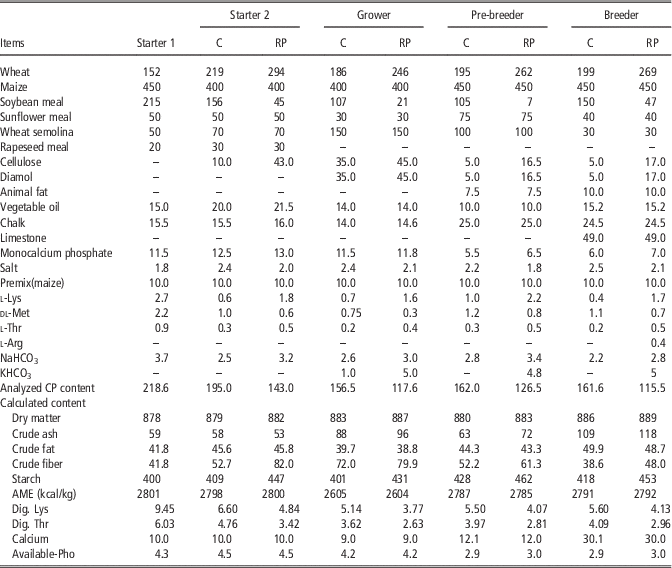
Pens were provided with sawdust wood shavings (~4 kg/pen; Aveve, Leuven, Belgium) to provide dustbathing possibilities and to absorb excreta moisture. Litter was replaced with fresh wood shavings twice a week through the entire rearing and laying periods. One bell shape drinker (36 cm of bell trough diameter) was supplied in the corner of each pen, opposite to the nest boxes. During the rearing period, a controlled amount of feed was allocated daily to each pen. This feed amount was calculated on a weekly basis by the number of animals and the required BW profile to achieve the target BW (Aviagen, 2013). From the start of the laying period, however, feed allocation per breeder hen was calculated according to the egg production of the corresponding groups. After peak production, the feed allocation was determined by the required weight increase and the level of egg production. The RP diet fed birds received about 10% more feed to achieve the similar target BW as the C diet fed birds. Birds had free access to water and were fed ad libitum for the first 2 weeks. From the 3rd week onwards, controlled feed amount was provided at 0900 h on each day and water was available during the light period. Pullets of all three generations were fed according to a four-phase feeding program during rearing. The starter 1 diet was fed for all birds from hatch until day 21, the starter 2 diet from day 22 until 42, the grower diet from day 43 to 105 and the pre-breeder diet from day 106 until 5% of egg production (calculated for each treatment). During the laying period, a breeder diet was given to breeder hens. For each feeding phase, diets were formulated to be isocaloric and composed of the same raw materials. Comparable with the female breeders, males were fed controlled from the 3rd week onwards and were fed a standard diet during the entire experimental period. The composition of the different diets is listed in Table 1.
Dietary ingredients and calculated nutrients of the diets during the rearing and laying phase (g/kg).

C=Control diet; RP=reduced balanced protein diet; Available-Pho=Available Phosphorus; AME = apparent metabolisable energy.
Premix provided per kg diet: vitamin A, 10 000 IU; vitamin D3, 3500 IU; vitamin E, 100 mg; vitamin K3, 3.0 mg; vitamin B1, 3.0 mg; vitamin B2, 6.0 mg; vitamin B6, 3.0 mg; vitamin B12, 20 µg; niacinamide, 35 mg; d-pantothenic acid, 15 mg; choline chloride, 600 mg; folic acid, 1.5 mg; biotin, 0.15 mg; iron, 40 mg; copper, 16 mg; manganese, 120 mg; zinc, 110 mg; iodine, 1.25 mg; selenium, 0.3 mg.
Temperature and light schedule were followed according to the parent stock management handbook (Aviagen, 2013). Specifically, the photostimulation was carried out in week 21 when light was increased to 11 h. From week 21, the light period increased with 1 h per week until week 24 to a photoperiod of 13L : 11D. Beak trimming was performed by a qualified veterinarian for each generation at day 3 (Lyon debeaker of USA was used and the tip of upper beak was removed). Vaccinations were carried out according to the standard commercial vaccination program (Galluvet, Lummen, Belgium).
Measurements
Litter moisture percentage was determined from week 11 until 14 in the F0 generation; at weeks 6, 10, 15 and 21 during the F1 generation, and at weeks 8, 10, 15, 21, 26, 30, 33 and 38 during the F2 generation. A period of 3 or 4 days after the provision of fresh wood shavings, duplicate litter samples were collected from each pen at two locations, near the drinker (NTD) and away from the drinker (AFD). Litter moisture percentage was assessed by weighing the samples before and after drying at 125 °C for 48 h and expressed as percentage of the sample weight before drying. The corrected litter moisture percentage of each pen=(sample weight before drying – sample weight after drying)/(sample weight before drying×number of animals in the pen×pen size (1.5×2 m) ×days after fresh wood shavings provision (3 or 4)).
Footpad and hock dermatitis were evaluated in weeks 11 and 14 for the F0 generation; at weeks 6, 10, 18 and 21 during the F1 generation and at weeks 6, 10, 15, 21, 26, 30, 33 and 38 during the F2 generation. The severity of the footpad and hock dermatitis were scored with 0=no dermatitis (footpads and hock joints with no lesions, without discoloration); 1 and 2=mild dermatitis (mild lesions on the metatarsal pad or digital pads, brown colored, total lesion surface <1 cm in diameter was scored 1 and 1 to 1.5 cm in diameter was scored 2) and with 3 and 4=severe dermatitis (severe lesions on the metatarsal pad or digital pads, dark brown colored, total lesion surface within 1.5 to 2 cm in diameter was scored 3 and >2 cm in diameter was scored 4) (modified from Nagaraj et al., Reference Nagaraj, Wilson, Hess and Bilgili2007). Ten chicks of each pen were randomly selected and the left footpad and hock were scored. Footpad dermatitis occurrence (FDO), mild footpad dermatitis occurrence (FDM) and severe footpad dermatitis occurrence (FDS) were calculated in each pen for statistical analysis.
The plumage condition (damage extent of feathers) was evaluated in weeks 26, 29, 32 and 36 for the F0 generation; in weeks 18, 21, 26, 30 and 38 for the F1 generation and in weeks 15, 18, 21, 26, 30, 33 and 38 for the F2 generation. The assessment of the plumage condition was performed according to the method developed by Herremans and Decuypere (Reference Herremans and Decuypere1987). The total index of body plumage wear (IBPW) was used to indicate the overall feather condition where a high IBPW value indicates a poor plumage condition. The footpad dermatitis, hock dermatitis and the plumage condition were evaluated by one and the same experienced person in all three generations. For practical reasons, the evaluator was not blinded to the treatments. We cannot exclude that this might have affected the results to some small extent. On the other hand, the observer is well experienced and trustworthy data was collected.
Statistical analysis
The data was statistically analyzed by using R Core Team (2013). Repeated measure ANOVA was performed to consider the effects of age, group and their interactions for litter moisture, footpad and hock dermatitis dermatitis. When significant interactions were found, one-way ANOVA was used to measure the significance of effects on group at certain ages. Matched pairs t test was performed to obtain the effects of location on litter moisture. For feather condition, two-way ANOVA with pen nested in group was used to test the significance of effects on group, age, pen and their interactions. Data expressed as percentage was arcsine square root transformed to reach normal distribution. Data are presented as mean±SEM. P<0.05 is taken as significantly different.
Results
Litter moisture
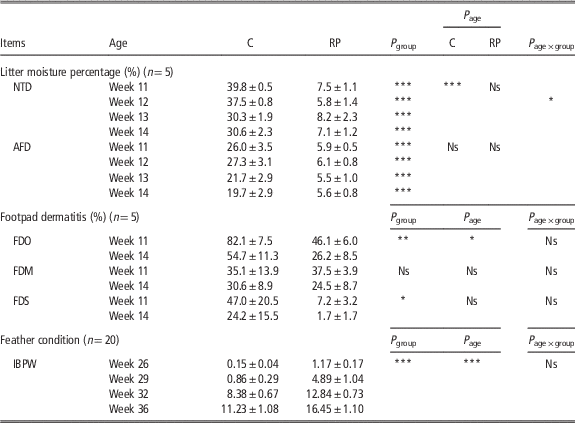
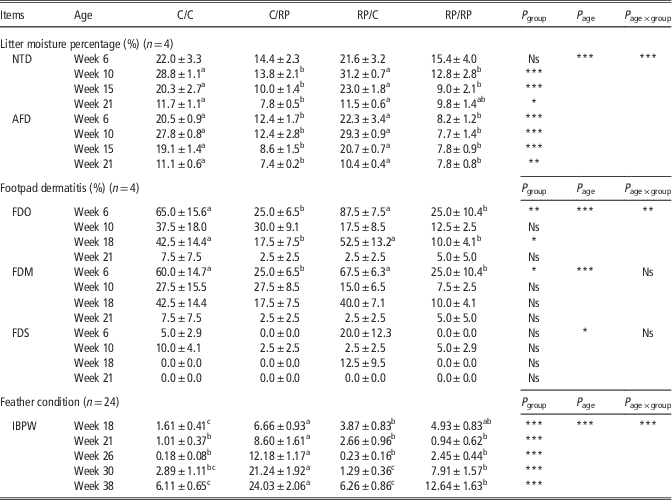
In the F0 generation (Table 2), from week 11 until 14, pens of RP group had significantly lower (P<0.05) litter moisture than the C group at NTD and AFD locations. Within the C group, the NTD location had a significantly higher (P<0.05) litter moisture than the AFD in all four weeks whereas no such differences were found for the RP group. The litter moisture of NTD in weeks 13 and 14 was lower (P<0.05) than in weeks 11 and 12 for C group, whereas no age difference was observed for the RP group. Similar to the F0 generation, the litter moisture of birds fed the RP diets in the F1 generation (Table 3) was significantly lower (P<0.05) at both locations and at all time points compared with birds receiving the C diets except for the NTD location at week 6. There were no dietary effects on the litter moisture between two locations. Litter moisture decreased with age (P<0.05) from week 10 onwards. No group differences were found in the litter moisture of the F2 generation (data not shown).
The effects of reduced balanced protein diet on the litter moisture, footpad dermatitis and feather condition of broiler breeders in the F0 generation

C=control group; RP=reduced balanced protein group; NTD=near to the drinker; AFD=away from the drinker; FDO=footpad dermatitis occurrence; FDM=mild footpad dermatitis occurrence; FDS=severe footpad dermatitis occurrence; IBPW=total index of body plumage wear.
Data are presented as mean±SEM.
*P<0.05, **P<0.01, ***P<0.001, Ns: P>0.05.
The effects of reduced balanced protein diet on the litter moisture, footpad dermatitis and feather condition of broiler breeders in the F1 generation

C=control group; RP=reduced balanced protein group; NTD=near to the drinker; AFD=away from the drinker; FDO=footpad dermatitis occurrence; FDM=mild footpad dermatitis occurrence; FDS=severe footpad dermatitis occurrence; IBPW=total index of body plumage wear.
Data are presented as mean±SEM.
a,b,c Means within a row with different superscripts are significantly different.
*P<0.05, **P<0.01, ***P<0.001; Ns: P>0.05.
Footpad and hock dermatitis
As no differences were found in the hock dermatitis occurrence, only the data of footpad dermatitis are shown. For the F0 generation (Table 2), the RP group had a significantly lower (P<0.05) FDO and FDS compared with the C group whereas there were no differences in FDM. The FDO was significantly higher (P<0.05) in week 11 compared with week 14 for both groups, whereas it was not the case for FDM and FDS. In the F1 generation (Table 3), the groups fed with RP diet had significantly lower (P<0.05) FDO in week 6 and 18 than the groups fed with C diet, whereas no differences were observed in weeks 10 and 21. The FDM of RP diet fed groups was significantly lower (P<0.05) than C diet fed groups in week 6. For FDO and FDM, the highest values were determined in week 6 and the lowest in week 21 (P<0.05). No difference was observed in FDS within groups. No differences were found in the F2 generation (data not shown).
Feather condition
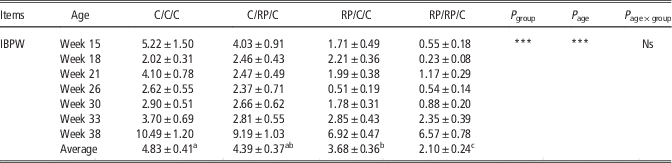
In the F0 generation (Table 2), the IBPW of the C group was significantly lower (P<0.05) than that of the RP group during the laying period. The IBPW of both groups increased with aging (P<0.05). For the F1 generation (Table 3), the C/RP group always had the highest IBPW value (P<0.05). The RP/RP group had a significantly lower and higher IBPW value than the C/RP group and the other two groups (P<0.05), respectively, in weeks 30 and 38. In week 18, RP/C and RP/RP groups had significantly higher IBPW value (P<0.05) than the C/C group but no differences were observed between C/C and RP/C in the other four weeks of evaluation. In the F2 generation (Table 4), no interaction was found between age and group. In general, a significantly lower IBPW value (P<0.05) was found in RP/RP/C group compared with the other three groups. A significant lower IBPW (P<0.05) was observed in the RP/C/C compared with the C/C/C group. No difference was found between the C/C/C and C/RP/C groups. The IBPW value was the highest in week 38 in the F2 generation (P<0.05). In all three generations, there was a significant pen effect within treatments (P<0.05).
The effects of reduced balanced protein diet on the feather condition of broiler breeders in the F2 generation, n=24

C=control group; RP=reduced balanced protein group; IBPW=total index of body plumage wear.
Data are presented as mean±SEM.
a,b,c Means within a row with different superscripts are significantly different.
***P<0.001; Ns: P>0.05.
Discussion
To improve the welfare condition of broiler breeders cogently, various aspects of modern management procedures such as environmental, behavioral and transgenerational effects should be comprehensively investigated. In present study, an improved litter condition and hence reduced FDO were determined in the RP diet fed groups. A positive transgenerational effect of RP diets on the feather condition can be inferred as well. With respect to animal welfare and environmental problems, less litter moisture is preferred in the commercial poultry industry. The RP diet with 25% protein reduction (17.5% net protein reduction considering the extra feed amount of 10% compared with the C diet during the rearing period) significantly decreased the litter moisture. This decreased litter moisture observed in the RP fed groups in F0 and F1 generation is most probably the result of a decreased water consumption which is in agreement with the results reported by Marks and Pesti (Reference Marks and Pesti1984). Different dietary protein levels and protein sources have been reported to affect the water consumption and hence influence the litter moisture and N content. Three diets varying in total protein (15%, 20% and 25%) formulated with fish meal and meat scrap without soybean meal were tested to evaluate broiler water consumption by Wheeler and James (Reference Wheeler and James1950). This study observed that a high level of dietary protein was correlated with a high level of water consumption and water content in the droppings. The same protein level with higher soybean meal content also increased the water consumption and this with greater quantitative effect than fish and meat protein. Soybean meal, which has a high content of fiber and fermentable sugars, was used as the main protein source in the current experimental breeder diets. Francesch and Brufau (Reference Francesch and Brufau2004) reported that the fiber and fermentable sugars can induce higher water consumption due to its strong water retention capacity. Various protein levels with different soybean meal content were studied as well. Broilers fed a diet formulated with soybean meal containing 26% of total protein had a higher water consumption than birds fed with 22% and 17% protein diets (Marks and Pesti, Reference Marks and Pesti1984). In the current study, the smaller amount of soybean meal in the RP diets resulted in lower CP level and water retention capacity compared with the C diets which partly explained the less litter moisture in the RP diet fed groups. Diet electrolyte balance is linearly related to water intake in broilers (Borges et al., Reference Borges, Da Silva, Ariki, Hooge and Cummings2003). The amounts of sodium and potassium were equalized in the C and RP diets by the supplementation of NaHCO3 and KHCO3. Besides the diet effect, polydipsia and stereotypic pecking behaviors were observed in controlled fed broiler breeders (Savory et al., Reference Savory, Seawright and Watson1992). The higher water requirement of the C birds compared with the RP birds may induce a higher water aimed stereotypic pecking and severe polydipsia which may greatly contribute to the higher litter moisture. A difference in litter moisture in the location relative to the bell drinker was observed in the C group of the F0 generation and an overall tendency of the F1 generation, whereas no location effects were found in the RP diet fed groups nor in the F2 generation. This shows the direct dietary effects on the litter moisture. Indeed, more activities around the drinker or aimed at the drinker of the C birds may contribute to the location difference as well. Therefore, the level of CP in the diet was the leading factor affecting litter moisture while the polydipsia might also be involved.
Footpad and hock dermatitis occurrence are positively correlated with litter moisture content. The footpad and hock can be softened by wet litter, making them more vulnerable to bacterial inflammation (Mayne, Reference Mayne2005). In line with the wetter litter of the C diet fed groups, a higher FDO was recorded in birds fed the C diet compared with birds receiving the RP diet. Higher inclusion of soybean meal in broiler diets was reported to increase the occurrence of footpad dermatitis (Eichner et al., Reference Eichner, Vieira, Torres, Coneglian, Freitas and Oyarzabal2007). High dietary soybean meal inclusion increases the N content of the excreta leading to an increased ammonia concentration (Ferguson et al., Reference Ferguson, Gates, Taraba, Cantor, Pescatore, Ford and Burnham1998), causing irritation of the footpads. It is hypothesized that the combination of the factors wet litter, bacterial inflammation and skin irritation due to ammonia contributed to the high FDO and FDS in the F0 generation and periodically in the F1 generation. The FDO reduced with age which is in line with the reduced litter moisture. It is hypothesized that the age-related increase in feed allocation during rearing, led to fewer interactions with the bell drinker and hence less wet litter. The varying flock density during the rearing period (6.3 birds/m2 for C/C and C/RP group, 5.7 birds/m2 for RP/C and RP/RP group) may influence the FDO as well. However, significant differences in FDO were observed between C/C and C/RP and between RP/C and RP/RP, both comparisons with the same flock density. Consequently, the RP dietary effect on footpad dermatitis is in agreement with the F0 generation. Another factor that cannot be neglected is that the RP diet fed groups received 10% more premix (vitamins and minerals) along with the 10% more feed allocation. A higher amount of biotin might have partially contributed to the better food pad condition of RP breeders (Harms and Simpson, Reference Harms and Simpson1975). Hock dermatitis has been shown to be positively correlated with footpad dermatitis in broilers (Meluzzi et al., Reference Meluzzi, Fabbri, Folegatti and Sirri2008). However, in broiler breeders hock dermatitis was hardly observed in this experiment including three generations. This discrepancy might be explained by the behavioral difference between broilers and broiler breeders. Due to the controlled feed intake, broiler breeders are more active spending more time standing up and walking around compared with ad libitum fed broilers which sit more down on their hocks (De Jong et al., Reference De Jong and Guémené2002).
In the current study, RP diet fed groups in the first two generations were fed with ~17.5% less protein and AA. Sulfur containing AA such as methionine and cystine are of great importance for the feather keratin formation. It is believed that the protein and AA reduction in the RP diet may have contributed to the poor feathering. The feathers of broilers are composed of ~89.9% to 97.6% CP (Fisher et al., Reference Fisher, Leeson, Morrison and Summers1981) and optimal feather formation and growth are therefore highly dependent on the dietary protein and sulfur containing AA level. The reduction for dietary CP in broilers has been reported to cause a decrease in feather weight (Lopez-Coello, Reference Lopez-Coello2003). In addition, feather-aimed pecking could also be the reason of the feather damage and further feather loss (unpublished data).
In the F1 generation, a significant difference between C/RP and RP/RP group with a remarkable poor feathering in C/RP group was seen. The difference between C/RP and RP/RP group might be explained by the dietary treatment in the F0 generation. Initial environmental or nutritional disturbance in parental animals could pass over the effects to subsequent generations (Ho and Burggren, Reference Ho and Burggren2010). In the present study, the RP diet is speculated to have altered the endocrine status and improved protein and AA (such as methionine and cysteine) utilization to cope with nutritional deficiencies which could subsequently improve the metabolic status of the offspring. Therefore, the RP/RP group may have had a better metabolic status than the C/RP group as the RP/RP group had the RP diet experience in the F0 generation. Various stress experiences of breeder hens may influence their stress-coping capacity and pass it to their progeny by programming the Hypothalamus-Pituitary-Adrenal gland axis (Ericsson et al., Reference Ericsson, Henriksen, Bélteky, Sundman, Shionoya and Jensen2016). In the present study, the nutritional stress and thereby induced behavioral stress (animal or feather-aimed oral activities) from the RP diet are suggested to program the different stress-coping capacities of breeders and hence their subsequent generations. In the F2 generation, the significantly better feather condition of RP/RP/C group compared with the other three groups may also be explained by a higher efficiency in nutrient utilization and an improved ability to cope with stress. It may further be possible that the lower flock density of RP/RP/C group compared with other three groups during the rearing period (4 compared with 5 to 6 birds/m2) and laying period (3 compared with 4 birds/m2) is partially conducive to the various feather condition. Flock density variation between C/RP (6.3 birds/m2) and RP/RP (5.7 birds/m2) group existed as well. However, with a rather similar flock density during the rearing period (5.9 birds/m2 for C/C/C and 5.5 birds/m2 for RP/C/C group) and the same flock density during the laying period (4 birds/m2), the RP/C/C group had a significantly better plumage condition than C/C/C group, indicating transgenerational effects. In addition, a significant pen effect was determined in all three generations. It is speculated that social activities in each pen might also influence the feather condition. Further behavioral studies would be helpful for comprehensive understanding of the welfare condition of broiler breeders.
In conclusion, the current study clearly demonstrated that feeding RP diets to broiler breeder hens remarkably improved litter condition and reduced the occurrence of footpad dermatitis. The RP diets were associated with a profound impairment of feather condition however may improve the feather condition of subsequent generations fed on standard C diets. Transgenerational effects of the maternal dietary protein content on feather condition can be inferred but exact mechanisms (e.g. at the level of sulfur – AA utilization efficiency) need to be further investigated.
Acknowledgments
The diligent technical assistance of André Respen is gratefully acknowledged. Parts of this work are supported by the Government Agency for Innovation by Science and Technology and China Scholarship Council.