Hermaphroditism—the presence of both male and female sexual organs in a single individual—is rarely found in elasmobranchs (sharks and rays) (Atz, Reference Atz, Armstrong and Marshall1964). This group is considered gonochoristic (i.e. one single sex per individual) (Compagno, Reference Compagno1990). Iglésias et al. (Reference Iglésias, Sellos and Nakaya2005), however, recently described the longhead catshark, Apristurus longicephalus, as a normal rudimentary hermaphroditic, where most individuals possess the developed genital apparatus of one sex and the undeveloped apparatus of the opposite sex. In abnormal hermaphrodites, however, only a single or a few individuals exhibit hermaphroditism. This is the most common case of hermaphroditism in elasmobranchs (sharks and rays). Within elasmobranchs, Squaliformes is the order with the largest number of cases of abnormal hermaphroditism. Abnormal hermaphrodite females and males have been reported for seven different squaliform species (Yano, Reference Yano1985, Reference Yano1995; Yano & Tanaka, Reference Yano and Tanaka1989; Wetherbee, Reference Wetherbee1996; Gelsleichter et al., Reference Gelsleichter, Grubbs and Musick1997; Veríssimo et al., Reference Veríssimo, Gordo and Figueiredo2003; Irvine, Reference Irvine2004).
The piked spurdog, Squalus megalops, is one of the most abundant shark species of southern Australia (Bulman et al., Reference Bulman, Althaus, He, Bax and Williams2001; Graham et al., Reference Graham, Andrew and Hodgson2001). It is a demersal species that inhabits the continental shelf and upper continental slope (depths <510 m) (Last & Stevens, Reference Last and Stevens1994). Squalus megalops is an important by-catch of several fisheries operating across south-eastern Australia (Walker et al., Reference Walker, Hudson and Gason2005). The aim of the present study was to report the occurrence of hermaphroditism in this species.
A total of 929 S. megalops were collected from the by-catch of shark gillnet and demersal trawl fishing vessels operating in south-eastern Australia during October 2002–April 2004. Of these sharks, one individual (i.e. 0.1% of the sampled individuals) was hermaphrodite. The frequency of hermaphroditism for other squaliform species has also been generally low. For example, 0.1% of 957 individuals of Centroscymnus coelolepis (Veríssimo et al., Reference Veríssimo, Gordo and Figueiredo2003) and one in more than 800 individuals of Etmopterus granulosus (Irvine et al., Reference Irvine, Laurenson and Stevens2002) were hermaphrodite. For E. unicolor, however, 23% of 70 individuals were hermaphrodite (Yano & Tanaka, Reference Yano and Tanaka1989).
The hermaphrodite S. megalops was caught in February 2004 at 38°55′S 144°50′E and a depth of 75 m. In the same fishing shot, another 33 males of similar body size were also collected; no females were present in this fishing shot. The hermaphrodite was measured (total length (TL) ±1 mm), weighed (body mass (TM) ±1 g) and dissected. Length of the right clasper (CL) was recorded from the join in skin near the anus to the distal end (±1 mm). Different criteria were used to describe maturity condition. Following Braccini et al. (Reference Braccini, Gillanders and Walker2006a), males were considered mature when claspers were rigid and fully calcified and had evident hooks, testes were enlarged and had evident testicular lobules, seminal vesicles had thickened opaque walls and seminal fluids present or absent, and vas deferens were enlarged and fully coiled. The 33 males captured in the same shot were measured and assessed following the same criteria.
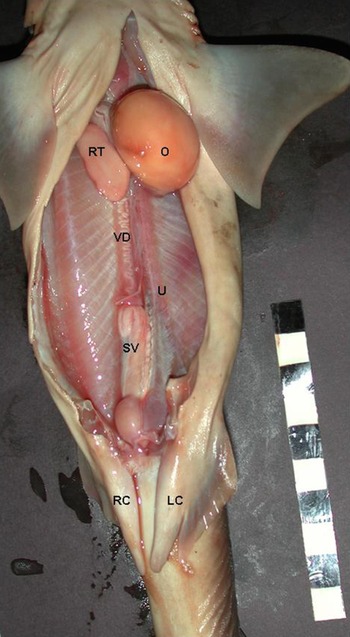
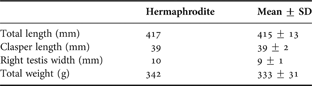
The total length, clasper length, testis width, and total weight of the hermaphrodite were similar to the values of the males collected in the same fishing shot (Table 1). Externally, the hermaphrodite had two fully calcified claspers with hooks. Internally, the hermaphrodite had male reproductive organs on the right side (Figure 1). All males captured with the hermaphrodite were mature. The clasper, testis, seminal vesicle and vas deferens of the hermaphrodite were fully developed (Figure 1). In addition, the seminal vesicle of both the hermaphrodite and the normal males were full of thick and cloudy sperm.
Reproductive system of the hermaphrodite Squalus megalops. O, ovary; LC, left clasper; RC, right clasper; RT, right testis; VD, vas deferens; SV, seminal vesicle; U, uterus. Scale bar 100 mm.

Comparisons between the hermaphrodite Squalus megalops and the males collected in the same fishing shot.

No females were collected with the hermaphrodite so comparisons were made using information on female maturation reported by Braccini et al. (Reference Braccini, Gillanders and Walker2006a). Females are mature when the largest ovarian follicle is yellow and of a diameter ≥15 mm, the oviducal glands are enlarged and kidney-shaped, and the uterus carries eggs or embryos or is post-partum, depending on pregnancy condition (Braccini et al., Reference Braccini, Gillanders and Walker2006a). The hermaphrodite possessed one yolky ovarian follicle of 34 mm in diameter, an indistinct oviducal gland and a uniformly thin tubular uterus (Figure 1).
The described individual presents a rare case of abnormal hermaphroditism in sharks. The male reproductive tract was fully developed whereas the female reproductive tract possessed a mature yolky ovarian follicle but completely undeveloped uterus and oviducal gland. A hermaphrodite male of the lantern shark E. unicolour had mature male reproductive organs and a small follicle attached to one of the testis with no other female reproductive organs (Yano & Tanaka, Reference Yano and Tanaka1989). A hermaphrodite E. granulosus had calcified claspers and mature testes but undeveloped vas deferens. The female tract of this individual was undeveloped (Irvine et al., Reference Irvine, Laurenson and Stevens2002). A rare hermaphrodite Port Jackson shark (Heterodontus portusjacksoni) had two calcified claspers, one functional and one non-functional ovary with two developed uteri, and two undeveloped testes and vas deferens (Jones et al., Reference Jones, White and Potter2005). Other cases of abnormal hermaphroditism in sharks include individuals with claspers and female internal reproductive tracts, commonly non-functional (e.g. Yano & Tanaka, Reference Yano and Tanaka1989), and individuals with external claspers and internal male and female tracts though commonly undeveloped (e.g. Pratt, Reference Pratt1979).
The hermaphrodite S. megalops presented mature gonads of both sexes. The length at fifty per cent maturity reported for normal male and female S. megalops is 398 and 484 mm TL, respectively (Braccini et al., Reference Braccini, Gillanders and Walker2006a). The hermaphrodite is therefore well into the size-range of maturation of males and below the maturation-range of females. Irvine et al. (Reference Irvine, Laurenson and Stevens2002) reported a hermaphrodite E. granulosus possessing a fully developed male tract and a maturing female tract. Had the animal continued growing, these authors suggested it may have been able to fully function as either sex. This seems unlikely for the hermaphrodite S. megalops. Although it possessed matured gonads, the uterus and oviducal glands were completely undeveloped. The male reproductive tract of this individual, on the contrary, was fully developed. In addition, the hermaphrodite was schooling with mature males. Squalus megalops commonly segregates by sex and size, where mature females and males occur in different regions and depths (Braccini et al., Reference Braccini, Gillanders and Walker2006b). Therefore, the morphological characteristics and behavioural schooling pattern exhibited by the hermaphrodite suggest that this individual would function as a normal male.
ACKNOWLEDGEMENTS
I am grateful to Peter Risley, Glenn Richardson and the crew of the fishing vessel ‘Nungurner’ for help in sample collection. Funding for the field and laboratory components was provided by an Australian Fisheries Research and Development Corporation grant (FRDC 2002/033).