Introduction
Treatment of injured persons at trauma centers has been shown to decrease morbidity and mortality.Reference Odetola, Mann, Hansen and Bratton 1 - Reference Cales 4 Trauma care is regionalized in many states, and studies of critically injured children show beneficial outcomes for children treated at designated pediatric trauma centers or centers with pediatric expertise.Reference Shackford, Hollingworth-Fridlund, Cooper and Eastman 5 - Reference Cooper, Barlow, DiScala, String, Ray and Mottley 10 Early timing of definitive care at a trauma center is regarded as a basic tenet in the care of critically injured persons, particularly among those whose injuries are amenable to surgical intervention, who, if left untreated, might die within one or more hours.Reference Potoka, Schall and Ford 11 Though not tested formally in the research arena, outcomes of trauma are believed to worsen if such definitive trauma care ensues beyond 60 minutes of injury,Reference Trunkey 12 (the golden hour of injury care) and trauma systems have incorporated the concept into daily practice. The practicality of such a time-sensitive approach in regions of the US, where barriers to rapid access to definitive trauma care might exist, is unknown.
This study was done to determine the factors independently associated with arrival at a regional pediatric trauma center within 60 minutes of injury versus beyond 60 minutes of injury. It was hypothesized that children who arrive at the emergency department (ED) of the pediatric trauma center within 60 minutes of injury would be more severely injured, and would be more likely to be transported by air, when compared with children who arrive there beyond 60 minutes of injury.
Materials and Methods
Data Source
Data within the Primary Children’s Hospital (PCH; Salt Lake City, Utah USA) trauma registry database were analyzed for this study. The database contains patient information, including demographics (age and gender), physiologic data (anatomic injury sites, injury severity, and mechanisms of injury), and clinical outcomes at the trauma center, including survival status at hospital discharge and duration of hospital stay. Transport data, including mode of transport and total prehospital time, were also available in the database. Other data included the settings of care within PCH, including the operating room and the pediatric intensive care unit (PICU). For children who received care in the PICU, the use of intensive care medical technology was documented, including arterial catheters, vasoactive medications, intracranial pressure monitors, central venous catheters, and mechanical ventilation. Survival status at PICU discharge and duration of stay in the PICU were also documented for these children. The institutional review board at the University of Utah School of Medicine (Salt Lake City, Utah USA) approved this study.
Study Population
All children 0-17 years of age admitted with traumatic injuries to PCH from January 1, 2006 through September 30, 2007 were included in this study. Primary Children’s Hospital is designated a Level 1 pediatric trauma center by the American College of Surgeons Committee on Trauma (Chicago, Illinois USA). It receives admissions from within and outside a vast network of 22 hospitals in the Intermountain Health Care Network (Utah, USA), and provides care to more than 1,000 critically injured children annually, admitted from within the state of Utah and from surrounding states.
Study Variable Definitions
Prehospital Time
This was the main exposure of interest. Prehospital time was categorized into arrival at the ED of the pediatric trauma center within 60 minutes or beyond 60 minutes from the time of injury.
Mechanisms of Injury
These included motor vehicle accidents, bicycle and motorcycle crashes, falls, sports injuries, non-accidental injuries, submersion injuries, and farm accidents.
Body Regions Injured
Isolated injuries to the head, neck, abdomen, extremities, chest, and spine, or injuries to multiple body regions, were evaluated.
Modes of Transport
These were ground ambulance, air ambulance, and private vehicle transport.
Distance between the Scene of Injury and the Pediatric Trauma Center
Geographic Information Systems software (ArcGIS 9.2; Environmental Systems Research Institute; Redlands, California USA) was used to calculate the distance from the geographical center (centroid) of the zip code of injury to the pediatric trauma center. This distance variable serves as a measure of access to the pediatric trauma center. The exact geographical locations of the injury zip code centroids and the pediatric trauma center were ascertained in longitudes and latitudes in decimal degrees and then converted to a 2-dimensional flat map surface using an Equidistant Conic projection, with a linear unit in meters centered on the United States, with an underlying geographic coordinate system of North American Datum 1983 and spheroid Geodetic Reference System 1980. The straight-line or Euclidian distance was then calculated in meters from the centroid of the zip code of injury to the pediatric trauma center. The distance in kilometers subsequently was calculated and incorporated in the analysis.
Rural-urban Status of the Zip Code Areas of Injury
Delayed transfer of critically ill or injured patients from rural to tertiary care facilities could negatively impact their outcome.Reference Franklin and Doelp 13 - Reference Houtchens 15 Also, traffic accidents and accompanying fatalities have been reported to occur at a higher frequency in rural versus urban settings.Reference Baker, Whitfield and O’Neill 16 Similar to methods used in recent studies,Reference Waller, Curran and Noyes 17 - Reference Tonelli, Klarenbach, Rose, Wiebe and Gill 19 the zip codes of injury were dichotomized into rural and urban zip code areas based on the rural-urban commuting area codes which are assigned to each US zip code, according to markers of population size, with values ranging from 1.0 (mostly urban) to 10.6 (mostly rural).Reference Penfold, Chisolm, Nwomeh and Kelleher 20
Injury Severity Score
Injury severity score (ISS) was measured at discharge (or death) from PCH. Values range from 1 to 75, with higher values signifying higher severity. 21 The ISS was also categorized to differentiate more severe (ISS>15) from less severe (ISS≤15) injuries, as described previously.Reference Baker, O’Neill, Haddon and Long 22
Glasgow Coma Scale Score
Glasgow Coma Scale (GCS) scoreReference Champion, Copes and Sacco 23 was measured at admission to the ED at PCH. Coma was defined as GCS≤8. The GCS score was incorporated in the analysis as a key injury severity variable because head injury is the most common cause (20%-30% mortality) of trauma-related death in children, and neurological injuries account for nearly one-fifth of all pediatric injuries.Reference Teasdale and Jennett 24
Vasoactive Medications
Administration of dopamine, epinephrine, norepinephrine, vasopressin, or dobutamine for hemodynamic support while in the PICU was recorded.
Statistical Analysis
The main outcome of interest in this analysis was duration of prehospital time: within 60 minutes versus beyond 60 minutes. Patient-level clinical and demographic characteristics were compared according to prehospital time (within 60 minutes versus beyond 60 minutes) using Chi-square or Fisher’s exact test for categorical data and Student’s t-test or Mann-Whitney U test for comparisons of continuous data. Geographical characteristics, including rural-urban status of the zip codes of injury and mode of transport, were also compared according to prehospital time. All variables associated with prehospital time, with P<.3 in the bivariate analysis, were incorporated into multivariate logistic regression models to assess their independent effect on prehospital time. In the multivariate analysis, indicator variables were created to represent the modes of transport, and private vehicle transport was used as the referent category for analysis. Interaction was assessed between the mode of transport and the distance traveled from the scene of injury to the trauma center, between the mode of transport and the rural-urban status of the zip code of injury, and between distance traveled from the scene of injury to the trauma center and the rural-urban status of the zip code of injury. No interaction of statistical significance was found. The fit of the logistic regression models was assessed with the likelihood-ratio test.
After admission to the pediatric trauma center, the frequency of receipt of PICU care was determined according to prehospital time, and among children who received PICU care, comparisons were made regarding the use of medical technology, duration of PICU stay, and PICU mortality, according to the prehospital time. For the entire study population, the overall duration of hospital stay and in-hospital mortality were compared according to prehospital time. A 2-sided alpha level of 0.05 was used as the threshold for statistical significance. Analyses were conducted using Stata 8 for Windows (Stata Corporation; College Station, Texas USA).
Results
Patient Characteristics and Transfer Patterns
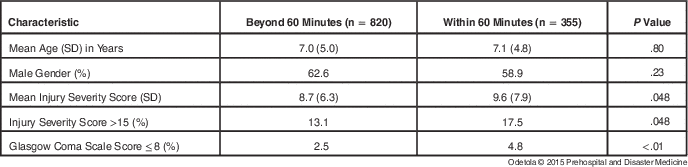
Of 1,175 admissions to the trauma center directly from the scene of injury during the 21-month study period, only 355 (30%) arrived at the ED of the trauma center within 60 minutes of injury. Overall, most of the children were male with a median age of seven years. There was no significant difference in average age according to prehospital time (Table 1). Children who arrived at the PCH ED within 60 minutes of injury had higher frequency of coma (4.8% vs 2.5%; P<.01) and higher mean ISS (9.6 (SD=7.9) vs 8.7 (SD=6.3); P=.048) upon arrival at the PCH ED (Table 1). A higher proportion of children who arrived at the PCH ED within 60 minutes of injury had more severe injury (ISS>15; 17.5 % vs 13.1 %; P=.048). Of note, those more severely injured children were more likely to be transported by air ambulance than by ground ambulance or private vehicle (29% vs 13% and 10%, respectively; P<.01).
Patient Characteristics According to Prehospital Time
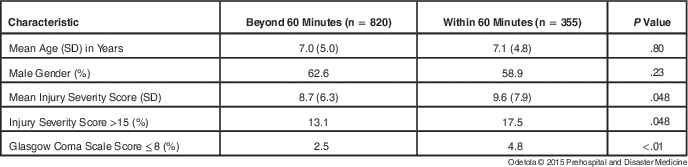
Abbreviation: SD, standard deviation.
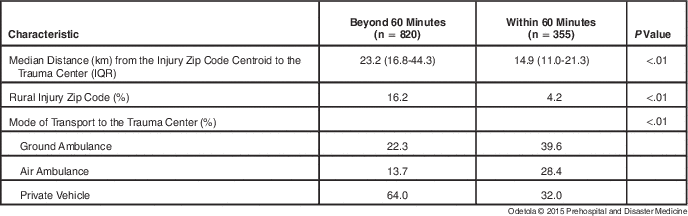
Among children who arrived at PCH ED beyond 60 minutes of injury, there was a 4-fold higher frequency of having sustained their injuries within rural zip code areas when compared with children who arrived at the trauma center within 60 minutes (Table 2). Transport via private vehicles was the predominant mode (64%) of transport among the children who arrived at the trauma center beyond 60 minutes of injury, compared with the children who arrived within 60 minutes of injury, among whom 32% were transported via private vehicles. Of note, there was a 2-fold higher incidence of air ambulance transport among children who arrived at the PCH ED within 60 minutes versus beyond 60 minutes of injury (Table 2). Arrival at the PCH ED within 60 minutes of injury was associated with shorter average travel distance (14.9 vs 23.2 kilometers; P<.01) from the injury scene.
Geographical and Spatial Characteristics by Prehospital Time
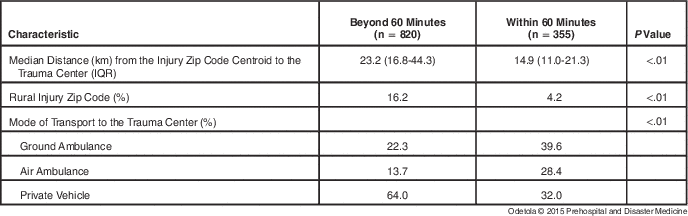
Abbreviation: IQR, interquartile range.
Overall, the predominant mechanisms of injury were via falls, sports injuries, and motorcycle crashes, while the head and the extremities were the most common regions injured, followed by injuries to the abdomen.
Analysis of the Determinants of Prehospital Time
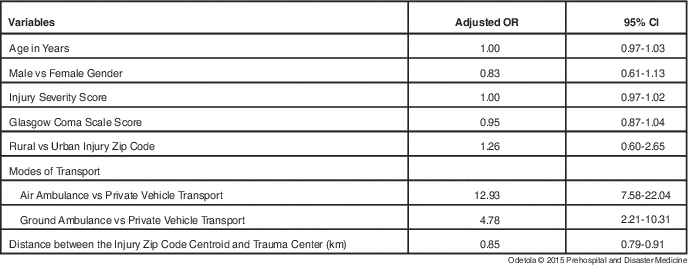
Multivariate analysis revealed that the mode of transport and the distance between the injury scene and PCH were independent factors associated with prehospital time, after controlling for potential confounders, including age, gender, ISS, GCS score, and rural-urban status of the zip code of injury (Table 3). Children who arrived at PCH within 60 minutes versus beyond 60 minutes were 13-fold (odds ratio [OR]: 12.9; 95% Confidence Interval [CI], 7.6-22.0) more likely to be transported via air ambulance than a private vehicle. Also, arrival at PCH within 60 minutes versus beyond 60 minutes was associated with 4.8-fold greater odds (95% CI, 2.2-10.3) of transport via ground ambulance than via a private vehicle. For each kilometer of distance between the injury zip code centroid and PCH, the odds of arrival at PCH within 60 minutes versus beyond 60 minutes decreased by 15% (OR: 0.85; 95% CI, 0.79-0.91). The final model’s specification was: Likelihood Ratio (Chi square with nine degrees of freedom)=283.51; P<.001.
Multivariate Logistic Regression Analysis of the Predictors of Prehospital Time
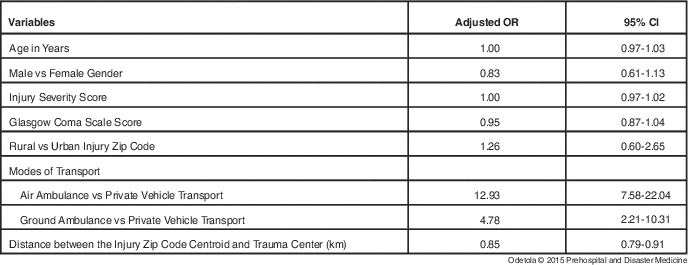
(Age, injury severity score, Glasgow Coma Scale score, and distance between the injury zip code centroid and trauma center were inserted in the model as continuous variables. The adjusted odds ratio reflects the odds of the specified outcome compared to the reference category within the same variable, as appropriate; adjusted for the other categories that appear in the table.)
Abbreviations: CI, confidence interval; OR, odds ratio.
Hospital and PICU Resource Use
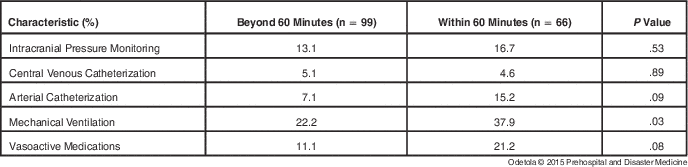
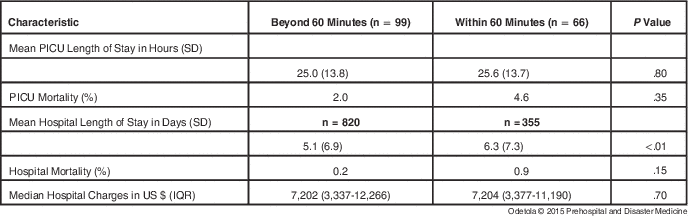
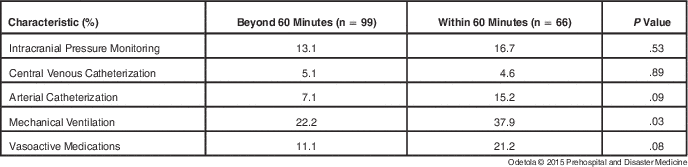
The frequency of receipt of PICU care was higher among children with a prehospital time within 60 minutes (18.6% vs 12.1%; P<.01) when compared with children with prehospital time beyond 60 minutes of injury. In the PICU, children who arrived at the trauma center within 60 minutes of injury were also more likely to receive mechanical ventilation (37.9 % vs 22.2%; P=.03) when compared with children with prehospital time beyond 60 minutes of injury (Table 4). There was no statistically significant difference in the use of other intensive care technology (Table 4). While there was no difference in PICU stay, prehospital time within 60 minutes was associated with longer overall hospital stay than prehospital time beyond 60 minutes (Table 5). There was no difference in overall hospital charges according to prehospital time. There were five deaths in the hospital, all occurring in the PICU. Three deaths occurred among the children who arrived to PCH within 60 minutes of injury, while two occurred among children who arrived at the trauma center beyond 60 minutes of injury.
Medical Device Use in the Pediatric Intensive Care Unit According to Prehospital Time
Mortality and Resource Use at a Pediatric Trauma Center According to Prehospital Time
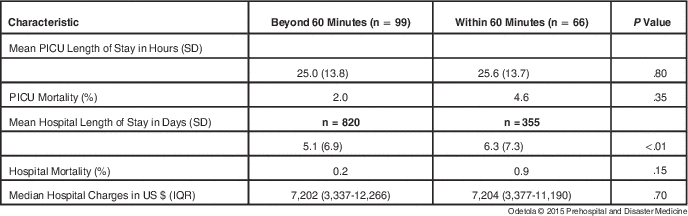
Abbreviations: IQR, interquartile range; PICU, pediatric intensive care unit; SD, standard deviation.
Discussion
Trauma care systems were designed with emphasis on the importance of prehospital care delivery for the critically injured that ensures the rapid definitive treatment of injuries that might lead to death within one or more hours, if left untreated.Reference Potoka, Schall and Ford 11 These injuries are unlike those that either lead to death at the scene of injury, or several days later, from sepsis or multisystem failure.Reference Potoka, Schall and Ford 11 The concept of the golden hour is hinged on the notion that arrival at the site of definitive trauma care within the first hour of injury might have survival benefits and is a key tenet of trauma care system design and delivery of care. In the current study, arrival at the trauma center within the golden hour was associated with two independent factors, namely, the mode of transport and the distance between the scene of injury and the trauma center.
Air transport was employed more often among children with a prehospital time within 60 minutes compared to children with longer prehospital time. Of note, air transport was also more likely to occur among the more severely injured. It is intuitive that children with higher injury severity will be transported to the trauma center in the most expeditious manner possible. It might be safe to surmise that triage at the injury scene by emergency medical personnel likely was influenced by injury severity and concern for high likelihood of clinical deterioration and poor outcomes in the absence of rapid delivery of definitive trauma care for the most severely injured children. This is a reassuring finding that field triage is indeed discriminating between the more- and less-severely injured. Similar findings were reported in a prior study by Petri et al. in which lower patient injury severity was associated with longer prehospital time.Reference Durkin, Olsen, Barlow, Virella and Connolly 25
Trauma mortality has been associated with location of the injury scene, with worse outcomes reported among rural versus urban dwellers.Reference Sampalis, Denis, Frechette, Brown, Fleiszer and Mulder 14 - Reference Baker, Whitfield and O’Neill 16 Several reasons have been suggested for such differential mortality, including reduced access to organized trauma systems, travel distance, inappropriate field triage and treatment, and delayed medical-surgical intervention. In the current study, a deliberate attempt was made to quantify differences in the rural-urban spread of the injury zip code areas, and to establish any association of such geographical distribution with prehospital time. It was instructive to find that although injuries were sustained in rural zip code areas more often among children with a prehospital time beyond 60 minutes, the mode of transport and distance to the trauma center were the only independent factors in multivariate analysis that were associated with arrival at the trauma center within 60 minutes. While it appeared intuitive that air transport will be associated with shorter prehospital time, it is unknown why two-thirds of children with prehospital time beyond 60 minutes were transported via private vehicles to the trauma center. Within the context of a trauma care system, the use of air transport extends the geographical reach of pediatric retrieval teams and enhances the likelihood that patients will arrive at the trauma center within the golden hour. The current study was, however, not designed to address which mode of transport is appropriate in urban areas with closer proximity to a trauma center. Further evaluation of clinical and non-clinical factors that might influence triage and clinical decision making at the injury scene, and at the prehospital care settings as a whole, might elucidate potential areas of opportunity to mitigate causes of delay and to optimize prehospital trauma care delivery.
Proximity to definitive trauma care settings has been associated with better population-level survival in pediatric trauma.Reference Petri, Dyer and Lumpkin 26 In the current study, increased distance from the trauma center was associated with lower likelihood of arrival within the first hour of injury. Due to low overall incidence of mortality in the current study, however, it was not possible to determine an association between prehospital time and mortality. Of note, hospital resource use differed significantly by prehospital time. Children with prehospital time within 60 minutes were more likely to receive intensive care overall, and specifically, were more likely to receive invasive mechanical ventilation. Although PICU stay was similar in duration by prehospital time, the overall stay in the hospital was longer among the children with prehospital time within 60 minutes, a likely reflection of their heightened illness severity as reflected in higher ISS and lower GCS scores upon presentation at the ED of the trauma center.
Although recent reportsReference Odetola, Miller, Davis and Bratton 27 , Reference Lerner and Moscati 28 have raised questions about the origin and validity of the golden hour in pediatric trauma care, and have called for an evidence-based approach to its application in the care of the critically injured, current trauma care systems emphasize such time-sensitive care with the belief that rapidity of delivery of definitive trauma care might benefit injured children. While the current study cannot answer the questions regarding the survival benefit associated with the duration of prehospital care, it highlights the association of severity of patient injury with field triage and decision making with expeditious transport of the most severely injured children to definitive trauma care. This study provides important information that might serve as groundwork for further research into factors that influence triage and optimal prehospital care, an essential component of trauma care delivery for critically injured children.
Limitations
The current study has certain limitations that should be considered in interpreting the findings. The quality of care provided at the injury scene, during the prehospital period, and at the trauma center could not be ascertained. The estimation of distance between the injury scene and the trauma center was not exact, but an approximation using the geographical center of the injury zip code. It is however, unlikely, that the actual distance would have differed in a non-random manner between the two study arms to significantly influence prehospital time.
The determination of the prehospital time was based on precise documentation of the date and time of injury and of the date and time of arrival at PCH and there were no missing data. However, there was still the possibility of inaccuracies from random error in documentation. The study data were limited to county-level data, and finer geographical details regarding exact injury sites were not accessible. Prior reports have, however, revealed that county-level organization of trauma and prehospital care might be associated with population-level outcomes.Reference Petri, Dyer and Lumpkin 26
Conclusion
In this study of injured children admitted directly to a regional pediatric trauma center, field triage and decision making in the prehospital setting appeared to correlate with severity of patient injury with expeditious transport of the most severely injured children to definitive trauma care. This finding serves as important groundwork that might enable further study into factors that influence triage and overall prehospital care for critically injured children.
Authors’ Contribution Statement
FOO made substantial contributions to the intellectual content of the paper by participating in the conception and design, data acquisition, interpretation of the data, drafting of the manuscript, critical revision of the manuscript for important intellectual content, and providing supervision.
NCM made substantial contributions to the intellectual content of the paper by participating in the conception and design and critical revision of the manuscript for important intellectual content.
KWH made substantial contributions to the intellectual content of the paper by participating in the conception and design, collection of the data, and critical revision of the manuscript for important intellectual content.
SLB made substantial contributions to the intellectual content of the paper by participating in the conception and design, data analysis, and critical revision of the manuscript for important intellectual content.
Acknowledgement
The authors acknowledge Ms. Danielle Gwinn, Geographic Information Systems consultant at the University of Michigan (Ann Arbor, Michigan USA), for her expertise and assistance with spatial data management.