Who is a missing person?
While there is no legal definition of a missing person under international law, the ICRC understands missing persons as individuals of whom their families have no news and/or who, on the basis of reliable information, have been reported missing as a result of an armed conflict – international or non-international – or of other situations of violence or any other situation that might require action by a neutral and independent body.Footnote 4 This includes disasters and the context of migration.
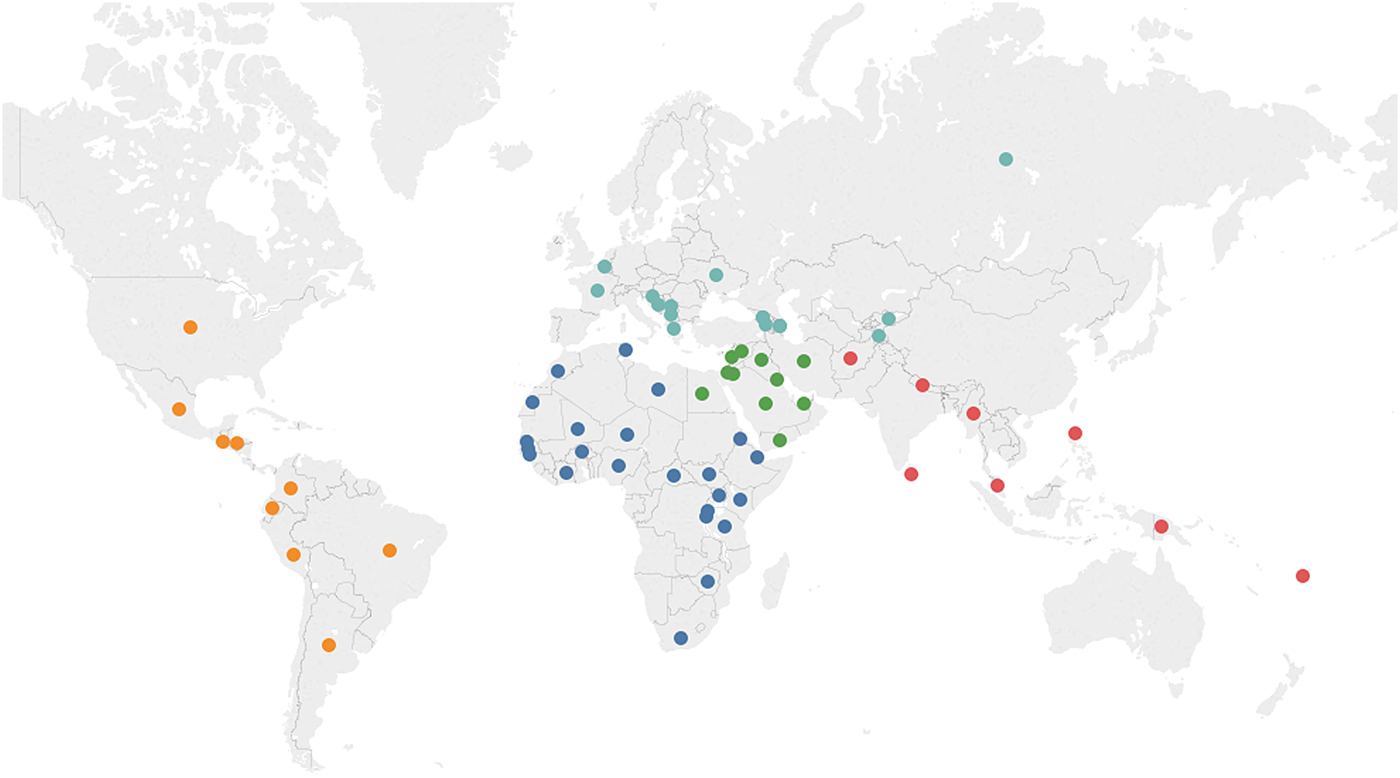
Map depicting the ICRC's missing-related activities in over sixty contexts. © ICRC/OSM, 2018. The boundaries, names and designations used in this map do not imply official endorsement, nor express a political opinion, and are without prejudice to claims of sovereignty over the territories depicted.

The circumstances in which disappearances occur vary greatly. For instance, armed conflicts can cause mass displacements, which result in people going missing because they may lack adequate means of communication or they may become separated en route. Migrants may go missing when they are unable, or choose not to, establish contact with their families, including when they are detained. Members of State armed forces or non-State armed groups can go missing in action. Individuals whose bodies are abandoned, buried in haste or mismanaged, making identification difficult or impossible, may also be reported missing. So may people who are captured, arrested or abducted and held incommunicado or in a secret location.
The 2006 International Convention for the Protection of All Persons from Enforced Disappearance (ICCPED), the first universal treaty on that subject, uses the term “disappeared person”, which covers only disappearances due to arrest, detention, abduction or any other form of deprivation of liberty by agents of the State or by persons or groups of persons acting with the authorization, support or acquiescence of the State, followed by a refusal of the State to acknowledge the deprivation of liberty or by concealment of the fate or whereabouts of the disappeared person, which place such a person outside the protection of the law. The ICRC definition of missing persons also includes those considered to be disappeared persons according to the Convention. However, a broader description of missing persons is deliberately applied by the ICRC to ensure that all missing persons, including those not covered by the ICCPED, are included and that the families’ needs, including their right to know the fate and whereabouts of their loved ones, are addressed.
There is no element of time and no presumption of death included in the ICRC's definition of a missing person. Hence, the ICRC considers persons to be missing from the moment their families report them missing, meaning there is no “waiting period” before considering a person missing. At the other end of the spectrum, a person is considered no longer missing when the family has received sufficient, reliable and credible information on the fate and whereabouts of their sought relative.
How widespread is the problem of missing persons?
Hundreds of thousands of people are currently missing around the world in relation to past and present armed conflicts, other situations of violence, and disasters, or in the context of migration. Whether combatants missing in action, children separated from their families when they flee or are forced into armed groups, detainees unable to contact their families, or internally displaced people and migrants who have lost touch with their loved ones, many are at risk and disappear every year. The full scale of the problem is unknown and chronically unacknowledged.
The impact of such disappearances on individuals, families and communities at large is damaging and can be long-lasting. The sense of mounting anxiety experienced as a result of disappearance is best told in the words of one father of a missing person in the South Caucasus:
The most difficult thing to overcome is this constant state of nervousness that does not leave you, that any moment he could be knocking on the door. During the night, I listen intently and each time I hear a small noise, the first thing that comes to my mind is that my son is back.Footnote 5
In the South Caucasus region, 7,538 peopleFootnote 6 have been reported missing in different armed conflicts.
The phenomenon of missing persons is widespread and touches all corners of the globe. In the Americas, for example, 20,329 peopleFootnote 7 are officially missing in Peru as a result of the conflict of 1980–2000, while 45,000 peopleFootnote 8 are estimated to be still missing in relation to the non-international armed conflict in Guatemala. In Asia, 1,333 individualsFootnote 9 remain unaccounted for after the non-international armed conflict in Nepal, which took place in the late 1990s and 2000s, while the ICRC has registered more than 16,000 people missing in Sri LankaFootnote 10 as a result of the conflict between the Sri Lankan government and the Liberation Tigers of Tamil Eelam. Africa is also deeply affected by disappearance. The ICRC is searching for 3,020 missing persons in South Sudan, and there have been over 13,000 requests to the ICRC and the Nigerian Red Cross made by families in Nigeria looking for their missing relatives.Footnote 11 In North Africa and the Middle East, a number of countries have been touched by disappearance in relation to past armed conflicts. In Lebanon, for instance, 17,000 peopleFootnote 12 went missing between 1975 and 1990 according to the Lebanese government. As a result of the armed conflicts in the Western Balkans in the 1990s, more than 35,000 people went missing; 70% of these have since had their fate clarified, but there are still more than 8,000 missing persons in this region.Footnote 13
As these examples show, today, cases of missing persons that occurred decades ago are still pending clarification in many countries. For families, this means that the waiting and anguish has spread over generations and has marked the history of entire communities. This and other unresolved consequences of crises that stretch over decades can hamper the prospects of peace in a country or region. This is worrisome for countries that are emerging from years of conflict and where thousands of families are already expecting answers.
There are also contexts where conflict has resurfaced and new cases of missing persons join countless others for whom no information has been found for years, even decades. In Iraq, for instance, external estimates range from 250,000 up to 1 million missing persons from past and current conflicts.Footnote 14
The number of persons reported missing in current conflicts around the world is substantial. For example, more than 10,000 casesFootnote 15 of missing persons have been opened with the ICRC in relation to the Syrian conflict. As with many of the above countries, this number only reflects cases registered by families with the ICRC.
Disappearances are a daily and chronic phenomenon in some contexts affected by situations of violence other than armed conflict. People are going missing every day at the hands of gangs, authorities and other groups, or as a result of collusion between those involved in the violence. Disappearance may be a tactic used as retaliation, to instil fear in individuals and communities, to eliminate or intimidate witnesses of criminal activity, or in armed conflict. In situations of violence below the threshold of armed conflict, people also go missing in ways unrelated to violations of the law, such as when they die and their remains are not found or properly identified. Over the last ten years, official numbers in Brazil, for instance, indicate that more than 750,000 peopleFootnote 16 have been reported as missing to the authorities, while in Mexico over 37,000 peopleFootnote 17 have been officially reported missing.
Today, the issue of the missing has taken on an even more global dimension in its overlap with migration. A significant number of migrants go missing in a variety of circumstances along migratory routes around the world, including when they are unable or unwilling to establish contact with their families for different reasons, when they are deprived of freedom without access to means of communication, or when they perish along their journey or at their destination. Efforts to trace missing migrants are complicated by the large number of potential countries concerned; in cases where these migrants die, their bodies are often not found or not identified. The International Organisation for Migration (IOM) estimates that around the world, more than 22,000 migrants have died or gone missing in countries of transit and destination, or along migratory routes, between 2014 and mid-2017.Footnote 18 According to the IOM, the number of recorded deaths is most pronounced in the Mediterranean Sea.
For all the above situations contributing to people going missing, the long-standing and growing number of cases is often the result of factors including negligence, a lack of awareness, capacity and/or political will, or a failure in information-sharing between different repositories of data.
What action does the ICRC take on behalf of the missing? How does the ICRC approach the issue of missing persons in its operations?
The issue of missing persons is an integral part of the mandate of the ICRC and the role of the Central Tracing Agency, and has been defined as an institutional priority.Footnote 19 The ICRC undertakes a wide range of activities on behalf of the missing and their families through its humanitarian approach in nearly sixty contexts around the world as of 2018. The ICRC's humanitarian approach is centred on the needs of affected individuals, which includes the direct victims and their families. In conducting needs assessments with the families of missing persons, these families tell us that their primary need is to know the fate and whereabouts of their missing relatives.
This means that the affected population's interests – namely, the search for the missing person and the response to his/her family's needs – are at the forefront at all times. The ICRC's humanitarian approach acknowledges that families may have an interest in, and right to, justice and accountability in addition to their other needs, and supports families so that their various needs are fully covered by the responsible authorities and/or other institutions. However, the ICRC's approach remains focused first and foremost on the humanitarian imperative to give an individualized response to the families’ need to know the fate and whereabouts of their missing relatives as soon as possible. Affected persons should be recognized as rights holders, and their multifaceted needs – socio-economic, legal, administrative, psychological and psychosocial, as well as the need for recognition and acknowledgement of their suffering – should all be taken seriously.
The ICRC's activities seek to address the families’ different needs through a variety of activities that include ensuring the environment is conducive to addressing the issue of the missing, preventive actions, activities to ensure protection for the missing and their families under the law, tracing activities, forensic activities and activities aimed at better understanding and addressing the needs of the families of missing persons.
The ICRC has carried out a number of such activities in support of missing persons, those at risk of going missing, and their families. To provide a snapshot, concrete examples of these include:
• Preventing the separation of families and the disappearance of individuals, and tracing missing persons, through the ICRC's Family Links networkFootnote 20 and tools such as Trace the Face,Footnote 21 which trace those who go missing while migrating and help separated families restore contact. The ICRC engages in a protection dialogue, reminding and supporting authorities and parties to armed conflicts to fulfil their obligations under international law to prevent family separation, help separated persons restore family contact and register detainees and other vulnerable groups in order to prevent disappearances. The ICRC also keeps families in contact when it visits places of detention in the over ninety contexts where it is operational.
• Supporting efforts to clarify the fate and whereabouts of missing persons. The ICRC chairs coordination mechanisms designed to clarify the fate of the missing in relation to armed conflicts in Georgia, as well as the Tripartite Commissions between Iraq and Kuwait and between Iran and Iraq, and the Kosovo Working Group on Missing Persons. The ICRC has also advocated for the establishment of (and later supported) humanitarian mechanisms in contexts including Colombia, Peru and Sri Lanka.
• Assessing the needs of families of missing persons and implementing multidisciplinary responses which involve elements of psychological, psychosocial, economic and legal or administrative support. This is sometimes done through local support networks via an accompaniment program, which helps families of missing persons cope with the associated ambiguity of having a missing relative. Accompaniment programs are in place in twenty contexts, including Sri Lanka, Tajikistan, Lebanon, Colombia, Ukraine and Senegal.
• Providing legal and technical support to States for developing and enacting laws and regulatory frameworks to implement their international obligations. In order to do this, the ICRC has developed several tools, including guiding principles and a Model Law on the Missing,Footnote 22 as well as a Handbook for Parliamentarians,Footnote 23 to assist authorities in preventing people from going missing, establishing the fate of those who nevertheless do go missing and protecting the rights of missing persons and their families. Between 2003 and 2016, the ICRC supported twenty-one States, including Lebanon, Sri Lanka and Peru, in developing national laws and measures related to missing persons associated with armed conflicts and the families of the missing.Footnote 24
• Supporting forensic activities. As the only international organization offering forensic support for purely humanitarian purposes, the ICRC supports national authorities in clarifying the identities of human remains, ensuring the dignified handling of the dead, and building national forensic capacities through support to medico-legal systems - for example, in Yemen, South Africa, Mexico and the Philippines. Indeed, building well-trained, well-resourced and independent domestic forensic capacities is essential for ensuring credible investigations into cases of missing persons and thereby reducing the number of persons going missing and ensuring proper and dignified burial.
• Convening a Transregional Missing in Migration Pilot Programme in collaboration with National Societies in Senegal, Mali and Mauritania, to support identification efforts in countries where human remains are recovered.
The ICRC recently undertook an internal stocktaking exercise into its activities on behalf of the missing between 2003 and 2016. What challenges did this exercise reveal for the ICRC in its work with the missing and their families?
In April 2016, the ICRC undertook a stocktaking exercise on the missing in twenty-two of its operational contextsFootnote 25 in order to review how much progress had been made since 2003, when the ICRC organized an International Conference of Governmental and Non-Governmental ExpertsFootnote 26 on the topic and established its Internal Operational Guidelines on the Missing and Their Families. The Guidelines framed the institutional response and operational activities in favour of missing persons and their families, taking into account families’ interconnected needs through long-term multidisciplinary responses.
The ICRC has developed strong expertise on the missing and the stocktaking exercise highlighted the organization's key strengths: its multidisciplinary, humanitarian approach based on solid expertise in prevention, protection, forensic science, mental health and psychosocial support, economic security, and legal support; its humanitarian forensic action; its trusted role as a neutral and independent intermediary; its close proximity to affected populations; and its influence, persuasion and dialogue in providing guidance and support to States and parties to armed conflicts, to help them adopt effective measures to prevent people from going missing and clarify the fate and whereabouts of those who do, as well as to assist their families.
However, the stocktaking exercise recognized other areas that required improvement with a view to increasing the rate and quality of responses, including on the fate and whereabouts of missing persons. For instance, the exercise underscored existing gaps in standards related to the timing of a missing response, such as the need for information on persons at risk of becoming missing and on missing persons to be collected as early as possible, and to be efficiently processed and transmitted. It also highlighted gaps in technical standards of support to families, including during the search process as well as during the identification and return of human remains. Furthermore, the exercise identified a need to explore the access, use and management of big data and new technologies in the search for missing persons. Finally, the study reconfirmed the long-term investment required by the ICRC's work on the missing to bear fruit at the national level, and the need to make better use of partnerships, in line with the ICRC's working modalities and the Fundamental Principles of the International Red Cross and Red Crescent Movement, to set the basis for sustainability from the outset.
Going forward, what developments are foreseen for the ICRC in its work with the missing and their families?
After the stocktaking exercise, a number of initiatives were set in motion as part of a consolidated approach aimed at effectively preventing disappearances, promoting human dignity and ensuring respect for the families’ right to know. These include multiyear operational strategies in contexts with active armed conflicts, long-term post-conflict settings and situations of violence not reaching the threshold of armed conflict, in regions such as North Africa, the Middle East and Europe; and concerted plans for global diplomatic engagement and public communications aimed at placing missing persons higher on the political agenda of States and raising the profile of the issue in the public arena. They also include a four-year project aimed at developing professional standards and creating a community of practice.
The Missing Persons Project, launched in 2018, will work to standardize and harmonize existing practices in the field of the missing so that practitioners worldwide can work more efficiently and effectively, and in a more coordinated manner, to provide an improved response to missing persons and their families. To do this, it will mobilize and coordinate all concerned stakeholders in order to build and strengthen the community of practitioners working on the missing. These include governmental and non-governmental bodies, local practitioners and renowned scientific experts, first responders and national societies, NGOs, academia, community-based associations (including family associations) and the private sector. Affected persons and their families will be actively engaged throughout the Project.
The Missing Persons Project will build on the conclusions and recommendations of the 2003 International Conference on the Missing, which are still important today. It will examine existing practices and review standards and guidelines currently in use, in order to identify gaps and needs for standardization. In conjunction with an ambitious communication campaign, the project will aim at putting the missing and their families at the centre of the humanitarian agenda.
How will the specific concerns and situations covered by the Missing Persons Project be addressed?
The technical standards envisioned by the Project will focus on five particular areas, or “pillars”, which reach across different situations such as armed conflict, other situations of violence, disasters, post-conflict settings and migration.
The first pillar aims to improve the quality and timeliness of the collection and processing of information on persons at risk of becoming missing and on missing persons. Faster collection of, and access to, an improved data set could help to significantly reduce the number of missing persons or those at risk of going missing. This will require measures to ensure compatibility of data and centralizing data collection where possible, paying due attention to the need for quality control to ensure data reliability. Also, this pillar will explore standardized “stay safe” methods and tools for prospective migrants to stay in contact with their relatives, as well as methods for migrants to provide information that could be used to facilitate identification should they go missing.
The second pillar concerns practices, principles and standards aimed at addressing the needs of families of the missing, in terms of mental health and psychosocial assistance as well as legal, administrative and economic support. As such, the project will try to better address the unique short- and long-term challenges experienced by the families of missing persons. The methodology for assessing family needs will also be addressed with a view to improving current practice.
The third pillar concerns the role and use of forensic science in preventing and resolving cases of the missing. It aims to identify needs and develop the required standards for improved planning and implementation of forensic activities. This includes the various aspects related to the management and identification of the dead, as well as the search for and identification of the living; communication with the families; and the collection and management of forensic data sets. The active participation and contribution of the global community of forensic practitioners and institutions will be sought throughout the Project, including for empowering their role in preventing and resolving cases of the missing worldwide.
The fourth pillar will focus on mechanisms to clarify the fate and whereabouts of the missing. It will not only focus on a humanitarian approach to the missing, but will also seek to develop guidance on how to ensure complementarity with other (e.g., rule-of-law-based) approaches. This pillar will aim to develop indicators to measure the effectiveness of mechanisms and provide standards for locating and accessing information, including in archives, for humanitarian purposes. Sets of incentives to obtain the information – for example, from witnesses – will be proposed. Finally, this pillar will examine links to the standardization of data sets discussed in pillars 1 and 3 and the use of big data explored in pillar 5.
The fifth pillar will look at the use of big data and information technology in the search for missing persons, both in past and ongoing conflicts. The Project will explore the need for specific standards to access, use, manage and protect such information for humanitarian purposes. Data reliability and digitization of data for humanitarian purposes will also be addressed, as will issues such as data analytics, image extraction from big data sets and search algorithms.
How does the ICRC intend to build external support and gather input for the Missing Persons Project?
The Missing Persons Project is outward-looking and recognizes the critical importance of knowledge-sharing and management among stakeholders and affected persons. It will mobilize stakeholders around the world to develop and share a repertoire of resources: experiences, stories, tools, best practices and ways of addressing recurring problems and challenges. A number of events, such as conferences and workshops, will be organized to create and develop the dialogue and exchanges. An online platform will be created to sustain dialogue and share resources, data and information.
The process of creating standards, including identifying topics, work-streams, and drafting and validating of documents, will be participatory and inclusive to ensure their broadest possible acceptance and application. It should be evidence-based and incorporate practices that have a proven track record of efficiency. Once technically validated and published, standards will depend on political support and effective promotion to ensure their effective implementation. The Project will look at how to ensure this beyond the lifespan of the Project itself.
There are many ways to become involved – either in expert meetings or conferences where the ICRC will gather practitioners and experts on topics relating to the five thematic pillars, or in online platforms with an active community of practitioners. Alternatively, we welcome those who would like to engage in more focused aspects such as project funding, co-funding and the co-organization of events. The issue of missing persons is one of the most damaging and long-lasting humanitarian consequences of past and current armed conflicts and other situations of violence, as well as migration and natural disasters. For more information, and to find out how you can get involved now, please contact the ICRC delegation in your country or email: missingpersonsproject@gva.org.