


Introduction
Anxiety is one of the most common psychological disorders diagnosed amongst patients with cancer (Mehnert et al., Reference Mehnert, Brähler, Faller, Härter, Keller, Schulz and Hund2014) and overlaps with other cancer-related clinical presentations, such as fear of cancer recurrence or progression (FCR), traumatic stress or fear of death (e.g. Simard and Savard, Reference Simard and Savard2015). To date, most of the literature on cancer-related anxiety is concerned with patients with early-stage disease who have completed treatment and are expected to have a good prognosis and low risk of recurrence, or patients at the end of life. However, in clinical practice, as medical treatments become more successful, the number of people living with advanced disease is increasing. These patients are often treated with palliative, but not curative, intent; and experience high levels of uncertainty about whether their cancer will respond to treatment. Even if treatment is successful, there is uncertainty about whether the cancer will recur, or for those patients who are not completely disease free, whether the cancer may progress in the future. These patients also experience frequent, ongoing reminders of the cancer threat, either from external cues (e.g. doctor’s appointments) or internal cues (physical symptoms). Treating anxiety in the context of a realistic and ongoing threat is a challenge for clinicians, as psychotherapy is usually provided after a threat has passed and the person’s environment is relatively safe, stable and predictable.
Unfortunately, interventions for cancer-related anxiety have, on average, only demonstrated small effect sizes (Sanjida et al., Reference Sanjida, McPhail, Shaw, Couper, Kissane, Price and Janda2018). This may be because most interventions have not been developed from a cancer-specific theoretical model, but are typically adapted from existing interventions for people who are experiencing anxiety in the absence of a life threat. Unfortunately, theoretically derived interventions developed for patients with advanced disease have also found small effect sizes on anxiety (e.g. meaning-centred therapies; Kang et al., Reference Kang, Han, Lim and Kim2019), suggesting that more extensive theoretical models are needed.
We developed a transdiagnostic model to identify the constructs that may explain the aetiology and maintenance of cancer-related anxiety (Curran et al., Reference Curran, Sharpe and Butow2017). The model suggests that pre-existing beliefs and coping responses become highly salient as the person draws on their knowledge and previous experience to adapt to their cancer. Anxiety is related to the degree to which the cancer is evaluated as threatening, based on previous experience or beliefs about illness, dependency or death. If the cancer impacts on role functioning, existential distress may result from disconnection with sources of life meaning. The inherent lack of control, ongoing uncertainty and awareness of mortality within the cancer context also gives rise to existential concerns, such as questioning core beliefs about the self, others and the world; and increases worries about dying. Natural cognitive processes occurring in response to the existential threat, such as intrusive thoughts, become problematic when people believe that those thoughts are uncontrollable and harmful or that worrying is helpful to prepare for future threats. People may therefore try to cope with unwanted intrusions by engaging in suppression and avoidance or worry and hyper-vigilance, thereby maintaining an anxiety cycle. Consequently, the model identifies targets for treatment, including cognitive processes (intrusions and subsequent cognitive responses such as suppression or worrying) and cognitive content (core beliefs, threat appraisals and worries about dying). This paper reports pilot testing of a novel, transdiagnostic intervention for anxiety for patients with advanced or recurrent cancer derived from the theoretical model.
Method
Intervention
In developing the intervention, we considered existing interventions that target the transdiagnostic constructs identified in the model of cancer-related anxiety. One such intervention is ConquerFear, a theoretically derived intervention for FCR (Butow et al., Reference Butow, Turner, Gilchrist, Sharpe, Smith, Fardell and Thewes2017), one of the most common forms of cancer-related anxiety. The ConquerFear intervention includes contemporary cognitive behavioural therapy (CBT) strategies, such as meta-cognitive techniques to modify beliefs about worry, mindfulness and attention training to help people disengage from worrying, and values clarification to help people re-engage with value-based goals. ConquerFear resulted in significant reductions in FCR amongst early-stage cancer survivors compared with an active control (Butow et al., Reference Butow, Turner, Gilchrist, Sharpe, Smith, Fardell and Thewes2017). To more explicitly address issues relevant for people with advanced disease, we added: (1) a novel strategy to explore helpful and unhelpful ways of coping when there is uncertainty and limited control; (2) a framework to differentiate worrying from productive cognitive processing and to identify when further processing of concerns may be helpful; and (3) cognitive therapy to address unhelpful appraisals, core beliefs and worries about death and dying. As such, the intervention is a novel integration of traditional and contemporary CBT (see Supplementary material for more information about the intervention, its theoretical underpinnings and considerations in integrating contemporary and traditional CBT approaches). The intervention was delivered individually over nine 60–90 minute sessions, by the first author, a clinical psychologist with over 10 years psycho-oncology experience.
Participants
Consecutive potentially eligible out-patients referred to a hospital psychology service were informed of the study and, if agreeable, were screened. Inclusion criteria included adults, with a diagnosis of recurred or advanced cancer or a second cancer primary, experiencing clinically significant anxiety (see Supplementary material for the screening measures used). Exclusion criteria included a serious mental health condition requiring ongoing treatment, such as psychosis, bipolar, personality disorder or substance dependence; cognitive impairment or receiving concurrent psychological treatment. Patients taking psychotropic medication were not excluded if they had been on a stable dose for at least 8 weeks.
Forty-five patients were invited to participate, 16 consented to screening and 12 of 13 eligible participants commenced the intervention. During the intervention, one participant died, one dropped out due to feeling better and two dropped out without reason. Eight participants completed the intervention and post-intervention assessments. Three participants received booster sessions during the follow-up period (see Supplementary material).
Design
The study was a single-group design, approved by the Hospital Research and Ethics Committee at which the research was conducted (approval number HREC/17/SVH/343) and registered with the Australian New Zealand Trials Registry (registration number ACTRN12618000406202). All procedures were in accordance with the ethical standards of the institutional research committee and informed consent was obtained for all participants in the study.
Feasibility and acceptability were assessed by (1) uptake and retention rates and (2) participant ratings of the session content. Protocol adherence was assessed with session checklists. Psychological outcomes [anxiety, traumatic symptoms and FCR, death anxiety, depression and quality of life (QOL)] were assessed pre-intervention, post-intervention and 2 months later. Anxiety was also assessed weekly during the intervention (see Supplementary material for the measures used).
Analyses
Descriptive statistics were generated. For incomplete outcome data, we assumed the last recorded value indicated treatment response. Preliminary efficacy was assessed with t-tests comparing post-intervention and follow-up scores to baseline, effect sizes (Hedges’ g), reliable change indices and the proportion of participants scoring in the clinical range. We report recovery rates that indicate all screening anxiety scores were in the normal range.
Results
Twelve participants, including eight males and four females, commenced the intervention. The sample was aged 33 to 76 years (mean 54.3 years). Eleven participants had advanced disease; one participant had two early stage cancers. The average time since diagnosis was 1.43 years (SD = 3.06). Most participants (83%) were receiving medical cancer treatment (see Supplementary material).
Feasibility, acceptability and adherence
Only 27% of those approached agreed to screening, but of eligible participants 92% (12/13) participated (see Supplementary material for a Consort diagram). The majority (92%) of participants (11/12) completed at least five therapy sessions (a therapeutic dose) and 67% (8/12) completed all nine sessions. Participants, on average, rated the sessions as effective (8.99/10) and the skills as essential (9.21/10). Adherence to the manual was acceptable (76%).
Efficacy outcomes
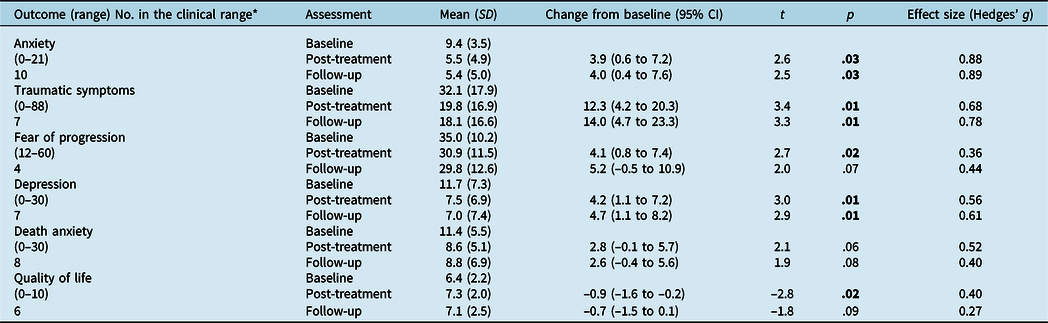
Mean scores significantly improved post-intervention on all psychological measures (all p < .03), except death anxiety (p = .055) (see Table 1). Effect sizes were large for anxiety (0.88), moderate for traumatic symptoms (0.68), depression (0.56) and death anxiety (0.52), and small for FCR (0.36) and QOL (–0.40). At follow-up, improvements on mean anxiety, traumatic symptoms and depression scores were maintained or increased (all p < .03), with moderate to large effect sizes.
Efficacy outcomes on psychological measures (n = 12)

*Number of participants in the clinical range for each outcome at study entry. Published clinical cut-offs were used when available. Criterion C was used for death anxiety and quality of life. See the measures section in the Supplementary material for more information. p values <.05 are highlighted in bold.
Regarding reliable changes, anxiety scores reliably improved for 7/10 participants post-treatment and 6/10 at follow-up. Of these, 6/10 demonstrated reliable and clinical change in anxiety post-treatment and 5/10 at follow-up. One participant reported reliable, but not clinical, deterioration in anxiety before the second session and dropped out of treatment. Regarding clinical recovery, 6/11 (55%) participants were clinically recovered at post-treatment and 7/11 (64%) at follow-up. One participant, who recovered post-treatment, showed reliable and clinical deterioration at follow-up on anxiety and FCR scores.
Discussion
This pilot study provides evidence for the feasibility, acceptability and preliminary efficacy of a transdiagnostic treatment for cancer-related anxiety. The majority of participants (11/12) completed at least five sessions and 67% (eight people) completed all nine sessions. We felt that this retention rate was acceptable in a study with patients with advanced or recurred disease where attrition rates are potentially higher than in other cancer populations. Participants rated all therapy aspects as essential and effective. Despite the small sample size, statistically significant improvements were demonstrated post-treatment for anxiety, FCR, traumatic symptomology, depression and QOL. Improvements were maintained at follow-up for anxiety, traumatic symptomology and depression.
Clinically, 55% of the participants were ‘recovered’ post-treatment and 64% at follow-up. These results are extremely promising because the sample was predominantly patients with advanced disease experiencing ongoing uncertainty, realistic threat and poor prognosis. These results also suggest this single intervention is feasible to deliver to patients with varied anxiety-related presentations.
Clearly this is a small sample treated by a single therapist. Our inclusion criterion was broad in that we included patients with advanced disease, recurred disease and a second primary. However, we posited that these patients share commonalities in that the cancer threat is realistically high and the inherent features of the cancer context (uncertainty, uncontrollability and death awareness) are particularly salient to this group of patients. Only 16 of 45 participants consented to initial screening as they preferred to access free psychological support within the cancer service. Our low recruitment rate has implications for the feasibility of translating the study to a larger trial. One possibility is that the study design could be amended to provide greater flexibility around session length and interval so that commitment to the study is less burdensome. Also recruitment could be extended to patients from hospitals that do not provide free psychology support as part of their cancer care. Small effect sizes were demonstrated for FCR. However, only four participants scored in the clinical range for FCR at study entry, so this may have impacted the effect sizes found. The measure of death anxiety used in the study did not have a clinical cut-off, so future research should establish clinical cut-offs in a sample of people with advanced disease to more accurately assess the clinical effect of the intervention. Anecdotally, in this acutely unwell population, more flexibility around content delivery was needed to accommodate varying physical symptoms and capacity to cognitively engage. Therefore, we would recommend re-organising sessions into modules completed at a pace suitable to each patient.
We are unaware of any previous intervention studies that have combined elements of traditional and contemporary CBT in the cancer setting. Our model of cancer-related anxiety identified that cognitive processes and content were important targets of treatment. In the context of advanced cancer, patients do have realistic concerns that are amenable to productive processing, but describe that their attempts to work through their concerns cognitively often result in worrying and rumination. Therefore providing (1) psychoeducation around helpful and unhelpful coping in response to uncertainty and limited control and a (2) framework around when and how to process concerns and when and how to disengage from unproductive processing were important, novel, strategies included in the intervention.
The study provides preliminary evidence for the feasibility and acceptability of this transdiagnostic intervention for cancer-related anxiety in patients with advanced cancer. Clearly, we cannot make conclusions about efficacy but recovery rates in this study were encouraging, particularly given most participants had advanced disease and were living with ongoing uncertainty. Further research is needed to evaluate the intervention in a randomised controlled trial.
Supplementary material
To view supplementary material for this article, please visit https://doi.org/10.1017/S1352465820000697
Acknowledgements
Thanks to Associate Professor Anthony Joshua for providing site support during the study. Thanks to Robin Cohen for providing the items of the McGill Quality of Life-revised questionnaire.
Financial support
Funding was provided by an NHMRC postgraduate scholarship (grant number 113309).
Conflicts of interest
None.




Comments
No Comments have been published for this article.