Introduction
Broilers are normally fed high density diets of 2800 to 3000 kilocalories of metabolisable energy (ME) per kg of feed (NRC, Reference NRC (National Research Council)1994). A high ME in broiler diets is associated with increases in fatness and a number of metabolic disorders, increased leg problems and increased incidence of ascites, as well as increased mortality due to heart attacks (Daghir, Reference DAGHIR1995). Although feed intake decreases as dietary energy is increased, the reduction in voluntary feed intake is not always enough to maintain constant energy intake. This is because the divergent genetic selection programme (over selection) for fast growth with the present day broiler has resulted in stocks that do not adequately regulate voluntary feed intake to achieve energy balance. The peripheral appetite control centres have been altered in the modern broiler strains (Denbow, Reference DENBOW1994), causing ad libitum fed birds to eat to near gut capacity (Bokkers and Koene, Reference BOKKERS and KOENE2003). Thus, the health of the adult broiler chicken can be threatened under ad-lib feeding conditions. A full-feeding environment (conventional feeding using a high density diet) can result in obese birds and a general loss of vigour (Cheema et al., Reference CHEEMA, QUERESHI and HAVENSTEIN2003). These effects are more pronounced in the tropics because of the harsh climatic conditions of this region.
A typical example was a study by Cresswell (2004) where the performance of broilers was compared in trials conducted in several countries against standard values for the strain of birds used. Those countries in the humid tropics had generally poorer all-round performance with higher associated feed costs compared to in the more temperate climates. Recent studies by Gous and Morris (Reference GOUS and MORRIS2005) revealed that the low performance of broilers in the tropics is because broiler production in these regions was introduced as a standardised farming system in environments that are unsuitable for such operations. There is therefore a need for feeding strategies that will improve the performance of broilers within the prevailing environmental conditions in hotter countries. Emmans (Reference EMMANS1994) suggested increases in the fibre content of the broiler diet to reduce the metabolisable energy content and increase feed intake. This strategy is similar to the concept of ‘quantitative nutrition.’
Quantitative nutrition
Quantitative nutrition is all about voluntary feed intake using diets formulated to lower nutrient specifications than would otherwise be possible. It involves allowing birds’ free access to feed using low density diets (Attamangkunne, Reference ATTAMANGKUNNE2006). According to Attamangkunne (Reference ATTAMANGKUNNE2006), animal nutrition can be far more efficient if the focus is on feed intake rather than feed quality, which involves the levels of individual nutrients, the quality of the ingredients and how best to formulate the diets. Meremikwu (Reference MEREMIKWU2009) has identified strict adherence to nutritional standards as one of the technical constraints to successful poultry production in the tropics. According to Meremikwu (Reference MEREMIKWU2009), nutritional standards such as NRC, (1994) may over-specify diets in many low income, resource-poor countries (particularly those in the humid tropics) because of environmental constraints. A trend in animal nutrition had been suggested by Bercovici et al. (Reference BERCOVICI, GAERTNER and PUIGSERVER1989), that states ‘when looking at least feed cost per unit of product produced, nutritionists should put their emphasis on formulating to produce the most economical product, rather than trying to meet a rigid set of specifications.’ A huge advantage can be gained if the feed intake of a lower density diet is more efficient than a higher nutrient density diet. Smith (Reference SMITH2001) had reported that the primary requirement of a feed is that the animal should eat it irrespective of the nutrient density, provided the animal eats sufficient quantity.
Potentials of quantitative nutrition
There are potentially both economic and health improvement benefits from the concept of quantitative nutrition. Farrell (Reference FARRELL2005) reported that, in many tropical countries, the use of low density diets may be the most economical option. This is because, when lowering nutrient specifications, more of the poorer quality feedstuffs can be brought into ration formulations and this will allow producers to match their production with available feed resources rather than placing too heavy a dependence on imported raw materials. This is particularly important now that many developing countries no longer have the luxury of importing feed ingredients, particularly maize and soybeans, as a result of foreign exchange difficulties. For example, Hutagalung (Reference HUTAGALUNG2000) reported that nearly 70% of all poultry farms and 50% of feed manufacturers had ceased production in Indonesia as a result of global economic crises. The Nigerian poultry industry was badly affected by a crisis as an indirect result of the ban on importation of wheat and maize by the Federal Government in 1987 (Udedibie, Reference UDEDIBIE2003). In terms of health improvement, Gous and Morris (Reference GOUS and MORRIS2005) reported that poor quality feed ingredients reduce the heat increment from a broiler diet, thereby reducing heat stress and its associated lethal effects. Whitehead (Reference WHITEHEAD2002) discussed that it may be beneficial for a broiler not to reach its maximum growth potential, considering the association between fast growth and a number of metabolic disorders. According to Whitehead (Reference WHITEHEAD2002), genetic predispositions to specific disorders affecting the skeletal and cardiovascular systems associated with selection of broilers for fast growth can be partially overcome by changes in diet composition or feed supply aimed at suppressing growth. Hocking et al. (Reference HOCKING, ZACHEK, JONES and MACLEOD2004) reported that diet dilution with oat hulls or sugar beet pulp to increase feeding time resulted in high antibody titre, as evidenced by reduction in the heterophil: lymphocyte ratio, as well as zero basophile values. These are indications of a higher level of immunity against diseases and optimal levels of stress.
Methods of quantitative nutrition
The development of feeding systems from non-conventional feed resources requires an equally non-conventional approach in the design of the production system. A specific approach has been developed and this involves diet dilution to reduce the AME value.
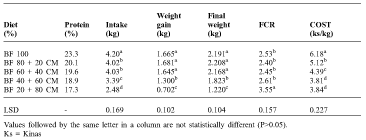
Diet dilution with high fibre feedstuffs reduces the AME content of broiler feeds and increases feed intake. This allows a high inclusion of lower quality feedstuffs for the later weeks of age of the broilers growth. Leeson et al. (Reference LEESON, SUMMER and CASTON1992) demonstrated the remarkable capacity of 35 day old broilers to increase feed intake in response to diet dilution without substantially altering body weight and breast meat yield. Recent research carried out at the National Research Institute in Papua New Guinea (PNG) showed that it was possible to dilute a broiler finisher diet with 400g coconut meal /kg without loss in performance (Table 1).
Dilution of a broiler finisher diet (BF) with coconut meal (CM) on broiler performance from 21- 53 days of age (Farrell, Reference FARRELL2005).
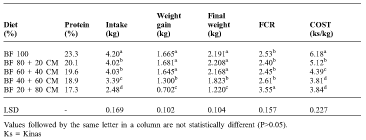
Values followed by the same letter in a column are not statistically different (P>0.05).
Ks = Kinas
Like palm kernel cake (PKC), coconut meal (CM) contains both protein and energy. The energy fraction is in the form of a residual oil following extraction from the nut and kernel respectively. These waste products (CM and PKC) are high in crude fibre (>150 g/kg) with a protein content of 180-200 g/kg which classifies them as medium grade protein sources (Akpodiete et al., Reference AKPODIETE, ERUVBETINE and GAGIYORWE2006). PKC is readily and commercially available during all seasons in the humid tropical zone of southern Nigeria, Cote d'Ivore, Costa Rica, Northern Togo, etc. It has great potential as farm animal feedstuffs because it has no other industrial use and does not compete with food or food component for humans.
Physiological and nutritional roles of insoluble fibre
Insoluble fibres such as cellulose have traditionally been regarded as nutrient diluents in monogastric animal diets. Earlier experiments have revealed that birds are able to increase feed intake when feed is diluted with low energy constituents such as oat hulls (Hill and Dansky, Reference HILL and DANSKY1954). Similar to former hybrids of poultry, the modern, highly selected strains of birds show their ability to compensate for reduced nutrient concentration due to insoluble fibre by increasing feed intake (Hetland and Svihus, Reference HETLAND and SVIHUS2001). Studies have indicated that performance does not decrease when insoluble fibre is included at moderate levels in broiler or layer diets, despite reduced nutrient concentration in the diets. The physiological and nutritional roles of insoluble fibres (non-starch polysaccharides and lignin) in poultry have been reviewed extensively by Hetland et al. (Reference HETLAND, CHOCT and SVIHUS2004). Insoluble fibre affects gut function, modulates nutrient digestion and has no significant influence on the composition and quantity of gut microflora. Research in poultry indicate that insoluble fibres are inert and therefore act only as nutrient diluents (Carre, Reference CARRE1990; Angkanaporn et al., Reference ANGKANAPORN, CHOCT, BRYDEN, ANNISON and ANNISON1994). Soluble fibres, such as pectin, can produce high viscosity in the small intestine and thereby inhibit digestion and absorption (Smits and Annison, Reference SMITS and ANNISON1996). Since negligible digestion of insoluble fibres occurs in poultry, the most obvious effects of such feedstuffs include the increased bulk of digesta in the tract and a faster passage through the digestive tract (Hetland and Svihus, Reference HETLAND and SVIHUS2001).
The effect of insoluble fibre on gut function stems from its ability to accumulate in the gizzard. Since coarse feed particles need to be ground before leaving the gizzard; they accumulate and are retained longer than other nutrients (Clemens et al., Reference CLEMENS, STEVENS and SOUTHWORTH1975; Moore, Reference MOORE1999). Duke (Reference DUKE1992) reported that the gizzard plays a major role in gastro-duodenal reflux of digesta. The presence of the coarse particles stimulates various downstream activities in the digestive tract, hence an empty gizzard may not be able to do this due to lack of stimuli. This specific role of the gizzard shows that poultry may have an inherent requirement for insoluble fibre in their diets. Studies have shown that layers consume litter (wood shavings) when the fibre level of their diet is low (Hetland et al., Reference HETLAND, CHOCT and SVIHUS2004). This supports the hypothesis that birds may have a requirement for structural feed components (coarse materials) for stimulation of the anterior tract and that a functional gizzard requires this intake (Duke, Reference DUKE1992). A number of experiments with poultry have shown beneficial effects of insoluble fibre on digestibility. A positive effect of 10% inclusion of fine cellulose powder was found on starch digestibility in birds fed wheat-based diets (Hetland and Svihus, Reference HETLAND and SVIHUS2001). A similar positive effect of including 3-4% wood shavings to layers fed wheat-based diets was observed (Hetland et al., Reference HETLAND, SVIHUS and KROGDAHL2003). Rogel et al. (Reference ROGEL, BALNAVE, BRYDEN, W and ANNISON1987) reported that oat hulls improved the digestibility of starch from wheat and potatoes when added up to 10% in feed. The mechanism by which the inclusion of insoluble fibre in poultry diets improves nutrient digestion is not clearly understood, but it is suspected that improved enzyme-substrate integrations may be responsible. It has been observed that bile reflux between the gizzard and the duodenum is increased by inclusion of insoluble fibre. In the study conducted by Hetland et al. (Reference HETLAND, SVIHUS and KROGDAHL2003), the amount of bile acid in the gizzard increased in proportion to the level of gizzard content. Improvements in starch digestibility may, in part, be due to enhanced emulsification of lipids as a result of more bile acids being available. Incomplete emulsification of dietary lipids could lead to the formation of a protective coating around nutrients in the lumen resulting in impaired solubility, and hence decreased digestibility (Hetland et al., Reference HETLAND, SVIHUS and KROGDAHL2003).
Conclusions
Diet dilution with insoluble polysaccharides provides a systematic approach to the concept of ‘quantitative nutrition’ which has been described as a strategy for improving the performance of broilers in the tropics. This would reduce the problems commonly seen in fast-growing broiler strains fed conventional high ME diets. In addition, including more fibre into the diet may have other benefits that can assist in nutrient digestion and gut function, leading to better use of feedstuffs.