Introduction
The whitefly Bemisia tabaci (Gennadius) (Hemiptera: Aleyrodidae) is a cryptic species complex composed of more than 35 morphologically indistinguishable species (De Barro et al., Reference De Barro, Liu, Boykin and Dinsdale2011; Liu et al., Reference Liu, Colvin and De Barro2012; Firdaus et al., Reference Firdaus, Vosman, Hidayati, Supena, Visser and van Heusden2013). Within this whitefly complex, the putative Middle East-Asia Minor 1 (MEAM1) and Mediterranean species, known formerly as the ‘B biotype’ and ‘Q biotype’, respectively, have become economically important pests due to their rapid spread from the Mediterranean regions to the rest of the world and to the serious damage they cause to a wide range of crops (Brown et al., Reference Brown, Frohlich and Rosell1995; Liu et al., Reference Liu, De Barro, Xu, Luan, Zang, Ruan and Wan2007; De Barro et al., Reference De Barro, Liu, Boykin and Dinsdale2011). The B. tabaci species complex causes severe crop losses through direct feeding and transmission of begomoviruses (Geminiviridae, Begomovirus) (Brown et al., Reference Brown, Frohlich and Rosell1995; Colvin et al., Reference Colvin, Omongo, Govindappa, Stevenson, Maruthi, Gibson, Seal, Muniyappa, Karl Maramorosch and Thresh2006; Jiu et al., Reference Jiu, Zhou, Tong, Xu, Yang, Wan and Liu2007; Navas-Castillo et al., Reference Navas-Castillo, Fiallo-Olivé and Sánchez-Campos2011), which are the most important group of plant viruses in tropical and sub-tropical regions (Moffat, Reference Moffat1999; Mansoor et al., Reference Mansoor, Briddon, Zafar and Stanley2003). Over 200 species of begomoviruses are exclusively transmitted by B. tabaci in a persistent-circulative mode (Hogenhout et al., Reference Hogenhout, Ammar, Whitfield and Redinbaugh2008; Nawaz-ul-Rehman & Fauquet, Reference Nawaz-ul-Rehman and Fauquet2009; Navas-Castillo et al., Reference Navas-Castillo, Fiallo-Olivé and Sánchez-Campos2011).
Plant-mediated whitefly–begomovirus interactions exert important influences on the abundance of the whitefly and the epidemiology of the virus diseases (Colvin et al., Reference Colvin, Omongo, Govindappa, Stevenson, Maruthi, Gibson, Seal, Muniyappa, Karl Maramorosch and Thresh2006; Jiu et al., Reference Jiu, Zhou, Tong, Xu, Yang, Wan and Liu2007). In recent years, several species of begomoviruses, such as Tomato yellow leaf curl virus (TYLCV) coupled either with the MEAM1 or Mediterranean species of the B. tabaci complex, have spread into many countries and regions (Liu et al., Reference Liu, De Barro, Xu, Luan, Zang, Ruan and Wan2007; De Barro et al., Reference De Barro, Hidayat, Frohlich, Subandiyah and Ueda2008; Varma et al., Reference Varma, Mandal, Singh and Thompson2011; Péréfarres et al., Reference Péréfarres, Thierry, Becker, Lefeuvre, Reynaud, Delatte and Lett2012). In some cases, the invasion of whiteflies and begomoviruses into new territories may have been facilitated by the plant-mediated whitefly–begomovirus interactions (Jiu et al., Reference Jiu, Zhou, Tong, Xu, Yang, Wan and Liu2007). The modes of virus transmission by insect vectors can be categorized as non-persistent, where viruses have a transient relationship with their vectors and are only associated with the mouthparts or foregut of vector insects, and persistent transmission, where viruses circulate (and replicate) in the vector body and have developed intimate interactions with more internal components of vectors for longer time periods. In theory, transmission of persistently transmitted (PT) viruses requires that vectors feed on infected host plants for a sustained period to acquire and circulate virions, and then move to a uninfected host plant (Mauck et al., Reference Mauck, Bosque-Pérez, Eigenbrode, De Moraes and Mescher2012). Thus, PT viruses may tend to enhance vector attraction to infected hosts, improve host quality or decrease host resistance for vectors and promote long-term feeding (Mauck et al., Reference Mauck, Bosque-Pérez, Eigenbrode, De Moraes and Mescher2012). However, whether plant-mediated whitefly–begomovirus interactions fit this hypothesis is not yet clear.
In this review, we survey and synthesize the case studies on plant-mediated interactions between whiteflies and begomoviruses in an attempt to identify patterns to the interactions; next, we consider investigations into the ecological, biochemical and molecular mechanisms underlying the interactions; and finally, we elaborate on the most interesting issues and suggest some likely fruitful areas for future research.
Patterns of plant-mediated whitefly–begomovirus interactions
Literature survey and synthesis
A literature survey following the method of Mauck et al. (Reference Mauck, Bosque-Pérez, Eigenbrode, De Moraes and Mescher2012) was conducted to detect possible patterns of plant-mediated whitefly–begomovirus interactions. The literature search was up to and including the 20th July 2013 and identified 24 papers that reported any aspect of whitefly, B. tabaci, attraction, settling and feeding, or comparative performance in relation to uninfected and begomovirus-infected plants (tables 1–3).
For assays to test whitefly performance, results were categorized as positive, neutral or negative effects for virus-infected plants or virus-invasion on vector life-history parameters, i.e. development, survival and reproduction. Where both positive and negative effects were observed in a single experiment, the experiment was categorized as neutral; for example, when whiteflies deposited fewer eggs on virus-infected plants, but developed more rapidly on these plants (Mann et al., Reference Mann, Sidhu, Butter, Sohi and Sekhon2008). For experiments to measure attraction or settling, probing and feeding behaviour, results were categorized as an indirect effect of the virus on a vector preference (for virus-infected plants, for uninfected plants, or no preference), via plants and a direct effect of virus on whitefly behaviour.
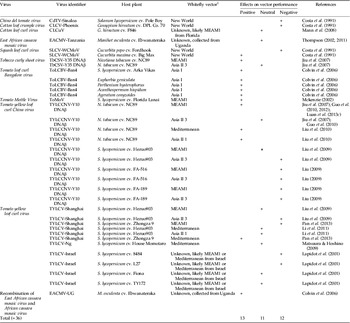
To examine the pattern of interactions, experiments reported in the 24 papers have been tabulated as individual case studies; each case study involves experiments investigating whitefly performance or behaviour with a given combination of virus isolate, plant cultivar and whitefly species (tables 1–3). When the same combination of virus isolate, plant cultivar and whitefly species was examined by different authors or by the same group of authors repeatedly using different protocols at different times, all the experiments were regarded as one case study. For example, the experiments with Tomato yellow leaf curl China virus (TYLCCNV), Nicotiana tabacum cv. NC89 and whitefly MEAM1 by Jiu et al. (Reference Jiu, Zhou, Tong, Xu, Yang, Wan and Liu2007), Guo et al. (Reference Guo, Ye, Dong and Liu2010, Reference Guo, Dong, Yang, Cheng, Wan, Liu, Zhou and Ye2012) and Luan et al. (Reference Luan, Yao, Zhang, Walling, Yang, Wang and Liu2013c ) to examine whitefly performance on virus-infected and uninfected plants were regarded as one case study (table 1).
Performance of whiteflies on begomovirus-infected or uninfected plants.

1 Names of the putative species of the Bemisia tabaci complex were taken from De Barro et al. (Reference De Barro, Liu, Boykin and Dinsdale2011) and Hu et al. (2011); ‘Unknown’ indicates the identity of the whitefly species was unknown.
Effects of viral infection on whitefly performance
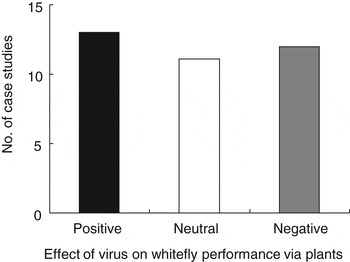
In total, 36 case studies were available for the comparative performance of whiteflies feeding on begomovirus-infected and uninfected plants. These case studies appear evenly distributed among positive, neutral and negative effects (table 1; fig. 1). As these studies involve complex three or four way (if endosymbionts are involved) interactions, it is worth noting that for the same virus isolate, e.g. TYLCCNV-Y10 DNAβ, the effect can vary from positive, neutral to negative, depending on the plant cultivar and/or whitefly species. Although not all publications identified the species within the B. tabaci complex involved, there is a strong bias towards the use of the highly invasive MEAM1 (possibly 13 case studies) and Mediterranean (8 case studies) species. This bias may partially help to explain why the effects appear evenly distributed, due to the relatively recent associations of the invasive whitefly with particular begomoviruses and plants.
Distribution of varying effects of viral infection of host plants on whitefly performance.

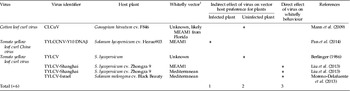
Only six case studies were available for the comparative performance of viruliferous and non-viruliferous whiteflies feeding on begomovirus-free plants. Of the six case studies, four show a negative effect of begomoviruses on the performance of whiteflies, one shows a positive effect and one shows negative effects (table 2).
Performance of viruliferous and non-viruliferous whiteflies on begomovirus-free plants.

1 Names of the putative species of the Bemisia. tabaci complex were taken from De Barro et al. (Reference De Barro, Liu, Boykin and Dinsdale2011) and Hu et al. (2011).
Effects of viral infection on whitefly behaviour
Only three case studies were available for the indirect effects of viral infection of plants on whitefly behaviour. One case study reports whitefly preference for virus-infected to uninfected healthy plants, whereas the other two report the reverse. In addition, three case studies report virus modulation of whitefly settling, probing and feeding behaviour in favour of its transmission (table 3).
Manipulation of settling, probing and feeding behaviour of whiteflies directly by begomovirus or indirectly through begomovirus-infected plants.

1 Names of the putative species of the Bemisia. tabaci complex were taken from De Barro et al. (Reference De Barro, Liu, Boykin and Dinsdale2011) and Hu et al. (2011); ‘Unknown’ indicates the identity of the whitefly species was unknown.
Mechanisms underlying plant-mediated whitefly–begomovirus interactions
Mechanisms related to changes in plant defence traits
Plant defences have a dynamic impact on the adaptations and interactions of vectors and pathogens (Huot et al., Reference Huot, Nachappa and Tamborindeguy2013). Whitefly–begomovirus interactions are often assumed to be mediated by plant defences (Belliure et al., Reference Belliure, Janssen, Maris, Peters and Sabelis2005; Colvin et al., Reference Colvin, Omongo, Govindappa, Stevenson, Maruthi, Gibson, Seal, Muniyappa, Karl Maramorosch and Thresh2006; Stout et al., Reference Stout, Thaler and Thomma2006). However, how plant defence signalling pathways and defensive compounds affect these types of interaction remains poorly understood. By integrating ecological, mechanistic and molecular approaches, however, Zhang et al. (Reference Zhang, Luan, Qi, Huang, Li, Zhou and Liu2012) recently demonstrated that jasmonic acid-associated defences in tobacco plants were suppressed by infection of TYLCCNV, thereby favouring the performance of the MEAM1 whitefly on virus-infected plants. Working on the same combination of virus, plant and whitefly with essentially the same multidisciplinary approach, Luan et al. (Reference Luan, Yao, Zhang, Walling, Yang, Wang and Liu2013c ) further showed that terpenoid synthesis and release were suppressed in the virus-infected plants, which become substantially more favourable to the performance of whitefly compared to uninfected plants. On the vector insect side of the interaction, the genes involved in the oxidative phosphorylation pathway and detoxification enzyme were down-regulated in MEAM1 individuals feeding on virus-infected plants, and reduced detoxification activity likely attenuated the energy costs, thereby enhancing whitefly performance (Luan et al., Reference Luan, Wang, Wang, Wang and Liu2013b ).
Mechanisms related to changes in plant nutrition
Begomovirus infection may alter plant nutrition and, in turn, its suitability to whiteflies. A population of African cassava B. tabaci from Uganda increased more rapidly on East African cassava mosaic virus-Uganda (EACMV-UG)-infected than on uninfected cassava plants, and concurrently, the concentrations of four amino acids increased significantly in the phloem sap of the virus-infected compared to uninfected cassava plants (Colvin et al., Reference Colvin, Omongo, Govindappa, Stevenson, Maruthi, Gibson, Seal, Muniyappa, Karl Maramorosch and Thresh2006). It seems that the mutualistic relationship between whiteflies and EACMV-UG may be achieved, at least in part, through improved nutrition in virus-infected plants. It is interesting to note that EACMV-UG is a recombinant virus of EACMV with African cassava mosaic virus (ACMV, Zhou et al., Reference Zhou, Liu, Calvert, Munoz, Otim-Nape, Robinson and Harrison1997), and the improved performance of the African cassava B. tabaci on EACMV-UG-infected cassava plants compared to that on uninfected plants was not observed on cassava plants infected with ACMV alone (Thompson, Reference Thompson2002, Reference Thompson and Thompson2011).
As noted above, the MEAM1 whitefly improved its performance on TYLCCNV-infected tobacco plants compared to uninfected plants (Jiu et al., Reference Jiu, Zhou, Tong, Xu, Yang, Wan and Liu2007). However, significant differences were not detected in terms of amino acid profiles, percentage of essential amino acids and sugars to the amino acids ratio between uninfected and TYLCCVN-infected tobacco plants (Wang et al., Reference Wang, Bing, Li, Ye and Liu2012). Further analysis of the whitefly honeydews indicate that the whitefly improved nutritional assimilation on virus-infected plants compared to that on uninfected plants, and this improved nutritional assimilation of the whitefly on virus-infected plants was speculated to be associated with the suppressed plant defence to the whitefly by the virus (Wang et al., Reference Wang, Bing, Li, Ye and Liu2012). It may also be related to the attenuation of energy costs associated with reduced detoxification activity required by the whitefly (Luan et al., Reference Luan, Wang, Wang, Wang and Liu2013b ).
Possible roles of whitefly endosymbionts
Symbiotic bacteria (symbionts) are ubiquitous in hemipteran insects (Akman Gündüz & Douglas, Reference Akman Gündüz and Douglas2009; Douglas, Reference Douglas2009). The endosymbiont ‘Candidatus Portiera aleyrodidarum’ (Oceanospirillales), which has evolved with B. tabaci and is strictly vertically transmitted through bacteriocytes during reproduction, is called the primary endosymbiont of the whitefly. The primary endosymbiont provides its whitefly hosts with essential amino acids as well as carotenoids (Sloan & Moran, Reference Sloan and Moran2012). In addition to ‘Candidatus Portiera aleyrodidarum’, seven secondary symbionts have been found in B. tabaci, including ‘Candidatus Cardinium hertigii’ (Bacteroidales), ‘Candidatus Fritschea bemisiae’ (Chlamydiales), ‘Candidatus Hamiltonella defensa’ (Enterobacteriales), Arsenophonus spp. (Enterobacteriales), Wolbachia spp. (Rickettsiales) and ‘Candidatus Hemipteriphilus asiaticus’ (Bing et al., Reference Bing, Yang, Zchori-Fein, Wang and Liu2013). These secondary symbionts may have important effects on whitefly biology (Gottlieb et al., Reference Gottlieb, Zchori-Fein, Mozes-Daube, Kontsedalov, Skaljac, Brumin, Sobol, Czosnek, Vavre, Flury and Ghanim2010).
Rickettsia can be transferred from the whitefly B. tabaci to a plant (Caspi-Fluger et al., Reference Caspi-Fluger, Inbar, Mozes-Daube, Katzir, Portnoy, Belausov, Hunter and Zchori-Fein2011). Some types of endosymbionts may regulate the plant defences (Casteel et al., Reference Casteel, Hansen, Walling and Paine2012; Frago et al., Reference Frago, Dicke and Godfray2012). Such regulation may influence the transmission of virus and whitefly–begomovirus interactions (Gutiérrez et al., Reference Gutiérrez, Michalakis, Munster and Blanc2013). As B. tabaci survival was influenced by an interaction effect between whitefly viruliferous status and amino acid diet type (Douglas, Reference Douglas2009), the variation of symbiont composition in whiteflies may be expected to affect plant mediated whitefly–begomovirus interactions.
Future directions of research
Expand the number and diversity of pathosystems for study
In terms of the influence of begomovirus infection on performance of whitefly vectors, the case studies available so far are distributed evenly among positive, neutral and negative effects (fig. 1). This pattern seems to deviate from those observed in other groups of PT viruses, where proportionally more cases of positive effects have been recorded (Mauck et al., Reference Mauck, Bosque-Pérez, Eigenbrode, De Moraes and Mescher2012). If the pattern depicted in fig. 1 is real and not due to the biases identified above, one may suggest that it is related to genome structures of viruses, as begomoviruses are DNA viruses whereas all other PT viruses that have been examined belong to RNA viruses (Mauck et al., Reference Mauck, Bosque-Pérez, Eigenbrode, De Moraes and Mescher2012). Different groups of plant viruses may have differential impact on plant physiology during infection, which probably affects vector–virus interactions.
As discussed above, the number of case studies is currently small considering the possible combinations of interactions in nature (over 200 species of begomoviruses×more than 30 putative cryptic B. tabaci species×100 s of crop species and varieties (Navas-Castillo et al., Reference Navas-Castillo, Fiallo-Olivé and Sánchez-Campos2011; Liu et al., Reference Liu, Colvin and De Barro2012). Further, invasions of some begomoviruses and whiteflies into new regions have created new tripartite associations. The diversity of plant-mediated interactions between begomoviruses and whiteflies is apparently enormous and will certainly increase with time, usually driven by human movements of plant material around the globe. We conclude, therefore, that with the limited number of case studies available so far (tables 1–3), any generalization of patterns in the interactions is premature. To proceed towards examination of a general pattern, we must expand the number and diversity of pathosystems for investigation with regard to all aspects of the virus–host–vector interactions. In particular, studies involving longstanding tripartite associations, where evolution has had a chance to operate for a significant period, will be particularly instructive.
We also propose that the diversity and identities of each of the three partners in the interactions needs to be considered and accurately documented in future studies. (1) Virus diversity: groups by genome structure, i.e. monopartite, monopartite with satellite DNA and bipartite; and different isolates or strains of viruses to examine the genetic basis for the viral effects. For example, cassava plants infected with EACMV does not benefit B. tabaci; in contrast, cassava plants infected with the recombinant virus EACMV-UG involving genomic components of both EACMV and ACMV promotes population increase of the vector whitefly (table 1; Thompson Reference Thompson2002; Colvin et al., Reference Colvin, Omongo, Govindappa, Stevenson, Maruthi, Gibson, Seal, Muniyappa, Karl Maramorosch and Thresh2006). (2) Whitefly diversity: different genetic groups or cryptic species, invasive and indigenous species, different biotypes of the same cryptic species to investigate the genetic basis for the vector effects. For instance, the invasive MEAM1 benefits from TYLCCNV-infected tobacco plants, whereas the indigenous Asia II 3 does not (table 1; Jiu et al., Reference Jiu, Zhou, Tong, Xu, Yang, Wan and Liu2007). Due to the distorted history of B. tabaci taxonomy and the enormous genetic diversity within this whitefly species complex, it is extremely important to know exactly the phylogenetic group and sub-clade of B. tabaci that is being used in each study (Gill & Brown, Reference Gill, Brown, Stansly and Narahjo2010; Liu et al., Reference Liu, Colvin and De Barro2012). It is increasingly apparent, for example, that within the Sub-Saharan Africa 1 there is a lot of biological variation that we did not recognize previously and this probably affects the outcome of the interactions when different populations/virus species are used (Boykin et al., Reference Boykin, Armstrong, Kubatko and De Barro2012; Mugerwa et al., Reference Mugerwa, Rey, Alicai, Ateka, Atuncha, Ndunguru and Sseruwagi2012). For future interaction studies, we may need to ‘type’ the B. tabaci populations much more rigorously by sequencing more than just their mtCO1 gene, perhaps some nuclear genes as well (Boykin et al., Reference Boykin, Armstrong, Kubatko and De Barro2012). (3) Plant diversity: different families, species, varieties/cultivars of the same species, and different levels of constitutive suitability to whitefly and/or virus to reveal the genetic basis for the plant effects. For example, MEAM1 performed better on TYLCCNV-infected tobacco plants compared to uninfected plants, whereas such a positive association between MEAM1 and TYLCCNV was not observed with TYLCCNV-infected tomato plants (table 1; Jiu et al., Reference Jiu, Zhou, Tong, Xu, Yang, Wan and Liu2007; Liu et al., Reference Liu, Zhao, Jiang, Zhou and Liu2009). (4) Novel vector–virus–plant systems brought about by biological invasions: invasion events of both whiteflies and begomoviruses have been increasing in recent years to create novel tripartite associations, which impose new challenges to world agriculture, but provide unique opportunities to study novel interactions in nature (De Barro et al., Reference De Barro, Hidayat, Frohlich, Subandiyah and Ueda2008; Mauck et al., Reference Mauck, Bosque-Pérez, Eigenbrode, De Moraes and Mescher2012; Péréfarres et al., Reference Péréfarres, Thierry, Becker, Lefeuvre, Reynaud, Delatte and Lett2012).
Investigate molecular and biochemical mechanisms
The recent progress of research on molecular and biochemical mechanisms of plant-mediated whitefly–begomovirus interactions demonstrates the complexity as well as the tractability of the subject when adopting a multidisciplinary approach and the latest technology (e.g. Zhang et al., Reference Zhang, Luan, Qi, Huang, Li, Zhou and Liu2012; Luan et al., Reference Luan, Wang, Wang, Wang and Liu2013b , Reference Luan, Yao, Zhang, Walling, Yang, Wang and Liu c ). To understand the underlying mechanisms of the tripartite interactions, each of the three bipartite interactions of virus–vector, plant–vector and virus–plant needs to be examined in detail and integrated for further analysis to reveal both direct and indirect effects (Blanc et al., Reference Blanc, Uzest and Drucker2011; Luan et al., Reference Luan, Li, Varela, Wang, Li, Bao, Zhang, Liu and Wang2011, Reference Luan, Wang, Wang, Wang and Liu2013b , Reference Luan, Yao, Zhang, Walling, Yang, Wang and Liu c ). In many cases, particular effort may be required to separate the direct from the indirect effects, e.g. direct effect of virus on vector and indirect effect of virus on vector via plants. Here, we elaborate briefly on a strategy to explore the molecular and biochemical mechanisms.
On the plant side of the interactions, crosstalk roles between individual defence signalling pathways and various classes of metabolites or toxic proteins involved in tripartite interactions should be determined. Moreover, other plant properties such as size, shape, colour, odour and development stage and disease severity must also be considered in the investigations (Wang et al., Reference Wang, Bing, Li, Ye and Liu2012; Zhang et al., Reference Zhang, Luan, Qi, Huang, Li, Zhou and Liu2012; Gutiérrez et al., Reference Gutiérrez, Michalakis, Munster and Blanc2013). On the insect side of the interactions, the role of the correctly identified putative B. tabaci species and its endosymbionts should be considered, since endosymbionts constitute an essential part of the insect in its structure and functions (Dale& Moran, Reference Dale and Moran2006; Frago et al., Reference Frago, Dicke and Godfray2012; Bing et al., Reference Bing, Yang, Zchori-Fein, Wang and Liu2013). Specifically, efforts are warranted to investigate: (1) effects of insect proteins or endosymbionts on efficiency of virus transmission (Gottlieb et al., Reference Gottlieb, Zchori-Fein, Mozes-Daube, Kontsedalov, Skaljac, Brumin, Sobol, Czosnek, Vavre, Flury and Ghanim2010; Götz et al., Reference Götz, Popovski, Kollenberg, Gorovits, Brown, Cicero, Czosnek, Winter and Ghanim2012); (2) roles of salivary proteins or endosymbionts in manipulating plant physiology and in turn virus transmission, virus evolution and vector–virus interactions (Blanc et al., Reference Blanc, Uzest and Drucker2011; Casteel et al., Reference Casteel, Hansen, Walling and Paine2012; Gutiérrez et al., Reference Gutiérrez, Michalakis, Munster and Blanc2013); and (3) effects of the insect itself or endosymbionts on nutritional assimilation and other metabolic regulation of vectors in response to changes in the physiology of virus-infected plants and to invasion by plant viruses (Luan et al., Reference Luan, Li, Varela, Wang, Li, Bao, Zhang, Liu and Wang2011, Reference Luan, Wang, Wang, Wang and Liu2013b ; Thompson, Reference Thompson and Thompson2011; Wang et al., Reference Wang, Bing, Li, Ye and Liu2012; Zhang et al., Reference Zhang, Luan, Qi, Huang, Li, Zhou and Liu2012). On the begomovirus side of the interactions, the pathogenicity factors and other proteins regulating plant physiology or whitefly behaviour require further identification (Czosnek & Ghanim, Reference Czosnek and Ghanim2012; Ingwell et al., Reference Ingwell, Eigenbrode and Bosque-Pérez2012). Ultimately, examination on many of the effects from bipartite interactions must be taken one step further to decipher their influence via other partners in the associations.
Examine virus–host–vector interactions in the field
For the agricultural entomologist, ecologist or evolutionary biologist, the necessity of investigating the interactions between begomoviruses, whiteflies and plants in the field is self-evident, because the tripartite interactions are often important determinants of the vector population dynamics and virus disease epidemiology (Colvin et al., Reference Colvin, Omongo, Maruthi, Otim-Nape and Thresh2004, Reference Colvin, Omongo, Govindappa, Stevenson, Maruthi, Gibson, Seal, Muniyappa, Karl Maramorosch and Thresh2006). In this regard, the diversity of begomoviruses and their mode of infection again must be considered, which include alien and indigenous viruses, cryptic viruses that do not cause symptoms, and new viruses via mutation and/or combination, as well co-infection of multiple geminiviruses that produces synergistic effects on transmission (da Silva et al., Reference da Silva, Castillo-Urquiza, Hora Júnior, Assuncão, Lima, Pio-Ribeiro, Mizubuti and Murilo Zerbini2011; Renteria-Canett et al., Reference Renteria-Canett, Xoconostle-Cazares, Ruiz-Medrano and Rivera-Bustamante2011; Varma et al., Reference Varma, Mandal, Singh and Thompson2011). Apart from studies on pathosystems in agriculturally relevant ecosystems, research on virus–host–vector interactions in natural plant communities will be particularly instructive (see above), especially in the context of gaining insight into the evolution of these interactions.
Field studies are always challenging, because so many important variables are not controllable. Studies using a correlative approach in this context may be more feasible in many circumstances than those using a manipulative approach. Correlative field studies may help to show significant associations between incidences, abundance and/or severities of whiteflies and viruses (e.g. Colvin et al., Reference Colvin, Omongo, Maruthi, Otim-Nape and Thresh2004) and provide a useful background for manipulative studies in the laboratory and field. Where feasible, manipulative field studies should also be pursued, because compared to correlative studies, they can yield stronger evidence for causality in the real world.
Ramification of community effects of the tripartite interactions
The ramification of community effects of the plant–virus–vector interactions has seldom been tested (Stout et al., Reference Stout, Thaler and Thomma2006). In nature, other pathogens, herbivores and natural enemies may co-occur with whiteflies in begomovirus-infected plants (Mayer et al., Reference Mayer, Inbar, McKenzie, Shatters, Borowicz, Albrecht, Powell and Doostdar2002; Inbar & Gerling, Reference Inbar and Gerling2008). These microbes and herbivores may interfere with or be affected by plant-mediated whitefly–begomovirus interactions. In addition, abiotic factors and environmental heterogeneity also influence these tripartite interactions (Rodelo-Urrego et al., Reference Rodelo-Urrego, Pagán, González-Jara, Betancourt, Moreno-Letelier, Ayllón, Fraile, Piñero and García-Arenal2013). Thus, in a broader perspective, how begomovirus-induced changes in host phenotype influence (and are influenced by) other pathogens and non-vector organisms cannot be ignored. Equally important, the effects of major abiotic factors such as temperature, humidity, fertilizer and soil type must be considered in field-based investigations of begomovirus–whitefly–plant interactions.
In summary, this review reveals that we are just starting to understand the tripartite interactions between whiteflies, begomoviruses and plants. As both whiteflies and begomoviruses are two groups of the most important and invasive pests of world agriculture, major effort to reveal the patterns and underlying mechanisms of the plant-mediated, vector–virus interactions is warranted in the years to come. Research in this area will likely produce breakthroughs not only in understanding vector–virus–plant interactions but also the development of urgently needed new strategies for the management of whiteflies and begomoviruses. Unravelling the role of plant defence traits in virus–vector interactions, for example, will likely promote development of new strategies for virus control through interference of vector transmission or of vector control through interference of whitefly development (Rodríguez-López et al., Reference Rodríguez-López, Garzo, Bonani, Fereres, Fernández-Muñoz and Moriones2011; Bragard et al., Reference Bragard, Caciagli, Lemaire, Lopez-Moya, MacFarlane, Peters, Susi and Torrance2013; Luan et al., Reference Luan, Ghanim, Liu and Czosnek2013a ). As such, future research in this field has the clear potential to create novel applied solutions for some of the greatest pest and crop-disease problems currently facing farmers in tropical and sub-tropical regions of the globe.
Acknowledgements
We thank two anonymous reviewers for their constructive comments on the manuscript. Financial support for this study was provided by the National Natural Science Foundation of China (grant numbers 31390421 and 31361140356) and The Special Fund for Agro-scientific Research in the Public Interest China (grant number 201003065).