Introduction
The aphid, Myzus persicae (Sulzer) (Hemiptera: Aphididae) is a major crop pest on many hosts such as potato, tomato, tobacco, cabbage and cole crops found throughout the world. It can transmit virus in more than 30 plant families, including beans, sugar beet and tobacco (Hill, Reference Hill and Hill1983). Agricultural misuse of insecticides has caused chemical resistance and also disrupted their natural enemies (Meyerdirk et al., Reference Meyerdirk, French and Hart1982). Insecticide resistance in M. persicae was been determined at the molecular level (Field et al., Reference Field, Devonshire and Forde1988).
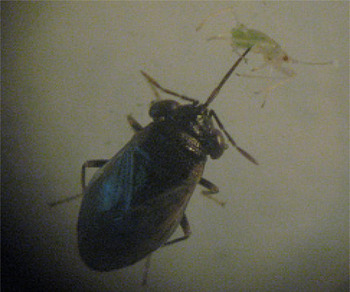
The use of predators as biological control agents may be an alternative for solving problems relating to insecticide resistance (Omoto et al., Reference Omoto, Dennehy, McCoy, Crane and Long1994), environmental pollution and also improve the economic and biological sustainability of agro-ecosystems (Alves et al., Reference Alves, Tamai, Rossi and Castiglioni2005). The predatory bug Geocoris pallidipennis (Costa) is an important biological control agent (Tong et al., Reference Tong, Lu and Wu2011), feeding on several arthropod pests including aphids, whiteflies, mites and moth eggs (fig. 1).
G. pallidipennis feeding on the aphid, M. persicae.

One of the most important interactions with regards to biological control is the predator–prey relationship (Jalali et al., Reference Jalali, Tirry and De Clercq2010). The functional response (Gotoh et al., Reference Gotoh, Nozawa and Yamaguchi2004) describes the relationship between the number of prey available and the number of prey killed by a predator (Holling, Reference Holling1959) and can be used to monitor the efficacy of a predator. Studies have indicated that nutritional history can affect the functional response of Neoseiulus californicus (Castagnoli & Simoni, Reference Castagnoli and Simoni1999; Morozov & Petrovskii, Reference Morozov and Petrovskii2013; Van Leeuwen et al., Reference Van Leeuwen, Brannstrom, Jansen, Dieckmann and Rossberg2013) and we study this effect with regards to G. pallidipennis. Searching rate (the predator's searching efficiency) and handling time (the time to kill and eat a prey) are the main behavioral parameters on which the functional response depends (Holling, Reference Holling1959), with the shape of the functional response curve being dependent on these parameters (Holling, Reference Holling1965; Hassell, Reference Hassell1978). These parameters may also be used to estimate ‘food quality’ for predators (Cohen, Reference Cohen2000; Castañé & Zapata, Reference Castañé and Zapata2005).
The field biology of G. pallidipennis has been extensively studied (Crocker & Whitcomb, Reference Crocker and Whitcomb1980; Ai & Zhu, Reference Ai and Zhu1989; Tillman et al., Reference Tillman, Lamb and Mullinix2009; Tong et al., Reference Tong, Lu and Wu2011), but, very few studies have been conducted that investigate the efficacy of G. pallidipennis for the control of M. persicae. Additionally, no study has examined the influence of nutritional history on the control ability of G. pallidipennis to M. persicae. We hypothesize that artificial diet may affect the predatory behavior of G. pallidipennis. Thus, we conducted an experiment to examine the influence of artificial diet versus live prey on the functional response of G. pallidipennis in order to enhance our understanding of the interaction between nutritional history and predation, and help to determine whether the predators maintained on the artificial diet can be used for the control of M. persicae in the future.
Materials and methods
Experimental setup and nutrition
The stock colony of G. pallidipennis in the laboratory was established in 2010 with individuals originally collected from a field near Xiaoyue River, Beijing. The two separate stock colonies were maintained on two separate nutritional foods. Each colony was given a different diet, either the aphid M. persicae (natural prey) or an artificial diet. G. pallidipennis used for this study was the sixth generation reared on the respective diets. The major components of the artificial diet used in this study were similar to those of Cohen (Reference Cohen1985) and Liu et al. (Reference Liu, Liu and Zeng2013) and included liver, yeast, chicken eggs and sugar. The diet was prepared in an electric mixer until moist and crumbly. The mixture was then divided into small amounts, packaged in Parafilm® and stored in a deep freeze (−20 °C) for later use. Natural prey (M. persicae) was reared on tobacco plants (Nicotiana tabacum L.) at 25±1 °C, 16:8 (L:D) photoperiod and 70±5% relative humidity (RH). The predator, G. pallidipennis, was held in an artificial climate incubator at 25±1 °C, 16L:8D photoperiod and 70±5% RH.
Nutritional history on the functional response of G. pallidipennis to M. persicae
Third, fourth and fifth instar nymphs and adult female G. pallidipennis from the two separate colonies with different nutritional histories were used during the experiment. Individual predators were starved for 24 h by being placed singly in Petri dishes (9 cm in diameter with agar melted and laid at the bottom of the dish) without prey. Each dish contained a tobacco leaf placed on the agar. M. persicae aged 3–5 days were used as prey in this experiment. Aphids were transferred using a Chinese writing brush from plants of the stock culture to the leaves in the test arena. Predation experiments were conducted by placing one predator and M. persicae at densities of 10, 20, 30, 40, 50 and 60 aphids per Petri dish in incubators at 25 °C and 16L:8D photoperiod (Zhi et al., Reference Zhi, Zheng, Zhang and Liu2011). At each prey density, there were four replicates. Controls consisted of dishes with a similar setup but without the predator. All Petri dishes were checked for predation activity after 24 h by counting the number of aphids consumed by G. pallidipennis under a microscope. Aphids with the body fluid having been sucked out or with the abdomen punctured were regarded as dead individuals (Gitonga et al., Reference Gitonga, Overholt, Löhr, Magambo and Mueke2002). Predatory mortality was corrected for control mortality using
 $$N_e = N_{\rm 0} (N_d - N_c )/(N_0 - N_c ),$$
where N e represents the number of prey killed, N 0 represents the initial number of prey, N d represents the number of prey eaten and dead in the treatment and N c represents the number of prey dead in the control (Xia et al., Reference Xia, Rabbinge and Van der Werf2003).
Data analysis
Data were analyzed using SAS (SAS Institute, 2004) to determine the functional response and two-way analysis of variance (ANOVA) was done to measure the effects of nutritional history and prey density on predation (including history×density interaction). The functional response data were fitted to type II response curve (Holling, Reference Holling1959). The parameters of type II model were calculated by the random predator equation
 $$Na = aNT/(1 + aThN),$$
where Na is the number killed, N is the initial density, T is the total time of the experiment, Th is the handling time and a is the search rate.
Results
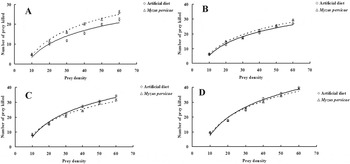
The functional response of both the nymphs and adult female G. pallidipennis was similar on both nutritional histories and confirmed the type II response (fig. 2A–D). With the increased M. persicae density, predation by G. pallidipennis increased. The study showed that the mean of prey killed by third, fourth and fifth instar nymphs and adult female G. pallidipennis was 22.5±0.7, 27.0±0.4, 34.2±0.9 and 40.0±0.9 (reared on artificial diet) versus 26.2±0.9, 29.5±0.6, 31.5±0.7 and 39.2±0.5 (reared on M. persicae), respectively. Predation increased rapidly as the density of M. persicae increased from 10 to 40, and then increased more slowly from 50 to 60 reaching an upper plateau (fig. 2A–D). All data were fitted to the random predator equation for the type II response curve. Measurable differences in predation at different prey densities were evident for third (F=343.55; df=5,5; P<0.0001), fourth (F=449.84; df=5,5; P<0.0001) and fifth instar nymphs (F=476.35; df=5,5; P<0.0001).
Functional response of G. pallidipennis from different nutritional history to M. persicae over 24 h, data are presented as mean number±SE and predicted lines are fitted using the random predator equation (2). A – The third instar G. pallidipennis, B – the fourth instar G. pallidipennis, C – the fifth instar G. pallidipennis and D – the female G. pallidipennis.

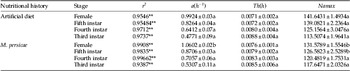
Type II functional response coefficients were calculated from the response curves (table 1). The attack rate of adult females was higher than that observed with the nymphs of G. pallidipennis. For both nutritional histories, third instar nymphs had a higher handling time than the other instars. The parameter a/Th is an index that evaluates the ability of a predator to control a pest insect (the higher the value, the stronger the control ability). On the same nutritional history, the control ability of G. pallidipennis to M. persicae was: adult female>fifth>fourth>third. The nutritional history had no measurable effect on the control ability of female adults. The theoretical maximum number of prey captured by the predator increased with the predator stage for each respective nutritional history.
Type II functional response parameters of G. pallidipennis to M. persicae.

** mean significantly correlative at the 0.01 level.
a, the attack rate; Th, the handling time; Namax, the theoretical maximum predation.
Different letters in the same stage between the diets indicates a measurable difference between the parameters (P<0.05).
Discussion
All G. pallidipennis instars studied successfully preyed on M. persicae reared on either artificial diet or prey. Within the same nutritional history, the rate of predation by the predator tested on M. persicae increased with prey density, but the mean ratio of prey killed decreased gradually and this suggested a type II functional response (Holling, Reference Holling1959, Reference Holling1965; Gotelli, Reference Gotelli1995). The study also showed that the previous rearing history had no measurable effect on the functional response of G. pallidipennis on M. persicae.
This study demonstrated that predation efficacy was enhanced with an advance in life stage. Adult female G. pallidipennis consumed more M. persicae than the nymphal stages tested, particularly, at a high density of prey. Attack rate increased with increasing developmental stage – this was probably influenced by the size difference of predators (Persson et al., Reference Persson, Leonardsson, de Roos, Gyllenberg and Christensen1998; Milonas et al., Reference Milonas, Kontodimas and Martinou2011). The observed decline in the attack rate for the third instar nymphs could be due to the difficulty encountered by the nymphs in capturing the prey (Milonas et al., Reference Milonas, Kontodimas and Martinou2011). Handling time decreased with increasing developmental stage; at the early developmental stage, the prey will be relatively large, with small predators needing more time for killing and prey consumption.
Previous studies on several species of predator have demonstrated that those reared on artificial diets are able to kill an equivalent amount of prey as those fed on natural prey or moth eggs such as Corcyra cehalonica eggs (Hagler & Cohen, Reference Hagler and Cohen1991; De Clercq & Degheele, Reference De Clercq and Degheele1993; Saavedra et al., Reference Saavedra, Zanuncio, Zanuncio and Guedes1997; Castañé et al., Reference Castañé, Iriarte and Lucas2002; Bonte & De Clercq, Reference Bonte and De Clercq2010). Cohen (Reference Cohen2000) also demonstrated that domesticated predators and their feral counterparts show similar characteristics of prey selection, metabolic efficiencies and digestive abilities. However, higher predation rates for predators reared on artificial diet have also been observed (Saavedra et al., Reference Saavedra, Zanuncio, Zanuncio and Guedes1997; Chocorosqui & De Clercq, Reference Chocorosqui and De Clercq1999; Castañé et al., Reference Castañé, Iriarte and Lucas2002). The results of no effect on the predation of adult female reared on artificial diet indicated that the artificial diet used can be considered to be nutritionally adequate (Bonte & De Clercq, Reference Bonte and De Clercq2010).
To our knowledge, this was the first time that the influence of artificial diet on G. pallidipennis predatory behavior has been studied. This study provides insight into the potential capability of G. pallidipennis reared on artificial diet for a long period as biological control agents. The assessment of functional responses showed that G. pallidipennis fed on artificial diet could consume as many prey as those reared on M. persicae. However, it is necessary to conduct further research to determine the efficiency of G. pallidipennis in the greenhouse or field.
ACKNOWLEDGMENTS
We thank the editors and reviewers for their comments and suggestions. We thank Danjuan Jin, Heqing Zhang, Changyan Liu and Shen Zhang for their technical assistance in this study. This work was supported from funds (973 Program 2013CB127600 and the agriculture cooperative research fund 2011-G4).