Introduction
This article discusses land reform in People’s Poland, which was started by the communist authorities of Poland in 1944. Its sole object was land subdivision. (The interesting but failed experiment of farm collectivisation will not be discussed here).Footnote 1 The article will analyse the legal basis for land reform, followed by problems encountered by the people implementing the reform and the statistical results of such reform. It presents the subjective aspect of land reform, as reflected in the memoirs of one of the builders of socialism in Poland – the First Secretary of the Central Committee of the Polish Workers’ PartyFootnote 2 – and diaries of peasants who benefited from reform, as well as those of landowners who became bereft of their property. Such a perspective gives a holistic and multi-dimensional presentation of land reform, which had major economic, social and cultural consequences.
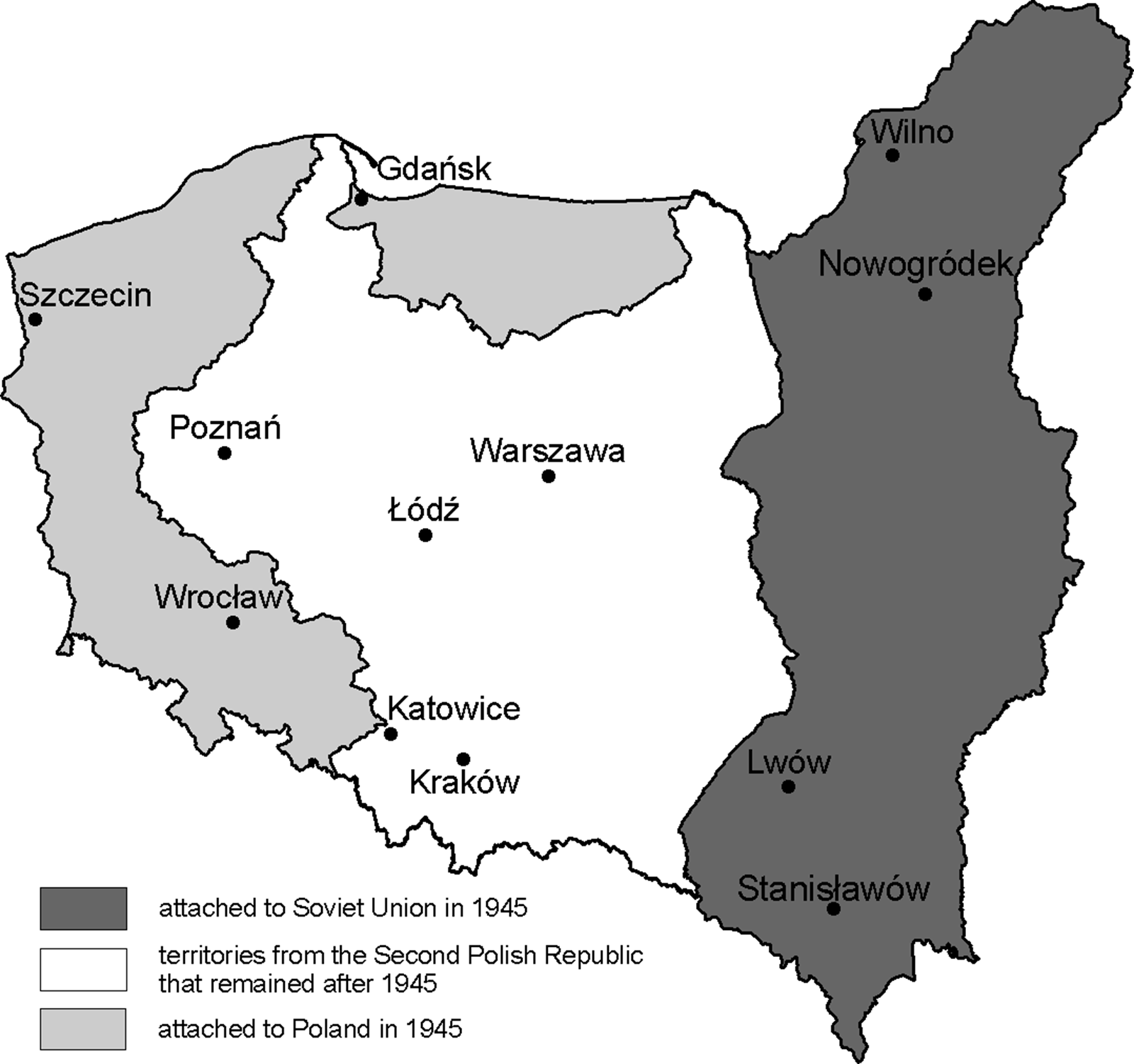
The Second World War (with the German and Soviet occupations) brought Poland exceptional material and population losses. It forced a population exodus, intensified by the postwar arrangements at Yalta and Potsdam (1945), which changed Polish borders (see Figure 1). The War Compensation Bureau estimated population lossesFootnote 3 at 6.03 million.Footnote 4 Over five to six million Poles (about 22 per cent of the Polish population) were removed from their hitherto communities.Footnote 5 In July 1944, as a result of the military and political situation in Europe, and the dominant position of Joseph Stalin and the Red Army, it became clear that Poland would be liberated from German occupation by the Soviet Union, and that the communists were preparing to take power in Poland.Footnote 6 Although there was a Polish government-in-exile in London, headed by Prime Minister Stanisław Mikołajczyk,Footnote 7 it was not accepted by Stalin as a potential continuator of power in postwar Poland.Footnote 8
The border of Poland before and after the Second World War, indicating territories lost to the Soviet Union and gains at Germany’s expense.

On 21st July 1944 in Moscow the Polish Committee for National Liberation (PKWN) was created: an institutional body under the supervision of Stalin.Footnote 9 The establishment of the PKWN marked the beginning of a new era in the history of Poland, called People’s Poland.Footnote 10 This lasted for forty-five years to 1989, under the communist rule imposed by the Soviet Union. The communists attempted to establish a new socio-economic system, so-called ‘state socialism’, which was also to embrace Polish agriculture and its very large rural areas. Land reform was not so much an economic necessity (though the agrarian questions were still unsolved issues, despite reforms conducted during the Second Polish Republic),Footnote 11 but above all was a political directive. The land reform programme was intended to attract Polish peasants to the idea of communism.Footnote 12 On 6th September 1944, the Land Reform Implementation Decree was released by the PKWN,Footnote 13 which provided for subdivision of agricultural estates exceeding fifty hectares, without any compensation to prior owners, for the sake of peasants holding small plots of agricultural land, landless farmworkers and fornals Footnote 14 (horsemen) working in the prewar manors.
Polish land reform of the 1940s was not unique (although Poland was a forerunner in many respects), as such reforms were also under way in other countries on which communism was imposed, the so-called ‘people’s democracy’ states’ of the Eastern Bloc: the Union of Soviet Socialist Republics, the German Democratic Republic, Czechoslovakia, Hungary, Romania, Bulgaria, Yugoslavia and Albania as well as certain non-European countries: the Peoples’ Republic of China, North Korea, North Vietnam and Cuba.
Land reform in all these countries occurred because of revolutionary changes, even though it was carried out de iure, based on special legislative acts, statutes or decrees. Expropriation of owners and confiscation of church estates were important aspects in many of the European countries. In almost every case the aim was to expropriate landowners, to eliminate them as a social class and to enable peasants to own land. Details of the reforms were different across these countries, for example as affecting the sizes of estates that were subject to subdivision. In Hungary, for example, the ceiling estate size was set at 57.5 hectares (within a 30-kilometre radius from Budapest – 28.8 hectares);Footnote 15 in the German Democratic Republic, at 100 hectares;Footnote 16 in Czechoslovakia, 250 hectares, which was then lowered to 50 hectares;Footnote 17 while in Bulgaria this limit was only 20 hectares.Footnote 18
The People’s Republic of China – the most populated country of the globe – was the ‘flagship’ example of communist reforms in Asia. The Chinese Land Reform Act was passed during the Mao Zedong regime, in July 1950. Landowners’ estates were confiscated in full.Footnote 19 As a result of the land reform between 1950–3, 46,600,000 hectaresFootnote 20 of land, which accounted for 43.2 per cent of China’s farming land,Footnote 21 were subdivided among more than three hundred million peasant families, each of them receiving an average of 0.15 hectares.Footnote 22 In China, however, such reform also had a gloomy dimension, and indeed the most deadly one of all the other socialist nations: several million, maybe even up to ten million,Footnote 23 of the former landownersFootnote 24 and members of their families are estimated to have been killed in its process.
Land reform implementation decree
On the first day after the Polish Committee for National Liberation (PKWN) was established, the PKWN Manifesto was broadcast on Moscow radio, calling all the Polish people to fight the German occupants and highlighting the role of the Soviet Red Army in liberating Poland. PKWN announced itself as the only legitimate government of Poland; the underground Polish government based in London was deemed a usurping government.
In its Manifesto, PKWN pledged to ‘materialize forthwith a broad land reform on the liberated lands’, in order to ‘boost the reconstruction of the state and to satisfy an eternal striving of Polish peasants for land’.Footnote 25
The Manifesto was a harbinger of land reforms, which were materialised in a legislative form by the PKWN Decree of 6th September 1944 concerning land reform implementation.Footnote 26 The first sentence of the Decree underlined the importance of land reform for the Polish state and presented its assumptions. ‘Land reform in Poland is a necessity for the state and for the economy …. The agricultural system is going to be based on strong, healthy and viable farms able to deliver, which are going to belong to their owners.’
Such a generally defined objective of the reform was elaborated upon further in detail. The most important were two specific objectives: to ensure the subsistence of the existing farms the size of which was below five hectares of utilised agricultural area, and to establish new individual farms to be owned by the landless, fornals, farmworkers and by small leaseholders.
The land stock which was to undergo subdivision by PKWN included property owned by state, land owned by the German Reich citizens and German nationals who were Polish citizens, as well as the land belonging to ‘traitors of the nation’, who included those convicted chiefly for treason and providing assistance to the German occupants to the detriment of the Polish state or local community. However, the biggest share of the land stock was expected from the so-called ‘kulaks’ (from Russia), that is, landowners whose farms exceeded one hundred hectares in general area, or fifty hectares of utilised agricultural area, and in Poznań, Pomerania and Silesia provinces – one hundred hectares in general size, regardless of the amount of utilised agricultural land within that area.
The land that was confiscated from landowners was to be taken over by the state without any compensation, so in reality the land was to be appropriated instead of being subject to a contract of conveyance.
The size of new farms and of the expanded ones could not exceed five hectares of medium quality soil; in case of horticultural and vegetable farms and lots dedicated for craftsmen it could not exceed two hectares, and in case of lots dedicated to workers, the figure was a quarter-hectare.
During the ‘transaction’ of land acquisition from landowners no money was involved, but the acquisitions of land by peasants and workers involved money. The price of land, as set in the Decree, was equivalent to the value of an average annual yield from a given area. Buyers were offered buyer-friendly and convenient payment conditions: they were to pay only 10 per cent of the purchase price in cash or in kind. Payment of the remainder was to be made in installments within ten years in the case of smallholders and within ten years for the landless. The landless people were privileged as they could be granted a postponement of payment of the first installment for up to three years.
Farm owners who, due to lack of a sufficient stock of land, could not enlarge their farms to five hectares, had the right to change a farm to a bigger one, situated on the so-called ‘Recovered Territories’.Footnote 27 The landless could also benefit from this privilege.
The Decee provided that the landowners, expropriated owners or co-owners of agricultural estate may receive individual farms that were situated outside the expropriated property or they could choose to receive a monthly remuneration, the amount of which corresponded to the remuneration of a Category 6 civil servant.
The start of the land reform
Efforts to implement the land reforms were undertaken immediately. The Proclamation of the Polish Workers’ Party (PPR) of 3rd October 1944 read: ‘No more landowners’ attempts at sabotaging and hindering the reform!’ and it called for: ‘Any attempt at postponing, sabotaging or distorting the land reform is to be broken! Any landowners’ resistance or terror attempted by the foul land possessors is to be nipped in the bud!’Footnote 28
The Instruction of the PPR’s Central Committee dated 10th October 1944 announced the establishment of special brigades to collaborate in organising propaganda actions: ‘The task of the campaigning brigades is to revolutionize the greatest possible peasant masses to implement the land reform, to break the resistance of landowners, to extend and reinforce the social foundation for the new democratic regime of Poland reborn.’Footnote 29
Effecting such a revolution was not an easy task for the reformers. What did they have to face? We can realise it when reading Dzieje polskiej reformy rolnej 1944–1948 [The History of Polish Land Reform 1944–1948] written in a lively way, albeit for propaganda purposes, by Henryk Słabek.Footnote 30
A typical problem for rural areas situated ‘east of the Vistula River’ was hunger for land and an insufficient stock of land to satisfy that hunger. For example, the land stock to the need for land ratio in the Cracow province (Lesser Poland) was a mere 8.3 per cent, while in Greater Poland it reached 76.5 per cent (thanks to the post-German land stock contribution).Footnote 31 Thus, in the former region the amount of land provided was limited, as a result of which the statutory five hectares could not be reached, while in the latter region the amount of land provided was above the norm.Footnote 32
In the eastern part of Poland, for example, in Lubelskie province, the stock of agricultural land taken over was sufficient to award a mere 15 per cent of beneficiaries, and in Rzeszów province – only 8–9 per cent.Footnote 33 Commotion was not infrequent among fornalsFootnote 34 who wanted more land and refused to accept the lots of two to three hectares, which were too small to ensure subsistence. On the other hand, in Greater Poland there was a surplus of land in relation to the number of those authorised to receive it: 25 per cent of land remained in stock because nobody claimed it.Footnote 35 Also, the problem in Greater Poland was that fornals were very unwilling to purchase land because they preferred to work on a state farm.
A problem that was shared by all the regions of Poland and which hindered the implementation of the land reform was the fact that the Polish government in London, headed by Stanisław Mikołajczyk, was still active. Słabek writes that the Mikołajczyk’s people called the authorities implementing the reform ‘a foreign element’, ‘foreign agents’, and they regarded the land reform as ‘wild restructuring’. The London government wanted to frustrate the PKWN’s intentions by trying to discourage peasants from participating in the reform.Footnote 36
Another factor, which was visible in central Poland and which caused much concern among peasants and fornals were attempts at reprivatisation and restitution. As approximately two hundred agricultural estates were subdivided into lots contrary to the PKWN Decree (the size of those estates was smaller than fifty hectares), complaints were lodged. In July and August 1944 a few former landowners were issued documents certifying that the subdivision of their estates was null and void and the land – subdividing authorities were told to return the titles to land to those landowners and to leave the subdivided lots.Footnote 37
Problems faced by the beneficiaries of the lots resulting from subdivision were a lack of funds, especially to pay the first installment for the land purchased, as a result of which a phenomenon of title waivers was more and more common – in particular in Greater Poland – and it prevailed chiefly among fornals.
A number of problems to be faced by the reformers were solved by means of the socalled ‘workers’ brigades’. It was in October 1944 that 150 workers were for the first time dispatched to the eastern rural areas to campaign for land reform and to subdivide huge estates into lots (the scale of the campaign for land reform is well shown by the fact that during the two weeks of October 1944, three hundred rallies and village meetings were organised in Rzeszów province itself). Approximately 1,500 individuals were working as campaigners in the liberated areas in 1944. Troops were also engaged to serve for the brigades: between October 1944 till the end of that year, six hundred officers and enlisted soldiers were sent to work as campaigners.Footnote 38 ‘Guidelines for workers’ brigades handling estate subdivision’ issued on 20th March 1945 ordered drastic and decisive steps against the landowners who were to be ‘absolutely removed within three days from the county area, while being allowed to take only personal belongings’.Footnote 39 In the majority of cases peasants did not dare subdivide and accept land in the presence of their landlords; this was done only after the landlords were ‘removed’ from their estates. Some peasants, however, felt sorry for the ousted landowners, so it sometimes happened that following peasants’ intervention landowners were set free from jail.
Estate subdivision was frequently carried out in an atmosphere of general euphoria, which is well illustrated, for example, by a fiesta following the subdivision of the estate of count Alfred Potocki, the biggest agricultural estate in Rzeszów province: ‘Approximately 500 peasants gathered in front of the Łańcut palace. A government representative climbed a ladder to a Pilawa coat of arms which had been hanging for 150 years above the palace gate. Using a hammer, he knocked off one of the oldest Polish coats of arms, which since the 13th century had served as the emblem for twenty generations of noblemen and magnates. This was the Szczęsny-Potocki’s coat of arms.’Footnote 40
Statistical results of the land reform
A large number of new peasant farms were established on the lands taken away from landowners on the originally Polish territories (so-called ‘Former Territories’),Footnote 41 as well as on the territories taken away from the Germans and assigned to Poland following the Second World War (the so-called ‘Recovered Territories’),Footnote 42 which were taken account of in Polish statistical records.
The principal period of carrying out land reform involved the first years after the PKWN Decree was issued in 1944. While in the Former Territories, from among the general amount of land subject to subdivision, 1,155,400 hectares of landFootnote 43 was subdivided by 1st December 1946, by 1st January 1949 the amount increased to a total of 1,210,900 hectares.Footnote 44 Hence, the subdivision was chiefly (95.4 per cent of land) carried out during the first two years of the reform.
Quite impressive were the results of land reform achieved in the first three-and-a-half months of the PKWN Decree’s coming into force. By 1944 the state took over 1,741 estates, the area of which amounted to 320,678 hectares. A portion of that area was dedicated to the development of agricultural culture and was subject to various types of exclusions, and the total of 212,084 hectares were subdivided among 109,899 families.Footnote 45
As far as the Former Territories were concerned, up to 1949, as many as 9,707 agricultural estates (3,485,600 hectares) were taken over for land reform. Nearly two-thirds of the total area was intended as exclusions, namely land that was not farming land (forests, public water sources) and which was to be used for other purposes, such as State Agricultural Farms, production cooperatives, state forests, vocational training facilities, etc. The other portion of land was subdivided.Footnote 46 The area taken over under the PKWN Decree in the Recovered Territories amounted to 9,437,600 hectares. 42.4 per cent of that area was subdivided under land reform, and the remaining part was excluded as non-farming land and land dedicated to other purposes.Footnote 47
As a result of the reform the area of 1,201,900 hectares located in the Former Territories was subdivided for the sake of 407,500 farms, those to be extended as well as those newly established (the biggest area was assigned to the manor workers (fornals) – 47.3 per cent, followed by small farmers at 19.6 per cent, and the landless at 17.8 per cent).Footnote 48 This area was accompanied by the former German land in the Former Territories, which was subdivided among 90,457 new farms with a total area of 736,235 hectares (an additional 42,756 hectares were intended for extension of the existing farms).Footnote 49 As far as the Recovered Territories are concerned, 483,300 farms were established, the total area of which amounted to 4,004,900 hectares.Footnote 50
When compared to the results of the land reform carried out in Poland in the interwar period,Footnote 51 the results of the land reform carried out in People’s Poland (PKWN reform) show that the PKWN reform was more effective in terms of statistics. While the area of land subdivided among farms amounted to 6,070,100 hectaresFootnote 52 (2.38 million hectares in the Former Territories and 3.69 million hectares in the Recovered Territories), the area of land subject to the reform during the Second Polish Republic amounted to a ‘mere’ 2,654,800 hectares, which accounted for 43.7 per cent of the former amount. As it relates to the number of farms provided with land as a result of reform, the number was also bigger in the case of the PKWN reform, namely 1,068,400 (601,500 in the Former Territories and 466,900 in the Recovered Territories) as opposed to 734,100 in the interwar period. The PKWN reform was also more efficient in terms of average size of the resulting farm: 5.7 hectares as opposed to 3.6 hectares.Footnote 53 When comparing the percentage of ‘peasant farms’, which came into being as a result of both reforms, the PKWN reform was also more effective. Depending on region, the percentage ranged between 20.6 per cent and 72.2 per cent farms. For comparison, in 1939 it ranged from 1.5 per cent to 19.7 per cent.Footnote 54 Thus, in terms of statistics, one can talk about a significantly greater ‘success’ of the PKWN reform, additionally having regard to the length of time in which those reforms were carried out: five years (PKWN reform) as opposed to twenty years (interwar period reform).
Higher statistics for the PKWN reforms are a result of a different approach to the implementing of the reform; it was carried out using force and sanctions, including capital punishment.Footnote 55
Land reform as seen by the First Secretary of Central Committee of Polish Workers’ Party
Let me now refer to the memoires of Władysław Gomułka – First Secretary of the Central Committee of Polish Workers’ PartyFootnote 56 – who, after stepping down, described what the land reform looked like from the point of view of a member of the ruling regime. What is even more important, he pointed out, was that the decisive role in the reform development was Josef Stalin, although the latter was not always entirely aware of the political situation in Poland, as is very well demonstrated by his opinions on the land reform.
Gomułka describesFootnote 57 a meeting of a delegation of Polish communists with the representatives of the USSR government, which was held on 28th September 1944 in Moscow. The meeting focused on economic matters, and especially on providing assistance for reconstruction of Poland. On the following day Josef Stalin threw a dinner in his private residence near Moscow. After the dinner, after midnight, ‘when the guests left the table after drinking champagne from rams’ horns and proceeded in three different groups to various corners of the dining room, Stalin and Molotov held a “rugatelnyj razgawor” with Bolesław Bierut’Footnote 58 [a Polish top communist activist].Footnote 59
Stalin changed his hitherto friendly attitude and attacked Bierut with offensive words. According to Bierut’s account to Gomułka, Stalin started from a question: ‘Czto ty, … [taboo words here] diełajesz w Polsze? Kakoj z tiebia komunist, ty … [taboo words] [What are you … doing in Poland? What kind of a communist are you, you …].’ Bierut thought at first, that Stalin was joking, but he was disabused by Molotov who said: ‘Czto ty durak ułybajeszsia? Zdieś nie szutki, a deło serioznyje [What are you smiling at, idiot? We’re not joking here, we’re being very serious.]’Footnote 60 Gomułka commented that Stalin and Molotov’s verbal aggression towards Bierut was not a personal attack, but it was a manifestation of criticism of political operations of the Polish communists ruling the liberated Poland, ‘especially the criticism of our attitude towards landowners which, according to Stalin – as he repeated it also later on various occasions – was liberal and “Tolstoy-like”’.Footnote 61
Stalin meant that following the announcement of the Land Reform Implementation Decree ‘we should vanquish the landowners forthwith, by putting some of them to jails and ousting the rest from their houses’. And you – Stalin accused Bierut – ‘left them in their mansions and palaces which they occupied before the reform’.Footnote 62
As a consequence of the conversation, the management of Polish Peoples’ Party decided to veer away from the hitherto implementation of the reform according to the law and take a revolutionary course. As Gomułka has written: ‘Due to reasons which were well understood, the real causes of this change of course could not be disclosed. They were known only to a narrow circle of top management party officials.’Footnote 63
However, the shift did not contribute to peasants becoming more trustful towards the PKWN, ‘and it may have changed their attitudes to hostile’. ‘Stalin was wrong when he thought that the revolutionary approach to the reform and applying repressions towards landowners will enjoy mass support of peasants and will reinforce our position in the rural areas.’Footnote 64
The October change of direction was a signal to the London underground to pursue armed struggle on a broader scale (attacks on prisons, treacherous assassinations), as a result of which the communist authorities toughened repressions towards the underground by issuing a KRN’sFootnote 65 State Security Decree, which provided for severe prison-time penalties, including capital punishment, for crimes of this kind. Meanwhile, the London-based underground movement increased ‘propaganda’ in order to raise concerns among peasants about participating in the reform. Leaflets and handouts said that ‘accepting land from the Polish Peoples’ Party is tantamount to reinforcing anti-Polish elements and opening a way for collectivization of agriculture’.Footnote 66
What did Josef Stalin say to that? He addressed PPR as follows: ‘You want everything to be roses, you want peasants to sell their souls and bodies to you. What you grasped in the peasant masses before the land reforms is already a lot. That peasants are reluctant in delivering quotas, is understandable. Peasants want to receive, not to deliver … Peasants are greedy, and you want them to kiss you. Years will pass until peasants start believing that there is no trick in their being given land by you … You should not be anxious about peasant discontent. I have no doubts that in their hearts peasants are grateful to you. And in a year it is going to be even better when they see that nobody takes land away from them.’Footnote 67
‘This land belongs to us’ – land reform in peasants’ diaries
Polish peasants were grateful indeed, as can be read in diaries issued on the twentieth anniversary of land reform.Footnote 68 However a valuable source of information this can be, one should bear in mind that it was meant as propaganda.
The diaries show happiness of their authors because of being given land, and hope for a better future. One diarist recalls: ‘I could not believe we would have our own piece of land, our own little cottage, that we will be independent. Everything seemed to be a dream, we thought it was not happening. … But it did happen. The land belongs to us’ (p. 42). Those who were given land treated it with great fondness: ‘All day long I would help the land-surveyor in field work. Each lot assigned was simply kissed by him, he circled its borders many times a day and he was devoted to People’s Poland with his whole heart’ (p. 141).
For fornals, the prospect of working on their own land was perceived as liberation. They explained: ‘The exploitation of landowners has come to an end and my sons will not be fornals working for a lord’ (p. 51). Or as follows: ‘After the hard prewar days, after a disastrous German occupation, came bright days in New Poland. From a landless farm worker I turned into a normal citizen of our country, given equal rights. … It happened so suddenly that all of us were thunderstruck with the avalanche of changes’ (p. 93).
After the first wave of joy felt because of the land received, the diarists wrote about the feeling of concern that somebody will take the land away from them or that the reform will be revoked. It was difficult for peasants to believe that they were given the land forever. Those they feared were the former owners – lords in the Former Territories and the Germans in the Recovered Territories. One diarist writes that [peasants] ‘were prejudiced against everything related with communism and to everything that was coming from the “Bolsheviks”. They believed that the situation was only temporary and that the lords would come back’ (p. 93). Another one writes that [peasants] ‘simply did not want to accompany the land-surveyor to the field’. Others would say: ‘Well, when they call us, let’s go, but there’s no use to go because when the lord comes back, he will take the land away from us anyway’ (p. 126).
Fears related with settling down on the Recovered Territories are described by one diarist as follows: ‘The most horrible stories were told – how people are murdered over there in the West, that the Germans throw away the Poles, that a Third World War is about to begin, as a result of which the Germans will come back to their estates’ (pp. 263–4).
Peasants were not only afraid that the lords and former owners would come back, they also feared for their own lives: ‘How much we feared when one had to go and collect hay from the field, as notices were stuck on fences and trees, on which somebody has written that the one who dares collect the hay will be shot’ (p. 102). Somebody mentioned that a coffin and a cross were drawn on a land plot, which was a result of the subdivision, with a notice attached to the cross: ‘He who ploughs the subdivided land must make a coffin ready for himself first’ (p. 48).
Some diarists wrote that the subdivision caused misunderstandings among people who were to receive the plots: everybody wanted to have as much as possible for himself. One of the peasants described irregularities taking place during subdivision; he was given one hectare of subdivided land, but other peasants, who already owned five and more hectares ‘received land for vodka, sausages and other bribes. Nobody could do anything about it. Those who did not want a little, receive nothing’ (p. 87).
Difficulties related to settling down were a common theme described in the diaries. Peasants, and especially fornals, were short of animals and agricultural tools, but everybody was determined to farm their fields trusting that their willingness and hands ready for work were enough: ‘when it came to starting work, everybody became sad thinking how to plough the field. The first days, months, years, were blood and tears. … The authorities gave us that piece of land so longed for but what should we do with it? We can only go to the field and cry. But a proverb says: “A man bears more than a horse” and so it was. … My brother and I … harnessed ourselves to the plough instead of horses, and sometimes we harnessed a cow’ (pp. 141–2).
The difficult situation for settlers was more specific in the Recovered Territories. The first difficulty encountered was the mere relocation and transport, especially from the easternmost territories of interwar Poland, which were assigned to the USSR as of 1945. One of the settlers describes the arduous transportation of migrants for several weeks from the eastern territories to the western ones as ‘The journey which lasted forever’ (p. 270). He describes how there was less and less food, for people and for animals; and when the train stopped somewhere in the field, agricultural crops were destroyed completely. Sometimes during a train stop, women tried to cook some warm food on two bricks, but they rarely succeeded, because a train whistle called them to get in the train again.
After surviving the arduous transportation they had to face the challenge of finding a house and a piece of land, which was not an easy task. One diarist describes how he arrived in the Recovered Territories with a group of migrants ‘with light bundles on our back, wearing shoes made of tarpaulin with holes in the soles, with two little children and a wife’ (p. 223). He took possession of an abandoned little house with an orchard and one hectare of land next to it, and to mark that the house was occupied he hung the Polish flag. While describing the difficult beginning of work in the field, he mentioned state as well as international aid, a ‘post-German’ cow he received from the Border Office and a horse from UNRRA,Footnote 69 as well as a few tonnes of grain from the Polish state (p. 225).
Another problem, often described in diaries, included looting in the Recovered Territories. ‘Looters took machinery, furniture and what not and took it to central Poland’ (p. 264). One of the settlers wrote: ‘The beginnings of our living there were very difficult. A settler lived in every other house, there was no village leader, or any shop, looters were everywhere’ (p. 279). He continues to talk about people organising, choosing a village head, and taking turns in guarding their estates, about harvesting rye and potatoes with wheelbarrows because there were no other means of transport, and about a shortage of horses and cattle: ‘After potatoes I sew rye while dragging harrow by myself. I sew one-and-a-half hectares of field in this way’ (ibid.). The author was chosen to work as an escort to bring horses from UNRRA, which he remembered for a long time: ‘I can’t forget the moment my boys walked a long way from home to meet me. There was so much joy that there is a horse and the fieldwork will proceed’ (p. 280).
I have already mentioned that diaries were used for conveying a propaganda message; a praise of communism is not difficult to find, as in such sentences as ‘Communists keep building a new life. Poland of which no one has ever dreamt is emerging from poverty and debris’ (p. 152).
Recollections gathered from PKWN reform beneficiaries more than thirty years later, thanks to a study of the team headed by Barbara Perepeczko,Footnote 70 paint a rather different picture of peasants’ attitudes. Interviews conducted during the study proved that some peasants did not show any enthusiasm whatsoever when they were offered land, and they refused to take it. Some of them did it for political reasons: ‘My understanding was that if the reform is conducted by a communist government, let communists participate in the reform and benefit from it. And I was not a communist’ (p. 197). Others wanted to stay loyal towards landowners who were deprived of their estates for the sake of peasants.
However, a refusal of land offered required courage, as coercion was not infrequent, and some peasants who refused to take the land were even arrested. According to one respondent, when his father did not want to take the land, ‘they chased him away from the yard and they said he had to take the land or he would have no job here. Other people who did not want to take land, were arrested’ (ibid.). The respondent’s father finally accepted the land under duress.
The taking over of the landowners’ land prompted ethical equivocation in peasants. For some of them it was wrong: ‘To me it is a common theft …’, or: ‘One cannot take away somebody else’s property, the Seventh Commandments says Thou shalt not steal’ (p. 198). Others neutralised their feeling of guilt by justifying their behaviour: ‘it was unjust that the lord led a rich and comfortable life and the major part of peasants did not have any prospects for development and improvement of their lives’.
Subdivision under the reform involved the land of well-to-do landowners, as well as the land of those politically ‘unstable’, despite the fact that their farms did not exceed the fifty hectares prescribed by the PKWN Decree. ‘The size of the subdivided estate was 10 hectares because the owner was convicted of being an opponent of the communist regime.’ ‘Someone ratted on X that he belonged to AK,Footnote 71 so he was taken away to Siberia, and the 48 hectares of his estate was subdivided’ (p. 199).
The respondents very often had reservations as to the operation of the Subdivision Committees that were deemed to show bias and as very political or simply unfair. ‘Land went to those who were friends with the commissar or the communist authorities’, ‘those took land who held power, belonged to the UBFootnote 72 or NKVDFootnote 73 ’ (ibid.).
The atmosphere surrounding the land reform was different depending on the presence of the landowner. This was less frequent in the eastern territories, because landowner families were taken away deep into the USSR. According to one of the respondents, ‘In 1945 the majority of estates were cleared of landowners because during the times of the first Soviets they were deported or simply disappeared’ (p. 201).
These statements distort the collective and unanimous enthusiasm manifested in the previously discussed diaries and show complexity of the reform process, which, as it turns out, was carried out on various levels, including mental and moral level.
‘The end of the world’ – land reform in landowners’ reminiscences
In the process of an ongoing land reform, landowners were on the other side of the ‘barricade’ because it was their estates that were subject to forced subdivision. Land reform did not, however, mean only a loss of property in a material sense; its all-embracing nature was to destroy this social class.Footnote 74 The destruction of landowners was called bluntly by Stanisław Lem as ‘extermination’,Footnote 75 while Franciszek Starowieyski called it the ‘atrocity’.Footnote 76
The memories of the landowners are precious evidence, which makes it possible to reconstruct how their destruction felt. The accounts often started with a moment of encounter with the Red Army. The interviewers remembered the experience of Soviet soldiers as a shock; the opinion shared by all of the interviewers was that of aliens, cultural cataclysm and barbarian conduct. Franciszek StarowieyskiFootnote 77 remembered that he was not afraid of the Germans, ‘but I was afraid of the Bolsheviks. I was simply afraid of Asia. The Germans fought against us, but this was something like a cruel gameplay within the same civilization. And suddenly you have people of an alien civilization, whose intention is to impose that civilization on us and destroy us.’
A reminiscence of looting landowners’ property, by Soviet soldiers or by Polish communists, or by local communities, is present in all the accounts. Iza and Jan Kochanowski remember trucks loaded with the Soviet soldiers equipped with rifles: ‘Amidst screaming and beating, furniture, carpets, personal belongings of the Kochanowskis, including pictures together with hooks ripped off from the walls, were loaded through open doors and windows onto the trucks. Books, which were of no use for them, were trampled into the dirt.’Footnote 78 The head of the family was arrested along with his brother, the remaining members of the family left the mansion with a few personal belongings in one cart. Other accounts are similar: ‘In October 1944 a truck arrived in front of his house, from which people dressed in civil and military clothes jumped out. My father was arrested on site and the search started of the house and the outbuildings. During the search they stole valuables while my mother was looking, they said we would not need them anymore. … Looting and burglary lasted till dusk.’Footnote 79 The father’s family went to jail and mother was displaced; she was allowed to take only personal belongings, and she was forbidden to settle down within the country borders.
The accounts tell about local inhabitants being bestowed with the manor’s equipment and land. As a rule, peasants, despite initial hesitation, accepted gifts offered to them by the new political regime, however, it does not mean that they did not have moral dilemmas. Tadeusz Grodzicki remembers
When … in 1944 the Soviets came, they called the local community in front of the manor house and told them to go inside and take the equipment with them ‘it is yours now’. People refused. Then, the Soviet soldiers went in and started shooting mirrors and portraits. When the people saw that everything is being destroyed, they also went inside and they took the equipment for themselves.Footnote 80
Peasants who hesitated to take somebody else’s property were sometimes intimidated. Maria Baehr, née Tyszkiewicz remembers that
Despite pressure, threats and persecution, eleven families living around the manorial house firmly resisted and did not accept the land. The communist revenge was typically Bolshevik-like. At night in 1950 or 1951 the authorities arranged for a freight train to arrive at Żydowo station. The obstinate families were ordered to leave their homes immediately, only personal belongings allowed. … Lamentations of the displaced people were terrible – they had no idea where they are being taken.Footnote 81
Also, the estates whose owners were absent were looted by local peasants or workers. As remembered by Tadeusz Czaplicki:
The manor house is already looted, and the yard is looted as well. One ox in the barn, and in the sheep house there are several dozen, or maybe more than 100 dying calves, whose mothers were taken away, and the little ones, climbing one onto the other, made up a hill of dying beings. I am going towards the manor house – the front door wide open, despite freezing cold. The majority of furniture taken away already. … Bathroom fixtures ripped off the wall, and the toilet bowl is broken.Footnote 82
Not all the landowners’ accounts describe peasants and fornals as thieves or opponents of landowners: ‘We were living at the coachman’s, he was kind to us. You know how it is with people, some are very kind, caring, and the others are even hostile. … Which ones dominated? I remember that the village people in general were kind to us.’Footnote 83 In some of the landowners’ accounts one can perceive a certain solidarity among the lords about to go and their servants; it was not infrequent that the property was distributed among the grounds staff by landowners themselves before the estate was taken over by official subdivision committees. It was often the servants’ initiative. ‘Fornals were concerned about the cows. “Lord – they said – those manor cows … can be taken away by the Bolsheviks. It will be better if they are distributed.”’Footnote 84
The accounts mentioned arrests, which were ‘a standard’ during the time of the reform implementation. Remarks about arrests can be found in almost all the accounts, although not all of those reminiscing were arrested, as in the case of this one:
On the next day a People’s Commissar appeared at night, about 11 p.m., completely drunk … and he said someone ratted on us that we store guns, so there is a need for a search. At this moment NKVDFootnote 85 arrived, three people. They spoke only Russian. They arranged a court martial in the living room and my brother-in-law was interrogated first. … The court followed typically Soviet methods. The voices of the men were silent …. They applied a ‘little by little does the trick’ method: you have hidden guns here, if we find them, you will be shot. Pleaded guilty at once. You were in the army, in AK,Footnote 86 … to which my brother-in-law kept answering ‘no’. … And they repeated: ‘it’s not true, you were in AK’ …. This lasted till 3 a.m. A feeling of total helplessness, hopelessness, because whatever you say, they would say it is not true.Footnote 87
But the last stage of the reform – leaving the estate, was the most painful to all the expropriated landowners. Maria Walewska’s account:
In the end [a representative of the authorities] kindly asked for keys to the outbuildings. … After a while, a bunch of huge keys bound with a leather cord, the symbol of rule over Kowala estate, laid on the table in front of the Commission. – Seems like we do not need you any more – said Marcinkowski … So I stood up and left, and they stayed in my house.Footnote 88
How did the landowners manage in exile, without land, without a house and an estate taken away from them without a penny of compensation in return?Footnote 89 In the reality of People’s Poland, they were indeed sentenced to social non-existence. They had an extremely difficult time, because they still used ‘that name of theirs’. But while reading the landowners’ accounts one cannot see many complaints or moaning, but often fortitude and valiance, pride and power not to give up, and a wish to organise their lives despite the circumstances, still with dignity and the class they represented before the war. ‘All of us were in dire straits’, remembers humbly Anna Branicka-Wolska,Footnote 90 when in 1944 her family were leaving the palace of Wilanów. Before they left, her mother had gathered everyone in the palace corridor: ‘She said not to think about petty things.’ At first the Branickis occupied two classrooms of the school in Nieborów, and after a few weeks they moved to Zygmuntowo, to three unoccupied chambers, each one in a different hut. They started to organise their lives: ‘They arranged for a wood stove, in which they burnt cones. It was freezing cold outside, and there was no WC in here. One had to go behind the barn. – Mother recommended to build a privy. And this is at least what was left of us there.’Footnote 91 The head of the family was detained by the Russians who afterwards made him change prisons all over Poland, all the way to Brest, and then to Lubianka,Footnote 92 and to the Krasnogorsk internment camp. He spent three years there, among prisoners of war, and soon after coming back from the camps he died.Footnote 93
Anna Branicka-Wolska writes that they survived thanks to memories and something else: ‘We wanted to prove that without palaces and estates we will still be ourselves. That we will survive.’Footnote 94 In the time when they had no home, Anna tells that she started moving from friends to other friends. She remembers how, together with her sister, they used to dine in soup kitchens open for the poorest, and how she knitted caps for a cooperative, to earn some money, and how she enrolled to sociology classes ‘Here [in Warsaw], not like in Cracov, her fellow students were afraid of her name. So she was sitting on her own, nobody approached her, and after lectures she went home also alone.’Footnote 95
Jan Zamoyski, sixteenth owner-in-fee-tail of the city of Zamość, remembers his difficult predicament after the reform, when he was arrested by political police (UB).Footnote 96 Together with his brother and uncle, they stayed in prisons in Olkusz and Kielce: ‘for boycotting the land reform’, that is, for UB’s belief that Zamoyski surely boycotted it. He was sentenced to ten years of prison for ‘anti-national operations’, ‘for a hostile attitude towards People’s Poland.’ He changed prisons, starting in the basement of Mokotowska and Rakowiecka edifices,Footnote 97 through a forced labour camp in Piechcin. He remembers being penalised one day for reciting Mickiewicz and SłowackiFootnote 98 with other prisoners: ‘Four days in a cooler – five feet by five feet. … Twenty-four hours standing, naked. In the morning a piece of bread was kicked inside, and some liquid which they called coffee. You were standing ankle-deep in faeces.’Footnote 99 After the amnesty in 1956 Jan Zamoyski was looking for a job. A graduate from the Institut Supérieur de Commèrce in Nancy and the Warsaw School of Economics, fluent in English, French and German, he could not find any employment for a long time. Various institutions were looking for employees featuring such excellent qualifications, but ‘when they hear your name, it turns out that the position has already been taken’.Footnote 100 Anna Radziwiłł, a senator and a former Deputy Minister for Education, living in a modest one-bedroom apartment inherited from her parents, when asked how she coped with such a radical change of her social position and financial situation, answered: ‘I will tell you with aristocratic pride that I’m fond of: very easy – for an aristocrat that I am.’Footnote 101 The pride and composure with which many landowners accepted their and their children’s fate as decreed on them by communism, is quite striking.
Conclusion
The 1944 land reforms carried out in People’s Poland can be viewed from different angles. If we look at the results in terms of statistics, we can conclude that it has fulfilled the expected hopes and the objective defined in the PKWN Decree, namely the establishment of new and independent farms and extension of the existing ones, as 6,070,100 hectares of land was subdivided among 1,068,400 farms. What is more, in quantitative terms, the reform was more effective than the reform implemented in interwar Poland in the 1920s, where ‘only’ 734,100 farms were established. That ‘success’ was cited at the time of People’s Poland in each publication on the subject that was issued in that period.Footnote 102
However, the continuously increasing distance from those events enables us to look at the reform from another perspective, namely focusing on the fact that the reform questioned individual’s ownership rights by taking away property from landowners. The 1944 land reform had no precedence in Poland, as it was forced and the landowners were expropriated without receiving any compensation in return and without the right to settle down within the borders of their county. Moreover, landowners were subjected to terror, arrest, displacement and even capital punishment. Thus, the communist land reform had its bright as well as dark sides.
The very idea of providing land to peasants in order to establish new farms or extend the already operating ones was good and right. The same motivation prompted the reformers before the Second World War – in the capitalist Second Polish Republic. In both periods the reform was a matter of historical necessity, there was a need to reduce disproportions in land ownership: landowners who in 1939 accounted for merely 0.25 per cent of the total populationFootnote 103 owned nearly 25 per cent of the total agricultural land.Footnote 104 However, in the communist time, that need was tinted with ideology, according to which the rural bourgeoisie, called the ‘kulaks’, was not entitled to exist and thus it had to be exterminated for the sake of peasants and workers who were to be the dominating and governing class. Being a spiritual and intellectual elite of rural areas, the landowners – ‘the salt of the earth’ – were the major obstacle for communists in their plans to conquer Poland, as that elite could be the basis for reconstructing Polish economy, science and culture after the Second World War. So, in order to hinder or even frustrate such reconstruction, a decision was made that the elite should be destroyed – which was effectively achieved by eliminating this social group.Footnote 105 The political aspect of the land reform of the People’s Poland was its main feature.
Effectiveness of the land reform can also be evaluated from the point of view of eliminating rural issues, especially inferior agrarian structure, which prevailed for ages in the Polish territories. As far as that is concerned, the PKWN reform was a failure. It turned out that an agrarian structure was solidified by the PKWN reform by providing a relatively small amount of land for each farm (sometimes even a mere one hectare), which did not secure either full-time employment or adequate income for rural communities. The results of this have had their consequences in contemporary time, chiefly in the form of dispersed Polish farms. In 1990, that is, in the first year after the end of People’s Poland, the size of an average farm in Poland did not exceed seven hectares.Footnote 106 Thus, the reform has not solved the problems of rural areas, although it has changed the structure of Polish agriculture by causing strong land dispersion and increasing the number of small farms.
Although ‘unique’ and quite specific, the PKWN land reform pointed also to a universality of the ‘agrarian question’, which has, metaphorically speaking, always been a ‘political hot potato’.Footnote 107 The agrarian question will always be a current topic, however controversial and emotional it might be, as it is about a type of economic and social imbalance foreboding a certain permanence, and such an imbalance was attempted to be corrected several times during the history of Poland by means of land reforms.Footnote 108