Implications
Growth is an important trait for livestock that is influenced by genetics, environment, nutrition and the endocrine system. In this study, we use an attenuated strain of Salmonella to transfer a plasmid DNA encoding somatostatin (SS) and hepatitis B surface antigens S fusion gene and immunize piglets by oral and intranasal vaccination. The development of SS DNA immunization technique is a benefit to obtain a high potent growth vaccine that could be applied in animal husbandry to promote growth and improve the food conversion ratio. In contrast to other SS vaccines such as a chemically synthetic or recombinant SS coupled to a carrier protein, no further protein or plasmid amplification and purification steps are needed, thereby reducing cost and labor extensively.
Introduction
Somatostatin (SS), consisting of 14 peptides, is one of the most important neuropeptides mainly secreted from hypothalamic nuclei, which inhibits the secretion of growth hormone (GH) and depresses growth in animals. Many studies have shown that the use of immuno-neutralization against SS could enhance growth in animals (Spencer, Reference Spencer1986; Yun et al., Reference Yun, Estrada, Gajadhar, Redmond and Laarveld1996). Immunization against either a chemically synthetic or recombinant SS coupled to a carrier protein has been confirmed to promote the growth rates of immunized animals, including sheep, steers and chickens (Buonomo et al., Reference Buonomo, Sabacky, Della-Fera and Baile1987; Dawson et al., Reference Dawson, Soar, Buttery, Craigon, Gill and Beever1997; Shulkes et al., Reference Shulkes, Moore, Kolivas and Whitley1999).
However, the preparation and purification of protein antigens are time-consuming and laborious, as well as costly. Recent advances in immunology and molecular biology have permitted the development of DNA vaccines, which have a wide range of applications (Leitner et al., Reference Leitner, Ying and Restifo1999; Donnelly et al., Reference Donnelly, Wahren and Liu2005). Owing to their potential advantages, many kinds of DNA vaccines encoding the SS gene fused with the S gene of hepatitis B surface antigens (HBsAg) or glycoprotein V of porcine reproductive and respiratory syndrome virus have been developed and proven to be a promising tool in enhancing growth in rats and pigs (Li et al., Reference Li, Qiu, Han, Han, Zhou and Tong2006; Han et al., Reference Han, Liang, Zhang, Fang, Hua, Sang, Geng, Wang and Yang2008; Liang et al., Reference Liang, Cao, Han, Yao, Moaeen-Ud-Din and Yang2008).
Recombinant attenuated Salmonella strains are currently receiving much attention with regard to their potential as an antigen delivery system for mucosal immunization (Roberts and Sockett, 1996; Sirard et al., Reference Sirard, Niedergang and Kraehenbuhl1999). It has been reported that the use of attenuated Salmonella strains as vehicles to deliver plasmid DNA in vivo into eukaryotic cells is able to induce humoral and cellular responses to both the Salmonella carrier and the delivered heterologous antigen (Redman et al., Reference Redman, Harmon and Michalek1996; Fló et al., Reference Fló, Tisminetzky and Baralle2001). In contrast to immunization with naked plasmid DNA, no further plasmid amplification and purification steps are needed, thereby reducing cost and labor extensively. In addition, the evaluation of different routes of immunization is an important way to modulate immune responses according to clinical requirements. The oral route of antigen delivery is the most common and frequent way of inducing effective immune responses (Sirard et al., Reference Sirard, Niedergang and Kraehenbuhl1999; Spreng et al., Reference Spreng, Dietrich and Weidinger2006), whereas there have been few studies concerning systemic immunity following intranasal vaccination based on this principle.
In this report, we use an attenuated strain of salmonella to transfer a plasmid DNA encoding SS and HBsAg S fusion gene CSO22 (plasmid granulocyte-macrophage colony-stimulating factor gene/somatostatin, pGM-CSF/SS) on the basis of previous studies that immunization with pGM-CSF/SS could induce the anti-SS antibodies and increase the concentrations of plasma GH and IGF-I in mice. The objectives of this study were to investigate the effect of the SS DNA vaccine on piglets in growth, anti-SS-specific antibody responses, SS secretion and to compare the effect of two mucosal immune ways, namely oral and intranasal vaccination.
Material and methods
DNA vaccine
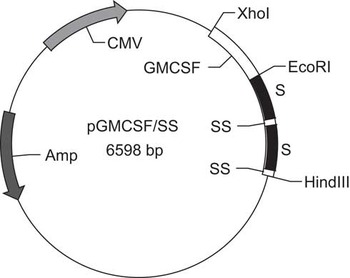
The pGM-CSF/SS recombinant plasmid described in Figure 1 (Shu et al., Reference Shu, Mao, Wu, Chen and Yang2008) was previously constructed in our laboratory using the pcDNA3.1 eukaryotic expression plasmid (Invitrogen, Shanghai, China). Briefly, it contained the GS /2SS fusion gene inserted into the multiple cloning site of the pcDNA3.1 vector bearing the resistance gene for ampicillin, and the GS/2SS fusion gene encoded two copies of SS genes presented by the HBsAg particle S gene and GM-CSF gene. The Salmonella enterica serovar Typhimurium strain (CSO22) was offered by the State Key Laboratory of Agricultural Microbiology, Huazhong Agricultural University. The DNA vaccine was formed by transformation of pGM-CSF/SS into CSO22 using an electro-transformation method.
The graph of plasmid granulocyte-macrophage colony-stimulating factor/somatostatin (pGM-CSF/SS) encoding two copies of SS genes. The plasmid contained the GS/2SS fusion gene inserted into the multiple cloning site (MCS) of the pcDNA3.1 vector bearing the resistance gene for ampicillin, and the GS/2SS fusion gene encoded two copies of SS genes presented by the hepatitis B surface antigen particle and GM-CSF.

Animals and feeding management
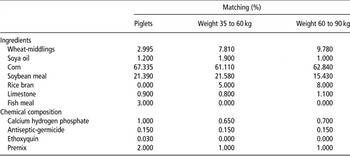
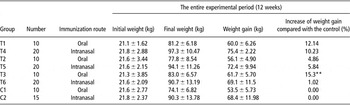
A total of 115 crossbred piglets (Duroc × Landrace × Large White) were obtained from the Experimental Pig Farm of Huazhong Agricultural University. All male piglets were castrated at the age of 10 days and weaned at the age of 2 months. In trial I, 20 female and 20 male piglets were selected for oral vaccination. In trial II, 75 clean piglets were selected for intranasal vaccination. During the whole experiment, all animals were housed in the same pigsty and taken care of according to institutional guidelines for the use of animals in research. The animals were fed three kinds of diets in different periods (Table 1) and given clean water ad libitum.
Ingredients and chemical composition of the piglet's diets

The premix was made of L-lysine, mineral, DL-methionine, threonine, tryptophan, choline chloride, piglet compound enzyme, salt and compound vitamins mainly.
Animal grouping and immunization procedures
Animals were assigned to two trials. In Trial I, 20 female and 20 male piglets were divided into four groups and orally immunized with vaccine strain CSO22 (pGM-CSF/SS) of 5 ml in 0 (as a control, C1), low (1 × 10⁸ colony forming units (CFU)/ml, as T1), moderate (1 × 10⁹ CFU/ml, as T2) and high dosages (1 × 10¹⁰ CFU/ml, as T3) based on previous studies (Shu et al., Reference Shu, Mao, Wu, Cheng and Yang2006; Liang et al., Reference Liang, Yao, Jin, Wu, Han and Yang2006). A booster immunization with the same dosage of vaccine as the primary immunization was given 1 week later. All animals in Trial II were deprived of feed and water for 4 h and were then given 10 ml of 7.5% sodium bicarbonate solution at 30 min before immunization. In Trial II, 75 weaned piglets were divided into 4 groups: 20 animals in groups 1 to 3 for each of the groups were intranasally immunized against the same DNA vaccine of 2.5 ml in three dosages, namely 2 × 10⁸ CFU/ml (T4), 2 × 10⁹ CFU/ml (T5) and 2 × 10¹⁰ CFU/ml (T6); another 15 piglets were intranasally given 2 ml of phosphate buffered saline (PBS) as an intranasal control (C2). The piglets were boosted twice at an interval of 4 weeks with the same dosage as the primary immunization.
Blood sampling
For oral immunization, blood samples were collected from the jugular vein of each piglet on days 0 and 35 of the primary immunization. The samples were kept at room temperature for 4 h and then were stored overnight at 4°C. Sera were collected by centrifugation at 3000 × g for 10 min and kept at −20°C until use.
Detection of antibodies against SS
SS-specific IgG was detected with an indirect ELISA method using SS-14 (S9129, Sigma-Aldrich, St. Louis, MO, USA) as the coating antigen. Briefly, 96-well immunoplates (Greiner bio-one, Solingen, Germany) were coated with 100 ng of SS diluted in bicarbonate buffer (pH 9.6, 0.05 mol/l) overnight at 4°C. Following blocking with 5% (w/v) of dry skimmed milk in PBS for 1 h at 37°C, serum samples diluted by 100 times in PBST (0.05% Tween-20 in PBS) were added to the wells and the plates were incubated for 1 h at 37°C. Each sample was tested in triplicate although positive and negative controls were also used. Bound antibodies were detected by the addition of horseradish peroxidase-labeled rabbit anti-pig IgG antibodies (Boster, Wuhan, China) diluted in 1/2500 in PBST and incubated for 1 h at 37°C. To develop the ELISA result, 10 mg of 3,3′,5,5′-tetramethylbenzidine (TMB tablets; Sigma-Aldrich, St. Louis, MO, USA) was dissolved in 0.025 mol/l phosphate–citrate buffer with H2O2 as the substrate and then incubated for 40 min at room temperature. Reactions were ended by 2 mol/l H2SO4 and the resulting optical density (OD) was measured at 450 nm of wavelength using an ELISA reader (Thermo Electron Corporation, San Jose, CA). The ELISA results were evaluated using P/N ratios of OD values. Symbols of P and N indicated the OD value of the tested and the negative control samples, respectively. The ratios of OD values of known positive and negative sera were termed as positive/negative (P/N) ratios. A P/N value >2.0 and OD value >0.2 was determined as a comprehensive positive standard for ELISA, otherwise negative (Yang et al., Reference Yang, Hu, Wei and Guo1998).
SS radioimmunoassay
The concentration of SS was measured using a Radioimmunoassay Kit (Sino-uk, Beijing, China). The sensitivity for the assay was 0.5 ng/ml and the intra- and inter-assay coefficients of variation for SS were <5% and 10%, respectively.
Body weighing
Animals were deprived of food and water for 12 h before body weighing. For oral immunization, the animals were weighed on the day before the primary immunization at 4, 8 and 12 weeks, respectively, after the primary immunization. For nasal immunization, the animals were each weighed on the day before the primary immunization and at the end of the entire test period (12 weeks).
Statistics
Data are presented in mean ± s.d. All analyses were performed by use of SPSS system 11.5 software (SPSS Inc). SS-specific antibodies and the body weight (BW) gains were compared by ANOVA. The percentage of BW gains between the oral and intranasal immunization routes was also compared by Mann–Whitney U-test. If the data indicated significant differences among the groups, pairwise comparisons of groups were made and the probability values were adjusted for multiple comparisons. A two-tailed P value of <0.05 was considered to be statistically significant.
Results
Health
All immunized piglets were observed in good health. No signs of disease in the immunized pigs were observed during the entire experimental period.
Antibody response in orally vaccinated piglets
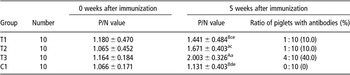
Antibody responses to SS in orally inoculated piglets were assayed by ELISA (Table 2). The P/N value of the high-dosage group (T3) was significantly higher than that of the low-dosage (T1) and PBS-immunized groups (C1; P < 0.01). Statistical difference between the moderate-dosage (T2) and the control groups (PBS) was also observed (P < 0.05). Accordingly, the piglets immunized with a high dosage of vaccine were shown to have the highest positive serum ratio (40%).
The P/N value and ratio of piglets with antibodies against SS after oral immunization of CSO22 (plasmid granulocyte-macrophage colony-stimulating factor/SS)

P = positive; N = negative; SS = somatostatin.
a.c,e,dValues with different superscript letters denote significant difference between groups (P < 0.05).
A,BValues with different superscript letters indicate very significant difference between groups (P < 0.01).
Concentration of SS in orally vaccinated piglets
Anti-SS antibodies would reduce SS concentrations in the blood by neutralizing the effect of SS. Therefore, it is necessary to detect the concentration of SS. After immunization of the SS DNA vaccine, the SS levels in the groups of T1, T2 and T3 were shown to be lower than that in the control group (Table 3, P < 0.01). Moreover, the SS levels in the experimental groups (T1, T2 and T3) were significantly lower in piglets after immunization than before immunization (Table 3, P < 0.01). However, there was no difference in SS concentrations among the three dose groups (Table 3, P > 0.05).
The concentration (pg/ml) of SS in sera of piglets on the day before oral immunization with CSO22 (plasmid granulocyte-macrophage colony-stimulating factor/somatostatin) and 5 weeks later

A,BValues with different superscript letters indicate very significant difference between groups (P < 0.01).
BW gain of orally immunized piglets
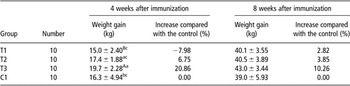
BW gains of piglets before and after inoculation were recorded and shown in Tables 4 and 5. After 4 weeks of the primary immunization, BW gain of piglets in the immunized group in high-dosage vaccine was significantly higher than that in the control group (P < 0.05) and the low-dosage group (P < 0.01). There were no statistically significant differences among all groups at 8 weeks after the primary immunization. Compared with that of the PBS control group, BW gain was increased by 20.86% (4 weeks after immunization), 10.26% (8 weeks after immunization) and 15.3% (12 weeks after immunization), respectively, in the high-dosage group; by 6.75% (4 weeks after immunization), 3.85% (8 weeks after immunization) and 4.86% (12 weeks after immunization), respectively, in the moderate dosage group; and by 2.82% (8 weeks after immunization) and 12.14% (12 weeks after immunization) in the low-dosage group.
Body weight gain in piglets orally immunized with CSO22 (plasmid granulocyte-macrophage colony-stimulating factor/somatostatin)

a,b,cValues with different superscript letters denote significant difference between groups (P < 0.05).
A,BValues with different superscript letters indicate very significant difference between groups (P < 0.01).
Comparison of body weight gains in piglets between oral and intranasal immunization methods

**Denotes very significant difference between groups (P < 0.01).
BW gain of intranasally immunized piglets
Initial BW and final BW of piglets intranasally immunized with CSO22 (pGM-CSF/SS) were recorded, and the weight gain was analyzed, although there was no statistically significant difference among groups (Table 5, T4 to T6). In contrast to the control group (C2), the low-dosage group (T4) increased by 10.23%, the moderate group (T5) by 5.84% and the high group (T6) by 1.02% in the whole experimental period.
Comparison of BW gains between oral and intranasal immunized piglets
The percentage of BW gains in the same dosage level was compared between the oral and intranasal immunization methods (T1 v. T4, T2 v. T5, and T3 v. T6, as shown in Table 5). In the entire experimental period (12 weeks), we found that the increase of percentage in the oral group immunized with high dosage of vaccine (T3, 15.3%) was significantly higher than that in the intranasal group (T6, 1.02%; P < 0.01). There were no statistically significant differences among other immunized groups.
Discussion
The ultimate goal of the experiments presented here was the development of oral vaccines to promote the growth of piglets. Avirulent but invasive Salmonella is an attractive carrier of heterologous antigens that can be used to elicit mucosal and systemic immune responses by the oral route (Weiss, Reference Weiss2003; Schoen et al., Reference Schoen, Stritzker, Goebel and Pilgrim2004). Long-term active immuno-neutralization of SS has been considered as a potential method of stimulating GH secretion and the consequent growth rate in domestic livestock. In a previous report, where DNA from plasmids carrying the SS gene was administered by the intramuscular route, the BW gain of vaccinated piglets was shown to be higher than controls, whereas detection of anti-SS antibodies was not carried out (Li et al., Reference Li, Qiu, Han, Han, Zhou and Tong2006). In this study, we have chosen 2-month-old piglets as the model and shown that Salmonella-mediated delivery of plasmid DNA immunization is an effective method to induce antibody responses against SS.
In this report, we have described anti-SS antibodies, serum SS concentrations and growth performance of piglets immunized against SS DNA vaccine CSO22 (pGM-CSF/SS). Oral administration of the vaccine strain was shown to induce anti-SS antibodies and increase the growth of immunized pigs. The experimental groups obtained 10% (T1), 10% (T2) and 40% (T3) positive sera ratios, respectively. These results also indicated that the proper increase of dosage augmented the P/N value and the positive antibody ratio to a certain extent. The lower concentrations of SS were measured in the tested group due to the neutralization by anti-SS antibodies. In contrast to the control group, the BW gain of the test group was obviously increased, especially during the early period of experiment (from 4 weeks after the first vaccination). The increased BW suggested that the antibodies induced by an oral vaccine strain could inactivate SS to promote the growth of animals. Elsaesser and Drath (Reference Elsaesser and Drath1995) detected equal or higher antibody titers in the pig after active immunization against SS; however, there was no effect on weight gain. The explanations may be that anti-SS antibodies were not sufficient for neutralizing SS, and they may also be related to the low level of dietary nutrition inthe latter part of the experiment. In addition, species and sex may be factors determining whether growth responses are obtained.
Although routes of delivery of antigens expressed in recombinant Salmonella strains have been extensively explored in pigs, there were few previous studies with regard to the intranasal route. In this study, we made an attempt to adapt intranasal vaccination against vaccine strain CSO22 (pGM-CSF/SS) with pigs. Though there were no statistically significant differences among all groups, the weight gain was obtained in all test groups. Interestingly, the low-dosage immunized group increased by 10.23% in BW, whereas the high-dosage group only increased by 1.02%. The result of weight gain in the intranasal group (T4, 10.23%) was similar to the result in oral immunization (T3, 10.26%). However, it should be noted that T3 is the high-dosage group of oral immunization but T4 is the low-dosage group of intranasal vaccination. The possible reason causing the difference is that there is a varied environment between the respiratory and gastrointestinal tract. Oral vaccination with live organisms represents a challenge in evading the bactericidal effects by gastric acid in the alimentary tract. To stimulate efficient immunity by oral vaccination, a large vaccine dosage and repeated administration are usually required (Smith et al., Reference Smith, Dilling, Da Roden and Stocker1993). For the intranasal immunization, the high concentration of vaccine strains or large particulars might be filtered by nasal traps (Hameleers et al., Reference Hameleers, van der Ven, Biewenga and Sminia1991). Therefore, the low-dosage strains were more easily able to enter the respiratory tract by passing through the nasal cavity than the high dosage of vaccine. In addition, the percentage of BW gains was also compared between the oral and intranasal immunization methods in the entire experimental period (12 weeks), and the increase in percentage in the oral group immunized with high dosage of vaccine (T3, 15.3%) was significantly higher than that in the intranasal group (T6, 1.02%). Therefore, the oral immunization program showed more suitability to present SS antigens and induce immuno-efficacy than the intranasal program for piglets.
In conclusion, we have shown that mucosal delivered recombinant attenuated Salmonella is a suitable vaccine vector for the promotion of growth in pigs. Further study is needed to explore the level of dietary nutrition required to impact the immunized pigs, and also to reveal the potential of the vaccine in pigs before comprehensive evaluation and practical application are done. In addition, it would be interesting to investigate whether this vaccine strain can be used in other animals, such as sheep, lamb and chickens.
Acknowledgments
This study was financially supported by the National Natural Science Foundation of China (numbers: 30771549 and 30972099) and the Genetically modified organisms breeding major projects (no. 2008ZX08007-003).