Introduction
Youth with a positive family history of alcohol use disorders (family history positive; FHP) are at increased risk for a number of negative outcomes, including initiation of alcohol use at an earlier age (Hill & Yuan, Reference Hill and Yuan1999; McGue et al. Reference McGue, Iacono, Legrand and Elkins2001), development of alcohol-related problems and alcohol use disorders (Milberger et al. Reference Milberger, Faraone, Biederman, Chu and Feighner1999; Elliott et al. Reference Elliott, Carey and Bonafide2012) and other drug involvement (Elliott et al. Reference Elliott, Carey and Bonafide2012), when compared with family history negative (FHN) youth. Recent findings suggest that these consequences, which carry hefty individual and societal burdens, could be due to underlying neural traits that exist before youth initiate substance use. Understanding pre-existing vulnerabilities in FHP youth could help inform interventions and preventative techniques to delay initiation age and the escalation of heavy drinking.
Several behavioral and neural differences have been found between FHP and FHN youth, prior to the initiation of drinking. Neuropsychological studies have shown that alcohol-naive FHP children tend to perform worse on tasks of attention (Tarter et al. Reference Tarter, Jacob and Bremer1989; Ozkaragoz et al. Reference Ozkaragoz, Satz and Noble1997; Corral et al. Reference Corral, Holguín and Cadaveira1999), visuospatial functioning (Ozkaragoz et al. Reference Ozkaragoz, Satz and Noble1997; Corral et al. Reference Corral, Holguín and Cadaveira1999), memory (Ozkaragoz et al. Reference Ozkaragoz, Satz and Noble1997) and executive functioning (Giancola et al. Reference Giancola, Peterson and Pihl1993; Harden & Pihl, Reference Harden and Pihl1995; Corral et al. Reference Corral, Holguín and Cadaveira2003) than FHN youth, with these cognitive deficits persisting into young adulthood (Lovallo et al. Reference Lovallo, Yechiam, Sorocco, Vincent and Collins2006; Acheson et al. Reference Acheson, Vincent, Sorocco and Lovallo2011).
Aberrations in neural development may help explain behavioral differences observed between FHP and FHN youth. During adolescence, overall gray matter tends to reduce while white matter increases. Gray matter maturation typically follows an inverted U-shaped pattern, with increases in gray matter until early adolescence (roughly peaking at age 11–13 years), followed by decreased volume into early adulthood (Huttenlocher, Reference Huttenlocher1990; Sowell et al. Reference Sowell, Thompson, Holmes, Jernigan and Toga1999; Giedd, Reference Giedd2004; Gogtay et al. Reference Gogtay, Giedd, Lusk, Hayashi, Greenstein, Vaituzis, Nugent, Herman, Clasen, Toga, Rapoport and Thompson2004; Giedd et al. Reference Giedd, Lalonde, Celano, White, Wallace, Lee and Lenroot2009). In contrast, white matter continues to increase linearly, well into early adulthood (Giedd, Reference Giedd2004; Lenroot & Giedd, Reference Lenroot and Giedd2006; Bava et al. Reference Bava, Thayer, Jacobus, Ward, Jernigan and Tapert2010; Yap et al. Reference Yap, Teh, Fusar-Poli, Sum, Kuswanto and Sim2013). Increased white matter volume is believed to be related to progressive myelination of axons during adolescence, and is associated with greater connectivity between brain regions (Pfefferbaum et al. Reference Pfefferbaum, Mathalon, Sullivan, Rawles, Zipursky and Lim1994, Sowell et al. Reference Sowell, Thompson, Leonard, Welcome, Kan and Toga2004; Jernigan & Gamst, Reference Jernigan and Gamst2005; Hüppi & Dubois, Reference Hüppi and Dubois2006), smoother and more efficient communication between frontal–subcortical brain regions (Luna & Sweeney, Reference Luna and Sweeney2004) and improved cognitive performance (Bava et al. Reference Bava, Thayer, Jacobus, Ward, Jernigan and Tapert2010).
Recent research has suggested that structural and functional neural abnormalities related to gray and white matter may underlie behavioral deficits found in FHP youth. Functional magnetic resonance imaging (fMRI) studies have demonstrated that FHP youth show aberrations in prefrontal brain activation during tasks of spatial (Spadoni et al. Reference Spadoni, Norman, Schweinsburg and Tapert2008; Mackiewicz Seghete et al. Reference Mackiewicz Seghete, Cservenka, Herting and Nagel2013) and verbal (Cservenka et al. Reference Cservenka, Herting and Nagel2012) working memory, risky decision making (Cservenka & Nagel, Reference Cservenka and Nagel2012) and inhibition (Schweinsburg et al. Reference Schweinsburg, Paulus, Barlett, Killeen, Caldwell, Pulido, Brown and Tapert2004; Silveri et al. Reference Silveri, Rogowska, McCaffrey and Yurgelun-Todd2011). Abnormalities in frontal, parietal and cerebellar functional connectivity have also been found in FHP youth (Herting et al. Reference Herting, Fair and Nagel2011; Wetherill et al. Reference Wetherill, Bava, Thompson, Boucquey, Pulido, Yang and Tapert2012).
White matter integrity findings have been less clear. Fractional anisotropy (FA) is a measure of white matter integrity derived from diffusion tensor imaging (DTI) that reflects white matter coherence by indexing the diffusion of water molecules in brain structures (Basser & Pierpaoli, Reference Basser and Pierpaoli1996; Le Bihan et al. Reference Le Bihan, Mangin, Poupon, Clark, Pappata, Molko and Chabriat2001). Additional measures of white matter integrity obtained during DTI include: mean diffusivity (MD), a measure of the overall magnitude of diffusional motion; radial diffusivity (RD), a quantification of the magnitude of diffusion perpendicular to the main fiber axis; and axial diffusivity (AD), the magnitude of diffusion parallel to the fiber axis (Lebel et al. Reference Lebel, Gee, Camicioli, Wieler, Martin and Beaulieu2012). High FA suggests strong fiber regularity and organization, but values may also reflect myelination and structural characteristics of the axon, while low MD values reflect greater white matter density (Schmithorst et al. Reference Schmithorst, Wilke, Dardzinski and Holland2002; Roberts & Schwartz, Reference Roberts and Schwartz2007). Increases in FA and decreases in MD typically occur in white matter during adolescence (Giorgio et al. Reference Giorgio, Watkins, Douaud, James, James, De Stefano, Matthews, Smith and Johansen-Berg2008), which are often associated with decreases in RD. Alcohol-naive FHP youth have shown both higher FA (left posterior superior corona radiata/centrum semiovale) and lower FA (right anterior superior corona radiata, left superior longitudinal fasciculus, right extreme capsule, left inferior longitudinal fasciculus, left anterior limb of the internal capsule, and right optic radiation) compared with FHN youth (Herting et al. Reference Herting, Schwartz, Mitchell and Nagel2010), while other studies have shown no differences between groups (Wetherill et al. Reference Wetherill, Bava, Thompson, Boucquey, Pulido, Yang and Tapert2012).
A growing number of studies have shown greater FA in frontal white matter tracts in at-risk adolescents when compared with controls, including youth who meet criteria for attention deficit/hyperactivity disorder (ADHD) (Li et al. Reference Li, Sun, Guo, Zang, Feng, Huang, Yang, Lv, Huang and Gong2010) and conduct disorder (Sarkar et al. Reference Sarkar, Craig, Catani, Dell'acqua, Fahy, Deeley and Murphy2013), as well as teens who engage in more dangerous and risky behaviors (Berns et al. Reference Berns, Moore and Capra2009). Increases in white matter integrity observed during adolescence (Bava et al. Reference Bava, Thayer, Jacobus, Ward, Jernigan and Tapert2010; Yap et al. Reference Yap, Teh, Fusar-Poli, Sum, Kuswanto and Sim2013), particularly in frontal regions, may begin earlier in high-risk youth, increasing their likelihood of engaging in sensation-seeking behaviors at an earlier age.
Alcohol consumption has been associated with lower white matter integrity in chronic alcoholic adults (Pfefferbaum et al. Reference Pfefferbaum, Adalsteinsson and Sullivan2006a , Reference Pfefferbaum, Adalsteinsson and Sullivan b ) and binge-drinking teens (McQueeny et al. Reference McQueeny, Schweinsburg, Schweinsburg, Jacobus, Bava, Frank and Tapert2009). In addition, the interaction of FHP and retrospective history of alcohol exposure has been associated with decreased white matter integrity (Hill et al. Reference Hill, Terwilliger and McDermott2013). On the other hand, teens with alcohol use disorders have shown higher FA values similar to the studies on at-risk youth above (De Bellis et al. Reference De Bellis, Van Voorhees, Hooper, Gibler, Nelson, Hege, Payne and MacFall2008). Given the data on post-consumption white matter, it is important to characterize the white matter status of individuals at risk for alcohol problems to better understand the influence of consumption on white matter development. Therefore, the goal of this study was to observe white matter integrity differences between FHP and FHN youth using a relatively large (N = 94) sample of alcohol-naive adolescents, and to examine if differences were associated with global and domain-specific cognitive functioning.
Method
Participants
Participants were 94 healthy 12- to 14-year-olds (54% female) recruited through flyers sent to households of students attending San Diego area public middle schools (Squeglia et al. Reference Squeglia, Spadoni, Infante, Myers and Tapert2009b , Reference Squeglia, McKenna, Jacobus, Castro, Sorg and Tapert2013b ). Extensive screening and background information were obtained from the youth, their biological parent, and one other parent or close relative. The study protocol was executed in accordance with the standards approved by the University of California, San Diego Human Research Protections Program.
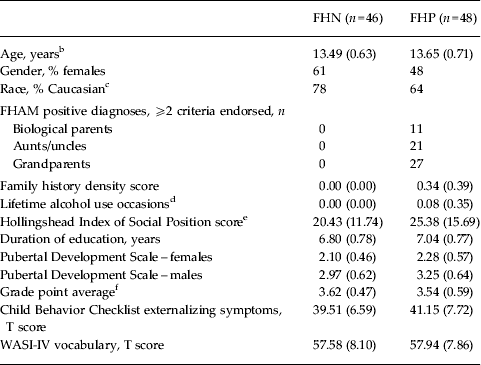
Exclusionary criteria included: any neurological or Diagnostic and Statistical Manual of Mental Disorders, fourth edition (DSM-IV) Axis I disorder (APA, 1994), determined by the National Institute of Mental Health Diagnostic Interview Schedule for Children–version 4.0 (Shaffer et al. Reference Shaffer, Fisher, Lucas, Dulcan and Schwab-Stone2000); any history of head trauma or loss of consciousness (>2 min); history of chronic medical illness; learning disability or mental retardation; use of medications potentially affecting the brain; premature birth (i.e. born prior to 35th gestational week); any suggestion of prenatal alcohol (>2 drinks during a given week) or illicit drug exposure; experience with alcohol or drugs, defined as >2 total days in their life on which drinking had occurred, or >1 drink consumed on an occasion; ⩾1 lifetime experiences with marijuana and any use in the past 3 months; ⩾1 lifetime cigarette use; and any history of other intoxicant use (Squeglia et al. Reference Squeglia, Spadoni, Infante, Myers and Tapert2009b , Reference Squeglia, Pulido, Wetherill, Jacobus, Brown and Tapert2012; Wetherill et al. Reference Wetherill, Squeglia, Yang and Tapert2013); contraindication to MRI (e.g. braces); inadequate comprehension of English; non-correctable sensory problems; and clinically abnormal brain anatomy as determined by neuroradiologist review. The final sample included 94 adolescents who were typically in the 7th grade, with modal family socio-economic status in the Hollingshead 11–15 range (Hollingshead, Reference Hollingshead1965), and commonly with high average estimated intelligence quotient and school grades (see Table 1). Of the 94 participants, two had had one drink on one occasion, while one participant had had one drink on two separate occasions, leaving this a mostly substance-naive sample.
Demographic information for 94 alcohol-naive adolescents a

Data are given as mean (standard deviation).
FHN, Family history negative; FHP, family history positive; FHAM, Family History Assessment Module; WASI-IV, Wechsler Abbreviated Scale of Intelligence – 4th edition.
a There were no group differences on any demographic variable.
b Age range 12–14 years.
c For the full sample, race was 71% Caucasian, 19% multi-racial, 5% Asian, 2% Black, and 2% Hawaiian/Pacific islander.
d Range 0–2 days.
e Higher scores indicate lower socio-economic status.
f Grade point averages were self-reported.
Measures
Family history
The Family History Assessment Module (Rice et al. Reference Rice, Reich, Bucholz, Neuman, Fishman, Rochberg, Hesselbrock, Nurnberger, Schuckit and Begleiter1995) ascertained familial alcohol use disorders in first- and second-degree relatives, as self-reports have been found to be a reliable way to determine familial alcohol or substance use (Andreasen et al. Reference Andreasen, Rice, Endicott, Reich and Coryell1986), and are valid predictors of alcohol use vulnerability and future dependence (Stoltenberg et al. Reference Stoltenberg, Mudd, Blow and Hill1988). Family history information was collected from the youth, one biological parent, and the other parent or (in <7% of cases) another close relative. Informants were asked if any of the youth's parents, aunts, uncles and/or grandparents ever had any problems due to alcohol, such as social, academic or occupational problems; alcohol-related arrests; negative health consequences; previous treatment for alcohol-related disorders; or if they were frequently intoxicated. Using these criteria to diagnose FHP is more conservative than other classification schemes, valuing specificity (98%) over sensitivity (39%), resulting in fewer false positives of alcohol use disorders diagnoses (Rice et al. Reference Rice, Reich, Bucholz, Neuman, Fishman, Rochberg, Hesselbrock, Nurnberger, Schuckit and Begleiter1995). Informants’ responses were compiled, and if any of the relatives endorsed two or more of the criteria, the youth was classified as FHP for an alcohol use disorder. FHP youth (n = 48) had one first- or second-degree relative with a history of alcohol use disorder, and FHN youth (n = 46) had no alcohol use disorder in any first- or second-degree relative. Additionally, family history density scores were calculated by adding 0.5 for each biological parent and 0.25 per biological grandparent (Zucker et al. Reference Zucker, Ellis and Fitzgerald1994) endorsed by either youth or parent as having alcohol use disorders. FH density scores ranged from 0 to 1.75 in the current sample.
Socio-economic status
Socio-economic background information (i.e. educational attainment, occupation and salary of each parent) was obtained from parents and converted to a Hollingshead Index of Social Position score (Hollingshead, Reference Hollingshead1965).
Pubertal development
The Pubertal Development Scale (Petersen et al. Reference Petersen, Crockett, Richards and Boxer1988) is a reliable and valid five-item self-report measure of pubertal maturation.
Neurocognition
A 180-min neuropsychological battery was administered by trained, reliable psychometrists within 1 week of scanning to assess cognitive functioning on six cognitive domains related to adolescent alcohol use (Squeglia et al. Reference Squeglia, Jacobus and Tapert2009a , Reference Squeglia, Jacobus, Brumback, Meloy and Tapertin press; Jacobus & Tapert, Reference Jacobus and Tapert2013): short-term memory; sustained attention; verbal learning and memory; visuospatial functioning; spatial planning and problem solving; and inhibition-interference. Domains were determined by a factor analysis of the Z scores of the 24 total neuropsychological test variables ascertained (Squeglia et al. Reference Squeglia, Jacobus, Sorg, Jernigan and Tapert2013a ). Short-term memory was comprised of: Wechsler Intelligence Scale for Children, third edition (WISC-III; Wechsler, Reference Wechsler1991) Digit Span, digit forward and digit backward raw scores; and Wechsler Adult Intelligence Scale, fourth edition (Wechsler, Reference Wechsler2008) Letter–Number sequencing raw scores. Sustained attention consisted of: Digit Vigilance Test (Lewis, Reference Lewis1995) total time (s); WISC-III Coding raw score; and Delis–Kaplan Executive Function System (D-KEFS; Delis et al. Reference Delis, Kaplan and Kramer2001) Trails Conditions 1, 2, 3 and 4 (i.e. Visual Scanning, Number Sequencing, Letter Sequencing, Letter–Number Switching) time to complete (s). Verbal learning and memory consisted of California Verbal Learning Test–Children's version (List A Total 1–5 raw, List A Trial 5 raw, Short Delay Free and Cued Recall raw, and Long Delay Free and Cued Recall raw scores; Delis et al. Reference Delis, Kramer, Kaplan and Ober1994). Visuospatial functioning was comprised of: Rey–Osterrieth Complex Figure Copy and 30-min Delay Accuracy scores (Rey & Osterrieth, Reference Rey and Osterrieth1993); Wechsler Abbreviated Scale of Intelligence (WASI; Wechsler, Reference Wechsler1999) Block Design raw scores; and Hooper Visual Organization Test (Hooper, Reference Hooper1958) raw total score. Spatial planning and problem solving included: the WISC-III Mazes total score; WASI Matrix Reasoning total score; and D-KEFS Towers total achievement score. Cognitive inhibition-interference was comprised of D-KEFS Color–Word Interference Conditions 3 and 4 time to complete (s). All timed raw scores (i.e. Digit Vigilance, Trails, Color–Word Interference) were reversed-coded so that longer times corresponded to poorer performance. An overall Global Functioning score was calculated by averaging all subtest Z scores together.
MRI acquisition
Participants were imaged in a 3 T General Electric Excite MR system with an eight-channel phase-array head coil (General Electric Medical Systems, USA). A scout scan ensured good head placement and whole-brain coverage. High angular resolution diffusion images (Frank, Reference Frank2001) were collected along 61 non-collinear directions determined by the electrostatic repulsion model which minimizes bias in measurements by sampling with approximately uniform distribution on a sphere (Jones et al. Reference Jones, Horsfield and Simmons1999), in addition to a reference image with no diffusion weighting (b = 0). The diffusion encoding scheme consisted of a single-shot dual spin echo excitation optimized for minimum echo time (TE) and reduction of eddy current artifacts (Reese et al. Reference Reese, Heid, Weisskoff and Wedeen2003). The following sequence parameters were applied: TE = 93 ms, repetition time (TR) = 10 900 ms, field of view = 240 mm, matrix = 128 × 128, 34 contiguous slices, 3 mm slice thickness, b-value = 1500s/mm2, one average. Two field maps were collected for unwarping to correct for signal loss and geometric distortion due to B0 field inhomogeneities (Jezzard & Balaban, Reference Jezzard and Balaban1995; Andersson & Skare, Reference Andersson and Skare2002). Total scan time including field maps was 16 min 2 s.
Data processing
Datasets were visually inspected slice by slice for each subject and all valid datasets were corrected for head motion, eddy current distortion and signal loss using FSL tools (FMRIB Software Library, UK; Smith et al. Reference Smith, Jenkinson, Woolrich, Beckmann, Behrens, Johansen-Berg, Bannister, De Luca, Drobnjak, Flitney, Niazy, Saunders, Vickers, Zhang, De Stefano, Brady and Matthews2004), and 48 participants (not described in this study) were removed from the analysis due to motion artifact. Specifically, image acquisitions for each direction were merged into a single four-dimensional file and aligned to the first volume using affine registration with six degrees of freedom and Fourier interpolation to correct for motion (FLIRT-FMRIB's Linear Image Registration Tool; Jenkinson et al. Reference Jenkinson, Bannister, Brady and Smith2002). Each of the 61 direction files were then registered to the B0 image using a six-parameter registration in two dimensions to minimize eddy current distortions (FDT-FMRIB's Diffusion Toolbox 2.0; Behrens et al. Reference Behrens, Woolrich, Jenkinson, Johansen-Berg, Nunes, Clare, Matthews, Brady and Smith2003). Next, phase unwrapping (PRELUDE-Phase Region Expanding Labeler for Unwrapping Discrete Estimates; Jenkinson, Reference Jenkinson2003) and regularization [FUGUE-FMRIB's Utility for Geometrically Unwarping EPIs (echo planar images); Jenkinson & Smith, Reference Jenkinson and Smith2001] of field maps were conducted for quantifying field distortions. Resulting measurements were translated into voxel shifts, effectively assigning image intensities to correct voxel locations.
For this study, FA was calculated using FMRIB's Diffusion Toolbox (Behrens et al. Reference Behrens, Woolrich, Jenkinson, Johansen-Berg, Nunes, Clare, Matthews, Brady and Smith2003). Diffusion indices were examined with tract-based spatial statistics (Smith et al. Reference Smith, Jenkinson, Johansen-Berg, Rueckert, Nichols, Mackay, Watkins, Ciccarelli, Cader, Matthews and Behrens2006), and involved the following steps. To achieve initial alignment, FA maps were registered to an averaged FA template (FMRIB-58) in Montreal Neurological Institute (MNI)-152 standard space using an affine-only registration. This was followed by a non-linear transformation into 1-mm cubic voxel dimensions (FNIRT-FMRIB's Non-linear Registration Tool). Data were examined for laterality, orientation and cross-subject anatomical alignment. Next, transformed images were averaged across subjects to create a mean FA image, from which a white matter skeleton was derived, representing tracts common to all subjects. Individual transformed FA images were then projected onto the skeleton. To minimize partial-volume effects and areas of high inter-subject variability, values were thresholded at FA >0.2 (Smith et al. Reference Smith, Johansen-Berg, Jenkinson, Rueckert, Nichols, Miller, Robson, Jones, Klein, Bartsch and Behrens2007). Data from each point on the skeleton formed the basis of voxel-wise statistical comparisons. Within clusters where FA values differed between FHP and FHN youth, average MD, RD and AD values were extracted using the same process as the FA analysis described above to further clarify the microstructural properties of white matter found to differ between groups.
Data analyses
Voxel-wise statistics on skeleton space FA data were carried out in AFNI (http://afni.nimh.nih.gov/afni/) using independent-samples t tests. Correction for multiple comparisons was achieved through a combination of individual voxel probability and cluster size thresholding using Monte Carlo simulation (Ward, Reference Ward2000) for type I error control. Consistent with previous findings (Jacobus et al. Reference Jacobus, Squeglia, Bava and Tapert2013a ), clusters ⩾21 μl (21 contiguous 1 × 1×1 mm voxels) with an individual voxel effect of α < 0.001 were interpreted, yielding a brain-wise α < 0.01 of finding such a cluster under the null hypothesis. Anatomical identification of tract structures was confirmed using white matter atlases (Wakana et al. Reference Wakana, Jiang, Nagae-Poetscher, van Zijl and Mori2004; Mori et al. Reference Mori, Oishi, Jiang, Jiang, Li, Akhter, Hua, Faria, Mahmood, Woods, Toga, Pike, Neto, Evans, Zhang, Huang, Miller, van Zijl and Mazziotta2008).
FHP and FHN groups were compared on demographic and cognitive functioning (both global and domain-specific) variables using a two-tailed Student's t test in SPSS (Rel. 18.0.0. 2009; IBM, USA). A 3d t test++ in AFNI (Cox, Reference Cox1996;Ward, Reference Ward2000) determined group differences between FHP and FHN youth on FA, as well as MD, RD and AD within the regions that significantly differed in regards to FA. For FHP youth, Pearson's r correlations were run between cognitive domains and FA values in the regions that differed between FHP and FHN youth; because of the exploratory nature of these correlations, α levels were set at 0.01.
Results
Demographics
FHP (n = 48) and FHN (n = 46) youth were matched at the group level on age, gender, race, socio-economic status, years of education, pubertal development, academic achievement, externalizing symptoms and verbal intelligence (see Table 1). FHP and FHN groups did not differ significantly on any demographic variable, or any item on the Pubertal Development Scale.
White matter
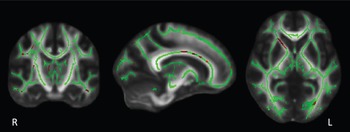
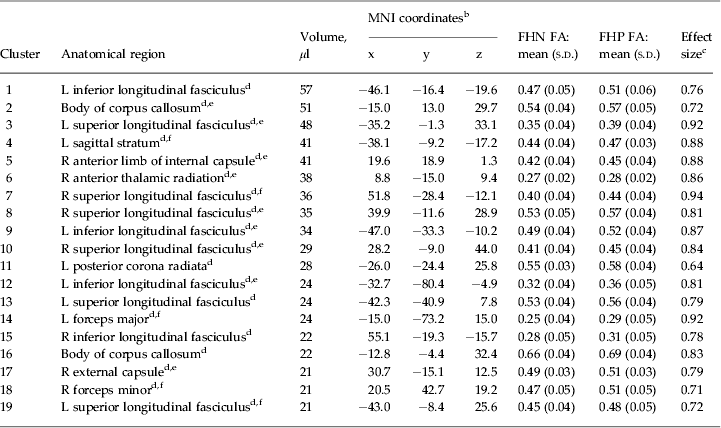
FHP youth (n = 48) had higher FA than FHN youth (n = 46) in 19 clusters, spanning projection, association and interhemispheric white matter tracts. Findings were confirmed after controlling for age, gender, socio-economic status, grade and pubertal development. These 19 regions included: the left inferior longitudinal fasciculus (Cohen's d = 0.76, 0.87 and 0.81), right inferior longitudinal fasciculus (d = 0.78), body of the corpus callosum (d = 0.72 and 0.83), left superior longitudinal fasciculus (d = 0.92, 0.79 and 0.72), right superior longitudinal fasciculus (d = 0.94, 0.81 and 0.84), left sagittal stratum (including inferior longitudinal fasciculus and inferior fronto-occipital fasciculus) (d = 0.88), right anterior limb of the internal capsule (d = 0.88), right anterior thalamic radiation (d = 0.86), left posterior corona radiata (d = 0.64), right external capsule (d = 0.79), left forceps major (d = 0.92) and right forceps minor (d = 0.71) (see Table 2 and Fig. 1). Within these 19 clusters, FHP youth had lower MD (in nine out of 19 regions), higher AD (in five out of 19 regions) and lower RD (in all 19 regions) compared with FHN youth (see Table 2). Relationships between family history density scores and diffusion indices did not reach statistical significance (p's < 0.01).
White matter clusters that showed significant group differences in fractional anisotropy (FA) between family history positive (FHP; n = 48) and family history negative (FHN; n = 46) youth (21 voxels; p's > 0.001), depicted in red. In all regions examined (highlighted in red), FHP youth show higher FA than FHN teens. R, Right; L, left.

Demonstration of significant group differences in FA between FHP (n = 48) and FHN (n = 46) youth (21 voxels; p's > 0.001) in 19 white matter clusters a

FA, Fractional anisotropy; FHP, family history positive; FHN; family history negative; MNI, Montreal Neurological Institute; s.d., standard deviation; L, left; R, right; MD, mean diffusivity; RD, radial diffusivity; AD, axial diffusivity.
a In all regions, FHP youth showed higher FA than FHN teens. Regions are listed in order by largest to smallest volume.
b Coordinates of the center of mass.
c Cohen's d effect sizes computed from means and s.d.s.
d Within this region, there was lower RD in FHP compared with FHN youth (note: no regions showed higher RD in FHP group compared with FHN); p's < 0.01.
e Within this region, there was lower MD in FHP compared with FHN youth (note: no regions showed higher MD in FHP group compared with FHN); p's < 0.05.
f Within this region, there was higher AD in FHP compared with FHN youth (note: no regions showed lower AD in FHP group compared with FHN); p's < 0.02.
Neurocognition
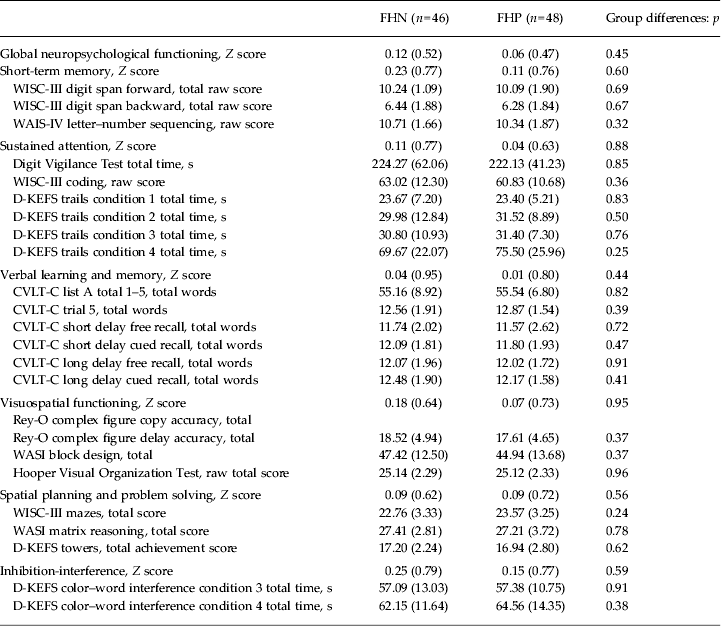
FHP and FHN groups did not differ on global or domain-specific neuropsychological test scores (p's > 0.44; see Table 3). For FHP youth (n = 48), FA in the 19 white matter tracts of interest did not relate to global or domain-specific neuropsychological test scores (p's > 0.01).
Neuropsychological test scores by domain and individual test a

Data are given as mean (standard deviation).
FHN, Family history negative; FHP, family history positive; WISC-III, Wechsler Intelligence Scale for Children – 3rd edition; WAIS-IV, Wechsler Adult Intelligence Scale – 4th edition; D-KEFS, Delis–Kaplan Executive Function System; CVLT-C, California Verbal Learning Test–Children's version; Rey-O, Rey–Osterrieth; WASI, Wechsler Abbreviated Scale of Intelligence.
a No cognitive domain or individual test differed between the FHN and FHP groups.
Discussion
The aim of this study was to understand white matter and cognitive functioning as they relate to family history of alcohol use disorders (i.e. FHP) in a relatively large sample of alcohol-naive adolescents. Despite having similar demographic backgrounds, age, pubertal development and neurocognitive performance, FHP youth had higher FA and AD, and lower MD and RD, than FHN youth in 19 different white matter fibers, spanning association, projection and interhemispheric tracts connecting diffusely distributed regions throughout the brain. The findings across regions were highly consistent, with no tracts showing lower FA or AD, or higher MD and RD, in FHP compared with FHN youth, and the observed effect sizes were quite large (Cohen's d 0.64 to 0.94). This suggests higher white matter integrity in these tracts among substance-naive early adolescents with familial alcohol use disorders.
The white matter tracts that differed between FHP and FHN youth connect several cortical and subcortical regions that undergo significant neurodevelopment during adolescence (Jellison et al. Reference Jellison, Field, Medow, Lazar, Salamat and Alexander2004; Barnea-Goraly et al. Reference Barnea-Goraly, Menon, Eckert, Tamm, Bammer, Karchemskiy, Dant and Reiss2005). These white matter tracts included the superior longitudinal fasciculus, a massive bundle of association fibers connecting the frontal, temporal, parietal and occipital regions of the brain, as well as the inferior longitudinal fasciculus, which connects temporal and occipital regions. Several projection fibers, connecting subcortical (e.g. thalamic, basal ganglia) to frontal brain regions, were also found to have higher white matter integrity in FHP youth. White matter development in these regions is important for the improvement of a number of cognitive skills during adolescence, including attention, memory, executive functioning and motor skills (Barnea-Goraly et al. Reference Barnea-Goraly, Menon, Eckert, Tamm, Bammer, Karchemskiy, Dant and Reiss2005). To that end, white matter abnormalities in these regions may help explain cognitive and behavioral differences found in FHP youth during adolescence.
Our findings are in contrast to some preliminary findings that suggest that FHP youth have lower (Herting et al. Reference Herting, Schwartz, Mitchell and Nagel2010) or equivalent (Wetherill et al. Reference Wetherill, Bava, Thompson, Boucquey, Pulido, Yang and Tapert2012) white matter integrity compared with FHN youth. However, our results are consistent with the growing research showing higher FA in youth who engaged in high rates of dangerous behaviors (Berns et al. Reference Berns, Moore and Capra2009), as well as youth diagnosed with conduct disorder (Sarkar et al. Reference Sarkar, Craig, Catani, Dell'acqua, Fahy, Deeley and Murphy2013) and ADHD (Li et al. Reference Li, Sun, Guo, Zang, Feng, Huang, Yang, Lv, Huang and Gong2010). Increases in white matter coherence and organization observed during adolescence (Bava et al. Reference Bava, Thayer, Jacobus, Ward, Jernigan and Tapert2010; Yap et al. Reference Yap, Teh, Fusar-Poli, Sum, Kuswanto and Sim2013) may begin earlier in youth who engage or are more likely to engage (as is the case with FHP youth) in risk-taking behaviors. On one hand, this accelerated maturation may be viewed as advantageous, as it could be related to earlier autonomy, behavioral exploration and prosocial behaviors. Alternatively, this early maturation could be viewed as ‘vulnerability’ for youth, increasing their likelihood of engaging in sensation-seeking behaviors at an earlier age. Our findings add to the emergent literature suggesting that these neurodevelopmentally precocious youth may have a tendency to initiate and escalate risk-taking behaviors when compared with their peers. This could lead to either positive or negative risk taking, depending on other environmental and peer influences.
For the FHP youth, higher FA was not related to better scores on cognitive testing, suggesting that more mature neural features do not necessarily indicate better cognitive functioning. These more developed white matter features may be influencing risk-taking behaviors specifically more than general cognition.
Despite alcohol-naive FHP youth showing greater white matter coherence, this advantage, or possible vulnerability, attenuates after youth initiate heavy substance use during adolescence. Specifically, previous studies have consistently found that heavy substance-using teens show decreasing FA compared with their non-using counterparts after alcohol and marijuana initiation (McQueeny et al. Reference McQueeny, Schweinsburg, Schweinsburg, Jacobus, Bava, Frank and Tapert2009; Bava et al. Reference Bava, Jacobus, Thayer and Tapert2013; Jacobus et al. Reference Jacobus, Squeglia, Bava and Tapert2013a , Reference Jacobus, Thayer, Trim, Bava, Frank and Tapert b ), suggesting that these higher FA levels are not maintained once heavy substance use begins. These findings are consistent with fMRI studies that show that more mature neural response patterns appear to be a risk factor for future initiation of substance use, with advantages decreasing after alcohol use initiation (Squeglia et al. Reference Squeglia, Pulido, Wetherill, Jacobus, Brown and Tapert2012; Wetherill et al. Reference Wetherill, Squeglia, Yang and Tapert2013). Importantly, these alcohol-related aberrations in brain structure and function are during a time when healthy non-using adolescents tend to show increasing white matter coherence and more mature neural processing (Giorgio et al. Reference Giorgio, Watkins, Douaud, James, James, De Stefano, Matthews, Smith and Johansen-Berg2008; Schmithorst & Yuan, Reference Schmithorst and Yuan2010; Stiles & Jernigan, Reference Stiles and Jernigan2010; Tamnes et al. Reference Tamnes, Ostby, Fjell, Westlye, Due-Tønnessen and Walhovd2010; Lebel et al. Reference Lebel, Gee, Camicioli, Wieler, Martin and Beaulieu2012). In sum, while more mature neural markers may predate substance use, advantages appear to reduce post-initiation.
Some limitations exist. Youth in this sample were alcohol-naive, high-functioning adolescents from high socio-economic status backgrounds, with no psychological, medical or behavioral issues who were performing well academically. In general, they were performing above average on all neurocognitive domains (see Table 3) and were within the average range in terms of externalizing behaviors (Table 1). Therefore, these youth were quite high functioning, and findings may not generalize to youth with co-occurring psychopathology or who have experienced significant traumatic life events that may typically be associated with positive family histories of alcohol use disorders. The current findings are cross-sectional; longitudinal studies are needed to understand the neural trajectory of white matter development in FHP youth and how development differs in youth at risk for developing substance-related problems.
Conclusions
In sum, we found that FHP teens have higher white matter integrity, but similar cognitive functioning, to FHN youth. More mature neural features could be related to more precocious behaviors, such as substance use initiation, in FHP youth. Future research exploring white matter maturation before and after substance use initiation will help elucidate the neurodevelopmental trajectories present in FHP youth, and could be used to inform preventive efforts.
Acknowledgements
Special thanks to the Adolescent Brain Imaging Project laboratory and the participating schools in the San Diego Unified School District and their families. Thanks also to Scott Sorg, Ph.D. for consultation regarding DTI analysis and interpretation.
Research reported in this paper was supported by: the National Institute on Alcohol Abuse and Alcoholism of the National Institutes of Health under award numbers R01 AA13419 (principal investigator: S.F.T.), U01 AA021695 (principal investigator: S.F.T.), F32 AA021610 (principal investigator: L.M.S.) and T32 AA013525 (T.B.); and the National Institute on Drug Abuse, award number F32 DA032188 (principal investigator: J.J.). The content is solely the responsibility of the authors and does not necessarily represent the official views of the National Institutes of Health.
The authors assert that all procedures contributing to this work comply with the ethical standards of the relevant national and institutional committees on human experimentation and with the Helsinki Declaration of 1975, as revised in 2008.
Declaration of Interest
None.