Introduction
Huntington’s disease (HD) is an autosomal dominant, progressive neurodegenerative disorder characterized by chorea, cognitive decline and psychiatric illness, with associated behavioural difficulties (Walker Reference Abu-Akel and Shamay-Tsoory2007). HD is reported to have an incidence of 6.4/100 000 in Northern Ireland (Morrison et al. Reference Bowers, Blonder and Heilman1995), although prevalence is unknown in the Republic of Ireland. HD is caused by a trinucleotide repeat expansion (CAG) in the huntingtin gene located on chromosome 4p16.3 (Huntington’s Disease Collaborative Research Group Reference Calder, Keane, Young, Lawrence, Mason and Barker1993). Subtle cognitive decline has been reported before the onset of motor features in patients with genetically confirmed HD (Henley et al. Reference Delis, Kramer, Kaplan and Holdnack2012; Paulsen et al. Reference Damasio and Maurer2013), although the focus herein is on social-affect deficits, specifically as social cognition can deteriorate over the course of the disease (Sprengelmeyer et al. Reference Dubois, Slachevsky, Litvan and Pillon2006; for a review of global cognitive decline in prodromal HD, see Paulsen et al. Reference Damasio and Maurer2013).
Social cognition refers to the cognitive processes associated with social interaction, which encompass the ability to recognize, process, and express emotions (Ekman Reference Duff, Beglinger, Therlault, Allison and Paulsen1992; Ekman Reference Ekman1993). These have been shown to be problematic in neurodegenerative diseases (Müller & Bekkelund Reference Ekman2013), including HD (Johnson et al. Reference Grace and Malloy2007). Some studies maintain that poor performance on tasks that examine the recognition of emotional stimuli, by patients with HD, may be due to task difficulty rather than specific social affective dysfunction associated with emotional processing (Midlers et al. Reference Hart, Dumas, Giltay, Middelkoop and Roos2003). However, impairment has been noted in the recognition of certain emotions in patients with HD, such as sadness and disgust, using a range of stimuli in different modalities (Snowden et al. Reference Henley, Marianne, Frost, King, Tabrizi and Warren2008). Modalities such as facial recognition of emotion (Calder et al. 2010) and prosodic tone in an individual’s voice (Snowden et al. Reference Johnson, Stout, Solomon, Langbehn, Aylward, Cruce, Ross, Nance, Kayson, Julian-Baros, Hayden, Kieburtz, Guttman, Oakes, Shoulson, Beglinger, Duff, Penziner and Paulsen2003) have evidenced deficits in emotive processing in patients with manifest HD (Henley et al. Reference Delis, Kramer, Kaplan and Holdnack2012).
Social cognition is theorized to be a sub-element of the executive system (Damasio & Maurer Reference Kenny, Coen, Frewen, Donoghue, Cronin and Savva1978); however, there is an increasing body of evidence suggesting that social cognition is characterized by its own subcomponents referred to as ‘Theory of Mind’ (ToM; Sprengelmeyer et al. Reference Dubois, Slachevsky, Litvan and Pillon2006). ToM is further categorized into ‘cognitive’ and ‘affective’ subtypes. Cognitive ToM governs the recognition that others may have knowledge and beliefs, which are different to one’s own (Abu-Akel & Shamay-Tsoory Reference Midlers, Crawford, Lamb and Simpson2011), whereas affective ToM is the ability to infer another’s emotional state and modulate socially appropriate behaviour accordingly (Shamay-Tsoory & Aharon-Peretz Reference Morey2007).
Social breakdown and interpersonal difficulties are common features of HD, and these may be mediated by cognitive dysfunction. Within the literature, it is unclear as to whether a common underlying executive deficit mediates impairment on tasks of social cognition. A limitation of many studies in HD is the use of single modality testing and sampling of manifest HD who exhibit co-morbid executive function.
A minority of individuals with HD have cognitive decline before the onset of motor features (Paulsen & Long Reference Morrison, Johnston and Nevin2014). Recent findings demonstrate how cognitive deterioration can be seen in persons with HD with no overt motor signs or symptoms, suggesting that subtle cognitive onset may precede motor features (Paulsen & Long Reference Morrison, Johnston and Nevin2014).
Behavioural/social-cognitive decline may occur before the onset of motor features, due to neurodegeneration in basal ganglia circuitry. The fronto-striatal system has been noted, in imaging studies of prodromal HD, to show local and global atrophy in the fronto-striatal tracts over a decade before symptom onset (Rees et al. Reference Müller and Bekkelund2013; Paulsen & Long Reference Morrison, Johnston and Nevin2014).
Detailed neuropsychological assessment is required with patients in order to delineate differential deficits in the expression, identification and recognition of emotion, as patients may present with heterogeneous neuropsychological deficits over time (Novak & Tabrizi Reference Nasreddine, Philips, Bédirian, Charbonneau, Whitehead, Collin, Cummins and Chertkow2010; Hart et al. Reference Novak and Tabrizi2013). We describe the case of genetically confirmed pre-manifest HD patient with specific social-affective deficits before the onset of motor features.
Case presentation
The patient was a 50-year old, right-handed Caucasian Irish male with 12 years of education and genetically confirmed HD (expansion of 41±1 CAG repeat). The patient had initially been assessed using Montreal Cognitive Assessment (MoCA; Nasreddine et al. Reference Paulsen and Long2005) and scored 27 of 30, within the average range for an Irish cohort (Kenny et al. Reference Paulsen, Smith and Long2013), when he initially presented in early 2011.
The patient, ‘Mr. A’ reported feeling ‘flat’, reported no disturbance of sleep, appetite or subjective low mood. He displayed insight into his lack of motivation for social activities, family and home life. Before presenting at his local services in early 2011, according to his wife, he had become more intolerant, he was difficult to interact and live with, and he could suddenly present as ‘acutely irate’ over small things, and then return to a ‘flat’ state. She referred to her husband as ‘lacking emotion’, stating that his symptoms were new, and that ‘he was not the man she married 20 years ago’, indicating a huge change from his premorbid personality. Together they have two children, although both report that he has become much more distant from them in recent times.
Mr. A was not formally employed at the time of his initial examination. He continued to earn an income by managing property, although he commonly reported interpersonal difficulties with his clients. Collateral interview, with his wife of over 20 years confirms this, and she further reported that these hostile interactions as new onset. Mr. A’s wife reports that his behaviour antagonizes clients, instigates interpersonal difficulties and there is often little resolution.
Mr. A’s father and paternal uncle were genetically diagnosed with HD. On examination, by an expert movement disorder specialist in 2012, our patient was described as physically unremarkable, and prodromal by traditional clinical characterization. Clinically, a major concern was effective treatment options for our patient, based on whether his new onset presentation was a reactive depression, or a premotor pathological decline in his HD.
Our patient had been attending a consultant psychiatrist, with a working diagnosis of idiopathic depression. After a multidisciplinary team and family meeting in late 2012, his anti-depressive medications were ceased and psychotherapeutic intervention commenced, as the patient was not experiencing any relief from medication. At that time, the evidence supported a severe apathetic profile, although our patient was not endorsing depressive or anxiety symptoms on empirical assessment.
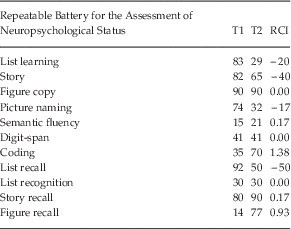
The patient was referred for further psychotherapeutic, neuropsychological and neurological review in early 2013. At this time, he completed an initial neuropsychological screening assessment (see Table 1). The patient was initially tested using the Repeatable Battery for the Assessment of Neuropsychological Status (Randolph Reference Randolph1998), which is reported to be reliable in the clinical assessment of cognition in HD (Duff et al. Reference Rees, Scahill and Hobbs2010). The patient continued, and continues, psychotherapeutic intervention. He reported that his symptoms have not been alleviated dramatically, and endorsed feeling flat, severely lacking empathy, and low tolerance for family, friends or social engagement.
Results from clinic-based neuropsychological assessment (percentile scores) RCI, Reliable Change Index
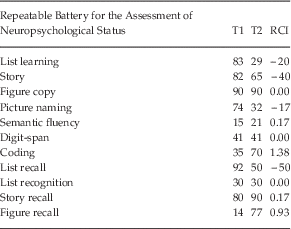
After ∼1 year, in early 2014, the team re-assessed the patient and his clinical presentation remained unchanged. During his annual follow-up assessment, the patient was assessed on an alternate form of the screening tool outlined below. Published normative age-matched data were used to compile standardized scores represented in Table 1.
One should interpret the differences in percentile scores with caution, and consider the accompanied Reliable Change Indices (RCIs). The patient appears to have dropped from the 74th to the 32nd percentile; however, this is reflective of a drop of one raw score on repeat assessment. Due to the fluctuations in the scoring pattern, RCIs were calculated for each of the measures, with none reaching significance. At the time of this assessment, he was further assessed on measures investigating executive processes and social cognitive processes in detail.
Neuropsychological assessment
Mr A’s estimated premorbid Full Scale IQ, using the Test of Premorbid Function (TOPF-UK), was estimated to be within the average range, standard score 107, functioning at the 68th percentile. On the Unified Huntington’s Disease Rating Scale, our patient scored at maximum level, at both time points, indicating no functional disability (100/100). Mr A had not been evaluated on this measure before cognitive testing, as he did not present clinically with motor symptoms. On the Frontal Assessment Battery (Dubois et al. Reference Shamay-Tsoory and Aharon-Peretz2000), he scored 17 of 18, with a reduced fluency score, congruent with the MoCA completed in 2011.
Scores were within the subclinical range for alexithymia, depression, anxiety and dissociative disorders on self-report questionnaires. On the Personality Assessment Inventory (Morey Reference Snowden, Austin, Sembi, Thompson, Craufurd and Neary1991), the patient scored within the clinical range for depression with elevation on the ‘Non-Support’ scale. A t-score >65t is considered in the clinically significant range.
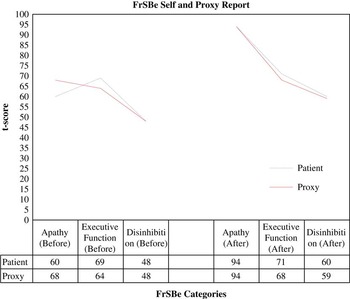
The Frontal Systems Behaviour Scale (Grace & Malloy Reference Snowden, Gibbon, Blackshaw, Doubleday, Thompson, Craufurd, Foster, Happé and Neary2001), a self- and proxy-report, measured apathy, executive function and disinhibition differences prior and subsequent to onset of illness (Fig 1).
Self- and Proxy-Frontal System Behavioural Scale (FrSBe).

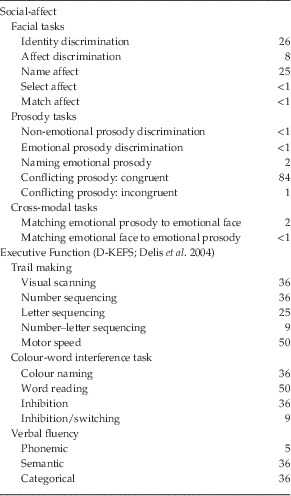
Executive functions were assessed using the Delis–Kaplan Executive Function System (D-KEFS; Delis et al. Reference Sprengelmeyer, Schroeder, Young and Epplen2004). Our patient performed within the expected range for tests of executive function, based on premorbid estimations. Scores were evidenced within the borderline impaired range on measures of phonemic fluency (see Table 2), although no set-loss or repetition errors were evident.
Supplementary investigations at T2: social affect and executive function scores (percentiles)

D-KEFS, Delis–Kaplan Executive Function System.
On the Social Faux Pas Recognition Test (Stone et al. Reference Stone, Baron-Cohen and Knight1998), a measure of cognitive ToM, our patient scored accurately on the experimental and control subtests. The Florida Affect Battery (Bowers et al. 1999) was used to assess this man’s ability on identity discrimination, emotional discrimination and emotional processing through facial, prosodic, and cross-modal tasks.
Our patient scored within the average range on a measure of facial affect processing. Subsequent to this, he was asked to verbally label emotive facial expressions in this task and his score was within the average range. Mr A was then asked to identify the picture of the face that corresponds to the emotion named by the examiner (i.e. ‘point to the angry face’). His score was reflected within the impaired range. Our patient was asked to match a target expression from presented choices, and his score was reflected within the impaired range
In the emotional prosody discrimination task, the patient was presented pairs of semantically neutral sentences that are spoken in the same or different emotional tone of voice. He achieved a score within the impaired range. On an emotional prosody identification task, assessing the ability to verbally label affective prosody, he achieved a score within the impaired range.
The patient further listened to emotionally intoned sentences whose semantic content may differ (i.e. conflict) or be parallel the prosodic message. On the incongruent task, our patient achieved a score in the impaired range. Interestingly, on the congruent task our patient scored within the high average range achieving a score at the 84th percentile, as seen in Table 2.
Lastly, the patient was shown a picture of an emotional face, and at the same time, he listened to sentences spoken in a different emotional tone. When the patient was asked to indicate which of three facial stimuli best represented an emotional tone, he performed within the impaired range.
Discussion
This case report describes a patient with genetically confirmed HD who is clinically in the pre-manifest stage. Comparing clinic-based assessments, our patient showed subtle cognitive and behavioural change over an annual period, consistent with HD, although not to a clinically or statistically relevant degree. He presents with severe apathy, and evidenced specific deficits relating to social affective processing, which was recorded using both visual, auditory and cross-modal measurements, in the absence of any motor symptoms.
Mr A had an elevated ‘Non-support’ scale score, whereby a score above 70t may represent combative family relationships, where friends are also unavailable or unhelpful. This is unsurprising considering the aforementioned social context this man is operating within.
On assessment, the patient showed a discrepancy between elements of social-affective processes, with impairments noted at the 1st percentile, compared with social-cognitive and executive tasks within the average range. Social-affect deficits were found on facial, prosodic and cross-modal measures of emotional processing. Lower scores were noted on the more executively loaded subtests of the D-KEFS, which may be indicative of a progressive disease trajectory typically seen in HD, however, Mr A has consistently scored poorly on measures of phonemic fluency, reporting ‘he was never good with words’.
This profile is suggestive of a specific social-affective cognitive deficit, likely to be secondary to prodromal Huntington’s disease, based on this man’s confirmed genetic diagnosis and new cognitive symptomatology. It may also be plausible that this patient’s disease is becoming more manifest, amplifying specific deficits, which were subclinical until recently. It is for this reason, auxiliary cognitive processes, such as executive functions, may appear relatively intact at this time. This case highlights a behaviourally interesting and scarcely reported domain-specific cognitive impairment within a pre-motor HD case, consequently creating dramatic behavioural implications in his life. Although limitations exist when reporting any single case, it is felt that this case delineates aspects of the behavioural and neuropsychological profile of genetically confirmed prodromal HD.
A limitation of this case report is that the patient had no extensive assessment before his more detailed neurocognitive evaluation in 2013, with a focus on executive function and/or social cognitive functioning. This may have been beneficial in categorizing the trajectory and rate of overall cognitive decline and behavioural features of this case; however, such an assessment was not initially indicated given his lack of overt symptoms at that point.
In future, it may be of clinical benefit to investigate social-affective deficits in prodromal HD, and other clinical presentations, where an idiopathic/organic depressive syndrome is possible, yet the presentation is unclear. Future clinic-based screening assessments should aim to delineate premorbid characteristics, functional decline and to empirically quantify the difficulties experienced by patients with genetically confirmed HD in the pre-manifest stage. Lastly, the emerging deficits in social cognition may explain the considerable interpersonal difficulties noted in early HD patients, which may in turn contribute to the behavioural profile, as these may often be masked by ancillary difficulties as the disease progresses. To this end, clinic-based assessment should routinely include measures of social cognitive processes, and clinicians should refer patients with neurodegenerative conditions for full neuropsychological assessment. Further references relative to assessments are available upon request from the authors.
Acknowledgements
The authors would like to express their gratitude to the patient and his family for allowing them to report on this case. The research leading to these results has received funding from the Irish Institute of Clinical Neuroscience (IICN; 12549. 201616).
Authors’ Contributions
Authors of this work were directly involved in the assessment and clinical care of this patient. Furthermore, all authors contributed to the design, review and overall development of this manuscript.
Conflicts of Interest
None.