Introduction
Improving children's lives is a prominent feature of the current UK social policy agenda, including the aim of ending of child poverty in a generation by 2020 (Harker, Reference Harker2006); the Every Child Matters framework (HM Government, 2004) which puts better outcomes for children at the centre of all policies and approaches involving children's services; and most recently the Children's Plan (DCSF, 2007). This latter document has as its first espoused aim to ‘strengthen support for all families during the formative early years of their children's lives’, which is an important prerequisite if the well-established and crucial link between disadvantage in early childhood and poor life chances is to be broken. Alongside concerns about economic disadvantage there is also increasing concern about the deterioration in the mental and emotional well-being of children (HM Treasury, 2007). There is growing acknowledgment that if children are to fare well they need to get the best start in life, which includes positive cognitive and emotional investments.
In this article, we examine for a recent birth cohort of UK children how parental resources in early childhood enhance or compromise their children's cognitive and behavioural development. The focus is on three aspects of parental resources: income, mother's mental well-being and family status. Broadly speaking, family income governs the amount and quality of material resources that are available to children; the mental health of parents may affect parenting capacities; and, although family status is less frequently regarded in resource terms, the presence of both parents is likely to benefit children not only through enhanced economic resources but also enhanced levels of social capital and parental engagement. In this article our main concern is how these three aspects of parental resources separately and jointly affect children's well-being. We also have a particular interest in finding out whether more persistent poverty or persistent maternal depression are more deleterious for children's current well-being than periodic episodes of poverty and depression.
Background
Several decades of research have shown that poverty and deprivation matter for the cognitive and behavioural development of children (reviews include Duncan and Brooks-Gunn, Reference Duncan and Brooks-Gunn1997; Shonkoff and Phillips, Reference Shonkoff and Phillips2000; Bradshaw and Mayhew, Reference Bradshaw and Mayhew2005). Research using the British Birth Cohort Studies has shown that even by the age of two years, children from lower socio-economic status backgrounds have lower cognitive scores (Feinstein, Reference Feinstein2003) and that the long hand of childhood poverty persists into adulthood in terms of lower educational and occupational attainment (Hobcraft, Reference Hobcraft, Chase-Lansdale, Kiernan and Friedman2004). Other research has shown that economically disadvantaged mothers are more likely than the more advantaged to experience psychological problems, particularly depression (Readings and Reynolds, Reference Reading and Reynolds2001). Higher levels of maternal depression have been shown to be associated with adverse outcomes, both in infancy and early childhood, such as language and cognitive deficits (Pettersen and Albers, Reference Petterson and Albers2001) and behaviour problems (Smith, Reference Smith2004). Poverty and maternal depression also vary according to family type, so, for example, lone-mother families have higher rates of poverty (Millar and Ridge, Reference Millar and Ridge2001) and lone mothers report more depressive symptoms than partnered mothers (Brown and Moran, Reference Brown and Moran1997), and such factors have been found to be important in explaining differences in children's development across family types (Joshi et al., Reference Joshi, Cooksey, Wiggins, McCulloch, Verropoulou and Clarke1999; McMunn et al., Reference McMunn, Nazroo, Marmot, Boreham and Goodman2001).
Methods
Data
The data for this study come from information collected in the first two waves of the Millennium Cohort Study (MCS). The MCS is a large-scale survey of babies born in the four constituent countries of the United Kingdom (Dex and Joshi, Reference Dex and Joshi2005). The first sweep (MCS1) was carried out during 2001–2 and contained information on 18,819 babies in 18,533 families, collected from the parents when the babies were nine to 11 months old. The sample design allowed for over-representation of families living in areas of England with high rates of child poverty or high proportions of ethnic minorities, and the three smaller countries of the UK. The families were followed up when the child was age three years (the majority of children were aged 35–39 months at interview) and the overall achieved response rate at this wave (MCS2) was 79 per cent of the target sample. Detailed information on the sampling strategy and response rates for the surveys can be found in Plewis et al. (Reference Plewis, Calderwood, Hawkes, Hughes and Joshi2004) and Plewis (Reference Plewis2007). Full details on the survey, its origins, objectives, sampling and content of the surveys are contained in the documentation attached to the data deposited with the UK Data Archive at Essex University. In this study, we include 14,777 families where the natural mother of the cohort child provided information at both the MCS1 and the MCS2 surveys.
Variables
We have divided the variables used in the analyses into three sets which are discussed in turn: focal variables which include poverty, maternal depression and family status; the outcome variables which include a measure of the child's cognitive ability and a measure of behaviour problems; and a set of controls. The distributions of the variables included in our analyses are given in Appendix Table A1.
Focal variables
For two of the focal variables, poverty and maternal depression, we used information from both the nine months old and three years old surveys in order to investigate whether poverty or depression reported at both of these surveys held stronger associations with children's well-being than experience on only one of the occasions.
A family was deemed to be living in poverty if the household income was 60 per cent below the median before housing costs. On this measure, 23 per cent of the children were living in poverty at nine months, and 25 per cent were living in poverty at age three. Sixteen per cent of the children lived in poverty on both occasions, 7 per cent were in poverty only at the nine months survey and 9 per cent at the time of the three years survey.
The measures of maternal depression for the two surveys were not identical. The measure from the first wave, when the baby was nine months old, was derived from whether the mother responded positively or negatively to the question, ‘Since (the baby) was born, has there ever been a time lasting two weeks or more when you felt low or sad?’. One in three of the mothers responded in the affirmative to this question. The measure used from the second wave, when the child was three years old, was derived from responses to the question, ‘During the last 30 days, about how often did you feel so depressed that nothing could cheer you up?’. There was a continuum of responses ranging from all of the time, through most, some, little or none of the time. We divided the mothers into two groups: 35 per cent who reported all, most or some of the time versus the rest. Seventeen per cent of the mothers as judged by the responses to these questions were depressed when their child was an infant and also when they were three years old. Fifteen per cent reported depressive symptoms only at the nine months old survey and 18 per cent at the time of the three years old survey.
These measures are only indicators of maternal depression. Ideally one would have preferred more concrete assessments, such as the Edinburgh Postnatal Depression Scale (Cox et al., Reference Cox, Holden and Sagovsky1987) administered at appropriate times following the birth of the baby so as to determine the mother's depression history. Within the MCS study design, the first interview occurred when the baby was nine months old, so the question used provides an indication of the mother's emotional history from birth to this time. In related work we have demonstrated that this simple indicator correlates strongly with depression constructs, including ever clinically diagnosed with depression and the malaise scale (Kiernan and Huerta, Reference Kiernan and Huerta2008). From the follow up survey at three years old we used the question which was the most similar measure available in that survey.
The family status measure included four groups of families and was based on their situation at the time of the three years old survey. These were: biological parents who were married to one another (69 per cent), biological parents who were cohabiting (15 per cent), lone mother families (14 per cent) and step-families (2 per cent). In this latter group, the father was not the biological father, and in two out of three of these cases the mother and social father were cohabiting. We distinguished between married and cohabiting parents as there are known differences between these types of families in terms of the potential durability of these unions, and the extent to which they share incomes (Vogler et al., Reference Vogler, Lyonette and Wiggins2008) and receive economic assistance from their families (Amato and Maynard, Reference Amato and Maynard2007). Moreover, the merits of marriage over cohabitation is an issue of political interest, discourse and dispute (Centre for Social Justice, 2006; Giddens, Reference Giddens2007)
Inter-relations between the focal variables
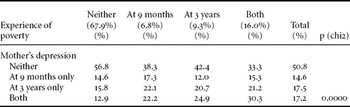
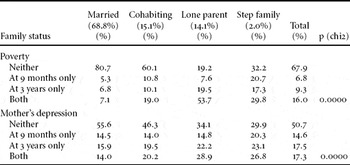
There are notable inter-relationships between the three focal variables. From Table 1 we see that mothers who were poor on both occasions were more than twice as likely to report depression on both occasions as those not in poverty on either occasion: 30 per cent of those in poverty on both occasions had repeatedly reported depression, as compared with 13 per cent of the not-poor group. There was also variation in the extent of poverty by family status (Table 2) in that married couples (among whom 81 per cent are not poor) are more economically advantaged than cohabiting couples (60 per cent not poor) and that eight out of ten lone parents are poor. Additionally, persistent poverty is more common in cohabiting couples than married couples and is a prominent feature of the lone-parent families. The step-families are a very small group but they are also relatively impoverished families, and as would be expected they had higher proportions in poverty at the time of the nine months old survey when they were more likely to have been lone-parent families. For maternal depression we see, as we did for poverty, that there are gradients down from marriage, to cohabitation and on to lone motherhood with respect to lack of depression or persistent depression, with mothers in lone and step-families exhibiting similar proportions of reported depression.
Association between poverty and maternal depression

Association between poverty, maternal depression and family type

We recognise that we are using the term persistent rather loosely (and as shorthand) to represent presence of poverty or depression at the time of the interviews and, for example, that families who have experienced poverty for extended periods but were not classified as poor at the time of the interviews would not be captured. If it had been available, information on duration of poverty or depression over the first three years of the child's life would be more reliable indicators of persistence than our inference made from two time points.
Outcome variables
At the three years old interview the children's stage of cognitive development was assessed via six tests of the Bracken Basic Concept Scale (BBCS), which assessed the children's comprehension of colours, letters, numbers, sizes, comparisons of objects and shapes, which provides an indication of the child's readiness for formal schooling (Bracken, Reference Bracken2002). The raw scores from these tests were added up, normalised and grouped into five categories: very delayed, delayed, average, advanced and very advanced. In this study we use a dichotomous variable which contrasts the 11 per cent of children who had scores in the delayed and very delayed categories with the rest. More of the boys exhibited delay, 14 per cent, compared with 8 per cent of the girls.
Behavioural adjustment was also assessed at age three with the Strengths and Difficulties Questionnaire (Goodman, Reference Goodman1997), a 25-item behavioural screening questionnaire on five different dimensions of children's behaviour: conduct problems, inattention-hyperactivity, emotional symptoms, peer problems and pro-social behaviour. Each attribute was rated by the mother using a scale from 0 to 2 (not true, somewhat true, and certainly true). Responses were summed to provide a total score for each dimension. The first four scales were combined to yield the total behaviour problem score. A score of 17 or more is regarded as high (Goodman, Reference Goodman1997, Reference Goodman2001). In the MCS sample, 7 per cent of the three-year old children fell into this category, with more of the boys than the girls having higher scores: 8 per cent compared with 6 per cent, respectively.
There is a major difference in the ways our two outcome measures were administered which may have a bearing on our findings; namely, the cognitive measure was administered directly to the child, whereas the mother reported on the child's strengths and difficulties. Some studies have suggested that depressed mothers may be more likely than non-depressed mothers to report more negatively on their children's behaviour, and that there is the possibility that the association between maternal depression and child behaviour problems may be spurious (see Smith, Reference Smith2004, for a clear exposition of these issues). A review of the research literature carried out by Richters (Reference Richters1992) suggested that there was no clear evidence for distortion or bias in the reports of depressed mothers. On the contrary, studies have shown that depressed mothers can be more accurate in detecting disorders in their children than non-depressed mothers (for example, Conrad and Hammen, Reference Conrad and Hammen1989), and that mothers in general are often keener observers of their children's development and behavioural well-being than are other types of observers (Glascoe, Reference Glascoe2005).
Focal variables and outcomes
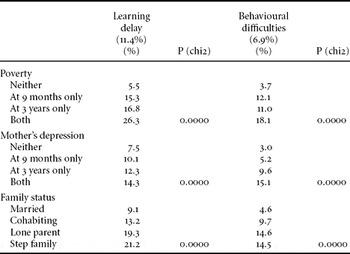
Table 3 shows the inter-relationship between the outcome measures and our focal variables. It is clear that there is an association between experience of childhood poverty and children's cognitive development. Children who have experienced persistent poverty (16 per cent) were over four times as likely to exhibit poorer cognitive development than children who had not experienced poverty. Children who experienced poverty on one occasion whether in infancy or early childhood held an intermediate position, and the proportions exhibiting cognitive delays were similar, regardless of whether the poverty was experienced during infancy or early childhood. It is striking that already at this early age 26 per cent of children in persistently poor households were exhibiting cognitive delay. We see a similar picture for behaviour problems in that children who experienced poverty on one occasion whether in infancy or early childhood held an intermediate position, and the proportions exhibiting behaviour problems were similar regardless of whether the poverty was experienced during infancy or early childhood. Again, children in persistently poor families were substantially more likely to have behaviour problems than those in non-poor families (18 per cent compared with 4 per cent).
Frequency of poor developmental outcomes for children according to poverty, maternal depression and family type

Compared with our findings in relation to poverty, we see a somewhat weaker association between maternal depression and children's cognitive development. But there was a strong association between maternal depression and poor behavioural outcomes. Children of mothers with persistent depression were the most likely to have behaviour problems (15 per cent did so) and those children who were aged three, but not earlier, when their mothers were experiencing depression had more reported problems than those who were infants when their mothers were depressed (10 per cent compared with 5 per cent).
There was a clear gradient in relation to family setting and cognitive delay, with children in married biological parent families having the lowest proportions of children exhibiting delays and children in step-families the highest. Around one in five children in lone and step-families exhibited delayed cognitive development. There is also an observable difference between children in cohabiting and married-couple families, with children in cohabiting families exhibiting more delay than their peers in married-parent families. There was also a noticeable gradient across the three main family groupings in the extent to which children were exhibiting behaviour problems: from marriage through cohabitation to lone parenthood. However, children in step-families exhibit similar levels of reported behaviour problems to those in lone-parent families.
Controls: background characteristics
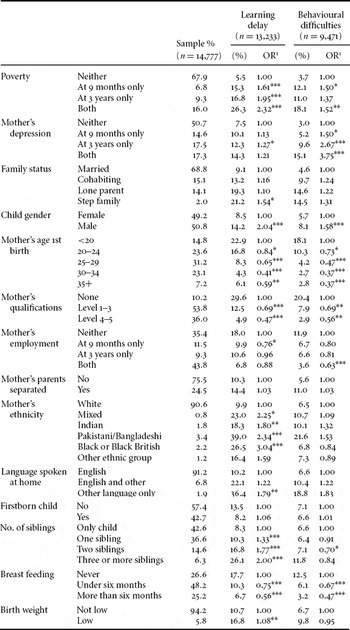
A range of background factors were also included as controls in our multivariate analyses. These child, mother and household attributes and their association with our outcome measures are shown in Appendix Table A1. All these factors were significantly related to a child's cognitive development. Boys were more likely than girls to have delayed cognitive development, first-born children were less likely to have delayed development than later-born children and children with no siblings or only one sibling exhibited less delay than children who had two or more siblings. Low birth-weight children exhibited more delayed development, and children who were breastfed and breastfed for longer exhibited less delay. Children of young mothers and less educated mothers exhibited more delay than children of older mothers and more educated mothers. Children whose mothers had experienced parental divorce during their own childhood were also more likely to exhibit delay in their conceptual development, as did children whose mothers were not in paid employment at either of the two survey dates. With regard to ethnicity, all ethnic groups relative to whites were more likely to exhibit delayed conceptual development, and children where the first language was not English or English was not spoken in the home showed more delayed conceptual development than those where English was the first language spoken in the home. A broadly similar story held for the behaviour problems measure, except that there were no strong birth-order or birth-weight differences, and there were weaker differences across the ethnic groups.
Results
Logistic regression analysis was used to assess whether children in different poverty circumstances, with different experiences of maternal depression and living in different family settings were more or less likely to exhibit delayed cognitive development or have a high level of behaviour problems. These analyses were carried out in a series of steps which are labelled as Models in the following tables. Model 1 includes the individual focal variable poverty or maternal depression or family status with no controls, Models 2 and 3 include the other focal variables entered individually, Model 4 includes the other focal variables collectively and Model 5 includes all the focal variables and all of the background characteristics described above. This sequential approach allowed us to evaluate the importance of each focal variable separately as well as in combination with the background variables in order to aid our understanding of potential associations. We examine each of the focal variables, poverty, maternal depression and family status in turn and present our findings in terms of estimated odds ratios (Tables 4–6). Participants for whom there was no information for any of the relevant focal or control variables were included by explicitly coding a missing category for each variable in the models. All analyses were carried out using STATA version 9 (Stata Corporation, 2006), using survey weights to correct for the sampling design of the study.
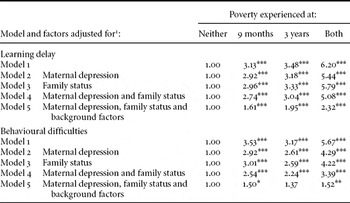
Association between poverty and poor developmental outcomes for children, odds ratios from logistic regression analysis

Notes: 1All effects adjusted for child's age at assessment.
*p<0.05, **p<0.01, ***p<0.001.
Association between maternal depression and poor developmental outcomes for children, odds ratios from logistic regression analysis

Notes: 1All effects adjusted for child's age at assessment.
*p<0.05, **p<0.01, ***p<0.001.
Association between family status and poor developmental outcomes for children, odds ratios from logistic regression analysis

Notes: 1All effects adjusted for child's age at assessment.
*p<0.05, **p<0.01, ***p<0.001.
Poverty and cognitive and behavioural outcomes
Poverty is very strongly associated with children's cognitive development. As we see in Table 4, taking into account maternal depression and family status separately or together lowers the size of the association, but not by very much. However, taking into account the set of background factors significantly reduces the odds of children in poverty exhibiting cognitive delay. Nevertheless, it still remains the case that experience of prior poverty in infancy, current poverty and persistent poverty were all strongly associated with a child's cognitive delay. An adjusted Wald test using the estimates from Model 5 showed that the differences in the estimates between the persistently poor group and those who had experienced poverty only at age three were not significantly different (F-test = 1.87 p = 0.17) and differences between the two estimates for experience of poverty at nine months and age three only were also not significant (F-test 1.31 p = 0.25). However, the difference between having experience of poverty at nine months only and experiencing poverty at both ages was statistically significant (F-test = 5.91 p = 0.016). These results indicate that the effect of poverty in infancy was significantly less than experience of persistent poverty, suggesting that the legacy of early poverty remains but with less impact than where poverty continues.
For the behavioural outcome measure as judged from the results for Model 5, it appears that any poverty matters, whether it is persistent or only present at age three years or nine months. The odds ratios of having high behaviour problems are broadly similar across the different poverty settings, and an application of an adjusted Wald test confirmed that the differences were not significantly different from one another. Introducing just the maternal depression and family status variables separately led to a reduction in the association between poverty and the behavioural outcome measure, most noticeably for the children living in the persistently poor families.
Maternal depression and cognitive and behavioural outcomes
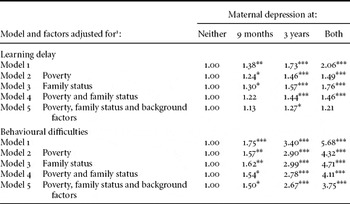
The picture for maternal depression and the child outcomes differed somewhat from that for poverty. As we see in Table 5, there is a much weaker association between maternal depression and children's cognitive development. Taking into account whether the family is living in poverty attenuates the association, and the introduction of the background factors almost eliminates the association between maternal depression and cognitive development. There is little legacy of earlier maternal depression or persistent depression on children's cognitive scores, but there is a legacy of what might be termed more recent onset. However, the size of the effects is small and there is no statistically significant difference across the groups of mothers according to the timing and persistence of depressive symptoms.
In contrast to the cognitive outcome, maternal depression is strongly related to child behaviour problems. The introduction of poverty and family status attenuates the association somewhat, and the introduction of the background factors lessens it still further. But it remains the case that prior depression, recent onset and persistent depression are all significantly related to child behaviour problems at age three, with the strongest association found for children with mothers with persistent depression. A Wald test for difference showed that this latter group of children were significantly more likely to have high levels of behaviour problems than their peers who had mothers who were depressed only when they were age three (F = 4.76 p = 0.029) or those whose mothers were depressed only when they were nine months old (F = 31.17 p = 0.0000).
Family status and cognitive and behavioural outcomes
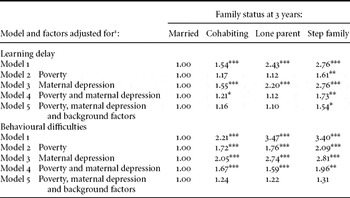
Unlike our findings for poverty and maternal depression, it is clear from Table 6 that there is little association between family status at age three and children's cognitive and behavioural outcomes once other factors have been taken into account. So, for example, after taking into account family poverty, children in lone-parent and cohabiting families are similar to children in married-couple families in the extent to which they are exhibiting cognitive delay, but children in step-families compared to children in married-couple families continue to have significantly higher relative odds of cognitive delay, and this continues to be the case after the introduction of the background factors. With regard to behaviour problems, after taking into account the higher probabilities of poverty and maternal depression in lone-mother families, the odds that children of lone mothers have higher levels of behaviour problems than children in married-couple families is substantially attenuated. Once the other background factors are taken into account, children in cohabiting, lone-parent and step-families are not statistically significantly different from the children in married-couple families with respect to the extent they are exhibiting behaviour problems.
Persistent poverty and persistent depression
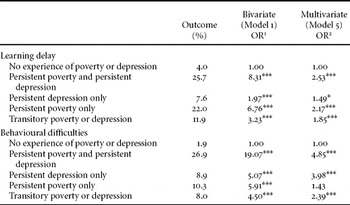
It is clear from our analysis that after taking into account a wide range of other potential influences, poverty is associated with children's cognitive and behavioural development, and that maternal depression is strongly associated with children's behaviour problems. Additionally, more persistent poverty and maternal depression enhance the chances of children doing less well on cognitive tests and to have higher reported levels of behaviour problems. As well as being interested in the separate effects of poverty and maternal depression, we were also interested in whether there was amplification in risk associated with being both in poverty and having a depressed mother. To elucidate this we compared children who were neither living in poor families nor had depressed mothers either at age nine months or at age three years with different sets of children: those who were in poor families at both times and their mothers' reported depression on both occasions (4.5 per cent of the sample), those who were in persistently poor families but did not have persistently depressed mothers (5 per cent of the sample) and those who had persistently depressed mothers but the family was not persistently poor (9 per cent of the sample).
Table 7 shows for these groups of children and the remaining children the bi-variate odds ratios of exhibiting cognitive delay and having high levels of behaviour problems along with the odds ratios after inclusion of the background factors used in our previous models. Before taking into account the background factors, we see that children living in persistently poor families have very high odds of exhibiting delay on the cognitive tests with odds seven to eight times those in non-poor non-depressed families (the baseline group). Children of persistently depressed mothers living in persistently poor families have strikingly high odds of having behaviour problems at age three, with odds of 19 times those of the baseline group compared with odds of around five times among the other groups of children.
Association between persistent poverty and depression and poor developmental outcomes for children, odds ratios from logistic regression analysis

Notes: 1All effects adjusted for child's age at assessment.
2Multivariate model additionally adjusted for family status and all background factors.
*p<0.05, **p<0.01, ***p<0.001.
From the multivariate analyses it is noteworthy that the cognitive development of children belonging to persistently poor families is seemingly not additionally impaired by having a depressed mother. The difference between the odds in living in a persistently poor family and having a persistently depressed mother (odds ratio of 2.53) compared with living in a persistently poor family but with a mother who was not depressed (odds ratio of 2.17) were not significantly different from one another (F test 0.79 p = 0.37). Similarly, persistent depression is more salient than poverty in relation to children's behaviour problems in that the odds of a child having behaviour problems who has a persistently depressed mother who is not living in poverty are not significantly different from where there is persistent depression and poverty (odds ratio of 3.98 and 4.85 respectively F = 0.83 p = 0.36).
Influential background factors
It is apparent from our multivariate analyses that some of the largest reductions in odds in our models for associations between our focal variables and our child outcome measures came with the introduction of the background factors. The influential background factors net of all the other factors (see Appendix Table A1) associated with tempering the effects of poverty, maternal depression and family status included whether the children had better educated mothers, older mothers and whether they had been breastfed. These children scored more highly on the cognitive tests and had lower levels of behaviour problems than the children of less educated, younger mothers and those who had not been breastfed. Low birth weight and greater numbers of siblings were associated with lower scores on the cognitive tests, as was ethnicity in that all except the ‘other’ group scored on average less well on the tests compared with the white group of children, and as did children where English was not spoken in the home. Furthermore, there were marked gender differences in that boys were more likely than girls to exhibit delay on the cognitive tests and to have higher levels of behaviour problems.
Summary and discussion
Our results show, after taking into account other attributes of the mother and the family, that there are strong associations between poverty and very young children's intellectual development and to a lesser extent their behavioural development at age three years. Family poverty during infancy or early childhood and persistent poverty all were found to be deleterious in relation to children's cognitive development. Maternal depression, net of other background characteristics, was found to be more weakly related to her child's cognitive development, but depression was strongly related to whether children were exhibiting behaviour problems at this young age. Prior depression, recent onset and persistent depression were all significantly related to children's behaviour problems at age three, with the strongest association found for children whose mothers were persistently depressed.
It is clear from this study that living in a persistently poor family or in one with a persistently depressed parent substantially increases the risk, respectively, of children experiencing delayed cognitive development and having high levels of behaviour problems. We also enquired whether living in a persistently poor family with a mother who was persistently depressed increased the chances of poorer outcomes. After taking into account other characteristics of the families, it appeared that the cognitive development of children belonging to persistently poor families was seemingly not additionally impaired by having a depressed mother, and a child with a persistently depressed mother did not have enhanced levels of behaviour problems if the mother was poor. This reinforces the message that poverty matters more for a child's cognitive development, and maternal depression impacts more on children's behaviour problems.
These findings are derived from observational data and consequently it cannot be inferred that there are causal links between poverty and depression and child outcomes. Nevertheless, poverty and maternal depression represent identifiable markers for development difficulties in children.
Unlike our findings for poverty and maternal depression, we found that there was little association between family status at age three and children's cognitive and behavioural outcomes, once other factors had been taken into account. So, for example, the negative gradient we saw across married, cohabiting and lone-parent families with respect to children's cognitive development was largely explained by differences in the extent of poverty across these families. For step-families there were some indications that these children did less well on the cognitive tests than children in other types of families. This was a small group of families that had gone through more transitions than the other families and this finding may be related to mothers and social fathers adjusting to their new circumstances, and having less time to invest in the children's cognitive needs. This finding is also in line with other studies which have found that older children in step-families do not fare as well as children in other families (Dunn et al., Reference Dunn, Deater-Deckard, Pickering, O'Connor and Golding1998).
At age three years there are already marked disparities in the cognitive and behavioural development of this recent cohort of British children. It is of concern that already at this early age, 26 per cent of children in persistently poor households are exhibiting cognitive delay (at the population level this represents about 4 per cent of all three years olds in the UK) and at this very young age 18 per cent of the children in persistently poor families have what are regarded as high levels of behaviour problems (Goodman, Reference Goodman2001). There are also marked gender differences: with 14 per cent of boys exhibiting delay on the cognitive tests compared with 8 per cent of girls. Thus the marked gender disparities seen at older ages in terms of school performance (Cassen and Kingdom, Reference Cassen and Kingdom2007) are already visible at this tender age. The gender gap in behaviour problems was less marked but still statistically significantly different, with 8 per cent of the boys having high levels of behaviour problems compared with 6 per cent of the girls.
These findings matter for how the lives of these children might unfold. There is evidence from US studies that disparities in learning and cognitive skills at the pre-school ages are amplified when they enter the school system, which eventually translate into lower educational attainment (Heckman, Reference Heckman2006). Indeed, it has been argued by Brooks-Gunn and Duncan (Reference Brooks-Gunn and Duncan1997) that the observed greater impact of early childhood poverty (relative to later life) on high school completion rates is due to the learning gap between economically disadvantaged and advantaged children when they arrive at school. There is also evidence from recent longitudinal studies of children and youth in the USA and Canada that behaviour problems in early childhood (from age four years) are predictive of future educational attainment both because behaviour problems seen during early childhood tend to persist and because early behaviour problems have independent and persistent effects on children's future cognitive test scores. In these studies the effects of behaviour problems on cognitive scores were larger than the effects of family income or mother's education (Currie and Stabile, Reference Currie and Stabile2007).
This study using data from the MCS, a nationally representative sample of children born since the current Labour administration came to power in 1997, has provided further evidence on the disparities that continue to exist in the cognitive and behavioural development of young children, and has shown the important contribution that both episodic and persistent poverty and maternal depression make to these disparities. The crucial role of poverty for children's well-being has already been recognised, but the role of parental mental health for children's well-being has received less emphasis. There are likely to be benefits for children of improving the mental health of their parents. For example, one of the few clinical trial studies that has assessed depressed mothers independently of their children showed that reductions in maternal depression following treatment had both a positive effect on both the mothers and their children, and that failure to treat depressed mothers was likely to increase the extent of behaviour problems in their children (Weissman et al., Reference Weissman, Pilowsky, Wickramaratne, Talati, Wisniewski, Fava, Hughes, Garber, Malloy, King, Cerda, Sood, Alpert, Trivedi and Rush2006). Current government policies and initiatives under the umbrella of Every Child Matters and the Children's Plan including, for example, the Sure Start Children's Centres Programme, Parents Early Years and Learning initiatives and the commitment to the improvement of Child and Adolescent Mental Health Services, aim to improve the lives of children. The MCS children will be coming of age soon after 2020, by which time the government aims to have eradicated child poverty, and hopefully their lives and those of later born children will have benefited from the programmes recently instituted.
Appendix
Association between poor developmental outcomes, poverty, maternal depression, family status and all background factors, odds ratios from logistic regression analysis models including all factors

Notes: 1All effects adjusted for child's age at assessment.
*p<0.05, **p<0.01, ***p<0.001.
Acknowledgements
We would like to thank the ESRC and the Institute for Effective Education at the University of York for funding this project and the ESRC Data Archive for supplying the Millennium Cohort Data. Our thanks also go to Jonathan Bradshaw and John Holmes who provided the poverty data for this analysis.