Introduction
The Late Ordovician mass extinction was the second-most devastating biosphere collapse of the Phanerozoic (e.g., Sepkoski, Reference Sepkoski1996; Alroy, Reference Alroy2008, Reference Alroy2010a, Reference Alroy2010b; Harper et al., Reference Harper, Hammarlund and Rasmussen2014; and many others). Crinoids were significantly affected with a single end-Katian episode of extinction (Peters and Ausich, Reference Peters and Ausich2008). Furthermore, these extinctions drove a macroevolutionary shift in crinoid faunas from the Early Paleozoic Crinoid Evolutionary Fauna (CEF) (Ordovician) to the Middle Paleozoic CEF (Silurian to middle Mississippian) (Baumiller, Reference Baumiller1994; Ausich et al., Reference Ausich, Kammer and Baumiller1994).
Silurian strata from Estonia provide a unique opportunity to further understand Silurian faunas from the Baltica paleocontinent. Whereas Wenlock and Ludlow faunas are well known from Gotland, Sweden, relatively little was known about Llandovery and Pridoli crinoid faunas from Baltica prior to Ausich et al. (Reference Ausich, Wilson and Vinn2012, Reference Ausich, Wilson and Vinn2015), who described Pridoli crinoids from western Estonia. We here describe new material from the Rhuddanian (early Llandovery) of western Estonia. Rhuddanian faunas are needed globally to understand the early diversification of the Silurian faunal recovery. Thus, the relatively small crinoid fauna reported here from Hiiumaa, Estonia, is significant as the oldest Silurian crinoid fauna known from the Baltica paleocontinent and for being among the six most diverse Rhuddanian faunas known globally. In addition, this fauna provides insight into biogeographical aspects of the Silurian crinoid recovery.
Crinoids are part of a diverse shelly fauna present in the Rhuddanian of western Estonia. Although they are a minor component of the overall Hilliste Formation fossil assemblages, crinoidal remains (pluricolumnals, columnals, and disarticulated calyx and arm plates) are locally abundant. Crinoid taxa reported here include Hiiumaacrinus vinni new genus new species, Protaxocrinus estoniensis new species, Eomyelodactylus sp. indeterminate, and potentially two calceocrinid taxa. In addition several crinoid holdfast and columnal types are present in the fauna, and specimens of two additional taxa are too heavily eroded to be described. Also, Vinn et al. (Reference Vinn, Wilson, Ausich and Toom2015) reported a Tremichnus domichnium (TUG-169-1) on a pluricolumnal from the Hilliste Quarry. (Note that the validity of the taxon Tremichnus is debated and beyond the scope of this paper to resolve; see Zonneveld and Gingras, Reference Zonneveld and Gingras2014; Wisshak et al., Reference Wisshak, Kroh, Bertling, Knaust, Nielsen, Jagt, Newmann and Nielsen2015; and Donovan and Pickerill, Reference Donovan and Pickerill2016).
Geographic and stratigraphic occurrences and geological setting
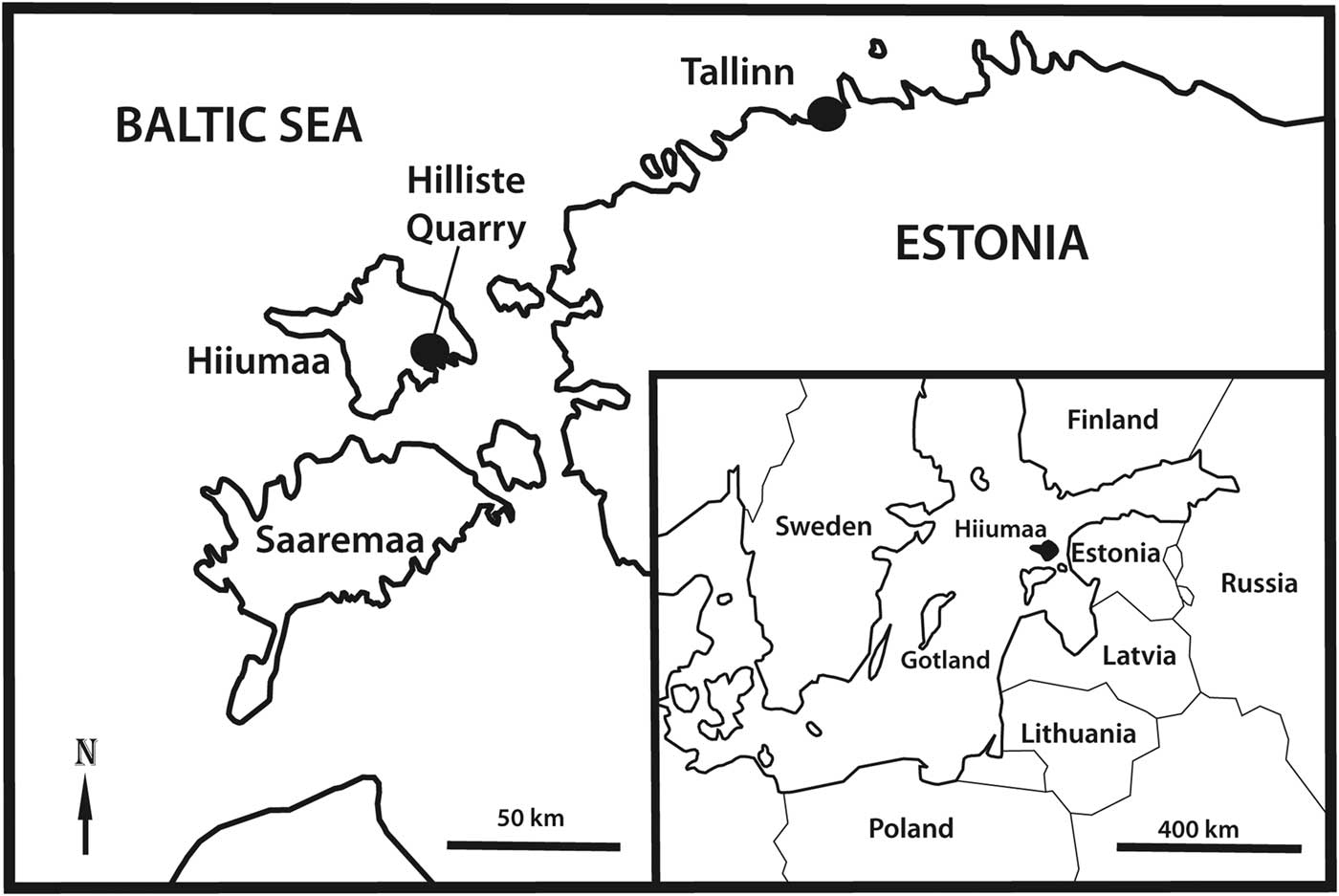
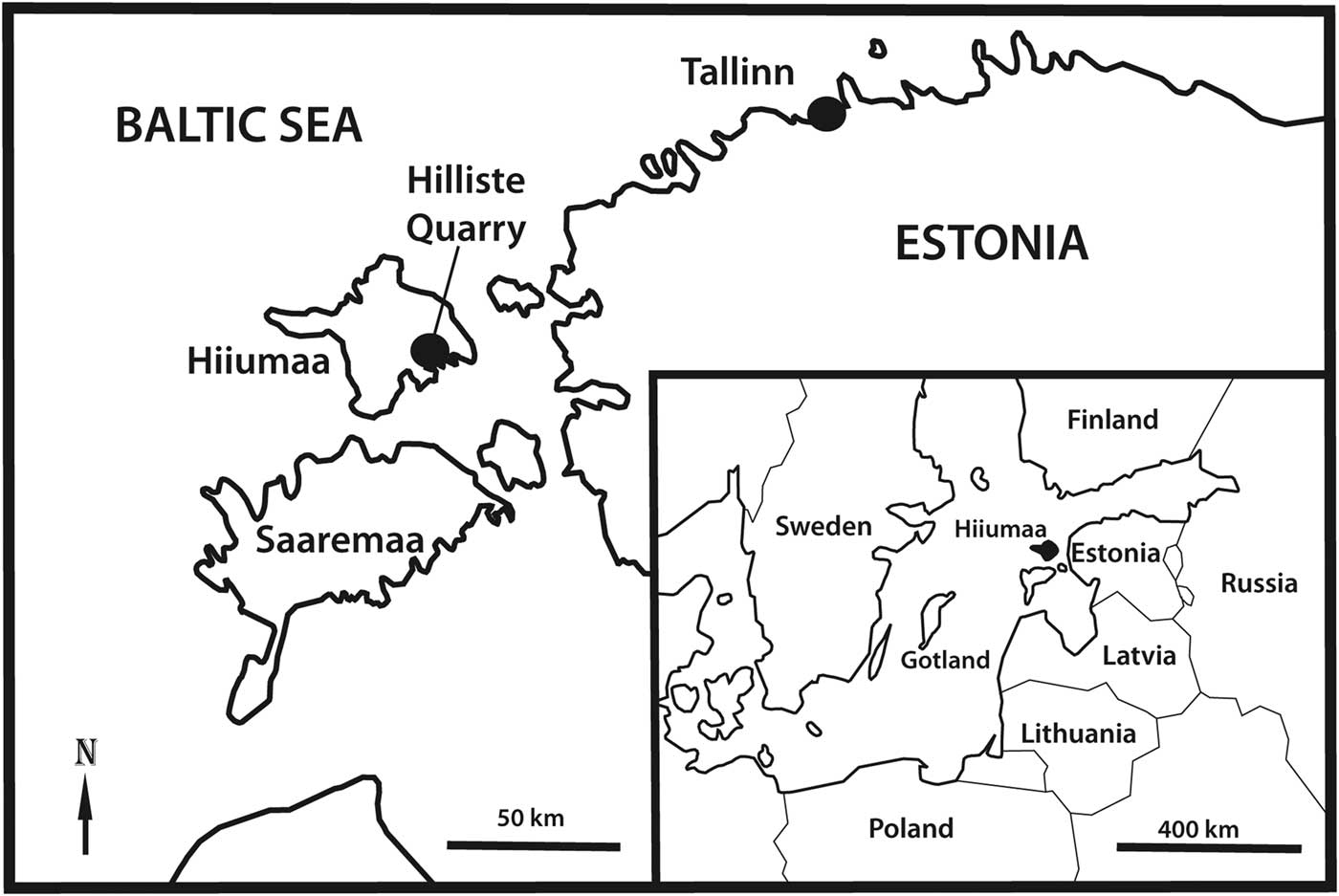
The fossils described here were collected from the Hilliste Formation exposed in the Hilliste Quarry on eastern Hiiumaa Island, western Estonia, ∽1.6 km northeast of the village of Suuremõisa (58.873889°N, 22.971944°E) (Fig. 1).
Locality map of the Hilliste Quarry on Hiiumaa. In the inset, Hiiumaa is indicated by solid black fill.
These new crinoids were found in the Hilliste Formation, a lower Silurian (Llandovery, Rhuddanian), mostly carbonate unit ∽7 m thick. The lower two-thirds of the Hilliste Formation are interbedded biomicrites and calcareous mudstones, and the upper third (from which the crinoids were collected) consists of biosparites with minor mudstones. The fossil content changes stratigraphically upward from primarily brachiopods (orthids, atrypids, rhynchonellids, pentamerids, and strophomenids) and mollusks (mostly gastropods with some bivalves) to a diverse assemblage of corals (mostly favositids, halysitids, heliolitids, and rugosans), stromatoporoids (Clathrodictyon, Ecclimadictyon, and Pachystylostroma), bryozoans, and crinoids in the upper third. The corals and stromatoporoids are commonly preserved overturned, indicating relatively high-energy events in the upper part of the unit. The lithology and paleontology suggest that the Hilliste Formation represents a shallowing-upward sequence.
The land that was to become Estonia was part of the Baltica paleocontinent during the Silurian, which was located near the equator (Melchin et al., Reference Melchin, Cooper and Sadler2004). The Estonian territory was part of the broad Baltica paleobasin with diverse paleoenvironments and fossil faunas (Hints et al., Reference Hints, Ainsaar, Männik and Meidla2008). Nestor and Einasto (Reference Nestor and Einasto1977) described five depositional environments in the Baltic paleobasin, from deep basin to tidal flats. The Hilliste Formation was deposited at the transition between the open shelf and shoal paleoenvironments (Nestor, Reference Nestor1995).
Silurian crinoid radiation: Lilliput Effect and paleobiogeography
With the exception of the new genus Hiiumaacrinus described here, all of the crinoids from the Hilliste Formation are very small. This is also true for Hirnantian and Rhuddanian crinoids from Anticosti Island, Quebec, Canada. Borths and Ausich (Reference Borths and Ausich2011) demonstrated that the Anticosti Hirnantian and Rhuddanian crinoids were significantly smaller than their counterparts in older and younger strata of Anticosti Island. They recognized this as a Lilliput Effect, which is a general trend of size reduction during recovery from a mass extinction (Urbanek, Reference Urbanek1993). Copper (Reference Copper2001, Reference Copper2006) and Delabroye et al. (Reference Delabroye, Munnecke, Vecoli, Copper, Tribovillard, Joachimski, Desrochers and Servais2011) also recognized the Lilliput Effect among Anticosti Island brachiopods. The small sample size of Hilliste Formation crinoids and the lack of immediately older and younger faunas for comparison prevent a definitive interpretation that the Hilliste fauna is a Lilliput fauna. However, with the exception of Hiiumaacrinus and a few medium-sized pluricolumnals, all crinoidal material from this fauna is quite small and consistent with being a Lilliput fauna.
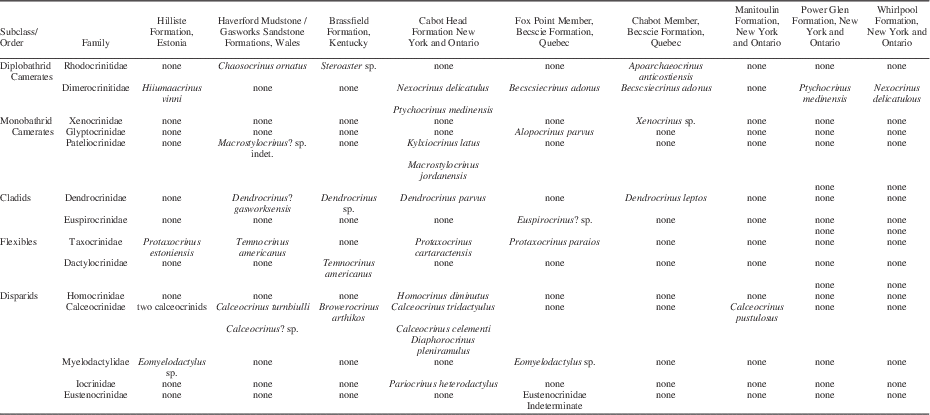
With this new fauna the Baltica and Avalonia paleocontinents have one Rhuddanian fauna each, and several are known from Laurentia (Table 1). These are the first post-extinction recovery faunas known. Despite the identification of so few taxa, the Hilliste crinoid fauna can be compared with Rhuddanian faunas elsewhere. Table 1 lists the distribution of crinoid taxa by family for known Rhuddanian faunas worldwide. Families with two or more occurrences in the Rhuddanian include the diplobathrid families Rhodocrinitidae and Dimerocrinitidae; the monobathrid family Patelliocrinidae; the cladid family Dendrocrinidae; the flexible family Taxocrinidae; and the disparid families Calceocrinidae and Myelodactylidae. The Hilliste fauna contains taxa in the Dimerocrinitidae (Hiiumaacrinus vinni n. gen. n. sp.), Taxocrinidae (Protaxocrinus estoniensis n. sp.), Calceocrinidae (potentially two taxa), and Myelodactylidae (Eomyelodactylus sp.).
Family composition of crinoid faunas from Rhuddanian (early Llandoverian, early Silurian) known globally.

Based on the stratigraphic and geographic distribution of families, Ausich and Deline (Reference Ausich and Deline2012) argued that the early Silurian crinoid faunal recovery was largely one of North American lineages diversifying globally. Other examples certainly existed, such as the Petalocrinidae (Mao et al., Reference Mao, Lin and Ausich2015), but the preponderance of taxa appears to be from North American Ordovician lineages. The Estonia material described here is the oldest Silurian fauna from Baltica, and what is known about its composition is very similar to Laurentian faunas. The only new genus belongs to the Dimerocrinitidae, which is well represented in other Rhuddanian faunas, as are the Calceocrinidae. Protaxocrinus and Eomyelodactylus first appeared during the Katian of Laurentia, and also occur in the Hilliste fauna, as they do in the Fox Point Member of the Becscie Formation on Anticosti Island. This fauna further supports the interpretation of an earliest Silurian migration from North America (Ausich and Deline, Reference Ausich and Deline2012) because the Dimerocrinitidae, Myelodactylidae, and Taxocrinidae are not known from the Ordovician of Baltica prior to their occurrence in the Hilliste fauna (Webster and Webster, Reference Webster and Webster2014). However, the Calceocrinidae; Bodacrinus (col.) Donovan, Reference Donovan1986; and an unusual subelliptical column have previously been reported from Baltica, from the Katian Boda Limestone (Jobson, Reference Jobson1983; Donovan, Reference Donovan1987). Myelodactylids have also been reported from the late Llandovery of Sweden (Donovan and Franzén-Bengston, Reference Donovan and Franzén-Bengtson1988).
Repositories and institutional abbreviations
Specimens are deposited in the Natural History Museum (Museum of Geology), University of Tartu (TUG).
Systematic paleontology
The suprageneric classification used here is from Moore and Teichert (Reference Moore and Teichert1978) and Ausich (Reference Ausich1998a, Reference Ausich1998b). Morphological terminology follows Ubaghs (Reference Ubaghs1978), holdfast terminology is from Brett (Reference Brett1981), and open nomenclature follows Bengtson (Reference Bengtson1988). The plating in the interrays is given as the number of plates in each range from the proximal-most plate to the last range before the tegmen. In the posterior interray, the primanal is indicated by “P,” and the first interradial in regular interrays is indicated by “1.” A “?” indicates the more distal plating is unknown. In measurement sections an asterisk indicates measurement is of a compressed or incomplete specimen, and measurements are in mm. In addition to crinoid crown fossil material, a few distinctive crinoid column morphologies are reported, and distinctive crinoid holdfasts are also described.
Class Crinoidea Miller, Reference Miller1821
Subclass Camerata Wachsmuth and Springer, Reference Wachsmuth and Springer1885
Order Diplobathrida Moore and Laudon, Reference Moore and Laudon1943
Superfamily Dimerocrinitoidea von Zittel, Reference von Zittel1879
Family Dimerocrinitidae von Zittel, Reference von Zittel1879
Genus Hiiumaacrinus new genus
Type species
Hiiumaacrinus vinni n. gen. n. sp.; by monotypy.
Diagnosis
Low bowl-shaped calyx, smooth calyx plate sculpturing, infrabasals entirely within the basal concavity and not visible in side view, anitaxial ridge absent, interareas depressed, first primibrachial tetragonal or hexagonal, primaxil heptagonal, second secundibrachial axillary, fixed pinnules absent, 20 free arms (free arm branching and brachial type not known), column circular.
Etymology
The genus name recognizes Hiiumaa Island, where this crinoid is known.
Occurrence
This genus is known only from the Llandovery (Silurian) of Estonia.
Remarks
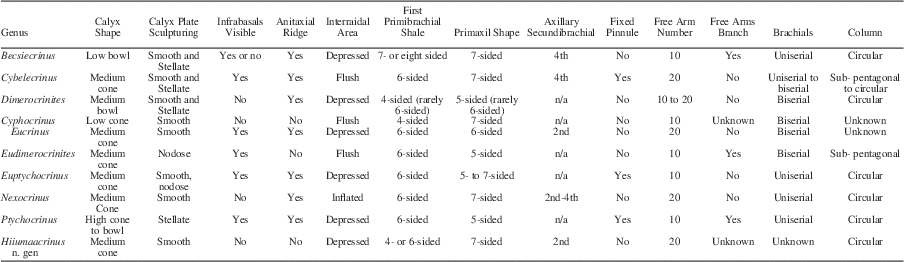
Among Silurian Dimerocrinitidae, Hiiumaacrinus is most similar to Cyphocrinus (middle Silurian, United States), Eucrinus (early Silurian to perhaps Early Devonian, United States and Australia), and Nexocrinus (early Silurian to perhaps Early Devonian, United States and Australia) (Table 2). Cyphocrinus has a low cone-shaped calyx, infrabasals not visible in lateral view, anitaxial ridge absent, interradial areas flush with rays, first primibrachial tetragonal, primaxil heptagonal, and 10 arms; Eucrinus has a medium cone-shaped calyx, infrabasals visible in lateral view, an anitaxial ridge, interradial areas depressed, first primibrachial hexagonal, primaxil pentagonal, and 20 arms; and Nexocrinus has a medium cone-shaped calyx, infrabasals not visible in lateral view, an anitaxial ridge, interradial areas inflated, first primibrachial hexagonal, primaxil heptagonal, and 20 arms. In contrast, Hiiumaacrinus has a low bowl-shaped calyx, infrabasals not visible in lateral view, anitaxial ridge absent, interradial areas depressed, first primibrachial tetragonal or hexagonal, primaxil heptagonal, and 20 arms.
Diagnostic characters for Silurian genera of the Dimerocrinitidae.

Hiiumaacrinus vinni new genus new species
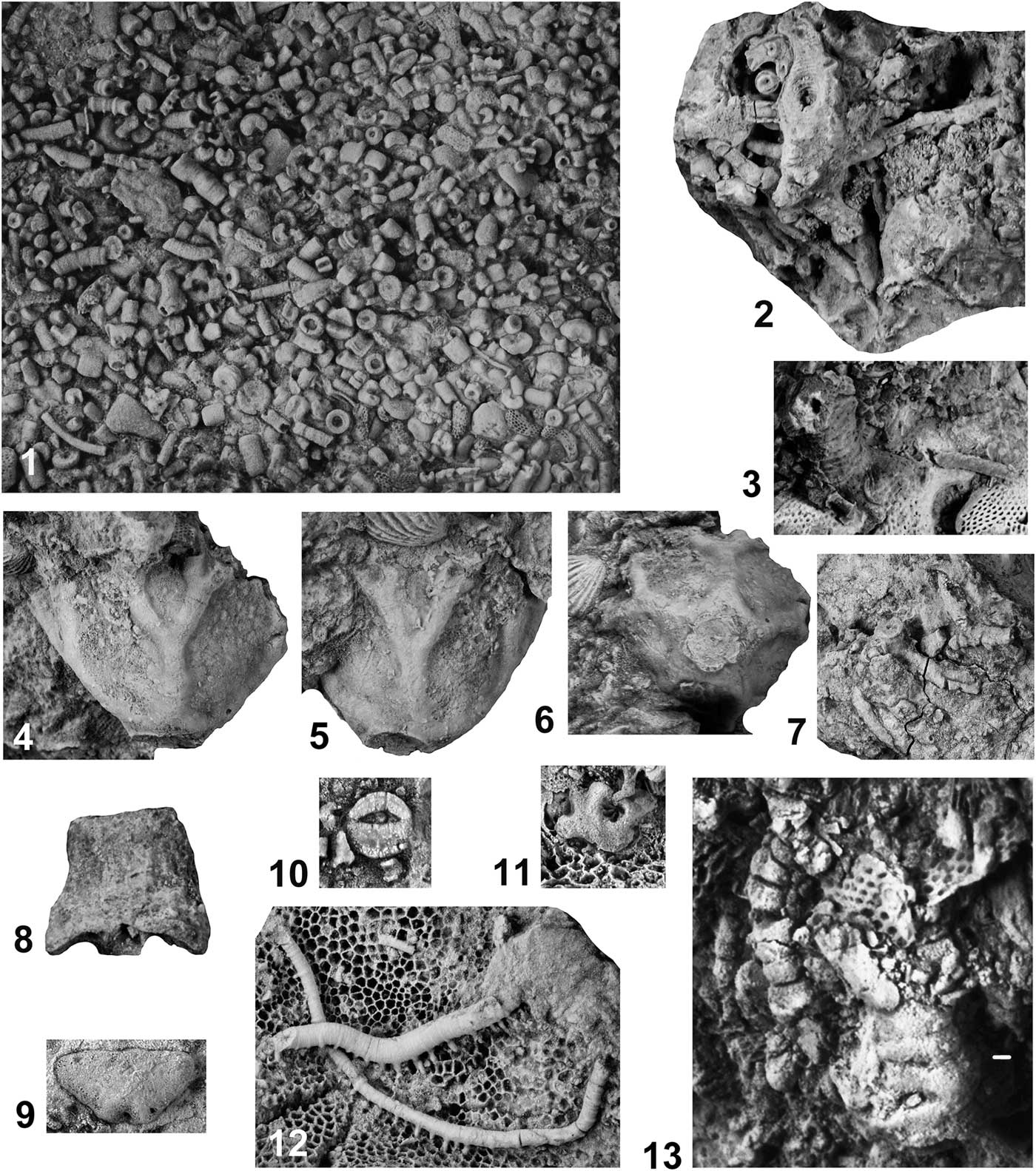
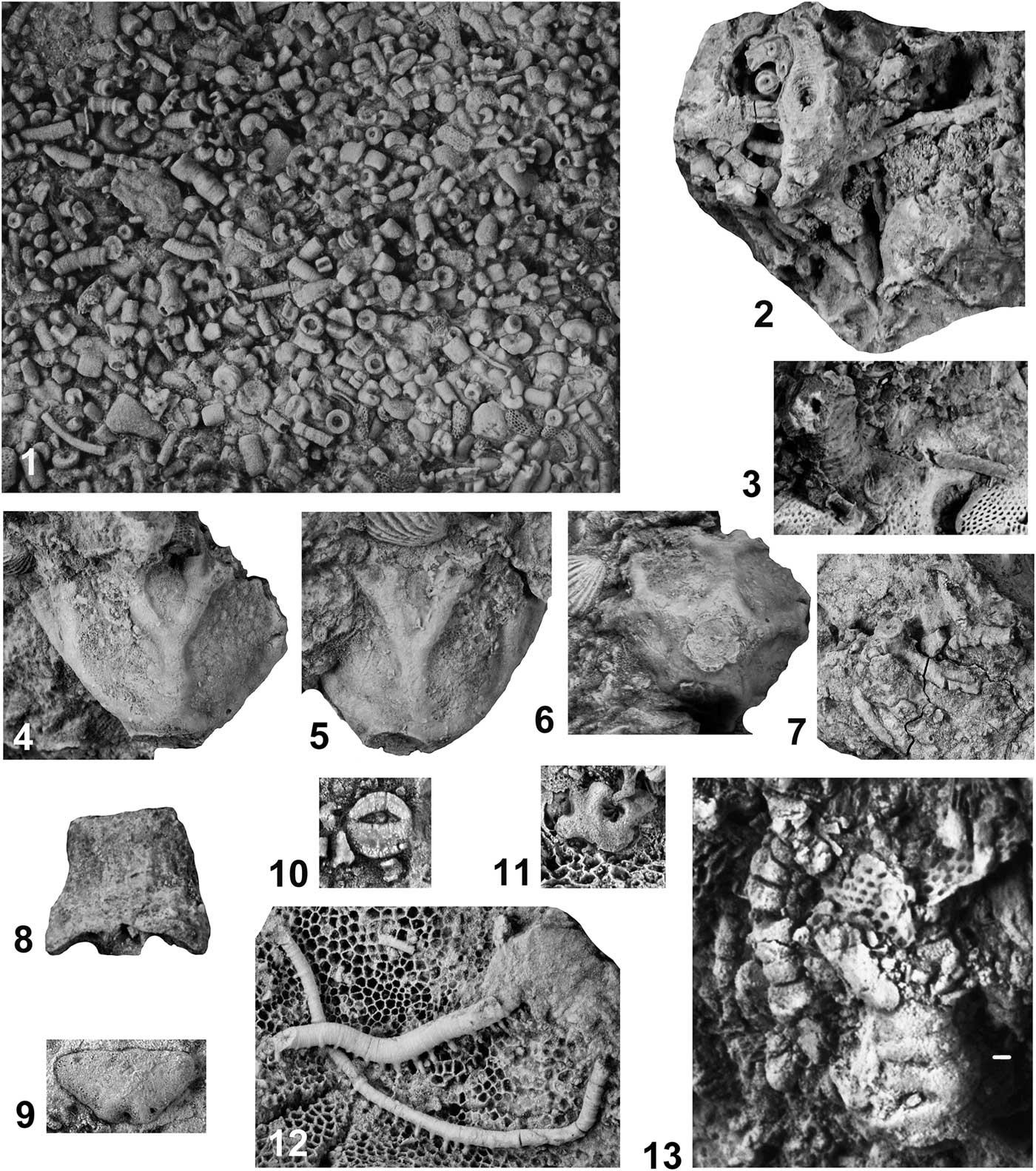
Rhuddanian crinoids from western Estonia: (1) Bedding surface composed primarily of crinoid columnals and pluricolumnals (×2.0) (TUG 1719-24); (2) Holdfast A: virgate radices anchored in coarse skeletal debris (×1.5) (TUG 1719-13); (3) Holdfast D: simple discoidal holdfast cemented to a bryozoan (×3.0) (TUG 1719-20); (4–6) Hiiumaacrinus vinni n. gen. n. sp. compare to Figure 3.4 (×2.5) (TUG 1719-1); (4) D-ray lateral view of calyx, (5) E-ray lateral view of calyx, (6) basal view of calyx; (7) Holdfast B: dendritic holdfast in coarse skeletal debris (×2.0) (TUG 1719-17); (8) radial circlet of Calceocrinidae gen. sp. indeterminate, compare to Figure 3.2 (×3.5) (TUG 1719-2); (9) basal circlet of Calceocrinidae gen. sp. indeterminate, compare to Figure 3.3 (×3.5) (TUG 1719-3); (10) Eomyelodactylus sp. indeterminate columnal (×4.5) (TUG 1719-4); (11) Holdfast C: Simple discoidal holdfast cemented to a tabulate coral (×2.5) (TUG 1719-18); (12) Two examples of Holdfast E: Stoloniferous holdfasts cemented to a tabulate coral (×1.5) (TUG 1719-21); (13) Protaxocrinus estoniensis n. sp. lateral view of partial crown, top of radial plate indicated by line, compare to Figure 2.4 (×5.0) (TUG 1719-5).
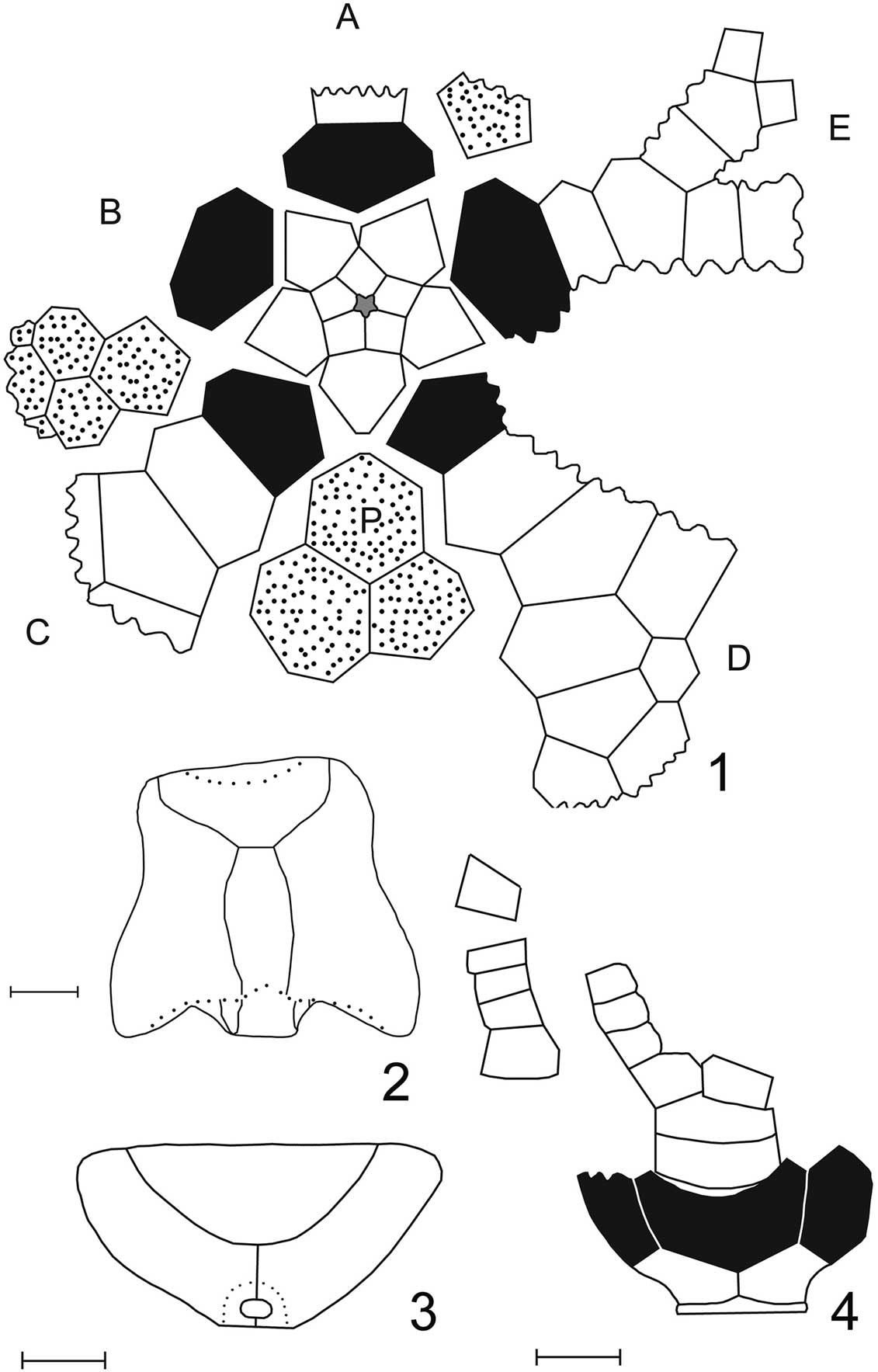
Camera lucida drawings of Rhuddanian crinoids from western Estonia (scale bar for all figures represents 1 mm). (1) Hiiumaacrinus vinni n. gen. n. sp., note distinct CD interray compare to Figure 2.4–2.6 (TUG 1719-1); (2) Radial circlet of Calceocrinidae gen. sp. indeterminate, compare to Figure 2.9 (TUG 1719-2); (3) Basal circlet of Calceocrinidae gen. sp. indeterminate, compare to Figure 2.3 (TUG 1719-3); (4) Protaxocrinus estoniensis n. sp., compare to Figure 2.13, note infrabasal circlet added in drawing but not present in Figure 2.13 (TUG 1719-5).

Holotype
The holotype and only known specimen is TUG 1719-1.
Diagnosis
See generic diagnosis.
Occurrence
Hilliste Formation (Rhuddanian); Hilliste Quarry, Hiiumaa Island, Estonia.
Description
Calyx medium in size; low bowl shape (Fig. 2.4); wide, convex ridges from basal plates to radial plates and distally as median ray ridges (Fig. 2.4); basal plates with a discontinuous proximal ridge (Fig. 2.5), otherwise smooth sculpturing.
Infrabasal circlet not visible, being completely hidden within the basal concavity (Figs. 2.6, 3.1). Five infrabasal plates. Basal circlet visible on side of calyx, ∽13% of calyx height; basal plates five, equal in size, except for a slightly larger CD basal plate. Radial circlet 13% of calyx height, interrupted in posterior. Radial plates five, heptagonal, ∽1.9 times wider than high.
Normal interrays in contact with tegmen, depressed, plate sculpturing smooth; first interradial plate hexagonal, slightly wider than high, smaller than radial plates and first primibrachials. Second range typically with two plates, incompletely known, but proximally 1-2-3-? (Fig. 3.1).
Posterior interray poorly preserved. Primanal hexagonal, approximately as large as radial plates, interrupts the radial circlet with a very narrow suture between the CD basal plate and the primanal; anitaxis and anitaxial ridge absent, plating in CD interray incompletely known, but P-2-3-? (Fig. 3.1).
First primibrachial fixed, hexagonal, ∽2.0 times wider than high, approximately same size as radial plate; second primibrachial axillary. Small intrabrachial plates may be between proximal secundibrachials beginning on shoulders of first secundibrachials. Second secundibrachial axillary, at least one fixed tertibrachial. Small intrabrachial plates between fixed tertibrachials. Tegmen unknown.
Free arms 20; other details unknown.
Proximal column circular, narrow symplectial crenularium. Lumen small and pentalobate where entering calyx.
Etymology
The species name recognizes Olev Vinn for his significant contributions to the Silurian paleontology of Estonia.
Remarks
The calyx of the single specimen of Hiiumaacrinus is only partially preserved, and sutures can be very difficult to identify. Thus, the plate diagram is partially interpretation.
Measurements
Holotype (TUG 1719-1): calyx height, 9.5 mm; distal calyx width, 15.5 mm; basal plate height, 2.0 mm; basal plate width, 3.6 mm; radial plate height, 2.0 mm; radial plate width, 4.5 mm.
Subclass Disparida Moore and Laudon, Reference Moore and Laudon1943
Order Calceocrinida Ausich, Reference Ausich1998a
Family Calceocrinidae Meek and Worthen, Reference Meek and Worthen1869
Calceocrinidae gen. spp. indeterminate
Description
Specimen TUG 1719-2: Radial circlet abanally-adanally compressed, trapezoidal with medial restriction in aboral view and entire radial circlet concave with the proximal and distal ends high and the middle depressed (Figs. 2.8, 3.2). A and D radials majority of radial plate circlet, E inferradial and E superradial presumably in narrow contact. E inferradial 13% of proximal margin of radial circlet along hinge; E superradial 100% of aboral cup distal margin, supports E-ray arm. A and D lateral arms from upper lateral facet of A and D radial plates, two lower lateral facets on A and D radial plates support B and C inferradials. Projections from the radial circlet divide the ligament pit on the proximal margin of the radial circlet. Three arms. Height of the radial circlet is 5.2 mm, its proximal width is 5.4 mm, and its distal width is 3.4 mm. The overall shape of the radial circlet of Hiiumaacrinus is unique for a Silurian calceocrinid, i.e., a medial constriction in aboral view and the entire radial circlet concave. This abanally-abanally compressed radial plate circlet with a short E-ray superradial-inferradial suture is similar with the following Silurian calceocrinids: Calceocrinus, Diaphorocrinus, and Browericrinus.
Specimen TUG 1719-3: Basal circlet comprised of three basal plates, only two in column concavity; all three basal plates part of distal margin of basal circlet with basal plate occupying 75% of this margin (Figs. 2.9, 3.3). Basal circlet height is 2.4 mm, and width is 4.7 mm.
Ten of the fifteen genera of Silurian calceocrinids have a basal circlet comprised of three basal plates. Thus, the basal circlet alone provides little support for generic assignment of this specimen. Of the three Silurian genera mentioned above with a radial circlet similar to TUG 1719-2, only Diaphorocrinus has a basal circlet comprised of three basal plates. However, because it is unknown whether the Hilliste Quarry calceocrinid basal circlet and radial circlet are from the same taxon and because arm characters (that comprise nearly half of Silurian calceocrinid characters) are unknown, these calceocrinid specimens are left in open nomenclature.
Occurrence
Hilliste Formation (Rhuddanian); Hilliste Quarry, Hiiumaa Island, Estonia.
Remarks
An isolated radial circlet and a basal circlet are known from the Hilliste Quarry. These two specimens occurred at separate positions within the quarry and are preserved very differently, with the radial circlet a darker calcite with pyrite overgrowths, and the basal circlet preserved with a whiter calcite. It is highly unlikely that these two fossils belonged to the same individual, and it is impossible to know with certainty whether these two specimens belong to the same taxon.
Order Myelodactylida Ausich, Reference Ausich1998b
Family Myelodactylidae Miller, Reference Miller1883
Genus Eomyelodactylus Foerste, Reference Foerste1919
Type species
Myelodactylus (Eomyelodactylus) rotundatus Foerste, Reference Foerste1919.
Diagnosis
Myelodactylid with a pentameric column.
Remarks
Eomyelodactylus columnals are distinctive, being the only crinoid columnals that are elliptical in outline and pentameric. This crinoid belongs to the Myelodactylidae, which is a unique disparid clade with the column coiled planispirally and the crown inside the coil. Individual columnals have a bilateral symmetry plane that is parallel with the plane of coiling. Accordingly, there are outer, inner, and lateral sides of a columnal (with respect to the coiled column).
Species of Eomyelodactylus are diagnosed on morphology of proxistele columnals, mesistele columnals, and various attributes of the cirri (rhizoids) branching from columnals (Ausich and Copper, Reference Ausich and Copper2010). With a single columnal known from the Hilliste quarry, a species designation is not possible, so this taxon is left in open nomenclature.
Previously, Eomyelodactylus was known only from the Katian and Llandovery of North America (Ausich and Copper, Reference Ausich and Copper2010), and other myelodactylids are present in the late Llandovery of Baltica (Donovan and Franzén-Bengtson, Reference Donovan and Franzén-Bengtson1988).
Occurrence
Hilliste Formation (Rhuddanian); Hilliste Quarry, Hiiumaa Island, Estonia.
Eomyelodactylus sp. indeterminate
Material
The individual columnal assigned to this taxon is TUG 1719-4.
Remarks
A single columnal belonging to Eomyelodactylus is known from the Hilliste Quarry (Fig. 2.10). This columnal is elliptical with a slightly longer axis parallel to the plane of coiling. It is pentameric with a small wedge-shaped mere on the lateral side of the columnal. Sutures are present approximately along the short diameter of the columnal, and larger meres on the inner half of the columnal have a suture along the inner radius of the long axis of the columnal. The lumen is very large, occupying ∽80% of the column along the short axis, and it is lenticular in shape with the outer side more convex.
Occurrence
Hilliste Formation (Rhuddanian); Hilliste Quarry, Hiiumaa Island, Estonia.
Measurements
This columnal is only slightly elliptical with the longer and shorter diameters being 1.9 mm and 1.8 mm. The maximum diameter of the lumen is parallel to the shorter diameter of the columnal. The maximum width of the lumen is 1.2 mm, and the maximum width of the shorter lumen diameter is 0.4 mm.
Subclass Flexibilia von Zittel, Reference von Zittel1895
Order Taxocrinida Springer, Reference Springer1913
Superfamily Taxocrinoidea Angelin, Reference Angelin1878
Family Taxocrinidae Angelin, Reference Angelin1878
Genus Protaxocrinus Springer, Reference Springer1906
Type species
Taxocrinus ovalis Angelin, Reference Angelin1878; by subsequent designation.
Occurrence
Late Ordovician (Katian) to Early Devonian (Gedinnian); Québec, Ontario, Missouri, Illinois, Tennessee, West Virginia, England, Sweden, Czech Republic, and western Estonia.
Protaxocrinus estoniensis new species
Holotype
The holotype for Protaxocrinus estoniensis is TUG 1719-5, the only known specimen.
Diagnosis
Infrabasal circlet 30% of aboral cup height, no fixed interradial plates, two primibrachials, five secundibrachials, arms divide at least twice, dorsal surface of free brachials convex, lateral surface of free brachials smooth.
Description
Crown small (Fig. 2.13). Aboral cup low cone shaped, distal width-to-height ratio ∽1.6, plates convex, smooth.
Infrabasals three; infrabasal circlet ∽30% of aboral cup height. Basals five, hexagonal, approximately as high as wide, considerably smaller than radials; basal circlet ∽30% of aboral cup height. Radials five, heptagonal in all rays, as known, 1.5 times wider than high; radial circlet ∽40% of aboral cup height (Fig. 3.4). Radial facets peneplenary, declivate, 69% of distal radial plate width; radial facet topography not known.
CD interray unknown; fixed interradial plates absent.
Arms branch isotomously at least two times (Fig. 3.4); no fixed brachials. Second primibrachial axillary, primibrachitaxis not fixed in calyx; nonaxillary primibrachials ∽3.0 times wider than high, primaxil 1.8 times wider than high. Secundibrachial five axillary; brachials rectangular uniserial, twice as wide as high, aborally convex.
Column unknown.
Etymology
The species name recognizes the occurrence of this crinoid in Estonia.
Occurrence
Hilliste Formation (Rhuddanian); Hilliste Quarry, Hiiumaa Island, Estonia.
Measurements
Holotype (TUG 1719-5): Crown height, 6.8 mm*; aboral cup height, 3.0 mm; aboral cup proximal width, 3.0 mm; aboral cup distal width, 4.1 mm.
Discussion
TUG 1719-5 is a small specimen; however, its wide, low brachials indicate that this specimen had reached its adult morphology. Unfortunately, it is partially buried in matrix, and the posterior is not exposed; thus, this important aspect of crinoid morphology is not known. The specimen is both small and quite delicate. Initial sample preparation resulted in breaking the infrabasal circlet off the aboral cup. Further preparation was not attempted. Despite being detached from the specimen, the infrabasal circlet is intact and is comprised of three plates: one azygous plate and two larger zygous plates. This species is placed within the Flexibilia on the basis of the infrabasal circlet and its similarity to Protaxocrinus paraios Ausich and Copper, Reference Ausich and Copper2010.
Protaxocrinus estoniensis lacks many typical flexible characters, such as fixed interradial plates and patelloid processes. Protaxocrinus estoniensis is similar to P. paraios, which is one of the few Ordovician-Silurian boundary-crossing crinoid species and is known from the Hirnantian and Rhuddanian of Anticosti Island, Quebec, Canada (Ausich and Copper, Reference Ausich and Copper2010). Protaxocrinus paraios and P. estoniensis are similar in their small size, lack of fixed interradial plates, and lack of patelloid processes. They differ in arm branching and size of the infrabasal circlet. Pariocrinus paraios has the third primibrachial axillary and an infrabasal circlet 25% of the aboral cup height, whereas P. estoniensis has the second primibrachial axillary and an infrabasal circlet 30% of the aboral cup height.
In addition to the holotype, several disarticulated radial plates, tentatively assigned to P. estoniensis?, are known. These specimens are TUG 1719-6 to TUG 1719-12 and are small radial plates with an ovate, declivate, peneplenary radial facet. Some of these radial plates are larger than the radial plates of the holotype, so they may represent another taxon.
Crinoidea spp. indeterminate
Discussion
Two distinct articulated crowns with stem attached (TUG 1719-25 and TUG 1719-26) are too damaged to allow any identification or adequate illustration. Five different types of holdfasts are described below, and multiple different types of columnals exist in this fauna. Because holdfast morphology can change through ontogeny, columnal morphology can change along a single column, and column and holdfast types are unknown for the species described above (with the exception of Eomyelodactylus), it is deemed inadvisable to speculate on how many additional species are represented by columnals and holdfasts. However, it is clear that the crinoid richness is considerably higher than suggested by the four or five taxa described above.
Column variability includes specimens ranging from high and narrow to wide and short columnals, the latus may have smooth sculpturing or various nodes and ridges, and columnals may have a narrow or wide epifacet. As a whole, both homeomorphic and heteromorphic columns are present. The lumina vary among specimens from being wide to narrow and circular to pentalobate (a collection of pluricolumnals is deposited as TUG 1719-27). The six types of holdfasts are described below with names applied by Brett (Reference Brett1981).
Holdfast A: Virgate radices (Fig. 2.2). Terminal holdfast with robust radices that anchored into unconsolidated sediment, the terminal portion of some radices are cemented to bioclasts. The columnals are relatively large in diameter, and the lumen is pentalobate and relatively wide. The incomplete diameter of this holdfast is 23 mm, and the diameter of the distal columnals is 7.4 mm (four specimens are known: TUG 1719-13–TUG 1719-16).
Holdfast B: Dendritic radices (Fig. 2.7). Terminal holdfast with slender, bifurcating radices that anchored into unconsolidated sediment. The columnals are relatively small in diameter, and the lumen is pentalobate and relatively narrow. The very incomplete diameter of this holdfast is 10.1 mm, and the diameter of the distal columnals is 2.3 mm (TUG 1719-17).
Holdfast C: Simple discoidal holdfast cemented to hard substratum (Fig. 2.11). Small, subelliptical with short, robust stereomic projections. Width of distal columnals with distal columnal 40% of holdfast width. The columnals are circular, and the lumen is pentalobate. The specimens of this holdfast type are cemented to tabulate corals. The diameter of this holdfast is 4.5 mm, and the diameter of the distal columnals is 1.8 mm (two specimens are known: TUG 1719-18 and TUG 1719-19).
Holdfast D: Simple discoidal holdfast cemented to hard substratum (Fig. 2.3). Large with long, narrow stereomic projections. Distal columnal width is 20% of holdfast width. The columnals are pentagonal, and the lumen is pentalobate. The specimen of this holdfast type is cemented to a bryozoan. The diameter of this holdfast is 16.2 mm, and the diameter of the distal columnals is 3.4 mm (TUG 1719-20).
Holdfast E: Stoloniferous holdfast cemented to hard substratum by fine, short stereomic projections (Fig. 2.12). Probably more than one species used this holdfast type, because examples include holdfasts comprised of narrow columnals with the holdfast straight (TUG 1719-21 and TUG 1719-22) and holdfasts composed of wide columnals with a coiled holdfast (TUG 1719-23). Holdfast segments of more narrow, straight holdfasts may exceed 40 mm. In both types, the columnals are circular, and the lumen is pentalobate. Specimen of this holdfast type cemented to either tabulate corals or stromatoporoids. The proximal columnals of the narrow, straight holdfasts have a diameter of 1.5 mm and 2.3 mm in the two examples known.
Acknowledgments
We thank A. Bancroft, R. Ekka, J. Novak, M. Peter, J. Thompson, and O. Vinn for help with field work. The reviews by B. Deline, S.K. Donovan, and D.L. Meyer significantly improved an earlier draft of this manuscript. Support for this research was from the National Geographic Society (NGS 60031112), The College of Wooster Luce Fund, The Ohio State University, and the National Science Foundation DEB 1036416 (W.I.A.).