INTRODUCTION
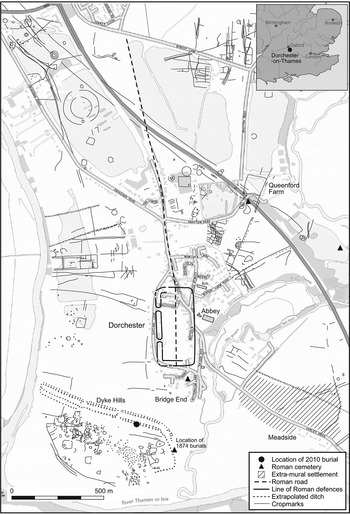
The Dorchester Dyke Hills, a major earthwork monument probably of later Iron Age date,Footnote 1 consist of a pair of substantial banks with an intervening ditch giving a combined width of a little over 60 m, and with a maximum extant height of c. 5.5 m. The banks, aligned for the most part roughly east–west but turning to the south-east at their eastern end, enclose the northern side of a large area (c. 45 ha) defined to the west and south by the River Thames and to the east by its tributary the River Thame, just south of the Roman ‘small town’ and modern village of Dorchester on Thames ( fig. 1). The location is overlooked from the south by the Wittenham Clumps, including the Iron Age hillfort of Castle Hill,Footnote 2 which lie immediately adjacent south of the Thames. The Dyke Hills monument lies mostly on gravels of the first (Northmoor) river terrace. In the 1870s human remains were recovered from several locations in the Dyke Hills in the course of levelling of parts of the monument. These remains included two burials found towards the south-eastern end in 1874. The potential significance of these burials was recognised early on, but the finds themselves came to greater prominence after their publication in 1954,Footnote 3 along with material from another grave found just north of the village ‘before 1914’,Footnote 4 owing to the presence of an unusual combination of late Roman and early Anglo-Saxon artefacts amongst the apparently-associated grave goods. The contents of the three graves then formed the starting point for a seminal article by Sonia Hawkes and Gerald DunningFootnote 5 presenting a theory relating certain types of metalwork, particularly belt fittings, to the employment of Germanic mercenaries, whose womenfolk were identified by the presence of Anglo-Saxon brooches, in the latest phases of Roman Britain; the paper included a gazetteer of analogous material, principally a range of late Roman belt buckles and other fittings. This work in turn prompted the attention of a generation of scholars concerned with aspects of the transformation of late Roman Britain into early Anglo-Saxon England. The interpretation was developed further in subsequent work.Footnote 6 More recently, these discoveries have been viewed in a wider range of different ways,Footnote 7 but the intrinsic importance of the Dyke Hills burials remains, and is emphasised by the continued scarcity of further examples of burials of this type in Britain.
Location of Dorchester on Thames, principal cropmarks and key local sites named in the text.

In late December 2009 a dog was lost in one of the numerous rabbit holes that pepper the Dyke Hills. Despite the status of the site as a Scheduled Ancient Monument a small tracked mechanical excavator was employed to assist in the recovery of the dog. This was used to excavate an area of intensive rabbit burrowing in the upper part of the inner (southerly) bank of the Dyke Hills, located at c. SU 57570 93625. The dog was not found, but in the course of the machine work human remains were recovered. The latter were examined by Dr Simon Mays of English Heritage and shown to represent parts of at least two individuals, principally an adult male, one of whose bones had distinct green staining, probably as a result of association with a copper-alloy object. A radiocarbon determination from the right fibula of this individual gave a date range of cal a.d. 240–430 at 95% confidence (SUERC-29382). In view of the importance of the 1874 burials, which were found some 250 m south-east of the new discoveries, it was felt particularly desirable that this disturbed area of the Dyke Hills should be examined for further evidence relating to what could be another significant burial of late Roman date.
After discussion with English Heritage, and with the kind permission of the landowner, Miss Anne Bowditch, a programme of work was agreed. With regard to the management of the monument the principal objective was to achieve appropriate reinstatement of its disturbed part, but clarification (if possible) of the context and character of the burial(s) was also a very high priority. The work was undertaken in early September 2010 by a team of postgraduate students and volunteers associated with the ongoing ‘Discovering Dorchester’ projectFootnote 8 under the direction of the writer. The purpose of the present paper is to present an account of the principal late Roman finds resulting from this exercise, with some preliminary comments on their wider context. A report dealing with other aspects of the work will be presented elsewhere.Footnote 9
THE EXCAVATION
The excavation involved the removal and re-examination of as much of the machine-disturbed soil as was possible (estimated at about 70 per cent) within the limited amount of time (one week) that could be allotted to the work. This was done by hand, mainly using mattocks and shovels. To improve recovery rates, particularly of fragmented human bone, a substantial proportion of the excavated soil, which was of a suitable sandy nature, was sieved. About half of the re-excavated soil was examined in this way, but the work was very time-consuming and it was not possible to sieve all the material. In addition, a metal-detector was used in the later stages of the work to ensure that no significant metal objects had been missed. After recording, the re-excavated soil was replaced and compacted at regular intervals using a tracked 360-degree excavator. New turf was laid upon the compacted surface.Footnote 10
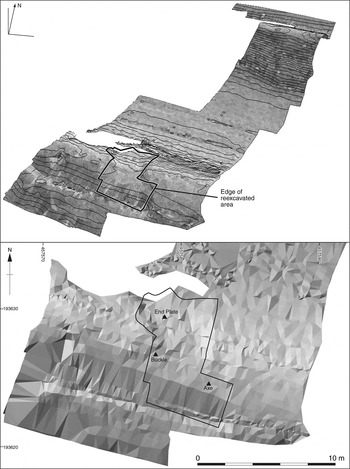
The original machine excavation, guided largely by the presence of rabbit burrows, had covered an irregular area with maximum estimated dimensions of c. 10 m north–south and east–west. The depth of the machine disturbance was very variable, being up to c. 1.3 m below ground level in line with the crest of the bank. The base of the disturbance was very uneven since it reflected inter alia the position of rabbit burrows, insofar as they could be observed by the driver of the excavator. The re-excavation encompassed a subrectangular area up to 8.8 m north–south and 8 m east–west ( fig. 2). This extended as far as the northern limit of the disturbance, at a point some 3 m north of the notional crest of the bank, which is relatively level at this point. The southernmost part of the disturbed area, close to the existing fence separating the southern rampart from the pasture field to the south, was not examined. The eastern edge of the re-excavated area, offset in plan, was partly straightened to enable a coherent record of the upper profile of the bank to be made. This involved the removal of part of two very small areas of previously undisturbed rampart material. The undisturbed rampart was examined to a maximum depth of c. 1.15 m at the eastern edge of the re-excavated area in the vicinity of the crest of the bank. The earliest deposit encountered was a compact yellowish brown sandy clay, overlain in turn by yellowish brown sand and gravel, compact dark brown sandy loam, and the main upper rampart deposit of yellowish brown loamy sand and gravel, up to 0.60 m thick in places beneath the topsoil. Two sherds of undiagnostic later prehistoric pottery were recovered from the main upper rampart deposit close to the top of the bank, and were the only finds not from disturbed soil.
Isometric profile of the Dyke Hills earthworks and location of area examined in 2010.

The redeposited material was very mixed, consisting principally of loose loamy sand, but with occasional patches of more compacted sandy clay and sandy loam, the latter representing the disturbed topsoil covering of the bank. There was no trace of any surviving grave cut or cuts. Nevertheless the presence of at least one grave is strongly suggested by the recovery of further quantities of human bone and of late Roman metal objects, the latter probably all derived from a single grave (see further below). Finds were distributed across the whole of the re-examined area, but more human bone was recovered from the southern than the northern half. The three principal metal objects recovered, a buckle and an end plate or strap end of copper alloy from a belt set, and an iron axe head, were also widely distributed across the disturbed area. Together these observations suggest that, as would be expected, there was relatively little system behind the removal and replacement of earth in the course of the attempted dog recovery.
THE FINDS
The finds were extremely mixed. Only those considered to relate to the late Roman burial are detailed here. All the copper-alloy pieces assigned to the belt set were in similar condition, well-preserved with a good patina. A couple of small fragments of copper alloy of uncertain function were in very different condition; they are considered not to belong to the belt set and are not discussed here. Other finds included 12 pieces of struck flint of various dates, and 22 prehistoric pottery sherds including Beaker as well as Iron Age material. The only Roman pottery sherd was from a flanged bowl (Young type C51) of Oxford colour-coated ware. The form is dated a.d. 240–400,Footnote 11 potentially reasonably close in date to the burial(s), and it is conceivable that the sherd was incorporated in a grave fill, although other mechanisms could account for its arrival here. No other fragments of this vessel were located, however. The sherd edges were old breaks and the type would be an unusual one in a late Roman burial context, in which beakers and jars tended to be favoured;Footnote 12 it is thus highly unlikely that the sherd was originally part of a grave good. A variety of post-medieval to modern finds included fragments of brick and tile, mortar, glass and metal objects. Fragments of fired clay could have been of any date, as could pieces of animal bone. None of the latter was of a character that clearly suggested meaningful association with the burial, but fragments of a cattle scapula had green staining, so this bone was probably from the fill of the grave, though whether deliberately deposited or an incidental element within the fill cannot be known.
THE LATE ROMAN METALWORK (FIGS 3–7)
The metalwork was cleaned in the Ashmolean Museum conservation department by Stephanie Ward. In the course of this work analysis by benchtop XRF was undertaken by Dr Andrew Shortland of Cranfield University, adding useful information which is incorporated in the descriptions of the objects below, showing the copper-alloy objects to be of bronze, and detailed in the online Appendix 1. The objects form a grave group of a type well recognised on the Continent, examples of which were discussed by Hawkes and Dunning in their 1961 paper, but which have since been the subject of several major reviews.Footnote 13 These provide a framework for understanding the current material, but a comprehensive search of recent continental literature for further individual comparanda, while certainly desirable, has not been undertaken as part of the present work.
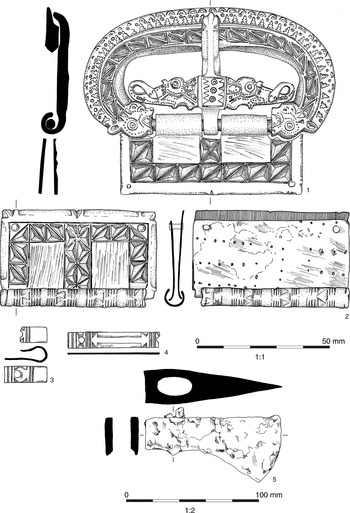
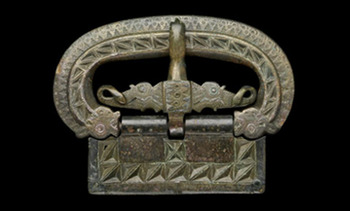
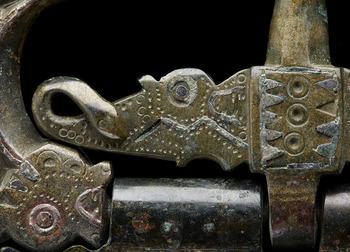
1. Buckle, bronze (SF 10018; AN 2011.33.1; figs 3–5). Maximum overall dimensions 95 by 71 mm. Width of buckle loop 95 mm. The buckle has a wide, heavy loop with a slightly stepped section. The outer part of the loop has three concentric rows of fine punched decoration. From the exterior these are a row of semicircular dots each surrounded by a semicircular line; next a row of very small circles, placed between the upper parts of the innermost row of punches, which resemble stylised Christmas trees. The main (inner) part of the buckle loop is decorated with relief-cast (‘chip carved’) cells, rectangular with a diagonal division. The cell borders and diagonal dividing bars are grooved on the top and in places the grooves retain traces of a black inlay which analysis shows to be niello. The inner ends of the broad loop adjacent to the buckle plate terminate in animal heads with gaping jaws, the details of the heads being executed with a variety of inlaid grooves, fine punched dots and larger punched elements. The eyes are in very slightly raised relief, the wide outer ring of the eyes and the gaping mouth and teeth are also inlaid ( fig. 5). Macroscopic inspection suggests that this inlay is more silvery in colour than the niello contained within the grooves bordering the relief-cast cells, but this distinction is not clearly supported by the XRF analysis (see online Appendix 1).
Dyke Hills: late Roman metalwork, Cat. Nos 1–5. Scale 1:1, except No. 5 at 1:2.

The bronze buckle after cleaning, Cat. No. 1. Scale 1:1. (© Ashmolean Museum, University of Oxford)

Detail of decoration on the buckle. (© Ashmolean Museum, University of Oxford)

The buckle plate is made of a single piece of sheet, rolled over the bar of the buckle loop and secured to the belt with two small rivets, still in situ. Fragments of leather survive between the two faces of the plate. The margins of the plate are largely plain, but slightly bevelled and with very small nicks defining the corners of the plate and the mid-point in line with the buckle pin. Inset from the edge is a single row of relief-cast cells, divided diagonally in the same manner as those on the buckle loop, but each roughly square, except for the cells on the short sides of the plate, articulating with the animal heads of the loop, which are more elongated. In the centre of the plate leading from the row of cells to the back of the pin is another elongated cell, this time with two diagonals creating a St Andrew's cross effect. All the cell borders and divisions are grooved in the same way as those on the buckle loop, and again fragmentary niello inlay survives in some of these grooves.
The buckle pin is elaborate. The tip, which is reasonably worn, appears to represent an animal head with a snout and ears. The centre takes the form of a rectangular block on the axis of the pin with three ring-and-dot motifs in the centre and a marginal groove all round, with triangular shapes projecting in from the groove on the long sides, four on one side and five on the other. Inlay survives in some of these and in parts of the surrounding groove. Facing each side of the block is an open-mouthed animal. Their execution is closely comparable with that of the animal heads on the buckle loop, with details of the eyes, open mouths and teeth again inlaid, also with material of silvery appearance. The narrow tails of the animals are bent back over their bodies and each terminates in a snake's head. Like the tip of the pin, these appear to be worn.
The buckle belongs to Hawkes type IIIA, the same general type as the 1874 buckle from Dyke Hills, but very different in other respects. The animals projecting from the pin are a distinctive feature of Böhme's Typ Misery,Footnote 14 which has elaborately decorated buckle plates, but also occur on some examples of his form Cuijk-Tongeren, to which the present piece can be assigned, although this is somewhat misleadingly defined as having a smooth or punch-decorated plateFootnote 15 despite the appearance of relief-cast decoration on the plates of a number of buckles assigned to this form. These include one of the type-site buckles from Cuijk, Noord Brabant (Netherlands),Footnote 16 which has several striking similarities with the Dyke Hills buckle. The two pieces are different in a number of details, but the similarities are such as to suggest that they might have derived from the same workshop. In Markus Sommer's more detailed typology this is Sorte 1 Form C Typ f Variant 5.Footnote 17 This is the only buckle in Sommer's corpus which has relief-cast decoration on the buckle loop, and the configuration of the rectilinear arrangement of further decoration of this type on the buckle plate is closely similar to that of the Dyke Hills buckle. Relief-cast ‘cells’ are a feature on the loop of a number of the buckles in H.W. Böhme's more wide-ranging corpus, mainly of Cuijk-Tongeren form, including the Tongeren type example, which also has this treatment on the buckle plate, as well as being comparable to the Dyke Hills buckle in having biting beasts on each side of the pin.Footnote 18 The original pin of the Cuijk buckle is lost, but it is quite possible that it had projecting animal heads.Footnote 19 The form of the animals projecting from the buckle pin can vary considerably,Footnote 20 but a version of the inward facing beast with curved snake's head tail is seen in a number of examples, those from Hemmoor-Warstade and Herstal being most like the Dyke Hills piece.Footnote 21
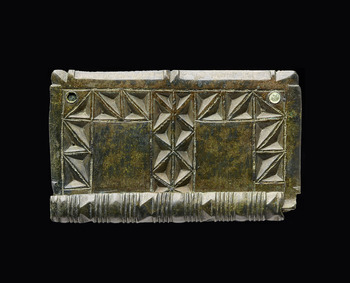
2. End plate, bronze (SF 10004, AN 2011.33.2; figs 3 and 6). Maximum dimensions 58.5 by 36 mm. Composite of three pieces, all of thin sheet. The front (58.5 by 33 mm) has relief cast decoration in the same style as that on the buckle, the cells arranged in an E-shaped pattern as on the buckle plate, but configured slightly differently. Niello inlay survives in some of the grooves defining the cells. The edges are bevelled and have notched decoration similar to but more pronounced than that on the buckle plate. The front is held against the back plate by an open tubular strip with ridged decoration 8 mm in (incomplete) diameter and by two small rivets in the corners, which survive in situ. The tubular strip is quite worn, particularly on its underside. As with the buckle, fragments of leather survive between the two plates. The back plate, 58.5 by 30 mm, is plain, but has clearly been reused from another object. The metal is noticeably different (more yellow) in colour and XRF analysis shows that it is indeed of significantly different composition from the other copper-alloy elements. This plate has rows of very small holes which are aligned at a slight angle to the axis of the piece.
The bronze end plate after cleaning, Cat. No. 2. Scale 3:2. (© Ashmolean Museum, University of Oxford)

3. Looped strip end, bronze (SF 10006; fig. 3). Narrow strip, 6 mm wide, with square cut end. Hole 3 mm in diameter, c. 3.5 mm from the end. The strip is doubled over (extant length 16 mm) and broken across a corresponding hole, the gap between the doubled-over strip at this point being about 2 mm. Pairs of transverse incised lines are set each side of the holes, the edges of the looped part of the strip are roughly bevelled and the margins of the strip adjacent to the holes are treated similarly, creating the effect of triangular notches.
4. Strip fragment, bronze (SF 10019; fig. 3). Fragment of belt stiffener strip as No. 3 above but flat (extant length 34 mm). Like No. 3 the strip is broken across the second hole from the end, but the two pieces do not appear to match exactly; they are presumably from two separate objects of similar type, and certainly component elements of the same belt set.
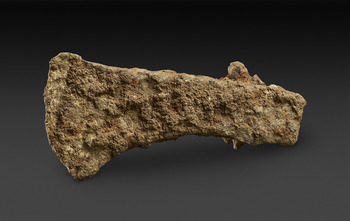
5. Axe head, iron (SF 10011, AN 2011.33.3: figs 3 and 7). Small axe head (maximum length 103 mm, width 25.5 mm) with an almost flat top, straight butt and blade widening to a rounded end 52 mm across. The oval socket for the haft is approximately 26 mm long and 19 mm wide, but its edges are not clearly defined because of corrosion. Two iron ?nails used as wedges to secure the haft are corroded within the socket. The nail closest to the front of the socket extends right through; that nearer the butt is shorter and appears to be more sharply angled. Weight (including corroded wedges) 218 g.
Iron axe, Cat. No. 5. Scale 1:1. (© Ashmolean Museum, University of Oxford)

THE BELT SET
Several reconstructions of the belt set are possible, depending in part on a view of how much has been lost, whether at the time of the original burial (was the belt set complete at that point?) or subsequently, and particularly whether objects such as a strap end were missed in 2010, either through inadequate recovery or because it was not possible to re-examine the entirety of the previously disturbed material. The most economical interpretation of the belt, however, is that there were only two principal components; items 1 and 2. The decorated plate (No. 2) could be seen as an end plate in a composite belt with multiple components, but in this case we have to assume that as a minimum a strap end and probably a further end plate are missing. Alternatively, No. 2 can be seen as the strap end itselfFootnote 22 — typologically such pieces appear to be interchangeable, and the critical question concerns the size of the piece in relation to the size of the buckle loop. In the present case the size of the plate is compatible with use as the strap end, as for example in grave 111 at Oudenburg.Footnote 23 If this was the case, the width of the belt may be indicated by the size of the buckle plate, suggesting a relatively narrow belt only c. 68 mm wide. The fragmentary belt stiffener strips give a little further information. In style they are closely comparable to examples from the belt of the 1874 Dyke Hills burial. This belt, which certainly was significantly broader than its component buckle, had two sizes of belt stiffener of similar pattern, each with three holes — the majority, of larger size,Footnote 24 being c. 90 mm long and the two smaller examplesFootnote 25 c. 55–56 mm long. Assuming the same three-hole form, one widely found in belt sets of this general type, the straight stiffener from the 2010 burial would have been 68 mm long, the same as the width of the buckle plate. The looped fragment presumably carried a suspension ring of some kind. While multiple belt stiffeners are typically present this was not always the case; Lankhills (Winchester) grave 376, for example, contained elements of a belt set which included only a single piece of this kind, albeit rather larger than the recent Dyke Hills fragments.Footnote 26
The similarity of the basic metal, of the stylistic treatment and of the surface condition of the pieces strongly suggests that the extant pieces were all made as components of a single belt. The use of different metal for pieces such as the rivets might suggest reworking, but might equally be related to practical issues such as the use of a rod of bronze of different composition as the basis for the rivets. The reused back plate of the strap end, markedly different in colour from the rest, might have been an original feature, but could equally represent a repair, on the basis that the quality of the belt set as first made is inconsistent with use of obviously recycled materials.
HUMAN REMAINS
By Simon MaysFootnote 27
Material
About 60 per cent of an adult skeleton was recovered. The remains include parts of most of the long bones, about half the vertebral column, parts of the pelvic and shoulder girdles, and a complete cranium. The material was well-preserved but with many fresh breaks. There was green staining on the proximal parts of the left radius and ulna, the distal part of the left humerus (slight), a fragment of a lumbar vertebra, and toward the sternal end of a left rib. This suggests the presence of one or more copper-alloy objects adjacent to these elements. If this was an extended inhumation the object(s) would have lain at about waist level on the left side of the body.
In addition to the above elements, there were also some remains of a child (right mandibular condyle and three cranial fragments). The remains are insufficient to provide any precise estimate of age at death, but the size of the mandibular condyle suggests an individual aged between about eight and twelve years. There were also some fragments of animal bones, including parts of a cattle scapula with green staining, and part of a vertebra from a cow or horse showing butchery marks, as well as a small fragment of burnt animal bone. The remainder of this report is devoted to the adult skeleton.
Age at death
All epiphyses are fused indicating completion of skeletal growth. Dental wearFootnote 28 suggests an age of about 30–40 years. The state of the pubic symphysisFootnote 29 is consistent with this.
Sex
Cranial and pelvic morphologyFootnote 30 indicate male.
Dental formula

. = tooth present in socket; X = socket present, tooth lost post-mortem; A = periapical void at socket; - = socket and tooth missing
Skeletal morphology
Stature is estimated at 174.7 cm (5 ft 9 ins), based on the Trotter and Gleser formula using femur length.Footnote 31 This compares with a mean stature of 170 cm found for male Romano-British burials from some Oxfordshire sites by Harman et al.,Footnote 32 and with 173 cm from fifth- to seventh-century males from Berinsfield, Oxon.Footnote 33
The right forearm bones are notably more robust than the left, although their fragmentary nature makes quantification of this difference problematic. This may be a consequence of right handedness and regular undertaking of manual tasks that involved higher mechanical forces upon the dominant arm (e.g. those involving using tools or weapons designed to be used one-handed).
There is a high degree of genetic control over cranial morphology, and different world populations differ in cranial form,Footnote 34 so quantitative study of cranial morphology has the potential to shed useful light on an individual's ancestry. The Dyke Hills cranium is complete and virtually undamaged meaning that all cranial measurements necessary for this purpose could be taken. Craniometric data classify the ancestry of the Dyke Hills man as White using the methodology of Giles and Elliot, and Gill.Footnote 35 Linear discriminant function analysis using CRANIDFootnote 36 indicates little resemblance to crania from Roman Poundbury, the only Romano-British group on the CRANID database.Footnote 37 CRANID groups the cranium most closely with male crania from Neolithic Denmark. The probability that it groups with the Danish material is given as 0.75; the next closest group being London medieval crania with a probability of 0.15. The probability that it groups with any one of the remaining 72 world populations on the database (which includes material from southern and central Europe and Scandinavia, as well as much non-European data) is <0.04; the probability that it comes from the same population as Poundbury is 0.00001. The probabilities should be interpreted with caution, since they are merely a measure of which of the groups on the CRANID database the Dyke Hills cranium most closely resembles.
The lack of resemblance in cranial morphology with Romano-British material from Poundbury supports the possibility of a foreign origin for the Dyke Hills burial. That the morphology suggests White ancestry indicates that his origin may be in Europe rather than further afield.
Pathological changes
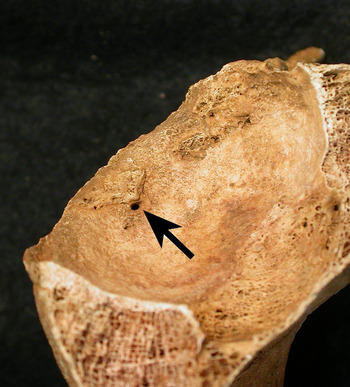
There is a small pore in the articular surface of the right acetabulum. It lies postero-superiorly, about 12 mm from the rim ( fig. 8). It communicates with a cavity in the subchondral bone about 8 mm deep. There is some irregularity of the acetebular surface between this pore and the acetabular rim, and also anterior to it near the acetabular rim, as a result of the formation of sclerotic nodules of bone. These resemble ‘surface osteophytes’ of Rogers,Footnote 38 but there are no other signs of osteoarthritis. The hole in the subchondral bone appears to be a supra-acetabular cyst. In the absence of osteoarthritis, supra-acetabular cysts appear to arise as a result of injury to the acetabular articular cartilage with penetration of synovial fluid into the subchondral bone.Footnote 39 The bony irregularities on the articular surface may also have arisen as a response to trauma of the hip joint.
Postero-superior portion of the right acetabulum. The arrow indicates a pore in the joint surface which communicates with a supra-acetabular cyst.

A post-depositional break in the left femur reveals that a thin lattice of bony trabecular spans the medullary cavity about 290 mm from the proximal end. This probably represents a Harris line. Harris lines arise due to episodes of arrested bone growth. They are associated with episodes of poor nutrition, disease or psychological stress during childhood, but these associations are fairly weak and they may also appear in normal individuals.
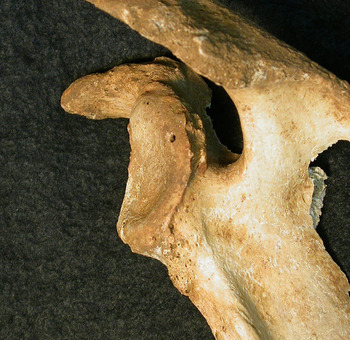
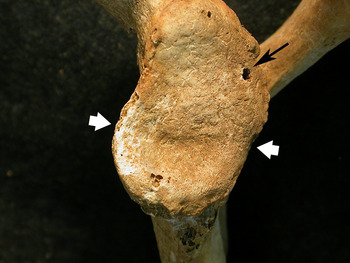
The glenoid surface of the left scapula is mildly retroverted — it is orientated about 30–40 degrees posteriorly ( fig. 9). There is a shallow, horizontal groove on the articular surface about one quarter of the way from the inferior margin ( fig. 10). There is minor osteophyte formation on the posterior margin of the articular surface. Near the posterior margin of the joint surface there is a pore ( fig. 10) which communicates with a cavity that penetrates 8 mm into the subchondral bone. The retroversion of the glenoid surface is probably owing to an anomaly of development of the bone: primary dysplasia of the scapula neck. In such cases there is often a horizontal groove in the joint surface reflecting disjuncture in growth of the two ossification centres which form the glenoid fossa. There appears to be an important genetic component in scapula neck dysplasia.Footnote 40 Scapula neck dysplasia may be symptomless, but an association has been reported with tears in the posterior glenoid labrum.Footnote 41 The labrum is a ring of fibro-cartilage about 4 mm high attached to the margins of the bony glenoid which helps to stabilise the shoulder joint. In scapula neck dysplasia, increased mechanical forces on the posterior part of the glenoid fossa, consequent upon its abnormal orientation, probably increase the risk of tears developing. The cystic cavity beneath the posterior glenoid communicating with the articular surface seen in the Dyke Hills case may be a bony response to tearing in the region of the base of the labrum — it may be that these cysts share a similar aetiology to the supra-acetabular cyst — i.e. penetration of synovial fluid into subchondral bone via cartilage tears near the labral base.Footnote 42 Scapula deformities resembling the current case have rarely been reported in palaeopathology. The writer is aware of only four other cases, one from Denmark and three from England.Footnote 43
Postero-inferior view of left scapula showing retroversion of the glenoid fossa.

Lateral view of glenoid surface of left scapula. The dark arrow indicates a pore near the posterior margin of the articular surface which communicates with a subchondral cyst. Light arrows indicate a shallow groove running approximately anterio-posteriorly across the joint surface.

In the nasal cavity, the left middle turbinate is rather enlarged. A small defect reveals the interior to be pneumatised. Pneumatisation of the middle turbinate is known as concha bullosa. The other internal structures of the nasal cavity are rather damaged, but it is clear that there was rightward deviation of the nasal septum. Concha bullosa is an anatomical variant which is rather frequent in modern populations (prevalence 9–56 per cent).Footnote 44 It is often symptomless, but when large may be a cause of nasal congestion.
Discussion of the skeletal evidence for the origins of the Dyke Hills man
The non-insular style grave goods suggest that the Dyke Hills man may have originated from outside Britain, and the cranial morphology suggests that he may be of continental European ancestry. In order to shed further light on his origins, a sample of tooth enamel was submitted for analysis of strontium and oxygen isotope ratios (see online Appendix 2). Strontium isotopes in living organisms vary depending upon the geology of the location in which they live. Oxygen isotope ratios vary in rainwater in different regions according to factors which include climate, altitude and distance from the coast, and are passed onto tissues in living organisms primarily through drinking water. The isotopic composition of dental enamel is essentially fixed during childhood, when the tooth crown forms. Therefore, the strontium and oxygen isotopic ratios in tooth enamel offer clues as to the locale in which an individual lived as a child.
The isotopic analyses on the Dyke Hills man were conducted at the NERC Isotope Geosciences Laboratory by Jane Evans. A crown of a maxillary second molar was analysed. This forms when a child is between about three and eight years old,Footnote 45 and so the isotopic composition gives an indication of the geographic area in which the Dyke Hills man lived between these ages. A full description of the methods and results are given in online Appendix 2.
Results showed an oxygen isotope ratio inconsistent with an origin in Britain. Because cranial morphology sheds light on ancestry, and isotopic data on the location that the person lived as a child, the two should only be compared with caution, but nevertheless there are some points worth noting. Both cranial morphologic and isotopic data suggest a non-British origin for the Dyke Hills man. The cranium grouped most closely with Neolithic Danish material on CRANID, but this is a function of the statistical analysis and a probable consequence of the relatively small number of European datasets within the CRANID database. This need not mean that the man was of Danish ancestry. The Danish Neolithic material is obviously rather remote in time from the Dyke Hills burial, making it of questionable value as a comparison. Cranial form has changed over time in Denmark so that Roman period Danish material (which does not appear in the CRANID database) is morphologically rather different from Neolithic crania.Footnote 46 The CRANID database has cranial data from central and southern Europe, and from Scandinavia, but coverage is patchy with many areas, particularly in eastern Europe, unrepresented. If we can assume (as suggested by the cranial morphology) that he was of European origin, the oxygen isotope data are consistent with locations in northern parts or in high altitude regions such as the Alps. The strontium data are inconsistent with inland parts of Scandinavia but coastal parts could produce these values.
The radiocarbon date obtained from the male individual is as follows:

DISCUSSION
THE CHARACTER AND DATE OF THE GRAVE
Despite the totally disturbed nature of the ground examined there can be little doubt that the material recovered amounts to a coherent, if incomplete, assemblage of human remains and associated finds. It is uncertain if the four fragments from the skull of a child represent an in-situ burial or disturbed material perhaps incorporated into the fill of the adult grave. These fragments apart, however, it is most likely that the remaining material, both skeletal and artefactual, derived from a single grave, the association strengthened by the copper staining on some of the human bone — in any case the stylistic similarities between the buckle and the strap end make it certain that these derived from the same belt and the consistent and distinctive surface character of all the copper-alloy pieces supports the same suggestion. Despite uncertainties about the degree of completeness of recovery of the grave goods, it is likely that the principal burial originally included a complete belt set, as did the 1874 male burial. The size and alignment of the grave are unknown. There was no certain evidence for a coffin; only four small possible iron nail fragments were recovered, and could have been of any date from the Roman period to the nineteenth century. Even if of Roman date they did not necessarily derive from a coffin, although this is possible.
The nature of the grave seems fairly clear, particularly when considered alongside the male burial recovered in 1874 (see further below). The character and likely date of the axe are consistent with derivation from the same burial as the copper-alloy objects. Parallels for the belt set, and perhaps also for the axe, suggest that these objects were of continental rather than insular origin, and indicate a date for the burial not before a.d. 400 at the very earliest. Buckles of Hawkes type IIIA are dated by BöhmeFootnote 47 to the last third of the century and the beginning of the fifth and were considered by Hawkes and Dunning to have been first imported into Britain c. a.d. 370.Footnote 48 One of the best-provenanced British examples comes from grave 376 excavated by Giles Clarke at Lankhills, Winchester, dated in terms of the general phasing scheme for the site to the period a.d. 390–410,Footnote 49 which is broadly consistent with the other evidence for the type. More specifically, however, the subtype of IIIA buckles in Sommer's typology to which the Dyke Hills buckle belongs is within the group of belts assigned by him to a date range from c. a.d. 407 to the middle of the fifth century.Footnote 50
The axe is not a very closely-datable object, but is of a type assigned by Böhme to the first half of the fifth century.Footnote 51 The list of British sites with such axes provided by BöhmeFootnote 52 is short and, with the exception of a single example from Housesteads,Footnote 53 is confined to locations on the east coast of England. Most have a more convex upper edge than the present example, but in this respect the latter is close to an axe from Richborough.Footnote 54 None of the examples listed by Böhme from Britain derives from a grave (and the only late Roman ‘Kriegergrab’ — i.e. with a weapon — listed by him, from Richborough, is of very different characterFootnote 55 ). Axes of this general type are a fairly frequent component of late Roman continental graves in which they are usually associated with belt sets of comparable form to that seen here, or components of such belt sets. Of the many examples illustrated by Böhme and Sommer most are rather larger than the Dyke Hills axe. Two axes from Rhenen (Utrecht), from graves 818 and 829,Footnote 56 are particularly close to the Dyke Hills axe in form, but the grave 829 example is 180 mm long and the length of the other is not given. Amongst the examples listed by Böhme are some seven with lengths of 145 mm and less. The smallest of these, c. 105 mm long, is from a grave, probably of a child, at Spontin (Namur),Footnote 57 while examples 125 mm and 128 mm long were from graves of another child (6–8 years old) at Ormont (Rhineland-Pfalz) and of a young man from Cortrat (Loiret).Footnote 58 The only possible exception to an apparent correlation of small axe with child or adolescent may be in the Vermand III cemetery, where an axe 120 mm long came from the partly robbed high-status grave (grave B in Böhme's terminology) of the so-called ‘Chef militaire’.Footnote 59 Details of the individual buried here are unclear. The issue of axe size has been pursued because it might have implications for the Dyke Hills burial. Heinrich Härke, for example, has suggested that in the context of early Anglo-Saxon cemeteries in England there is a correlation between the sizes of knives and the age of the individuals with which they are associated.Footnote 60 If a similar correlation existed in relation to axes, it might be possible to argue that the Dyke Hills axe was associated with a child burial, and this could then bring the very fragmentary remains of the child's skull into consideration. However, while the twelve axes from British sites listed by BöhmeFootnote 61 show similarities with the continental material, with an overall size range of c. 105 mm to c. 160 mm they lack the largest sizes. The smallest example is almost exactly the same size as the Dyke Hills axe; the mean length is c. 132 mm, while the median and mode are both 126 mm. The significant part of the British sample is therefore in the size range associated in a couple of continental examples with the burials of children. While such an association is possible for the particularly small Dyke Hills example there is no certainty that this was necessarily the case. On balance, therefore, the axe might just as well have been a weapon associated with the adult individual with the belt set.
The contemporary record of the discard of iron objects at the time of the 1874 Dyke Hills discovery suggests the presence of weapons there and in addition reveals that there can be little doubt about the close association of these objects with the male burial, and indeed of the associations of the 1874 female burial and of the proximity of the two burials.Footnote 62 It is unfortunate, however, that there is still not complete certainty about what might have been present in addition to the knife which was specifically mentionedFootnote 63 and is still extant, along with a more fragmentary object, just possibly part of another knife.Footnote 64 That the objects included a sword has been suggested on the basis of the survival of a bone sword-knot bead,Footnote 65 but the exact identification of now lost ironwork amongst the 1874 finds is unclear. The most puzzling aspect is the possible attribution of a spearhead, identified by Swanton as a spearhead of his type B2 but described by him as lost subsequent to 1961.Footnote 66 Although Swanton identified the spearheadFootnote 67 with Dyke Hills accession number 1886.1707, the original accession register makes no reference to a spearhead, and it seems inconceivable that such an object would have gone unremarked by the earlier writers. While this particular spearhead type would have been readily consistent with the chronology and the character of the burial as interpreted here, it appears most likely that the attribution to the 1874 grave arose from some confusion. Despite this lack of clarity, the 1874 burial probably, and the present one certainly, may be regarded as weapon burials. It may also be noted that a further example of an axe of identical type and size to the recent example was found at Dorchester in 1963.Footnote 68 This came not from a burial but from a pit (E XII 2) within the walled town, which also contained very late Roman glasswork and a hoard of Theodosian coins.Footnote 69 A date for the feature in the fifth century, presumably in the first half of the century, seems certain and would be consistent with that of the axe. Although Manning noted the similarity of this example to axes of ‘francisca’ type the link was not taken any further at the time of publication. In view of the discovery of the Dyke Hills example it may be reasonable to regard the axe from feature E XII 2 as another weapon rather than a woodworking tool, for which its use would have been ‘severely limited’.Footnote 70 A further find from the same pit was a bone ‘spindle whorl’Footnote 71 of identical size and with similar decoration to the ‘sword-knot bead’ from the 1874 burial.
The artefact chronologies suggest a date after a.d. 400 for the burial, but more precise dating within the first half of the fifth century is difficult. The single radiocarbon date from human bone has a very wide range (a.d. 240–430) when calibrated at 95 per cent confidence (see above). The potential date for the burial falls just within this range, but at its extreme upper end. An exactly similar problem was noted in relation to some other dates from very late Roman burials, for example at Lankhills, where again artefact dating was secure.Footnote 72 An approximate date for the burial may lie in the area where the radiocarbon and artefact date ranges overlap, in the first three decades of the fifth century, or in the second and third decades of that century if a terminus post quem of c. a.d. 407 for the buckle type is strictly followed, but this chronology, while likely, is not certain.
THE LOCAL CONTEXT
A significant aspect of the 2010 work is its contribution to knowledge of the late Roman reuse of the Dyke Hills monument, despite the severe limitations placed on the recovered evidence as a result of the machine disturbance. Amongst the most important of these limitations is the failure to locate any trace of a grave, but while it is possible that burials were placed informally in the top of the bank it seems more likely that they were originally contained in regular graves, all evidence of which, in the present case, was destroyed by the machining. Demonstration of the existence of a burial (whether or not placed in a formal grave) of a similar character to the male example of the artefact-producing pair recovered in 1874 indicates that the latter was not the only one of this type. This very obvious point is in itself an important conclusion because the potentially solitary nature of the 1874 burial (notwithstanding the presence of an apparently associated female burial) has made its real significance hard to assess. It seems reasonable to describe these burials as Waffengräber (or Kriegergräber).
The description and discussion up to this point has been based on the assumption that, although a fifth-century date seems certain, the character of these burials is late Roman, as supported by the numerous continental parallels for such burials presented by Böhme, Sommer and other scholars. The ethnicity of the individuals concerned may have been a very different matter, but cannot be determined on the basis of the grave goods alone. These issues will be discussed further below.
The probable presence of a further burial, of a child, close to the recently recovered adult male (unless of significantly different date and fortuitously adjacent) again suggests the existence of at least a small and probably mixed burial community, although it was already clearFootnote 73 that other burials, presumably (but not certainly) without striking associated finds, were also found in the Dyke Hills in the 1870s, and were located by the Ordnance Survey in the western part of the monument (e.g. on the 1912 edition of Oxfordshire 1:2500 sheet XLVI.13), the area of the most intensive levelling of the Dykes at that time.Footnote 74 Fragmentary human remains have been recovered from elsewhere in the Dyke Hills, including from the top of the northern mound close to its ‘middle point’,Footnote 75 while a further burial at the western end of the upstanding part of the same bank, some 130 m WNW of the recent discovery, was found and excavated in 1943.Footnote 76 Continued animal disturbance elsewhere in the eastern half of the Dyke Hills at various times since has resulted in the recovery of other fragmentary human remains, although these have not been collated systematically. While none of the additional burials is dated and therefore none need necessarily be associated with the Waffengräber, it is possible, therefore, that a significant stretch of the Dyke Hills was used as a cemetery at the very end of the Roman period.
The location of the burials encountered in 1874 is quite clear from contemporary accounts, and contrasts with that of the other remains noted in the 1870s in being at the eastern end of the Dykes, in a component mound quite close to the River Thame. The 1874 burials therefore lie some 250 m south-east of the latest discoveries. If burials had been placed at regular intervals between these points, or between the site of the recent discovery and that of the burials found in the early 1870s to the west, the total number of burials involved could have been quite substantial. However this may be, it is at least unlikely that the 1874 and 2010 burials were the only late Roman individuals interred in the Dyke Hills. It seems probable that the burials represent a community with family groups rather than just a few individuals of a particular status.
A key question concerns the chronology of the community. Was this (probably fairly small) group in a position of local power for a very short time or for a more extended period? A possible date for the present burial is in the range c. a.d. 410–30. The general character of the 1874 male burial is very similar, but the relative chronology of the two is unclear. Although there are differences of detail in the two belt sets, the buckle of the 1874 burial is assigned by Sommer to the same chronological horizon (the first half of the fifth century) as the recent find, but this does not refine the dating further. The buckle loop of the 1874 belt set was worn and the buckle plate had been repairedFootnote 77 and Hawkes suggested that this burial could have dated as late as the 440s.Footnote 78 The early Anglo-Saxon material from the 1874 female grave could be consistent with such a date. We do not need to assume that the two 1874 burials were of husband and wife (although this is possible). Equally, however, it seems perverse to argue that there was no association between these burials at all; membership of a military community that now has at least a third member seems almost certain, though the question of the duration of that community within the first half of the fifth century remains unresolved.
The location of the burials of this community is another point of considerable interest. Lying barely 350 m from the south-west corner of the walled Roman town the burial site was an extremely prominent one and its position can hardly have been accidental; it presumably served to assert the status and particular character of this burial community. Like any other small town, Dorchester would have been surrounded by cemeteries in the late Roman period. The locations of some of these are relatively well known,Footnote 79 and the recent excavation of 24 west–east unaccompanied inhumation burials, forming part of a larger group, at a location just south of the walled town, and thus only about 200 m distant from the Dyke Hills,Footnote 80 emphasises the suggestion based on earlier scattered finds that this was another significant cemetery area. The recently-excavated burials are not yet closely dated, however, and a late Roman date, while probable, is not certain. The best-known late Roman cemetery is at Queenford Farm some 500 m north-east of the Roman town walls; a large cemetery containing inhumation burials aligned broadly west–east and almost entirely lacking in grave goods.Footnote 81 On the basis of a small number of radiocarbon dates it was at one time thought possible that this cemetery had continued in use through the fifth century.Footnote 82 A recent more comprehensive programme of radiocarbon dating has shown that this is not the case, but that there may have been a slight chronological overlap in the early to mid-fifth century between the latest dated burial here and the earliest from the early Anglo-Saxon cemetery at Wally Corner, Berinsfield, only another 800 m distant to the north.Footnote 83
It is quite likely that the Dyke Hills burials were closely contemporary with some of the latest ones at Queenford Farm (and therefore perhaps with the earliest from Wally Corner). The character of the three sets of burials is very different, but within a late Roman framework the contrast between the Queenford Farm and Dyke Hills burials is particularly stark and it is probable that the ostentatious placement of the latter, mentioned above, was part of a deliberate process of underlining that contrast, although it may represent a continuation of an already existing tradition.Footnote 84 It is less clear, however, whether this occurred within a framework of conscious reuse of an ‘ancient monument’ conceived of as a location of ancestral or local power.Footnote 85 However that may be, what was the role of this very distinct community: was its location at Dorchester fortuitous, and are there any indications from the adjacent town of particular characteristics that might help explain its presence here?
The Roman small town is not well known in detail,Footnote 86 but despite the limited scale of excavation in its interior existing evidence is still sufficient to suggest unusually intensive activity at the end of the Roman period. This is not the place for a full review, but a few key points are relevant. Dorchester is one of only two nucleated Roman settlements in the Oxford region (the other being Alchester) with formal defences, enclosing an area of c. 5.5 ha. These seem to have followed a fairly typical development trajectory, with earthworks (perhaps of the later second century) supplemented with a stone wall at an uncertain date in the later Roman period.Footnote 87 None of the gates is known (though the location of the north gate is fairly certain) and there is at present no evidence for towers associated with the wall.Footnote 88 Excavations in 1962 in the allotments which now cover the south-western quarter of the walled area revealed a small stone-walled building with a terminus post quem for its construction of a.d. 395.Footnote 89 This lay adjacent to the axial north–south road through the town, while features a short distance to the north included an early Anglo-Saxon sunken-featured building, also in a roadside location.Footnote 90 Early Anglo-Saxon finds and features occur remarkably consistently within the walled area (and beyond, for example at Bishop's Court just to the westFootnote 91 ), not only in Sheppard Frere's excavations,Footnote 92 but also at Beech House Hotel close to the north gate,Footnote 93 close to the defences on the east side,Footnote 94 and in a number of test pits excavated recently in the village.Footnote 95 Current excavations of a small area (c. 30 by 20 m) in the northern part of the allotments (centred at SU 5774 9410),Footnote 96 have produced inter alia evidence for intensive very late Roman activity and another early Anglo-Saxon sunken-featured building beside the axial road, barely 50 m north of the example excavated by Frere, mentioned above.Footnote 97 Finds include more than 50 coins of the House of Theodosius and three late Roman buckles of Hawkes type 1B, an unusual frequency for a small site. Although certainty is not possible at this stage the site sequence is suggestive of continuous activity through the late Roman to early Anglo-Saxon transition. The fifth-century pit E XII 2 (see above) with the Theodosian coin hoard, late glass and ‘francisca’-like axe, excavated by Frere, lies less than 10 m east of the eastern margin of the current excavation.
Overall the evidence from small-scale work over a period of 50 years indicates a remarkable concentration of closely juxtaposed latest Roman and (apparently) very early Anglo-Saxon activity within Dorchester. As already indicated, it is currently impossible to demonstrate a seamless sequence, but this is what the evidence appears to suggest. Fundamental questions therefore relate to absolute chronology and the nature of the late Roman to early Anglo-Saxon transition. At present this concentration of evidence appears exceptional in the region, although close spatial and chronological juxtapositions both of late Roman and early Anglo-Saxon settlements and/or burials are documented in the immediately surrounding area, for example at Barton Court Farm and adjacent Barrow Hills,Footnote 98 and slightly further afield at sites such as Frilford and Tubney.Footnote 99 Also suggestive is the occurrence of important late Roman objects in graves at the early Anglo-Saxon cemetery at Long Wittenham, only about 3.5 km west of Dorchester,Footnote 100 although the possible Roman settlement context here is uncertain. Dorchester therefore appears as a focal point of activity of the fifth century — as has been known for a long time, but is now supported by a much stronger evidence base, both qualitatively and quantitatively.
NATIONAL CONTEXT
The two Dorchester Waffengräber still appear exceptional in a late Romano-British context. There is a small but significant corpus of late Roman burials elsewhere in Britain with belt sets and related accoutrements, but without weapons other than (in some cases) knives. The largest single group of these comes from the Lankhills cemetery at Winchester, where they can be divided into several related groups on the basis of combinations of artefacts, including a number with crossbow brooches,Footnote 101 but while some of these contain elements of official belt sets (such as Clarke burial 376 already referred to above), none is associated with weapons apart from knives. The significance of the knives may be debatable, and some of them were certainly special objects, and were designated ‘fancy knives’ in the recent publication,Footnote 102 but it is not clear that these should be regarded as weapons in the same sense as swords and axes. A small cemetery group at Scorton, near Catterick in North Yorkshire, has similar characteristics, including the combination of belts and crossbow brooches (but not knives). Elsewhere, exceptional individual burials are known which are usually characterised by elaborate belt fittings but not associated with weapons. Examples include the ‘Gloucester Goth’, who was accompanied by a knife with silver fittings and is thus reminiscent of some of the Lankhills burials.Footnote 103 Another important burial with belt fittings and a crossbow brooch is the individual from grave 538 in the Eastern Cemetery of London.Footnote 104 A further individual with spectacular belt fittings comes from the well-known grave 117 at Mucking.Footnote 105 These are in quoit brooch style, and the question here is whether the burial context can be regarded as late Roman, or should be seen as distinct from that tradition, despite the character of the grave goods themselves. There are of course relatively numerous examples of late Roman belt fittings, particularly buckles, deriving from ‘Anglo-Saxon’ cemeteries (including a number discussed by Hawkes), but most, including further examples of buckles at Mucking, seem to involve the use of individual pieces, rather than complete belt sets.Footnote 106 While such pieces may have been seen as having significance relating to ‘Roman’ authority, the wider context of the burials within which they are found suggests a character distinct from that of the Dorchester burials.Footnote 107 Moreover, the apparent association in a number of cases of late Roman buckles with female burials, as for example the type IIIB buckle from Long Wittenham (see above) and the type 1B buckle associated with the 1874 Dyke Hills female burial, also suggests that in being reduced to individual pieces detached from their original context the significance of these objects has been transformed.Footnote 108
A narrow view based on the belt buckle type is perhaps indicative. Hawkes and Dunning listed eleven examples of buckles of their types IIIA and IIIB, of which only the 1874 Dyke Hills example clearly derived from a late Roman grave. Of the rest, two of the three type IIIB buckles were from Anglo-Saxon graves (one being the piece from Long Wittenham grave 57), and the character of the ensemble of the unprovenanced group from KentFootnote 109 strongly suggests that this also derived from a grave, albeit of uncertain date. Sommer's Reference Sommer1984 corpus was discussed by Ellen Swift,Footnote 110 but without adding substantially to the number of examples of these particular buckle types. Interestingly, Swift's refined versions of Sommer's distribution mapsFootnote 111 show that at the time of her work the particular variant represented by the recent Dyke Hills find was absent in Britain. Subsequent work has added significantly to the overall numbers of buckles of the Hawkes and Dunning types IIIA and IIIB (although not the particular variant), but the great majority of the more recent examples are metal-detected finds with no detailed contexts — whether they derive from graves at all, let alone of what character and with what other associations, is therefore typically unknown. Of some 153 late Roman buckles recorded by the Portable Antiquities Scheme by late 2012, there are seven examples of Hawkes and Dunning type IIIA, five of type IIIB, and two fragments which could be from either type.Footnote 112 It may be noted that one of these type IIIA buckles comes from Stadhampton, only 5 km north-east of Dorchester. It is not clear if there is any overlap between the PAS finds and any of those illustrated by Laycock (his ‘dragon type’ buckles), but in any case those from England are described as ‘comparatively few’.Footnote 113 A rapid count therefore suggests a minimum of about 40 examples of Hawkes type III buckles in England, and a considerably smaller number of type IV buckles. Leaving aside the Mucking examples, only four of these are certainly from late Roman graves. Belt sets in East London grave 538 and Lankhills grave 376 are from major late Roman cemeteries, but are unaccompanied by weapons of any kind. Dyke Hills still appears to be the only site in late Roman Britain with graves in which belt sets incorporating Hawkes type III or type IV buckles are associated with weapons.
There appears to be no compelling reason why this apparently unique situation should not change as a result of future discoveries, but for now the question of what is particularly special about Dorchester in the early fifth century remains. This may be addressed indirectly. The present assessment of the Dyke Hills burials has a number of points in common with that of Hawkes, not least with regard to chronology. The question of the ethnicity of the buried individuals is more complex, however. The continental origin of the late Roman military metalwork from both the 2010 and 1874 male burials seems secure, but this does not necessarily define the origins of their wearers. Assumptions about the ‘ethnic’ character of the metalwork are no more appropriate in relation to the ‘Roman’ material than they are in relation to the Anglo-Saxon pieces found with the 1874 female burial, although these must have originated east of the Rhine, whatever the mechanism(s) that brought them to Dorchester. Staying with the artefacts, a view that furnished burial is anachronistic in a late Roman context is clearly mistaken, as the evidence of cemeteries such as Lankhills makes clear. The contrast with the rite in the adjacent Dorchester cemeteries noted above indicates that the Dyke Hills burials are in a rather different tradition, but one which can potentially be accommodated within the range of late Roman practice, while equally it is not necessarily inconsistent with early Anglo-Saxon practice as encountered at Wally Corner and many other sites in the region.
The biological evidence provides further pointers to the origins of the 2010 individual, but these are not conclusive. The CRANID assessment is of interest in indicating a very substantial difference between this individual and the fairly closely contemporary Poundbury (Dorset) population, but the absence of other comparative British data precludes further comment. The isotope evidence strongly suggests a non-British origin for this individual, and the size of the dataset against which this can be assessedFootnote 114 provides some encouragement for this belief, though due account must be taken of areas of uncertainty that still attach to aspects of interpretation of isotopic analysis.Footnote 115 What the isotopic evidence does not do clearly is identify a particular likely region of origin for the 2010 individual, although in broad terms it is most likely that this lay outside the Roman Empire. In the absence of evidence either way, however, it cannot be assumed that the three identified adult members of this distinct burial community necessarily originated from the same geographical area.
The character of the belt equipment suggests that regardless of their place of origin the individuals with this equipment were soldiers of the late Roman army, rather than ‘mercenaries’,Footnote 116 although whether they were still regarded as such by the time they were buried might have been a different question. An alternative view, argued recently by Simon Esmonde Cleary,Footnote 117 suggests that analogous burials in areas such as northern Gaul represent militarisation of local élites rather than interments of military personnel. Whether the extremely limited British evidence would support a similar interpretation is debatable and, for what it is worth, the location of the Dorchester burials does not suggest such a context.
The equipment of the 1874 burial has been taken to suggest an association with comitatensian forces,Footnote 118 although if the foederati of this period were ‘equipped by the government’ as suggested by Hugh Elton,Footnote 119 there might have been little that enabled the two categories to be distinguished archaeologically. However this may be, it seems altogether improbable that the location of these military personnel at Dorchester can be seen in the broad context of the Adventus Saxonum. Dorchester could have had little strategic significance in such a context. If the situation is viewed in relation to the disintegration of the Diocese of the Britains in the fifth century, however, things might have been rather different. A case for such a process has been made in a number of different ways, most recently by Esmonde Cleary.Footnote 120 One view, set out cogently by Roger White,Footnote 121 has seen this process as involving the separation of the individual provinces, with consequent military implications. However one maps the provincial boundaries of late Roman Britain, Dorchester seems likely to have lain close to the dividing line between Britannia Prima and Maxima Caesariensis,Footnote 122 its position at a conjunction of major road and river communication routes probably of increased strategic importance at a time when investment in road maintenance is likely to have become considerably reduced. In a situation of political instability the potential importance of such a location could be explained in at least two contrasting ways. One model would place Dorchester as a frontier post for forces controlling one or other of the two provinces, and a variant on this would see the territorial blocs involved as even smaller, at the level of individual civitas or tribal units perpetuating long-standing inter-tribal rivalries.Footnote 123 An alternative view might be to see a place such as Dorchester, in a liminal location, as a local centre established within a power vacuum at the margins of territories which were not fully under the control of their respective authorities. Any of these models (or perhaps others) might provide an explanatory framework for the presence of military personnel at Dorchester, but if the interpretation of these as regular troops — at least at the time when they were originally outfitted — is correct, then perhaps the suggestion that they owed their deployment to the authorities of Maxima Caesariensis is the most likely.Footnote 124 This might be compatible with the view that, despite the lack of evidence for central authority in Britain, the idea that independent rule was the immediate response to wider ‘political decay’ in the Western Empire is unlikely to have prevailed.Footnote 125 On the contrary, evidence such as that from Dorchester can be used to support the interpretation that ‘power was displayed through claiming links to the Empire and traditional sources of authority’.Footnote 126 These suggestions are inevitably extremely speculative, but their consideration, and modification or rejection as necessary in the light of better evidence, might help shed further light on the complex history of the ending of Roman Britain.
SUPPLEMENTARY MATERIAL
For supplementary material for this article please visit http://journals.cambridge.org/bri
Appendix 1: Analysis of the buckle and end plate By Andrew Shortland
Appendix 2: Strontium and oxygen isotope analysis of tooth enamel from an individual from Dyke Hills By Jane Evans
ACKNOWLEDGEMENTS
Thanks are owed to all of the members of the team who gave their time to participate in the fieldwork, particularly Chris Ferguson, John Gibbs, Chris Green, John Metcalfe, Wendy Morrison, Clifford Sofield, Richard Tilley, Mim Umney-Grey and David Wilkinson, as did Chris Gosden and Helena Hamerow, directors of the ‘Discovering Dorchester’ project. The help of Chris Welch and Dan Bashford of English Heritage in facilitating the work is gratefully acknowledged, as is that of Miss Susan Bowditch and Miss Anne Bowditch. Chris Welch also kindly made available information from his research on the history of nineteenth-century destruction and earlier archaeological finds from the Dyke Hills. The support of curatorial staff at the Ashmolean Museum, Alison Roberts and Eleanor Standley, and the conservation team, Mark Norman and particularly Steph Ward, was fundamental to the project. At Oxford Archaeology the drawings were the work of Magdalena Wachnik and the survey was done by Gary Jones and Jane Smallridge. I am very grateful to Ian Scott for discussion of the metal objects and help with references, and to Helena Hamerow for helpful comments on the draft text.