Introduction
Urinary incontinence (UI) is a common symptom in women, especially in old age. Loss of continence has a significant impact on the individual and their carers. This includes personal health and hygiene problems, restriction of employment and leisure activities, avoidance behaviour (going out, sexual activity), psychiatric co-morbidity, carer strain and institutionalization due to breakdown of relationships with carers. UI is also associated with an increased risk of falls, hip fractures and urinary tract and skin infections.Reference Wagner, Hu and Bentkover1, Reference Brown, McGhan and Chokroverty2, Reference Brown, Vittinghoff and Wyman3
Estimates suggest that 20.4% of people aged 40 years and over (representing around 5 million people in the UK) have a healthcare requirement due to incontinence, with figures as high as 35.6% above the age of 80 years.Reference Brown, Vittinghoff and Wyman3 The resource implications for health services are considerable. The annual National Health Service (NHS) cost of treating urinary incontinence was estimated at £526 million (£233 million for women) and societal cost estimates at £743 million in the Leicestershire MRC Study.Reference Turner, Shaw and McGrother4
In this review, we summarize the epidemiology of UI, the initial assessment and available management options, and focus on the properties of the different anticholinergic drugs that are the mainstay of pharmacological management of urge incontinence. Full details of the search strategy are available from the authors. 189 articles published from 2005 onwards were found and the reference lists reviewed to identify additional relevant articles. This was a pragmatic review rather than a comprehensive systematic review of all available articles.
Definitions
Urinary incontinence has been defined by the International Continence Society as ‘involuntary leakage of urine’,Reference Abrams, Cardozo and Fall5 and based on symptoms, can be categorized into:
i. Stress urinary incontinence (SUI) – involuntary urine leakage on effort or exertion or on sneezing or coughing, usually due to pelvic floor weakness and consequent reduced urethral closure pressure.
ii. Urge urinary incontinence (UUI) – involuntary urine leakage accompanied or immediately preceded by urgency (a sudden compelling desire to urinate that is difficult to defer), and is usually due to involuntary bladder contractions, i.e. detrusor hyperactivity. (It should be noted that UUI is only the ‘tip of an iceberg’ of symptoms of overactive bladder (OAB), representing a third of the group. OAB also includes frequency and urgency without incontinence.)
iii. Mixed urinary incontinence (MUI) – a combination of stress and urge incontinence.
iv. Other forms of incontinence, e.g. retention with overflow, situational (limited mobility), medication associated, secondary to polyuria due to a medical cause.
Prevalence
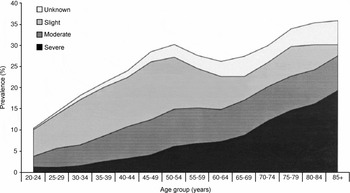
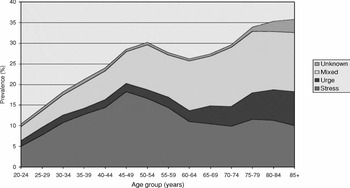
The prevalence of any UI tends to increase up to the age of 50, with a further steady increase in those over 70 years of age (Figure 1).Reference Hannestad, Rortveit and Sandvik6 While slight UI is more common in younger women, severe UI is seen more often in the older population. The Leicestershire MRC Incontinence Study reported that 34.2% of women reported UI, with 3.5% experiencing symptoms on a daily basis, 11.8% weekly, 7.3% monthly and 11.6% yearly.Reference Brown, Vittinghoff and Wyman3 Also, the overall prevalence of overactive bladder (OAB) in women over 40 years was 21.4%.Reference McGrother, Donaldson and Hayward7 A reduction in stress incontinence in the over-50s is balanced by an increase in urge UI and mixed UI in women over 60 years (Figure 2).Reference Hannestad, Rortveit and Sandvik6, Reference Minassian, Drutz and Al Badr8
Prevalence of incontinence by age group and severityReference Hannestad, Rortveit and Sandvik6

Prevalence of categories of urinary incontinence by age

Initial assessment
The initial assessment serves to categorize the type of incontinence, assess symptom severity, identify potentially reversible associated conditions and elucidate past medical history including a detailed obstetric history (see Table 1). It also aids in clarifying the need for specialist referral, and indications for urgent referral. Examination enables identification of inadequate bladder and bowel emptying, assessment of pelvic floor strength, diagnosis of prolapse, and identification of features of neurological and other predisposing medical conditions. Urine dipstick testing and post-void bladder scanning should be carried out as routine.
Initial assessment of urinary incontinence

Where the category of incontinence is unclear, 3-day bladder diaries, and frequency volume charts are recommended. Urodynamic testing rarely refutes the clinical categorization of symptoms in urge and mixed incontinence (in the absence of symptoms of UUI or MUI, detrusor overactivity on urodynamic testing is seen in around 10% only), and adds little value to initial diagnosis and treatment.9 Thus it is reserved for when conservative therapy has failed and surgery is being considered, or where previous surgery has been unsuccessful. Indications for urgent and routine specialist referral are set out in Table 1.
Treatments for urge incontinence
Treatment goals
The aim of successful management of continence problems is ‘independent continence’, maintained with non-pharmacological interventions. Where ongoing pharmacological therapy is required, this is termed ‘dependent continence’. If, despite appropriate medications and consideration of surgical options, incontinence persists, then a secondary goal ‘contained incontinence’, using containment methods may be appropriate. Serial use of validated quality of life (QOL) assessments enables a greater understanding of the impact of incontinence and the benefits of treatment to patients, which cannot always be quantified by an estimation of symptom burden alone.Reference Kelleher and Cortes10 Anecdotally, in our clinic, patients filling in QOL questionnaires have reported that reflecting on the questionnaire makes them realize how symptoms have improved, even if incontinent episodes persist. Thus QOL assessment should be incorporated into routine assessment of patients presenting with UI. A patient's self-assessment of the appropriate balance of therapeutic effect and adverse effects is helpful in dose titration.
Prevention
There is evidence that pelvic floor muscle training used during a first pregnancy reduces the likelihood of postnatal UI, and is routinely recommended to all pregnant women.11
Conservative therapy
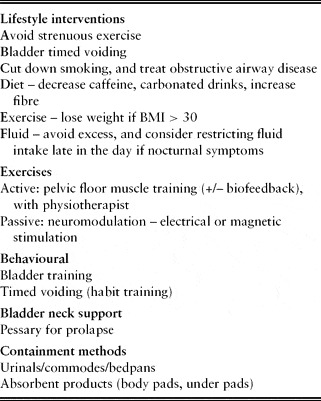
Non-pharmacological. This includes a combination of lifestyle interventions, pelvic floor muscle training, behaviour modification, and pessaries for prolapse (Table 2). Where continence cannot be achieved, containment methods are employed. There is good evidence that bladder training is an effective treatment for urge or mixed UI, with fewer adverse effects and lower relapse rates than treatment with anticholinergic drugs. Thus a 6-week course of bladder training remains the first-line treatment for urge incontinence,11 following which anticholinergics can be considered.
Non-pharmacological interventions for urinary incontinence

However, the majority of participants in the two trials quoted were under 80 and one trial excluded those with cognitive impairment (Mini-Mental Status Examination ≤ 23).Reference Fantl, Wyman and McClish12, Reference Jarvis and Millar13 Guidance from a trained physiotherapist and lack of significant cognitive impairment are key pre-requisites for success with bladder training, and applicability in those over 80 years of age has not been demonstrated. Selection of appropriate patients for bladder training is essential.
Pharmacological. Anticholinergics are the mainstay of pharmacological treatment for overactive bladder, with or without incontinence. About 50% of people gain satisfactory benefit from pharmacotherapy. The National Institute of Health and Clinical Excellence (NICE) recommends immediate release (IR) non-proprietary oxybutynin as first-line drug treatment if bladder training has been ineffective.11 Second-line options include darifenacin, solifenacin, tolterodine, trospium and alternative formulations of oxybutynin (extended release (ER) or transdermal). Much of the published evidence for their benefit comes from trials sponsored by pharmaceutical companies and in which new drugs have commonly been compared with placebo, although some recent studies report the more useful comparison with best available treatment, i.e. another drug agent. Counselling about the adverse effects of this class of drugs is advised. Other unlicensed drug options include desmopressin tablets (for nocturia), and repeated intravesical botulinum toxin for refractory urge incontinence.
However, others have suggested that oxybutynin IR is not appropriate for use in the older population,Reference Fick, Cooper and Wade14 because of potential cognitive side-effects, attributed to increased lipophilicity and propensity to cross the blood–brain barrier. It would be prudent to avoid using oxybutynin IR in patients with known cognitive deficits or previous delirium, until this issue is clarified further, and consequently cognitive screening should be a part of assessment at initiation of therapy.
Surgical therapy. Surgical treatment options for refractory detrusor overactivity (i.e. not responding to conservative therapy) include sacral nerve stimulation, with up to two-thirds of patients achieving continence or substantial improvement in symptoms after this treatment.9 Other options are augmentation cystoplasty with lifelong self-catheterization or urinary diversion procedures. Life-long specialist follow-up is advised following these procedures.11
Anticholinergic drugs
Physiology
For voiding to occur, frontal inhibition of the ‘pontine micturition centre’ must cease. This results in stimulation of the sacral parasympathetic system. Acetylcholine released from sacral (S2 to S4) parasympathetic nerve endings activates bladder muscarinic receptors (primarily M3 subtype), increasing intracellular calcium and causing bladder muscle contraction. In idiopathic cases with no underlying neurological condition, putative mechanisms for overactive bladder include damage to central inhibitory pathways, sensitization of peripheral afferent pathways, increased afferent activity and partial denervation with increased detrusor excitability.Reference Hashim and Abrams15
Individual agents
Oxybutynin. Oxybutynin is a tertiary amine that undergoes first-pass metabolism in the liver to form N-desethyloxybutynin, an active metabolite. It has antimuscarinic properties with higher affinity at the M1 and M3 receptors, direct muscular relaxant effect and a local anaesthetic effect.Reference Chapple16 The recommended daily dose of oxybutynin IR ranges from 5 to 30 mg, in divided doses, usually starting at 2.5 mg three times daily with gradual increase in dose.
Oxybutynin with bladder training was found to be superior to bladder training alone in elderly patients.Reference Szonyi, Collas and Ding17 Oxybutynin IR is more effective at reducing frequency and incontinence episodes compared with placebo.Reference Burgio, Locher and Roth18 A review of 15 randomized controlled trials (RCT) including 476 patients showed an overall subjective improvement rate of 74%, with a reduction in incontinence episodes of 54%, and a 33% reduction in frequency.Reference Thuroff, Chartier-Kastler and Corcus19 Oxybutynin is associated with a high incidence of side-effects (~70%), predominantly dry mouth and blurred vision.Reference Thuroff, Chartier-Kastler and Corcus19 In an analysis of the subjective efficacy of oxybutynin treatment for women with detrusor instability, only 20% continued treatment beyond 6 months, despite persisting bladder symptoms.Reference Kelleher, Cardozo and Khullar20 This was attributed, in part, to adverse effects. There is also concern about long-term cognitive effects of oxybutynin due to its non-selective action on muscarinic receptors and lipophilicity permitting transfer across the blood–brain barrier. Oxybutynin is known to cause deterioration in cognitive measures in elderly volunteersReference Katz, Sands and Bilker21 and those suffering from Parkinson's disease.Reference Donnellan, Fook and McDonald22
Thus oxybutynin IR has demonstrated efficacy, but with frequent adverse effects and need for multiple dosing. Though NICE has recommended oxybutynin IR as the first-line cost-effective anticholinergic, caution is advised in the elderly population due to a high frequency of adverse effects and potential worsening of cognitive function. Moreover, it is probably best avoided if there is pre-existing cognitive impairment and perhaps even in those with a history of delirium. The British National Formulary (BNF) advises caution in the elderly, renal and hepatic impairment, and cites potential worsening of coronary artery disease, congestive heart failure, hypertension, prostatic hyperplasia, arrhythmias and tachycardia, all of which are quite common in the elderly.
Oxybutynin extended release (ER). Due to a novel osmotic drug delivery system, oxybutynin ER is delivered into the small intestine over 24 hours, resulting in a more sustained and steady drug level with less fluctuation. The recommended dose is 5–10 mg once daily.
Several randomized controlled studies have shown that oxybutynin ER is as effective as IR preparations with dose-dependent efficacy, and reduced rate of adverse effects, especially dry mouth.Reference Appell, Sand and Dmochowski23, Reference Diokno, Appell and Sand24 Oxybutynin ER 10 mg daily was found to be more efficacious than tolterodine IR 2 mg twice daily in reducing urge incontinence, total incontinence and micturition frequency in the OBJECT trial, with similar rates of adverse events.Reference Appell, Sand and Dmochowski23 The OPERA study reported no difference between oxybutynin ER and tolterodine ER in terms of the primary outcome of weekly urge incontinence episodes.Reference Diokno, Appell and Sand24 However, there was a reduction in micturition frequency and more participants reported ‘no incontinence’ with oxybutynin ER 10 mg daily compared with tolterodine ER 4 mg daily (23 vs. 16.8%). While dry mouth was more common with oxybutynin ER, this was mild and other adverse events were similar with no difference in discontinuation rates. Notably, oxybutynin 5 mg ER in nursing home residents over 65 years with mild to moderate dementia produced no new episodes of delirium and no significant worsening of the cognitive impairment, suggesting that slow release preparations may be less prone to causing cognitive deterioration.Reference Lackner, Wyman and McCarthy25 However, follow-up was limited to 4 weeks only.
In summary, oxybutynin ER has similar efficacy to oxybutynin IR and tolterodine ER, and better tolerability compared with oxybutynin IR due to a lower likelihood of adverse effects.
Other preparations of oxybutynin: transdermal and intravescial. Since N-desethyloxybutynin (primary metabolite of oxybutynin) contributes to the adverse effects associated with oxybutynin, alternative delivery routes have been sought that would bypass its formation by first-pass metabolism.
A transdermal preparation is now available, which, when applied twice weekly, delivers continuous oxybutynin over a 96-hour patch wear period. A comparative study of transdermal oxybutynin and oxybutynin IR showed a statistically equivalent reduction in daily incontinence episodes, with less incidence of dry mouth (38 vs. 94%).Reference Davila, Daugherty and Sanders26 The MATRIX trial reported that transdermal oxybutynin was well tolerated by a community-based population, with significant improvement in QOL as measured by the King's Health Questionnaire,Reference Sand, Zinner and Newman27 a multi-domain health-related QOL measure specific for individuals with lower urinary tract conditions, which incorporates general health perception; symptom burden; role limitations; social and physical impact; impact on relationships; emotions; sleep and energy; and severity coping measures – ‘www.nice.org.uk/nicemedia/pdf/word/CG40ImplmentationAdviceKHQ.doc’.
In comparison with placebo, transdermal oxybutynin offers efficacy similar to oxybutynin IR, and has been shown to improve QOL. The main side-effect is local skin reaction at the site of patch application, seen in 14% of patients.Reference Lackner, Wyman and McCarthy25 The incidence of adverse effects is much lower than with oral anticholinergics and equivalent to placebo in some studies, suggesting possible use as a first-line agent.Reference Cartwright and Cardozo28
Intravesical oxybutynin has been studied, at a dose of 5 mg mixed with normal saline, administered twice a day via a urethral catheter. In open labelled studies, intravesical oxybutynin increases bladder capacity and reduces incontinence episodes. Reduction in adverse effects was offset by an increase in local site reactions.Reference Saito, Tabuchi and Otsubo29 Administration requires intermittent self-catheterization and, due to side-effects including irritant cystitis and urinary tract infections, it has limited clinical application, but may be considered in refractory cases.
Tolterodine. NICE recommends tolterodine as one of the second-line drugs for management of urge incontinence.11 It is a tertiary amine with an active 5-hydroxymethyl metabolite, responsible for the majority of its therapeutic effects. Tolterodine is available in IR (1 or 2 mg) and ER (2 or 4 mg) formulations. Lower lipophilicity makes it less likely to cross the blood–brain barrier, theoretically causing fewer cognitive side-effects.Reference Van Kerrebroeck, Kreder and Jonas30
In a pooled analysis of 1120 participants from four studies, both tolterodine and oxybutynin reduced frequency of micturition, decreased incontinence episodes and increased volume voided per micturition, compared with placebo.Reference Appell31 A 2 mg twice-daily dose of tolterodine was as effective as 5 mg three times per day of oxybutynin, but tolterodine 1 and 2 mg twice daily had better tolerability when compared with oxybutynin 5 mg three times daily and a lower incidence of dry mouth (4 and 17% vs. 60%, respectively). Therapy with tolterodine ER 4 mg appears to be efficacious irrespective of age.Reference Zinner, Mattiasson and Stanton32 Night-time dosing with tolterodine ER 4 mg (<4 h before bedtime) was more effective in reducing nocturnal overactive bladder-related micturition, with potentially no effect on normal micturition and few adverse effects and withdrawals.Reference Rackley, Weiss and Rovner33
In summary, tolterodine ER is more effective than tolterodine IR in reducing episodes of urge incontinence, and is equivalent to oxybutinin IR in terms of efficacy. However, it has a more favourable adverse effect profile compared with both.
Trospium. Trospium chloride is a quaternary amine with high water solubility (minimal transfer across the blood–brain barrier) and low oral bioavailability (9.6%). Hence it is believed to lack CNS effects. The usual dose is 20 mg twice daily before meals or on an empty stomach, as food impairs bioavailability.Reference Rovner34 Trospium does not have any pharmacologically active metabolites and is almost entirely (80%) excreted by the kidneys. It is not selective for any of the muscarinic receptor subtypes.
Trospium chloride at a dose of 20 mg twice daily produced a significant improvement in mean bladder capacity and urinary volume at first unstable contraction, compared with placebo, at 3 weeks from treatment initiation.Reference Cardozo, Chapple and Toozs-Hobson35 Similar results were reproduced in another study, which showed significant and sustained effectiveness in terms of reduction of daily toilet voids, average urgency severity, urge frequency and urge urinary incontinence episodes, with minimal adverse effects of dry mouth and constipation.Reference Rudy, Cline and Harris36 In a RCT of 601 patients, trospium ER 60 mg once a day was found to reduce daily incontinence and urgency episodes as early as week 1 compared with placebo, and it was similar to trospium IR twice daily.Reference Staskin, Sand and Zinner37 The most common adverse effects were dry mouth (8.7 vs. 3% placebo) and constipation (9.4 vs. 1.3% placebo). Central nervous system side-effects were rare.
In summary, trospium is an effective alternative for treatment of urge incontinence and overactive bladder. The rarity of CNS side-effects makes it an attractive choice in the elderly and cognitively impaired.
Darifenacin. Darifenacin is a tertiary amine with selective M3 receptor inhibition and moderate lipophilicity leading to fewer central nervous system adverse effects. Dosages available include a once-daily controlled release formulation in 7.5 mg and 15 mg doses.
A pooled analysis of phase three multicentre studies of 1039 patients over a 12-week period with darifenacin (7.5–15 mg) and placebo showed a significant reduction in the median number of incontinence episodes per week and decrease in the frequency and severity of urgency vs. placebo.Reference Chapple, Steers and Norton38 Darifenacin was well tolerated with significant dose-related responses and a central nervous system and cardiovascular side-effect profile comparable to that of placebo. In an open labelled study of 497 patients, among those who had expressed dissatisfaction with prior oxybutynin ER or tolterodine ER, more than 85% expressed satisfaction with darifenacin, based on patient satisfaction scores (Patient Perception of bladder condition) with infrequent treatment discontinuation due to adverse effects.Reference Zinner, Kobashi and Ebinger39 A QOL study on long-term efficacy of darifenacin, which was an open label 2-year extension study of two double-blind feeder studies using the Kings Health Questionnaire (KHQ), showed that more than 50% improved significantly in the KHQ scores in seven of nine domains tested.Reference Dwyer, Kelleher and Young40 Similar results were noted in the subgroup over 65 years of age.
Darifenacin is associated with a dose-related improvement in outcome measures, and is well tolerated at high doses, main adverse effects being dry mouth and constipation.Reference Hill, Khullar and Wyndaele41 Darifenacin was not associated with impairment of memory or dysfunction in other cognitive domains in three RCTs, as opposed to oxybutynin, which showed evidence of cognitive impairment in four RCTs.Reference Kay and Ebinger42 Due to M3 receptor selectivity, there is a potential for QT prolongation on the electrocardiogram and subsequent fatal ventricular tachyarrhythmias. However, no significant increase in the QT/QT/corrected QT interval on electrocardiography was seen in patients on darifenacin at 15 mg dose (therapeutic) and 75 mg dose (supratherapeutic) for 7 days, compared with placebo.Reference Serra, Affrime and Bedigian43
Overall darifenacin has been found to have good efficacy with very few adverse effects, and it has specifically been found to be effective in the elderly with cognitive impairment.
Solifenacin. Solifenacin succinate is a relatively new bladder-selective anticholinergic drug with antimuscarinic properties, predominantly at the M3 receptor. It is a tertiary amine with a bioavailability of 90%. It has a mean time to maximum plasma concentration of 3–8 hours and long elimination half-life of >45–68 hours. The accepted doses are 5 and 10 mg daily.
In the VENUS trial, solifenacin treatment significantly increased the warning time, and reduced episodes of urgency and incontinence, compared with placebo. Solifenacin is the first antimuscarinic to demonstrate significant warning time improvement at approved dosing.Reference Karram, Toglia and Serels44 Solifenacin was found to be effective in reducing symptoms in patients with mixed urinary incontinence, maintained over 52 weeks.Reference Staskin and Te45 A pooled analysis of data from four placebo controlled phase 3 trials (2800 patients) showed that solifenacin at 5 and 10 mg once daily is significantly more effective than placebo in reducing urgency, frequency of micturition, incontinence episodes, volume voided per micturition and nocturia, with a mild to moderate incidence of adverse effects.Reference Chapple, Cardozo and Steers46 Reduction in urgency is reported as early as day 3 of treatment,Reference Cardozo, Hessdorfer and Milani47 as well as reduction of nocturia.Reference Brubaker and FitzGerald48 Results from the STAR trial, an active controlled trial of 1777 patients comparing solifenacin 5/10 mg (flexible dosing) and tolterodine ER 4 mg, indicated that solifenacin is superior in reducing episodes of incontinence and urge incontinence in patients with OAB.Reference Chapple, Martinez-Garcia and Selvaggi49 This study found that a significantly higher proportion of patients became dry after treatment with solifenacin (58.7%) compared with tolterodine ER (48.9%; P = 0.0059). In a pooled analysis of four randomized placebo controlled trials and a 40-week open label flexible dose extension trial, both in elderly patients above 65 years of age, solifenacin 5 mg and 10 mg were efficacious and well tolerated, with dry mouth, constipation and urinary tract infection as the most common adverse effects.Reference Wagg, Wyndaele and Sieber50
In summary, solifenacin is superior to placebo and tolterodine ER, with 50% of patients reporting no incontinence after 12 weeks.Reference Pelman and Capo51 Flexible patient-led dosing has been successful. It is also well tolerated with a low incidence of adverse effects, and may become first-line therapy in the future, especially in the elderly.
Recent developments. Newer drugs have been introduced into the market, and others may be available in the future. In a recent placebo controlled trial oxybutynin chloride topical gel was associated with a significant improvement in symptoms compared with matching placebo.Reference Staskin, Dmochowski and Sand52 There were no serious adverse effects; dry mouth and infrequent application site reactions were noted. Potential application in those with swallowing difficulties is feasible. Fesoterodine was significantly better than tolterodine for improving urinary incontinence and episodes of severe urgency, and significantly better than the placebo group in QOL outcome measures.Reference Chapple, Van Kerrebroeck and Junemann53 No dosage reduction is required in renal or hepatic impairment.Reference Simon and Malhotra54 Imidifenacin has higher affinity for M1 and M3 muscarinic receptors, making it more selective for the bladder compared with the salivary gland. In an open label Japanese study, imidefenacin (0.1 mg twice daily) showed significant improvement in symptoms of overactive bladder and also in QOL outcomes, sustained over 52 weeks.Reference Homma and Yamaguchi55 Dry mouth occurred in 40.2%.
Costs
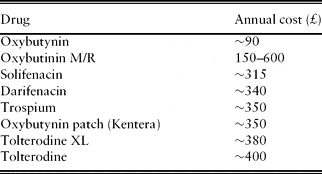
Generic oxybutinin IR is by far the cheapest anticholinergic on the market and is recommended by NICE as first line as it can be well tolerated. However, cost-efficacy analysis has suggested that oxybutinin ER may be a better option for reducing frequency of micturition and frequency of incontinence, as it improved outcome at a lower cost, possibly a reflection of better tolerance.Reference Guest, Abegunde and Ruiz56 It is likely that oxybutynin IR will remain the first-line drug, despite its adverse effect profile. However, evidence suggests that older people are more likely to suffer from cognitive side-effects due to anticholinergics, and perhaps one of the alternative anticholinergics (e.g. trospium, solifenacin, tolterodine) may have a more favourable risk-benefit profile. There may be important differences in longer-term adherence between individual anticholinergic agents that influence cost-effectiveness. Costs of individual drug formulations are tabulated in Table 3.
Costs of various anticholinergic agents licensed for treatment of overactive bladder (Source: British National Formulary)

Patient-led flexible dosing
Interpretation of OAB symptoms is subjective and varies between patients. Thus patient-controlled flexible dosing allows the patient to decide the right dose for an appropriate balance between efficacy and adverse effects. Flexible dosing is highly effective at ameliorating urgency, with roughly 50% of patients requesting a dose increase, mostly those with severe symptoms at baseline. Outcomes were similar amongst groups that did and did not request a dose increase.Reference Chapple, Rosenberg and Brenes57 This approach is suitable for those without cognitive impairment, and where relatives/carers are able to monitor side-effects and have access to advice where needed.
Conclusion
Incontinence is a common problem, predominantly in women and the elderly. Urge and mixed incontinence are more prevalent in the older population compared with younger populations, and will be encountered more frequently due to the ageing population. Categorization of the type of incontinence is essential to guide initial therapy. More specialized investigations are generally unnecessary in the absence of pointers to specific underlying medical conditions. Conservative treatment includes: non-pharmacological interventions as first-line therapy, followed by pharmacological therapy. In refractory cases, surgical options can be explored, but the procedural risks must be explained and life-long specialist follow-up is advised.
Anticholinergics are the main-stay of pharmacological intervention, with no clearly demonstrated difference in efficacy amongst the various drugs available. Newer formulations are associated with fewer adverse effects, and are recommended by NICE where immediate-release oxybutinin is not tolerated.
More research is required to clarify overall cost-effectiveness of using newer drugs as first-line therapy, preferably with long-term follow-up. Efficacy should incorporate patient-relevant parameters including structured symptom diaries and QOL, and from the societal perspective, costs of medications, physician review, and complications consequent to incontinence. Structured post-marketing surveillance may help provide some of the answers.
Conflicts of interest
The authors declared no conflicts of interest.