

Introduction
A secure energy future will require the development of sustainable, nonfossil energy sources such as solar, wind, geothermal, and nuclear energy.Reference Armaroli and Balzani1–Reference Lubitz and Tumas3 For these energy sources to ultimately replace fossil fuels, energy storage will be required. In principle, fuels can be generated from abundant and inexpensive small molecules such as H2O, N2, and CO2. The simplest of these energy conversion reactions is the splitting of water to produce H2 and O2. This article will focus on the development of electrocatalysts for the conversion of electrical energy and protons from water to produce H2 (Reaction 1)

Because the production of H2 is the simplest fuel generation reaction, there is much that we can learn from its study that is applicable to other fuel generation reactions.
Although platinum is an excellent catalyst for H2 production and oxidation, its limited supply and high cost provide a significant impetus to develop alternatives based on more abundant and less expensive metals. Nature solved this problem, evolving hydrogenase enzymes, that rapidly and reversibly catalyze Reaction 1. These enzymes use nickel and iron in conjunction with carefully selected ligands in a highly evolved protein environment to create fast (1,000 to 10,000 turnovers per second) and efficient (overpotentials of less than 100 mV) catalysts for H2 production and oxidation. From detailed studies of these enzymes,Reference Frey4–Reference Fontecilla-Camps, Volbeda, Cavazza and Nicolet8 hypotheses regarding how the enzymes achieve such high catalytic rates can be developed and used to guide the design of simpler synthetic catalysts, so-called molecular catalysts. By incorporating selected structural features into molecular catalysts and evaluating their catalytic activity, it is possible to test these hypotheses and gain a deeper understanding of the enzymes and the catalytic principles involved. It is hoped these studies will lead to catalysts suitable for practical applications. Although the focus of this article is on the design of catalysts at the molecular scale, many of the principles of catalyst design at the molecular level have counterparts in the design of materials at larger length scales, and we will endeavor to emphasize some of these connections.
General design principles from hydrogenase enzymes
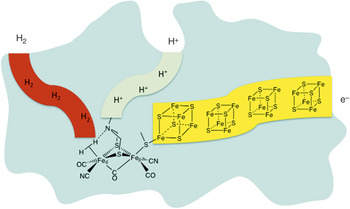
X-ray diffraction studies of the hydrogenase enzymes have provided structural information suggesting a number of concepts for catalyst design.Reference Frey4–Reference Fontecilla-Camps, Volbeda, Cavazza and Nicolet8Figure 1 shows a schematic depiction of [FeFe] hydrogenase. The active site of this enzyme is located at the intersection of an electron-transport chain, hydrophobic channels for H2 diffusion, and a proton-transport chain. The electron transport chain consists of three [Fe4S4] clusters spaced about 12 Å apart. This electron transport chain serves as a molecular wire that conducts electrons between the active site and the exterior of the protein via an electron hopping mechanism. The outermost [Fe4S4] clusters are embedded in recognition sites that allow attachment of specific redox partners,Reference Fontecilla-Camps, Volbeda, Cavazza and Nicolet8 and this specificity allows for regulation of the overall process.
Depiction of hydrogenase enzyme emphasizing channels for H2, proton, and electron transport. Fed and Fep represent distal and proximal Fe atoms, respectively.

The distance between the [Fe4S4] clusters suggests that intimate contact is not required for efficient electron transport (i.e., electron transfer over several angstroms is efficient).Reference Vincent, Parkin and Armstrong9–Reference Axup, Albin, Mayo, Crutchley and Gray12 On the other hand, the [Fe4S4] cluster proximal to the active site of the [FeFe] hydrogenase enzyme is intimately connected to the active site, suggesting it may serve as an electron reservoir. This is not observed for the [NiFe] hydrogenase.Reference Fontecilla-Camps, Volbeda, Cavazza and Nicolet8
The proton transport chain is composed of acidic or basic groups that allow for facile proton movement between the exterior of the enzyme and the active site. The precise pathway in many instances is a subject of debate,Reference Fontecilla-Camps, Volbeda, Cavazza and Nicolet8 and it is possible that these pathways are branched. For the [FeFe] hydrogenase enzymes, the pendant base, the nitrogen atom connecting the two bridging sulfur atoms shown in Figure 1,Reference Nicolet, de Lacey, Vernède, Fernandez, Hatchikian and Fontecilla-Camps7, Reference Silakov, Wenk, Reijerse and Lubitz13, Reference Lubitz, Reijerse and van Gastel14 is capable of approaching the Fe atom closely, allowing for proton transfer to or from the metal center. This pendant base is adjacent to a proton transfer channel that facilitates a series of proton transfer steps over short distances (less than 1 Å) between acidic and basic functional groups followed by rotation and translation of these groups.Reference Williams15–Reference Montet, Amara, Volbeda, Vernède, Hatchikian, Field, Frey and Fontecilla-Camps17 Thus the movement of protons involves a continuous pathway from the iron atom to the exterior of the molecule. This observation suggests that similar control may be important for synthetic catalysts. It is clear that the distances between the individual groups of the proton transport chain during the actual proton transfer event are much shorter than the distances between the electron transport clusters. This difference in distances is reasonable when one considers the difference in mass and resulting tunneling distances of these two particles. This suggests that attention should be paid to this particular aspect in the design of synthetic catalysts for H2 production and oxidation.
A second important observation is that although water may be involved in the proton transport chain, protons are transported, not water. Indeed, the pocket immediately surrounding the active site is often described as hydrophobic.Reference Fontecilla-Camps, Volbeda, Cavazza and Nicolet8, Reference Peters, Lanzilotta, Lemon and Seefeldt16 One of the reasons for placing the active site in the interior of the enzyme instead of on its surface may be to provide a non-aqueous environment. This possibility calls into question the commonly expressed view that hydrogen oxidation and production catalysts should be designed to operate in aqueous conditions. It would seem that if there were strong advantages to operating in an aqueous environment, hydrogenase enzymes would have evolved to position the active site in contact with the aqueous environment of the cell.
It is also thought that a hydrophobic tunnel provides a pathway for hydrogen diffusion that connects the distal iron atom of the active site in the [FeFe] hydrogenase enzyme with the surface of the protein.Reference Fontecilla-Camps, Volbeda, Cavazza and Nicolet8 A similar channel is proposed to exist in the [NiFe] hydrogenase, and this tunnel appears to connect the nickel atom of the active site with the surface of the enzyme.Reference Montet, Amara, Volbeda, Vernède, Hatchikian, Field, Frey and Fontecilla-Camps17 From the existence of these channels, we can infer that the protein structure has evolved to control or assist the movement of all three substrates to the catalytically active site. In this respect, the hydrogenase enzyme is a molecular entity that incorporates many of the features of a fuel cell.
Comparison of enzymes and potential artificial systems for H2 production
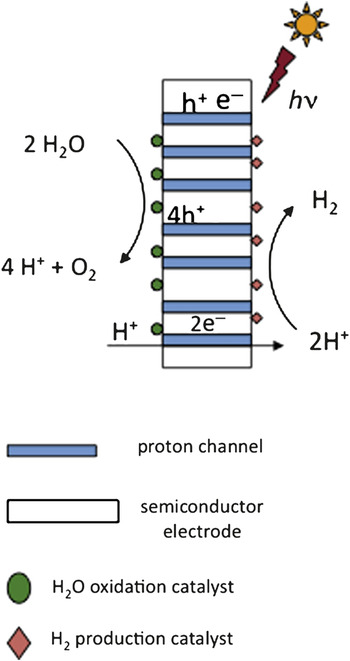
Figure 2 shows a cartoon of a proposed light-harvesting and catalytic membrane illustrating the essential features of an integrated system for solar conversion of H+ to H2. In this schematic, light absorption and charge separation occur at the semiconductor, the light-harvesting component (possible compositions and configurations for semiconductors are discussed in the Introduction article of this issue). The charge separation requires the movement of electrons or holes over a significant distance. Accompanying this movement of electrons is the movement of protons from one side of the membrane to another. There are also two catalytic half-reactions. The catalyst on the right side accepts two electrons from the semiconductor surface and combines these electrons with two protons (from a proton conduction pathway) to produce hydrogen. The water oxidation catalyst, shown on the left side of the membrane, mediates the oxidation of two water molecules to produce O2 and four protons. This proposed membrane represents a highly integrated system for the solar production of fuels that would require the precise organization of the components necessary for charge separation, proton transport, and catalysis.
Schematic of a proposed membrane for artificial photosynthetic production of H2 showing light harvesting, charge separation, proton flux, and catalytic oxidation of H2O (left side) and proton reduction (right side). h, Planck’s constant; ν, frequency.

An examination of the hydrogenase enzyme (Figure 1) and the synthetic membrane for achieving water splitting (Figure 2) illustrates features that are common to biological systems and totally synthetic systems for energy conversion processes. Both systems require channels for conducting electrons and protons to and from the catalytically active sites. In addition, the enzyme has a channel for the transport of H2. This organized architecture requires the transport of electrons, protons, and hydrogen over nanoscale dimensions and an intersection of all three channels at the molecular scale. This highly structured assembly from the molecular to the nanoscale is important to the overall efficiency of the enzyme, and precisely organized structures consisting of multiple functional components will also be important for the development of highly efficient devices for solar H2 production. In the hydrogenase enzyme, the proposed artificial photosynthetic membrane, and in fuel cells, proton and electron transport must occur over micro- to nanoscale dimensions, and these pathways must be coupled on a molecular scale with the catalytically active site.
The role of the structure of the active site of hydrogenase enzymes in the evolution of molecular catalysts
Structural studies of the [FeFe] and [NiFe] hydrogenase enzymes have also provided important information on the geometry and composition of the active sites,Reference Frey4–Reference Fontecilla-Camps, Volbeda, Cavazza and Nicolet8, Reference Peters, Lanzilotta, Lemon and Seefeldt16 as illustrated in Structures 1 and 2 (where R represents an attachment site to the protein in Structure 1 and an aryl or alkyl substituent in Structure 2). Notable features of 1 and 2 are the presence of two metal atoms bridged by thiolate ligands and the presence of both CO and CN– ligands bound to iron. In addition, it has been suggested that the central atom of the dithiolate ligand of [FeFe] hydrogenase is a nitrogen atom.Reference Fontecilla-Camps, Volbeda, Cavazza and Nicolet8 Although the structural data alone are not sufficient to resolve the latter point, spectroscopic studies,Reference Silakov, Wenk, Reijerse and Lubitz13, Reference Lubitz, Reijerse and van Gastel14 theoretical studies,Reference Fan and Hall18 and studies of simple model complexes containing similar pendant aminesReference Rakowski DuBois and DuBois19–Reference Wang, Wang, Liu, Jin, Chen and Sun25 suggest that this is likely. Finally, the structures have vacant coordination sites located on the distal iron, Fed, in Structure 1, and on Ni and Fe in Structure 2.Reference Frey4–Reference Fontecilla-Camps, Volbeda, Cavazza and Nicolet8
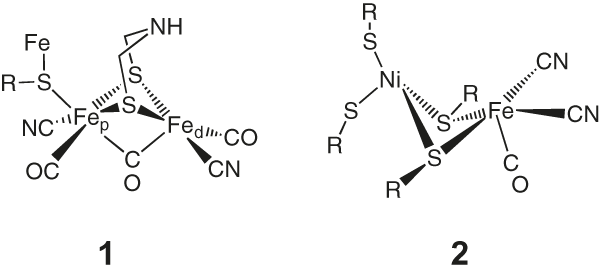
This information on the structure and composition of the enzyme active sites resulted in numerous efforts to synthesize structural analogues and to explore the catalytic activity of these analogues. This effort has been summarized in recent thematic issues and reviews on hydrogen and bioinspired hydrogen production and uptake catalysts.Reference Schollhammer and Talarmin26–Reference Tard and Pickett28 Initial efforts in this area focused on very simple models containing two iron atoms bridged by two thiolate ligands and a variety of cyanide, CO, phosphine, and thiolate bridge substituents (e.g., Structure 3, where Ph represents a phenyl, C6H5, substituent).Reference Tard and Pickett28–Reference Felton, Vannucci, Okumura, Lockett, Evans, Glass and Lichtenberger34 Although some of these complexes were catalysts for H2 production, the overpotentials were greater than 1 V. This led to efforts to synthesize diiron structures with vacant coordination sites (e.g., Structure 4) or terminal hydrides (e.g., Structure 5) adjacent to the backbone of the dithiolate ligands,Reference Felton, Vannucci, Okumura, Lockett, Evans, Glass and Lichtenberger34, Reference Liu and Darensbourg35 but these structures are inherently unstable. The hydride ligands in the latter complexes prefer a bridging position (e.g., Structure 6) as opposed to Structure 5.Reference Barton, Olsen and Rauchfuss24, Reference Wang, Wang, Liu, Jin, Chen and Sun25 Only recently have diiron structures with a pendant base adjacent to either a bridging or terminal hydride been prepared.Reference Barton, Olsen and Rauchfuss24, Reference Wang, Wang, Liu, Jin, Chen and Sun25 One of these, Structure 5, is an active catalyst for H2 production at low temperatures, where it must operate in order to avoid rearrangement to an inactive bridging hydride.Reference Barton, Olsen and Rauchfuss24

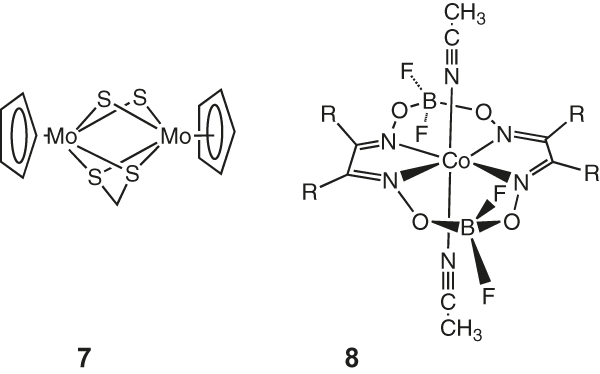
Other molecular catalysts for H2 production have been developed that are not bioinspired but that show very interesting activity. The Mo2S4 dimer 7 is a hydrogen formation catalyst that operates at very low overpotential (less than 100 mV) but also at low rates (1.5 s−1).Reference Appel, DuBois and DuBois36 This complex appears to evolve H2 from two adjacent sulfur atoms rather than from the metal. Another interesting class of molecules is based on cobalt diglyoxime complexes, such as 8 and its derivatives. These complexes were originally studied by EspensonReference Connolly and Espenson37 and more recently by the groups of Peters, Artero, and Gray.Reference Hu, Brunschwig and Peters38–Reference Dempsey, Brunschwig, Winkler and Gray40 Selected members of this class of catalysts also operate at low overpotentials and at moderate catalytic rates. In summary, there are a variety of molecular catalysts that are attractive for further development. Some of these catalysts have been designed using structural features found in the hydrogenase active sites and some have not.
Research in the authors’ laboratories has focused on using concepts suggested by structural features of hydrogenase enzymes to guide the design of simple synthetic catalysts. The observation of heterolytic cleavage of H2 by hydrogenase enzymes and the presence of a pendant base suggest that one of the roles of the CN and CO ligands is to produce an electronic tuning of the active site (Structure 1) so that it is capable of interacting with H2 to form an H2 adduct (Structure 9) and inducing heterolytic cleavage of the H–H bond to form a hydride ligand, H−, bound to Fe and a proton bound to the pendant nitrogen atom (Structure 10), as shown in Reaction 2. The CN− and CO ligands found in the active sites of the hydrogenase enzymes are strong-field ligands that favor the formation of low-spin complexes. Low-spin complexes are important because the electrons are more localized, resulting in metal-based orbitals having two electrons while other orbitals have none. Such empty orbitals provide an acceptor orbital, or vacant coordination site, for the two electrons of the hydride ligand. The energy of this orbital also controls the hydride acceptor ability of the metal. In Structure 1, the vacant coordination site is adjacent to the pendant base. This structural arrangement creates an ideal geometry for heterolytic cleavage of the H–H bond.

Design criteria for molecular electrocatalysts for H2 production/oxidation
The structural features of the hydrogenase enzymes suggest two design criteria for molecular catalysts for H2 production or oxidation: the presence of a vacant coordination site and positioning it adjacent to a pendant base (Structure 1). Alternatively, a hydride ligand may be positioned adjacent to a pendant protonated amine (Structure 10). Energy considerations add a third requirement. The hydrogenase enzymes are very fast, and they operate in both directions (i.e., they are rapid and efficient catalysts for H2 production and oxidation). These features require that the hydride acceptor ability of the metal match the proton acceptor ability of the base incorporated into the dithiolate ligand. The energies associated with H− addition to the metal and H+ addition to this pendant base should be balanced so that the free energy associated with the heterolytic cleavage or formation of H2 is close to 0 kcal/mol. High-energy intermediates would lead to a large barrier for this step and result in either slow rates and/or large overpotentials. A highly exoergic step in a mechanism, leading to a low-energy intermediate, will result in a high barrier for a subsequent step. Thus the energies of the proton acceptor and the hydride acceptor must be matched for optimum performance. Similar considerations are important for developing synthetic catalysts for hydrogen production or oxidation. This leads to the third requirement for an efficient H2 production/oxidation catalyst; the hydride acceptor ability of the metal and the proton acceptor ability of the pendant base must be matched to avoid high-energy intermediates and ensure reversibility in the heterolytic cleavage or formation of the H–H bond.
These considerations led our laboratory to study the factors controlling the hydride acceptor abilities of a variety of [M(diphosphine)2]2+ complexes (where M = Ni, Pd, and Pt).Reference Berning, Noll and DuBois41–Reference Nimlos, Chang, Curtis, Miedaner, Pilath and DuBois46 These complexes are 16-electron species, and the strong-field diphosphine ligands result in low-spin complexes with a vacant coordination site. It was also determined that the hydride acceptor abilities of [M(diphosphine)2]2+ complexes are governed by three factors: the metal, the electron donor ability of the substituents on the ligands, and the dihedral angle between the two planes defined by the two phosphorus atoms of each diphosphine ligand and the metal. The hydride acceptor ability follows the order Ni > Pt > Pd.Reference Curtis, Miedaner, Raebiger and DuBois43 For example, the free energy associated with Reaction 3

(where PNP is Et2PCH2NMeCH2PEt2) is −66 kcal/mol for Ni, −55 kcal/mol for Pt, and −51 kcal/mol for Pd.
Thus, nickel complexes are approximately 15 kcal/mol better hydride acceptors than the corresponding palladium complexes. The hydride acceptor ability of [M(diphosphine)2]2+ complexes is also a function of the substituents on the diphosphine ligands. The free energies associated with the hydride acceptor abilities of [Ni(dppe)2]2+ and [Ni(dmpe)2]2+ are –63 kcal/mol and −51 kcal/mol, respectively (where dppe is bis(diphenylphosphino)ethane, and dmpe is bis(dimethylphosphino)ethane).Reference Berning, Noll and DuBois41, Reference Berning, Miedaner, Curtis, Noll, DuBois and DuBois44 Thus replacement of the methyl substituents with phenyl substituents favors the hydride acceptor ability by 12 kcal/mol. Increasing the dihedral angle between the two diphosphine ligands also increases the hydride acceptor ability of [M(diphosphine)2]2+ complexes. [Ni(dmpe)2]2+ has a dihedral angle of 3° and a hydride acceptor ability of −51 kcal/mol, whereas [Ni(dmpp)2]2+ (where dmpp is bis(dimethylphosphino)propane) has a dihedral angle of 44° and a hydride acceptor ability of −61 kcal/mol.Reference Berning, Noll and DuBois41 Even larger effects (more than 25 kcal/mol) have been observed for a series of [Pd(diphosphine)2]2+ and [Pt(diphosphine)2]2+ complexes.Reference Raebiger, Miedaner, Curtis, Miller and DuBois42, Reference Miedaner, Raebiger, Curtis, Miller and DuBois45 These large changes in hydride acceptor abilities with dihedral angle can be understood in terms of simple overlap arguments for the lowest occupied molecular orbitals of the [M(diphosphine)2]2+ complexes.Reference Nimlos, Chang, Curtis, Miedaner, Pilath and DuBois46
An understanding of the factors controlling the hydride acceptor ability of these complexes allows this property to be tuned to match the proton acceptor ability of a pendant base. In particular, we were interested in the hydride acceptor abilities of the [Ni(diphosphine)2]2+ complexes, which fell between −51 and −67 kcal/mol.Reference Berning, Miedaner, Curtis, Noll, DuBois and DuBois44 The large hydride acceptor abilities of these molecules indicated that they would be capable of reversibly activating or forming H2 in solution with pH values between 6 and 18 in acetonitrile. This corresponds to a pH range of approximately −2 to 10 in water.Reference Kristjánsdóttir, Norton and Dedieu47 Thus, these nickel complexes should be capable of activating or producing H2 at pH values commonly accessible in aqueous solutions.
Similar energy-matching strategies are also important for other steps in the catalytic cycle, including H2 binding and transfer of a second proton between the metal and the pendant base following or preceding oxidation. As a result, a deeper and more general understanding of the thermodynamic relationships relevant to catalysis is desirable, and these relationships have been discussed in more detail elsewhere.Reference Dubois and Dubois20 However, the basic concepts of energy matching are the same as those described in the preceding paragraphs on the heterolytic activation/formation of H2.
Control of proton movement at the molecular level
Once some of the issues relating to energetics have been addressed, the next step in catalyst design is to synthesize complexes that incorporate pendant amines to act as proton relays. Because typical synthetic organometallic molecules have much lower molecular weights than enzymes, it is reasonable to ask if relays similar to those found in the hydrogenase enzymes will be beneficial or required. Space-filling models of selected [Ni(diphosphine)2]2+ complexes and their corresponding structural representations (11–14) illustrate that only for the structure with the least sterically demanding ligand set, 11, is the metal atom readily accessible to an acid or base of intermediate size. (The central nickel atom is green, phosphorous is orange, nitrogen is blue, carbon is dark gray, and hydrogen is light gray.) However, close approach of these reactants is required for facile proton transfer. Significant structural reorganization of the complexes 12–14 must occur for the close approach of organic acids or bases required for direct proton transfer between the metal and an acid or base in solution. The energy required for these rearrangements will result in large energy barriers, and hence slow rates. Such energy barriers can be minimized by incorporation of proton relays (analogous to those used in the hydrogenase enzymes) within the second coordination sphere of these complexes. Small hydrophobic molecules such as hydrogen should be able to access the metal centers of 11–14, and electron transfer between molecules at the surface of the catalyst and the metal center or between an electrode and the metal center should still occur, as the radius of the largest complex, 14 (where Cy is cyclohexyl and Bz is benzyl) is approximately 8 Å. Of the three reactants and products that must be able to access or leave the active metal site, protons are the most likely to need assistance. As a result, management of proton transfer is a central issue in the design of even relatively small synthetic catalysts for multi-electron/multi-proton processes, and this has been a central focus of recent research in our laboratories.

Our studies of [Ni(diphosphine)2]2+ complexes demonstrated that these can act as hydride acceptors in the presence of suitable bases.Reference Curtis, Miedaner, Ellis and DuBois48 Our initial attempt to prepare [Ni(diphosphine)2]2+ complexes with pendant bases used 1,2-bis(di-2 pyridylphosphino)ethaneReference Curtis, Miedaner, Ciancanelli, Ellis, Noll, DuBois and DuBois23 (dpype) as a ligand (see Structure 13). This ligand contains pendant pyridyl substituents that could act as an internal base. However, reaction of this ligand with [Ni(CH3CN)6](BF4)2 produced paramagnetic species, consistent with coordination of the ligand via the pyridyl substituents rather than the desired coordination of phosphorus. To promote the formation of Ni–P bonds, the softer Ni(0) complex, Ni(COD)2, was reacted with dpype to form Ni(dpype)2 (Structure 13). In this case, the phosphorus atoms are coordinated to Ni, as desired. However, oxidation of Ni(dpype)2 by two electrons again rapidly produced a paramagnetic product or products, consistent with rapid rearrangement and coordination of the ligand through N rather than P. To overcome the problems encountered with dpype, the PNP ligand (where PNP is Et2PCH2NMeCH2PEt2) was prepared to favor coordination of phosphorus over nitrogen. For this ligand, there are fewer N atoms to coordinate to Ni, and the four-membered chelate rings resulting from coordination of nitrogen and phosphorus should be less favorable than the six-membered rings that result from coordination of PNP through the two phosphorus donors. Using the PNP ligand, the complexes [Ni(PNP)2](BF4)2, 15, [HNi(PNP)2](PF6), and Ni(PNP)2 could be prepared. All of these complexes contain PNP ligands coordinated through the two phosphorus atoms, whereas the amines function as pendant bases and do not coordinate to Ni. In short, the introduction of a pendant base must take into account that these bases can also coordinate directly to the metal, and the ligands must be designed to minimize this possibility.
To determine the role played by the pendant amine in the [Ni(PNP)2]2+ complex, 15, during electrocatalytic oxidation of H2, we prepared the analogous complex [Ni(depp)2]2+, 16, where depp is l,3-bis(diethylphosphino)propane.Reference Curtis, Miedaner, Ciancanelli, Ellis, Noll, DuBois and DuBois23 The diphosphine ligands in 16 do not incorporate an amine base, but rather contain a (CH2)3 connector between phosphorus atoms. Both 15 and 16 are catalysts for H2 oxidation, but the incorporation of the proton relay results in a 0.6–0.7 V decrease in the overpotentials for [Ni(PNP)2]2+ relative to [Ni(depp)2]2+. The substantial decrease in overpotential (down to approximately 100 mV) is attributed to the ability of the pendant nitrogen base to act as a relay to transfer a proton from nickel to the solution without major structural reorganization of the first coordination sphere. Nuclear magnetic resonance (NMR) and electrochemical studies of these compounds strongly support the role of these ligands in promoting fast proton transfer steps. However, despite the effective proton relay capability, the catalytic rate for [Ni(PNP)2]2+ is slow, < 0.2 s–1, because H2 binding/cleavage is slow.
To overcome the problem of slow H2 activation, complexes with positioned pendant bases (e.g., 17) were synthesized and investigated.Reference Wilson, Shoemaker, Miedaner, Muckerman, DuBois and Rakowski DuBois21, Reference Wilson, Newell, McNevin, Muckerman, DuBois and Dubois22 The proposed structure of the active site of the [FeFe] hydrogenase active site (Structure 1) includes a pendant base incorporated into a six-membered ring that is forced to be in a boat conformation with respect to the iron-H2 binding site because of steric interactions with the second Fe atom and its ligands. This boat conformation results in a base that is positioned to assist in the binding and heterolytic cleavage of H2. This structural feature is also incorporated into the nickel complexes shown in Structures 17 and 18 by the introduction of a second six-membered ring system in the chelating diphosphine ligands. The enforced boat conformation for at least one of the chelate rings of each ligand avoids the activation energy associated with converting from the more stable chair conformation observed in the resting state of the [Ni(PNP)2]2+ complex, 15, to the boat conformation required for catalysis. Complexes having the structure shown by 17 are indeed very active catalysts for H2 oxidation (turnover frequency of 10 s–1 for Cy, Bz under 1.0 atm H2). These results document the importance of positioned pendant bases in H2 activation in addition to their role as proton relays in these nickel complexes.

Catalytic mechanism for H2 oxidation/production
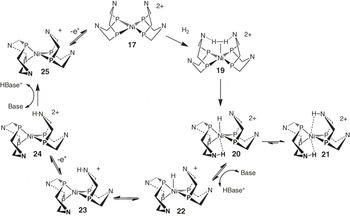
Scheme 1 shows a proposed catalytic cycle for the oxidation (clockwise direction) or production (counterclockwise direction) of H2. This cycle is based on a combination of spectroscopic and electrochemical measurements and theoretical calculations for the structurally characterized [Ni(PCy2NBz2)2]2+ complex, 17, and related complexes. Reaction of H2 with 17 is proposed to result in the formation of a dihydrogen complex, 19, which has not yet been observed experimentally.
Catalytic cycle for H2 oxidation (clockwise) and formation (counter clockwise). (Substituents on P and N are not shown.)

However, on the basis of theoretical calculations and kinetic studies,Reference Wilson, Shoemaker, Miedaner, Muckerman, DuBois and Rakowski DuBois21, Reference Wilson, Newell, McNevin, Muckerman, DuBois and Dubois2219 is thought to be a transient intermediate that evolves to form the doubly protonated Ni(0) complex 21 via intermediate 20. Complex 21 has been extensively characterized by one- and two-dimensional NMR studies using deuterium and Reference Williams15N labeled derivatives. For complex 21, the intramolecular movement of protons between the Ni center and the nitrogen atoms and between N atoms via intermediate 20 is fast and reversible. This rapid exchange clearly demonstrates the ability of the pendant amines to promote rapid and reversible intramolecular transfer of a proton between nickel and nitrogen. Deprotonation of 21 with an external base (a rapid intermolecular process) is accompanied by an intramolecular proton transfer to form the nickel hydride, 22, via intermediate 20. Thus the transformation from 21 to 22 involves both intra- and intermolecular proton transfer steps involving the pendant amines, and it is clear that the bases incorporated into the ligands of the complex are controlling the movement of the protons on the molecular scale, just as the proton conduction channels control the flow of protons between the active site and solution in hydrogenase enzymes.
A great deal of chemistry has occurred upon interaction of H2 with complex 17 to arrive at complex 22. The H2 molecule has been activated, and the pendant bases have assisted in the cleavage of the H–H bond. These steps are the rate-determining steps in the overall catalytic cycle. In addition, the transfer of a proton from Ni to solution has occurred. However, no electrons have been transferred between the nickel complexes and the electrode, which is an essential part of any electrocatalytic process.
The oxidation of hydride complexes such as 22 occurs at potentials that are 0.5 to 0.6 V more facile than the potentials observed for analogous complexes without a pendant amine.Reference Wilson, Shoemaker, Miedaner, Muckerman, DuBois and Rakowski DuBois21–Reference Curtis, Miedaner, Ciancanelli, Ellis, Noll, DuBois and DuBois23, Reference Yang, Bullock, Shaw, Twamley, Fraze, Rakowski DuBois and DuBois49 This indicates that this is a proton coupled electron transfer (PCET) process in the thermodynamic sense. In some cases, this process is thought to occur by an intramolecular proton transfer from nickel to nitrogen (as shown in the conversion of 22 to 23 in Scheme 1) followed by a one-electron oxidation of the resulting Ni(0) species, 23 to 24. In other cases, PCET may occur by an electron transfer reaction followed by a proton transfer or by a concerted process. Regardless of the precise sequence of proton and electron transfers, the presence of the pendant base has a very profound influence on the potential of the observed oxidation process, illustrating the importance of this intramolecular PCET process in determining the overall efficiency of the catalytic process. Similarly, a second PCET occurs during the oxidation of complex 24 to regenerate 17. Again, this process can occur stepwise via 25, as shown in Scheme 1, or in a concerted fashion. In this case, the PCET step involves an intermolecular proton transfer process. It is this combination of intramolecular proton transfers (conversion of 22 to 23) and intermolecular proton transfers (conversion of 24 to 25) that leads to the description of the pendant bases as proton relays for the electron transfer steps as well as for the chemical steps (17 to 22).
A practical consideration for H2 oxidation catalysts is their inhibition by CO. It is well known that CO acts as a poison for hydrogenase enzymes and for platinum in fuel cells. As a result, when platinum is used as a catalyst, it is necessary to keep CO levels in the hydrogen gas below 100 ppm. In contrast, studies of [Ni(PCy2NBz2)2]2+, 17, using H2 gas containing 5% CO show that electrocatalytic H2 oxidation is not significantly inhibited by CO even at these very high concentrations.Reference Wilson, Shoemaker, Miedaner, Muckerman, DuBois and Rakowski DuBois21, Reference Wilson, Newell, McNevin, Muckerman, DuBois and Dubois22 Although CO binding to this catalyst occurs, H2 binds 20 times more strongly. As a result, CO does not significantly inhibit this synthetic catalyst for H2 oxidation at concentrations 100 times higher than those at which platinum is inhibited, and any inhibition caused by even pure CO gas is reversible. Structural studies of the CO adduct of 17 support a model for CO binding that involves stabilizing interactions between two pendant amines and the electropositive carbon of the coordinated CO ligand.Reference Wilson, Fraze, Twamley, Miller, DuBois and DuBois50
Catalysts for H2 production
In the preceding section, the catalytic cycle was discussed in terms of H2 oxidation. This is because key intermediates can be observed for the H2 oxidation catalysts that cannot be observed for H2 production catalysts. However, the mechanism for H2 formation is simply the reverse of that shown for H2 oxidation, and the proposed steps proceed in a counterclockwise sequence in the catalytic cycle shown in Scheme 1. We have previously reported that [Ni(PPh2NPh2)2](BF4)2 is an electrocatalyst for H2 production with a turnover frequency or catalytic rate of 350 s−1 at 22°C and an overpotential of approximately 0.3 V using a buffered solution of protonated dimethylformamide in acetonitrile as the substrate.Reference Wilson, Shoemaker, Miedaner, Muckerman, DuBois and Rakowski DuBois21, Reference Wilson, Newell, McNevin, Muckerman, DuBois and Dubois22 For comparison, catalytic rates of 700 s–1 have been reported for H2 formation at 30°C for [NiFe] hydrogenases with overpotentials of less than 0.1 V.Reference Frey4, Reference Peters, Lanzilotta, Lemon and Seefeldt51, Reference Montet, Amara, Volbeda, Vernède, Hatchikian, Field, Frey and Fontecilla-Camps52 Thus the best synthetic molecular catalysts are not yet as energy efficient as hydrogenase enzymes, but they can exhibit rates comparable to those of the enzymes at moderate overpotentials.
The role of pendant bases in catalytic H2 production is not unique to the nickel complexes described in the preceding paragraphs. Recent studies have shown that cobalt complexes with a single cyclic diphosphine ligand containing pendant bases, such as [Co(PPh2NPh2)(CH3CN)3](BF4)2, are electrocatalysts for H2 formation with turnover frequencies and overpotentials very similar to those of [Ni(PPh2NPh2)2(CH3CN)3](BF4)2.Reference Jacobsen, Yang, Twamley, Wilson, Bullock, Rakowski DuBois and DuBois53 Comparison of the catalytic behavior of [Co(PPh2NPh2)(CH3CN)3](BF4)2 with that of [Co(dppp)(CH3CN)3](BF4)2 (where dppp is bis(diphenylphosphino)propane), for which no catalytic activity is observed, suggests that the pendant amine is playing important roles in the catalysis of H2 production, similar to those described previously for the nickel complexes.
A final step in the development of molecular catalysts for practical H2 production processes will be the attachment of highly active molecular catalysts to electrode surfaces. Initial work in this area appears promising. Both cobalt tetraimine complexes similar to 8 and [Ni(PR2NR’2)2]2+ complexes similar to 17 have been attached to electrode surfaces and shown to retain catalytic activity.Reference Berben and Peters54, Reference Le Goff, Artero, Jousselme, Tran, Guillet, Métayé, Fihri, Palacin and Fontecave55 The nickel complexes have also been demonstrated to function under conditions found in proton-exchange membrane fuel cells.Reference Le Goff, Artero, Jousselme, Tran, Guillet, Métayé, Fihri, Palacin and Fontecave55 These initial results are quite promising and suggest that highly integrated multifunctional materials such as the membrane shown in Figure 2 may be possible. A significant challenge in such devices will be controlling proton movement from the macroscopic scale to the molecular scale.
Summary
The best catalysts for H2 oxidation and production are platinum and the hydrogenase enzymes. The observation that nickel and iron are involved in the active site of these enzymes has resulted in a great deal of research to develop simple molecular catalysts capable of performing as well as the enzymes, but to date this has not been achieved. Research in different research groups has sought to identify key aspects of the enzyme structure that are responsible for their high activity. Important aspects appear to be the presence of proton conduction channels, H2 tunnels, and molecular wires for electron transport. These features indicate that the precise control of the delivery and removal of all reactants and products from the catalytically active site is important, and they have counterparts in structural features of proton-exchange membrane fuel cells. These channels, tunnels, and wires are all connected to the catalytically active site in precise ways. For example, the H2 channel leads to the vacant coordination site found on the distal iron atom of the [FeFe] active site, and the proton channel connects to this same site via the nitrogen atom of the azadithiolate ligand that delivers and removes protons from the same coordination site.
These structural considerations as well as energetic considerations are important in the design of molecular electrocatalysts as well. To achieve control of proton movement between the molecular catalysts and solution and within the molecular catalysts itself, molecular electrocatalysts containing pendant amines as proton relays have been developed. There are several important design considerations for these proton relays. First, the proton relay should be positioned adjacent to a vacant coordination site. This permits the pendant amines to assist in the heterolytic cleavage of H2. Important to this design feature is the incorporation of a pendant base in a manner that facilitates interaction with H2 bound to the metal while preventing the base from binding directly to the metal. This can be achieved by designing an amine into the backbone of the diphosphine ligand in the same way it is incorporated into the azadithiolate ligand shown in Structure 1. Additional fine tuning of the position of the pendant amine in [Ni(PR2NR’2)2]2+ complexes is achieved by forcing the six-membered rings of the ligands to adopt boat conformations that place the nitrogen atoms close to the Ni center, Structure 17. This ensures that the relays are always correctly positioned. Comparisons of catalysts incorporating these structural features to analogues lacking the pendant amines confirm that the bases play important roles in assisting proton transfer between the metal and solution, heterolytic formation/cleavage of H2, and in proton coupled electron transfer steps, all of which are important in the catalytic production and oxidation of H2. Indeed, derivatives of [Ni(PR2NR’2)2]2+ with appropriate R and R’ substituents are highly active catalysts for both H2 formation and oxidation, due in large part to the multiple roles played by the pendant amines in the second coordination sphere. The design criteria suggested by a careful consideration of the roles of proton channels and relays in hydrogenase enzymes also appear to play an important role in the design and development of fast and efficient molecular electrocatalysts for H2 production and oxidation. More generally, it is expected that the control of proton movement by the rational incorporation of proton relays into molecular electrocatalysts will be applicable to a broad range of fuel generation reactions in addition to hydrogen production, because all of these reactions involve multiproton as well as multielectron reactions.
Acknowledgments
The authors would like to acknowledge support by the Office of Basic Energy Sciences, Division of Chemical Sciences, Biosciences and Geosciences of the Department of Energy and by the Center for Molecular Electrocatalysis, an Energy Frontier Research Center funded by the U.S. Department of Energy, Office of Science, Office of Basic Energy Sciences. The Pacific Northwest National Laboratory is operated by Battelle for the U.S. Department of Energy.