

Humans’ natural predisposition toward effortless acquisition of a mother tongue has always marvelled the inquisitive mind. The loss of such ease in any subsequent language learning has also been the centre of debate for decades, especially in the second language acquisition (SLA) enterprise. Different schools of thought offer different perspectives on language learning issues. While the nativists attach much importance to the innate ability to acquire language and argue against the significance of habit formation in language learning as purported by behaviourists, the interactionists maintain that language acquisition and its subsequent development are the result of interactions between the individual and the environment in which the language is learned and used. Each argument stands on the extreme ends of a continuum without a bridging arch to reconcile them or to offer a more converging lens to look at second language development. In this article, the author propose that dynamic systems theory (DST) is a promising meta-theory to embrace both perspectives and form a more cohesive approach to language acquisition (de Bot, Lowie, Thorne, & Verspoor, Reference de Bot, Lowie, Thorne, Verspoor, García Mayo, Gutierrez Mangado and Martínez Adrián2013; Larsen-Freeman, Reference Larsen-Freeman2012).
Originally developed as a branch of natural sciences, DST was quickly embraced by a diverse range of disciplines (de Bot, Reference de Bot2008; de Bot & Makoni, Reference de Bot and Makoni2005; Larsen-Freeman & Cameron, Reference Larsen-Freeman and Cameron2008), including meteorology when investigating the weather patterns, ornithology when explaining bird flight and migration behaviour, and many other social sciences, such as business, arts, and law (Kellert, Reference Kellert2008), while its integration into the field of developmental psychology owes much to the seminal works of Thelen and Smith (Reference Thelen and Smith1993, Reference Thelen and Smith1994, Reference Thelen, Smith, Damon and Lerner1998, Reference Thelen, Smith, Damon and Lerner2006). One main reason for the theory's appeal lies in the new perspectives it offers. DST is a theory of how change happens over time (de Bot, Lowie, & Verspoor, Reference de Bot, Lowie and Verspoor2007; van Geert, Reference van Geert2008) and how it shapes the outward behaviour of the system. In other words, it is a theory of how development unfolds. DST offers not only new conceptual abstractions but also a set of tools, drawn from mathematical and statistical principles, to both detect and visualise the jumps — the moments developmental transitions occur — in a dynamically developing system (de Bot, Verspoor, & Lowie, Reference de Bot, Lowie and Verspoor2005; Larsen-Freeman, Reference Larsen-Freeman1997; van Dijk & van Geert, Reference van Dijk and van Geert2007). This approach is so powerful and all inclusive that it has been considered by several writers, such as de Bot (Reference de Bot2008), Fogel et al. (Reference Fogel, Greenspan, King, Lickliter, Reygadas, Shanker, Toren, Fogel, King and Shanker2008), Larsen-Freeman (Reference Larsen-Freeman and Kramsch2002), van Geert (Reference van Geert2008), and Verspoor and Behrens (Reference Verspoor, Behrens, Verspoor, de Bot and Lowie2011), among others, to account for change and growth in dynamic systems.
The integration of this new framework into the study of language development has been recent. An early milestone that marks the introduction of DST into the SLA research enterprise is Larsen-Freeman's Reference Larsen-Freeman1997 article ‘Chaos/Complexity Science and Second Language Acquisition’, although its informal adoption may be much earlier. However, it is only in the second half of the last decade that DST has started to gain popularity in the SLA research enterprise. An extensive body of literature on ways of incorporating this approach into SLA research was published in 2007 and 2008 (Bilingualism: Language and Cognition, 2007, Volume 10, Issue no. 2; and The Modern Language Journal, 2008, Volume 92, Issue no. 2), followed by a comprehensive book 3 years later (Verspoor, de Bot, & Lowie, Reference Lowie, Caspi, van Geert, Steenbeek, Verspoor, de and Lowie2011).
The articles in the abovementioned journals either explained the DST concepts or illustrated how to apply them into research practice. Very few, if any, explicitly discussed the main and most fundamental changes DST has introduced to SLA research. This article supplements the current scholarship by showing the paradigm shifts DST has induced in the SLA research enterprise. It argues that DST has not only introduced new concepts and novel angles to look at SLA issues, but also revolutionised the methodological design of research practice by expanding it to embrace approaches from other fields. This article also suggests some possibilities for future cross-disciplinary inquiries.
Concepts in DST: Characteristics of a Dynamic System
Simply put, a system is a collective aggregate of related-yet-identifiable components (van Geert, Reference van Geert2008). The definition of a dynamic system, however, is circumscribed by the notions of continual change as well as all the exclusive characteristics of such a system.
A dynamic system is a set of changing components that influence each other. These components . . . can be described as dynamic subsystems nested in the greater system, and which in turn comprise of interacting, developing subcomponents. Not only do the components of a complex system change over time, but their interaction itself is also dynamic and changes with time. (Caspi & Lowie, Reference Caspi, Lowie, Chacón-Beltrán, Abello-Contesse and Torreblanca-López2010, p. 42)
Emphasised in this definition are four primary concepts within the confines of which a system could be identified as being dynamic: highly intertwined components, nestedness, change over time, and nonlinearity. Complex systems are made up of a large number of highly interconnected components. Some of these components are more closely related in comparison to others, and they form groups which are then called subsystems. These subsystems, too, are comprised of many interconnected components which then form groups of (sub)subsystems, and these (sub)subsystems are also further comprised of smaller components. This process continues at all levels of a system, resulting in fractal shapes. Figure 1 gives a simplified illustration of nestedness and complete interconnectedness.
Simple illustration of a highly-interconnected dynamic system.

As can be seen from Figure 1, a system is made up of many interconnected components called subsystems. These subsystems are also comprised of many intertwined components, which are (sub)subsystems. In other words, while a subsystem is nested in a wider system, it, in turn, also contains (sub)subsystems nested in itself. The components are interconnected, not only within their own (sub)subsystems, but also across different subsystems and different levels. Therefore, a complex system contains many nested, interconnected subsystems (de Bot & Larsen-Freeman, Reference de Bot, Larsen-Freeman, Verspoor, de Bot and Lowie2011).
The system is dynamic in the sense that both the components and their interactions change over time. They continuously and simultaneously shape themselves and their interactions according to the feedback from each preceding interaction. Their outward behaviour is the totality of the interactions (both internally and externally) among the components collectively (Larsen-Freeman, Reference Larsen-Freeman1997) and with the environment (de Bot & Larsen-Freeman, Reference de Bot, Larsen-Freeman, Verspoor, de Bot and Lowie2011). Therefore, the system is dynamic in any sense and hence ‘unpredictable’ — at least in the conventional sense.
A dynamic system displays nonlinearity along its development, the outcome of interactions being not proportionate to the simple sum of the factors that give rise to them (de Bot, Reference de Bot2008; de Bot & Larsen-Freeman, Reference de Bot, Larsen-Freeman, Verspoor, de Bot and Lowie2011; Larsen-Freeman, Reference Larsen-Freeman1997). The developmental process does not project a linear, step-wise trajectory. Rather, it ebbs and flows, resulting in a high degree of variability along the way (van Dijk, Verspoor, & Lowie, Reference Lowie, Caspi, van Geert, Steenbeek, Verspoor, de and Lowie2011; Verspoor, Lowie, & van Dijk, Reference Verspoor, Lowie and van Dijk2008). Nonlinearity is partially caused by the sensitive dependence on the earlier condition. It means that subsequent development of any dynamic system is largely determined by the earlier state; a slight difference may alter the developmental route, leading to a totally disparate outcome (de Bot & Larsen-Freeman, Reference de Bot, Larsen-Freeman, Verspoor, de Bot and Lowie2011; de Bot et al., Reference de Bot, Lowie and Verspoor2007; van Dijk et al., Reference van Dijk, Verspoor, Lowie, Verspoor, de Bot and Lowie2011). The best metaphor to describe this is the butterfly effect (Lorenz, Reference Lorenz1963), which illustrates the fact that small perturbation in the initial condition may lead to an immense change in the long run.
To add to its complexity, a dynamic system interacts with factors existing in the environment and continuously adapts itself based on the feedback from the previous interaction. It shapes itself via internal self-organisation (de Bot, Reference de Bot2008) and proceeds to test out the newly adapted structure to collect feedback afresh, which will then be internalised again through a self-organising mechanism (de Bot & Larsen-Freeman, Reference de Bot, Larsen-Freeman, Verspoor, de Bot and Lowie2011). This process is repetitive (Caspi & Lowie, Reference Caspi, Lowie, Chacón-Beltrán, Abello-Contesse and Torreblanca-López2010; de Bot et al., Reference de Bot, Lowie and Verspoor2007), displaying fractal shapes along its trajectory and leading to the emergence of complexity (Ellis, Reference Ellis2008; Larsen-Freeman, Reference Larsen-Freeman and Kramsch2002; van Geert, Reference van Geert2008). During this massive restructuring, the system is highly unstable and displays variability and unpredictable behaviour (de Bot, Reference de Bot2008; de Bot et al., Reference de Bot, Verspoor and Lowie2005). Hence, high variability is a visible indicator of growth (de Bot & Larsen-Freeman, Reference de Bot, Larsen-Freeman, Verspoor, de Bot and Lowie2011; van Dijk et al., Reference van Dijk, Verspoor, Lowie, Verspoor, de Bot and Lowie2011).
When changes occur in a dynamic system, the system falls into chaos, which is ‘the period of complete randomness that complex nonlinear systems enter into irregularly and unpredictably’ (Larsen-Freeman, Reference Larsen-Freeman1997, p. 143). Randomness and a high degree of variability will occur during this chaotic period, which will soon be replaced by another set of order. Order is a relatively stable state with a minimum amount of variability. The system tends to be attracted to and prefers to settle in these stable states. However, when there is sufficient perturbation to push the system beyond its threshold level, it will move out of its relatively stable state, fall into chaos and eventually settle down in another stable state (Larsen-Freeman, Reference Larsen-Freeman1997). Along its development, a dynamic system goes through many chaotic and stable states, one after the other, and grows through these cycles of movements.
So far, this section has discussed several major characteristics of a dynamic system: nonlinearity, dynamism, nestedness and complete interconnectedness, among others. The next section will then argue that second language development is indeed a dynamic process and will, therefore, be well accounted for by DST.
DST and SLA: The Parallels
The integration of DST into the field of SLA stems from the logic that language is a dynamic system and language learning is a dynamic process (de Bot et al., Reference de Bot, Lowie and Verspoor2007; Verspoor & Behrens, Reference Verspoor, Behrens, Verspoor, de Bot and Lowie2011). These claims can be evidenced from the linguistic makeups and the sociocultural uses of a language. Being made up of a large number of phonemes, morphemes, syntactic structures, and so on, language has many subsystems that are highly interconnected with each other. Changes in one level will affect the other. For example, the plural morpheme ‘-s’ remains as ‘-s’ when attached to nouns that end in ‘-y’ that is preceded by a vowel (essay ➔ essays), but changes form to ‘-es’ when attached to nouns that end in ‘-y’ that is preceded by a consonant, and alters the ‘-y’ into ‘-i’ (baby ➔ babies). This example shows that a change at phonological level results in a change at morphological level. The pronunciation of the plural morpheme also changes according to the final sound of the noun to which it is attached (e.g., the plural marker -s is pronounced as /-s/ in cats, /-z/ in tables, and /-iz/ in pages) and will blend with the initial sound of the next word that follows it (e.g., blocks seven to ten /blɒksevən tə ten/).
It follows that language learning is also a dynamic process. Second language learning process may follow a so-called natural route comparable to that of a first language (Brown, Reference Brown1973) but this route is not necessarily discretely step-wise. Progresses, backslides, stagnations and jumps are prevalent phenomena in any L2 learning experience (de Bot, Reference de Bot2008; de Bot, Lowie, & Verspoor, Reference de Bot and Makoni2005; Larsen-Freeman, Reference Larsen-Freeman2007; van Dijk et al., Reference van Dijk, Verspoor, Lowie, Verspoor, de Bot and Lowie2011). In other words, the path of language development is neither linear nor unidirectional.
Research in SLA has acknowledged many factors interacting with each other to shape the development of learners’ interlanguage, a term coined by Selinker (Reference Selinker1972) to mean a linguistic system that an L2 learner develops when learning a second language. This process results in much of the variability among and within learners. Age, language aptitude, motivation, amount of input and the context of learning are among the most frequently mentioned factors (Ellis, Reference Ellis2008). These factors are inextricably intertwined and their interactions contribute to the learning as a whole. The existence of and the interactions among these highly interconnected variables further demonstrate that learning is a dynamic process.
Also, the finding that resources are essential to sustain learning further supports the claim. Development is resource-dependent (van Geert, Reference van Geert, de and Schrauf2009), but resources are limited (de Bot & Larsen-Freeman, Reference de Bot, Larsen-Freeman, Verspoor, de Bot and Lowie2011). In L2 learning, for example, input, motivation, and memory are essential resources without which the system cannot sustain its development. In the case of foreign language learning, a prolonged period of infrequent use usually results in language attrition. Therefore, resource availability and distribution are the key points here. When resources are optimally — not necessarily equally — distributed, the system is sufficiently fed and has a chance to develop. That is to say, development is dependent on the availability and distribution of resources. When one type of resources is depleted — for example, lack of motivation — the system can hardly maintain its optimal state and may slide back to its previous state unless compromised by other types of resources; for example, extensive exposure to the target language and the need to communicate. This complex and dynamic relation is a prevalent yet complicated phenomenon in any second or foreign language learning.
All these characteristics of the learning process support that language learning is a highly complex, non-linear, and, to a certain extent, unpredictable process consisting of completely interconnected components. The previous section has explored how DST accounts for some of the key phenomena prevalent in second language learning from a dynamic angle. Although the full explanatory power of DST to account for all issues raised in the field of SLA is beyond the scope of current discussion, this article highlights the novel concepts that DST has introduced into SLA research. The next section will discuss how this new approach has revolutionised the field and caused a paradigm shift.
The Application of DST in SLA Research: Paradigm Shift
The introduction of DST as a new paradigm into SLA research has revolutionised the field (de Bot, Chan, Lowie, Plat, & Verspoor, Reference de Bot, Chan, Lowie, Plat and Verspoor2012). This article argues that it has introduced novel perspectives into at least three levels of SLA research, that is, the basic conceptual level underpinning the research, the practical level, and the methodological level of research design. The following discussion will elaborate the paradigm shift in these three levels of SLA research.
Conceptual Level
Central to DST is a set of concepts about complex dynamic systems (de Bot et al., Reference de Bot, Lowie and Verspoor2007) and approaches to study them. The core concept of a highly dynamic system is variability. According to DST, the existence of variability is not to be discounted as noise or measurement error; rather, it is an inherent property of development. Variability is a necessary prerequisite to, and hence a sign of, development (van Dijk et al., Reference van Dijk, Verspoor, Lowie, Verspoor, de Bot and Lowie2011). It bears the information about the changes the system undergoes (de Bot & Larsen-Freeman, Reference de Bot, Larsen-Freeman, Verspoor, de Bot and Lowie2011) and, if studied carefully, reveals much about the underlying process of change.
How variability signals development, however, cannot be explained without mentioning the concept of self-organising criticality. In terms of L2 learning, the continuous extensive exposure to linguistic input builds up the learner's interlanguage to a certain critical point. Beyond this point, the system is thrown into a massive restructuring period, during which the disconnected parts fall into place and after which learners show substantial development. The restructuring period is a relatively chaotic period, extremely unstable, and displaying a high degree of variability, but it is the channel through which the system moves into the next level of order. Therefore, in a DST perspective, variability is an integral part of a dynamic system (van Dijk et al., Reference van Dijk, Verspoor, Lowie, Verspoor, de Bot and Lowie2011; Verspoor et al., Reference Verspoor, Lowie and van Dijk2008), intrinsic and central to its self-organising mechanism. It is an indicator of development (Larsen-Freeman & Cameron, Reference Larsen-Freeman and Cameron2008; Verspoor et al., Reference Verspoor, Lowie and van Dijk2008).
Another characteristic of a dynamic system is emergence, that is, how the iterations of simple procedures give rise to complexity (van Geert, Reference van Geert2008). Such a process applies equally well in language acquisition and development. Through repetitive exposure to the plural form in English, for example, learners see that the plural is formed by attaching -s morpheme to most nouns and -es to nouns with an s as the final phoneme. Starting just from these two simple rules, learners iteratively apply them and get feedback from the environment (explicitly or implicitly given) and continuously shape their linguistic repertoire until they find out the complex rules that guide not only how -s/-es is selected to form plural nouns, but also the pronunciation of these morphemes, which changes according to the context in which they occur (they can be pronounced as either /s/, /z/, or /iz/). It is evident that complexity arises from iterations of simple rules (de Bot et al., Reference de Bot, Lowie and Verspoor2007) and eventually leads to acquisition.
As every single component in a dynamic system is related to others and at the same time interacting with the environment (de Bot et al., Reference de Bot, Verspoor and Lowie2005; de Bot & Larsen-Freeman, Reference de Bot, Larsen-Freeman, Verspoor, de Bot and Lowie2011), it is not plausible, if not impossible at all, to single out independent variables that act in a unidirectional causative way (Larsen-Freeman & Cameron, Reference Larsen-Freeman and Cameron2008). Moreover, their interactions change over time and the totality of the system's behaviour is the collective result of the components’ interactions among themselves and with the environment. Reducing the full complexity of the matter will only conceal the underlying mechanism in the system.
These novel concepts offer new angles to look into and explain L2 learning phenomena. What DST provides for SLA research are not only these new conceptual perspectives through which the issues of current interest in the field can be approached and accounted for, but also a set of tools to study them empirically. They are mirrored in more practical and methodological issues of research design.
Practical Level
Rather than searching for a causal relationship between affective factors and learning outcomes and establishing a neat pattern to account for the acquisition process in general, DST suggests a more coherent view on the development itself. Development is nonlinear, coloured by both progress and backsliding, and the trajectory displays a great deal of variability (Larsen-Freeman, Reference Larsen-Freeman1997; Verspoor & Behrens, Reference Verspoor, Behrens, Verspoor, de Bot and Lowie2011). DST is interested in examining change over time in the developmental process (van Geert, Reference van Geert2008). Hence, research that is based on this approach aims at exploring dynamism in development in all practical levels including its focus, centre of attention, level of insights it offers, and timespan of observation.
As language learning is dynamic and results from the outcome of the interactions among a lot of highly interconnected components in multilevel subsystems, DST-based studies assume full complexity of the highly interrelated components and shift their focus from individual components, and their unidirectional causal effect on L2 development, to the interactions of the components and ‘how it gives rise to new patterns of behaviour’ (Larsen-Freeman & Cameron, Reference Larsen-Freeman and Cameron2008, p. 201). In other words, there is a shift of focus from studying the causal effect on the outcome of learning to exploring the process of development itself.
Central to the developmental process is its inherent characteristic, variability, which is a sign of development of such a system. Leaving behind the linear assumptions, DST starts out with a basic understanding that variability is an internal property of any dynamic system. In language learning, the very existence of variability shows adaptability of the learner (Verspoor et al., Reference Verspoor, Lowie and van Dijk2008). In DST-based research, variability is raised to the centre of inquiry as it not only serves as an indicator of change, but also reveals the dynamics via which development takes place (de Bot, Reference de Bot2008; Larsen-Freeman & Cameron, Reference Larsen-Freeman and Cameron2008; van Dijk et al., Reference van Dijk, Verspoor, Lowie, Verspoor, de Bot and Lowie2011; Verspoor et al., Reference Verspoor, Lowie and van Dijk2008).
Although language acquisition is said to follow a natural sequence, DST-based research argues for a more cohesive pattern and looks instead at development as a process, rather than as a series of stages (Verspoor et al., Reference Verspoor, Lowie and van Dijk2008). Development is a highly overlapping process of continuity and discontinuity rather than a series of discrete points. By analysing the instability surrounding the developmental process, DST-based research offers insights into the underlying process of change the system undergoes and sheds light on understanding how development unfolds. DST-based research is therefore more concerned with discovering patterns and exploring variability that usually marks the emergence of new behaviour (de Bot & Larsen-Freeman, Reference de Bot, Larsen-Freeman, Verspoor, de Bot and Lowie2011).
However, an important dimension of any developmental process is time. Development is not spontaneous. Input does not cause a sudden change in a dynamic system, but builds up to a critical level before pushing the system out of its relatively stable state into chaos, to eventually settle down in the next stable state. This ‘building up’ takes time and, hence, explains the null effect in even very well designed intervention studies (de Bot, Reference de Bot2008). It is not that the intervention or treatment does not work, but it is the not-the-time-yet effect. Therefore, DST-based research is better suited to a time series approach with a longitudinal design (van Dijk et al., Reference van Dijk, Verspoor, Lowie, Verspoor, de Bot and Lowie2011) rather than as a pre-test to post-test comparison. Moreover, longitudinal observation has another advantage. It provides a series of developmental snapshots. As argued before, language development is the result of dynamic interactions over time. Therefore, discrete pictures of separate moments are not sufficient to capture the dynamism. In order to understand the nature of development, it is essential to follow it for a relatively longer period. To discern its underlying mechanism, DST suggests longitudinal observation with dense data collection points (de Bot & Larsen-Freeman, Reference de Bot, Larsen-Freeman, Verspoor, de Bot and Lowie2011; Larsen-Freeman & Cameron, Reference Larsen-Freeman and Cameron2008; Verspoor et al., Reference Verspoor, de Bot and Lowie2011).
Methodological Level
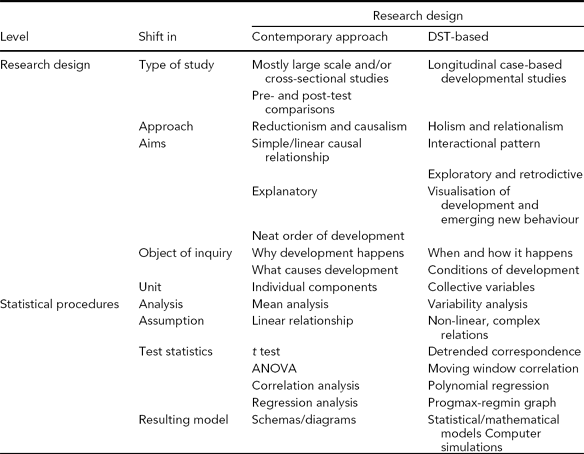
Changes in both conceptual and practical levels are reflected in the methodological design of DST-based studies. The research is mostly designed longitudinally (or quasi-longitudinally), the aims are highly unconventional, and the statistical analysis employed in DST-based research is very different from traditional modes. DST-based research involves very advanced calculations that assume non-linearity in their underpinning principles (de Bot, Reference de Bot2008).
The emphasis of a dynamic approach to development is on change over time; therefore, timescale is an important issue in the whole research design. Research within this particular framework is usually designed as longitudinal case studies with continuous developmental records of few participants (usually fewer than ten, sometimes even only one; see Larsen- Freeman, Reference Larsen-Freeman2006; Lowie, Caspi, van Geert, & Steenbeek, Reference Lowie, Caspi, van Geert, Steenbeek, Verspoor, de and Lowie2011; Plaza-Pust, Reference Plaza-Pust2008; Schmid, Verspoor, & MacWhinney, Reference Schmid, Verspoor, MacWhinney, Verspoor, de Bot and Lowie2011; Spoelman & Verspoor, Reference Spoelman and Verspoor2010; Verspoor & Behrens, Reference Verspoor, Behrens, Verspoor, de Bot and Lowie2011; van Geert, Reference van Geert2008; Verspoor et al., Reference Verspoor, Lowie and van Dijk2008).
The shift from large-scale comparative studies of cross-sectional design to multidimensional, longitudinal case studies reflects the transition in the underlying philosophical spectrum from reductionism towards a more holistic approach (Larsen-Freeman, Reference Larsen-Freeman and Kramsch2002; Larsen-Freeman & Cameron, Reference Larsen-Freeman and Cameron2008). DST-based research adopts a more holistic and relational stance, looking at the system as a whole and trying to study the pattern of its development (Larsen-Freeman & Cameron, Reference Larsen-Freeman and Cameron2008; Verspoor et al., Reference Verspoor, Lowie and van Dijk2008), hence a move from aiming at a causal explanation to a more descriptively exploratory retrodiction (de Bot & Larsen-Freeman, Reference de Bot, Larsen-Freeman, Verspoor, de Bot and Lowie2011; van Geert, Reference van Geert2008).
What DST-based research tries to achieve is to ‘visually see’ when and how development happens (de Bot at al., Reference de Bot, Lowie and Verspoor2007; Larsen-Freeman & Cameron, Reference Larsen-Freeman and Cameron2008; Verspoor et al., Reference Verspoor, Lowie and van Dijk2008) and how new forms of behaviour emerge (Thelen & Smith, Reference Thelen and Smith1994, Reference Thelen, Smith, Damon and Lerner2006). This is accomplished by employing advanced statistics that examine the variability instead of smoothing it away by an averaged mean (for detailed explanations of the logic behind these statistical methods and how to conduct the analysis and the simulations see van Dijk et al., Reference van Dijk, Verspoor, Lowie, Verspoor, de Bot and Lowie2011; van Dijk & van Geert, Reference van Dijk and van Geert2007; van Geert & van Dijk, Reference van Geert and van Dijk2002; van Geert, Steenbeek, & Kunnen, Reference Kunnen, van Dijk, Lichtwarck-Aschoff, Visser, van Geert and Kunnen2012). To test the hypotheses and validate the claims, DST-based studies turn to statistical simulations and/or computer modelling to compare the data at hand with the simulated set and try to find the best fit (for more discussion, see Kunnen, van Dijk, Lichtwarck-Aschoff, Vieser, & van Geert, Reference van Geert, Lauren, Little and Card2012).
Table 1 summarises the shift from contemporary approach to a DST-based one in terms of research methodology.
Paradigm Shift in Research Methodology
So far, this article has discussed the characteristics of a dynamic system and how L2 development mirrors the behaviour of such a system. By pointing out the paradigm shift induced by the integration of such a powerful approach into SLA research, this article argues that DST has revolutionised the SLA research enterprise. The next section will highlight its contributions to the SLA enterprise and also point out its limitations, and conclude by pointing out some future directions.
Contributions of DST to SLA Research
DST has contributed to at least three areas in SLA research enterprise: conceptual, methodological, and pedagogical levels.
Conceptual Contributions
By accommodating the extremities in the approaches to L2 acquisition issues, DST provides a bigger lens to view and account for the phenomena in SLA (Larsen-Freeman, Reference Larsen-Freeman and Kramsch2002). DST does not reject social, cognitivist, and interactionist views on language acquisition and development, but embraces all and bridges the gap between reductionism and holism in SLA research (de Bot & Larsen-Freeman, Reference de Bot, Larsen-Freeman, Verspoor, de Bot and Lowie2011; de Bot et al., Reference de Bot, Lowie and Verspoor2007). It serves as a meta-theory to reconcile extremities in the fields (Witherington, Reference Witherington2007).
DST provides alternatives to look at and examine the nature of development at both theoretical and empirical levels (van Geert, Reference van Geert2011). As DST views the system as a whole and tries to see development as the total result of the interactions, it resembles the real world in a more naturalistic way. Its contribution to our understanding of dynamic systems and their development is extremely valuable (Larsen-Freeman, Reference Larsen-Freeman and Kramsch2002; van Geert, Reference van Geert2008). Not only does it introduce a set of concepts to complement and advance the current understanding of the issues in the field, it also brings about methodological expansion to include a variety of statistical methods and computational modelling to enrich the enterprise.
Methodological Expansion
DST brings into the SLA research field a variety of tools, statistical or otherwise, to study complex systems, detect transitions and see how development unfolds. It is in its ability to visualise the moment and the process of development that the true power of DST can be found. As pointed out in the previous section, DST provides methods to test theories and hypotheses as well as the interpretations of empirical findings through computer modelling and statistical simulations.
Furthermore, DST acknowledges a multilayered design of observations. Since DST recognises the concepts of nestedness and fractal shapes, it follows that research at any level of these nested (sub)systems is as equally valid as its contribution to the understanding of the system as a whole. Therefore, DST-based research expands its methodology to include all levels of observations, ranging from microgenetic to macrogenetic developmental studies.
Pedagogical Implications
Another equally substantial contribution is the DST view of dependence on early states. DST acknowledges that early states play an important role in any subsequent development (de Bot & Larsen-Freeman, Reference de Bot, Larsen-Freeman, Verspoor, de Bot and Lowie2011; van Dijk et al., Reference van Dijk, Verspoor, Lowie, Verspoor, de Bot and Lowie2011). A slight difference in the early states may have a profound effect in the long run. Initial misperception of sounds, for example, may eventually lead to fossilisation in terms of pronunciation (de Bot et al., Reference de Bot, Lowie and Verspoor2007). In this case, teachers should take caution, especially when teaching beginner learners, in order to ‘avoid early entrenchment of non-target patterns’ (de Bot et al., Reference de Bot, Lowie and Verspoor2007, p. 19) as such fossilisation needs much more force to undo and to push the system out of it (de Bot et al., Reference de Bot, Verspoor and Lowie2005). This is where pedagogical intervention should emphasise prevention.
In line with this idea is the concept of the snowballing effect, where one early error will lead to further errors. Thewissen (Reference Thewissen2013) demonstrated that the current pedagogical practice that is heavily built upon a sentence-based approach in teaching grammar has misplaced the focus of meaning conveyed by the structure that stretches over discourse, rather than clusters of words or phrases. An error in the first usage will then lead to more erroneous usage to follow. This snowballing effect again demonstrates the importance of pedagogical attention to the initial encounter with the target form, in order to avoid long-term fossilisation.
Also, DST assumes that learning is a dynamic process, and ideally, assessment would be dynamic too. In other words, static pictures of what learners can do in one assessment session do not tell all about a learner's capability. DST emphasises that progression, stagnation, and regression constitute development (van Dijk et al., Reference van Dijk, Verspoor, Lowie, Verspoor, de Bot and Lowie2011); so, even when no progress has been detected at a surface level between two time points, it does not mean that the learners are not developing during that time period (Thewissen, Reference Thewissen2013). Single occasional assessment is not capable of capturing the dynamism of language development. From the DST point of view, longitudinal portfolio assessment is an ideal way of profiling learners’ developmental dynamics.
This has impacts on not only teachers but also educational psychologists. Measuring a learner's capability based on his/her performance in one or few assessment sessions is not a fair practice as the high degree of variability along the developmental dynamics may be misinterpreted as incompetence. In terms of second language learning, teachers and educational psychologists should be aware of the interconnectedness of all linguistic subsystems in the learner's mind, including their first language (L1) and the fact that it is impossible to completely deactivate the L1 subsystem during the L2 learning process. Forcing the learners to shut down their L1 subsystem during L2 learning is discouraged in the DST perspectives. The interference from the learner's L1 and their errors in L2 performance should not be condemned as incomplete learning (Sunderman & Fancher, Reference Sunderman, Fancher and Schwieter2013), but rather as a natural part of developmental dynamics. Therefore, teachers and educational psychologists should keep these in mind when designing the teaching programs, assessment tools, and/or treatment programs (in the case of developmental or language disorder).
However, despite its potentially promising contributions, current DST-based research has some remaining limitations (de Bot et al., Reference de Bot, Lowie and Verspoor2007). The following sections will discuss some of these limitations and suggest future directions for researchers applying and refining this approach to language developmental studies.
Limitations of Current Studies Adopting DST
Sceptical criticism was put forward to accentuate the lack of generalisability of the findings from DST-based research, which is usually designed as case studies of few individuals. When generalisability is understood in its most conservative definition, DST-based research may not fit in well (van Geert, Reference van Geert2011) because it examines particular cases and contexts in depth and is not designed to examine the representativeness of findings in other contexts. However, as van Geert (Reference van Geert, Lauren, Little and Card2012) pointed out, generalisability in such developmental research can be attempted in ‘the relation between data and theory’ (p. 730). The findings from longitudinal case studies can further verify-and-validate (or refute-and-reject) the theory and claim the generalisability of the theory to individuals. Van Geert further added that: ‘In order to arrive at general theories, one must first collect many individual cases and start with a model of each individual case particularly’ (p. 730). Scientific validity can then be attempted through the comparison of many different case-studies’ records (Fogel et al., Reference Fogel, Greenspan, King, Lickliter, Reygadas, Shanker, Toren, Fogel, King and Shanker2008) as together they weave a larger and clearer picture. Therefore, the case study design of the current DST-based research is not a limitation in its methodology but rather a characteristic of developmental research. The aim of such a design is to identify key parameters and the moments of change. The key parameters bear information about the essential elements for changes in a dynamic system, and the moments of change offer insights into the onset and the process of change itself. Once identified, the ‘when, how and why’ development unfolds can be explained (Thelen & Smith, Reference Thelen, Smith, Damon and Lerner2006).
Nevertheless, DST assumes that not only the components of the system change over time, the interactions among them are also dynamic. This presents a challenge to the theory itself as it is difficult to measure circumstances that continually change and also constitute a problem to the data collection. In order to capture the full account of dynamism, data would ideally be collected from longitudinal observation of the behaviour and analysed to show the interactions among highly intertwined components. However, such dense longitudinal data are not easily available in large scale (de Bot & Larsen-Freeman, Reference de Bot, Larsen-Freeman, Verspoor, de Bot and Lowie2011). The current DST-based research is at the stage of attempting longitudinal case studies of a few participants. The data collected from these participants are then compared to computer simulations. Although some models of these simulations have been developed in this field (e.g., connected growth model, precursor model) to map this dynamic development and interaction, they are still at an early stage and constitute only a small step forward in our understanding of the complex system (de Bot, Reference de Bot2008). Fine-tuning these models will require both time and further understanding of the development itself (de Bot, Reference de Bot2008; van Geert, Reference van Geert2008). One of the recently developed models, however, is the dynamic modelling of L2 vocabulary developmental data (Lowie et al., Reference Lowie, Caspi, van Geert, Steenbeek, Verspoor, de and Lowie2011), which has successfully simulated the developmental patterns of L2 vocabulary knowledge. The model not only demonstrates the power of dynamic modelling in hypothesis testing, but also allows for speculations on the possible outcomes of learning in different individuals at different levels. Further development of such a model may allow for generalisation to larger populations.
However, such developmental models draw heavily from mathematical abstractions and involve advanced statistical analysis. It is, therefore, preferable for researchers in this field to attempt further inquiries into the advancement in the field of applied mathematics and statistics and become more familiar with their applications. Van Geert (Reference van Geert2011) argued that unless research moves beyond the conservative boundary, our view and understanding of the phenomena will be confined to the current pragmatic way of thinking. In other words, DST-based research needs to expand its boundary to integrate a more diverse range of methods in order to overcome these limitations. Attempting cross-disciplinary communication may lead to more novel and fruitful empirical studies. The next section will discuss the possibility of such cross-disciplinary inquiries.
Future Directions
Although de Bot (Reference de Bot2008) recommended developing DST-based SLA research in the lines of longitudinal studies, experimental work, and developmental modelling within the SLA enterprise, this article suggests that merging the field of SLA with other fields could also be fruitful. In support of such integration are the findings of Vyatkina (Reference Vyatkina2012, Reference Vyatkina2013) and Thewissen (Reference Thewissen2013), who demonstrated that a learner corpus could, to some extent, solve the problem of paucity of large-scale longitudinal data. Integrating DST views with corpus study has been effective in profiling and benchmarking development in SLA research. Their successful demonstration of interdisciplinary study opens up vast possibilities of novel cross-boundary investigation. In this article, the author suggests that SLA researchers can apply this integrated approach and pursue understanding beyond the boundaries of DST. Such collaborations may include: neuroscientists or neuro-linguists, applied mathematicians, computer engineers, and, most importantly, second language teachers and learners.
Research can be conducted at many different levels of time-scales. The DST assumptions of the iterative and fractal process along development allows for a more flexible approach to view and explore the unfolding of development at ‘different levels of granularity across time’ (de Bot et al., Reference de Bot, Lowie, Thorne, Verspoor, García Mayo, Gutierrez Mangado and Martínez Adrián2013, p. 201). Researchers can attempt macrogenetic longitudinal studies ranging from decades to a lifespan to achieve a global view of development. If information about development is needed at a detailed level, a microgenetic design to study a short-term change but with dense data collection points will reveal more fine-grained findings. Since both approaches offer insights into the dynamics of change, both are equally valid and encouraged in the DST framework.
Conclusions
This paper has argued that since language is a dynamic system and language learning is a dynamic process, applying DST into SLA research may reveal interesting information about what is happening in the language acquisition and developmental process. Researchers who embrace DST may either want to look deeply into detailed analysis of variability surrounding the developmental trajectory to visually analyse both the moment and the process of development (van Geert, Reference van Geert2008), or attempt cross-disciplinary studies to profile and benchmark language development. This article emphasises that DST has not only contributed much to our understanding of language learning as a dynamically complex process, but also shown the potentials to unveil the mystery of how human mind acquires, and then produces, complex linguistic forms. It also augments the research methodology in developmental studies and bridges the gap between holistic and reductionist perspectives, hence providing a comprehensive meta-theory of development.
Acknowledgments
The author would like to offer special thanks to Dr Aek Phakiti and Dr Minkang Kim (Faculty of Education, The University of Sydney) and the two anonymous reviewers for their valuable comments on the draft of this paper. All remaining weaknesses are my responsibility.
Financial Support
This work was supported by the Prime Minister's Australia Asia Endeavour Award (award no. PMPGI_DCD_3027_2012).