Introduction
Since the first discovery of a bark beetle pheromone more than a half century ago (Silverstein et al. Reference Silverstein, Rodin and Wood1966), much progress has been made in the development of semiochemicals for the management of bark beetles (Silverstein et al. Reference Silverstein, Brownlee, Bellas, Wood and Browne1968; Silverstein Reference Silverstein1981; Wood Reference Wood1982; Borden Reference Borden, Kerkut and Gilbert1985, Reference Borden, Cardé and Minks1997; Seybold et al. Reference Seybold, Bohlmann and Raffa2000, Reference Seybold, Bentz, Fettig, Lundquist, Progar and Gillette2018; Gillette and Munson Reference Gillette, Munson, Hayes and Lundquist2009; Progar et al. Reference Progar, Gillette, Fettig and Hrinkevich2014). Researchers have already identified semiochemicals for many of the most damaging bark beetle species, primarily in the Scolytine genera Dendroctonus Erichson (Coleoptera: Curculionidae) and Ips De Geer (Coleoptera: Curculionidae) but also in Pityophthorus Eichhoff (Coleoptera: Curculionidae) (Borden Reference Borden, Cardé and Minks1997; Seybold et al. Reference Seybold, Bohlmann and Raffa2000; El-Sayed Reference El-Sayed2020). Furthermore, new application techniques are continually being developed (Holsten et al. Reference Holsten, Webb, Shea and Werner2002, Reference Holsten, Shea and Borys2003; Gillette et al. Reference Gillette, Stein, Owen, Webster, Fiddler, Mori and Wood2006; Mafra-Neto et al. Reference Mafra-Neto, de Lame, Fettig, Munson, Pering, Stelinski, Beck, Coats, Duke and Koivunen2013; Fettig et al. Reference Fettig, Munson, Reinke and Mafra-Neto2015, Reference Fettig, Steed, Bulaon, Mortenson, Progar and Bradley2016).
Bark beetles nevertheless continue to cause enormous losses to western North American forests, compromising forest productivity, biodiversity, and crucial forest carbon sinks (Bentz et al. Reference Bentz, Logan, MacMahon, Allen, Ayres and Berg2009; Hicke et al. Reference Hicke, Meddens and Kolden2016; Morris et al. Reference Morris, Cottrell, Fettig, DeRose, Mattor and Carter2018). There are several options for managing bark beetle damage, including silvicultural treatments, insecticides, and semiochemicals (Gillette et al. Reference Gillette, Wood, Hines, Runyon and Negrón2014b). Semiochemical treatments often do not yield total control, but they are widely favoured over both insecticide treatments, which may have negative nontarget effects, and silvicultural methods, which are expensive and cumbersome (Progar et al. Reference Progar, Gillette, Fettig and Hrinkevich2014). Although we do have effective semiochemicals for management of some bark beetle species, many of these products are too expensive for widespread use. For example, one of the most effective repellents, conophthorin, is effective against many bark beetle species (Borden et al. Reference Borden, Wilson, Gries, Chong and Pierce1998; Huber et al. Reference Huber, Borden, Jeans-Williams and Gries2000, Reference Huber, Borden and Stastny2001; Huber and Borden Reference Huber and Borden2001a, Reference Huber and Borden2001b; Graves et al. Reference Graves, Holsten, Ascerno, Zogas, Hard and Huber2008), but its synthesis is currently prohibitively expensive for most forestry uses (Unelius et al. Reference Unelius, Schiebe, Bohman, Andersson and Schlyter2014). The search for improved semiochemical treatment methods is a multifaceted challenge requiring basic science to identify allomones, kairomones, and pheromones, laboratory and field bioassays to confirm behavioural activity, development of controlled-release devices to diffuse the active ingredients at an ethologically relevant rate during beetle flight, and regulatory approvals to make such products available for commercial development and use. The situation is further complicated by the fact that most applications occur on public lands in western North America, where human and environmental safety are paramount and treatment areas are often remote, rugged, and expansive.
Climate trends indicate a progressively worsening situation for forests globally, with drought and increasing temperatures expected to further stress forest ecosystems and exacerbate the negative impacts of bark beetles on forests (Raffa et al. Reference Raffa, Aukema, Bentz, Carroll, Hicke, Turner and Romme2008; Bentz et al. Reference Bentz, Logan, MacMahon, Allen, Ayres and Berg2009, Reference Bentz, Régnière, Fettig, Hansen, Hayes and Hicke2010; Jamieson et al. Reference Jamieson, Trowbridge, Raffa and Lindroth2012; Kolb et al. Reference Kolb, Fettig, Ayres, Bentz, Hicke and Mathiasen2016). There exists, therefore, an acute need for a more intensive focus on research and development of more effective and economical methods for tree protection, from the individual-tree level to the landscape level. Indeed, a recent meta-analysis established strong evidence for an overall treatment effect of anti-attractant treatments for the genera Dendroctonus and Ips, suggesting great promise for such a research investment (Schlyter Reference Schlyter2012). In this paper, we focus primarily on the most damaging western North American bark beetles, the mountain pine beetle (Dendroctonus ponderosae Hopkins) (Coleoptera: Curculionidae), the Douglas-fir beetle (Dendroctonus pseudotsugae Hopkins) (Coleoptera: Curculionidae), the spruce beetle (Dendroctonus rufipennis Kirby) (Coleoptera: Curculionidae), and the western pine beetle (Dendroctonus brevicomis Le Conte) (Coleoptera: Curculionidae).
Release devices and active ingredients
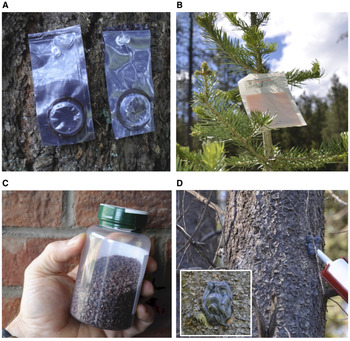
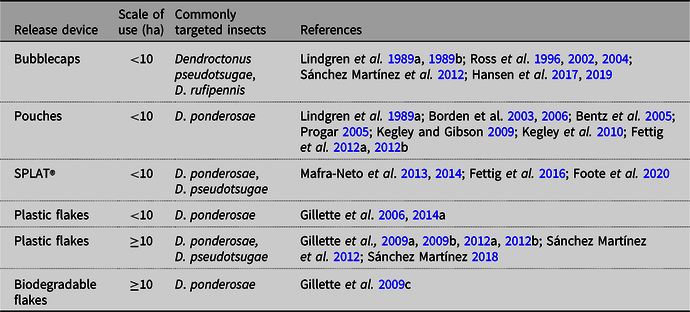
The mostly commonly used release devices have been polymeric matrix reservoirs (bubble capsules, or “bubblecaps,” and pouches) that release semiochemicals slowly and passively through a plastic membrane (Fig. 1A,B). Two newer release devices are flakes (Fig. 1C; Hercon Environmental Inc., Emigsville, Pennsylvania, United States of America) consisting of small laminated plastic or biodegradable chips with a pheromone-releasing layer in the middle, and SPLAT® (Fig. 1D), consisting of a spreadable wax-emulsion matrix incorporating semiochemicals (Specialized Pheromone & Lure Application Technology, ISCA Technologies Inc., Riverside, California, United States of America). In addition, there is a laminated pheromone-releasing polymer strip that can be hand applied from ground level. These release devices and their applications are summarised in Table 1. Currently registered active ingredients include verbenone (4,6,6-trimethylbicyclo[3.1.1]hept-3-en-2-one) and MCH (3-methylcyclohex-2-en-1-one). Currently available commercial products include: Verbenone ─ Beetleblock Verbenone (ChemTica USA, Durant, Oklahoma, United States of America), Disrupt MicroFlake® VBN (Hercon Environmental Inc., Emigsville, Pennsylvania, United States of America), Disrupt BioFlake® VBN (Hercon Environmental Inc.), Synergy Shield Verbenone Pouch and Bubble (Synergy Semiochemical Corp., Burnaby, British Columbia, Canada), Verbenone Pine Beetle Repellent Pouch (ISCA Technologies Inc.), and SPLAT® Verb Bark Beetle Repellent (ISCA Technologies Inc.) for D. ponderosae and other bark beetles; and MCH ─ Beetleblock MCH (ChemTica USA), Disrupt® MCH HA (Hercon Environmental Inc.), Disrupt MicroFlake® MCH (Hercon Environmental Inc.), MCH Douglas-fir/Spruce Beetle Repellent BC (ISCA Technologies Inc.), and Synergy Shield MCH Bubble and Double Bubble (Synergy Semiochemical Corp.) for D. pseudotsugae and D. rufipennis. In addition, there are several products in the development pipeline, including SPLAT® MCH for D. pseudotsugae (Foote et al. Reference Foote, Fettig, Ross, Runyon, Coleman and Gaylord2020), MCH + AKB for D. rufipennis (Hansen et al. Reference Hansen, Munson, Wakarchuk, Blackford, Graves, Stephens and Moan2019), SPLAT® Verb Plus for D. brevicomis (Fettig et al. Reference Fettig, McKelvey, Dabney, Huber, Lait, Fowler and Borden2012b), and a blend of limonene and conophthorin for the walnut twig beetle, Pityophthorus juglandis Blackman (Coleoptera: Curculionidae) (Audley et al. Reference Audley, Bostock and Seybold2020).
Release devices for bark beetle semiochemicals include: A, bubbles (Synergy Semiochemical Corp., Burnaby, British Columbia, Canada); B, pouches (ISCA Technologies Inc., Riverside, California, United States of America); C, flakes (Hercon Environmental Inc., Emigsville, Pennsylvania, United States of America); and D, SPLAT® (ISCA Technologies Inc.). Photo credits: A, R.A. Progar, United States Department of Agriculture Forest Service; B and D, C.J. Fettig, United States Department of Agriculture Forest Service; and C, W. Murray, Department of Biological Sciences, San Jose State University, San Jose, California, United States of America.

Examples of commonly used release devices for bark beetle (Coleoptera: Curculionidae) semiochemicals.

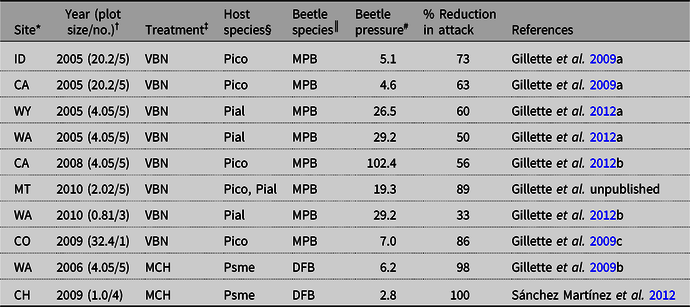
Bubblecap, pouch, and SPLAT® releasers often provide good protection from beetle attack (Gillette and Munson Reference Gillette, Munson, Hayes and Lundquist2009; Seybold et al. Reference Seybold, Bentz, Fettig, Lundquist, Progar and Gillette2018), but results can vary depending on the semiochemical used, beetle population densities, stand structure, and tree stress, among other factors (Bentz et al. Reference Bentz, Lister, Schmid, Mata, Rasmussen and Haneman1989, Reference Bentz, Kegley, Gibson and Thier2005; Huber and Borden Reference Huber and Borden2001a, Reference Huber and Borden2001b; Fettig et al. Reference Fettig, McKelvey, Dabney, Borys and Huber2009b; Kegley and Gibson Reference Kegley and Gibson2009; Kegley et al. Reference Kegley, Gibson, Gillette, Webster, Pederson and Mori2010; Sánchez Martínez et al. Reference Sánchez Martínez, Mehmel, Gillette, González Gaona, López and Alanís Morales2012). 3-Methylcyclohex-2-en-1-one is generally much more effective for D. pseudotsugae than is verbenone for D. ponderosae, regardless of the release device. On its own, MCH has not been consistently effective against D. rufipennis, but MCH in conjunction with the new nonhost blend, AKB, has shown good efficacy in several studies (Hansen et al. Reference Hansen, Munson, Blackford, Wakarchuk and Baggett2016, Reference Hansen, Munson, Blackford, Graves, Coleman and Baggett2017, Reference Hansen, Munson, Wakarchuk, Blackford, Graves, Stephens and Moan2019). The MCH + AKB blend will be commercially available in 2020 (Synergy Semiochemical Corp.). More recently, a nonhost blend used in conjunction with SPLAT® MCH has also shown great promise for use against D. rufipennis in Engelmann spruce, Picea engelmannii Parry ex Engelm. (Pinaceae) (Fettig et al., unpublished). Verbenone alone has not proven to be consistently effective for protection of ponderosa pine, Pinus ponderosa Dougl. ex Laws. (Pinaceae), from D. brevicomis or D. ponderosae (Negrón et al. Reference Negrón, Allen, McMillin and Burkwhat2006; Fettig et al. Reference Fettig, McKelvey, Borys, Dabney, Hamud, Nelson and Seybold2009a). Verbenone in conjunction with a blend of nonhost volatiles, Verbenone Plus, has shown some promise based on studies in British Columbia, Canada and California, United States of America (Fettig et al. Reference Fettig, McKelvey, Dabney, Borys and Huber2009b, Reference Fettig, Bulaon, Dabney, Hayes and McKelvey2012a, Reference Fettig, McKelvey, Dabney, Huber, Lait, Fowler and Borden2012b) but has yet to be commercialised. Light applications of MCH-flake releasers (371–1112 g/ha) over large areas yield good results for protection of Douglas-fir, Pseudotsuga menziesii (Mirbel) Franco (Pinaceae), from D. pseudotsugae (98–100% reduction in tree attack or mortality; Gillette et al. Reference Gillette, Mehmel, Webster, Mori, Erbilgin, Wood and Stein2009b; Sánchez Martínez et al. Reference Sánchez Martínez, Mehmel, Gillette, González Gaona, López and Alanís Morales2012), and verbenone flakes show reasonably good reductions (33–89%) in tree attack by D. ponderosae in area-wide applications in several hosts, especially at low-to-moderate beetle populations (Table 2).
A summary of area-wide bioassays of pheromone-releasing flakes for bark beetle (Coleoptera: Curculionidae) management in western North America.
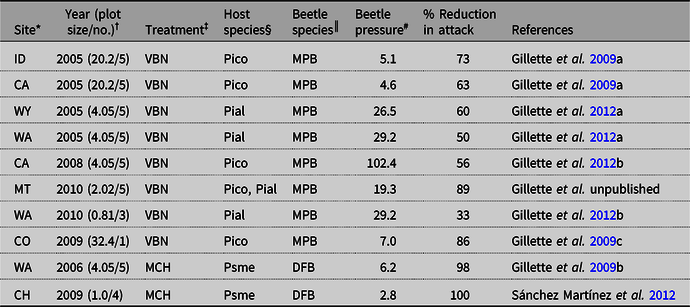
* CH, Chihuahua (Estados Unidos Mexicanos (Mexico)); CA, California; CO, Colorado; ID, Idaho; MT, Montana; WA, Washington; WY, Wyoming (United States of America).
† Year of treatment application (plot size in hectares per number of replicated plots).
‡ VBN, verbenone; MCH, methylcyclohexenone.
§ Pico, Pinus contorta; Pial, Pinus albicaulis; Psme, Pseudotsuga menziesii.
‖ MPB, mountain pine beetle, Dendroctonus ponderosae; DFB, Douglas-fir beetle, Dendroctonus pseudotsugae.
# Beetle pressure was estimated using previous year attack rate, as measured by number of stems per hectares attacked.
Needs and constraints
Future progress in the development of semiochemical methods for bark beetle management depends upon: (1) identification of new semiochemicals and blends; (2) assessment of the role of optical isomers in beetle behaviour; (3) development of less expensive methods for synthesising semiochemicals; (4) improvements in release-device performance (to include development and refinement of biodegradable releasers); (5) assessment and optimisation of various single-tree and area application tactics (e.g., antiaggregation, trap-out, and push–pull); (6) improvements in application methods, particularly aerial application; and (7) regulatory streamlining to expedite the commercial availability of products to resource managers. Research to support these activities is expensive, but cost–benefit analyses for agricultural products indicate a cost–benefit ratio of $2655 to $26 548 (U.S. dollars) per dollar spent on research (Bento et al. Reference Bento, Parra, de Miranda, Adami, Vilela and Leal2016). Although benefits to forest health are more difficult to quantify than those to agricultural crops, concerns about carbon sequestration and climate change (Vose et al. Reference Vose, Peterson, Domke, Fettig, Joyce, Keane, Reidmiller, Avery, Easterling, Kunkel, Lewis and Maycock2018) support a different sort of valuation – one based on ecosystem services that depend on healthy, intact, and diverse forests.
The discovery and development of new semiochemical active ingredients is a laborious process involving isolation of headspace volatiles from insects and plants and assessment of their neurophysiological activity using electroantennogram detection (EAD), followed by identification of the behaviourally active compounds using analytical chemical instruments such as gas chromatography/mass spectrometry (GC/MS). Coupled GC–EAD assays may be conducted to confirm the neurophysiological responses to individual active ingredients. While GC–EAD yields information regarding which chemicals an insect is capable of perceiving, it cannot reveal the behavioural response (i.e., is it attractive or repellent, or does it simply inhibit an insect’s response to attractants?). Furthermore, GC–EAD cannot assess the activity of blends of chemicals on insect response, because with GC–EAD the chemicals are presented singly. The behavioural activity of individual active ingredients and blends at the level of the organism, therefore, requires exhaustive and often repetitive laboratory olfactometer and wind tunnel assays, followed by field trials to determine insect responses using both baited traps and baited trees, small stands, and eventually larger forest stands. In the latter stages of research, the responses of nontarget insects such as predators, parasitoids, and pollinators are conducted to assess the risk of unintended treatment effects.
As mentioned, MCH is extremely effective as a single-component semiochemical for the protection of Ps. menziesii, but more effective products are needed for all of the pine-killing species of Dendroctonus (where verbenone alone has not always been as effective as desired) and for D. rufipennis in Alaska, United States of America, where MCH + AKB is less effective (Hansen et al. Reference Hansen, Munson, Wakarchuk, Blackford, Graves, Stephens and Moan2019). Beetles such as fir engraver, Scolytus ventralis (Le Conte) (Coleoptera: Curculionidae), western balsam bark beetle, Dryocoetes confusus (Swaine) (Coleoptera: Curculionidae), and many Ips species also have the potential to cause landscape-scale tree mortality (Bentz et al. Reference Bentz, Régnière, Fettig, Hansen, Hayes and Hicke2010) and, thus, present additional challenges for forest pest management using semiochemicals. These chemical–ecology challenges have typically been addressed by researchers in government and academia, but innovations in release device technology have usually been the domain of the semiochemical industry and are understandably largely market-driven. In more recent years, government agencies, academia, and industry have worked more closely on all aspects of bark beetle semiochemical innovation. As an example, the development of SPLAT® Verb, a highly effective flowable formulation, resulted from collaborations between government scientists and the semiochemical industry (Mafra-Neto et al. Reference Mafra-Neto, de Lame, Fettig, Munson, Pering, Stelinski, Beck, Coats, Duke and Koivunen2013; Fettig et al. Reference Fettig, Munson, Reinke and Mafra-Neto2015). Industry–government collaboration has also resulted in new active ingredient registration applications for Synergy Shield GVLM and AKB (Synergy Semiochemical Corp.) to be used as adjuvants for verbenone and MCH, respectively (David Wakarchuk, personal communication). Because bark beetle semiochemicals are often applied on public lands throughout western North America, there is a need for both biodegradable dispersible releasers and “discrete retrievable dispensers” that are made of polymeric matrix materials and are intended to be removed after depletion (United States Government Printing Office 2012).
In addition to these fine-scale issues, there remain substantial questions regarding the optimal tactics and strategies for bark beetle management using semiochemicals. For example, while anti-aggregation methods using repellent semiochemicals (the “push” tactic; Gillette and Munson Reference Gillette, Munson, Hayes and Lundquist2009) have been the most thoroughly tested approach, there remain unanswered questions about the comparative efficacy of other tactics, such as push–pull (a combination of attractant-baited traps or baited trees placed near areas treated with antiaggregation formulations; Borden et al. Reference Borden, Birmingham and Burleigh2006; Gillette et al. Reference Gillette, Mehmel, Mori, Webster, Wood, Erbilgin and Owen2012b; Hansen et al. Reference Hansen, Munson, Wakarchuk, Blackford, Graves, Stephens and Moan2019) and trap-out (using attractant-baited traps or baited trees to concentrate bark beetle populations; Bedard and Wood Reference Bedard, Wood and Mitchell1981; Gray and Borden Reference Gray and Borden1989; Progar et al. Reference Progar, Sturdevant and Rinella2010; Hansen et al. Reference Hansen, Munson, Wakarchuk, Blackford, Graves, Stephens and Moan2019).
Studies to resolve these questions require replicated and controlled tests over large areas where sources of heterogeneity (i.e., stand structure, beetle populations, and tree stress) are difficult to measure and account for as covariates. Once all of these issues have been adequately resolved, the hurdles of regulatory approvals at multiple levels of government remain. These hurdles include fees for registration and costs of human and environmental health testing requirements, such as mammalian acute oral, dermal, and inhalation toxicities, and extensive avian, fish, host plant, and nontarget insect effects (United States Code of Federal Regulations 2019). Although testing to assess human and environmental effects of active ingredients is cumbersome and costly, forest trees are a minor use crop, which may make them commercially marginal for investment by industry. Some effective new active ingredients, therefore, remain unexplored by industry and unavailable for commercialisation and widespread use in forest pest management. The recent increasing movement of human populations into the wildland–urban interface, however, has resulted in an increased demand for green, safe, semiochemical solutions to manage bark beetles in those landscapes and may drive further development of commercially viable products.
New opportunities
Despite the obstacles described above, some promising avenues exist for overcoming constraints to semiochemical bark beetle management (Seybold et al. Reference Seybold, Bentz, Fettig, Lundquist, Progar and Gillette2018). These include: (1) regulatory harmonisation across countries and agencies; (2) development of new biodegradable formulations for release devices; (3) advances in microbial synthesis of active ingredients; (4) transgenic plants that produce relevant semiochemicals; and (5) developments in unmanned aerial vehicle (drone) technology for application of semiochemicals to large expanses.
Regulatory harmonisation is an effort that began in North America decades ago with North American Free Trade Agreement support for harmonisation of biopesticide regulations across North America, to include the United States of America, Canada, and Mexico (United States Environmental Protection Agency 2016). In 1998, a technical working group comprising members from all three countries began to develop joint standards for assessing and registering biopesticides. In the intervening decades, initiatives have sprung up to harmonise these standards across continents and globally, including in Asia, Africa, North America, South America, and the European Union (Odong Reference Odong2009; Food and Agriculture Organization of the United Nations 2013, 2019; Arora et al. Reference Arora, Verma, Prakash, Mishra, Arora, Mehnaz and Balestrini2016; Frederiksa and Wesselerb Reference Frederiksa and Wesselerb2019). Furthermore, the Organisation for Economic Coordination and Development has developed a programme to harmonise pesticide testing and registration across member countries in Europe, the United Kingdom, North America, South America, and Oceania (Organisation for Economic Coordination and Development 2019). Although progress is slow, the increasing market share of biopesticides in the overall pesticide market, driven largely by consumer demands for residue-free produce and protection of biodiversity, has increased global attention to the need for regulatory streamlining for biopesticides (Olson Reference Olson2015).
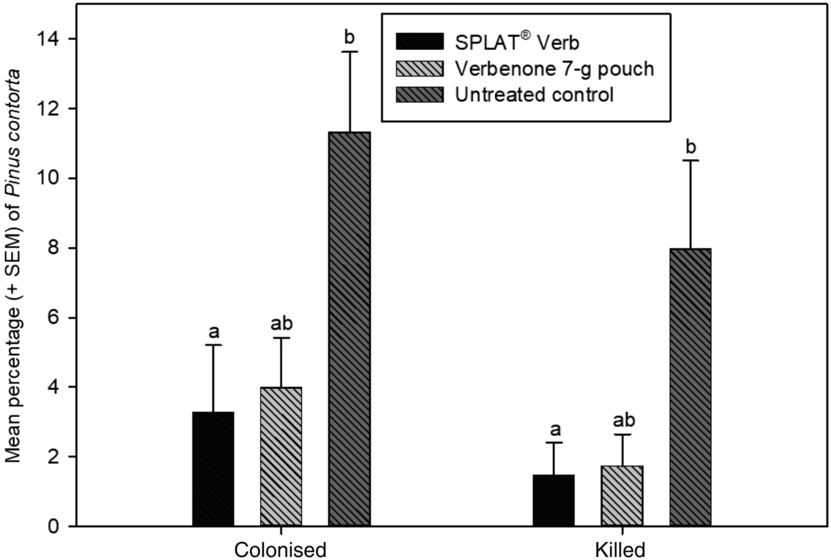
Advances in the development of biodegradable semiochemical-release devices have been driven largely by the medical market, but more recently greater attention has been given to the use of such products in agriculture (Zada et al. Reference Zada, Falach and Byers2009; Jadhav et al. Reference Jadhav, Chiou, Wood, DeGrande-Hoffman, Glenn and John2011; Mafra-Neto et al. Reference Mafra-Neto, de Lame, Fettig, Munson, Pering, Stelinski, Beck, Coats, Duke and Koivunen2013, Reference Mafra-Neto, Fettig, Munson, Rodriguez-Saona, Holdcraft, Faleiro, Gross, Coats, Beck and Duke2014). Sol–gel (Zada et al. Reference Zada, Falach and Byers2009; Jadhav et al. Reference Jadhav, Chiou, Wood, DeGrande-Hoffman, Glenn and John2011) and flowable semi-liquid (Mafra-Neto et al. Reference Mafra-Neto, de Lame, Fettig, Munson, Pering, Stelinski, Beck, Coats, Duke and Koivunen2013, Reference Mafra-Neto, Fettig, Munson, Rodriguez-Saona, Holdcraft, Faleiro, Gross, Coats, Beck and Duke2014) formulations have obvious uses for individual-tree and small-stand applications where hand-applied releasers can be deployed easily. This type of product has demonstrated efficacy for use with bark beetle semiochemicals in individual-tree and small-area bioassays (Fig. 2). Release devices that can be aerially broadcast, such as semiochemical-releasing flakes, have been produced in a biodegradable laminated-flake formulation and have demonstrated efficacy over both small and large areas (Gillette et al. Reference Gillette, Murray, Kelly, Webster and Mori2009c, Reference Gillette, Hansen, Mehmel, Mori, Webster, Erbilgin and Wood2012a, Reference Gillette, Kegley, Costello, Mori, Webster, Mehmel and Wood2014a; Sánchez Martínez et al. Reference Sánchez Martínez, Mehmel, Gillette, González Gaona, López and Alanís Morales2012). Considering the overriding importance of biodegradable products for use on public lands, we encourage further research and development into these materials for use as semiochemical-release devices.
Mean percentages (+SEM) of Pinus contorta colonised and killed by Dendroctonus ponderosae on 0.4-ha square plots treated with SPLAT® Verb (ISCA Technologies Inc., Riverside, California, United States of America) and 7-g verbenone pouches (ISCA Technologies Inc.), Caribou-Targhee National Forest, Idaho, United States of America, 2012−2013. Means (+SEM) followed by the same letter within group are not significantly different (Tukey’s HSD; P > 0.05). Adapted from Fettig et al. (Reference Fettig, Munson, Reinke and Mafra-Neto2015).

The need for cheaper, purer, and more effective active ingredients may soon be met using transgenic microbial pheromone “breweries” that harness genetically modified microbes (yeasts and bacteria) to produce chemically pure stereoisomers of semiochemicals at vastly reduced cost (Chang and Keasling Reference Chang and Keasling2006; Macek et al. Reference Macek, Kotrba, Svatos, Novakova, Demnerova and Mackova2008; Kirby and Keasling Reference Kirby and Keasling2009; Bruce et al. Reference Bruce, Aradottir, Smart, Martin, Caulfield and Doherty2015). Similarly, researchers in Sweden are developing transgenic Nicotiana (Solanaceae) plants that produce moth sex pheromones of high purity with minimum hazardous waste (Ding et al. Reference Ding, Hofvander, Wang, Durrett, Stymne and Löfstedt2014). While transgenic agricultural plants are already in widespread use for short-cycle crops (Bruce et al. Reference Bruce, Aradottir, Smart, Martin, Caulfield and Doherty2015), we expect that transgenic forest trees are unlikely to be accepted on public lands in the foreseeable future because of public concerns about genetic pollution and unintended consequences for native forests (Strauss et al. Reference Strauss, Costanza and Séguin2015). On the other hand, research and development efforts to develop microbial synthesis of pharmaceuticals and biofuels have been underway for decades (Chang and Keasling Reference Chang and Keasling2006), and many of the drug and biofuel targets are based on isoprenoid compounds that are structurally similar to bark beetle pheromones (Seybold et al. Reference Seybold, Huber, Lee, Graves and Bohlmann2006). We expect that semiochemicals produced by genetically engineered micro-organisms and forbs will be more readily accepted by the public and regulatory agencies for use on public lands than transgenic trees will be, because using microbe- and plant-produced semiochemical products poses little long-term ecological risk compared to introducing long-lived bioengineered trees to complex forest environments. Two further promising developments are the creation of CRISPR-Cas9 techniques (Doudna and Charpentier Reference Doudna and Charpentier2014) and “prime editing” (Anzalone et al. Reference Anzalone, Randolph, Davis, Sousa, Koblan and Levy2019) for more rapid and precise genome editing. The CRISPR-Cas9 techniques are particularly useful in genome editing of model organisms such as yeasts and bacteria, and these techniques are expected to generate much more efficient and rapid development of microbially produced isoprenoid compounds (Jakočiūnas et al. Reference Jakočiūnas, Jensen and Keasling2016). Prime editing is currently limited to human-disease applications but has great promise for a wider variety of targets. We hope that these new techniques will be adopted for the production of bark beetle semiochemicals, thereby reducing the cost and increasing the purity of semiochemicals available for use in forest pest management.
The use of drones in forestry is rapidly evolving for several kinds of applications (Hartley Reference Hartley2017). In the recent past, applications were limited by the technical limitations of drones to uses such as forest inventory, wildfire assessment, and forest health monitoring. For example, until recently, payload limits were as low as the 22-kg range, which would seriously limit the areas that could be reasonably treated with semiochemicals by drones (e.g., verbenone flakes are currently labelled for application rates of 2.47–7.4 kg/ha of formulated product). Furthermore, until recently, battery life was insufficient to maintain flight for area-wide treatments, especially in remote areas of mountainous terrain. Obviously, there will always be a trade-off between payload weight and flight duration, but recent advances in “megadrones” and “quadcopters” have vastly increased payloads (up to 440 kg), and a newly developed drone with 18 rotors is specifically designed for application of pest management products such as pesticides, fertilisers, pheromones, and other semiochemicals (Volocopter, Bruchsal, Germany). Drone application of semiochemicals would appear to be ideally suited for forestry situations, where spatial constraints, remote locations, and steep terrain limit ground applications and the use of helicopters and fixed-wing aircraft (Hartley Reference Hartley2017). The technology is now available for testing in forest pest management applications (Hartley Reference Hartley2017; King Reference King2017; Kislaya and Goutam Reference Kislaya and Goutam2019). Indeed, Anderson (Reference Anderson2014) reports that, in 2014, agricultural drones were named the number-one breakthrough technology for that year. As such, we envision greater use of this technology in forest pest management in the future.
Conclusions
We emphasise that forest stand management, specifically thinning to increase tree and stand resistance and resilience, is still the lynchpin of bark beetle management (Wood et al. Reference Wood, Stark, Waters, Bedard, Cobb, Waters, Stark and Wood1985; Gillette et al. Reference Gillette, Wood, Hines, Runyon and Negrón2014b). Stand management is considered indirect control, because it aims to minimise tree losses to bark beetles by focussing on stand conditions rather than by targeting the beetles themselves (Wood et al. Reference Wood, Stark, Waters, Bedard, Cobb, Waters, Stark and Wood1985; Progar et al. Reference Progar, Blackford, Cluck, Costello, Dunning and Eager2013; Fettig and Hilszczański Reference Fettig, Hilszczański, Vega and Hofstetter2015). Nevertheless, in many situations, especially in high-value developed recreation settings (e.g., campgrounds) or around homes in the wildland–urban interface, homeowners or resource managers are constrained from implementing stand treatments and must therefore rely on direct bark beetle control. Of all the direct control methods available to manage bark beetles (Fettig and Hilszczański Reference Fettig, Hilszczański, Vega and Hofstetter2015), semiochemical treatments are highly favoured because of their negligible effects on nontarget species, including other invertebrates, wildlife, and humans (Seybold et al. Reference Seybold, Bentz, Fettig, Lundquist, Progar and Gillette2018). In the face of recent extensive bark beetle outbreaks in western North America (Bentz et al. Reference Bentz, Logan, MacMahon, Allen, Ayres and Berg2009), it is our hope that new advances in the production of semiochemicals by microbes, regulatory streamlining, and unmanned aerial application will provide land managers with cheaper and more effective means to mitigate tree mortality attributed to bark beetles and its associated effects on a variety of resource objectives and ecological goods and services produced by forests.
Acknowledgements
Collaboration and cooperation have been essential to our past successes in the development and registration of semiochemicals for protection of this minor use crop. We applaud our many colleagues and cooperators who have contributed to this success. Critical among them are academic and government researchers, government resource managers in land management agencies at the state, provincial, estadal, and federal levels, the semiochemical industry, and private small- and large-scale landowners who have contributed their resources to this effort. In particular, we extend profound thanks to our forest health colleagues at all levels of government. We also thank A. Steven Munson (United States Department of Agriculture Forest Service, Forest Health Protection, Ogden, Utah, United States of America) for a very helpful review of this manuscript.
The authors wish to express their immense respect and gratitude for our deceased friend and colleague, Dr. Steven J. Seybold, whose contributions to our field are incalculable. He is sorely missed.