


In an era of political upheaval, contemporary parliaments need both fresh ideas and initiative as well as experience and knowledge to effectively introduce and amend policies, secure their position vis-à-vis other increasingly powerful actors such as interest groups and the bureaucracy, and ultimately represent their citizens. Broadly, we know that the capacity and accountability of any legislature hinges on who is present in it (Martin and Strøm Reference Martin and Strøm2024) and, more specifically, that the quality of representation depends on a balance between experienced legislators and new entrants (François and Grossman Reference François and Grossman2015; Matland and Studlar Reference Matland and Studlar2004). What the exact balance between the two should be, however, is contested. In this article, we examine variations in elite circulation in parliaments by conceptually distinguishing between three groups of parliamentarians (MPs) and examining the share of newcomers (turnover), the share of seniors (MPs who have served at least three terms) and the share of super-seniors (comprising only those MPs who have served five terms or more).
As such, we broaden the theoretical and empirical scope compared to existing studies on turnover (François and Grossman Reference François and Grossman2015; Gouglas et al. Reference Gouglas, Maddens and Brans2018; Matland and Studlar Reference Matland and Studlar2004; Verzichelli et al. Reference Verzichelli, Marino, Marangoni and Russo2022) and incumbency (Fiva and Smith Reference Fiva and Smith2018; Klašnja and Titiunik Reference Klašnja and Titiunik2017; Martin and Strøm Reference Martin and Strøm2024; Uppal Reference Uppal2009). The literature thus far has mainly dealt with factors shaping the entry of new or returning representatives, respectively. Our perspective on persistence builds on this literature by focusing on those incumbents who are re-elected multiple times and turn into parliamentary seniors. These MPs are frequently characterised as wielding most power in and knowledge of parliamentary procedures (Heinsohn and Schiefer Reference Heinsohn and Schiefer2019; Jeydel and Taylor Reference Jeydel and Taylor2003; Lawless and Theriault Reference Lawless and Theriault2005; Muriaas and Stavenes Reference Muriaas and Stavenes2024; Murray and Sénac Reference Murray and Sénac2018; Ollion Reference Ollion2024; Verzichelli et al. Reference Verzichelli, Marino, Marangoni and Russo2022). Extending classic studies of parliamentary careers and seniority (Blondel Reference Blondel1973; Polsby Reference Polsby1968), we leverage new comparative data which – as a novelty – allows us to identify the political and institutional conditions under which senior legislators persist. We argue that integrating current turnover approaches with research on legislators’ career persistence is crucial for grasping the dynamics of elite circulation in contemporary parliaments and for analysing changes in the collective profile of the political elite (see Verzichelli Reference Verzichelli, Best and Higley2018b).
Building on the existing literature, we propose a three-dimensional theoretical framework which highlights how institutional access (the electoral system), the political environment (volatility) and the structure of career opportunities (bicameralism and federalism) shape the share of both newcomers and seniors in a parliament by influencing an individual politician’s opportunity structure (Norris Reference Norris1997; Schlesinger Reference Schlesinger1966). Shifting the analytical focus from turnover to long-term persistence allows us to trace how political career opportunities evolve over time and to identify the institutional mechanisms through which political systems structure elite circulation.
Our core argument is that electoral and parliamentary institutions actively structure the balance between renewal and continuity by regulating long-term political careers, rather than simply allowing seniority to accumulate by default. Persistence is most likely in institutional settings that grant legislators personal control over ballot access and offer limited alternative political opportunities, particularly when combined with advantageous political conditions such as low electoral volatility. At the same time, from an empirical perspective, few political systems exhibit this full combination of features. Instead, most of them contain institutional mechanisms that moderate the accumulation of seniority, either by constraining repeated returns to parliamentary office through party-controlled access to ballots or by providing alternative career opportunities in the upper house. These mechanisms typically operate as relatively mild constraints, which help explain why political culture and informal rules remain important in shaping patterns of long-term persistence across contexts.
We draw on a new cross-national dataset on parliamentary seniority that covers 14 European democracies (1965–2021) to demonstrate that legislative persistence reflects a set of institutional and electoral dynamics that are partly distinct from those shaping turnover and re-election. The dataset is built on aggregated individual-level MP data distinguishing individuals having served multiple terms from those having served just one or two terms. Most importantly, we find that the predictors of turnover are also crucial for career persistence – but in the exact opposite way. The structure of ballot access and volatility shape the level of turnover, but also the share of both seniors and, especially, super-seniors. Strong bicameralism, as expected, means more turnover with fewer super-seniors, suggesting that the most experienced politicians can exploit the career advancement possibilities inherent in strong bicameral systems, thus making room for more newcomers. Interestingly, we find that previous levels of seniority (lagged effect) are a strong and significant predictor of the share of both seniors and super-seniors, showing how the political culture for persistence shapes the composition of contemporary parliaments.
Elite circulation: what we know
Questions of elite circulation and concentration have long occupied a central place in political science, particularly in research on political institutions and representation. Cross-national and longitudinal research on turnover and incumbency rates finds that some countries exhibit high incumbency levels and low turnover over time, while others display the opposite pattern (Matland and Studlar Reference Matland and Studlar2004). In Western European parliaments from the 1980s onwards, Heinrich Best (Reference Best2007) finds that the level of turnover went up, while the level of incumbency went down (see also Verzichelli Reference Verzichelli, Vogel, Gebauer and Salheiser2018a). A recent study by Shane Martin and Kaare Strøm (Reference Martin and Strøm2024) shows that the US had the highest incumbency rate among 68 democracies from 2000 to 2018, closely followed by the United Kingdom (UK), Australia and New Zealand. Like previous studies, they find low incumbency rates in Latin America, Asia and Africa (see also Uppal Reference Uppal2009). Post-communist countries in Central and Eastern Europe have also consistently exhibited high turnover levels, averaging at about 50% (Semenova Reference Semenova, Kulas and Wielecki2024: 48; see also Crowther and Matonyte Reference Crowther and Matonyte2007; Kuklys Reference Kuklys2013). In a cross-national study among eight countries in Western Europe, Athanassios Gouglas et al. (Reference Gouglas, Maddens and Brans2018) find that Italy has the highest mean turnover between 1945 and 2015 (46.9%), while the UK, echoing the incumbency findings presented above, has the lowest turnover (mean 20.7%) (see also Verzichelli Reference Verzichelli, Vogel, Gebauer and Salheiser2018a: 93).
When it comes to the factors affecting membership change in legislatures, much of the early research on incumbency was US-oriented (see e.g. Cox and Katz Reference Cox and Katz1996; Erikson Reference Erikson1971; Fiorina Reference Fiorina1977; Mayhew Reference Mayhew1974; Romero and Sanders Reference Romero and Sanders1994). These studies document how access to resources increased incumbency advantages, particularly at the state level (Cox and Morgenstern Reference Cox and Morgenstern1993; King Reference King1991) and, more generally, at the federal level (Fiorina Reference Fiorina1989). Cross-national studies have identified a range of other political and institutional factors associated with variation in legislative renewal and incumbent persistence. First, electoral swings drive turnover (Gouglas et al. Reference Gouglas, Maddens and Brans2018; Matland and Studlar Reference Matland and Studlar2004; Verzichelli Reference Verzichelli, Vogel, Gebauer and Salheiser2018a). This finding also extends to case studies – such as those on Ireland, Malta and Germany (Gallagher Reference Gallagher, Bowler and Grofman2000; Manow Reference Manow2007) – and to the subnational level, for example in Switzerland and the US (Heinsohn and Freitag Reference Heinsohn and Freitag2012; Moncrief et al. Reference Moncrief, Niemi and Powell2004). Second, term length is a strong and significant predictor of turnover, and short term lengths drive incumbency levels (Gallagher Reference Gallagher, Bowler and Grofman2000; Gouglas et al. Reference Gouglas, Maddens and Brans2018, Reference Gouglas, Maddens and Brans2018; Martin and Strøm Reference Martin and Strøm2024; Matland and Studlar Reference Matland and Studlar2004; Verzichelli Reference Verzichelli, Vogel, Gebauer and Salheiser2018a).
Third, aspects relating to the electoral system can shape both turnover (district magnitude, gender quotas, double listing and systems using proportional representation (PR)) and incumbency (incentives to cultivate a personal vote, proportional versus majoritarian systems) (Gouglas et al. Reference Gouglas, Maddens and Brans2018, Reference Gouglas, Marzi, Maddens, Brans and Verzichelli2024; Martin and Strøm Reference Martin and Strøm2024; Matland and Studlar Reference Matland and Studlar2004; Semenova Reference Semenova, Kulas and Wielecki2024; Somit Reference Somit, Somit, Wildenmann, Boll and Römmele1994; Verzichelli Reference Verzichelli, Vogel, Gebauer and Salheiser2018a; see also Dos Santos Reference Dos Santos2006). Lauri Karvonen’s (Reference Karvonen2004) comparative study of electoral systems, however, did not find a statistically significant relationship between electoral system and yearly turnover rates. The importance of the electoral system for incumbency has been highlighted in case studies on Japan and Turkey (Ariga Reference Ariga2015; Moral et al. Reference Moral, Ozen and Tokdemir2015).
Finally, being a new democracy drives turnover (Matland and Studlar Reference Matland and Studlar2004; Semenova Reference Semenova, Kulas and Wielecki2024; see also Kuklys Reference Kuklys2013; Verzichelli Reference Verzichelli, Vogel, Gebauer and Salheiser2018a), while greater economic prosperity and growth, plus less corruption, favour incumbency (Martin and Strøm Reference Martin and Strøm2024). Gouglas et al. (Reference Gouglas, Maddens and Brans2018) also document that systemic factors such as strong bicameralism and high regional authority drive turnover (see also Somit Reference Somit, Somit, Wildenmann, Boll and Römmele1994). Interestingly, however, Luca Verzichelli (Reference Verzichelli, Vogel, Gebauer and Salheiser2018a) does not find an impact of regional authority on turnover, which could be related to his inclusion of both Western and Eastern European countries in his analysis. Elena Semenova (Reference Semenova, Kulas and Wielecki2024) finds that countries in the post-communist context with a popularly elected president have higher turnover.
Summarising these findings, the literature suggests that higher electoral volatility and longer term lengths are associated with greater parliamentary turnover. It also indicates that contexts where party elites exert stronger control over access to electoral lists, such as in some PR systems, tend to experience higher turnover than first-past-the-post systems (Matland and Studlar Reference Matland and Studlar2004; Verzichelli Reference Verzichelli, Vogel, Gebauer and Salheiser2018a). Finally, institutional settings characterised by more diversified structures of career opportunities (bicameral and federal systems) are generally associated with higher turnover. While we also empirically assess these well-established expectations for turnover in our analysis, the main enterprise of this article is to theoretically and empirically examine how they play out when the focus shifts to senior (3+ terms) and super-senior (5+ terms) legislators in parliament, an issue to which we now turn.
Theory and hypotheses: explaining legislative persistence across career stages
In this section, we develop a theoretical framework to explain legislative persistence across career stages, conceptualising long-term service in parliament as a distinct outcome shaped by institutional and political opportunity structures. Early work on legislative elites already recognised that parliamentary careers differ substantially in length, and that legislatures vary in their overall levels of accumulated experience (see e.g. Blondel Reference Blondel1973; Polsby Reference Polsby1968; Putnam Reference Putnam1976). These studies suggested that the composition of parliaments in terms of experience and tenure has implications for elite circulation and legislative functioning, even if they did not systematically theorise long-term persistence as a distinct analytical outcome, which we do here. Subsequent research on turnover and incumbency has operationalised legislative renewal by distinguishing between newcomers (or returning MPs) and a large, residual category of incumbent legislators. While this approach has generated important insights, it tends to treat all re-elected legislators as analytically equivalent, despite potentially large differences in accumulated experience and career trajectories.
We argue that sustained parliamentary tenure represents a distinct analytical phenomenon, as legislators who serve multiple consecutive terms may face different incentives, constraints and opportunities than shorter-serving incumbents. To explore this theoretically, we take the career choices made by individual politicians as our starting point, as these are crucial for understanding elite circulation at the legislative level. Following seminal works on political careers (Borchert Reference Borchert, Borchert and Zeiss2003; Norris Reference Norris1997), our argument is situated within the new institutionalist approach (Hall and Taylor Reference Hall and Taylor1996; March and Olsen Reference March and Olsen1989), building on the premise that legislators have both ambition and agency but structure this according to the context in which they operate (Borchert Reference Borchert, Borchert and Zeiss2003; Fowler Reference Fowler1993). Reflecting the literature review above, there are several features within the politico-institutional context that could be relevant for a political career.
To examine career persistence, we distinguish analytically between three dimensions that are prominent in the literature on turnover and incumbency. First, we tackle institutional access by focusing on the structure of access to the ballot. Following other studies on turnover (Gouglas et al. Reference Gouglas, Maddens and Brans2018; Matland and Studlar Reference Matland and Studlar2004), we thus look at one specific characteristic of the electoral system, rather than distinguishing between the two major electoral system families, i.e. majoritarian and proportional.Footnote 1 Second, we move on to the political environment in which candidates run and capture electoral volatility. Third, factors related to career agency include bicameralism and federalism. Our contribution lies in examining whether and how the influence of these politico-institutional factors changes as legislative careers progress. The following theoretical arguments outline how we expect the dynamics that fuel turnover (such as volatility) to negatively impact seniority, but less so super-seniority.
Persistence and institutional access
Persisting in parliament requires candidates to contest elections repeatedly, and the decision to run again ultimately rests with the individual legislator. Building on established research on institutional access, we focus on the ease with which incumbent MPs themselves can secure a winnable position on the electoral list. Arguably, the structure of ballot access can shape candidacy decisions differently across different stages of a legislative career and is likely to have different implications for senior and super-senior legislators.
John M. Carey and Matthew S. Shugart (Reference Carey and Shugart1995) distinguish between whether party gatekeepers exercise control over the ballot or not. Concretely, in systems where party selectors nominate candidates and/or decide on their rank on the electoral list – a procedure usually associated with PR systems – a successful incumbent cannot be guaranteed the best position on the list, even if he or she might be qualified for it. Party elites may want to try a new candidate or prioritise other considerations besides incumbency, such as gender or geographical origin, when selecting and prioritising candidates. Some (incumbent) politicians have static or progressive ambitions, meaning that their aim is either to remain in the role of an MP or to attain a higher and more important office than that of being an MP (Schlesinger Reference Schlesinger1966: 10). Insecurity at the nomination stage might therefore be off-putting for such MPs, not least because of the high reputational costs of losing a nomination. In systems where the candidate alone can control ballot access, on the other hand – for example by paying a registration fee or collecting signatures (Carey and Shugart Reference Carey and Shugart1995) – the picture is reversed. In these systems, successful incumbents with a high personal reputation are not dependent on the good graces of party elites to appear on the ballot, and can act as political entrepreneurs and decide whether to get onto the ballot themselves.Footnote 2
While we expect the structure of ballot access to significantly impact the decision-making of those who have a few terms’ experience (i.e. seniors), we believe that the very experienced politicians, the super-seniors, are less concerned about the structure of ballot access when deciding on whether to run again or not. Arguably, super-seniors can rely on their networks, experience and reputation to be given a winnable position on any party list, irrespective of the electoral system. Consequently, some seniors are also likely to thrive in less candidate-oriented electoral systems. Super-seniors, across systems, are conceivably more able to defeat potential challengers at the ballot stage due to their high profile, credit from the electoral district and experience as a reputable parliamentarian (Heinsohn Reference Heinsohn2014; see also Cox and Katz Reference Cox and Katz1996; Gelman and King Reference Gelman and King1994). These are also the same benefits that are crucial for convincing party gatekeepers – if they control ballot access – to secure them a safe position on the electoral list. Nonetheless, while the importance of the ballot structure is less important for explaining variation in the share of super-seniors in a parliament, we still expect it to make a difference, and we develop the following hypothesis:
Hypothesis 1 (H1): Institutional access hypothesis – Stronger candidate control over ballot access is associated with a higher share of senior legislators in parliament, but the effect is weaker for super-seniors.
Persistence and electoral volatility
Electoral volatility is widely regarded as a key determinant of legislative turnover, as shifts in party support increase the risk of involuntary exit for candidates and incumbents alike (Gouglas et al. Reference Gouglas, Maddens and Brans2018; Heinsohn Reference Heinsohn2014; Matland and Studlar Reference Matland and Studlar2004; Pedersen Reference Pedersen1979; Rosenthal Reference Rosenthal1974). In contexts where electoral volatility is low, seniors and incumbents have less to fear from partisan shifts. The reverse is true in high-volatility contexts, because ‘seats all over the country are at risk from one election to the next’ (Matland and Studlar Reference Matland and Studlar2004: 95). Nevertheless, we expect the effect of electoral volatility to vary across stages of a legislative career. Long-serving legislators typically occupy advantaged positions within their parties and electoral systems, either through high placement on closed lists in proportional systems or through name recognition in open-list systems and majoritarian systems. As a result, they are likely to be less exposed to electoral swings than legislators with shorter tenure. Put differently, the political opportunities that are offered by the electoral environment are within reach for the super-seniors to a greater extent than for seniors (and newcomers).
Hypothesis 2 (H2): Political environment hypothesis – Higher electoral volatility is associated with a lower share of senior legislators in parliament, but this effect is weaker for the share of super-seniors.
Persistence and career opportunities
For those politicians, whether seniors or not, who have a progressive ambition (Schlesinger Reference Schlesinger1966), staying elected to the lower house may not be sufficient to fulfil their plans and aspirations for a political career. In some contexts, politicians with progressive ambition have greater possibilities to chase higher and alternative offices, simply because more prestigious offices are available within the state structure (Norris Reference Norris1997). This is the case in strong bicameral and federal systems.
The presence of strong bicameralism represents an expansion of the political marketplace. Strong bicameralism means that the lower and upper houses are directly elected and yield the same legislative powers, which means that there are two houses to seek election to, instead of one (Borchert Reference Borchert2011; Gouglas et al. Reference Gouglas, Maddens and Brans2018; Martin and Strøm Reference Martin and Strøm2024). Thus, politicians may decide to seek election to the upper house after having served in the lower house, or vice versa, creating a larger circulation of elites in both legislative assemblies.
Federal systems also offer more and different career paths than unitary ones (Borchert Reference Borchert2011) due to the presence of more powerful regional assemblies. Political posts in powerful regional assemblies may be equally attractive to those at the national level, which means that goal-driven politicians may decide to move between the two levels to secure the continuation of a political career. This is simply not possible in a unitary state, which has no alternative political office with the same prestige as that of being a member of parliament (Martin and Strøm Reference Martin and Strøm2024; Norris Reference Norris1997). David Samuels (Reference Samuels2000) illustrates this in the case of Brazil, where mayoral and other positions at the state level are more attractive to former congressional representatives than the legislature itself.
As a legislative career progresses, an experienced politician tends to acquire greater agency in connection with the politico-institutional context. In systems characterised by bicameralism and federalism, this agency translates into expanded career opportunities beyond being a representative in the lower chamber.
Hypothesis 3 (H3): Career opportunities hypothesis – Bicameralism and federalism are associated with a lower share of senior legislators in parliament, with a stronger effect for the share of super-seniors.
Research design
To analyse our theory, we include data from 14 European democracies, comprising Austria, Czech Republic, Denmark, France, Germany, Greece, Ireland, Italy, Lithuania, Norway, Romania, Spain, Sweden and the UK. Although exclusively European, this sample is broader than in existing works on turnover, which have usually focused on specific regions (but see Verzichelli Reference Verzichelli, Vogel, Gebauer and Salheiser2018a), such as Western Europe (Gouglas et al. Reference Gouglas, Maddens and Brans2018), post-communist countries (Semenova Reference Semenova, Kulas and Wielecki2024, Reference Semenova2017), the US (Palmer and Simon Reference Palmer and Simon2006) or the European Parliament (Gouglas et al. Reference Gouglas, Marzi, Maddens, Brans and Verzichelli2024). The range of countries exhibits variation when it comes to the share of both newcomers, seniors and super-seniors in parliament, as well as the independent variables, creating a rich empirical basis for testing existing claims on turnover and assessing how the politico-institutional context shapes persistence.Footnote 3
Within the realm of the SUCCESS project, we have built a novel individual-level, longitudinal MP dataset including name, gender, party affiliation, first entry into parliament (post-1965) and the number of terms served in parliament.Footnote 4 The latter captures which legislatures the MP served in since the starting date of our dataset, and we can thus trace the legislative career of each politician at the national level over time. This level of detail concerning the persistence (or not) of MPs’ careers is what sets our dataset apart from datasets used for studies on incumbency rates (Martin and Strøm Reference Martin and Strøm2024) and turnover (Gouglas et al. Reference Gouglas, Maddens and Brans2018, Reference Gouglas, Marzi, Maddens, Brans and Verzichelli2024). For the purposes of this article, our individual-level data have been aggregated.
Our focus is on the lower house of parliament in the selected countries. We have collected the data from a variety of sources, of which the most important is the Comparative Legislators Database (Göbel and Munzert Reference Göbel and Munzert2022). Country datasets at the individual level that we have either collected ourselves or retrieved from existing databases have also been added to the data. The unit of observation is legislatures, and we currently have 144 legislatures included in our turnover and seniority models.Footnote 5 Section A in the Supplementary Material presents all the countries and data sources as well as the legislatures included for each country.
The timeframe of the study is from the mid-1970s until today. In practice, that means that we count seniority status for individual representatives from 1965 and onwards, as seniority status is only acquired after three and five or more terms, respectively (see definition and operationalisation below). This means that the first valid data point for seniority in parliament is from the mid-1970s and onwards. In the Czech Republic, Romania, Lithuania, Spain and Greece, we calculate seniority from the 1980s and 1990s; that is, after these countries transitioned to democracies. Even if this means that we have fewer observations for some countries, the range of observations is broad enough to flesh out our theoretical argument empirically.
Dependent, independent and control variables
We have three dependent variables: share of newcomers (turnover), share of seniors and share of super-seniors in any given parliament. Newcomers are those who enter parliament for the first time, seniors are those who have served three or more periods in a parliament, while super-seniors are those who have served five or more periods. Existing studies set the seniority threshold at either two or more periods (Verzichelli et al. Reference Verzichelli, Marino, Marangoni and Russo2022), or three or more (Muriaas and Stavenes Reference Muriaas and Stavenes2024). We follow the latter definition, and reiterate the authors’ argument that representatives having served three or more terms have enough experience to make it matter in their role, irrespective of whether we measure seniority in a context where seniors have served for decades (US) or in a parliament where seniors on average serve fewer terms (as in some post-communist countries). We add super-seniors to this framework in order to capture those with the very longest experience.
We operationalise the politico-institutional features in our theoretical argument into four independent variables. We rely on the dataset on Electoral Systems and the Personal Vote (Johnson and Wallack Reference Johnson and Wallack2012) to capture the level of party control over the ballot. This is a continuous variable, ranging from 0 (parties control ballot access) to 2 (few or no barriers to individuals’ access to the ballot). Volatility is measured by Pedersen’s index of volatility, calculated by Fernando Casal Bértoa (Reference Casal Bértoa2024). Federalism and bicameralism are made into dummy variables in the dataset. The data are drawn from the Comparative Political Data Set (Armingeon et al. Reference Armingeon, Engler, Leemann and Weisstanner2023). Federalism is coded 0 for no or weak federalism, and 1 for strong federalism. Bicameralism was originally an index ranging from 1 to 4, from which values below 2.1 are coded as no or weak bicameralism (0), and values above as medium/strong bicameralism (1).
Based on findings from existing research, we also include several control variables in our analysis. First, we include term length, as previous works have documented that longer legislative terms are generally associated with higher turnover and lower incumbency rates (Gouglas et al. Reference Gouglas, Maddens and Brans2018; Heinsohn Reference Heinsohn2014; Martin and Strøm Reference Martin and Strøm2024; Matland and Studlar Reference Matland and Studlar2004). We calculate term length ourselves, measured in number of years. Second, existing studies have found conflicting results concerning the impact of gender on turnover. Some studies in the US context find that men and women are re-elected at the same rate (Palmer and Simon Reference Palmer and Simon2005, Reference Palmer and Simon2006), while others find that women representatives have fewer chances to get re-elected than their male colleagues (Thomas and André Bodet Reference Thomas and André Bodet2013). Other studies look at gender quotas and find that they drive turnover up in Western Europe (Gouglas et al. Reference Gouglas, Maddens and Brans2018) but have the reverse effect on turnover in post-communist countries (Semenova Reference Semenova, Kulas and Wielecki2024). Gouglas et al. (Reference Gouglas, Marzi, Maddens, Brans and Verzichelli2024: 168) find that ‘men are pushed towards the exit by gender quotas’. We thus control for the share of women in parliament using data from V-Dem (Coppedge et al. Reference Coppedge, Gerring, Knutsen, Lindberg, Teorell, Altman, Michael Bernhard, Fish, Gastaldi, Gjerløw, Glynn, God, Grahn, Hicken, Kinzelbach, Krusell, Marquardt, McMann, Mechkova, Medzihorsky, Natsika, Neundorf, Paxton, Pemstein, Pernes, Ryd´en, Von Römer, Seim, Sigman, Skaaning, Staton, Sundström, Tzelgov, Wang, Wig, Wilson and Ziblatt2023; Pemstein et al. Reference Pemstein, Marquardt, Tzelgov, Wang, Medzihorsky, Krusell, Miri and Von Romer2023).
Moreover, we control for decade in order to discern whether there has been a change in turnover and seniority patterns with the passage of time from the 1960s until today, reflecting findings that there has been an increase in legislative turnover over the past 25 years (Best Reference Best2007; Verzichelli Reference Verzichelli, Vogel, Gebauer and Salheiser2018a). Duration of the democratic regime is included because recently democratised countries – as in the post-communist context – experienced high levels of turnover immediately after transition (Semenova Reference Semenova, Kulas and Wielecki2024). We include Michael Gallagher’s disproportionality index (Gallagher Reference Gallagher1991) as a control, reflecting suggestions – although not yet confirmed – that higher disproportionality can decrease turnover (Gouglas et al. Reference Gouglas, Maddens and Brans2018). We then control for presidentialism, which has been associated with lower incumbency rates (Martin and Strøm Reference Martin and Strøm2024), whereby a 0 value refers to parliamentary systems and a 1 value corresponds to semi-presidential/hybrid/semi-presidential dominated by president and presidential systems. Finally, we include a lagged dependent variable in all of our models to correct the temporal autocorrelation component of the dataset, which stems from the repeated observations over time for each of our countries (Beck and Katz Reference Beck and Katz2011). Section B in the Supplementary Material presents additional details about our included variables, while Section C provides a descriptive overview of the dependent and independent variables.
Modelling
Our dependent variables range from 0 to 100 (percentage of newcomers/seniors/super-seniors). In line with existing research on turnover and incumbency rate (Gouglas et al. Reference Gouglas, Maddens and Brans2018; Martin and Strøm Reference Martin and Strøm2024), we run ordinary least squares (OLS) regression models to empirically assess our argument. We account for the fact that our data are structured at the country level by clustering the standard errors (Abadie et al. Reference Abadie, Athey, Imbens and Wooldridge2022), but avoid using a fixed-effects model. The reason is that our explanatory and control variables are found at the system level, and they will correlate with the fixed effects, potentially underestimating the relevance of our theoretically relevant variables (Jakobsen and Jakobsen Reference Jakobsen, Jakobsen, Eikemo and Clausen2012).Footnote 6 We have checked the assumptions of OLS models, and they are met in all our models. In addition, we have tested for influential outliers and re-run the models with the relevant observations included as indicators. Finally, for robustness reasons, we ran beta-regressions due to the proportional nature of our dependent variables (see Ferrari and Cribari-Neto Reference Ferrari and Cribari-Neto2004), and a seemingly unrelated regression due to the interdependence of our dependent variables. These models yield nearly identical findings as our OLS models. To further substantiate our findings, we have run our OLS models with alternative electoral system variables with similar results as those presented here, and explored interaction effects between our political (volatility) and institutional variables (bicameralism, federalism, ballot) – in addition to the lagged effect – with no significant findings at conventional levels and no major changes to the overall models. Sections D and F in the Supplementary Material outline all the details of these robustness checks and additional analyses.
An empirical analysis of seniority patterns and drivers of legislative persistence
Descriptive overview of seniority patterns across 14 democracies
While the main empirical enterprise of this article is to analyse how politico-institutional features shape persistence, we are also the first – to our knowledge – to flesh out some descriptive patterns of seniority, which we do here. Table 1 shows that the share of newcomers, seniors and super-seniors in the selected countries differs widely, and the share of newcomers is similar to what has been found in other studies: the Czech Republic and Romania, two out of three post-communist countries in the sample, stand out with the highest level of average turnover in this period (i.e. 54% and 61%, respectively; see also Semenova Reference Semenova, Kulas and Wielecki2024). Italy and France – both having experienced electoral shocks since the 1990s – have an average of 51% and 42% newcomers, respectively. The UK has the lowest share, at 22%.
Overview of the Share of Newcomers, Seniors and Super-Seniors across Europe

Table 1 Long description
Country level values are listed for N, mean turnover percent, mean seniors percent, and mean super seniors percent. N ranges from 3 in Lithuania and Romania to 17 in Denmark, with 14 in Austria. Mean turnover ranges from 22 percent in the United Kingdom to 61 percent in Romania, with other high values of 54 percent in the Czech Republic and 51 percent in Italy. Mean seniors ranges from 18 percent in Romania to 59 percent in the United Kingdom, followed by 57 percent in Ireland and 54 percent in Denmark. Mean super seniors ranges from 3 percent in Romania to 32 percent in Ireland, with 28 percent in Denmark and 26 percent in the United Kingdom. By country, Austria reports turnover 33 percent, seniors 43 percent, super seniors 16 percent; Czech Republic 54, 23, 5; Denmark 27, 54, 28; France 42, 37, 13; Germany 31, 47, 18; Greece 30, 48, 23; Ireland 24, 57, 32; Italy 51, 28, 7; Lithuania 45, 35, 12; Norway 39, 34, 7; Romania 61, 18, 3; Spain 38, 37, 13; Sweden 33, 44, 17; United Kingdom 22, 59, 26.
Source: Authors’ own calculations based on aggregated, individual-level data. N refers to the N in the largest dataset, amounting to 144 observations.
Notes: See Section C in the Supplementary Material for an overview in figure format, and Section E for trends over time in each country.
When it comes to the share of seniors, we observe that Ireland, the UK and Denmark all have, on average, more than 50% seniors in their parliaments in the period under scrutiny. Among these, the UK ranks on top with a share of seniors having three or more terms of 59%; while Ireland sits just behind with its average of 57%. The findings for the UK correspond to Martin and Strøm’s results concerning incumbency rates, where the UK is only second to the US for the period 2000–2018 (Martin and Strøm Reference Martin and Strøm2024: 359). The Danish Folketing has a relatively high average share of seniors (54%), corresponding to its historically high incumbency figures (see Somit Reference Somit, Somit, Wildenmann, Boll and Römmele1994), while its Scandinavian neighbours Norway and Sweden average at 34% and 44%, respectively. The lowest share of seniors with three or more terms’ experience is found in Romania with an average of 18%.
When we move on to the share of super-seniors, Table 1 shows that they constitute a much smaller share of MPs in all countries. The UK, Ireland and Denmark – similar to the findings on the share of seniors – have the highest share of super-seniors, with on average 26%, 32% and 28%, respectively. In other words, every third politician in the Irish Dáil has served for five periods or more. Parallel to existing findings on turnover (Semenova Reference Semenova, Kulas and Wielecki2024) and our own figures, we find that the post-communist contexts – Romania and the Czech Republic – stand out with particularly low average shares of super-seniors. Interestingly – but unsurprisingly – countries which have experienced the sudden rise of new parties built on an explicit anti-career politician agenda in the most recent decade, such as France with Macron’s En Marche (later Renaissance) and Italy with The Five Star Movement, have among the lowest shares of super-seniors in this period reaching from the early 1970s until today, averaging 13% and 7%, respectively.
We have demonstrated that there is great variation between cases when it comes to the share of newcomers, seniors and super-seniors. We now move on to investigate if there is support for our theoretical assumptions concerning the impact of the politico-institutional framework on legislative persistence at the aggregate level.
The association between the politico-institutional context and persistence
Theoretically, we argued that individual control over ballot access (H1) would be associated with an increased share of seniors but have a weaker effect on super-seniors, and that electoral volatility (H2) and alternative career opportunities (bicameralism and federalism) (H3) are associated with a lower share of seniors, with a weaker impact on super-seniority for the former, and a stronger one for the latter. Hence we also empirically assess the impact of our variables on turnover.
Table 2 shows the results from our three OLS models. We find partial support for our hypotheses. Increasing the individual candidates’ control over ballot access is significantly associated with higher shares of both seniors and super-seniors, supporting H1. The ballot coefficient has a p-value of 0.051 for seniors, and is thus only registered as significant at the less conventional 10% level, even if it is very close to significant at 5%. Moreover, as expected, we observe the opposite relationship between ballot access and turnover. The more individualised the ballot access stage is, therefore, the more experience a parliament can accumulate. This corroborates existing studies that have found that increased incentives to cultivate a personal vote drive the incumbency rate up (Martin and Strøm Reference Martin and Strøm2024).
Determinants of the Share of Newcomers, Seniors and Super-Seniors

Table 2 Long description
Regression results are reported as beta coefficients with standard errors in parentheses for three columns: Model 2 Turnover, Model 4 Seniors, and Model 6 Super-seniors. Intercepts are 32.772 with three stars, 44.419 with three stars, and 20.151 with three stars, with standard errors 1.370, 1.192, and 0.917. Ballot coefficients are minus 3.063 with one star for turnover, 2.137 with a plus for seniors, and 2.580 with two stars for super-seniors, with standard errors 1.052, 0.995, and 0.827. Electoral volatility is 6.800 with three stars for turnover, minus 3.737 with two stars for seniors, and minus 1.401 with two stars for super-seniors, with standard errors 0.950, 0.930, and 0.412. Federalism, dummy is minus 3.559, 0.914, and 7.325 with one star, with standard errors 3.082, 2.212, and 3.254; bicameralism, dummy is 5.758 with one star, minus 2.355, and minus 7.456 with two stars, with standard errors 2.322, 2.429, and 1.908. Disproportionality is 0.007, minus 0.912, and 0.181, with standard errors 1.389, 1.220, and 0.729; presidentialism, dummy is 1.308, minus 0.881, and minus 1.232, with standard errors 2.377, 1.649, and 1.337. Term length is 4.191 with three stars, minus 3.003 with two stars, and minus 1.556 with two stars, with standard errors 0.978, 0.843, and 0.473; female legislators is 1.091, minus 1.621, and minus 2.544 with one star, with standard errors 1.585, 1.179, and 0.963. Age of democracy is minus 1.564, 0.738, and 0.762, with standard errors 1.355, 1.125, and 0.883; decade is minus 0.853, 0.725, and minus 1.324 with one star, with standard errors 1.209, 0.880, and 0.596. Lagged dependent variable is 2.871 with a plus, 8.060 with three stars, and 5.928 with three stars, with standard errors 1.415, 0.903, and 0.774. Model summary rows list num. obs. as 144, 144, and 130; adjusted R2 as 0.69, 0.76, and 0.76; AIC as 991.0, 965.7, and 803.6; and BIC as 1029.6, 1004.3, and 840.9.
Notes: See also Section D in the Supplementary Material. +p < 0.1, *p < 0.05, **p < 0.01, ***p < 0.001.
Interestingly, and contrary to the second part of our H1, the ballot coefficient becomes slightly bigger – and significant at a higher level – when we move on to the share of super-seniors. The empirical difference is not large, but theoretically we expected the inverse relationship, namely that the structure of the ballot would be less important for super-seniors, as they arguably have the experience, recognition and networks to thrive in any kind of electoral system. These results suggest that systems that allow political parties to control the ballot achieve an enhanced circulation of the political elite, and that the more experience a politician accumulates, the more important it is for them to control ballot access themselves. In turn, our results could be indicative of the fact that long tenure is not an undisputed good among party gatekeepers.
When it comes to the impact of volatility on persistence, our theoretical argument in H2 is supported. Importantly, we observe that volatility is associated with a decreased share of both seniors and super-seniors, representing the inverse relationship compared to volatility’s positive impact on turnover, which is documented in our Model 1 and in the existing literature (Gouglas et al. Reference Gouglas, Maddens and Brans2018; Heinsohn and Freitag Reference Heinsohn and Freitag2012; Matland and Studlar Reference Matland and Studlar2004). Models 2 and 3 also show that volatility is particularly detrimental for the share of seniors, but less so for super-seniors, as theorised. The coefficient size is halved when moving from the turnover to the seniority model, and then again when going from the seniority to the super-seniority model. This supports our reasoning that super-seniors are shielded from the worst electoral swings as they usually occupy privileged positions on party lists in PR systems, or enjoy name recognition and strong constituency support in majoritarian electoral systems.
Our final theoretical argument in H3 concerns the career opportunities inherent in the institutional design. As expected in H3, we find that bicameralism is a significant and positive driver of turnover, in line with existing studies (Gouglas et al. Reference Gouglas, Maddens and Brans2018), and that a strong bicameral legislature is associated with a significantly lower share of super-seniors. This underlines how super-seniors are able to exploit the career opportunities inherent in the institutional set-up – and advance to another parliamentary chamber to promote their political career – in a way that seniors with shorter political experience cannot.
Interestingly, we only find empirical support for the argument concerning bicameralism, but not federalism. In fact, the association between federalism and super-seniority is significantly positive, meaning that moving from no or weak federalism to strong federalism means a significant increase in the share of super-seniors. This finding indicates that federal systems create good prospects for a long political career at the national level. As outlined in the theoretical section, a federal system is characterised by not just a powerful national assembly, but also powerful regional assemblies. While this has been described as an opportunity for a multi-level career, it could also be seen as a hindrance to the same, as moving between the different legislatures may not be easy, and some systems are characterised by autonomy between the levels, rendering a multi-level career difficult. Canada is a case in point (Borchert Reference Borchert2011). In such cases, one can imagine that a federalist system is conducive to producing a higher share of super-seniors in parliament, since having once entered parliament, a political career freezes at this level due to the challenges of winning elections at other administrative levels.
In terms of control variables, we find that term length is a significant negative predictor of the share of both seniors and super-seniors, and that increasing term length – supporting existing research on both turnover and incumbency – drives turnover (Gallagher Reference Gallagher, Bowler and Grofman2000; Gouglas et al. Reference Gouglas, Maddens and Brans2018; Martin and Strøm Reference Martin and Strøm2024; Matland and Studlar Reference Matland and Studlar2004; Verzichelli Reference Verzichelli, Vogel, Gebauer and Salheiser2018a). More women in parliament is associated with a decreased share of super-seniors, a finding which corroborates existing studies that have documented large gender gaps in seniority between women and men – particularly when focusing on the longest-serving group of seniors (Muriaas and Stavenes Reference Muriaas and Stavenes2024). Reflecting the existing literature, which has documented an increase in turnover in recent decades (Best Reference Best2007; Verzichelli Reference Verzichelli, Vogel, Gebauer and Salheiser2018a), we find a time effect in our data: decade is significant for super-seniority, which suggests that the share of super-seniority is decreasing over time.
Interestingly, we find that our lagged dependent variables are significant when it comes to the share of both seniors and super-seniors, and marginally significant in terms of turnover. Substantively, this means that previous levels of seniority drive the current level of seniority. There is thus a status-quo effect of seniority, meaning that contexts which exhibit high levels of seniority in their legislature will continue having this, a point to which we return in the discussion below. Neither disproportionality, presidentialism nor age of democracy reach conventional levels of significance in the models, and thus do not significantly shape persistence.
Discussion: exploring persistence in 14 democracies
The main empirical contribution of this article is to examine legislative persistence through a three-dimensional analytical framework. Our findings allow us to interpret how the politico-institutional features included in our framework shape the conditions under which legislative careers persist or circulate. In Table 3, we summarise these dimensions and outline how they are associated with a higher likelihood of persistence or circulation. We limit the table to the dimensions that we theorised upon and that are empirically relevant across career stages – that is, for both turnover and for seniority – namely, ballot, volatility and bicameralism. These are assigned to different columns in the table. We also include the lagged effect in a separate row in the table, as previous levels of seniority are a significant and distinct formative aspect of persistence. Our aim is not to evaluate the strength of these dimensions vis-à-vis one another, but rather to outline how – whether individually or in combination – they create a favourable context for either persistence or circulation.
Dimensions Shaping Legislative Persistence and Elite Circulation

Table 3 Long description
Three columns list Dimension 1, Dimension 2, and Dimension 3, labeled institutional shielding: control of the ballot, electoral shocks: volatility, and institutional alternatives: concentration. Two outcome rows compare higher likelihood of persistence with higher likelihood of circulation. For persistence, Dimension 1 is candidate control over access to ballot, Dimension 2 is low electoral volatility, and Dimension 3 is limited alternatives, noted as unicameral. A separate line states cumulative advantage, with seniority self-reinforcing over time. For circulation, Dimension 1 is party control over access to ballot, Dimension 2 is high electoral volatility, and Dimension 3 is more alternatives, noted as bicameral.
Table 3 shows that candidate control over access to the ballot, low electoral volatility and limited career alternatives – i.e. unicameral systems – are associated with higher levels of legislative persistence and reduced elite circulation. In such contexts, incumbents are at a lower risk of de-selection by party organisations, are less exposed to electoral loss and have fewer incentives to pursue alternative elected offices. At the same time, the cumulative advantage of seniority operates irrespective of these three dimensions. While electoral shocks can disrupt the levels of parliamentary persistence in the short run, our findings suggest a degree of institutionalised resistance to permanent shifts in the overall distribution of seniority.
We now explore some descriptive super-seniority patterns in the individual countries in our sample to shed light on how their politico-institutional context combines – similarly and differently – to shape their (a) low or (b) high levels of super-seniority. We have scored every country on each of the independent variables, an overview which can be consulted in Table C2 in Section C of the Supplementary Material. Overall, there is no country that offers the optimal politico-institutional environment for persistence – even if the UK, Denmark and Ireland are relatively close – indicating that (whether intentionally or unintentionally) there are mechanisms built into the institutional design of contemporary democracies to avoid an excessive accumulation of experience in the legislature. This reflects the general agreement in the literature concerning elite circulation that a balance between new and experienced members (even if the actual threshold is not agreed upon) is regarded as most favourable for a parliament’s quality of representation (François and Grossman Reference François and Grossman2015; Matland and Studlar Reference Matland and Studlar2004).
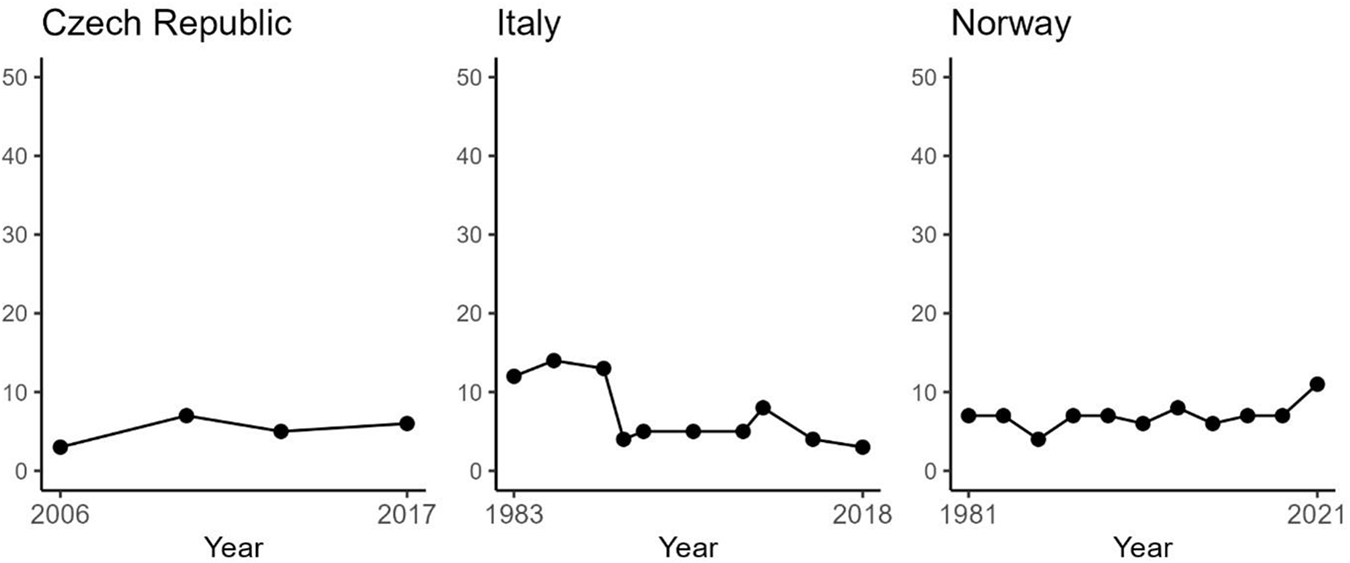
The Czech Republic, Italy and Norway all have a consistently low share of super-seniors over time, as outlined in Figure 1, hovering around and under 10% of MPs. While there are some shifts in each of the countries over time, Italy experienced a particular drop in the share of super-seniors in the early 1990s, reflecting the collapse of the party system due to corruption scandals. Among these countries, Norway is the odd one out, as it exhibits relatively modest volatility over time (12.8% on average) and is unicameral – two features associated with persistence, even though the country still has a fairly low and stable share of super-seniors. Italy and the Czech Republic, on the other hand, score high on dimensions that favour circulation and not persistence, underlining their low super-seniority figures: both countries have among the highest levels of volatility in the sample, with the Czech Republic averaging 26.4% and Italy 17%. Additionally, Italy is a bicameral legislature, while the Czech Republic has a party-controlled electoral ballot system. The strong position of political parties in candidate selection in Norway (see Røed and Stavenes Reference Røed, Stavenes, Kolltveit, Allern, Braut-hegghammer and Rasch2025, for example), and their commitment to balancing the electoral slate with different candidates, likely explains why the share of super-seniors is comparatively low here, even in an otherwise favourable environment for persistence.
Countries with a Low Share of Super-Seniors over Time

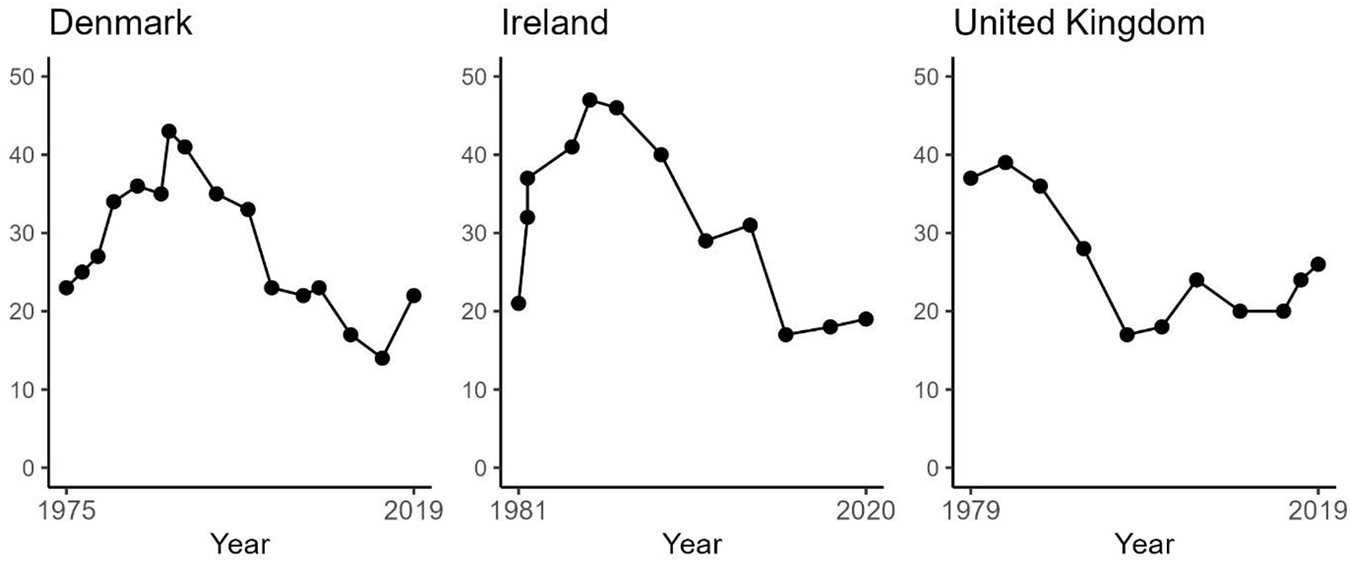
Denmark, Ireland and the UK are the countries in the sample with the overall highest share of super-seniors in their legislatures, sometimes reaching as high as nearly 50% of all legislators, as Figure 2 illustrates. Nevertheless, all three countries, reflecting our own findings on turnover (see Figure E1 in Section E of the Supplementary Material) and other literature (Best Reference Best2007; Verzichelli Reference Verzichelli, Vogel, Gebauer and Salheiser2018a), show a declining trend in super-seniority over time.
Countries with a High Share of Super-Seniors over Time

Contrary to the group of countries above, there is more in common between these three countries than what separates them. Specifically, candidates control ballot access themselves to a moderate (Ireland and Denmark) or large (UK) extent. Furthermore, all three countries are at the absolute lower end when it comes to the average level of electoral volatility, the UK being at the bottom of all 14 countries in the sample with an average of 8.17%. Also, they have a shared history of high levels of super-seniority, even if the share has declined across all three in recent decades. The institutional feature that separates these countries is that the UK is the only one that is bicameral. That said, the House of Lords is not an elected assembly, setting it apart from several other bicameral parliaments.
This discussion has shown how persistence is a result of two inter-related trends: first, parliaments that have higher levels of super-seniority tick off more of the features along our three dimensions of persistence than countries that have lower levels of super-seniority. In consequence, this also means that the countries with several persistent MPs are more similar to one another than the legislatures where there are more newcomers and regular seniors (3+ terms). While we cannot weigh these dimensions against each other within the scope of this article, or determine which conditions are necessary and/or sufficient for persistence, this brief discussion serves as a fertile starting point for future studies that wish to delve deeper into the identified mechanisms for persistence, and how they are inter-related.
Conclusion
Extending a rich literature on elite circulation, which to date has focused mostly on turnover (Gouglas et al. Reference Gouglas, Maddens and Brans2018; Matland and Studlar Reference Matland and Studlar2004) and the incumbency rate (Cox and Katz Reference Cox and Katz1996; Fiva and Smith Reference Fiva and Smith2018; Martin and Strøm Reference Martin and Strøm2024), this article has presented a three-dimensional framework for understanding persistence in contemporary parliaments. By leveraging a novel dataset of aggregated individual-level data, we were able to explore how politico-institutional factors associated with turnover play out when analysing the persistence of MPs in parliament, which is particularly crucial if we are to tap into questions concerning the circulation and concentration of parliamentary elites in an era of political turbulence.
Broadly, our findings mirror those from the turnover literature (Gallagher Reference Gallagher, Bowler and Grofman2000; Gouglas et al. Reference Gouglas, Maddens and Brans2018; Manow Reference Manow2007; Martin and Strøm Reference Martin and Strøm2024; Matland and Studlar Reference Matland and Studlar2004; Semenova Reference Semenova, Kulas and Wielecki2024; Verzichelli Reference Verzichelli, Vogel, Gebauer and Salheiser2018a), according to which factors associated with higher turnover – such as volatility, party control over the electoral ballot and the presence of alternative career opportunities – increase elite circulation and are associated with lower levels of persistence in parliament. The significant effect of increased term length on reduced levels of persistence also aligns well with the existing literature (Gallagher Reference Gallagher, Bowler and Grofman2000; Gouglas et al. Reference Gouglas, Maddens and Brans2018; Martin and Strøm Reference Martin and Strøm2024; Matland and Studlar Reference Matland and Studlar2004; Verzichelli Reference Verzichelli, Vogel, Gebauer and Salheiser2018a). Our findings indicate that super-seniors are particularly well positioned to take advantage of available career opportunities. Specifically, bicameralism is associated with a reduction in the share of super-seniors, but not of seniors more broadly. Also, super-seniors are affected by electoral swings, but less so than other MPs, whether newcomers or seniors. These patterns suggest that long-term persistence is shaped by an interaction between institutional opportunity structures and individual career considerations.
At the same time, our analysis shows that prior levels of seniority drive current ones, hinting at an institutional resistance to change in seniority levels in contemporary democracies. Most political systems contain mechanisms that constrain the accumulation of seniority, although informal rules of conduct may offset these constraints by affording greater leeway to legislators who possess the knowledge, resources and networks that come with long tenure. Importantly, these informal dynamics are likely to interact with additional features that we do not model explicitly here, such as rules governing the holding of multiple offices, eligibility for ministerial appointments, or the conditions that regulate legislators’ term limits. Future research would benefit from in-depth case studies that examine how these legal and temporal institutional features interact with informal seniority systems and shape elite circulation in specific political contexts.
In sum, the article contributes theoretically to the state of the art by outlining how factors crucial for turnover also shape persistence, and empirically by outlining – for the first time – descriptive patterns of seniority, showing how politico-institutional features shape the share of newcomers, seniors and super-seniors differently. Our findings thus help us understand how turbulence and stability in contemporary parliaments can coexist as simultaneous trends.
Supplementary material
The supplementary material for this article can be found at https://doi.org/10.1017/gov.2026.10061.
Data availability
The data that support the findings of this study are available from the corresponding author upon reasonable request. The data will be made publicly available by 2027.
Acknowledgements
We thank participants in the panel Parliamentary Elites in Europe and Beyond at the ECPR General Conference in Prague (September 2023); participants at the Norwegian Political Science Association’s annual conference in Stavanger (January 2024); and participants at the DIGSSCORE research seminar (February 2024) at the University of Bergen for valuable comments on earlier drafts of this article. We are also indebted to Despina Alexiadou, Elena Semenova, Clint Claessen, Marija Taflaga, Jana Birke Belschner, Corentin Poyet, Carlo Koos, Mona Lena Krook, Kristoffer Grønsberg, Paulina Salek-Lipcean and Endre Tvinnereim for fruitful comments and reflections related to this article. Finally, we thank Sascha Göbel and Simon Munzert for making the Comparative Legislators Database open access, Thorkil Klint and colleagues for releasing Danish MP data, Väinö Yrjänäinen and colleagues for the Swedish Parliament Corpus, Raimondas Ibenskas for sharing Romanian and Lithuanian data, and Sigmund Andreas Tveit in SIKT for help with Norwegian data. Finally, we thank three anonymous reviewers for constructive comments on a previous version of this article.
Financial support
This study is supported by the European Research Council (ERC) under the European Union’s Horizon 2020 research and innovation programme grant number 101002248 (SUCCESS).
Disclosure statement
The authors report that there are no competing interests to declare.




 Open access

