Monogamy in one's intimate relationships is largely considered the norm worldwide (Cherlin, Reference Cherlin2009; Watkins & Boon, Reference Watkins and Boon2015), with 94–99% of individuals indicating that they expect sexual and romantic exclusivity from their partner (Treas & Giesen, Reference Treas and Giesen2000). Despite prevailing strong preferences for monogamy, acts of infidelity (defined as a secret sexual, romantic, or emotional involvement that violates the commitment of monogamy to an exclusive relationship; Glass, Reference Glass, Gurman and Jacobson2002) are fairly common (Hall & Fincham, Reference Hall and Fincham2009; Mark, Janssen, & Milhausen, Reference Mark, Janssen and Milhausen2011; Martins et al., Reference Martins, Pereira, Andrade, Dattilio, Narciso and Canavarro2015; Schmitt, Reference Schmitt2004). Between 20% and 35% of adults report engaging in some type of infidelity in their lifetime (Hall & Fincham, Reference Hall and Fincham2009; Mark et al., Reference Mark, Janssen and Milhausen2011). Furthermore, in a recent study assessing experience with infidelity, 23.4% of men and 15.5% of women reported engaging in physical/sexual extra-dyadic behaviour during their current relationship (Martins et al., Reference Martins, Pereira, Andrade, Dattilio, Narciso and Canavarro2015).
Actor-Observer Differences in Infidelity Judgments
If people feel so strongly that violations of monogamy are unacceptable, why do so many report infidelity? Research indicates that judgments (i.e., the range of behaviours incorporated into an individual's understanding of infidelity) vary according to the type of behaviour (Thompson & O'Sullivan, Reference Thompson and O'Sullivan2015; Kruger et al., Reference Kruger, Fisher, Edelstein, Chopik, Fitzgerald and Strout2013; Wilson, Mattingly, Clark, Weidler, & Bequette, Reference Wilson, Mattingly, Clark, Weidler and Bequette2011), with sexual behaviours judged as more indicative of infidelity than ambiguous behaviours (e.g., romantic/affectionate behaviour and technology-based interactions). However, these differences in judgments cannot fully explain why we find this paradox between monogamy expectations and experiences with infidelity. One explanation may be that the behaviours judged to constitute infidelity vary according to whom is being judged. People have a tendency to judge the behaviour of others more harshly than their own. In social psychology, this tendency is referred to as the actor-observer bias (Fiedler, Semin, Finkenauer, & Berkel, Reference Fiedler, Semin, Finkenauer and Berkel1995; Malle, Reference Malle2006; Nisbett, Caputo, Legant, & Marecek, Reference Nisbett, Caputo, Legant and Marecek1973) or occasionally as the victim-perpetrator bias, when describing interpersonal conflicts or indiscretions (Baumeister, Stillwell, & Wotman, Reference Baumeister, Stillwell and Wotman1990; Feeney & Hill, Reference Feeney and Hill2006). The actor-observer bias tends to be self-serving and other-blaming, and can be defined as the propensity for actors to attribute the cause of their own negative actions externally to situational or contextual factors while attributing others’ negative actions to internal causes, such as permanent personal or dispositional characteristics (Jones & Nisbett, Reference Jones, Nisbett, Jones, Kanouse, Kelley, Nisbett, Valins and Weiner1987). For example, an individual is likely to attribute poor exam results to situational factors (e.g., a poor instructor) for themselves but to dispositional factors (e.g., low intelligence) for others.
There have been several explanations proposed for the actor-observer bias. First, the bias may exist because actors can draw easily upon their personal history and life experiences when judging their own sexual/explicit behaviour (Jones & Nisbett, 1972; Markus, Reference Markus1977; Storms, Reference Storms1973). However, observers usually have little to no prior knowledge of another's life experiences or typical behaviour, so they are more likely to view another person's behaviour as a product of his/her disposition, character, or personality. Second, the actor-observer bias may reflect the fact that we judge ourselves to be more ‘versatile, complex, and multi-faceted than others’ (Sande, Goethals, & Radloff, Reference Sande, Goethals and Radloff1988, p. 20). Finally, we are motivated to protect our self-esteem and view ourselves in a consistently positive manner (Kelley, Reference Kelley, Jones, Kanouse, Kelley, Nisbett, Valins and Weiner1972; Miller & Ross, Reference Miller and Ross1975) but have little motivation to view others in such a positive light.
Research on close relationships reveals that actor-observer differences are fairly common between partners. Actor-observer biases exist in roommates’ attributions for interpersonal conflicts (Sillars, Reference Sillars1980), blame for communication problems in romantic relationships (Vangelisti, Reference Vangelisti1992), and blame for spousal abuse (Overholser & Moll, Reference Overholser and Moll1990). Despite the large number of studies assessing the actor-observer bias among intimate partners, no studies have examined actor-observer differences relating to judgments of infidelity (i.e., the range of behaviours incorporated into an individual's understanding of what constitutes infidelity; their standard of monogamy). However, related research has revealed that actor-observer biases are most prominent for negative behaviours, particularly those occurring in the context of romantic relationships (see Malle, Reference Malle2006, for a review). The extent to which people judge behaviours as comprising infidelity is likely to produce large actor-observer differences because of the highly distressing nature of infidelity and because it is often evaluated negatively in the social realm (Allen & Baucom, Reference Allen and Baucom2006; Hall & Fincham, Reference Hall and Fincham2009; Shackelford, LeBlanc, & Drass, Reference Shackelford, LeBlanc and Drass2000; Spanier & Margolis, Reference Spanier and Margolis1983; Treas & Geisen, Reference Treas and Giesen2000). Thus, the current study assessed actor-observer differences in judgments of infidelity to determine if people judge their partner's behaviour as comprising infidelity to a greater extent than they judge their own.
Inconsistencies in Judgments of infidelity and Self-Reported Behaviour
Inconsistencies in judgments can be taken a step further to examine discrepancies between judgments and self-reported experience with infidelity. For example, people may judge some behaviours as comprising infidelity for a romantic partner, but then report participating in these same behaviours. This inconsistency between beliefs and behaviour has been referred to in the social psychological literature as hypocrisy. Hypocrisy is defined as ‘failing to practice what you preach’ (e.g., Stone & Fernandez, Reference Stone and Fernandez2008, p. 147), ‘saying one thing and doing another’ (e.g., Barden, Rucker, & Petty, Reference Barden, Rucker and Petty2005, p. 1463), or publicly upholding moral norms, especially for others to follow, but personally violating them in private (e.g., Lammers, Stapel, & Galinsky, Reference Lammers, Stapel and Galinsky2010). Although this construct might well explain the discrepancy between expressed disapproval of infidelity and relatively high rates of infidelity, no studies have examined hypocrisy with respect to infidelity. There has been a substantial amount of work dedicated to examining hypocrisy in other areas of social psychology, including religiosity (Wollschleger & Beach, Reference Wollschleger and Beach2011, Reference Wollschleger and Beach2013; Yousaf & Gobet, Reference Yousaf and Gobet2013), academic cheating (Vinski & Tryon, Reference Vinski and Tryon2009), and sexual health/condom use (Aronson, Fried, & Stone, Reference Aronson, Fried and Stone1991; Stone, Aronson, Crain, Winslow, & Fried, Reference Stone, Aronson, Crain, Winslow and Fried1994). Many report strict religious beliefs but inconsistent behaviour, indicate negative attitudes toward academic dishonesty but report cheating on a test, or stress the importance of safe sex yet fail to use condoms during their own sexual experiences. The current study examined hypocrisy related to infidelity in terms of inconsistencies between judgments of a partner's behaviour and reports of one's personal experience with that same behaviour.
Although no studies have examined this type of discrepancy before, some related research found that those who had engaged in infidelity reported more permissive attitudes and greater levels of approval toward infidelity as compared to those had not engaged in infidelity (Sagarin, Becker, Guadagno, Nicastle, & Millevoi, Reference Sagarin, Becker, Guadagno, Nicastle and Millevoi2003; Sharpe, Walters, & Goren, Reference Sharpe, Walters and Goren2013). Research has also indicated that affect toward infidelity and self-reported experience with infidelity are related (Burchell & Ward, Reference Burchell and Ward2011). Those who had experienced a partner's infidelity reported greater levels of jealousy than did those who had not experienced a partner's infidelity. Because of the documented relationship between self-reported experience with infidelity (both their own and a partner's) and affect/attitudes relating to infidelity, it is likely that self-report experience with infidelity and judgments of infidelity will also be related. Thus, the current study examined the relationship between judgments of and self-reported experiences with infidelity both as someone who has engaged in infidelity and as someone who has experienced a partner's infidelity.
Predicting Inconsistencies between Infidelity Judgments and Self-Reports of Infidelity
Although there has been no research predicting discrepancies between judgments and self-reported experience with infidelity, related research has identified several variables that are associated with judgments of infidelity and/or self-reported experience with infidelity. Research has indicated that gender (Brand, Markey, Mills, & Hodges, Reference Brand, Markey, Mills and Hodges2007; Knox, Vail-Smith, & Zusman, Reference Knox, Vail-Smith and Zusman2008; Kruger et al., Reference Kruger, Fisher, Edelstein, Chopik, Fitzgerald and Strout2013; Treger & Sprecher, Reference Treger and Sprecher2011; Wiederman, Reference Wiederman1997), age (Treas & Giesen, Reference Treas and Giesen2000; Whitty, Reference Whitty2003), relationship status (Vaughn Becker, Sagarin, Guadagno, Millevoi, & Nicastle, Reference Vaughn Becker, Sagarin, Guadagno, Millevoi and Nicastle2004), and religiosity (Mattingly, Wilson, Clark, Bequette, & Weidler, Reference Mattingly, Wilson, Clark, Bequette and Weidler2010; Whisman, Gordon, & Chatav, Reference Whisman, Gordon and Chatav2007) predict judgments of infidelity. Men, those who are older, are not in romantic relationships and have lower levels of religiosity report more permissive judgments of infidelity as compared to women, those who are younger, are in romantic relationships, and have higher levels of religiosity. With regard to self-reported experience with infidelity (both their own and that of a partner), research has revealed that sexual orientation (Martell & Prince, Reference Martell and Prince2005), sexual attitudes (Hansen, Reference Hansen1987; Treas & Geisen, Reference Treas and Giesen2000; Treger & Sprecher, 2010), and religiosity (Whisman et al., Reference Whisman, Gordon and Chatav2007) predict self-reported infidelity experience. Non-heterosexuals and those with more permissive sexual attitudes and lower levels of religiosity are more likely to report participating in infidelity behaviours as compared to heterosexuals, those with more restrictive sexual attitudes, and those with higher levels of religiosity. Although some recent research indicates that demographic variables may not be the best predictors of judgments and self-reported experience with infidelity (Mark et al., Reference Mark, Janssen and Milhausen2011), the current study examined whether these variables were able to predict hypocrisy by distinguishing between those who report inconsistent judgments and self-reported experience with infidelity and those who report consistent judgments and self-reported experience with infidelity, for exploratory purposes.
The Current Study
The current study was designed to examine the actor-observer bias related to judgments of infidelity, hypocrisy in judgments of infidelity versus self-reported experience with infidelity, and the relationship between judgments of infidelity and self-reported experience with infidelity (both one's own and a partner's experience), allowing for a potential bidirectional relationship. Because no study to date has examined or predicted hypocrisy with respect to infidelity (i.e., inconsistencies in judgments and self-reported behaviours), another objective was to identify variables that distinguish between those who report (vs. do not report) inconsistencies between judgments of and self-reported experience with infidelity for exploratory purposes. Examining inconsistencies in judgments related to infidelity provides insights into how individuals determine whether they or a partner have violated an agreement to be monogamous, as well as how individuals might justify, rationalise, or dismiss their own infidelity while proclaiming support for exclusivity in their closest relationships. In line with previous research, it was expected that:
-
H1 — People would judge a partner's behaviour as more indicative of infidelity in comparison to their own.
-
H2 — Judgments of infidelity would be related to self-reported experience with infidelity (both one's own and a partner's).
Method
Participants
A total of 875 adults (18 years and older) residing in the United States or Canada were recruited to participate in the current study via Mechanical Turk® (MTurk®) in November, 2014. MTurk® is a widely used crowdsourcing website that has been adopted by many researchers to recruit participants (Buhrmester, Kwang, & Gosling, Reference Buhrmester, Kwang and Gosling2011; Casler, Bickel, & Hackett, Reference Casler, Bickel and Hackett2013). After initial data screening, 48 participants failed to complete the entire survey and 17 participants were ineligible to participate (were under the age of 18 and/or were not currently residing in the United States or Canada), resulting in a sample size of 810 (328 men and 482 women). Participants had a mean age of 34.4 years (SD = 11.65; range = 18–71 years) and primarily identified as Caucasian (85.22%), with the majority (90.71%) currently residing in the United States. A large proportion of our sample identified as heterosexual (89.19%). Most participants indicated that they were in a committed relationship (74.30%), 18.74% indicated that they were currently single, and 7.01% indicated that they were currently dating or in an open relationship.
Measures
Demographic questionnaire
Participants completed a demographic measure that assessed gender, age, sexual orientation, ethnicity, primary language, experiences with infidelity, monogamy expectations, religiosity, sexual experience, relationship status, and relationship duration.
The Definitions of Infidelity Questionnaire (DIQ; Thompson & O'Sullivan, Reference Thompson and O'Sullivan2015)
The DIQ consists of 32 items organised into four subscales with each item describing a behaviour (see Table 1 and Table 2 for a list of all items). The Sexual/Explicit Behaviour subscale consists of seven items related to partnered activities involving explicit physical contact (e.g., sexual intercourse, performing/receiving oral sex, touching genitals). The Technology/Online Behaviour subscale includes seven items that relate to the use of and communication through technology (e.g., sending sexually explicit text messages/e-mails, browsing a singles website, masturbating over webcam). The Romantic/Affectionate Behaviour subscale consists of 13 items related to intimate activities and/or displaying romantic interest (e.,g., having a casual dinner, sharing secrets, providing emotional support). The Solitary Behaviour subscale has five items that depict behaviours that people typically engage in alone (e.g., masturbation, viewing pornography).
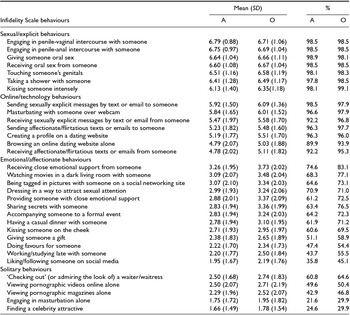
Comparative Statistics for Actor-Observer Differences

Note: N = 798. A = Judgments of one's own behaviour (actor). O = Judgments of a partner's behaviour (observer). Percentages indicate the proportion of participants who rated each behaviour as a 2 or above.
Participants were asked to indicate the extent to which they would think their partner (current or past) was ‘unfaithful’ for having engaged in the behaviour on a scale from 1 (not at all unfaithful) to 7 (very unfaithful). The DIQ produces a mean score that reflects the average rating for all behaviours and average scores for each subscale. The DIQ has demonstrated excellent internal consistency (Sexual/Explicit Behaviours subscale, α = .95; Emotional/Affectionate Behaviours subscale, α = .95; Technology/Online Behaviours subscale, α = .91; Solitary Behaviours subscale, α = .88); and test–retest reliability, 6-week interval = r(156) = .96, p < .001. The infidelity scale also has demonstrated adequate convergent, discriminant, and predictive validity (Thompson & O'Sullivan, Reference Thompson and O'Sullivan2015).
For the purposes of the current study, the original version of the DIQ, which measured judgments of a partner's infidelity (the ‘observer-version’), was adapted to create three additional versions. The first adaptation measured participants’ judgments of his/her own behaviour (the ‘actor-version’), rather than judgments of a partner's behaviour (producing overall and subscale DIQ scores). The second adaptation asked participants to indicate which of the behaviours they had ‘engaged in at any point throughout their life with someone other than their primary romantic partner at that time’ (‘self-version’). The third adaptation asked about the behaviour of a past partner using the instructions ‘for each item, indicate whether a past partner has ever engaged in the behaviour with someone other than you during the course of your romantic relationship’ (‘partner-version’). These versions were piloted on a group of 20 undergraduate students who were currently in a romantic relationship. Results from the pilot study revealed that the results from the actor-version and the two experience versions produced similar ratings as the initial observer-version. Results from open-ended questions asked to pilot participants revealed that all items and instructions were interpreted appropriately.
Brief Sexual Attitudes Scale — Permissiveness subscale (BSAS; Hendrick, Hendrick, & Reich, Reference Hendrick, Hendrick and Reich2006)
The BSAS is a multidimensional measure of sexual attitudes that assesses the following dimensions: conservatism/permissiveness, instrumentality, communion/relationality, and sexual practices. We used the 10-item Permissiveness subscale (e.g., ‘It is okay for sex to be just good physical release’, ‘I do not need to be committed to a person to have sex with him/her’; Explicit Sexual Attitudes) as our measure of sexual attitudes. The other subscales assessed constructs irrelevant to our hypotheses. Participants indicated their agreement with each item using a 5-point Likert scale from 1 (strongly disagree) to 5 (strongly agree), with higher scores indicating more permissive attitudes toward sexuality. The Permissiveness subscale and the measure as a whole have strong psychometric properties (Hendrick et al., Reference Hendrick, Hendrick and Reich2006; α = .94 in the current study).
Religiosity scale (Whisman et al., Reference Whisman, Gordon and Chatav2007)
The religiosity scale consisted of four items used in Whisman and colleagues’ study (Reference Whisman, Gordon and Chatav2007), assessing the relationship between religiosity and infidelity experience. The four items measured: (1) the importance of religious or spiritual beliefs in daily life, (2) the frequency of attending religious services, (3) whether participants sought spiritual comfort during problems or difficulties, and (4) to what extent participants asked themselves what God would want them to do when making decisions in daily life. Each item was ranked on a 5-point Likert scale, with higher scores representing greater religiosity. The measure has demonstrated good internal consistency (Whisman et al., Reference Whisman, Gordon and Chatav2007, α = .87 in the current study).
Procedure
After receiving ethics approval from our institution, participants were recruited via MTurk® to complete an anonymous online survey about ‘how people define infidelity’. All interested participants were instructed to click the link to the online survey hosted on a secure web server. Once directed to the online survey, participants were randomly assigned to receive two of four conditions, one of the judgment versions (either the ‘actor-version’ or the ‘observer-version’) and one of the experience versions (either the ‘self-version’ or the ‘partner-version’) of the infidelity scale. Each participant had an equal chance to be assigned to one of the two judgment versions and one of the two experience versions, thus a participant assigned to the ‘actor-version’ was not necessarily assigned to the ‘self-version’. By adopting a between-subjects design, we were able to reduce or potentially eliminate contrast effects that may result from comparing one condition to another, thus producing more accurate ratings of each behaviour. Participants were compensated for their participation by receiving USD1.50 for their time through a deposit into their MTurk® website account, consistent with payment guidelines for academic studies (Mason & Suri, Reference Mason and Suri2012).
Data Analysis
Missing data were examined at the case and item level from our final sample. There were no participants missing more than 2.00% of their data and missing values across individual items varied from 0.00% to 1.70%. All data were missing completely at random. However, there were 11 participants who showed signs of patterned responding and another three who were identified as multivariate outliers. These 14 participants were removed from the data file, resulting in a final sample of 796 adults (320 men and 476 women).
After data were cleaned following procedures outlined by Tabachnick and Fidell (Reference Tabachnick and Fidell2013), actor-observer differences in judgments of infidelity were examined using a 2 (actor/observer condition) × 4 (category of infidelity behaviour) mixed-design analysis of variance with scores on the infidelity scale used as the dependent variable. Descriptive statistics and Tukey post-hoc tests were used to follow up significant main effects, and a simple effects test was used to follow up interaction effects.
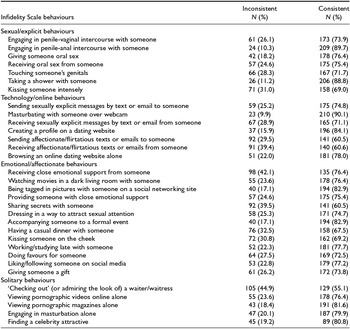
Descriptive Information for the Item-Level Consistency Scores

Note: N = 234.
When examining inconsistencies between judgments and reports of infidelity in the current sample, a consistency score was calculated for each infidelity behaviour by categorising participants into one of two groups. The first group identified participants who reported judging a given behaviour as indicative of infidelity but also reported having engaged in the behaviour (inconsistent group). For example, if a participant judged a behaviour as indicative of infidelity (i.e., a 2 or higher on the infidelity scale ranging from 1–7) but also reported engaging in this same behaviour, he/she would be coded as part of the inconsistent group. The second group included all participants who reported consistent judgments and self-reported experience with infidelity (consistent group). This group included all participants who judged a behaviour as indicative of infidelity (as a 2 or higher) but no personal experience with the behaviour. These item-level scores were then used to create two consistency scores. For the first consistency score (the categorical consistency score), participants classified as inconsistent for at least one behaviour on each of the infidelity subscales received a 1, whereas those who were not inconsistent for any of the behaviours received a 0. For the second consistency score (the average consistency score), the average number of behaviours producing inconsistencies was calculated for each subscale. For example, if a person reported inconsistencies between infidelity judgments and self-reported experience with infidelity for two of the seven behaviours on the Sexual/Explicit Behaviours subscale, then the participant received a score of 0.29. It should be noted that there were participants who did not judge a behaviour as indicative of infidelity but also reported no experience with the behaviour. However, because there were very few participants coded into this group, they were omitted from the inconsistency analyses. To assess whether participants were more likely to report inconsistencies on some DIQ subscales in comparison to others, a repeated measures ANOVA was conducted using the DIQ subscales as the independent variable and the average consistency score as the dependent variable.
Two regression analyses were conducted to examine the bidirectional relationship between judgments of infidelity and self-reported experience with infidelity. The first was a binary logistic regression that was conducted to determine whether judgments of infidelity predicted self-reported personal experience with infidelity, with DIQ scores entered as the predictor variable and self-reported experience as the criterion. The second regression (a multiple regression), examining whether infidelity experience (own or partner's infidelity) predicted judgments of infidelity, was conducted with own and partner infidelity experience as the predictor variables and DIQ scores as the criterion variable.
Finally, four separate binomial logistic regressions were conducted to identify variables that distinguish between those with consistent and inconsistent infidelity judgments and self-reports. In particular, these analyses examined whether the six predictor variables (gender, age, sexual orientation, relationship status, sexual attitudes, and religiosity) distinguished between those who reported inconsistent judgments and self-reported experience from those who were consistent (using the categorical consistency scores) for the four DIQ subscales.
Results
Descriptive Information
Overall, 411 of the 796 (51.63%) participants reported engaging in some form of infidelity, whereas 294 (36.93%) had experienced a partner's infidelity at some point in the past. Participants’ judgments of infidelity behaviours varied considerably, with DIQ item scores ranging from a low of 1.75 (SD = 1.52 for ‘finding a celebrity attractive’) to a high of 6.74 (SD = 1.00 for ‘engaging in penile-vaginal intercourse’), with an average DIQ score of 4.18 (SD = 1.02).
Actor-Observer Differences in Infidelity Judgments
The actor-observer mixed-design analysis of variance produced a significant within-subject main effect for infidelity behaviour, F(3, 2382) = 221.10, p < .001, η2 = .75, revealing that infidelity judgments differed significantly across the different categories of behaviours. A significant actor-observer main effect also emerged, F(1, 794) = 8.38, p < .004, η2 = .02, indicating that judgments of one's own infidelity were significantly different from judgments of a partner's infidelity (see Table 1 for actor-observer differences for each behaviour). There was also a significant interaction effect, showing that the magnitude of the actor-observer differences varied across the categories of infidelity behaviour, F(1, 794) = 6.52, p < .02, η2 = .01.
When following up the significant within-subject main effect (types of infidelity behaviour), the post-hoc tests revealed that the sexual/explicit behaviours (M = 6.58, SD = 0.96), the technology/online behaviours (M = 5.47, SD = 1.37), the emotional/affectionate behaviours (M = 2.93, SD = 1.52), and the solitary behaviours (M = 2.27, SD = 1.55) were all significantly different from one another (ps < .001). Participants’ average scores indicated that they viewed sexual behaviours as most indicative of infidelity, followed by technology/online behaviours and emotional/affectionate behaviours, then solitary behaviours, respectively.
The descriptive statistics following up the significant between-subject main effect (actor/observer difference) revealed that, as expected, participants judged the hypothetical behaviour of a romantic partner (M = 4.26, SD = 1.00) as more indicative of infidelity than they did their own hypothetical behaviour (M = 4.03, SD = 1.04). This finding indicates that people make more permissive judgments for their own behaviour than for a partner's.
The simple effects analyses used to follow up the significant interaction effect indicated that the actor-observer difference was only significant for two of the four categories of infidelity behaviour. People judged their partner's hypothetical technology/online behaviour, F(1, 794) = 6.13, p = .01, η2 = .01, and their partner's emotional/affectionate behaviour, F(1, 794) = 8.59, p = .003, η2 = .01, as more indicative of infidelity than they did their own participation in these behaviours. No actor-observer differences in judgments of sexual/explicit behaviours or solitary behaviours were found.
Inconsistencies in Judgments and Reports of Infidelity
Overall, the average number of behaviours that participants judged as infidelity yet reported having engaged in was 7.99 (SD = 7.06; see Table 2 for consistency scores for each behaviour). Approximately two thirds of the participants reported inconsistency (i.e., hypocrisy) in their infidelity judgments and self-reported experience with infidelity for three or more behaviours (65.0%), whereas one third of the participants indicated inconsistency in ten or more of the behaviours (32.5%). The categorical consistency scores were examined to determine the proportion of participants who reported inconsistency in their infidelity judgments and reports of infidelity for the four categories of behaviours. The romantic/affectionate behaviours resulted in the greatest proportion of participants classified as inconsistent (76.9%), followed by the sexual/explicit behaviours (73.5%) and the solitary behaviours (60.3%), with the technology/online behaviours producing the smallest proportion of inconsistent participants (51.7%). These percentages indicate that a substantial proportion of our sample reported hypocritical/inconsistent judgments of and self-reported experience with infidelity, meaning that they participated in behaviours that they judged as indicative of infidelity.
The repeated measures ANOVA examining inconsistency between judgments and self-reports of infidelity revealed that the average consistency scores differed significantly across the four subscales of infidelity behaviour, F(3, 231) = 3.34, p < .05. Examination of the Tukey post hoc comparisons revealed that the sexual/explicit behaviours (M = 0.21, SD = 0.33) produced significantly less inconsistency than the technology/online behaviours (M = 0.26, SD = 0.33) or the emotional/affectionate behaviours (M = 0.27, SD = 0.27), but did not differ from the solitary behaviours (M = 0.25, SD = 0.28). The differences between the technology/online, emotional/affectionate, and solitary behaviours were not significant.
The Relationship Between Experience With Infidelity and Judgments of Infidelity
To examine the relationship between judgments and experience with infidelity, two regressions were conducted. For the first regression, judgments of infidelity were used to predict self-reported experience with infidelity. This logistic regression revealed that judgments of infidelity predicted self-reported personal experience with infidelity, b = -0.17, SEb = .07, Wald(1) = 5.40, p < .02. Those who reported more permissive judgments of infidelity were more likely to report having engaged in the infidelity behaviours as compared to those with more restrictive judgments. For the second regression, self-reported experience with infidelity (both one's own and a partner's) was used to predict judgments of infidelity. This multiple regression revealed that infidelity experience predicted infidelity judgments, R 2 = .01; F(2, 760) = 3.07, p < .05. However, only experience with a partner's infidelity uniquely predicted variations in judgments of infidelity (β = -.09, p < .05). Those who reported at least one past experience of a partner's infidelity were more likely to report restrictive judgments than were those who had not experienced a partner's infidelity.
Predicting Inconsistencies between Judgments of and Self-Reports of Infidelity
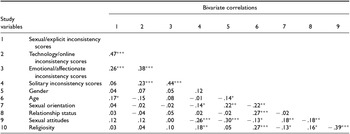
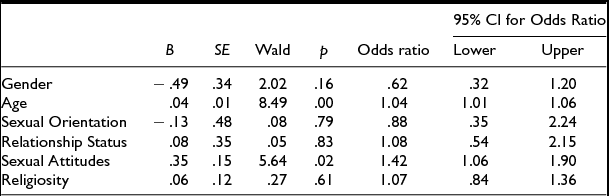
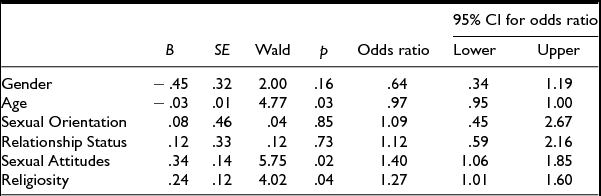
The binary logistic regressions that identified the variables (gender, age, sexual orientation, relationship status, sexual attitudes, and religiosity) that distinguish between those who reported consistent judgments and self-reported experience with infidelity versus those who did not for the sexual/explicit behaviours was significant, χ 2 (6) = 14.64, p = .02, indicating that the model was able to distinguish between the consistent and inconsistent participants for the sexual/explicit behaviours (correlations between each variable can be found in Table 3). The model explained between 6.0% and 8.3% of the variance and correctly classified 66.4% of cases in the sample. As shown in Table 4, two of the predictors (age and sexual attitudes) made a statistically significant unique contribution to the model. Those who were older and had more permissive sexual attitudes were more likely to be classified as inconsistent in their judgments and self-reported personal experience.
Correlations Among Variables Used in Logistic Regressions

Note: Gender: Men = 0, Women = 1. Sexual orientation: Heterosexuals = 0, Non-heterosexuals = 1. Relationship status: Single = 0, In a relationship = 1. *p < .05; **p < .01, ***p < .001.
Summary of the Sexual/Explicit Behavior Binary Logistic Regression

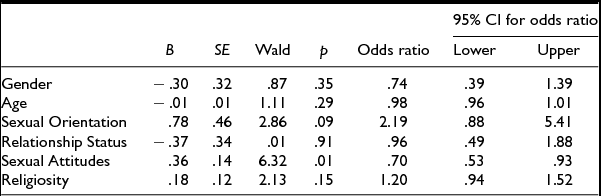
The model for the technology/online behaviours logistic regression was also statistically significant, χ 2 (6) = 13.34, p = .04, explaining between 6.0% and 7.5% of the variance and correctly classifying 60.0% of cases. Again, age and sexual attitudes made a significant unique contribution to the model as well as religiosity (see Table 5). However, for the technology/online behaviours, those who were younger in age, with more permissive sexual attitudes and with higher levels of religiosity, were more likely to be classified as inconsistent in their judgments and self-reported personal experience.
Summary of the Technology/Online Behavior Binary Logistic Regression

Although the romantic/affectionate logistic regression was not significant, χ 2 (6) = 5.10, p = .53, the solitary behaviour logistic regression did produce a significant overall model, χ 2 (6) = 22.23, p = .001. The regression model for the solitary behaviours explained between 9.0% and 12.2% of the variance and correctly classified 67.2% of cases. Only sexual attitudes made a significant unique contribution to the model (see Table 6). Again, those with more permissive sexual attitudes were more likely to be classified as inconsistent in their judgments and self-reported personal experience.
Summary of the Solitary Behavior Binary Logistic Regression

Discussion
The current study was conducted to explore and explain inconsistencies in judgments of and self-reported experiences with infidelity. Previous research indicates that rates of infidelity are high despite strong prohibition against infidelity and endorsement of exclusivity as a norm. Little research has attempted to understand what accounts for or explains this paradox between judgments and self-reported experience.
Actor-Observer Differences in Judgments of Infidelity
The first inconsistency identified in the current study was the inconsistency in judgments of infidelity between actors and observers. Our findings indicate that individuals judge a partner's hypothetical behaviour as indicative of infidelity to a greater extent than they do their own, revealing a self-enhancing bias and possibly a greater willingness to discount one's negative behaviour, especially more ambiguous forms of negative behaviour, in ways that help maintain a positive self-image (Kelley, Reference Kelley, Jones, Kanouse, Kelley, Nisbett, Valins and Weiner1972; Miller & Ross, Reference Miller and Ross1975; Sande et al., Reference Sande, Goethals and Radloff1988). This actor-observer difference was only found in judgments of emotional/affectionate and technology/online infidelity behaviours, not sexual/explicit or solitary behaviours.
The actor-observer difference may have been noted for the emotional/affectionate and technology/online infidelity behaviours because of the ambiguity associated with these behaviours and the lack of insight into another person's typical behaviour (reducing the chances of discounting the behaviour because of contextual factors; Jones & Nisbett, Reference Jones, Nisbett, Jones, Kanouse, Kelley, Nisbett, Valins and Weiner1987; Markus, Reference Markus1977; Storms, Reference Storms1973). Although to our knowledge no research has examined the influence of context on infidelity judgments specifically, related research suggests that feelings of jealousy are related to contextual factors (Buunk, Solano, Zurriaga, & Gonzalez, Reference Buunk, Solano, Zurriaga and González2011; Russell & Harton, Reference Russell and Harton2005). For example, people report more jealousy in response to hypothetical interactions involving their partner and a stranger as compared to interactions involving their partner and a good friend. For more ambiguous behaviours, such as emotional/affectionate infidelity behaviours (e.g., having a casual dinner) or technology/online infidelity behaviours (e.g., browsing online dating website), we have less insight into the intentions or context as an observer than as an actor, possibly contributing to the greater actor-observer difference. Such subtleties would be small to non-existent for the most explicit behaviours (e.g., sexual intercourse, kissing) because they are consistently judged by their overt, graphic, and physical nature as infidelity by nearly everyone in every circumstance (Randall & Byers, Reference Randall and Byers2003; Wilson et al., Reference Wilson, Mattingly, Clark, Weidler and Bequette2011).
It is less clear why we did not find actor-observer differences for the solitary behaviours. Although a substantial proportion of the participants judged solitary behaviours as indicative of infidelity to some extent because even these behaviours involve attraction/arousal to another, they mostly judged these behaviours as indicative of infidelity to a relatively low degree. Consequently, little variability accompanied the infidelity scores for these behaviours, likely explaining why solitary behaviours did not produce actor-observer differences. They are, in essence, not considered very serious violations of monogamy expectations.
Inconsistencies Between Judgments and Reports of Infidelity
The second inconsistency identified in the current study was between judgments and self-reported experience with infidelity. These contradictions are supported in the literature on hypocrisy in that people's behaviour often does not correspond with their thoughts, attitudes, and/or beliefs (Barden et al., Reference Barden, Rucker and Petty2005; Lammers et al., Reference Lammers, Stapel and Galinsky2010; Stone & Fernandez, Reference Stone and Fernandez2008). Inconsistencies between judgments and self-reported experience with infidelity were reported for some categories of behaviours more frequently than others. People reported the largest number of inconsistencies for the romantic/affectionate behaviours and sexual/explicit behaviours, with the solitary behaviours and technology/online behaviours producing the least inconsistency.
A reason why some behaviours produced greater levels of inconsistency than others may be related, again, to the ambiguity associated with some behaviours. Sexual behaviours (e.g., intercourse, kissing), in particular, are viewed as comprising infidelity almost all of the time, no matter what. Consequently, people act in ways consistent with their judgments because there is almost never a time with which these behaviours are viewed as acceptable outside of an ostensibly monogamous relationship by most people. The discrepancy is stark, between endorsing a view that sex with someone other than one's primary partner is unacceptable and actually participating in the behaviour; thus individuals are least likely to engage in — or at least to admit to engaging in — these behaviours. By contrast, more ambiguous behaviours (browsing singles website, viewing pornography) are likely to be judged as infidelity in certain situations but not others. For example, a person may judge browsing an online dating website as infidelity (because in his/her opinion it is, in most situations). However, this same person may have experience browsing online dating websites because they did so in a scenario that they deemed appropriate (e.g., at a party with friends).
We also found that judgments of infidelity and experiences with infidelity (both one's own and a partner's) were related. Judgments predicted one's own experience with infidelity and experience with a partner's infidelity predicted judgments. Interestingly, one's own infidelity did not predict judgments of infidelity. This can likely be explained using the concept of cognitive dissonance (Festinger, Reference Festinger1957). Cognitive dissonance is the ‘discomfort/dissonance produced when someone holds a cognition that is psychologically inconsistent with his/her behaviour’ (Festinger, Reference Festinger1957, p. 1127), which relates well to the concept of hypocrisy. For example, people likely experience cognitive dissonance when engaging in infidelity, given how universally infidelity is viewed as unacceptable. A common way people cope with the dissonance is to justify their infidelity (Abelson et al., Reference Abelson, Aronson, McGuire, Newcomb, Rosenberg and Tannenbaum1968), making the behaviour no longer unacceptable and no longer indicative of infidelity. However, cognitive dissonance would not be produced in the same way from experience with a partner's infidelity. Because experience with a partner's infidelity cannot be justified, it may be more devastating and may carry more weight than one's own infidelity, thus biasing one's judgments to a greater extent.
Sexual attitudes, age, and religion distinguished those with inconsistent and consistent judgments and experiences. Sexual attitudes best predicted inconsistent judgments and experiences across infidelity behaviours. Age was significant for several subscales, but in opposite directions: older individuals were more likely to be classified as inconsistent for the sexual/explicit behaviours, whereas younger individuals were more likely to be classified as inconsistent for the technology/online behaviours. Research suggests that recent generations are becoming more sexually permissive than previous generations (Fielder & Carey, Reference Fielder and Carey2010; Garcia, Reiber, Massey & Merriwether, Reference Garcia, Reiber, Massey and Merriwether2012; Paul, McManus, & Hayes, Reference Paul, McManus and Hayes2000). Thus, younger people are less likely to judge these behaviours as indicative of infidelity and are therefore less likely to be hypocritical (or inconsistent) as compared to older adults. With regard to the technology/online behaviours, younger adults are more familiar and use technology more frequently than do older adults (Czaja et al., Reference Czaja, Charness, Fisk, Hertzog, Nair, Rogers and Sharit2006; Van Volkom, Stapley, & Malter, Reference Van Volkom, Stapley and Malter2013). This exposure may provide young people with more opportunities to participate in technology-related infidelity, resulting in greater levels of hypocrisy as compared to older people.
Gender did not predict consistency in judgments and behaviour, despite the prevalence of gender differences in the infidelity literature (Allen & Baucom, 2004; Atkins, Baucom, & Jacobson, Reference Atkins, Baucom and Jacobson2001; Buss, Larsen, Westen, & Semmelroth, Reference Buss, Larsen, Westen and Semmelroth1992; Cann, Mangum, & Wells, Reference Cann, Mangum and Wells2001; Green & Sabini, Reference Green and Sabini2006). Hypocrisy has been linked to many personality traits, such as Machiavellianism, defined as manipulativeness or ‘attending to one's interests more than to others’ (Shome & Rao, Reference Shome and Rao2009), and honesty-humility (Ashton, Lee, & Son, Reference Ashton, Lee and Son2000). Yet, research suggests that there are no differences in hypocrisy between men and women (Foster & Misra, Reference Foster and Misra2013; Whitley & Keith-Spiegel, Reference Whitley and Keith-Spiegel2001). Consequently, variables capturing personality traits (i.e., Machiavellianism, honesty-humility) may better predict consistency in judgments and behaviours than the demographic variables we used here, such as gender.
Limitations and Future Directions
There are a number of limitations to this research that should be noted. First, because the study was described as ‘how people define infidelity’ in our recruitment procedure, we may have introduced a selection bias. Research recruiting a more diverse sample by disguising the focus of the study would be beneficial. The current study measured judgments of hypothetical infidelity to measure actor-observer differences possibly limiting its external validity. Future research should assess judgments of real cases of infidelity to determine whether the actor-observer difference is comparable to that found for hypothetical cases of infidelity. Future studies should expand this work by investigating the contextual features that influence infidelity judgments of one's own and a partner's infidelity (e.g., familiarity with the rival, gender of the rival) as well as those associated with both discounting/dismissal versus heightened condemnation. Research reveals that personality variables are important to consider when predicting variations in experience with infidelity (Mark et al., Reference Mark, Janssen and Milhausen2011), thus the study of hypocrisy as it relates to infidelity could be expanded by incorporating measures of personality such as Machiavellianism and honesty-humility.
Conclusions
Overall, our study helps to unravel the paradox of the near universal prohibition surrounding infidelity yet relatively high prevalence rates across populations. What is clear is that individuals apply a double standard — one that is more tolerant of their own behaviour than that of their partner's. Our study distinguished who most strongly reinforces this paradox by endorsing restrictive or intolerant views of infidelity and yet report having engaged in infidelity. As such, our study has implications for clinicians and relationship educators helping couples to establish clear boundaries and to communicate their understanding about their expectations of monogamy, as well as the behaviours that constitute infidelity and hence violations of exclusivity.
Acknowledgment
This research was supported in part by a Canada Research Chair held by Lucia F. O'Sullivan.