James Clerk Maxwell's use of analogy in his first paper on electromagnetism, ‘On Faraday's lines of force’, has long been a subject of discussion among philosophers and historians of science.Footnote 2 Yet little attention has been paid to the broad range of uses to which analogical arguments were put in late Georgian and early Victorian Britain. In the second quarter of the nineteenth century, analogies were used to bring order to the natural and social worlds by maintaining a coherent and collective experience across cultural oppositions such as the ideal and material, the sacred and profane, theory and fact. Indeed, the way in which these oppositions were negotiated at a moment when Victorian society was moving from the turmoil and insecurity of the 1830s and 1840s to the relative calm of the 1850s directly informed both how Maxwell interpreted Michael Faraday's Experimental Researches in Electricity and how Faraday's material practice informed Maxwell's theoretical method.
At the beginning of ‘On Faraday's lines’, Maxwell claimed that he was seeking to give mathematical form to the ‘methods … suggested by the processes of reasoning which are found in the researches of Faraday’.Footnote 3 That claim depended upon an analogy between Faraday's material practice, which Maxwell understood to be reasoning with objects, and reasoning with mathematical symbols on paper. ‘On Faraday's lines’ is the result of Maxwell's attempt to think on paper with theoretical objects in a way analogous to Faraday's thinking with objects in the laboratory. It represents the articulation of a new theoretical practice that would culminate in the Maxwellian physics of the fin de siècle.Footnote 4
At Cambridge University before 1850, analogical arguments were used in order to maintain a strict boundary between the material and the ideal, between the inherently evil body and the spiritually elevated mind, and between secular society and a morally superior intellectual culture. This in turn encouraged a strict distinction between fact-producing observation and experiment, and theory, especially mathematical theory, which brought order to those facts. In contrast, after 1850, arguments depending on an analogy between thought and things that brought the material and ideal closer together began to attract increased attention. Embedding Maxwell's use of analogy in the broad range of analogical arguments being made from the beginning of the 1830s into the 1850s provides a means of telling a sociocultural history of a new cognitive tool.Footnote 5
‘On Faraday's lines of force’, which is divided into two parts and was read on separate occasions to the Cambridge Philosophical Society in the winter of 1855–1856, is one of the most complete discussions we have of Maxwell's use of analogy. The other is an essay, ‘Are there real analogies in nature?’, read to a Cambridge debating society called the Apostles in the same winter.Footnote 6 These two texts have much in common because they engage a conversation about the use of analogies and the moral and natural order that reached a particularly high pitch in Cambridge University around 1853 when Maxwell was studying for his undergraduate degree. The focus of this paper is on the issues raised by that discussion and how they informed Maxwell's theoretical practice.Footnote 7
The theoretical concept most closely associated with Michael Faraday is that of lines of force, a concept originally drawn from representations of nature such as the mapping of terrestrial magnetic fields that was common to a network of 1820s electrical researchers of which Faraday was a member.Footnote 8 From the very beginning, Faraday's work to develop what were then known as magnetic curves into a powerful new image of electricity and magnetism met resistance from leading figures in electrical research such as André-Marie Ampère, who denied the possibility of using them as theoretical concepts. That was also true in Cambridge, until at least the 1840s, where the material procedural origins of Faraday's lines of force continued to eclipse their potential as theoretical concepts. One reason for that was the high authority mathematical reasoning enjoyed at Cambridge, where it was promoted as the foundation of a liberal education. That authority was maintained, at least in part, through the use of analogical argument. Thomas Rawson Birks's 1833 prizewinning essay, ‘The analogy of mathematical and moral certainty’, not only gave support to the idea that training in mathematics disciplined the mind, but also added weight to a larger campaign to establish a new moral order at Cambridge that had much in common with early nineteenth-century ‘atonement’ natural theology.Footnote 9
A leading figure in the campaign to establish atonement natural theology at Cambridge was William Whewell, whose philosophy of science was an important resource for Maxwell. In order to promote the cultural hegemony of Cambridge University, Whewell would build on analogical arguments such as those made by Birks and by the eighteenth-century theologian Joseph Butler. Whewell's Butlerian moral order required the maintenance of a very clear distinction between the purity of the mind and the dangerously corrupt body. That distinction also informed a strict division between fact and idea, material and theoretical practice, which would become a source of problems for natural philosophers developing the new physics of energy such as James Clerk Maxwell and his older colleague William Thomson.
Thomson began the project of mathematizing Faraday's concept of lines of force, and provided many of the mathematical tools Maxwell would use in ‘On Faraday's lines’. Maxwell and Thomson received the same training in mathematics at Cambridge (although Thomson was trained around ten years before Maxwell) and by mid-century both were associated with the group of mathematicians organized around the Cambridge Mathematical Journal (CMJ). Indeed, it was while working with Thomson that Maxwell first became concerned with the project of finding a new relationship between mathematical theory and experimental fact compatible with the new energy physics. Maxwell even wrote to Thomson, before beginning work on ‘Faraday's lines’, that ‘there can be no doubt that you have the mathematical part of the theory in your desk’.Footnote 10 But we now know Thomson did not have a complete electromagnetic field theory in his desk and that actually Maxwell would use Thomson's mathematics in a way that would completely change their meaning.Footnote 11
Maxwell left Thomson's Glasgow to pursue an undergraduate degree at Cambridge in the first half of the 1850s just as the atonement theology of the early nineteenth century was being re-evaluated and renewed by a new theological movement of ‘incarnation’.Footnote 12 A leading figure in that movement was the former Cambridge Apostle and leading liberal Anglican Frederick Denison Maurice, whose book Theological Essays (1853) was the subject of considerable debate. Central to the Maurice controversy of the early 1850s was the problem of how to redeem the individual and social body, an issue of consequence for Maxwell, who had just undergone a profound religious experience that had left him with a sense of his own body as radically evil. Maxwell's response to Maurice's incarnation theology was largely worked out through his participation in two Cambridge intellectual communities, the Apostles elite debating club and a mathematical community organized around what was now called the Cambridge and Dublin Mathematical Journal.
The issues involved in the Maurice controversy required the re-evaluation of the atonement distinction between the ideal and the material, thought and things. The result was a new emphasis, beginning around mid-century, on analogies made between the order of thought and the order of things. This essay follows the analogical arguments from Birks to the Maurice controversy in order to explore how they informed Maxwell's use of analogy in ‘On Faraday's lines’.
Experiment and theory
Maxwell's ‘On Faraday's lines’ depended upon the use of what he called ‘Faraday's mathematical methods’.Footnote 13 One fruitful interpretation of what Maxwell meant by that is geometric, especially given Faraday's close association with the development of field theory.Footnote 14 However, interpreting Faraday's approach as geometric does not distinguish sufficiently between Maxwell's and Thomson's understandings of Faraday's concept of lines of force. Instead the focus here is on what Maxwell meant by method and the specific meanings associated with material and mathematical practices in early nineteenth-century Britain.Footnote 15 For example, early nineteenth-century material practice had political associations with the mechanic and the artisan, while the truth of Cambridge mathematics carried deep religious significance. Those meanings had implications for the kinds of material and theoretical practices a natural philosopher of the early nineteenth century could employ. Faraday's material practices, especially his demonstrations of new effects, were important in establishing him as a natural philosopher.Footnote 16 But despite the considerable reputation he built for himself Faraday found it much harder to gain support for his theory of lines of force. That difficulty was due, in no small part, to the fact that Faraday had no mathematical training and did not consider his theory of lines as mathematical.Footnote 17 The first thing to notice, then, about Maxwell's need to describe Faraday's methods as mathematical is what it says about the importance of mathematics as a means of making theory in early to mid-nineteenth-century Britain. The reception of a paper Faraday published in the Quarterly Journal of Science in 1821 describing a device he had built to make electromagnetic rotations visible will illustrate the point.Footnote 18
Faraday's rotation device demonstrated an entirely new effect of physical forces – the continuous action of a current-carrying wire around the pole of a magnet.Footnote 19 No one had ever used an arrangement of magnets in order to produce a continuous action and it immediately propelled Faraday to the status of a first-rank investigator of electromagnetic effects. Nonetheless, French electromagnetic researcher André-Marie Ampère quickly objected that the ‘revolution of the conducting wire and of a magnet, one around the other, that M. Faraday considers as the basic fact [fait primitif] throughout his memoir will not permit the phenomena to be analysed mathematically’.Footnote 20 The priority Ampère gave to mathematical analyses was emblematic of his membership in a narrow technical elite community in Paris (Ampère taught at the Ecole polytechnique and then in the mid-1820s joined the faculty of the Collège de France).Footnote 21 The well-known Newtonian concepts and techniques on which his theory relied were drawn from the mathematical language of Europe's scientific elite and were therefore readily adopted as the basis of the new field of electrodynamics.
The cultural boundary between the material practice of electrical research and the mathematical theory of electromagnetism was also maintained at Cambridge. While Faraday established a reputation as the discoverer of new electromagnetic effects such as induction, his theory of lines did not achieve credibility even in Britain. One reason for that was the moral authority that mathematical reasoning enjoyed at Cambridge. One way in which that authority was maintained into the 1830s and 1840s was through the use of analogical argument.
In 1833, second wrangler and future professor of moral science at Cambridge Thomas Rawson Birks provided valuable ammunition for the campaign to maintain the moral authority of Cambridge mathematics in the shape of a prizewinning essay called ‘The analogy of mathematical and moral certainty’.Footnote 22 Birks sought to establish a moral certainty not contingent on consequences, even those that could be calculated with Benthamite precision. Instead, he argued for a moral science whose unchanging and eternal a priori truth was analogous to geometry, an absolute moral truth in which it is ‘as easy to conceive that the properties of the circle might change, as that treachery might become a virtue, and compassion a crime’.Footnote 23 Geometric truth was not moral truth, however, and Birks was careful to delineate the limits of his analogy. The absolute truth of moral science (representative of the divine will of God) would inevitably conflict with the desires of the ‘fallen [human] will’. Restating Samuel Taylor Coleridge, Birks put it this way: ‘that the postulates of geometry, no one denies or wishes to deny – those of Moral Science, they who wish it most earnestly cannot always’.Footnote 24
Birks's analogy articulated the argument that the study of geometry disciplined the reasoning mind by teaching it to feel the full weight of moral science. It also contributed to a larger campaign, originating in the 1820s with a group of young intellectuals that included future master of Trinity College William Whewell, Julius and Augustus Hare, Connop Thirwall and Apostle Frederick Denison Maurice, to establish a new moral order at Cambridge generally and at Trinity College in particular. However, by the early 1850s, when Maxwell became a Fellow at Trinity and wrote his analogies essay for the Apostles, Birks and Whewell's moral order and the analogical arguments on which it was raised were being re-evaluated. Maxwell's analogies essay was a contribution to that reassessment.
Are there real analogies in nature?
The central problem of Maxwell's Apostles essay concerns the ‘real analogy between the constitution of the intellect and that of the external world’, a subject the historian of science P.M. Harman has described as being inspired by Whewell.Footnote 25 Harman is quite right when he points out that Maxwell's essay is full of the Whewellian language of fundamental ideas and clearly owes much to an essay Whewell read to the Cambridge Philosophical Society in 1844 called ‘The fundamental antithesis of philosophy’.Footnote 26 But Whewell's philosophy of science should also be seen as presenting a problem for Maxwell to overcome because of its emphasis on inspired guesswork over reasoning in the process of induction. To understand the significance of that problem requires discussion of the kind of analogical arguments such as those of Birks that stood behind Whewell's philosophy of science.
Whewell's ‘Fundamental antithesis’ is between fact and idea, or between contingent and necessary truth, oppositions combined in scientific knowledge but philosophically distinct. Whewellian contingent truth depends upon experience and induction, necessary truth on idea and deduction. Inductive truth is found ‘like the guess which answers a riddle’. It is the mind's inspired leap over the fundamental divide between the material and ideal, the kind of leap only possible for a genius such as Newton. In contrast, Whewellian deductive truths are necessary truths ‘proved, like arithmetical sums, by adding together the portions of which they exist’.Footnote 27 It requires no leaps of imagination and is therefore a more mundane kind of work that can be done by anyone with the appropriate training. These two truths come together in a historical process leading to the moment when a science achieves absolute truth in the final form of a mathematical conceptual scheme recapitulating all the established facts of its historical development (exemplified by Newton's celestial mechanics, the final form of astronomy). Whewellian scientific laws therefore have an a priori form that parallels their empirical content. That empirical content is found out by observation, for Whewell a broad term that includes the observation of experimental effects. It is then left to the inspired natural philosopher to recognize the correspondence between a theoretical idea (such as an ellipse) and a set of observed facts (the positions of a planet in the sky, for example), and bring them together to make new knowledge.
This is not an analogical argument. The emphasis here is on antithesis, even though the oppositions between fact and idea, or contingent and necessary truth, are finally combined in Whewellian scientific knowledge. It is especially important to note that for Whewell, ‘the Antithesis of Theory and Fact implies the antithesis of Thought and Things; for a theory (that is a true Theory) may be described as a Thought which is contemplated distinct from Things and seen to agree with them’.Footnote 28 As we shall see, Maxwell's analogy essay suggests that he had some difficulty in reconciling Whewell's assertion that a theory is a thought contemplated distinct from things with his understanding of Faraday's material practice as ‘physical reasoning’.Footnote 29
But while Whewell's ‘Fundamental antithesis of philosophy’ did not employ analogy directly, he did use analogical argument to promote the moral authority of late Georgian and early Victorian Cambridge. By the 1830s, the importance of technical mathematical reasoning on paper as a measure of academic rank was fostering an increasingly competitive environment of coaches and training for the tripos examination. But it also raised doubts about the value of a highly technical mathematical education as the means of providing the moral discipline expected of the British elite.Footnote 30 Whewell had once been a strong advocate of the reforming Analytical Society, which had sought to introduce French algebra to Cambridge. However, his staunch Anglicanism and moderate political conservatism had increasingly led him to campaign, from at least the beginning of the 1830s, for an undergraduate education rooted in geometry and Newtonian celestial mechanics rather than symbolic algebra.Footnote 31 Whewell recognized that the challenges presented by the rapid economic growth generated by steam power in the second quarter of the nineteenth century required Cambridge reform. Such a delicate task could be carried forward only by responsible insiders respectful of the twin pillars of Cambridge authority – geometrical reasoning and Newtonian celestial mechanics – and wary of the reckless secularism of radicals in general and Utilitarians in particular.
Birks's argument that mathematical training could be used to help bend the recalcitrant fleshly will to ideal moral truth was useful for promoting geometry, of course, but Whewell was also concerned to further the related project of eclipsing Paleyite Enlightenment reasoning with the analogical reasoning of eighteenth-century Anglican Bishop Joseph Butler. Butler's original argument had been against eighteenth-century deists who could agree that the divine creator had made the world but who could not accept that their deity was the same harsh God of the Bible. Butler countered that since God was the author of both nature and the Bible it was not surprising to find that both contained anomalies that could never be fully understood by human beings. Just as nature sometimes appeared to be unreasonably cruel so could the God of the Bible. But in both cases the appearance of cruelty was a misconception resulting from the limits of human knowledge rather than from the imperfections of either nature or the Bible. Although Butler's argument received little notice throughout the eighteenth century it began to gain attention in the early nineteenth century as the experience of political and economic conflict undermined the optimism of Paleyite natural theology. But now Butler's argument was reversed, and the Bible was used to underscore the point that the apparent injustices of nature, including poverty and starvation, were nonetheless part of a divine providence unfathomable by mortal beings.Footnote 32
Reworking Butler in this way, the Anglican reaction to Paleyite natural theology at Cambridge embraced a gloomier, more anxious religious outlook that worried with Thomas Malthus about the inevitability of poverty and with William Wilberforce about the eternal damnation of the soul.Footnote 33 The all too obvious evidence of natural suffering and individual depravity now damned the material world. In Whewell's words, ‘not only the rocks and the mountains, but the sun and the moon have the sentence “to end” stamped upon their foreheads’.Footnote 34 A human life was little more than a place of moral trial in which men and women were tempted and tested in order to sort out those who would be saved and granted eternal salvation from those who would be lost to eternal damnation. Salvation had been bought by the sacrifice of Jesus Christ, who atoned for sin. Atonement theology thus played an integral part in Whewell's campaign to eclipse Paleyite natural theology and give both geometry and Butlerian moral philosophy hegemony at Cambridge.Footnote 35
Anthropologist Mary Douglas has argued that rituals of purity and impurity can be used to order our environment and make it conform to an idea.Footnote 36 The analogical arguments of Butlerian natural theology differentiated between the material and the spiritual in a way designed to safeguard an Anglican ideal order from the reckless and corrupting forces of radical reform. Butlerian theology allowed that the material culture of early nineteenth-century Britain was a source of enormous creative potential but also of danger, of great wealth but also of bankruptcy, and of great innovation but also of poverty and disease. Birks's analogy between geometry and an absolute moral order pointed to an ideal space beyond the vicissitudes of early Victorian material culture, to an ideal eternal order that would survive the visible world. In Douglas's terms, the Butlerian theological threat of eternal damnation was a kind of ‘danger-belief … threats which one man uses to coerce another’ that aimed to bring an area associated with radical Whigs and Utilitarians, the rapidly changing material order (the dirt of industry), under control by making it subordinate to an eternal ideal (spiritual) reality. That ideal order was symbolized (and represented in ritual) by the promise of an eternal life after death and secured for the faithful by their belief in the sacrifice of Jesus' body on the cross as atonement for sin.
The separation between the ideal and the material in the Butlerian theology that Whewell and his group worked so hard to establish at Trinity College also established a strict boundary between the mind and the body and, by extension, between the mind and the external world. The boundary was important because it banished any investigation of the mind from the domain of natural philosophy. Materialistic theories of the brain such as phrenology could not therefore be properly considered natural philosophy. But if natural philosophy could say nothing about the mind then how could the mind know anything about nature? By strictly separating thought and things was there not a danger of slipping into idealism? Whewell recognized that danger. In 1825, as professor of mineralogy at Cambridge, he wrote to economist Richard Jones, ‘Do not go and conspire … to tell our friends that I am bedeviled with German philosophy as you once raised an essay with the accusation of a priori metaphysics … anything I believe is must force philosophical and inductive’.Footnote 37 Whewell's philosophy of science was a careful balancing act that insisted that no knowledge of nature could be known without empirical facts but that the mind, by an inspired leap, could apply an idea arrived at independently of those facts to give them order. It maintained the distinction between mind and matter by elevating induction to the highest form of thought, the work of a genius, and thus also set limits on by whom and how theory could be made. It was an effective position for arguing for the cultural hegemony of Anglicanism and Cambridge University during the politically turbulent 1830s and 1840s.
But by time the time Maxwell came to Cambridge in the early 1850s the atonement natural and moral order was beginning to face serious challenges. Maxwell's Apostles paper, ‘Are there real analogies in nature?’, looked squarely at the some of the questions that were now being raised. Were analogies arbitrary? Or was there a real analogy between the order of thought and the order of things? Such questions concerned the use of analogy as a means not only of making social and religious order but also of making scientific knowledge. Consequently, any discussion of the changing use of analogies at mid-century Cambridge must also include consideration of the physical and mathematical analogies used in the 1840s to begin articulating a new physics of energy.
William Thomson, the CMJ and mathematical analogies
The paper that actually began the project of giving mathematical form to Faraday's electrical researches was written by William Thomson, then only seventeen, and sent to the editor and founder of the Cambridge Mathematical Journal, Duncan Farquarson Gregory, in 1841. At the centre of the paper was an analogy which Thomson made between Joseph Fourier's work on the mathematics of heat flow and the calculation of electric force some distance from a bounded uniformly charged surface.Footnote 38 Thomson's interest in Fourier had begun in his home town of Glasgow before he entered Cambridge, and the use of mathematics in this first paper was very much in line with both his Glaswegian background and the mathematical practices developed in the pages of the CMJ.Footnote 39 By making an analogy between Fourier's temperature gradient in a homogeneous solid and the force distribution generated in space by a charged closed surface, Thomson was able to represent the latter in terms of geometrical relations that avoided assumptions of forces between point charges.
Thomson's mathematical analogy was not made with Faraday's experimental researches in mind (although we do know he had learned something of Faraday's work at Glasgow University in David Thomson's natural philosophy class).Footnote 40 Indeed, in 1843, and now a Cambridge undergraduate, Thomson would record that he had been ‘very much disgusted with his [Faraday's] way of speaking of the phenomena, for his theory can be called nothing else’.Footnote 41 Thomson's ‘disgust’ appears most obviously as a young Cambridge Wrangler's contempt for Faraday's mathematical ignorance (Faraday had no formal training in mathematics), but it also represents more than that: a striking expression of disapproval of Faraday's theoretical transgressions.
Thomson's ‘disgust’ was consistent with the 1840s atonement natural order and there were indeed members of Thomson's Glaswegian circle who respected the boundary between the material and the ideal, maintained by both Birks's analogy and Whewell's philosophy of science.Footnote 42 One of those was family friend Thomas Chalmers, whose atonement theology was an important resource for Thomson's natural philosophy. But others did not and it was only by exercising a latitudinarianism in matters of religion and scientific theory that Thomson was able to resolve the tension between Chalmers's gloomy evangelicalism and the progressive liberalism of his astronomy professor at Glasgow, J.P. Nichol.Footnote 43 Thomson's deep commitment to avoiding physical hypotheses was inextricably linked to a highly personal and lifelong commitment to the avoidance of all doctrinal disputes whether in natural philosophy, religion or politics, while simultaneously seeking the practical advantages of shared truth. This was his ‘latitudinarian’ position and his commitment to mathematics as the language of nature was perfectly consistent with it.Footnote 44 It also meant he was able to respect the cultural separation between the material and the ideal maintained by Butlerian theology and by the social boundary that limited those who could speak the language of nature to those trained as mathematicians. The importance of maintaining the latter was illustrated only too clearly by Faraday's account of his electrical researches that introduced dangerous metaphysical ideas of powers and lines of force into natural philosophy that sullied Thomson's CMJ ideal of pure mathematical description. It was those transgressions that had prompted Thomson's ‘disgust’. Thus even as Thomson came to realize the correspondence between his mathematical analogy and Faraday's ideas, his thinking continued to be in terms of reconciling Faraday with Siméon Denis Poisson's and Charles Augustin Coulomb's mathematical theory of forces between point charges. And yet, at the same time, he was also coming to realize that the CMJ ideal of replacing microscopic mechanical explanation with macroscopic mathematical description was too restricting.Footnote 45
In 1846, when he was still aged only twenty-two, Thomson returned to Scotland to take up the position of professor of natural philosophy at Glasgow College. The Glasgow chair demanded a professor skilled in lecture demonstrations as well as mathematics and Thomson was dispatched to Paris for a year to learn from both French lecture demonstrations and the physical laboratory of Victor Renault.Footnote 46 He was well prepared, therefore, to take up the investigation of questions raised by the emerging energy physics of steam engines and electromagnetic theory in his increasingly well-equipped Glasgow laboratory, which by 1847 was mobilized as a space for research as well as for teaching. But the problem with which he was now grappling – how to explain the interrelationships between different forces arising from heat, electricity and magnetism – demanded answers his theoretical practice was unable to provide. Purely mathematical analogies could not explain how heat could be converted to motive force or say anything about whether magnetic matter or electric current was the source of magnetic forces.Footnote 47 Thomson was at a latitudinarian impasse.
Given the deep family commitment that Thomson's latitudinarianism entailed, moving beyond that impasse involved a difficult personal struggle amounting almost to apostasy. It was only as the decade ended that Thomson finally became convinced of a new dynamical way of understanding heat, no longer as a macroscopic state, but as the result of the motion of some internal part of a system. A rise in gas temperature, for example, could now be understood as the increased motion of gas molecules leading to higher pressure. And if heat could be explained as a result of mechanical effect then there was every reason to believe the same principle could also provide the basis of a microscopic theory of magnetic phenomena. Thomson's way out of his latitudinarian impasse would be to develop molecular theory, but the difficulties involved in that move were not simply scientific but also deeply personal and religious. The death of his father and his brother's open disavowal of the Trinity, both in 1849, contributed to a ‘soul-searching examination of his scientific beliefs’ through the late 1840s and into the 1850s.Footnote 48 Thomson's struggle to find a new unity in terms of matter and motion was also a struggle to renegotiate his latitudinarianism. While before that had meant a commitment to a descriptive mathematics that used only macroscopically defined physical entities, it would now require that mathematical theory be capable of mechanical representation and be firmly grounded in empirical reality.Footnote 49
Thomson's respect for Faraday's experimental work would grow as he finally found a new direction for his natural philosophy, but he would never fully accept Faraday's theoretical concept of lines of force because of the difficulties in giving them mechanical representation. Nonetheless, Thomson's work on electricity and magnetism did demonstrate to at least one younger natural philosopher, James Clerk Maxwell, that Faraday had provided a genuinely new way of seeing electromagnetic phenomena. After finishing at Edinburgh University, Maxwell briefly worked as a kind of laboratory assistant for Thomson during the summer of 1850.Footnote 50 Thomson's friendship with James David Forbes, who taught Maxwell at Edinburgh, as well as overlapping family networks, allowed Maxwell entry into the Glasgow scientific community and access to Thomson just as he was developing his new research direction. But at almost exactly the same time that Thomson finally moved sharply away from the interests of the research community organized around what was now the Cambridge and Dublin Mathematical Journal, Maxwell entered Cambridge. While there, in the early 1850s, Maxwell would develop a theoretical practice with a trajectory distinctly different from Thomson's, directed toward an analogy between reasoning with symbols and reasoning with objects.
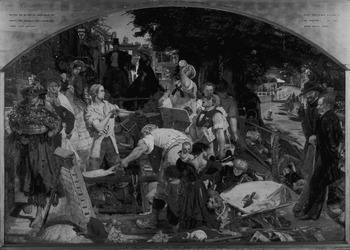
Making the body spiritual also had implications for the meaning of physical work. In Ford Madox Brown's Work (1852–1863) ‘skilled workmen, shrewd thinkers chiefly’, heroically repair the fabric of Victorian society while two ‘brainworkers’, Thomas Carlyle and Frederick Denison Maurice, look on from the right. (Image courtesy of Manchester City Galleries.)

Redeeming the body
When James Clerk Maxwell arrived in Cambridge in 1850, a general feeling of prosperity was beginning to soften the middle-class perception of political and economic insecurity that had predominated in the previous two decades. After 1848, class tensions had eased as popular political movements such as Chartism began to lose their force. At the same time, liberal Anglican Frederick Denison Maurice had begun to reconsider and soften stern Butlerian theology. Maurice's theology shared much common ground with more conservative Cambridge Anglicans such as Birks and Whewell. Like theirs, his theology was Platonic, although, unlike Birks, Maurice gave greater religious authority to human language, especially the written word, rather than mathematics.Footnote 51 But while Birks's careful analogy between geometrical reasoning and absolute morality distanced moral truth from the experience of material reality, Maurice brought them closer together. In Maurice's more thoroughly New Testament theology, Jesus, not Adam, symbolized the spirit of man. In place of the Fall of Adam and the atonement of Christ as a provision of salvation for the few, Christ's life and death now ‘redeemed the body and made it spiritual’.Footnote 52 For Maurice, Christ was a symbol of the divine in all humanity, as the communion of all men and women.Footnote 53 Such a message had political power: ‘If religion … can only tell us about a fall for the whole race, and an escape for a few individuals of it, then our wants must be satisfied without religion. Then begin Chartism and Socialism and whatever schemes make rich men tremble’.Footnote 54 Maurice's theology (and the wider Christian socialist movement) began to gain authority by articulating the changing political and economic environment of mid-century Britain.
Making the body spiritual also had implications for the meaning of physical work (see Figure 1).Footnote 55 By the 1850s radical Whig education was no longer the threat it had been perceived to be by cultural critics of the 1830s and 1840s such as Whewell. Maurice had once been included among those critics, but now an important symbol of the mid-century perception of prosperity, the Great Exhibition of 1851, led him to declare, in a lecture ‘On Mechanics Institutes’, that ‘we are all mechanics’ and that ‘[I] may have made some mistakes in my attempt to fathom the intentions of Dr. Birkbeck [a leading figure in the Utilitarian movement for the diffusion of useful knowledge] and his coadjutors’. Maurice illustrated his revised opinion with the example of a glazier met on the day after his return from a visit to the Crystal Palace. The glazier was an example of
working men who visited the Great Exhibition … [and] were not distracted as many of us were by the general splendour of the scene or by the mere objects of curiosity … They took the more honest, sensible and manly course of going at once to examine those instruments of which they were best able to judge, of studying their construction … They [these working men] might be censured or despised for not availing themselves of an opportunity to see things which they would never see again. But their instinct was right.
Indeed, the glazier had expressed gratitude ‘not for having seen the great diamonds on the Queen of Spain's jewels … but for having learnt for the first time what a wonderful material it was with which he had been working for twenty years’. Maurice was now led to think that ‘Each time … he [the tradesman] mended a window it would be cause to him of new wonder’. And to conclude, ‘that to teach a man the secrets of his own craft, to make him know that there is something in that which rests upon truths which are older than the hills & wider than the universe, is to confer on him a benefit quite unspeakable’.Footnote 56 For Maurice, the atonement now represented the victory of the spirit over the body, a spirit that continued to act in the material world. There was now the possibility of the discovery of profound truth even in the material practices of an artisanal worker such as a glazier. Maurice's theology did not redeem the dirt of the factory, but it did bring the tradesman out from the shade of profane materiality and into greater spiritual communion with the Anglican Church.
Such views remained controversial. The publication of Maurice's Theological Essays in 1853 would cost him his chairs of history and literature at conservative King's College London.Footnote 57 In the controversy that unfolded through the autumn of 1853, the issue of whether Maurice's Essays should be considered heretical increasingly focused on one issue, the meaning of ‘eternity’. The words ‘eternal’ or ‘eternity’ were key to Maurice's understanding of the Gospel, which emphasized man as a spiritual being capable of direct communion with God. For Maurice, the word ‘eternal’ was not to be understood as having any temporal meaning in the sense that ‘eternal death’ could be interpreted to mean a never-ending punishment. Rather, ‘eternal life’ represented an eternal world or kingdom ‘which is about us, in which we are living, which has nothing to do with time’. For Maurice, man was not a temporal creature but a spiritual being belonging to an eternal order, a truth, Maurice insisted, about which even ‘peasants and women and children’ could have some intuition.Footnote 58
Oxford theologian Henry Longueville Mansel, a prominent disciple of Sir William Hamilton, Maxwell's professor of logic at Edinburgh, provided the loudest opposition to Maurice's views. Mansel believed that the limitations of human thought made any understanding of the concept of eternity quite impossible, a position inherited directly from Hamilton.Footnote 59 For Mansel, as for Hamilton, Kant's philosophy demonstrated the limits of human knowledge, a position Hamilton had characterized as the ‘wisdom of learned ignorance’ – a wisdom which would guard against placing the ignorance of man on a par with the omniscience of God. Hamilton explained what he meant by that with the example of an absolute whole.Footnote 60 It is impossible to conceive of an absolute whole; that is, a whole that is itself not part of a greater whole. Our belief that an absolute whole might exist, even though we cannot conceive of it, is only possible by defining it against that which we can conceive; that is, as a whole which is not part of a greater whole. Thus knowledge is limited by our thoughts but consciousness of those limits enables us to have beliefs that go beyond them. Mansel therefore objected to Maurice's conception of eternity on the Hamiltonian grounds that any idea we have of God could only come as a negation of our conditionally limited thoughts. No human being (let alone peasants, women and children) could have any intuition of eternity since the idea clearly went beyond common experience.Footnote 61 In contrast, Maurice's theology, representative of a growing liberal force within the Church of England, promoted the idea of Jesus as the incarnation of the Word, the spirit of the one God acting in and through the material world.
Maxwell's own religious beliefs took an evangelical turn just as the Maurice controversy erupted. Exhausted by the intense study for the Cambridge tripos exam that was to be administered the following January, Maxwell collapsed and became seriously ill. G.W.H. Tayler, an evangelical rector at whose house Maxwell was staying, cared for him for the two weeks of his breakdown. The kindness of the Taylers, perhaps in combination with his own physical and mental exhaustion, moved Maxwell to a profound religious realization that ‘Love abideth, though Knowledge vanish away’. Maxwell now fully committed himself to evangelicalism, considering his own physical body to be radically evil with such depth of feeling that the Reverend Tayler was alarmed.Footnote 62 Maxwell's evangelical awakening was significant in the first instance because his religious position, especially the belief in the radical evilness of his own body, broadly aligned him with Butlerian theology. Equally important, the transformation occurred at exactly the moment when Maxwell joined the Apostles and the publication of former leading Apostle F.D. Maurice's Theological Essays began to generate controversy.
Maxwell would follow the Maurice controversy throughout 1853. One of the first books he read after his breakdown was Maurice's Theological Essays ‘at the same time successively’ with Vestiges of Creation, commenting in his letters that ‘Both have excited Thought and Talk’. He wrote to his friend and future biographer, Lewis Campbell, of how Principal Jelf (of Kings College London) was ‘going to “have up” Maurice for heresy published in his Theological Essays’, and in November of the same year, to his cousin Elizabeth Cay of the pamphlets and counterpamphlets appearing on the meaning of the word ‘eternal’. In December, again to Campbell, Maxwell wrote of the ‘discussion here on labour parliaments, multiplicity of votes, Eternity and Maurice and Jelf’.Footnote 63
Maxwell would always remain something of an atonement evangelical.Footnote 64 In a letter to Lewis Campbell, written in October 1855, Maxwell wrote that
Maurice is a man I am loath to say nay to, or to accuse of wilful perversion of facts; but in some matters I think he is in great error, especially in his estimate of respectable ordinary Christians, as far as regards their creed. He cannot go too far in enforcing practice and work on people who were bound to it before, and theoretically confess it, but he is too hard upon their theories, and totally misrepresents them. I would rather be taken for a Yezide than for one of Maurice's popular religionists.Footnote 65
Maxwell's letter to Lewis is clearly meant to distance himself from Maurice's more controversial and cynical representations of atonement doctrine, which were informed by Unitarian objections to Evangelicalism.Footnote 66 But his unwillingness to say no to Maurice also implies that he found Maurice's moral sincerity compelling, especially his emphasis on practice and work as a means of redeeming both the social and the individual body, which must have been helpful in Maxwell's struggle to come to terms with what he now considered his own corrupt body. Certainly Maxwell's actions would indicate so. In that same year, 1855, Maxwell began participating in the Cambridge Branch of the Working Men's Colleges, which Maurice had founded in 1854 after being dismissed from King's College London.
Maxwell's interest in the Maurice controversy was also directly connected with his participation in the work of the Cambridge Mathematical Journal, for which he had now produced a paper.Footnote 67 Of particular importance was Maxwell's interest in the work of leading CMJ mathematician George Boole, the son of a shoemaker who closely sympathized with Maurice.Footnote 68 Maxwell had first been impressed by Boole's Mathematical Analysis of Logic (1847) at Edinburgh.Footnote 69 And in 1870 Maxwell would describe Boole as one of ‘the most profound mathematicians and thinkers of our time’, concluding his address to the mathematical and physical sections of the British Association for the Advancement of Science with a long quotation from Boole's Investigation into the Laws of Thought.Footnote 70 Boole's Laws of Thought, published in 1854, addressed the Maurice controversy directly, arguing with Maurice and against Mansel that there were ‘even scientific grounds for believing that human nature is constituted in some relation to the infinite … [and] Eternity’.Footnote 71 Central to Boole's argument was his discovery (and he did see it in those terms) that Aristotelian syllogistic reasoning could be given mathematical form. That discovery was the basis for a formal analogy, between the mathematical laws of thought and the mathematical laws of matter.Footnote 72
Boole's analogy between thought and things suggested a deeply moral natural order that Maxwell would explore in the highly exclusive space of the Apostles debating club. For Boole, the mathematical laws of nature demanded the absolute obedience of matter and therefore, by analogy, the mathematical laws of mind must also demand the obedience of human action. The difficulty was human free will, which, because it was free, could deny its obedience and commit a moral wrong. While the laws of thought were no less absolute than the laws of nature they could only ask, but not force, the obedience of the human will. The echo of Birks is unmistakable, except that Boole's analogy is not between geometry and moral science but between the laws of matter and the laws of mind, an analogy between thought and things. Boole's analogy recognizes a difference between the material and the ideal, but unlike Whewell and Birks, is more explicit in pointing toward a deeper unity.
Boole also discussed Whewell in his Laws of Thought, objecting that ‘[w]hat have been termed the “fundamental ideas” of those sciences as force, polarity, crystallization, &c., are neither, as I conceive, intellectual products independent of experience, nor mere copies of external things’.Footnote 73 For Boole, the discovery of scientific laws was only possible because of a profound correspondence between the laws of thought and the laws of nature. Boole also rejected Whewell's notion of inspired guesswork as the source of inductive truth, arguing instead for a process of abstract reasoning, whose domain ‘is thus revealed to us larger than that of the imagination’.Footnote 74
Boole's mathematical practice had roots in a philosophy of algebra developed by Cambridge mathematician George Peacock. The problem Peacock sought to address was how algebra, for him an empirical discipline and therefore directly verifiable by the experience of objects, could employ negative numbers or impossible quantities such as the square root of minus one. Peacock's solution was to distinguish between arithmetical algebra (in which impossible quantities were forbidden) and a later, more historically advanced and abstract mathematics – symbolical algebra. For Peacock, the same empirically confirmed laws of operation that governed arithmetical algebra (addition, subtraction, multiplication and division) also governed symbolical algebra and could therefore be used for operations performed on quantities not restricted to empirically verifiable quantities such as the positive numbers. Peacock did not want to argue that these laws of combination were derived from arithmetic; rather, they were laws of mind suggested by, although quite distinct from, arithmetical algebra, a relation he encapsulated in his ‘law of equivalent forms’.Footnote 75 Peacock's laws of combination were, therefore, a set of possible operations that could be performed on symbols or signs that had been discovered through the practice of arithmetical algebra. Since these laws were discovered, not invented, Peacock's mathematics was a science whose objects were not only quantities but also the properties of operators.
One of Peacock's most important followers was D.F. Gregory, co-founder of the CMJ and mentor to both Boole and William Thomson. Gregory sought to develop Peacock's abstraction even further by promoting a research programme that would explore alternative ‘suggesting sciences’, perhaps most importantly geometry. William Thomson's early use of mathematical analogies, which applied the mathematics of one physical phenomenon, such as heat flow, to another, electricity, can be seen as contributing to Gregory's research programme, as can George Boole's mathematical logic. But Boole not only sought new applications for the laws of combination suggested by arithmetical algebra, he also looked for new laws of combination that could extend what might count as a Peacockian ‘science of suggestion’. It was this latter endeavour that would result in Boole's project of giving mathematical form to logic, first in his Mathematical Analysis of Logic of 1847 and then more completely in his Laws of Thought of 1854.
The ‘suggesting science’ for Boole's mathematical logic was Aristotle's syllogistic logic, whose laws of combination, Boole argued, differed from arithmetical algebra in the form of its index law, which Boole gave as x 2=x.Footnote 76 For Boole, mathematical reasoning was now to be understood as a set of languages, which included logic, generated from a grammar of abstract thought expressed as mathematical laws of combination. It was the resulting analogy between the mathematical laws of thought and the mathematical laws of matter that gave Boole cause to think that human reasoning could offer a glimpse into, and therefore the possibility of participation in, the progress of divine providence.
The analogy between thought and things
The close association with Maurice, well-defined procedure and select membership made the Apostles debating club an ideal social space for Maxwell to explore a way forward from Birks's Coleridgean analogy and Whewell's philosophy of science in the light of the Maurice controversy and Boole's analogy between scientific law and the law of right reasoning.Footnote 77 The first point of discussion in Maxwell's analogies essay addresses the argument for Boole's analogy directly:
Now, if in examining the admitted truths in science and philosophy, we find certain principles appearing throughout a vast range of subjects, and sometimes re-appearing in some quite distinct part of human knowledge; and if, on turning to the constitution of the human intellect itself, we think we can discern there the reason of this uniformity, in the form of a fundamental law of the right action of the intellect, are we to conclude that these departments of nature in which analogous laws exist, have a real interdependence; or that their relation is only apparent and owing to the necessary conditions of human thought?Footnote 78
The discussion that follows, as Harman has pointed out, owes much to Maxwell's reading of Whewell. But I would argue that Maxwell's essay is an attempt to reconcile his view that there is ‘an analogy, but I think not an identity, between these two orders of thoughts and things’ with Whewell.Footnote 79 Seen against the uses Whewell made of Birks's and Butler's analogies, Maxwell's emphasis on the analogy between the orders of thoughts and things rather than their opposition strongly suggests to me that his reading of Whewell is informed by his engagement with the new uses of analogy that emerged around mid-century and are represented here by Boole's mathematical logic and the Maurice controversy.Footnote 80 Recall Whewell's explicit argument: that thought and things are fundamentally antithetical.
The importance of the analogy between thought and things is also suggested by the kind of moral order Maxwell discusses in his essay. That discussion is complex. Maxwell purposefully and playfully seeks to deny any identity between the moral and the mechanical order by seeking the limits of any analogy between them. For example, he investigates the possibility of exploring the physical consequences of a moral act to see whether tracing out the trains of its moral consequences can capture ‘the idea of necessary retribution’. And yet, Maxwell points out, given the limited view of such a moral act such an exercise might permit, we are much more likely to connect the idea of retribution
with that of justice [an ideal moral order] than with that of cause and effect. We therefore regard retribution as the result of interference with the mechanical order of things, and intended to vindicate the supremacy of the right order of things, but still we suspect that the two orders will eventually dissolve into one.Footnote 81
Again, there are echoes here of Birks's attempt to establish a moral certainty not contingent on consequences, except that Maxwell's discussion, like Boole's, is exploring the analogy between an ideal moral order of thought and the order of things which he suspects ‘will dissolve into one’. That correspondence, between a chain of consequences determining the moral effect of an event and the necessary laws of mind that determine our idea of justice, is highly suggestive not only of a greater moral order, but also of one in which all men are able to participate even though they may never have complete knowledge of it. That argument runs throughout Boole's work on logic.Footnote 82
Maxwell ends the essay with a purely mathematical relation found in nature, ‘the secondary forms of crystals … sparkling in the rigidity of mathematical necessity and telling us, neither of harmony of design, usefulness or moral significance – nothing but the spherical trigonometry of Napier's analogies’. This final image is all Maxwell needs to boldly assert ‘the great doctrine that the only laws of matter are those which our mind must fabricate, and the only laws of mind are fabricated for it by matter’.Footnote 83 Again, taken together these two assertions do have at least a broad correspondence with Whewell's ‘Fundamental antithesis of philosophy’. But placed against the backdrop of the discussions of Butler's analogy by Maurice and the analogy between the laws of thought and the laws of matter made by Boole they also represent a significant development. Whewell would never argue that the only laws of matter we can know are fabricated by the human mind; for him scientific laws are made by God and discovered by inspired guesswork. And the idea that matter fabricates the laws of mind would deeply offend Whewell's natural theology. Maxwell's use of the word ‘fabricate’ and the symmetry of his assertion instead bring the material and ideal closer together in a way that Whewell would not allow. They mark Maxwell's ‘doctrine’ as an expression of the 1850s, not the 1830s and 1840s.
Maxwell also differed from Boole. Boole's laws of mind were not generalizations from the experience of a large number of cases (the way he understood the discovery of knowledge in the inductive sciences to be), but instead were like the general truths of logic that could be determined from reflection on a single instance. For Boole, it was the general truth of its form that made the Aristotelian syllogism a law of mind with an ontological standing comparable to the laws of physical science.Footnote 84 In contrast, Maxwell believed that mathematical forms existed in nature with an independent reality much more like material objects. The secondary forms of crystals, sparkling in the rigidity of mathematical necessity, were one example; Faraday's mutual embrace of electricity and magnetism was another. For Maxwell, these were examples of mathematical relations that existed in nature – laws of mind fabricated by matter both because they had an ontological status akin to objects and because they could be made visible by the manipulation of physical objects. But they were also relations that required expression by the human mind, and in that sense they were also laws of matter the mind must fabricate.
Maxwell's theoretical practice
Maxwell's ‘On Faraday's lines of force’ is a purely theoretical paper. In its methodological preamble, Maxwell wrote that the methods of his ‘On Faraday's lines of force’ were ‘those suggested by the processes of reasoning which are found in the researches of Faraday’.Footnote 85 I would argue that the word ‘suggested’ should be taken literally: Faraday's physical reasoning was the CMJ ‘suggesting science’ for Maxwell's mathematics. The result of that reasoning, according to Maxwell, was the production of a set of ‘ideas and methods’ that provided a ‘connexion of the very different orders of phenomena which he [Faraday] has discovered’ – the connection between static and current electricity and the attractions and inductive effects of electricity in both states. By the 1850s, Faraday's experimental researches and Thomson's theoretical work had gone some way towards establishing lines of force as a new way of thinking about electromagnetic phenomena, but Thomson's work had always been intended to show the compatibility between mathematical descriptions of heat flow or elastic solids and electric effects rather than to give Faraday's ideas mathematical expression.Footnote 86 Like Thomson, and very much in line with the CMJ ideals of macroscopic geometric description, Maxwell also proposed using analogies in order to give a mathematical description of electric and magnetic lines of force in a variety of situations. But Maxwell departed from Thomson in using mathematical analogies to demonstrate not that Faraday's ideas and methods were compatible with alternative mathematical descriptions of electromagnetic phenomena, but that Faraday's physical reasoning had made a new theoretical fact, the dynamic geometrical structure of electricity and magnetism. Thus although Maxwell's mathematical toolkit was largely developed by Thomson, Maxwell used it in a very different way.
In order to achieve that aim Maxwell first needed to provide a more complex representation of Faraday's idea of lines of force than Thomson had done, one that took account of what Faraday had called the electrical intensity (tension along a line of force) and quantity (number of lines passing through a particular surface).Footnote 87 In order to do so, Maxwell conceived of a different kind of analogy than any that Thomson had imagined. Maxwell did not apply the mathematical description of one physical effect (for example, heat flow) to another (such as an electromagnetic effect), but instead the mathematical description of an idea that was ‘not even a hypothetical fluid … [but] merely a collection of imaginary properties’ to another, Faraday's lines of force.Footnote 88 Maxwell's incompressible fluid was an ideal (geometric) object not a physical object, or, perhaps more precisely, an abstract ideal fluid, devised as a means of illustrating real actions occurring in space.
But although physically fantastic, Maxwell's ideal fluid remained a theoretical object and therefore able, at least to a degree not possible with mere symbols, to give embodied descriptions of a range of electrical and magnetic effects. But the analogy with an ideal fluid also allowed the electric and magnetic lines to be visualized as separate from material objects such as current-carrying wires and permanent magnets. By expressing the event in terms of lines of force, Maxwell was able to show (in agreement with Ampère) that the mutual action of two closed currents on one another is equivalent to two magnetic bars magnetized perpendicular to the plane of the currents. Here is an example, I would argue, of Maxwell's use of reasoning with an imaginary object in a way analogous to Faraday's reasoning with objects in the laboratory.
It was also here, towards the end of the first part of his paper, with the first image including both electrical currents and magnetic lines of force, that Maxwell began to make visible a structure or form that encapsulates a geometric relation between electricity and magnetism:
If we examine the lines of magnetic force produced by a closed current, we shall find that they form closed curves passing round the current and embracing it, and that the total intensity of the magnetizing force all along the closed line of force depends on the quantity of the electric current only.Footnote 89
Maxwell's embrace implied a symmetry between electric and magnetic lines of force, but in order to give that symmetry mathematical form Maxwell had first to find a way of seeing a current in a wire as a result of actions going on in space, rather than the other way around. Doing so required a bold move – the adoption of a conjecture Faraday had made in the early 1830s that followed from his work on induced currents. Faraday's conjecture concerned a new state of matter called the electro-tonic state.Footnote 90 Since a current will be induced in a closed conductor in a magnetic field only when there is a change in the number of lines of force that pass through the circuit, it follows that the electromotive force that arises is caused by an alteration of state measured by the change in the number of lines which pass through the closed conductor. The idea of an electro-tonic state offered a means of understanding electromagnetic phenomena in terms of the lines of force in space rather than by the action of a permanent magnet or a current-carrying wire.
At this point, the style of Maxwell's paper changed; for the first part of the paper Maxwell had sought to present mathematical ideas in an ‘embodied form, as a system of lines and surfaces, and not as mere symbols’.Footnote 91 But now, because the electro-tonic state ‘has not presented itself to my mind in such a form’ Maxwell proposed to use symbols freely. But the pay-off was that Maxwell could now represent the electro-tonic state as a condition of space due to the presence of magnetic and electric lines of force and demonstrate their symmetrical mathematical form. Maxwell was then able to develop a mathematical representation of what he called ‘the mutual embrace of electricity and magnetism’, an image originally developed by Faraday of two interlocking circles of force, one of electricity and one of magnetism, at right angles to one another.Footnote 92 The mutual embrace was a geometric relation between electric and magnetic lines of force and assumes the lines of force as the basic theoretical fact rather than forces between point charges or current elements. The result was an essentially mathematical relation encapsulated by the mutual embrace of electric and magnetic lines of force.Footnote 93
By the end of the second part of the paper, then, Maxwell's mutual embrace between electricity and magnetism has become a purely mathematical relation. Since it captured a state of space containing lines of force under tension (that is, with intensity) it implied a mechanical system without material specification. But it was exactly the lack of mechanical specificity that Maxwell offered as the most compelling reason why his mathematical account of electromagnetic effects should be considered a valuable alternative to action-at-a-distance theories of electromagnetic effects (for example, the much more complete theory developed by M.W. Weber). Because the dynamic relation between interlocking magnetic and electric lines of force offered in ‘On Faraday's lines’ is finally completely disembodied it did not, as Maxwell pointed out, contain ‘even the shadow of a true physical theory; in fact its chief merit as a temporary instrument of research is that it does not, even in appearance, account for anything’.Footnote 94 What it represented was a pure relation Faraday had discovered in nature by manipulating material objects – and for Maxwell that was its advantage. It was not an idea, such as that of forces acting at a distance between points, imposed on experimental facts, but an idea discovered by experimental research, an idea existing in nature, quite literally a law of mind fabricated by matter. Maxwell's achievement in ‘On Faraday's lines’ was to give that relation its first recognizably mathematical form, a law of matter fabricated by mind.
Whewell had claimed that when we learn about things through sight and touch, ‘we do not make them by seeing or touching, as we make our thoughts by thinking them’. For Whewell, we make thoughts by thinking but ‘are passive when Things act upon our organs of perception’.Footnote 95 In contrast, Maxwell thought the manipulation of objects could also discover ideas. For Maxwell, Faraday's interlocking lines of electric and magnetic forces (Maxwell's mutual embrace) were literally a deduction from experiment: the manipulation of things that made visible a profound natural relation.Footnote 96 This is more than simply intervening in nature in order to make a new fact, which Whewell would count as a kind of observation, or a discovery of a relation between things by an inspired leap of mind, but ‘physical reasoning’ that makes visible a pure relation – and that is the sense in which Maxwell understood Faraday's method as mathematical.
Conclusion
Maxwell's theoretical practice remade the Cambridge boundary between the material and the ideal in order to articulate a new kind of theoretical reasoning analogous to physical reasoning. Thomson provided the mathematical toolkit, but Maxwell's use of those tools was significantly different. Maxwell acknowledged his debt to Thomson at the end of the second part of ‘On Faraday's lines’, especially to Thomson's paper of 1847, ‘On a mechanical representation of electric and galvanic forces’, and his ‘Mathematical theory of magnetism’.Footnote 97 There are indications in these papers, especially the first, that Thomson was beginning to think in terms of understanding electromagnetism as actions going on in some kind of material in space, although he would not be able to completely renegotiate his latitudinarian position until after 1850. But even then, when Thomson had overcome his latitudinarian impasse, he would only consider positive knowledge of nature to be of mechanical systems. Indeed, in 1884 he would famously remark, ‘if I can make a mechanical model of a thing I can understand it. As long as I cannot make a mechanical model all the way through I cannot understand; and that is why I cannot get the [Maxwellian] electro-magnetic theory’.Footnote 98 Unlike Thomson, Maxwell considered mathematical structures, such as the mutual embrace of magnetism and electricity, as having an ontological status analogous to objects. This position, I have argued, owed something to his engagement with the kinds of analogical argument that were gaining increased attention around mid-century.
Placing Maxwell's analogical arguments in the context of the changing use of analogies between the 1830s and the 1850s provides one example of how the negotiation between experimental research and theoretical work is undertaken within a specific historical context. But it should also be noticed that that context was subject to considerable local variation. Maxwell's attempts to accommodate Butlerian natural theology to the practice of energy physics in Cambridge were different from Thomson's efforts to do the same in Glasgow. The Maurice controversy and Maxwell's engagement with it through discussion with his fellow Apostles, and his involvement with the CMJ, especially George Boole's analogy between the laws of thought and the laws of nature, have been used here to illustrate the importance of seeing theoretical practices as not only technical but also socially and culturally meaningful.
And because it was socially and culturally meaningful, the theoretical practice Maxwell began to pursue at Cambridge in the 1850s also informed his participation in F.D. Maurice's Working Men's Colleges. Although, due to a lack of space, I have been unable to develop the argument fully here, there does seem to be some correspondence between Maurice's ‘intuitive reason’ (that allowed ordinary people to have some knowledge of God) and Maxwell's profound belief that ‘every human mind is capable of understanding something of the elementary laws of the Universe and that in some case these laws are seen most clearly when embodied in material forms’. That idea gave hope for individual moral responsibility, because acquiring ‘a habit of healthy and vigorous thinking … will enable us to recognize error in all the popular forms in which it appears’.Footnote 99 At least for Maxwell, deduction from experiment could provide something of the necessary discipline to discern the natural and moral order for a new age of incarnation.